


1 Samuel 10:8
- וְיָרַדְתָּve·ya·rad·Taand you will go downH3381Conj-w ¦ V-Qal-ConsecPerf-2msVerb Qal Consecutive Perfect 2nd Singular Masculineוְandיָרַדְתָּyou will go down
- לְפָנַיle·fa·Nai<to> before meH6440Prep-l ¦ N-mpc ¦ 1csNoun Plural Masculine Constructלְ<to>פָנַbeforeיme
- הַגִּלְגָּלha·gil·Gal<the> GilgalH1537Art ¦ N-properNoun Proper Locationהַ<the>גִּלְגָּלGilgal
- וְהִנֵּהve·hi·Nehand there!H2009Conj-w ¦ PrtParticle Interjectionוְandהִנֵּהthere!
- אָנֹכִי'a·no·KhiIH595Pro-1csPronoun Personal 1st Singular common gender
- יֹרֵדyo·Red[am] about to come downH3381V-Qal-Prtcpl-msVerb Qal Participle Singular Masculine Absolute
- אֵלֶיךָ'e·Lei·khato youH413Prep ¦ 2msPreposition Definiteאֵלֶיtoךָyou
- לְהַעֲלוֹתle·ha·'a·Lotto offer upH5927Prep-l ¦ V-Hiphil-InfVerb Hiphil Infinitive Constructלְtoהַעֲלוֹתoffer up
- עֹלוֹתo·Lotburnt offeringsH5930N-fpNoun Plural Feminine Absolute
- לִזְבֹּחַliz·Bo·achto sacrificeH2076Prep-l ¦ V-Qal-InfVerb Qal Infinitive Constructלִtoזְבֹּחַsacrifice
- זִבְחֵיziv·Cheisacrifices ofH2077N-mpcNoun Plural Masculine Construct
- שְׁלָמִיםshe·la·Mimpeace offeringsH8002N-mpNoun Plural Masculine Absolute
- שִׁבְעַתshiv·'AtsevenH7651N-cscNoun Singular common gender Construct
- יָמִיםya·MimdaysH3117N-mpNoun Plural Masculine Absolute
- תּוֹחֵלto·Chelmay you waitH3176V-Hiphil-Imperf-2msVerb Hiphil Imperfect 2nd Singular Masculine
- עַד'aduntilH5704PrepPreposition
- בּוֹאִיbo·'II comeH935V-Qal-Inf ¦ 1csVerb Qal Infinitive ConstructבּוֹאִcomeיI
- אֵלֶיךָ'e·Lei·khato youH413Prep ¦ 2msPreposition Definiteאֵלֶיtoךָyou
- וְהוֹדַעְתִּיve·ho·da'·Tiand I will make knownH3045Conj-w ¦ V-Hiphil-ConsecPerf-1csVerb Hiphil Consecutive Perfect 1st Singular common genderוְandהוֹדַעְתִּיI will make known
- לְךָle·Khato <the> youPrep-l ¦ 2msSuffix Personal 2nd Singular Masculineלְto <the>ךָyou
- אֵת'et<obj.>H853DirObjMParticle Object Indicator
- אֲשֶׁר'a·Sher[that] whichH834RelParticle Relative
- תַּעֲשֶׂהta·'a·Sehyou will doH6213V-Qal-Imperf-2msVerb Qal Imperfect 2nd Singular Masculine
English is a literal word-by-word gloss of the Hebrew, not the KJV's wording. Why?
This is the original text the KJV's translators worked from — each Hebrew word with its own literal English meaning in this verse, prepared by scholars at Tyndale House, Cambridge. The KJV translates whole sentences, not word by word, so its wording differs: one Hebrew word can become several English words, and the KJV may choose “the LORD” where the gloss reads “Yahweh”. Both are faithful — they answer different questions. For the KJV's own rendering, switch to the KJV text.
Details
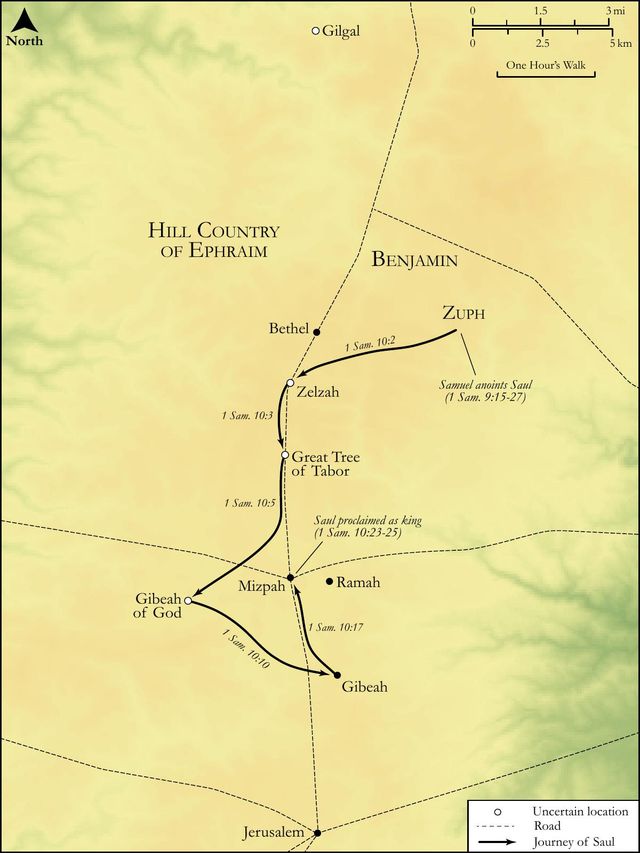
See on the biblical-era map
Study this verse
Public-domain commentary
Matthew Henry
From his Commentary on the Whole Bible. Henry comments on passages, not single verses — this entry covers 1 Samuel 10:1–8. His three-level outline is real structure in the source text, so it is rendered as structure.
Samuel is here executing the office of a prophet, giving Saul full assurance from God that he should be king, as he was afterwards, according to these prophecies which went before of him.
I.He anointed him and kissed him, Sa1 10:1.
This was not done in a solemn assembly, but it was done by divine appointment, which made up the want of all external solemnities, nor was it ever the less valid for its being done in private, under a hedge, or, as the Jews say, by a fountain. God's institutions are great and honourable, though the circumstances of their administration be ever so mean and despicable.
1.Samuel, by anointing Saul, assured him that it was God's act to make him king: Is it not because the Lord hath anointed thee? And, in token of that, the high priest was anointed to his office, to signify the conferring of those gifts upon him that were requisite for the discharge of its duties, and the same was intimated in the anointing of kings; for whom God calls he qualifies, and suitable qualifications furnish good proof of a commission. These sacred unctions, then used, pointed at the great Messiah, or anointed one, the king of the church, and high priest of our profession, who was anointed with the oil of the Spirit, not by measure, but without measure, and above all the priests and princes of the Jewish church. It was common oil, no doubt, which Samuel used, and we read not of his blessing it or praying over it. But it was only a vial of oil that he anointed him with, the vessel brittle, because his kingdom would soon be cracked and broken, and the quantity small, because he had but little of the Spirit conferred upon him to what David had, who was therefore anointed with a horn of oil, as were Solomon and Jehu with a box of oil.
2.By kissing him, he assured him of his own approbation of the choice, not only his consent to it, but his complacency in it, though it abridged his power and eclipsed his glory and the glory of his family. "God has anointed thee," says Samuel, "to be king, and I am satisfied and very well pleased, in pledge of which take this kiss." It was likewise a kiss of homage and allegiance; hereby he not only owns him to be king, but his king, and in this sense we are commanded to kiss the Son, Psa 2:12. God has anointed him, and therefore we must thus acknowledge him and do homage to him. In Samuel's explication of the ceremony, he reminds him,
(1.)Of the nature of the government to which he is called. He was anointed to be a captain, a commander indeed, which bespeaks honour and power, but a commander in war, which bespeaks care, and toil, and danger.
(2.)Of the origin of it: The Lord hath anointed thee. By him he ruled, and therefore must rule for him, in dependence on him, and with an eye to his glory.
(3.)Of the end of it. It is over his inheritance, to take care of that, protect it, and order all the affairs of it for the best, as a steward whom a great man sets over his estate, to manage it for his service and give an account of it to him.
II.For his further satisfaction he gives him some signs, which should come to pass immediately, this very day; and they were such as would not only confirm the word of Samuel in general, and prove him a true prophet, but would confirm this word to Saul in particular, that he should be king.
1.He should presently meet with some that would bring him intelligence from home of the care his father's house was in concerning him, Sa1 10:2. These he would meet hard by Rachel's sepulchre. The first place Samuel directed him to was a sepulchre, the sepulchre of one of his ancestors, for Rachel died in travail with Benjamin; there he must read a lecture of his own mortality, and now that he had a crown in his eye must think of his grave, in which all his honour would be laid in the dust. Here two men would meet him, perhaps sent on purpose to look after him, and would tell him the asses were found, and his father was in pain concerning him, saying, What shall I do for my son? He would reckon it happened well that he met with these messengers; and it is good to eye Providence in favourable conjunctures (though the matter be minute) and to be encouraged to trust it in greater matters.
2.He should next meet with others going to Bethel, where, it should seem, there was a high place for religious worship, and these men were bringing their sacrifices thither, Sa1 10:3, Sa1 10:4. It was a token for good to one that was designed for the government of Israel, wherever he came, to meet with people going to worship God. It is supposed that those kids and loaves, and the bottle of wine which the three men had with them, were designed for sacrifice, with the meat-offerings and drink-offerings that were to attend the sacrifice; yet Samuel tells Saul that they will give him two of their loaves, and he must take them. Such a present would look to us now like the relieving of a beggar. Saul must hereafter remember the time when he received alms, and must therefore be humble and charitable to the poor. But perhaps it would then be construed a fit present for a prince; and, as such, Saul must receive it, the first present that was brought to him, by such as knew not what they did, nor why they did it, but God put it into their hearts, which made it the more fit to be a sign to him. These two loaves, which were the first tribute paid to this newly-anointed king, might serve for an admonition to him not to spend the wealth of his crown in luxury, but still to be content with plain food. Bread is the staff of life.
3.The most remarkable sign of all would be his joining with a company of prophets that he should meet with, under the influence of a spirit of prophecy, which should at that time come upon him. What God works in us by his Spirit serves much more for the confirming of faith than any thing wrought for us by his providence. He here (Sa1 10:5, Sa1 10:6) tells him,
(1.)Where this would happen: At the hill of God, where there was a garrison of the Philistines, which is supposed to be near Gibeah, his own city, for there was the Philistines' garrison, Sa1 13:3. Perhaps it was one of the articles of Samuel's agreement with them that they should have a garrison there, or, rather, after they were subdued in the beginning of his time they got ground again, so far as to force this garrison into that place, and thence God raised up the man that should chastise them. There was a place that was called the hill of God, because of one of the schools of the prophets built upon it; and such respect did even Philistines themselves pay to religion that a garrison of their soldiers suffered a school of God's prophets to live peaceably by them, and did not only not dislodge them, but not restrain nor disturb the public exercises of their devotion.
(2.)Upon what occasion; he should meet a company of prophets with music before them, prophesying, and with them he should join himself. These prophets were not (as it should seem) divinely inspired to foretel things to come, nor did God reveal himself to them by dreams and visions, but they employed themselves in the study of the law, in instructing their neighbours, and in the acts of piety, especially in praising God, wherein they were wonderfully assisted and enlarged by the Spirit of God. It was happy for Israel that they had not only prophets, but companies of prophets, who gave them good instructions and set them good examples, and helped very much to keep up religion among them. Now the word of the Lord was not precious, as it had been when Samuel was first raised up, who had been instrumental in founding these colleges, or religious houses, whence, it is probable, the synagogues took their rise. What a pity was it that Israel should be weary of the government of such a man, who though he had not, as a man of war, expelled the Philistines, yet (which was a greater kindness to Israel) had, as a man of God, settled the schools of the prophets! Music was then used as a proper means to dispose the mind to receive the impressions of the good Spirit, as it did Elisha's, Kg2 3:15. But we have no reason to look for the same benefit by it now, unless we saw it as effectual as it was then in Saul's case, to drive away the evil spirit. These prophets had been at the high place, probably offering sacrifice, and now they came back singing psalms. We should come from holy ordinances with our hearts greatly enlarged in holy joy and praise. See Psa 138:5. Saul should find himself strongly moved to join with them, and should be turned thereby into another man from what he had been while he lived in a private capacity. The Spirit of God, by his ordinances, changes men, wonderfully transforms them; Saul, by praising God in the communion of saints, became another man, but whether a new man or no may be questioned.
III.He directs him to proceed in the administration of his government as Providence should lead him, and as Samuel should advise him.
1.He must follow Providence in ordinary cases (Sa1 10:7): "Do as occasion shall serve thee. Take such measures as thy own prudence shall direct thee." But,
2.In an extraordinary strait that would hereafter befal him at Gilgal, and would be the most critical juncture of all, when he would have special need of divine aids, he must wait for Samuel to come to him, and must tarry seven days in expectation of him, Sa1 10:8. How his failing in this matter proved his fall we find afterwards, Sa1 13:11. It was now a plain intimation to him that he was upon his good behaviour, and, though a king, must act under the direction of Samuel, and do as he should order him. The greatest of men must own themselves in subjection to God and his word.
Historical interpretation
Ten Centuries of Reception
2 surviving comments on this verse. Each one is dated, so this reads as a timeline rather than a list.
Select a marker to jump to its quote. Markers stagger vertically where authors wrote within a few decades of each other.
And descending before me in Gilgal, etc. The Lord descended before John in Gilgal, that is, the place of rolling, namely those about which he speaks to the Father in the Psalm: Save me, O God, for the waters have come up to my soul. I sink in deep mire, where there is no foothold (Psalm 68). Not because the Lord had undergone death's destruction before John, but because before they killed John, the Jews were persecuting Jesus and seeking to kill Him; because He not only broke the Sabbath but also called God His Father, making Himself equal to God (John 5). And John descended to Him, because he accepted the mud of prison and death as an example of His humility and patience. The Lord offered Himself as a sacrifice to the Father and made peace through His blood, both on earth and in heaven. But He awaited the time of His forerunner’s example. The completeness of this, according to the custom of the Scriptures, is signified by the number of seven days, until, namely, the same John, having undergone death by the wicked, showed what the Lord Himself would suffer.
Galgal: Here also by dispensation was an altar of God.
Continue studying 1 Samuel 10:8 across the web’s major study libraries — every link below opens this exact verse, chapter, or book on the destination site.
Read & Compare
 BibleGatewayThis verse in more than 200 translations and 70 languages.
 Bible.comThe YouVersion reader — hundreds of translations, reading plans, and highlights.
 ESV.orgCrossway's official English Standard Version reader.
 NET BibleThe NET translation with 60,000+ translators' notes on every rendering decision.
 STEP BibleTyndale House's free study tool — original text, vocabulary, and scholarly resources.
 BibliaLogos Bible Software's free web reader.
 USCCBThe New American Bible (Revised Edition) with the U.S. bishops' study notes.
Commentaries
 BibleHub CommentariesDozens of classic commentaries on this verse, gathered on one page.
 StudyLightMore than 100 commentary sets — the largest collection on the web.
 BibleRefPlain-English commentary on what this verse means, verse by verse.
 Enduring WordDavid Guzik's free commentary on this chapter, widely used by Bible teachers.
 Bible Study ToolsVerse commentary alongside Greek and Hebrew study aids.
Original Language & Research
- BibleHub InterlinearThe verse word by word — original language, transliteration, and English.
- BibleHub LexiconEvery word's original-language definition and Strong's entry.
 Blue Letter BibleDeep-study tools — Strong's numbers, concordance, and word studies.
 SefariaThe Hebrew text with Rashi and centuries of Jewish commentary.
Sermons, Hymns & Audio


TrulyRandomVerse is not affiliated with these sites and doesn’t control their content. They’re linked because they’re genuinely useful.
Summary
1 Samuel 10:8 records a pivotal divine directive from the prophet Samuel to the newly anointed King Saul, instructing him to proceed to Gilgal and patiently await Samuel's arrival for a period of seven days. This command was crucial, as Samuel intended to offer sacred burnt and peace offerings and then impart further divine guidance to Saul. Far from being a mere logistical instruction, this directive served as a foundational test of Saul's obedience, patience, and submission to God's appointed authority, establishing the spiritual parameters for his nascent reign and subtly foreshadowing the critical juncture where his faithfulness would be decisively tried.
Context
ShowHideLiterary Context
This verse concludes a series of specific, prophetic instructions given by Samuel to Saul immediately following his private anointing as Israel's first king in 1 Samuel 10:1. Prior to this command, Samuel had provided Saul with three confirming signs designed to affirm his divine calling and equip him for leadership: encountering two men at Rachel's tomb, meeting three men on their way to Bethel, and joining a company of prophets, resulting in his being "turned into another man" (1 Samuel 10:2-7). The instruction to proceed to Gilgal and await Samuel for seven days, therefore, is not an isolated command but the final, climactic test of obedience and submission to prophetic authority, strategically placed before Saul's public acclamation as king in 1 Samuel 10:17-27. It underscores that even the king's authority is subservient to God's divine word, delivered through His prophet.
Historical & Cultural Context
Gilgal was a site of profound historical and spiritual resonance for the Israelites, deeply embedded in their national memory. It was the first encampment of the Israelites after their miraculous crossing of the Jordan River into the Promised Land (Joshua 4:19), where the covenant of circumcision was renewed (Joshua 5:2-9), and where the first Passover in Canaan was observed (Joshua 5:10). Furthermore, Gilgal served as a crucial base for military operations during the conquest (Joshua 10:6-9) and later functioned as a regular circuit stop for Samuel in his capacity as judge and prophet, often serving as a center for worship and sacrifice (1 Samuel 7:16). By directing Saul to Gilgal, Samuel was placing the nascent king in a location intrinsically linked to Israel's covenant history, emphasizing the continuity of God's redemptive work and the paramount importance of proper worship and obedience at a site of national and spiritual significance. Culturally, the offering of burnt and peace offerings was a sacred priestly function, highlighting Samuel's authoritative role and the strict boundaries concerning who could perform such rituals.
Key Themes
ShowHideThe central themes interwoven within 1 Samuel 10:8 are obedience and submission to divine authority. Saul, as the newly anointed monarch, is immediately presented with a test of his willingness to meticulously follow God's specific instructions, which are mediated through His prophet, Samuel. This establishes the foundational principle that even the king of Israel is ultimately under God's sovereign authority, not above it. Another significant theme is patience and waiting on God's timing, as Saul is commanded to wait for a precise period of seven days. This duration would undoubtedly test his trust, self-control, and reliance on divine providence. The explicit mention of sacrifices and proper worship underscores the centrality of Israel's covenant relationship with Yahweh, where offerings like the burnt offering (symbolizing complete dedication and atonement) and the peace offering (symbolizing fellowship and thanksgiving) were indispensable for maintaining communion with God. Crucially, this verse functions as a powerful instance of foreshadowing, subtly yet profoundly setting the stage for the tragic moment in 1 Samuel 13:8-14 where Saul's failure to adhere to this very command leads to the devastating pronouncement of his kingdom's removal, highlighting the severe consequences of disobedience.
Exposition and Analysis
ShowHideKey Word Analysis
ShowHideThis geographical location, meaning "circle" or "rolling," held profound historical and spiritual significance for Israel. It was the first encampment after crossing the Jordan River, where the "reproach of Egypt" was "rolled away" (Joshua 5:9). Gilgal served as a central worship site, a place of covenant renewal, and a strategic military base. By commanding Saul to go to Gilgal, Samuel was directing him to a place deeply connected to Israel's identity, history, and covenant with God, thereby emphasizing the spiritual foundation upon which his new kingship was to be built.
Literally meaning "that which goes up," the burnt offering was a whole burnt sacrifice, entirely consumed by fire on the altar, with its smoke ascending to God. It symbolized total dedication, complete consecration, and a comprehensive atonement for sin. The offering of an 'ôlâh by Samuel (or by Saul, had he waited for Samuel) would signify a complete surrender to God's will and a fervent plea for divine favor and blessing upon the new king and the nation.
Derived from the root shalom (meaning "peace," "completeness," "well-being"), the peace offering was a sacrifice of fellowship, thanksgiving, and communion. Unlike the burnt offering, only a portion of the animal was burned on the altar, with the remainder shared by the offerer, the priests, and their families in a communal meal. This offering signified a state of peace and harmonious communion with God, often celebrating His blessings, faithfulness, and the restoration of relationship. Samuel's intention to offer these sacrifices underscores the importance of communal worship and maintaining a right, peaceful relationship with God at the very outset of Saul's reign.
Verse Breakdown
ShowHide"And thou shalt go down before me to Gilgal;"
This is a direct, imperative command from Samuel, establishing his prophetic authority over the newly anointed king. The phrase "go down" likely refers to a geographical descent from Saul's current location (perhaps Gibeah, which was on higher ground) to the plain where Gilgal was situated. This clause sets the specific location for the upcoming divine encounter and the critical test of obedience.
"and, behold, I will come down unto thee, to offer burnt offerings, [and] to sacrifice sacrifices of peace offerings:"
Samuel promises his personal arrival at Gilgal, explicitly stating his purpose: to perform sacred sacrifices. The mention of both "burnt offerings" and "peace offerings" highlights the solemn, religious nature of the meeting and the importance of proper worship at this foundational moment for the monarchy. Crucially, only authorized priests or those acting under direct divine mandate were permitted to offer such sacrifices, underscoring Samuel's dual role as prophet and priest (or one acting with priestly authority) and the strict boundaries of worship in ancient Israel.
"seven days shalt thou tarry, till I come to thee, and shew thee what thou shalt do."
This clause introduces the most critical element of the command: the specific duration of waiting. Saul is given a precise timeframe – seven days – during which he is to patiently wait for Samuel's arrival. This period serves as a direct test of his obedience, trust in God's timing, and humble submission to Samuel's prophetic guidance. The concluding promise, "and shew thee what thou shalt do," indicates that further divine instructions, strategic guidance, and perhaps a formal commissioning for his kingship would be revealed only after this period of patient waiting and proper worship.
Literary Devices
ShowHideThe passage employs several significant literary devices that enrich its meaning and foreshadow future events. Foreshadowing is profoundly evident, as this seemingly straightforward command directly sets the stage for Saul's later, fateful act of disobedience in 1 Samuel 13:8-14, where his failure to wait the prescribed seven days leads to the tragic pronouncement of his kingdom's removal. This creates a powerful dramatic irony for the discerning reader, who is aware of the impending tragic outcome. The specific mention of sacrifices—"burnt offerings" and "peace offerings"—functions as potent symbolism, representing total consecration, atonement, fellowship, and the indispensable role of proper worship in Israel's covenant relationship with God. The command itself, particularly the instruction to wait, serves as a direct test of Saul's character, evaluating his patience, his trust in God's timing, and his submission to divine authority. The repeated emphasis on "go down" and "come down" (Saul to Gilgal, Samuel to Saul) subtly highlights the divine condescension and the prophet's role as God's messenger descending to meet and guide the human king.
Theological and Thematic Connections
ShowHide1 Samuel 10:8 powerfully illustrates the critical importance of absolute obedience to God's specific commands, particularly when they involve patient waiting and humble submission to delegated authority. It establishes a foundational principle for leadership in Israel: the king is not above God's law or His chosen prophets. Saul's immediate test is not one of military prowess or administrative skill, but of spiritual discipline – his willingness to trust God's timing and process, rather than impulsively rushing ahead in his own strength or anxiety. This passage underscores that true authority and effective leadership flow from humble submission to divine guidance, and that proper worship, mediated by authorized individuals, is essential for maintaining a right covenant relationship and receiving God's continued direction. The failure to adhere to such divine mandates, as Saul later demonstrates, carries severe consequences, highlighting the seriousness of God's expectations for His anointed leaders and the sanctity of divine commands.
Reflection and Application
ShowHideThe divine instruction given to Saul in 1 Samuel 10:8 serves as a timeless and profound reminder of the spiritual discipline required in our daily walk with God: the absolute necessity of patient obedience. Just as Saul was commanded to wait for Samuel, we are frequently called to wait on God's timing, trusting implicitly that His perfect plan and His divine revelation will unfold precisely when and how they should. In a contemporary world that often prizes immediate action, instant gratification, and self-reliance, this verse challenges us to cultivate a spirit of humble submission, recognizing that true wisdom and spiritual maturity often lie in patiently waiting for divine guidance rather than impulsively forging ahead. Our willingness to submit to God's authority, which is often mediated through His inspired Word, the counsel of trusted spiritual leaders, or the promptings of the Holy Spirit, is a direct and tangible measure of our faith and trust in Him. Saul's subsequent, tragic failure to obey this command vividly illustrates the perilous consequences of impatience, self-will, and presumptuous action, urging us to carefully consider whether our own actions are truly aligned with God's revealed will or are instead driven by our anxieties, perceived necessities, or a desire for immediate results.
Questions for Reflection
ShowHideFAQ
ShowHideWhy was Gilgal such an important location for this command?
ShowHideGilgal was strategically and spiritually significant for Israel. Historically, it was the first encampment of the Israelites after their miraculous crossing of the Jordan River into the Promised Land (Joshua 4:19). It was the site where the covenant of circumcision was renewed, symbolically "rolling away the reproach of Egypt" (Joshua 5:2-9), and where the Passover was first celebrated in Canaan (Joshua 5:10). Furthermore, Gilgal served as a frequent and important center for Samuel's judicial and sacrificial activities (1 Samuel 7:16). By directing Saul to Gilgal, Samuel was placing the new king in a location deeply steeped in Israel's covenant history and divine encounters, emphasizing the spiritual foundation of his reign and the paramount importance of proper worship and obedience at a place of national and spiritual significance. It underscored that Saul's kingship was rooted in God's covenant with Israel, not merely in human ambition.
Why was the seven-day waiting period so crucial?
ShowHideThe seven-day waiting period was a direct and critical test of Saul's obedience, patience, and submission to God's authority, as mediated through Samuel. It was not merely about the duration itself, but about the profound principle of waiting on God's appointed time and method for divine revelation and action. This period would test Saul's trust in God's overarching plan, his ability to control his own impulses and anxieties, and his willingness to humbly acknowledge Samuel's prophetic authority as God's representative. It was a foundational lesson in spiritual discipline for a king who would need to consistently rely on divine guidance rather than self-reliance or expediency. Saul's subsequent failure to wait the full seven days later in 1 Samuel 13:8-14 proved to be a pivotal moment leading to the tragic pronouncement of the loss of his kingdom, highlighting the profound and enduring importance of this initial command and the consequences of disobedience.
Christ-Centered Fulfillment
ShowHideThe narrative of Saul's initial instruction and his subsequent failure at Gilgal finds its profound and ultimate Christ-centered fulfillment in the person and perfect work of Jesus Christ. Saul, as Israel's first earthly king, was given a specific divine command to patiently wait and obey, a test he tragically failed, leading to the loss of his kingdom and the anointing of David. This historical account powerfully foreshadows the desperate need for a perfect King, one who would perfectly obey God's will in all things. Jesus Christ is that ultimate King, the true Son of David, who perfectly fulfilled all righteousness and meticulously adhered to every command of God, even to the point of sacrificial death on a cross (Philippians 2:8). Unlike Saul, who impatiently presumed to offer an unauthorized sacrifice, Christ Himself became the perfect, once-for-all sacrifice, the Lamb of God who takes away the sin of the world (John 1:29). His self-offering fulfills the true meaning and purpose of the Old Testament burnt and peace offerings, providing ultimate atonement and establishing eternal peace and fellowship with God for all who believe (Hebrews 9:11-14). Christ's perfect obedience, even in patiently waiting upon the Father's timing throughout His earthly ministry, secures an eternal kingdom, not merely for a temporary dynasty, but for all who place their faith in Him (Hebrews 5:8-9; Daniel 7:13-14). In Jesus, we behold the King who perfectly submitted to divine authority, perfectly offered the ultimate sacrifice, and perfectly waited on God's sovereign plan, thereby securing our eternal peace and unbreakable fellowship with God.