


1 Samuel 13:4
- וְכָלve·kholand allH3605Conj-w ¦ N-mscNoun Singular Masculine Constructוְandכָלall
- יִשְׂרָאֵלYis·ra·'ElIsraelH3478N-properNoun Proper Location
- שָׁמְעוּsha·me·'Uthey heardH8085V-Qal-Perf-3cpVerb Qal Perfect 3rd Plural common gender
- לֵאמֹרle·Mor<to> sayingH559Prep-l ¦ V-Qal-InfVerb Qal Infinitive Constructלֵ<to>אמֹרsaying
- הִכָּהhi·Kahhe has attackedH5221V-Hiphil-Perf-3msVerb Hiphil Perfect 3rd Singular Masculine
- שָׁאוּלsha·'UlSaulH7586N-proper-mNoun Proper Masculine
- אֶת'et<obj.>H853DirObjMParticle Object Indicator
- נְצִיבne·Tziv[the] garrison ofH5333N-mscNoun Singular Masculine Construct
- פְּלִשְׁתִּיםpe·lish·Tim[the] PhilistinesH6430N-mpNoun Gentilic Plural Masculine Absolute
- וְגַםve·gamand alsoH1571Conj-w ¦ AdvAdverbוְandגַםalso
- נִבְאַשׁniv·'ashit has made itself odiousH887V-Niphal-Perf-3msVerb Niphal Perfect 3rd Singular Masculine
- יִשְׂרָאֵלYis·ra·'ElIsraelH3478N-properNoun Proper Location
- בַּפְּלִשְׁתִּיםba·pe·lish·Timwith the PhilistinesH6430Prep-b ¦ N-mpNoun Gentilic Plural Masculine Absoluteבַּwith theפְּלִשְׁתִּיםPhilistines
- וַיִּצָּעֲקוּvai·yi·tza·'a·Kuand they were summonedH6817Conj-w ¦ V-Niphal-ConsecImperf-3mpVerb Niphal Consecutive Imperfect 3rd Plural Masculineוַandיִּצָּעֲקוּthey were summoned
- הָעָםha·'Amthe peopleH5971Art ¦ N-msNoun Singular Masculine Absoluteהָtheעָםpeople
- אַחֲרֵי'a·cha·ReiafterH310Adj-mpcAdjective Numerical Plural Masculine Construct
- שָׁאוּלsha·'UlSaulH7586N-proper-mNoun Proper Masculine
- הַגִּלְגָּלha·gil·Gal<the> GilgalH1537Art ¦ N-properNoun Proper Locationהַ<the>גִּלְגָּלGilgal
English is a literal word-by-word gloss of the Hebrew, not the KJV's wording. Why?
This is the original text the KJV's translators worked from — each Hebrew word with its own literal English meaning in this verse, prepared by scholars at Tyndale House, Cambridge. The KJV translates whole sentences, not word by word, so its wording differs: one Hebrew word can become several English words, and the KJV may choose “the LORD” where the gloss reads “Yahweh”. Both are faithful — they answer different questions. For the KJV's own rendering, switch to the KJV text.
Details
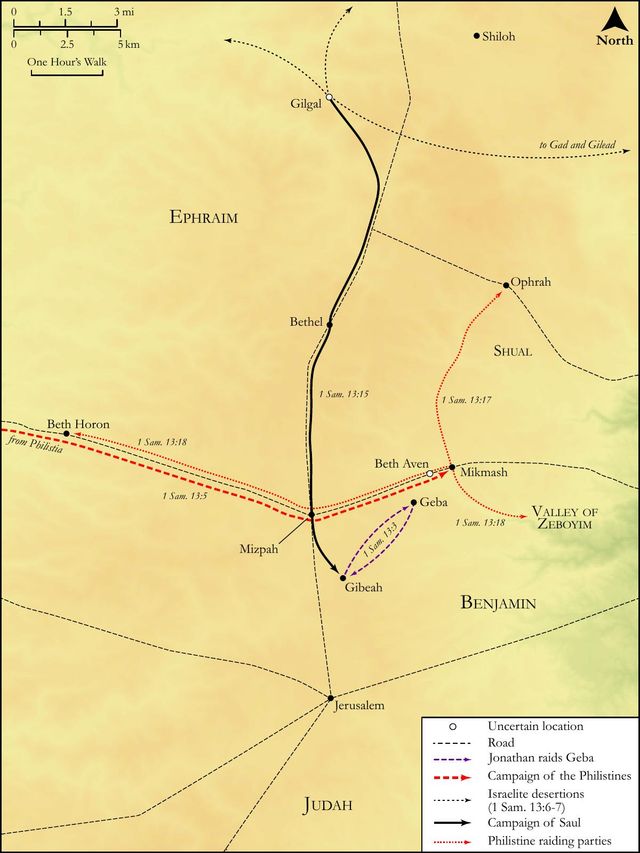
See on the biblical-era map
Study this verse
Public-domain commentary
Matthew Henry
From his Commentary on the Whole Bible. Henry comments on passages, not single verses — this entry covers 1 Samuel 13:1–7. His two-level outline is real structure in the source text, so it is rendered as structure.
We are not told wherein it was that the people of Israel offended God, so as to forfeit his presence and turn his hand against them, as Samuel had threatened (Sa1 12:15); but doubtless they left God, else he would not have left them, as here it appears he did; for,
I.Saul was very weak and impolitic, and did not order his affairs with discretion.
Saul was the son of one year (so the first words are in the original), a phrase which we make to signify the date of his reign, but ordinarily it signifies the date of one's birth, and therefore some understand it figuratively - he was as innocent and good as a child of a year old; so the Chaldee paraphrase: he was without fault, like the son of a year. But, if we admit a figurative sense, it may as well intimate that he was ignorant and imprudent, and as unfit for business as a child of a year old: and the subsequent particulars make this more accordant with his character than the former. But we take it rather, as our own translation has it, Saul reigned one year, and nothing happened that was considerable, it was a year of no action; but in his second year he did as follows: - 1. he chose a band of 3000 men, of whom he himself commanded 2000, and his son Jonathan 1000, Sa1 13:2. The rest of the people he dismissed to their tents. If he intended these only for the guard of his person and his honorary attendants, it was impolitic to have so many, if for a standing army, in apprehension of danger from the Philistines, it was no less impolitic to have so few; and perhaps the confidence he put in this select number, and his disbanding the rest of that brave army with which he had lately beaten the Ammonites (Sa1 11:8-11), was looked upon as an affront to the kingdom, excited general disgust, and was the reason he had so few at his call when he had occasion for them. The prince that relies on a particular party weakens his own interest in the whole community. 2. He ordered his son Jonathan to surprise and destroy the garrison of the Philistines that lay near him in Geba, Sa1 13:3. I wish there were no ground for supposing that this was a violation or infraction of some articles with the Philistines, and that it was done treacherously and perfidiously. The reason why I suspect it is because it is said that, for doing it, Israel was had in abomination, or, as the word is, did stink with the Philistines (Sa1 13:4), as men void of common honesty and whose word could not be relied on. If it was so, we will lay the blame, not on Jonathan who did it, but on Saul, his prince and father, who ordered him to do it, and perhaps kept him in ignorance of the truth of the matter. Nothing makes the name of Israel odious to those that are without so much as the fraud and dishonesty of those that are called by that worthy name. If professors of religion cheat and over-reach, break their word and betray their trust, religion suffers by it, and is had in abomination with the Philistines. Whom may one trust if not an Israelite, one that, it is expected, should be without guile? 3. When he had thus exasperated the Philistines, then he began to raise forces, which, if he had acted wisely, he would have done before. When the Philistines had a vast army ready to pour in upon him, to avenge the wrong he had done them, then was he blowing the trumpet through the land, among a careless, if not a disaffected people, saying, Let the Hebrews hear (Sa1 13:3), and so as many as thought fit came to Saul to Gilgal, Sa1 13:4. But now the generality, we may suppose, drew back (either in dislike of Saul's politics or in dread of the Philistines' power), who, if he had summoned them sooner, would have been as ready at his beck as they were when he marched against the Ammonites. We often find that after-wit would have done much better before and have prevented much inconvenience.
II.Never did the Philistines appear in such a formidable body as they did now, upon this provocation which Saul gave them.
We may suppose they had great assistance from their allies, for (Sa1 13:5), besides 6000 horse, which in those times, when horses were not so much used in war as they are now, was a great body, they had an incredible number of chariots, 30,000 in all: most of them, we may suppose, were carriages for the bag and baggage of so vast an army, not chariots of war. But their foot was innumerable as the sand of the sea-shore, so jealous were they for the honour of their nation and so much enraged at the baseness of the Israelites in destroying their garrison. If Saul had asked counsel of God before he had given the Philistines this provocation, he and his people might the better have borne this threatening trouble which they had now brought on themselves by their own folly.
III.Never were the people of Israel so faint-hearted, so sneaking, so very cowardly, as they were now.
Some considerable numbers, it may be, came to Saul to Gilgal; but, hearing of the Philistines' numbers and preparations, their spirits sunk within them, some think because they did not find Samuel there with Saul. Those that, awhile ago, were weary of him, and wished for a king, now had small joy of their king unless they could see him under Samuel's direction. Sooner or later, men will be made to see that God and his prophets are their best friends. Now that they saw the Philistines making war upon them, and Samuel not coming in to help them, they knew not what to do; men's hearts failed them for fear. And.
1.Some absconded. Rather than run upon death among the Philistines, they buried themselves alive in caves and thickets, Sa1 13:6. See what work sin makes; it exposes men to perils, and then robs them of their courage and dispirits them. A single person, by faith, can say, I will not be afraid of 10,000 (Psa 3:6); but here thousands of degenerate Israelites tremble at the approach of a great crowd of Philistines. Guilt makes men cowards.
2.Others fled (Sa1 13:7): They went over Jordan to the land of Gilead, as far as they could from the danger, and to a place where they had lately been victorious over the Ammonites. Where they had triumphed they hoped to be sheltered.
3.Those that staid with Saul followed him trembling, expecting no other than to be cut off, and having their hands and hearts very much weakened by the desertion of so many of their troops. And perhaps Saul himself, though he had so much honour as to stand his ground, yet had no courage to spare wherewith to inspire his trembling soldiers.
Historical interpretation
Historical reception
2 surviving comments on this verse. Each one is dated, so this reads as a timeline rather than a list.
Therefore the people cried after Saul in Gilgal, etc. As the zeal for performing virtues increases in the good, so also increases the zeal of the unclean spirits to hinder and break the same virtue; who, seeing the friends of the faithful risen against them, strive to assail these hills of various snares and deceptions with their forces: and as if they ascend in chariots, the Philistines, when numerous cohorts of gentiles, or of perfidious synagogues, or assemblies of heretics, ascend with the most wicked enemy against the army of virtue: they sit on horses, when they compel the hearts of the perverse, constricted by the bridle of error, to oppose the faithful: they proceed on foot, when they lay traps for themselves. Of which it is aptly subjoined:
And Israel rose up against the Philistines. With the word ministers pressing on, either to crush the enemies of their virtue, or with the trumpet of lofty preaching to rouse their neighbors to the path of virtue, the spirits of the listeners are aroused to undergo the spiritual struggle, to investigate, avoid, and overcome the wiles of the airborne powers.
Continue studying 1 Samuel 13:4 across the web’s major study libraries — every link below opens this exact verse, chapter, or book on the destination site.
Read & Compare
 BibleGatewayThis verse in more than 200 translations and 70 languages.
 Bible.comThe YouVersion reader — hundreds of translations, reading plans, and highlights.
 ESV.orgCrossway's official English Standard Version reader.
 NET BibleThe NET translation with 60,000+ translators' notes on every rendering decision.
 STEP BibleTyndale House's free study tool — original text, vocabulary, and scholarly resources.
 BibliaLogos Bible Software's free web reader.
 USCCBThe New American Bible (Revised Edition) with the U.S. bishops' study notes.
Commentaries
 BibleHub CommentariesDozens of classic commentaries on this verse, gathered on one page.
 StudyLightMore than 100 commentary sets — the largest collection on the web.
 BibleRefPlain-English commentary on what this verse means, verse by verse.
 Enduring WordDavid Guzik's free commentary on this chapter, widely used by Bible teachers.
 Bible Study ToolsVerse commentary alongside Greek and Hebrew study aids.
Original Language & Research
- BibleHub InterlinearThe verse word by word — original language, transliteration, and English.
- BibleHub LexiconEvery word's original-language definition and Strong's entry.
 Blue Letter BibleDeep-study tools — Strong's numbers, concordance, and word studies.
 SefariaThe Hebrew text with Rashi and centuries of Jewish commentary.
Sermons, Hymns & Audio


TrulyRandomVerse is not affiliated with these sites and doesn’t control their content. They’re linked because they’re genuinely useful.
Summary
1 Samuel 13:4 chronicles a pivotal moment in Saul's reign, marking the escalation of the long-standing conflict between Israel and the Philistines. Following Jonathan's audacious strike against a Philistine garrison, this verse details the widespread news throughout Israel, attributing the decisive blow to King Saul. More significantly, it reveals the Philistines' profound revulsion and intense loathing for Israel, signaling a shift from mere political tension to open, visceral enmity. In response to this heightened animosity and the imminent Philistine retaliation, Saul strategically mobilizes the Israelite forces, summoning them to the historically and spiritually significant site of Gilgal, thereby preparing the nascent nation for a full-scale confrontation that would define the early years of his monarchy.
Context
ShowHideLiterary Context
This verse immediately follows 1 Samuel 13:3, which explicitly states, "Jonathan smote the garrison of the Philistines that was in Geba." The subsequent attribution of this act to Saul in 1 Samuel 13:4 is a crucial narrative detail, reflecting the ancient Near Eastern concept of royal prerogative where the king receives credit for the actions of his army, or perhaps a deliberate strategic move by Saul to consolidate national support under his leadership. This verse serves as the direct catalyst for the massive Philistine counter-mobilization described in 1 Samuel 13:5, initiating the major conflict that defines much of Saul's early kingship. It marks the transition from localized skirmishes to full-scale warfare, a direct and unavoidable consequence of Israel's challenge to entrenched Philistine hegemony. The narrative carefully builds tension, highlighting the immediate and severe repercussions of Jonathan's bold act.
Historical & Cultural Context
During this period, Israel was largely under Philistine subjugation, a situation vividly detailed in 1 Samuel 13:19-22, which describes the Philistine monopoly over ironworking, effectively disarming the Israelites and hindering their military capabilities. The Philistines, a powerful "Sea Peoples" group, had established a strong presence along the coastal plain and were aggressively expanding inland, posing a constant, existential threat to Israelite autonomy and identity. Jonathan's attack was not merely a random raid but a direct act of rebellion against this oppressive Philistine control, targeting their garrisons—military outposts that maintained their dominance and collected tribute. Gilgal, the chosen rallying point, held immense historical and religious importance for Israel, serving as the initial encampment after crossing the Jordan (Joshua 4:19), a place of covenant renewal (Joshua 5:9), and a traditional site for sacrifices and mustering troops. Its selection by Saul underscores his attempt to invoke national and spiritual unity, drawing upon Israel's foundational memories in the face of a formidable enemy.
Key Themes
ShowHideThis verse underscores several key themes central to the book of Samuel and the broader biblical narrative. Firstly, it highlights the consequences of defiance against an oppressive power. Challenging the status quo, while necessary for freedom, inevitably provokes a strong and often violent reaction, as seen in the Philistines' "abomination" of Israel. Secondly, it emphasizes the role of leadership in times of crisis, as Saul, though imperfect and later prone to disobedience, takes on the immediate responsibility of mobilizing his people for war. This act of calling Israel together to Gilgal signifies his assumption of the kingly duty to protect his nation and lead them into battle. Thirdly, the phrase "Israel also was had in abomination with the Philistines" introduces the profound theme of intense enmity and spiritual opposition, portraying the Philistines not just as political rivals but as a people with deep-seated hatred for Israel. This reflects the ongoing spiritual battle between God's chosen people and the forces that oppose His purposes, a theme echoed throughout the narrative of Israel's struggles against its enemies and culminating in the ultimate cosmic conflict between good and evil.
Exposition and Analysis
ShowHideKey Word Analysis
ShowHideThe Hebrew verb נָכָה (nâkâh, H5221) is a primitive root meaning "to strike (lightly or severely, literally or figuratively); beat, kill, slay, smite." In this context, it signifies a decisive military blow or attack. While 1 Samuel 13:3 explicitly attributes the "smiting" of the garrison to Jonathan, the credit is given to Saul in 1 Samuel 13:4. This highlights the concept of royal authority and unified command, where the king, as the head of the military, is credited for the actions of his subordinates. It transforms Jonathan's individual act of bravery into a national act of defiance under Saul's leadership, underscoring the king's responsibility for the ensuing conflict.
The Hebrew verb בָּאַשׁ (bâʼash, H887) is a primitive root meaning "to smell bad; figuratively, to be offensive morally; (make to) be abhorred (had in abomination, loathsome, odious), (cause a, make to) stink." This word conveys a much stronger sense than mere anger or annoyance. When Israel "was had in abomination with the Philistines," it means Israel had become utterly repulsive, disgusting, and intolerable to them. This signifies a profound and visceral revulsion, indicating that the Philistines would now seek not just to defeat Israel, but to utterly crush them, viewing them as an intolerable stench in their nostrils. It underscores the depth of the Philistine animosity and the gravity of the impending, existential conflict.
Verse Breakdown
ShowHide"And all Israel heard say [that] Saul had smitten a garrison of the Philistines"
This clause emphasizes the widespread dissemination of the news throughout the nation of Israel. The attribution of the "smiting" to Saul, despite 1 Samuel 13:3 crediting Jonathan, serves to centralize the authority and leadership under the newly appointed king. It transforms a localized skirmish into a national declaration of intent, rallying the people under Saul's banner. The news would have stirred both hope and apprehension among the Israelites, knowing that such a bold act would inevitably provoke a severe Philistine response.
"and [that] Israel also was had in abomination with the Philistines"
This crucial phrase reveals the immediate and intense reaction of the Philistines. The use of "abomination" (from bâʼash) signifies that Israel had become utterly detestable and loathsome to them. This was not just a political or military grievance but a profound, visceral hatred, indicating a complete breakdown of any semblance of peaceful coexistence. It signals the Philistines' determination to retaliate decisively and crush Israel's burgeoning independence, viewing them as an intolerable affront.
"And the people were called together after Saul to Gilgal"
This final clause describes Saul's decisive action to mobilize the nation. "Called together" (from tsâʻaq, H6817) indicates a formal summons or muster, a call to arms. Gilgal, a site of immense historical and religious significance (where Israel encamped after crossing the Jordan and where Saul himself was confirmed as king in 1 Samuel 11:14-15), was strategically chosen as the rallying point. This act demonstrates Saul's leadership in preparing his people for the inevitable war, gathering them at a place associated with their national identity and covenant with God, aiming to foster unity and resolve.
Literary Devices
ShowHideThe verse effectively employs Foreshadowing, as the intense "abomination" felt by the Philistines clearly portends a major, brutal conflict, which indeed unfolds in the subsequent chapters of 1 Samuel. There is an element of Irony in Saul being credited with Jonathan's strike, highlighting the nature of ancient royal authority where the king's name becomes synonymous with the actions of his forces, even when performed by others. This narrative choice emphasizes Saul's overarching responsibility and the national scope of the conflict. The phrase "had in abomination" functions as Hyperbole, emphasizing the extreme emotional reaction of the Philistines and underscoring the severity of the situation, making the reader fully grasp the depth of their animosity. This dramatic language effectively builds tension, setting the stage for the escalating confrontation and the significant challenges that lie ahead for Saul's fledgling kingdom.
Theological and Thematic Connections
ShowHide1 Samuel 13:4 powerfully illustrates the theological principle that actions, particularly those taken in defiance of oppressive forces, carry significant consequences and often provoke intense opposition. It reveals the reality of spiritual warfare, where the forces opposing God's people are not merely political or military but are often driven by deep-seated hatred and visceral revulsion. This "abomination" reflects the inherent conflict between the kingdom of God and the kingdoms of this world, which often find God's truth and His people offensive. Yet, it also underscores God's sovereignty, as He often uses such confrontations to demonstrate His power and to solidify the leadership of His chosen instruments, in this case, Saul. The call to Gilgal signifies the need for unity, remembrance of covenant identity, and reliance on God when facing overwhelming odds, reminding Israel of their unique relationship with Yahweh.
Reflection and Application
ShowHideThis verse offers profound insights for contemporary believers. Just as Israel's act of defiance provoked intense "abomination" from the Philistines, so too can a commitment to Christ and His truth provoke strong opposition from a world that often finds God's ways "abominable" or offensive. Standing for righteousness, justice, and the Gospel can lead to being misunderstood, reviled, or even hated by those who oppose God's kingdom. This verse calls us to recognize the spiritual nature of such opposition and to be prepared for its consequences, understanding that our struggle is not merely against flesh and blood. Furthermore, Saul's act of calling the people to Gilgal reminds us of the importance of courageous and unifying leadership in times of crisis, and the essential need for the church to gather, to be discipled, and to stand united in faith when facing external pressures. It encourages us to be ready to engage in the spiritual battle, not in our own strength, but by relying on God's power and the indissoluble unity of the body of Christ, drawing strength from our shared identity in Him.
Questions for Reflection
ShowHideFAQ
ShowHideWhy is Saul credited with smiting the garrison when 1 Samuel 13:3 says Jonathan did it?
ShowHideThis is a common practice in ancient Near Eastern kingship and military reporting, reflecting the principle of royal prerogative. While Jonathan performed the direct action, Saul, as the newly established king and commander-in-chief, was the ultimate authority and leader of the nation. His son's act of defiance against the Philistines was effectively an act of war declared under Saul's reign and command. Therefore, the credit for the national provocation and the subsequent mobilization falls to the king. It underscores Saul's role in initiating a full-scale conflict with the Philistines, moving beyond individual skirmishes to a national confrontation that he would be held accountable for.
What does it mean that "Israel also was had in abomination with the Philistines"?
ShowHideThe Hebrew word translated "abomination" (בָּאַשׁ, bâʼash) literally means "to stink" or "to become odious." It conveys a much stronger sense than mere anger or annoyance. It means that Israel had become utterly repulsive, disgusting, and intolerable to the Philistines. This profound loathing indicates that the Philistines would not merely seek to defeat Israel but to utterly crush them, viewing them as an intolerable presence and a grave affront to their dominance. It highlights the depth of their animosity and the existential nature of the conflict that was about to unfold, signaling a fight to the finish.
Why did Saul choose Gilgal as the rallying point for the people?
ShowHideGilgal held immense historical and religious significance for Israel, making it a powerful symbolic choice. It was the first encampment site after the Israelites crossed the Jordan River into the Promised Land (Joshua 4:19), where they renewed their covenant with God through circumcision (Joshua 5:9), and where the first Passover in Canaan was celebrated. Crucially, it was also the place where Saul himself was publicly confirmed as king by Samuel and the people following his victory over the Ammonites (1 Samuel 11:14-15). By calling the people to Gilgal, Saul was invoking national memory, spiritual identity, and a sense of divine purpose, aiming to unite the tribes under his leadership for the impending battle and reinforce his legitimacy as king.
Christ-Centered Fulfillment
ShowHideWhile 1 Samuel 13:4 describes an earthly king mobilizing his people for a physical battle against a human enemy, it powerfully foreshadows the ultimate spiritual conflict and the perfect King who leads His people to eternal victory. Saul's attempt to rally Israel at Gilgal points to Jesus Christ, the true King, who gathers His elect from every nation, tribe, and tongue through the power of His Gospel (Matthew 24:31). The Philistines' "abomination" of Israel, signifying intense hatred and opposition, prefigures the world's deep-seated animosity towards Christ and His followers, as Jesus Himself warned that the world would hate His disciples just as it hated Him (John 15:18-19). Yet, unlike Saul, whose leadership would ultimately falter due to his disobedience, Jesus perfectly leads His church against the true enemies: sin, death, and the spiritual forces of evil (Ephesians 6:12). He is the Lamb of God who takes away the sin of the world (John 1:29), and through His sacrifice on the cross and His glorious resurrection, He has already secured the decisive victory, ensuring that the gates of hell will not prevail against His church (Matthew 16:18). Thus, 1 Samuel 13:4, with its depiction of a people called to battle under their king, ultimately points to the greater spiritual reality of Christ's triumph and His call for His people to stand firm in Him, knowing that the ultimate victory is already secured through His finished work.