


1 Samuel 13:6
Bible text: King James Version (1769 Blayney text) · Public domain
Bible text: King James Version with Strong's numbers · Public domain
Bible text: Berean Standard Bible · Public domain
Bible text: American Standard Version (1901) · Public domain
Bible text: World English Bible, Messianic edition · Public domain
Bible text: Geneva Bible (1599) · Public domain
Bible text: Young's Literal Translation · Public domain
- וְאִישׁve·'Ishand everyone ofH376Conj-w ¦ N-mscNoun Singular Masculine Constructוְandאִישׁeveryone of
- יִשְׂרָאֵלYis·ra·'ElIsraelH3478N-properNoun Proper Location
- רָאוּra·'Uthey sawH7200V-Qal-Perf-3cpVerb Qal Perfect 3rd Plural common gender
- כִּיkithatH3588PrtParticle Conditional
- צַרtzarit was distressH6862N-csNoun Singular common gender Absolute
- לוֹloto <the> itPrep-l ¦ 3msSuffix Personal 3rd Singular Masculineלto <the>וֹit
- כִּיkiforH3588PrtParticle Conditional
- נִגַּשׂni·Gasit was hard pressedH5065V-Niphal-Perf-3msVerb Niphal Perfect 3rd Singular Masculine
- הָעָםha·'Amthe peopleH5971Art ¦ N-msNoun Singular Masculine Absoluteהָtheעָםpeople
- וַיִּתְחַבְּאוּvai·yit·cha·be·'Uand they hid themselvesH2244Conj-w ¦ V-Hithpael-ConsecImperf-3mpVerb Hithpael Consecutive Imperfect 3rd Plural Masculineוַandיִּתְחַבְּאוּthey hid themselves
- הָעָםha·'Amthe peopleH5971Art ¦ N-msNoun Singular Masculine Absoluteהָtheעָםpeople
- בַּמְּעָרוֹתba·me·'a·Rotin <the> cavesH4631Prep-b ¦ N-fpNoun Plural Feminine Absoluteבַּin <the>מְּעָרוֹתcaves
- וּבַחֲוָחִיםu·va·cha·va·Chimand in <the> thicketsH2336Conj-w ¦ Prep-b ¦ N-mpNoun Plural Masculine Absoluteוּandבַin <the>חֲוָחִיםthickets
- וּבַסְּלָעִיםu·va·se·la·'Imand in <the> cliffsH5553Conj-w ¦ Prep-b ¦ N-mpNoun Plural Masculine Absoluteוּandבַin <the>סְּלָעִיםcliffs
- וּבַצְּרִחִיםu·va·tze·ri·Chimand in <the> underground chambersH6877Conj-w ¦ Prep-b ¦ N-mpNoun Plural Masculine Absoluteוּandבַin <the>צְּרִחִיםunderground chambers
- וּבַבֹּרוֹתu·va·bo·Rotand in <the> cisternsH953Conj-w ¦ Prep-b ¦ N-fpNoun Plural Feminine Absoluteוּandבַin <the>בֹּרוֹתcisterns
English is a literal word-by-word gloss of the Hebrew, not the KJV's wording. Why?
This is the original text the KJV's translators worked from — each Hebrew word with its own literal English meaning in this verse, prepared by scholars at Tyndale House, Cambridge. The KJV translates whole sentences, not word by word, so its wording differs: one Hebrew word can become several English words, and the KJV may choose “the LORD” where the gloss reads “Yahweh”. Both are faithful — they answer different questions. For the KJV's own rendering, switch to the KJV text.
Details
See on the biblical-era map
Study this verse
Public-domain commentary
Matthew Henry
From his Commentary on the Whole Bible. Henry comments on passages, not single verses — this entry covers 1 Samuel 13:1–7. His two-level outline is real structure in the source text, so it is rendered as structure.
We are not told wherein it was that the people of Israel offended God, so as to forfeit his presence and turn his hand against them, as Samuel had threatened (Sa1 12:15); but doubtless they left God, else he would not have left them, as here it appears he did; for,
I.Saul was very weak and impolitic, and did not order his affairs with discretion.
Saul was the son of one year (so the first words are in the original), a phrase which we make to signify the date of his reign, but ordinarily it signifies the date of one's birth, and therefore some understand it figuratively - he was as innocent and good as a child of a year old; so the Chaldee paraphrase: he was without fault, like the son of a year. But, if we admit a figurative sense, it may as well intimate that he was ignorant and imprudent, and as unfit for business as a child of a year old: and the subsequent particulars make this more accordant with his character than the former. But we take it rather, as our own translation has it, Saul reigned one year, and nothing happened that was considerable, it was a year of no action; but in his second year he did as follows: - 1. he chose a band of 3000 men, of whom he himself commanded 2000, and his son Jonathan 1000, Sa1 13:2. The rest of the people he dismissed to their tents. If he intended these only for the guard of his person and his honorary attendants, it was impolitic to have so many, if for a standing army, in apprehension of danger from the Philistines, it was no less impolitic to have so few; and perhaps the confidence he put in this select number, and his disbanding the rest of that brave army with which he had lately beaten the Ammonites (Sa1 11:8-11), was looked upon as an affront to the kingdom, excited general disgust, and was the reason he had so few at his call when he had occasion for them. The prince that relies on a particular party weakens his own interest in the whole community. 2. He ordered his son Jonathan to surprise and destroy the garrison of the Philistines that lay near him in Geba, Sa1 13:3. I wish there were no ground for supposing that this was a violation or infraction of some articles with the Philistines, and that it was done treacherously and perfidiously. The reason why I suspect it is because it is said that, for doing it, Israel was had in abomination, or, as the word is, did stink with the Philistines (Sa1 13:4), as men void of common honesty and whose word could not be relied on. If it was so, we will lay the blame, not on Jonathan who did it, but on Saul, his prince and father, who ordered him to do it, and perhaps kept him in ignorance of the truth of the matter. Nothing makes the name of Israel odious to those that are without so much as the fraud and dishonesty of those that are called by that worthy name. If professors of religion cheat and over-reach, break their word and betray their trust, religion suffers by it, and is had in abomination with the Philistines. Whom may one trust if not an Israelite, one that, it is expected, should be without guile? 3. When he had thus exasperated the Philistines, then he began to raise forces, which, if he had acted wisely, he would have done before. When the Philistines had a vast army ready to pour in upon him, to avenge the wrong he had done them, then was he blowing the trumpet through the land, among a careless, if not a disaffected people, saying, Let the Hebrews hear (Sa1 13:3), and so as many as thought fit came to Saul to Gilgal, Sa1 13:4. But now the generality, we may suppose, drew back (either in dislike of Saul's politics or in dread of the Philistines' power), who, if he had summoned them sooner, would have been as ready at his beck as they were when he marched against the Ammonites. We often find that after-wit would have done much better before and have prevented much inconvenience.
II.Never did the Philistines appear in such a formidable body as they did now, upon this provocation which Saul gave them.
We may suppose they had great assistance from their allies, for (Sa1 13:5), besides 6000 horse, which in those times, when horses were not so much used in war as they are now, was a great body, they had an incredible number of chariots, 30,000 in all: most of them, we may suppose, were carriages for the bag and baggage of so vast an army, not chariots of war. But their foot was innumerable as the sand of the sea-shore, so jealous were they for the honour of their nation and so much enraged at the baseness of the Israelites in destroying their garrison. If Saul had asked counsel of God before he had given the Philistines this provocation, he and his people might the better have borne this threatening trouble which they had now brought on themselves by their own folly.
III.Never were the people of Israel so faint-hearted, so sneaking, so very cowardly, as they were now.
Some considerable numbers, it may be, came to Saul to Gilgal; but, hearing of the Philistines' numbers and preparations, their spirits sunk within them, some think because they did not find Samuel there with Saul. Those that, awhile ago, were weary of him, and wished for a king, now had small joy of their king unless they could see him under Samuel's direction. Sooner or later, men will be made to see that God and his prophets are their best friends. Now that they saw the Philistines making war upon them, and Samuel not coming in to help them, they knew not what to do; men's hearts failed them for fear. And.
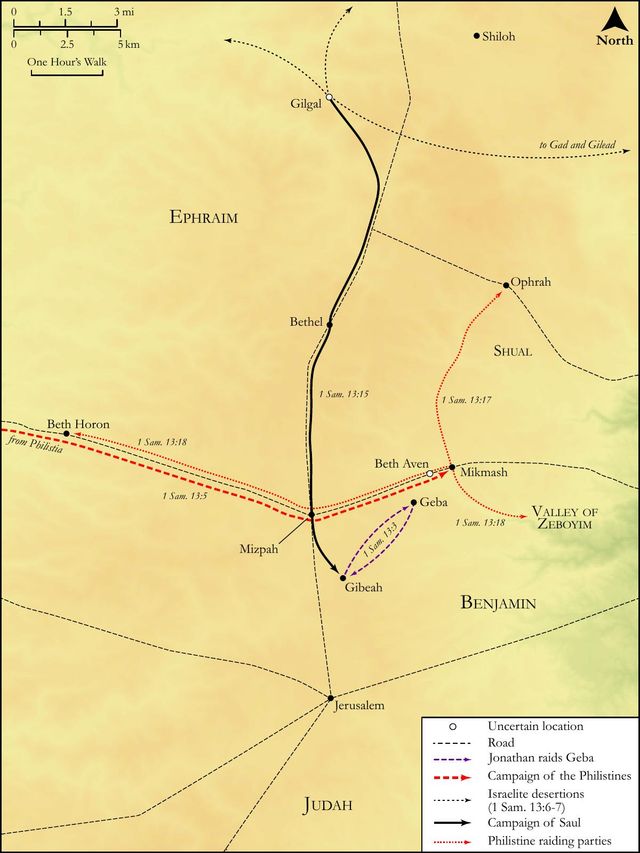
1.Some absconded. Rather than run upon death among the Philistines, they buried themselves alive in caves and thickets, Sa1 13:6. See what work sin makes; it exposes men to perils, and then robs them of their courage and dispirits them. A single person, by faith, can say, I will not be afraid of 10,000 (Psa 3:6); but here thousands of degenerate Israelites tremble at the approach of a great crowd of Philistines. Guilt makes men cowards.
2.Others fled (Sa1 13:7): They went over Jordan to the land of Gilead, as far as they could from the danger, and to a place where they had lately been victorious over the Ammonites. Where they had triumphed they hoped to be sheltered.
3.Those that staid with Saul followed him trembling, expecting no other than to be cut off, and having their hands and hearts very much weakened by the desertion of so many of their troops. And perhaps Saul himself, though he had so much honour as to stand his ground, yet had no courage to spare wherewith to inspire his trembling soldiers.
Historical interpretation
Historical reception
1 surviving comment on this verse from the historical church.
When the men of Israel heard this, that they were positioned on high places, etc. When the faithful perceive the snares of the ancient enemy to be prepared to combat, either within themselves or in their neighbors by means of humility's walls, or perhaps even some of the weaker ones afflicted by their frequent incursions, it is necessary at once to resort to the bulwarks of spiritual readings, fasts, alms, prayers, and other virtues by which they may be defended and hidden from the contradiction of tongues; and the Father, who sees in secret, may have mercy and help.
Continue studying 1 Samuel 13:6 across the web’s major study libraries — every link below opens this exact verse, chapter, or book on the destination site.
Read & Compare
 BibleGatewayThis verse in more than 200 translations and 70 languages.
 Bible.comThe YouVersion reader — hundreds of translations, reading plans, and highlights.
 ESV.orgCrossway's official English Standard Version reader.
 NET BibleThe NET translation with 60,000+ translators' notes on every rendering decision.
 STEP BibleTyndale House's free study tool — original text, vocabulary, and scholarly resources.
 BibliaLogos Bible Software's free web reader.
 USCCBThe New American Bible (Revised Edition) with the U.S. bishops' study notes.
Commentaries
 BibleHub CommentariesDozens of classic commentaries on this verse, gathered on one page.
 StudyLightMore than 100 commentary sets — the largest collection on the web.
 BibleRefPlain-English commentary on what this verse means, verse by verse.
 Enduring WordDavid Guzik's free commentary on this chapter, widely used by Bible teachers.
 Bible Study ToolsVerse commentary alongside Greek and Hebrew study aids.
Original Language & Research
- BibleHub InterlinearThe verse word by word — original language, transliteration, and English.
- BibleHub LexiconEvery word's original-language definition and Strong's entry.
 Blue Letter BibleDeep-study tools — Strong's numbers, concordance, and word studies.
 SefariaThe Hebrew text with Rashi and centuries of Jewish commentary.
Sermons, Hymns & Audio


TrulyRandomVerse is not affiliated with these sites and doesn’t control their content. They’re linked because they’re genuinely useful.
Summary
1 Samuel 13:6 vividly portrays the overwhelming fear and desperation that seized the Israelite populace and their nascent army when confronted by the formidable military might of the Philistines. This verse captures a critical moment of national crisis, where the instinct for self-preservation overrides any sense of national resolve or military discipline, compelling the people to abandon their positions and seek refuge in any available natural hiding place amidst the perceived hopelessness of their situation.
Context
ShowHideLiterary Context
This verse is strategically placed at a pivotal juncture in the early reign of King Saul. It immediately follows Jonathan's audacious, yet strategically provocative, strike against a Philistine garrison at Geba, as detailed in 1 Samuel 13:3. This act of aggression triggered a massive and terrifying Philistine retaliation, with their army described in 1 Samuel 13:5 as "as the sand which is on the sea shore in multitude." The Israelite forces, already under immense pressure and dwindling in numbers due to desertion and fear, found themselves in an untenable predicament. The widespread panic and flight described in this verse serve as the immediate backdrop for Saul's subsequent, fateful act of disobedience in offering a burnt offering without waiting for the prophet Samuel, a critical event detailed in 1 Samuel 13:8-12, which ultimately marked the beginning of his kingdom's decline. The people's profound fear is thus a direct precursor to Saul's own lapse in faith and judgment.
Historical & Cultural Context
The period of Saul's early monarchy was defined by persistent and often brutal conflict with the Philistines, who held a significant technological and military advantage over Israel. Crucially, the Philistines maintained a virtual monopoly on iron weaponry and metallurgy, while the Israelites were largely armed with bronze and stone implements, even being dependent on Philistine smiths for sharpening their agricultural tools, as explicitly stated in 1 Samuel 13:19-22. This technological disparity created an immense psychological and practical disadvantage for Israel. The Philistine army's strategic encampment at Michmash further amplified the immediate threat. The natural landscape of the region, characterized by numerous caves, rugged rocky outcrops, and dense thickets, provided the very hiding places the terrified Israelites sought. This desperate flight reflects not only their immediate fear but also the pervasive cultural reality of constant warfare and the crushing Philistine dominance that shaped the daily lives and actions of the people.
Key Themes
ShowHideThe most prominent theme illuminated in this verse is the paralyzing power of fear and its profound capacity to drive a people to extreme measures of self-preservation. The description of Israel being "in a strait" and "distressed" powerfully underscores their feeling of being utterly trapped, overwhelmed, and without recourse. This critical moment also starkly highlights the contrast between human panic and divine sovereignty, as the people's widespread flight reveals a profound and immediate lack of trust in God's ability to deliver them, even when faced with seemingly insurmountable odds. This stands in stark contrast to later narratives where faith triumphs over fear, such as Jonathan's audacious and faith-filled move against the Philistines in 1 Samuel 14:6 or Gideon's miraculous victory with a minuscule army in Judges 7:7. Furthermore, the people's desperate reaction foreshadows and sets the stage for the impending crisis of leadership under King Saul, whose own faith would soon falter under similar pressure, directly leading to his fateful act of disobedience and the beginning of his ultimate rejection as king.
Exposition and Analysis
ShowHideKey Word Analysis
ShowHideThis verb (H6887) is a primitive root meaning "to cramp, literally or figuratively, transitive or intransitive." It conveys a powerful sense of being hemmed in, confined, or in a tight, narrow place with no apparent escape. In this context, it perfectly encapsulates the feeling of being cornered and overwhelmed by an enemy, implying not just physical constriction but also profound psychological anguish and a complete lack of viable options. The Israelites felt utterly trapped and without recourse, facing an impossible situation.
This verb (H5065) is a primitive root meaning "to drive (an animal, a workman, a debtor, an army); by implication, to tax, harass, tyrannize." Here, it signifies the deep anxiety, anguish, or vexation that the people experienced. It describes the intense emotional and psychological state of the Israelite populace, highlighting that their fear was not merely a reaction to physical danger but a profound internal suffering. It emphasizes the mental and emotional toll the overwhelming Philistine threat had taken on them, leading to a state of profound disquiet, despair, and a sense of being driven to their limits.
This verb (H2244) is a primitive root meaning "to secrete" or "to hide (self)." Its use here, followed by a list of various hiding places, underscores the pervasive nature of the fear and the desperate, widespread attempt to disappear from the threat. The people were not merely seeking temporary cover; they were actively attempting to conceal themselves completely, indicating a catastrophic loss of morale and a desperate, instinctual effort to preserve their lives at any cost, abandoning any pretense of military engagement or national cohesion.
Verse Breakdown
ShowHide"When the men of Israel saw that they were in a strait"
This opening clause establishes the critical perception of both the Israelite army and the general populace. They "saw" (H7200, râʼâh') not merely the Philistine multitude, but their own dire and inescapable predicament—a situation of extreme confinement, pressure, and limited options. This perception of being utterly trapped, both militarily and psychologically, was the immediate catalyst for their subsequent desperate actions.
"(for the people were distressed,)"
This parenthetical clause serves as an immediate explanation and amplification of the preceding phrase. It clarifies why they perceived themselves to be "in a strait"—because they were overwhelmed by deep anxiety, anguish, and a profound sense of being harassed or driven to their limits. This emotional state highlights the devastating psychological impact of the Philistine threat, demonstrating that their fear was not just a tactical assessment but a deeply personal and pervasive internal suffering.
"then the people did hide themselves in caves, and in thickets, and in rocks, and in high places, and in pits"
This final, highly descriptive clause details the desperate, widespread, and chaotic response to their profound fear. The repeated use of "and in" followed by a comprehensive list of diverse natural hiding places emphasizes the sheer panic and the extent to which the people scattered to find any available concealment. This vivid imagery powerfully portrays a complete breakdown of military order and national cohesion, replaced by individual acts of frantic self-preservation and an all-consuming desire to escape the immediate threat.
Literary Devices
ShowHide1 Samuel 13:6 masterfully employs several literary devices to convey the intense fear and utter desperation that gripped the Israelite people. The most striking is Imagery, powerfully invoked through the vivid and extensive catalog of hiding places: "caves, and in thickets, and in rocks, and in high places, and in pits." This creates a strong, visceral visual of a scattered, terrified populace, frantically seeking refuge in every conceivable natural crevice, thereby underscoring the pervasive and overwhelming nature of their panic. The phrase "in a strait" functions as a potent Metaphor for their confined and desperate situation, extending beyond mere physical constraint to encompass their psychological and strategic predicament, suggesting a feeling of being trapped with no way out. The parenthetical clause "(for the people were distressed,)" acts as Explanatory Parenthesis, offering immediate and crucial insight into the internal emotional state that drove their external actions, reinforcing the cause-and-effect relationship between their profound anguish and their flight. Furthermore, the extensive list of hiding places, connected by the repeated conjunction "and in," can be seen as a form of Polysyndeton, which serves to emphasize the sheer multitude of places sought and the exhaustive, frantic nature of their search for any possible refuge, amplifying the sense of widespread panic and desperation.
Theological and Thematic Connections
ShowHideThe profound fear and widespread flight of the Israelites in 1 Samuel 13:6 illuminate a recurring and crucial theological theme throughout the Old Testament: the tension between human reliance on self-preservation and the divine call to courageous trust in God's sovereign power. This moment of widespread panic serves as a stark and sobering reminder that even God's chosen people can succumb to overwhelming fear when faced with seemingly insurmountable odds, momentarily forgetting His past deliverances and His unwavering promises. It powerfully underscores the spiritual battle between faith and fear, demonstrating how a lack of complete trust in God can lead to desperate, unfaithful, and ultimately self-defeating actions. The narrative implicitly contrasts this human-driven fear with the divine promise of protection and the consistent call to courage that God often extends to His people, reminding us that true security is found not in hiding places, but in the Lord Himself, who is an ever-present help in trouble.
Reflection and Application
ShowHide1 Samuel 13:6 offers a poignant and timeless mirror to the human condition, revealing our natural inclination to panic, withdraw, and seek self-preservation when confronted with overwhelming challenges or perceived threats. In moments of "strait" or profound distress—whether these manifest as financial crises, health scares, relational breakdowns, professional setbacks, or societal upheavals—our deeply ingrained first instinct might be to hide, to withdraw from the challenge, or to rely solely on our own limited resources and ingenuity. This verse powerfully challenges us to critically examine our default responses to fear and adversity. Do we, like the Israelites, instinctively seek refuge in temporary, earthly "caves" and "thickets," or do we turn to the ultimate and unfailing refuge and strength found exclusively in God? The narrative implicitly calls us to cultivate a deeper, more robust trust in God's providence, power, and faithfulness, even when circumstances appear bleak, human solutions are exhausted, and the path forward seems obscured. It reminds us that true courage is not the absence of fear, but rather the profound willingness to act in faith despite it, knowing with unwavering conviction that our ultimate security and deliverance rest not in our ability to hide, but in God's unwavering presence, His sovereign control, and His unfailing power to deliver.
Questions for Reflection
ShowHideFAQ
ShowHideWhy were the Israelites so afraid, even with a king and an army?
ShowHideThe Israelites' profound fear was multifaceted and deeply rooted in their historical, military, and spiritual context. Firstly, the Philistines possessed a significant and demoralizing technological advantage, particularly in iron weaponry, which the Israelites conspicuously lacked, as explicitly detailed in 1 Samuel 13:19-22. This created not only a practical but also an immense psychological disadvantage. Secondly, the sheer size of the Philistine army was truly overwhelming, described in 1 Samuel 13:5 as "as the sand which is on the sea shore in multitude," a clear hyperbole emphasizing their vast numbers. Thirdly, the Israelite "army" was not a standing professional force but largely a conscripted militia, often lacking the discipline, training, and experience necessary to face such a formidable foe. Finally, and perhaps most significantly, their fear stemmed from a spiritual deficit—a profound lack of complete trust in God's ability to deliver them, despite His consistent faithfulness and miraculous interventions throughout their history (e.g., the Exodus, the victories under the Judges). This potent combination of military inferiority, numerical disadvantage, and spiritual wavering led to widespread panic, desertion, and a catastrophic breakdown of morale.
Christ-Centered Fulfillment
ShowHideThe desperate and fear-driven hiding of the Israelites in 1 Samuel 13:6, as they sought refuge from the overwhelming threat of death and an insurmountable enemy, powerfully foreshadows the ultimate refuge and deliverance found exclusively in Jesus Christ. Their futile flight into natural "caves, and in thickets, and in rocks, and in high places, and in pits" symbolizes humanity's inherent inability to escape the consequences of sin and the ultimate fear of death through self-preservation or earthly means. In stark contrast to the Israelites' panic, Jesus, the perfect Son of God, faced the ultimate "strait" of the cross not with fear-driven flight or self-preservation, but with resolute obedience, unwavering courage, and perfect trust in His Father, as profoundly demonstrated in His agonizing prayer in Gethsemane and His complete submission to God's redemptive will. He did not hide from death but willingly embraced and conquered it, becoming the true "high place" and "rock" of eternal refuge for all who place their faith in Him. Through His atoning sacrifice on the cross and His glorious resurrection, Christ delivers us from the ultimate fear—the fear of death and the just judgment of sin—as the author of Hebrews 2:14-15 so eloquently explains. Where the Israelites sought temporary physical hiding places that could not ultimately save them, Christ offers eternal spiritual security, unfailing peace, and complete liberation from the power of sin and death, assuring us, "In the world you will have tribulation; but be of good cheer, I have overcome the world" (John 16:33). He is the Lamb of God who truly takes away the sin of the world, and in Him, we find our ultimate, unfailing, and everlasting refuge, far surpassing any earthly cave or thicket.