


Judges 10:9
Bible text: King James Version (1769 Blayney text) · Public domain
Bible text: King James Version with Strong's numbers · Public domain
Bible text: Berean Standard Bible · Public domain
Bible text: American Standard Version (1901) · Public domain
Bible text: World English Bible, Messianic edition · Public domain
Bible text: Geneva Bible (1599) · Public domain
Bible text: Young's Literal Translation · Public domain
- וַיַּעַבְרוּvai·ya·'av·Ruand they passed overH5674Conj-w ¦ V-Qal-ConsecImperf-3mpVerb Qal Consecutive Imperfect 3rd Plural Masculineוַandיַּעַבְרוּthey passed over
- בְנֵיve·nei[the] people ofH1121N-mpcNoun Plural Masculine Construct
- עַמּוֹן'a·mOnAmmonH5983N-proper-mNoun Proper Masculine
- אֶת'et<obj.>H853DirObjMParticle Object Indicator
- הַיַּרְדֵּןhai·yar·Denthe JordanH3383Art ¦ N-properNoun Proper LocationהַtheיַּרְדֵּןJordan
- לְהִלָּחֵםle·hi·la·Chemto fightH3898Prep-l ¦ V-Niphal-InfVerb Niphal Infinitive Constructלְtoהִלָּחֵםfight
- גַּםgamalsoH1571AdvAdverb
- בִּיהוּדָהbi·hu·Dahagainst JudahH3063Prep-b ¦ N-properNoun Proper LocationבִּagainstיהוּדָהJudah
- וּבְבִנְיָמִיןu·ve·vin·ya·Minand against BenjaminH1144Conj-w ¦ Prep-b ¦ N-proper-mNoun Proper MasculineוּandבְagainstבִנְיָמִיןBenjamin
- וּבְבֵיתu·ve·Veitand against [the] house ofH1004Conj-w ¦ Prep-b ¦ N-mscNoun Singular Masculine Constructוּandבְagainstבֵית[the] house of
- אֶפְרָיִם'ef·Ra·yimEphraimH669N-proper-mNoun Proper Masculine
- וַתֵּצֶרva·Te·tzerand it was distressH3334Conj-w ¦ V-Qal-ConsecImperf-3fsVerb Qal Consecutive Imperfect 3rd Singular Feminineוַandתֵּצֶרit was distress
- לְיִשְׂרָאֵלle·Yis·ra·'Elto IsraelH3478Prep-l ¦ N-properNoun Proper LocationלְtoיִשְׂרָאֵלIsrael
- מְאֹדme·'OdexceedinglyH3966Adj-msAdjective Numerical Singular Masculine Absolute
English is a literal word-by-word gloss of the Hebrew, not the KJV's wording. Why?
This is the original text the KJV's translators worked from — each Hebrew word with its own literal English meaning in this verse, prepared by scholars at Tyndale House, Cambridge. The KJV translates whole sentences, not word by word, so its wording differs: one Hebrew word can become several English words, and the KJV may choose “the LORD” where the gloss reads “Yahweh”. Both are faithful — they answer different questions. For the KJV's own rendering, switch to the KJV text.
Details
See on the biblical-era maps
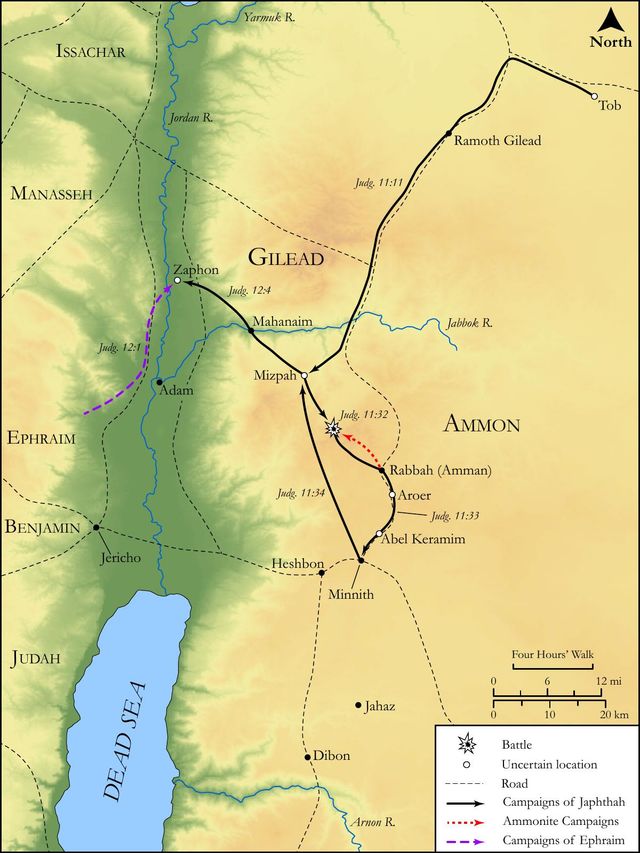

Study this verse
Public-domain commentary
Matthew Henry
From his Commentary on the Whole Bible. Henry comments on passages, not single verses — this entry covers Judges 10:6–9. His two-level outline is real structure in the source text, so it is rendered as structure.
While those two judges, Tola and Jair, presided in the affairs of Israel, things went well, but afterwards,
I.Israel returned to their idolatry, that sin which did most easily beset them (Jdg 10:6):
They did evil again in the sight of the Lord, from whom they were unaccountably bent to backslide, as a foolish people and unwise.
1.They worshipped many gods; not only their old demons Baalim and Ashtaroth, which the Canaanites had worshipped, but, as if they would proclaim their folly to all their neighbours, they served the gods of Syria, Zidon, Moab, Ammon, and the Philistines. It looks as if the chief trade of Israel had been to import deities from all countries. It is hard to say whether it was more impious or impolitic to do this. By introducing these foreign deities, they rendered themselves mean and despicable, for no nation that had any sense of honour changed their gods. Much of the wealth of Israel, we may suppose, was carried out, in offerings to the temples of the deities in the several countries whence they came, on which, as their mother-churches, their temples in Israel were expected to own their dependence; the priests and devotees of those sorry deities would follow their gods, no doubt, in crowds into the land of Israel, and, if they could not live in their own country, would take root there, and so strangers would devour their strength. If they did it in compliment to the neighbouring nations, and to ingratiate themselves with them, justly were they disappointed; for those nations which by their wicked arts they sought to make their friends by the righteous judgments of God became their enemies and oppressors. In quo quis peccat, in eo punitur - Wherein a person offends, therein he shall be punished.
2.They did not so much as admit the God of Israel to be one of those many deities they worshipped, but quite cast him off: They forsook the Lord, and served not him at all. Those that think to serve both God and Mammon will soon come entirely to forsake God, and to serve Mammon only. If God have not all the heart, he will soon have none of it.
II.God renewed his judgments upon them, bringing them under the power of oppressing enemies.
Had they fallen into the hands of the Lord immediately, they might have found that his mercies were great; but God let them fall into the hands of man, whose tender mercies are cruel. He sold them into the hands of the Philistines that lay south-west of Canaan, and of the Ammonites that lay north-east, both at the same time; so that between those two millstones they were miserably crushed, as the original word is (Jdg 10:8) for oppressed. God had appointed that, if any of the cities of Israel should revolt to idolatry, the rest should make war upon them and cut them off, Deu 13:12, etc. They had been jealous enough in this matter, almost to an extreme, in the case of the altar set up by the two tribes and a half (Jos. 22); but now they had grown so very bad that when one city was infected with idolatry the next took the infection and instead of punishing it, imitated and out-did it; and therefore, since those that should have been revengers to execute wrath on those that did this evil were themselves guilty, or bore the sword in vain, God brought the neighbouring nations upon them, to chastise them for their apostasy. The oppression of Israel by the Ammonites, the posterity of Lot, was,
1.Very long. It continued eighteen years. Some make those years to be part of the judgeship of Jair, who could not prevail to reform and deliver Israel as he would. Others make them to commence at the death of Jair, which seems the more probable because that part of Israel which was most infested by the Ammonites was Gilead, Jair's own country, which we cannot suppose to have suffered so much while he was living, but that part at least would be reformed and protected.
2.Very grievous. They vexed them and oppressed them. It was a great vexation to be oppressed by such a despicable people as the children of Ammon were. They began with those tribes that lay next them on the other side Jordan, here called the land of the Amorites (Jdg 10:8) because the Israelites had so wretchedly degenerated, and had made themselves so like the heathen, that they had become, in a manner, perfect Amorites (Eze 16:3), or because by their sin they forfeited their title to this land, so that it might justly be looked upon as the land of the Amorites again, from whom they took it. But by degrees they pushed forward, came over Jordan, and invaded Judah, and Benjamin, and Ephraim (Jdg 10:9), three of the most famous tribes of Israel, yet thus insulted when they had forsaken God, and unable to make head against the invader. Now the threatening was fulfilled that they should be slain before their enemies, and should have no power to stand before them, Lev 26:17, Lev 26:37. Their ways and their doings procure this to themselves; they have sadly degenerated, and so they come to be sorely distressed.
Continue studying Judges 10:9 across the web’s major study libraries — every link below opens this exact verse, chapter, or book on the destination site.
Read & Compare
 BibleGatewayThis verse in more than 200 translations and 70 languages.
 Bible.comThe YouVersion reader — hundreds of translations, reading plans, and highlights.
 ESV.orgCrossway's official English Standard Version reader.
 NET BibleThe NET translation with 60,000+ translators' notes on every rendering decision.
 STEP BibleTyndale House's free study tool — original text, vocabulary, and scholarly resources.
 BibliaLogos Bible Software's free web reader.
 USCCBThe New American Bible (Revised Edition) with the U.S. bishops' study notes.
Commentaries
 BibleHub CommentariesDozens of classic commentaries on this verse, gathered on one page.
 StudyLightMore than 100 commentary sets — the largest collection on the web.
 BibleRefPlain-English commentary on what this verse means, verse by verse.
 Enduring WordDavid Guzik's free commentary on this chapter, widely used by Bible teachers.
 Bible Study ToolsVerse commentary alongside Greek and Hebrew study aids.
Original Language & Research
- BibleHub InterlinearThe verse word by word — original language, transliteration, and English.
- BibleHub LexiconEvery word's original-language definition and Strong's entry.
 Blue Letter BibleDeep-study tools — Strong's numbers, concordance, and word studies.
 SefariaThe Hebrew text with Rashi and centuries of Jewish commentary.
Sermons, Hymns & Audio


TrulyRandomVerse is not affiliated with these sites and doesn’t control their content. They’re linked because they’re genuinely useful.
Summary
Judges 10:9 vividly portrays the escalating national crisis faced by Israel, detailing the Ammonite invasion that decisively crossed the Jordan River to afflict the prominent central Israelite tribes of Judah, Benjamin, and Ephraim. This verse underscores the severe and widespread distress resulting from Israel's persistent spiritual apostasy, serving as a poignant illustration of the consequences of abandoning the Lord and marking a critical moment in the recurring cycle of sin, oppression, and divine discipline that defines the book of Judges.
Context
ShowHideLiterary Context
Judges 10:9 is strategically placed within a particularly grim segment of Israel's history, immediately following a stark account of their profound spiritual decline. The preceding verses (Judges 10:6-8) establish that Israel had once again "done what was evil in the sight of the Lord," forsaking Him to serve a multitude of foreign gods, including the Baals, Ashtaroth, and deities of Syria, Sidon, Moab, Ammon, and the Philistines. This widespread idolatry ignited the Lord's anger, leading Him to "sell them into the hand of the Philistines and into the hand of the Ammonites." While Judges 10:8 specifies the Ammonite oppression of the Transjordanian tribes for eighteen years, verse 9 marks a critical escalation. The Ammonites' crossing of the Jordan River signifies a direct invasion of Israel's heartland, extending their reach to the pivotal tribes of Judah, Benjamin, and Ephraim. This intensified threat serves as the immediate backdrop for Israel's desperate cry for deliverance in Judges 10:10, setting the stage for the narrative of Jephthah's judgeship.
Historical & Cultural Context
The period of the Judges (approximately 12th to 11th centuries BC) was characterized by a decentralized tribal confederacy in Israel, often lacking strong national leadership, leading to a state where "everyone did what was right in his own eyes" (Judges 21:25). This era was punctuated by frequent incursions from surrounding peoples, often understood as divine discipline for Israel's covenant unfaithfulness. The Ammonites, descendants of Lot (as recorded in Genesis 19:38), were a consistently hostile neighbor situated east of the Jordan River, in what is modern-day Jordan. Their expansionist ambitions frequently brought them into conflict with Israel, particularly the Transjordanian tribes of Reuben, Gad, and the half-tribe of Manasseh. The act of crossing the Jordan, as depicted in this verse, represented a major strategic and existential threat. It indicated a full-scale invasion aimed at the core Israelite territories west of the river. Judah, Benjamin, and Ephraim were not arbitrary targets; they represented the dominant southern, central, and leading northern (or central highlands) parts of the Israelite confederacy, respectively. Their affliction signaled a comprehensive national calamity, impacting the very heart of the Israelite land and identity.
Key Themes
ShowHideJudges 10:9 powerfully contributes to several overarching themes pervasive throughout the book of Judges. Firstly, it starkly exemplifies the consequences of apostasy, illustrating how Israel's spiritual rebellion and abandonment of Yahweh directly led to profound national vulnerability and widespread suffering under foreign oppressors. This is a recurring pattern, explicitly articulated in the theological framework of Judges 2:11-19. Secondly, the verse emphasizes widespread national distress, showing that the Ammonite invasion was not a localized skirmish but a comprehensive assault affecting key tribes across the land, signaling a truly national crisis. This underscores how the collective spiritual state of a people can profoundly impact their physical, political, and psychological well-being. Thirdly, while not explicitly stated as God's direct action in this specific verse, the broader narrative of Judges consistently frames these periods of oppression as divine discipline, designed to humble Israel and compel them back to repentance and renewed reliance on Him. Finally, the verse highlights the severity of the threat, with the Ammonites "passed over Jordan" to "fight also against" major tribes, indicating a serious, organized, and expanding military threat that brought Israel to a state of profound distress, setting the stage for their eventual cry to God for deliverance.
Exposition and Analysis
ShowHideKey Word Analysis
ShowHideThis word refers to a "son" in the widest sense, encompassing literal and figurative relationships, including descendants, subjects, or members of a nation. Here, "children of Ammon" (H1121 with H5983) refers to the Ammonites as a collective people, the descendants of Lot, emphasizing their national identity and unified hostile action against Israel.
This word literally means "a descender" and refers to the principal river of Palestine. Its mention here is crucial as it signifies a geographical and strategic boundary. The Ammonites' act of "passing over Jordan" (H5674 with H3383) indicates a significant escalation, moving their aggression from the Transjordan region into the very heartland of Israel, transforming a localized conflict into a full-scale invasion of the western territories.
This primitive root means "to press (intransitive), i.e. be narrow; figuratively, be in distress." The KJV's "sore distressed" (with H3966, mᵉʼôd, meaning "vehemence" or "very") vividly conveys a state of being severely constrained, hemmed in, or in a strait. It describes not merely physical difficulty or military pressure but also deep psychological anguish, pressure, and oppression, emphasizing the profound and pervasive suffering experienced by the Israelites.
Verse Breakdown
ShowHide"Moreover the children of Ammon passed over Jordan"
This opening clause immediately signals a critical and ominous development. The Ammonites, who had previously confined their oppression to the Israelite tribes east of the Jordan River (as detailed in Judges 10:8), now breach this natural barrier. This act signifies a dramatic escalation, transforming their regional dominance into a full-scale invasion of Israel's heartland, demonstrating their aggressive intent to extend their control and inflict widespread suffering.
"to fight also against Judah, and against Benjamin, and against the house of Ephraim;"
This clause precisely identifies the new targets of the Ammonite aggression, highlighting the comprehensive nature of the threat. Judah, representing the powerful southern tribes; Benjamin, a strategically central tribe; and Ephraim, a dominant tribe in the central highlands often symbolic of the northern Israelite confederation, were all under attack. The phrase "the house of Ephraim" (H1004 with H669) particularly emphasizes the familial and communal aspect of their suffering. By targeting these pivotal tribes, the Ammonites were striking at the very core of Israel's strength and identity, ensuring that the distress was truly national in scope, affecting the entire nation from south to north.
"so that Israel was sore distressed."
This concluding clause encapsulates the dire consequence of the Ammonite invasion. The phrase "sore distressed" (H3966 with H3334), as explored in the key word analysis, conveys a profound state of being hemmed in, severely vexed, and overwhelmed. It speaks to not only physical hardship and military defeat but also deep psychological and spiritual anguish. This final declaration underscores the profound suffering and helplessness felt by the entire nation, highlighting the severity of the divine discipline and the desperate need for divine intervention.
Literary Devices
ShowHideJudges 10:9 effectively employs several literary devices to convey the gravity and widespread nature of Israel's predicament. The explicit listing of specific tribes—Judah, Benjamin, and Ephraim—serves as a powerful example of Enumeration. This technique emphasizes the comprehensive reach of the Ammonite invasion, indicating that no major region of Israel was spared and highlighting the truly national scope of the crisis. Furthermore, the concluding phrase "sore distressed" functions as a potent instance of Intensification. While literally true that Israel was distressed, the addition of "sore" (from the Hebrew mᵉʼôd, meaning "very" or "vehemently") amplifies the sense of extreme suffering, psychological anguish, and being utterly overwhelmed and trapped. This choice of language evokes a strong emotional response in the reader, underscoring the dire consequences of Israel's apostasy. The entire verse also plays a crucial role in advancing the overarching Cyclical Narrative structure of the book of Judges, marking a specific and severe point in the recurring pattern of Israel's sin, subsequent oppression, and eventual cry for divine deliverance.
Theological and Thematic Connections
ShowHideJudges 10:9 powerfully illustrates the immutable theological principle that disobedience to God's covenant commands inevitably leads to dire consequences, often manifested in external oppression and national suffering. Israel's persistent abandonment of the Lord for foreign deities resulted directly in their vulnerability to hostile nations, demonstrating God's righteous judgment and His sovereign use of external pressures to call His people back to Himself. This widespread distress was not merely a random misfortune but a direct and painful outcome of their spiritual choices, designed to humble them and prompt genuine repentance. The affliction's comprehensive nature, impacting key tribes across the land, underscores the corporate responsibility of God's people and how the spiritual health of a nation profoundly affects its collective well-being.
Reflection and Application
ShowHideJudges 10:9 serves as a timeless and sobering reminder that our choices, particularly our spiritual allegiances, carry profound and often far-reaching consequences. For individuals and communities today, it underscores the critical importance of singular and undivided devotion to God. When we, like ancient Israel, allow "other gods"—whether they manifest as materialism, self-sufficiency, the pursuit of power, pleasure, or even the subtle elevation of our own opinions above divine truth—to compete for the throne of our hearts, we inevitably open ourselves to various forms of "distress." This distress may not manifest as a physical army crossing a river, but it can appear as internal turmoil, relational brokenness, spiritual barrenness, or a pervasive sense of being "hemmed in" by life's pressures and anxieties. The verse challenges us to honestly examine what we truly worship and to recognize that genuine peace, security, and flourishing are found only in faithful adherence to the Lord. Furthermore, it highlights that God's discipline, though painful and difficult, is ultimately redemptive and purposive. The "sore distress" was intended to bring Israel to a point of brokenness and repentance, prompting them to cry out to the Lord for deliverance, as they eventually do in Judges 10:10. This passage encourages us, when facing personal or collective hardships, to examine our hearts, confess our sins, and turn back to God, trusting in His mercy and power to deliver, much like the promise found in 2 Chronicles 7:14 about humbling ourselves and seeking His face for healing.
Questions for Reflection
ShowHideFAQ
ShowHideWhy did the Ammonites cross the Jordan River, and what was the significance of targeting Judah, Benjamin, and Ephraim?
ShowHideThe Ammonites crossed the Jordan River as a significant and aggressive escalation of their long-standing conflict with Israel. Prior to this, their oppression had been primarily directed at the Israelite tribes located east of the Jordan (Transjordan) for eighteen years, as explicitly mentioned in Judges 10:8. Their act of crossing the river signaled a full-scale invasion aimed at the core territories of Israel west of the Jordan, demonstrating their strategic intent to inflict widespread damage and assert dominance over the entire nation, not just the frontier regions. The targeting of Judah, Benjamin, and Ephraim was both strategically and symbolically significant. Judah was the leading and most populous tribe in the south, from which the Davidic monarchy would later emerge. Benjamin was a centrally located tribe, home to important cities and a critical link between the northern and southern tribal territories. Ephraim was a powerful and influential tribe in the central highlands, often representing the strength and leadership of the northern tribes. By attacking these three prominent tribes, the Ammonites were striking at the very heart of Israelite identity, strength, and population centers, ensuring that the "distress" was truly national and comprehensive, affecting all major regions of the land of Israel.
Christ-Centered Fulfillment
ShowHideJudges 10:9, with its stark depiction of Israel's "sore distress" due to their unfaithfulness and the overwhelming power of their enemies, powerfully foreshadows humanity's ultimate predicament apart from Christ. Just as Israel was "hemmed in" and without recourse against the Ammonites, humanity is inherently "sore distressed" by the pervasive power of sin and death (Romans 3:23 and Romans 6:23). The recurring cycle of sin and oppression throughout the book of Judges points to a deeper, spiritual bondage from which Israel, and indeed all humanity, could not ultimately deliver themselves through human effort or temporary judges. This verse highlights the desperate, universal need for a true and ultimate deliverer, one who would not merely provide temporary relief from external foes but conquer the very root causes of distress: sin, spiritual alienation, and death. Jesus Christ is this ultimate Deliverer. He is the one who crosses the ultimate Jordan—the chasm between a holy God and sinful humanity—not to bring judgment, but to bring salvation and reconciliation. He faced the full force of spiritual oppression and distress on the cross, becoming sin for us (2 Corinthians 5:21) and enduring the ultimate separation from God, so that we might be set free from the dominion of sin and death (Colossians 1:13-14). His decisive victory over sin and death provides the true and lasting peace that Israel's temporary deliverers could not fully secure, offering eternal freedom from the distress caused by our own spiritual rebellion and bringing us into the glorious liberty of the children of God (John 8:36).