


2 Chronicles 14:9
- וַיֵּצֵאvai·ye·Tze'and he came outH3318Conj-w ¦ V-Qal-ConsecImperf-3msVerb Qal Consecutive Imperfect 3rd Singular Masculineוַandיֵּצֵאhe came out
- אֲלֵיהֶם'a·lei·Hemagainst themH413Prep ¦ 3mpPrepositionאֲלֵיagainstהֶםthem
- זֶרַחZe·rachZerahH2226N-proper-mNoun Proper Masculine
- הַכּוּשִׁיha·ku·Shithe CushiteH3569Art ¦ N-msNoun Gentilic Singular Masculine AbsoluteהַtheכּוּשִׁיCushite
- בְּחַיִלbe·Cha·yilwith an armyH2428Prep-b ¦ N-msNoun Singular Masculine Absoluteבְּwithחַיִלan army
- אֶלֶף'E·lefa thousandH505N-cscNoun Singular common gender Construct
- אֲלָפִים'a·la·Fimthousand<s>H505N-cpNoun Plural common gender Absolute
- וּמַרְכָּבוֹתu·mar·ka·Votand chariotsH4818Conj-w ¦ N-fpNoun Plural Feminine Absoluteוּandמַרְכָּבוֹתchariots
- שְׁלֹשׁshe·LoshthreeH7969N-cscNoun Singular common gender Construct
- מֵאוֹתme·'othundred<s>H3967N-fpNoun Plural Feminine Absolute
- וַיָּבֹאvai·ya·Vo'and he cameH935Conj-w ¦ V-Qal-ConsecImperf-3msVerb Qal Consecutive Imperfect 3rd Singular Masculineוַandיָּבֹאhe came
- עַד'adtoH5704PrepPreposition
- מָרֵשָׁהma·re·ShahMareshahH4762N-properNoun Proper Location
English is a literal word-by-word gloss of the Hebrew, not the KJV's wording. Why?
This is the original text the KJV's translators worked from — each Hebrew word with its own literal English meaning in this verse, prepared by scholars at Tyndale House, Cambridge. The KJV translates whole sentences, not word by word, so its wording differs: one Hebrew word can become several English words, and the KJV may choose “the LORD” where the gloss reads “Yahweh”. Both are faithful — they answer different questions. For the KJV's own rendering, switch to the KJV text.
Details
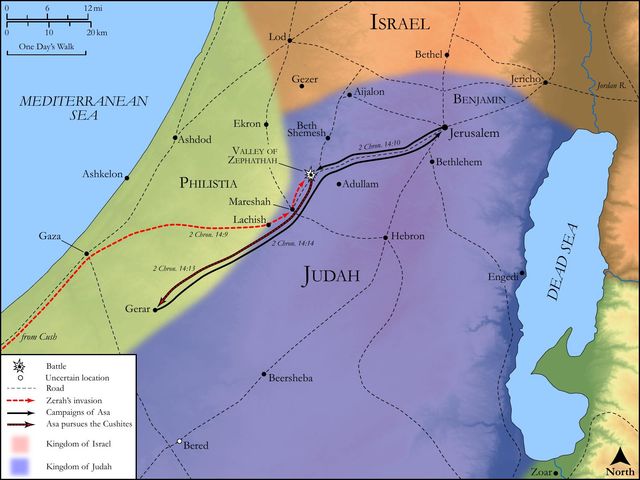
See on the biblical-era map
Study this verse
Public-domain commentary
Matthew Henry
From his Commentary on the Whole Bible. Henry comments on passages, not single verses — this entry covers 2 Chronicles 14:9–15. His three-level outline is real structure in the source text, so it is rendered as structure.
Here is, I. Disturbance given to the peace of Asa's kingdom by a formidable army of Ethiopians that invaded them, Ch2 14:9, Ch2 14:10. Though still they sought God, yet this fear came upon them, that their faith in God might be tried, and that God might have an opportunity of doing great things for them. It was a vast number that the Ethiopians brought against him: 1,000,000 men; and now he found the benefit of having an army ready raised against such a time of need. That provision which we thought needless may soon appear to be of great advantage.
II.The application Asa made to God on occasion of the threatening cloud which now hung over his head, Ch2 14:11.
He that sought God in the day of his peace and prosperity could with holy boldness cry to God in the day of his trouble, and call him his God. His prayer is short, but has much in it. 1. He gives to God the glory of his infinite power and sovereignty: It is nothing with thee to help and save by many or few, by those that are mighty or by those that have no power. See Sa1 14:6. God works in his own strength, not in the strength of instruments (Psa 21:13), nay, it is his glory to help the weakest and to perfect strength out of the mouth of babes and sucklings. "We do not say, Lord, take our part, for we have a good army for thee to work by; but, take our part, for without thee we have no power." 2. He takes hold of their covenant-relation to God as theirs. O Lord, our God! and again, "Thou art our God, whom we have chosen and cleave to as ours, and who hast promised to be ours." 3. He pleads their dependence upon God, and the eye they had to him in this expedition. he was well prepared for it, yet trusted not to his preparations; but, "Lord, we rest on thee, and in thy name we go against this multitude, by warrant from thee, aiming at thy glory, and trusting to thy strength." 4. He interests God in their cause: "Let not man" (mortal man, so the word is) "prevail against thee. If he prevail against us, it will be said that he prevails against thee, because thou art our God, and we rest on thee and go forth in thy name, which thou hast encouraged us to do. The enemy is a mortal man; make it to appear what an unequal match he is for an immortal God. Lord, maintain thy own honour; hallowed by thy name."
III.The glorious victory God gave him over his enemies.
1.God defeated the enemy, and put their forces into disorder (Ch2 14:12): The Lord smote the Ethiopians, smote them with terror, and an unaccountable consternation, so that they fled, and knew neither why nor whither.
2.Asa and his soldiers took the advantage God gave them against the enemy.
(1.)They destroyed them. They fell before the Lord (for who can stand before him?) and before his host, either an invisible host of angels that were employed to destroy them or the host of Israel, called God's host because owned by him.
(2.)They took the plunder of their camp, carried away very much spoil from the slain and from the baggage.
(3.)They smote the cities that were in league with them, to which they fled for shelter, and carried off the spoil of them (Ch2 14:14); and they were not able to make any resistance, for the fear of the Lord came upon them, that is, a fear which God struck them with to such a degree that they had no heart to withstand the conquerors.
(4.)They fetched away the cattle out of the enemy's country, in vast numbers, Ch2 14:15. Thus the wealth of the sinner is laid up for the just.
Continue studying 2 Chronicles 14:9 across the web’s major study libraries — every link below opens this exact verse, chapter, or book on the destination site.
Read & Compare
 BibleGatewayThis verse in more than 200 translations and 70 languages.
 Bible.comThe YouVersion reader — hundreds of translations, reading plans, and highlights.
 ESV.orgCrossway's official English Standard Version reader.
 NET BibleThe NET translation with 60,000+ translators' notes on every rendering decision.
 STEP BibleTyndale House's free study tool — original text, vocabulary, and scholarly resources.
 BibliaLogos Bible Software's free web reader.
 USCCBThe New American Bible (Revised Edition) with the U.S. bishops' study notes.
Commentaries
 BibleHub CommentariesDozens of classic commentaries on this verse, gathered on one page.
 StudyLightMore than 100 commentary sets — the largest collection on the web.
 BibleRefPlain-English commentary on what this verse means, verse by verse.
 Enduring WordDavid Guzik's free commentary on this chapter, widely used by Bible teachers.
 Bible Study ToolsVerse commentary alongside Greek and Hebrew study aids.
Original Language & Research
- BibleHub InterlinearThe verse word by word — original language, transliteration, and English.
- BibleHub LexiconEvery word's original-language definition and Strong's entry.
 Blue Letter BibleDeep-study tools — Strong's numbers, concordance, and word studies.
 SefariaThe Hebrew text with Rashi and centuries of Jewish commentary.
Sermons, Hymns & Audio


TrulyRandomVerse is not affiliated with these sites and doesn’t control their content. They’re linked because they’re genuinely useful.
Summary
2 Chronicles 14:9 dramatically introduces Zerah the Ethiopian, leading an unprecedentedly vast army of one million men and three hundred chariots, as he advances against King Asa's Judah, specifically targeting Mareshah. This verse abruptly shatters a decade of peace and prosperity, setting the stage for a monumental confrontation that would profoundly test Asa's faith and Judah's reliance on God, highlighting the sudden emergence of overwhelming external threats even amidst periods of spiritual faithfulness and national security.
Context
ShowHideLiterary Context
This verse marks a pivotal turning point in the narrative of King Asa's reign, immediately following a period of significant religious and national reform detailed in 2 Chronicles 14:1-8. The preceding verses emphasize a decade of peace and prosperity directly attributed to Asa's diligent purging of idolatry, his rebuilding of cities, and the strengthening of Judah's army. The abrupt introduction of Zerah's colossal army in verse 9 shatters this established peace, creating immediate narrative tension and setting the stage for the climactic battle and Asa's desperate, yet faithful, prayer in 2 Chronicles 14:11. This sudden shift underscores the vulnerability of even a righteous kingdom to external threats and highlights the narrative's focus on divine deliverance.
Historical & Cultural Context
Zerah the Ethiopian (Hebrew: Zerah ha-Kushi) likely refers to a general or king from the Kingdom of Cush (ancient Ethiopia), a formidable power located south of Egypt. Cush was renowned for its military strength and had a history of involvement in regional conflicts, sometimes extending its influence into the Levant. The description of Zerah's army as "a thousand thousand" (one million) men and "three hundred chariots" is staggering. While ancient numerical figures often served to emphasize scale rather than precise literal counts, this portrayal unequivocally signifies an overwhelming, technologically advanced military force. Chariots were the ancient world's premier offensive weapon, capable of devastating infantry formations. Mareshah, the target city, was a strategically vital location in the Shephelah (lowlands) of Judah, positioned to control access to the Judean highlands. Its selection as the invasion point indicates a direct and serious threat to the heartland of Judah, reflecting the constant geopolitical pressures and military incursions faced by ancient Israel from surrounding empires.
Key Themes
ShowHideThe primary themes emerging from this verse are the testing of faith in the face of overwhelming odds, the sudden emergence of adversity even after periods of faithfulness and blessing, and the profound contrast between human strength and divine power. Asa had prepared Judah militarily, but the sheer scale of Zerah's force clearly exceeded any human capacity for resistance, necessitating an absolute reliance on God. This event serves as a critical narrative pivot, moving from a period of peace secured by obedience to a crisis demanding profound trust in God's ability to deliver. It underscores the sovereignty of God over nations and historical events, even when they appear to threaten His people, a central theological tenet woven throughout the book of 2 Chronicles. The narrative thus prepares the reader for a demonstration of God's miraculous intervention, emphasizing that His power is made perfect in weakness, as seen in 2 Chronicles 14:12-13.
Exposition and Analysis
ShowHideKey Word Analysis
ShowHideThis proper noun refers to the leader of the invading army. The name "Zerah" itself means "rising" or "shining," but in this context, it identifies a specific individual, an Ethiopian prince or general, who poses an existential threat to Judah. His identification as "the Ethiopian" (Kushite) immediately signals a powerful, foreign adversary from the south, known for their military might and occasional conflicts with Egypt and the Levant.
This word, meaning "force," "army," "strength," or "valor," is used here to describe the immense military contingent led by Zerah. The use of chayil emphasizes not just the numerical size but also the formidable power and capability of this invading force. It denotes a well-organized and potent fighting machine, equipped for war and possessing significant might, underscoring the gravity of the threat to Judah.
This verb signifies an active, purposeful movement, specifically "to go out" or "to come forth." In a military context, it denotes the initiation of a campaign or an advance. The phrase "came out against them" vividly portrays Zerah's army not as a passive presence, but as an aggressive, advancing force directly confronting Judah, underscoring the immediate and direct nature of the invasion.
Verse Breakdown
ShowHide"¶ And there came out against them Zerah the Ethiopian"
This opening clause introduces the primary antagonist, Zerah, and specifies his origin as "the Ethiopian" (Cushite), immediately establishing him as a formidable, foreign military leader. The phrase "came out against them" signifies the aggressive initiation of a military campaign, directly targeting Judah and abruptly ending the kingdom's period of peace.
"with an host of a thousand thousand, and three hundred chariots;"
This segment vividly describes the overwhelming scale and composition of Zerah's invading army. "A host of a thousand thousand" (one million men) functions as a hyperbole to convey an unimaginably vast numerical superiority, while "three hundred chariots" highlights the advanced military technology and destructive power at Zerah's disposal. This description emphasizes the human impossibility of resisting such a force through conventional means.
"and came unto Mareshah."
This final clause specifies the precise geographical objective of the invasion. Mareshah was a strategically important city in the Shephelah, the lowlands of Judah, serving as a critical defensive point controlling access to the Judean highlands. The arrival of such a massive army at Mareshah underscores the immediate and direct threat to the heartland of Judah, setting the precise stage for the impending conflict and highlighting the dire urgency of the situation.
Literary Devices
ShowHide2 Chronicles 14:9 employs several potent literary devices to convey the gravity and scale of the impending crisis. Hyperbole is prominently featured in the description of "a thousand thousand" men, which, whether interpreted literally or as a rhetorical exaggeration, serves to dramatically emphasize the overwhelming numerical superiority of Zerah's army. This exaggeration effectively instills a sense of dread and human hopelessness, underscoring the absolute necessity of divine intervention. The sudden introduction of such a colossal threat after a decade of peace creates significant dramatic tension, abruptly shifting the narrative from prosperity and security to immediate peril. Furthermore, the verse functions as foreshadowing, setting the stage for the climactic battle in the subsequent verses and King Asa's desperate, yet faithful, prayer to God. The stark contrast between Judah's recently established peace and the sudden, immense military challenge highlights the unpredictable nature of life and the constant need for divine reliance.
Theological and Thematic Connections
ShowHide2 Chronicles 14:9 serves as a profound theological statement on the nature of divine testing and the limits of human strength. It illustrates that even in seasons of obedience and blessing, God may permit overwhelming challenges to arise, not as punishment, but as opportunities to demonstrate His power and solidify His people's faith. The sheer scale of Zerah's army underscores the principle that true security does not rest in human preparation or military might, but in absolute dependence on God. This narrative prepares the reader for the subsequent display of God's miraculous deliverance, emphasizing that His ability to save is not constrained by the magnitude of the enemy. It is a powerful reminder that when human resources are exhausted, divine power is often most clearly revealed.
Reflection and Application
ShowHideThe arrival of Zerah's seemingly invincible army in 2 Chronicles 14:9 offers a timeless lesson for believers facing daunting challenges. Just as Asa's decade of peace was abruptly interrupted by an overwhelming threat, our lives, too, can experience sudden, immense difficulties that far exceed our personal resources or strategic preparations. This verse reminds us that the magnitude of our problems—whether financial crises, health battles, relational breakdowns, or spiritual attacks—is never a measure of God's ability to deliver. Instead, it is often in the face of such "million-man armies" that our faith is most profoundly tested and, paradoxically, most powerfully forged. The immediate human response might be despair or fear, but the spiritual imperative is to recognize our utter dependence on a power far greater than our own. This sets the stage for the crucial truth that our ultimate hope and victory lie not in our strength or wisdom, but in our willingness to turn to God and trust in His sovereign might, as Asa would soon demonstrate in his desperate prayer and God's subsequent miraculous intervention. It calls us to examine where our true security lies.
Questions for Reflection
ShowHideFAQ
ShowHideWas Zerah's army literally one million men, or is "a thousand thousand" a hyperbole?
ShowHideWhile "a thousand thousand" (Hebrew: eleph 'eleph) literally translates to one million, scholars debate whether this figure represents a precise literal count or is a hyperbolic expression intended to convey an overwhelmingly vast and formidable army. In ancient Near Eastern warfare accounts, large numbers were often used to emphasize the scale and power of an invading force, serving a rhetorical purpose to highlight the magnitude of the threat and the miraculous nature of any deliverance. Regardless of its precise literalness, the intent of the text is clear: to portray Zerah's army as an immense, humanly insurmountable threat, setting the stage for a miraculous divine intervention. The emphasis is on the qualitative impact of such a force, rather than a precise quantitative census, underscoring that the victory would clearly be God's, not Judah's.
Christ-Centered Fulfillment
ShowHideThe overwhelming threat posed by Zerah the Ethiopian in 2 Chronicles 14:9 powerfully foreshadows the infinitely greater spiritual enemies that humanity faces: sin, death, and the devil. No human king, no matter how righteous or militarily prepared, could ever muster an army capable of defeating these existential forces. Just as Asa was confronted with an enemy far beyond his military capacity, so too is humanity utterly helpless against the spiritual powers of darkness that hold the world captive. This narrative points forward to the ultimate Deliverer, Jesus Christ, who faced and triumphed over these formidable foes, not with an earthly army, but through His sacrificial death and glorious resurrection. His victory on the cross disarmed the principalities and powers, making a public spectacle of them, triumphing over them in it, as Colossians 2:15 declares. For believers, the spiritual battle is not against flesh and blood, but against spiritual forces of evil in the heavenly places, as described in Ephesians 6:12. Our victory is found solely in the power and authority of Christ, the true Lamb of God who takes away the sin of the world, as proclaimed in John 1:29. He is the one who delivers us from the domain of darkness and transfers us to the kingdom of His beloved Son, as beautifully articulated in Colossians 1:13, offering a salvation far grander than any earthly military triumph.