


2 Chronicles 11:8
Bible text: King James Version (1769 Blayney text) · Public domain
Bible text: American Standard Version (1901) · Public domain
Bible text: World English Bible, Messianic edition · Public domain
Bible text: Geneva Bible (1599) · Public domain
Bible text: Young's Literal Translation · Public domain
- וְאֶתve·'Etand <obj.>H853Conj-w ¦ DirObjMParticle Object Indicatorוְandאֶת<obj.>
- גַּתgatGathH1661N-properNoun Proper Location
- וְאֶתve·'Etand <obj.>H853Conj-w ¦ DirObjMParticle Object Indicatorוְandאֶת<obj.>
- מָרֵשָׁהma·re·ShahMareshahH4762N-properNoun Proper Location
- וְאֶתve·'Etand <obj.>H853Conj-w ¦ DirObjMParticle Object Indicatorוְandאֶת<obj.>
- זִיףZifZiphH2128N-properNoun Proper Location
English is a literal word-by-word gloss of the Hebrew, not the KJV's wording. Why?
This is the original text the KJV's translators worked from — each Hebrew word with its own literal English meaning in this verse, prepared by scholars at Tyndale House, Cambridge. The KJV translates whole sentences, not word by word, so its wording differs: one Hebrew word can become several English words, and the KJV may choose “the LORD” where the gloss reads “Yahweh”. Both are faithful — they answer different questions. For the KJV's own rendering, switch to the KJV text.
Details
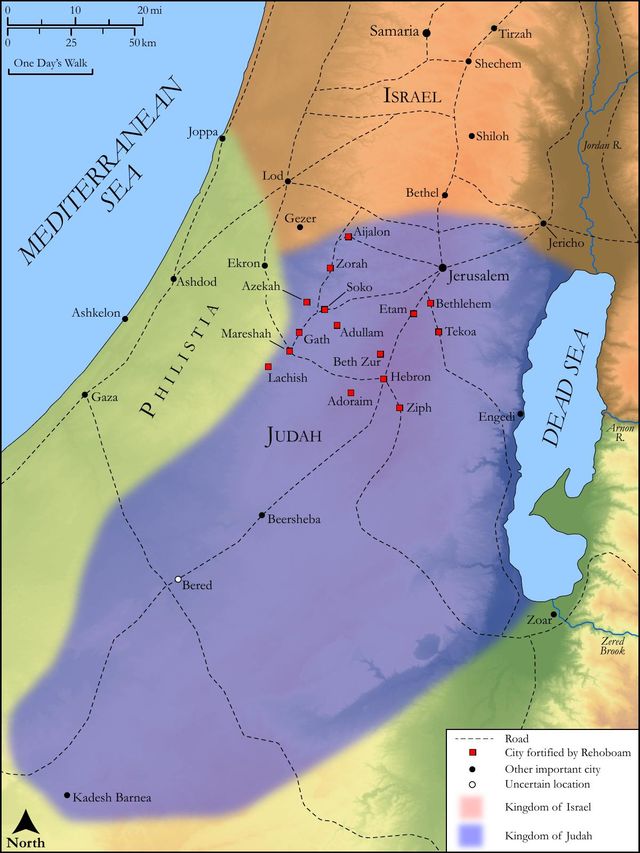
See on the biblical-era map
Study this verse
Public-domain commentary
Matthew Henry
From his Commentary on the Whole Bible. Henry comments on passages, not single verses — this entry covers 2 Chronicles 11:1–12.
How the ten tribes deserted the house of David we read in the foregoing chapter. They had formerly sat loose to that family (Sa2 20:1, Sa2 20:2), and now they quite threw it off, not considering how much it would weaken the common interest and take Israel down from that pitch of glory at which it had arrived in the last reign. But thus the kingdom must be corrected as well as the house of David. 1. Rehoboam at length, like a bold man, raises an army, with a design to reduce the revolters, Ch2 11:1. Judah and Benjamin were not only resolved to continue their allegiance to him, but ready to give him the best assistance they could for the recovery of his right. Judah was his own tribe, that owned him some years before the rest did; Benjamin was the tribe in which Jerusalem, or the greatest part of it, stood, which perhaps was one reason why that tribe clave to him. 2. Yet, like a conscientious man, when God forbade him to prosecute this design, in obedience to him he let it fall, either because he reverenced the divine authority or because he knew that he should not prosper if he should go contrary to God's command, but instead of retrieving what was lost would be in danger of losing what he had. It is dangerous undertaking any thing, but especially undertaking a war, contrary to the will of God. God calls him (Ch2 11:3), Rehoboam the son of Solomon, to intimate that this was determined for the sin of Solomon, and it would be to no purpose to oppose a decree that had gone forth. They obeyed the words of the Lord; and though it looked mean, and would turn to their reproach among their neighbours, yet, because God would have it so, they laid down their arms. 3. Like a discreet man, he fortified his own country. He saw it was to no purpose to think of reducing those that had revolted. A few good words might have prevented their defection, but now all the forces of his kingdom cannot bring them back. The think is done, and so it must rest; it is his wisdom to make the best of it. Perhaps the same young counsellors that had advised him to answer them roughly urged him to fight them, notwithstanding the divine inhibition; but he had paid dearly enough for being advised by them, and therefore now, we may suppose, his aged and experienced counsellors were hearkened to, and they advised him to submit to the will of God concerning what was lost, and to make it his business to keep what he had. It was probably by their advice that, (1.) He fortified his frontiers, and many of the principal cities of his kingdom, which, in Solomon's peaceable reign, no care had been taken for the defence of. (2.) He furnished them with good stores of victuals and arms, Ch2 11:11, Ch2 11:12. Because God forbade him to fight, he did not therefore sit down sullenly, and say that he would do nothing for the public safety if he might not do that, but prudently provided against an attack. Those that may not be conquerors, yet may be builders.
Continue studying 2 Chronicles 11:8 across the web’s major study libraries — every link below opens this exact verse, chapter, or book on the destination site.
Read & Compare
 BibleGatewayThis verse in more than 200 translations and 70 languages.
 Bible.comThe YouVersion reader — hundreds of translations, reading plans, and highlights.
 ESV.orgCrossway's official English Standard Version reader.
 NET BibleThe NET translation with 60,000+ translators' notes on every rendering decision.
 STEP BibleTyndale House's free study tool — original text, vocabulary, and scholarly resources.
 BibliaLogos Bible Software's free web reader.
 USCCBThe New American Bible (Revised Edition) with the U.S. bishops' study notes.
Commentaries
 BibleHub CommentariesDozens of classic commentaries on this verse, gathered on one page.
 StudyLightMore than 100 commentary sets — the largest collection on the web.
 BibleRefPlain-English commentary on what this verse means, verse by verse.
 Enduring WordDavid Guzik's free commentary on this chapter, widely used by Bible teachers.
 Bible Study ToolsVerse commentary alongside Greek and Hebrew study aids.
Original Language & Research
- BibleHub InterlinearThe verse word by word — original language, transliteration, and English.
- BibleHub LexiconEvery word's original-language definition and Strong's entry.
 Blue Letter BibleDeep-study tools — Strong's numbers, concordance, and word studies.
 SefariaThe Hebrew text with Rashi and centuries of Jewish commentary.
Sermons, Hymns & Audio


TrulyRandomVerse is not affiliated with these sites and doesn’t control their content. They’re linked because they’re genuinely useful.
Summary
2 Chronicles 11:8 is a concise yet pivotal verse within the Chronicler's detailed account of King Rehoboam's strategic fortifications following the catastrophic division of the Israelite kingdom. It specifically enumerates Gath, Mareshah, and Ziph as key cities strengthened by Rehoboam. These locations, chosen for their vital geographical and tactical significance, formed crucial components of Judah's new defensive network, reflecting Rehoboam's immediate and pragmatic response to the profound political instability and heightened security threats posed by the newly formed northern kingdom of Israel and other regional adversaries.
Context
ShowHideLiterary Context
This verse is deeply embedded within a meticulously cataloged list of fifteen cities fortified by King Rehoboam, spanning from 2 Chronicles 11:5 to 2 Chronicles 11:10. The Chronicler's precise enumeration, which includes Bethlehem, Etam, Tekoa, Beth-zur, Soco, Adullam, Gath, Mareshah, Ziph, Adoraim, Lachish, Azekah, Zorah, Aijalon, and Hebron, underscores the thoroughness and scale of Rehoboam's defensive strategy. This detailed military preparation is presented as a direct and necessary consequence of the kingdom's schism, which is vividly recounted in the preceding chapter, 2 Chronicles 10. The list serves to highlight Rehoboam's diligence in consolidating his diminished territory and securing its borders against potential incursions, thereby setting the stage for subsequent narratives of Judah's early monarchy.
Historical & Cultural Context
The historical setting for Rehoboam's actions is the immediate aftermath of the united monarchy's dramatic disintegration, as narrated in 1 Kings 12 and 2 Chronicles 10. Following the northern tribes' rejection of Rehoboam's oppressive policies and their subsequent allegiance to Jeroboam, the kingdom of Judah was reduced to the territories of Judah and Benjamin. This sudden geopolitical shift created immense vulnerability, necessitating a robust defensive posture. Among the kings of that day, the fortification of cities was a fundamental aspect of royal governance and national security, symbolizing a king's strength and his commitment to protecting his populace and resources. Rehoboam's initiative was a pragmatic and culturally expected response to safeguard Jerusalem and the fertile Judean heartland from potential threats, not only from the new northern kingdom but also from traditional adversaries like the Philistines to the west and other regional powers.
Key Themes
ShowHideThe meticulous listing of cities in 2 Chronicles 11:8 and the broader passage illuminates several critical themes. Firstly, Strategic Defense and National Security are paramount, showcasing Rehoboam's immediate and practical response to Judah's newfound vulnerability. His strategic placement of these strongholds reveals a keen understanding of the necessity to secure key routes and borders. Secondly, the Geographical Significance of each city is crucial; Gath, Mareshah, and Ziph were not arbitrary choices but locations possessing inherent historical importance and tactical value, guarding critical approaches to Judah. Gath, while historically a major Philistine city, likely refers to a border settlement or a re-established point of control within Judah's sphere, indicating an effort to secure the western frontier. Mareshah, situated in the Shephelah, was a significant administrative and military hub, later renowned for King Asa's decisive victory against the Ethiopians in 2 Chronicles 14:9-12. Ziph, located in the Judean hill country, secured eastern approaches and held historical significance as a place of refuge for David during his flight from Saul, as recounted in 1 Samuel 23:14. Lastly, the extensive fortifications underscore the dire Consequences of Disunity, vividly demonstrating the instability and insecurity that resulted from the kingdom's schism, forcing Rehoboam to invest heavily in defense rather than unified national development, a situation further elaborated in 2 Chronicles 11:12.
Exposition and Analysis
ShowHideKey Word Analysis
ShowHideWhile famously known as one of the five major Philistine city-states and the hometown of Goliath (1 Samuel 17:4), the Gath mentioned here is most likely a border town or a strategic outpost within or on the periphery of Judah's territory, possibly one that had been captured, re-established, or brought under Israelite control during previous reigns. Its fortification by Rehoboam signifies a critical effort to secure the western frontier of Judah, establishing a bulwark against lingering Philistine threats and controlling access from the coastal plain into the Judean lowlands (Shephelah).
Formed like "summit," Mareshah was a city of considerable strategic importance, located in the Shephelah, the lowlands of Judah. Its position commanded a major route connecting the coastal plain with the Judean hill country, making it a key administrative and military center. The fortification of Mareshah was thus crucial for defending the heartland of Judah from western incursions, controlling vital agricultural lands and trade routes. Its enduring significance is highlighted by its later role as the site of King Asa's decisive victory over Zerah the Ethiopian (2 Chronicles 14:9-12).
Meaning "flowing," Ziph was situated in the Judean hill country, southeast of Hebron. It was particularly known for its adjacent wilderness, which famously served as a hiding place for David when pursued by King Saul (1 Samuel 23:14). Rehoboam's fortification of Ziph was vital for securing the eastern approaches to Judah, particularly from the wilderness regions and potentially from Edom. This measure ensured the safety of the Judean heartland from threats emanating from the desert or the Dead Sea region, completing a comprehensive defensive perimeter.
Verse Breakdown
ShowHide"And Gath"
The inclusion of Gath in Rehoboam's list of fortified cities underscores his strategic focus on securing the western flank of his kingdom. By strengthening this location, he aimed to establish a robust defensive line against the Philistines and to control a key entry point into the fertile Shephelah, thereby protecting the agricultural and population centers further inland.
"and Mareshah"
The fortification of Mareshah highlights its critical role as a strategic hub within the Shephelah. Its commanding position allowed for effective oversight of significant trade routes and military movements, rendering it an indispensable stronghold for defending the central and western parts of Judah. This strengthening was a clear indication of Rehoboam's intent to maintain firm control over this vital region, safeguarding access to Jerusalem.
"and Ziph"
The fortification of Ziph demonstrates the comprehensive nature of Rehoboam's defensive strategy, extending to the eastern reaches of the Judean hill country. This measure was crucial for protecting Judah from potential threats originating from the wilderness areas to the east and south, thereby securing the approaches to Hebron and other important cities in the Judean highlands.
Literary Devices
ShowHideThe primary literary device employed in 2 Chronicles 11:8, and indeed throughout the extended list in 2 Chronicles 11:6-10, is Enumeration or Cataloging. By systematically listing each fortified city, the Chronicler emphasizes the sheer scale, thoroughness, and strategic foresight of Rehoboam's defensive preparations. This detailed catalog serves to underscore the king's diligence in securing his diminished kingdom. Furthermore, the passage effectively utilizes Topography as a narrative element, where the specific geographical locations are not merely names but carry inherent strategic significance, contributing directly to the overarching narrative of defense and security. The very names Gath, Mareshah, and Ziph also function as Historical Allusions, subtly invoking past events and associations (e.g., Gath's Philistine connection, Ziph's link to David's flight from Saul, Mareshah's future as a battleground), enriching the text with layers of historical context and demonstrating the enduring importance of these sites in Israelite history.
Theological and Thematic Connections
ShowHideRehoboam's diligent fortification of cities like Gath, Mareshah, and Ziph, while a testament to human prudence and strategic thinking, implicitly raises profound theological questions about the nature of true security and ultimate reliance. In the Chronicler's overarching theological framework, genuine security ultimately rests in God's faithfulness and protective hand, not solely in human strength, military might, or physical fortifications. While Rehoboam's actions were practically necessary in the face of immediate threats, the broader narrative of Chronicles often contrasts human efforts with the transformative power of divine intervention, especially when kings demonstrate faithful trust in God. The very necessity for such extensive fortifications also serves as a stark reminder of the profound consequences of sin and disobedience, as the kingdom's division was a direct result of the people's and kings' turning away from God, leading to the instability and vulnerability that necessitated these human defensive measures.
Reflection and Application
ShowHideThe detailed account of Rehoboam's fortifications in 2 Chronicles 11:8 offers a timeless lesson in foresight, preparedness, and the multifaceted nature of security. Just as Rehoboam recognized the vulnerabilities of his kingdom and proactively built strongholds, individuals and communities today are called to establish robust foundations against anticipated challenges. This might involve cultivating spiritual disciplines as a defense against temptation and spiritual attack, fostering strong, healthy relationships as a bulwark against isolation and despair, or developing practical skills and resilience in an increasingly uncertain world. The passage also subtly highlights the profound cost of division; the urgent need for these extensive defenses underscores the instability, resource drain, and constant threat that result when unity is fractured. Thus, it serves as a powerful reminder of the intrinsic value of peace, reconciliation, and communal solidarity in fostering true and lasting security, both within the church and in society at large. Our greatest fortifications are often not physical walls, but the spiritual and relational disciplines we cultivate.
Questions for Reflection
ShowHideFAQ
ShowHideWhy did Rehoboam fortify these specific cities like Gath, Mareshah, and Ziph?
ShowHideRehoboam fortified these cities because they were strategically vital locations for the comprehensive defense of the southern kingdom of Judah. Gath, though historically a Philistine city, likely controlled a key western approach from the coastal plain, securing Judah's border and access to the fertile Shephelah. Mareshah, located in the Shephelah (lowlands of Judah), was a critical administrative and military center, commanding important routes into the Judean heartland and towards Jerusalem. Ziph, situated in the Judean hill country, secured the eastern flank, protecting against incursions from the wilderness regions and potentially from Edom. Together with the other cities listed in 2 Chronicles 11:5-10, they formed a comprehensive network of strongholds designed to protect Judah's borders, key trade routes, and the capital, Jerusalem, from potential attacks by the newly formed northern kingdom of Israel or other regional adversaries.
Does the Chronicler approve of Rehoboam's actions here?
ShowHideThe Chronicler presents Rehoboam's fortification efforts as a necessary and prudent response to the dire political and security realities of the divided kingdom. While the Chronicler frequently emphasizes the paramount importance of trusting in God over human strength (e.g., 2 Chronicles 16:7-9), Rehoboam's actions in 2 Chronicles 11 are depicted as a practical and wise measure for the immediate security of his realm. The text does not condemn these actions; rather, it highlights Rehoboam's diligence in consolidating his power and protecting his people. The Chronicler's primary theological concern is often the spiritual state of the kings and their adherence to the Mosaic Law, but effective and responsible governance, when exercised, is also noted and implicitly affirmed as part of a king's duty.
Christ-Centered Fulfillment
ShowHideThe earthly fortifications meticulously built by Rehoboam, while necessary for temporal security in a fractured kingdom, ultimately point to the inherent futility of relying solely on human strength and the profound, enduring need for a divine stronghold. In a profoundly Christ-centered view, these physical walls foreshadow the spiritual security and ultimate, eternal refuge found exclusively in Jesus Christ. While Rehoboam built cities of stone and mortar, Christ builds an eternal kingdom that is "not of this world" (John 18:36), a spiritual reality far surpassing any earthly defense. He is the true "strong tower" (Proverbs 18:10) and "fortress" (Psalm 18:2) for His people, offering a security that no earthly wall can provide and no enemy can breach. The tragic division of the kingdom, which necessitated these extensive fortifications, also powerfully highlights humanity's brokenness, the consequences of sin, and the desperate need for a unifying King. Jesus, the Lamb of God, came precisely to break down the "dividing wall of hostility" (Ephesians 2:14) between God and humanity, and between peoples, gathering all who believe into one unified body, the Church, against which "the gates of hell shall not prevail" (Matthew 16:18). He is the ultimate architect and builder of a city with eternal foundations, "whose architect and builder is God" (Hebrews 11:10), providing ultimate and everlasting security for all who trust in Him.