


2 Chronicles 11:12
- וּבְכָלu·ve·Kholand [were] in everyH3605Conj-w ¦ Prep-b ¦ N-mscNoun Singular Masculine Constructוּandבְ[were] inכָלevery
- עִיר'ircityH5892N-fsNoun Singular Feminine Absolute
- וָעִירva·'Irand a cityH5892Conj-w ¦ N-fsNoun Singular Feminine Absoluteוָandעִירa city
- צִנּוֹתtzi·Notbody shieldsH6793N-fpNoun Plural Feminine Absolute
- וּרְמָחִיםu·re·ma·Chimand spearsH7420Conj-w ¦ N-mpNoun Plural Masculine Absoluteוּandרְמָחִיםspears
- וַיְחַזְּקֵםvay·cha·ze·Kemand he made strong themH2388Conj-w ¦ V-Piel-ConsecImperf-3ms ¦ 3mpVerb Piel Consecutive Imperfect 3rd Singular Masculineוַandיְחַזְּקֵhe made strongםthem
- לְהַרְבֵּהle·har·Behto abundanceH7235Prep-l ¦ V-Hiphil-InfAbsVerb Hiphil Infinitive Absoluteלְtoהַרְבֵּהabundance
- מְאֹדme·'OdexceedinglyH3966Adj-msAdjective Numerical Singular Masculine Absolute
- וַיְהִיvay·hiand it belongedH1961Conj-w ¦ V-Qal-ConsecImperf-3msVerb Qal Consecutive Imperfect 3rd Singular Masculineוַandיְהִיit belonged
- לוֹloto himPrep-l ¦ 3msSuffix Personal 3rd Singular Masculineלtoוֹhim
- יְהוּדָהye·hu·DahJudahH3063N-properNoun Proper Location
- וּבִנְיָמִןu·vin·ya·Minand BenjaminH1144Conj-w ¦ N-proper-mNoun Proper MasculineוּandבִנְיָמִןBenjamin
English is a literal word-by-word gloss of the Hebrew, not the KJV's wording. Why?
This is the original text the KJV's translators worked from — each Hebrew word with its own literal English meaning in this verse, prepared by scholars at Tyndale House, Cambridge. The KJV translates whole sentences, not word by word, so its wording differs: one Hebrew word can become several English words, and the KJV may choose “the LORD” where the gloss reads “Yahweh”. Both are faithful — they answer different questions. For the KJV's own rendering, switch to the KJV text.
Details
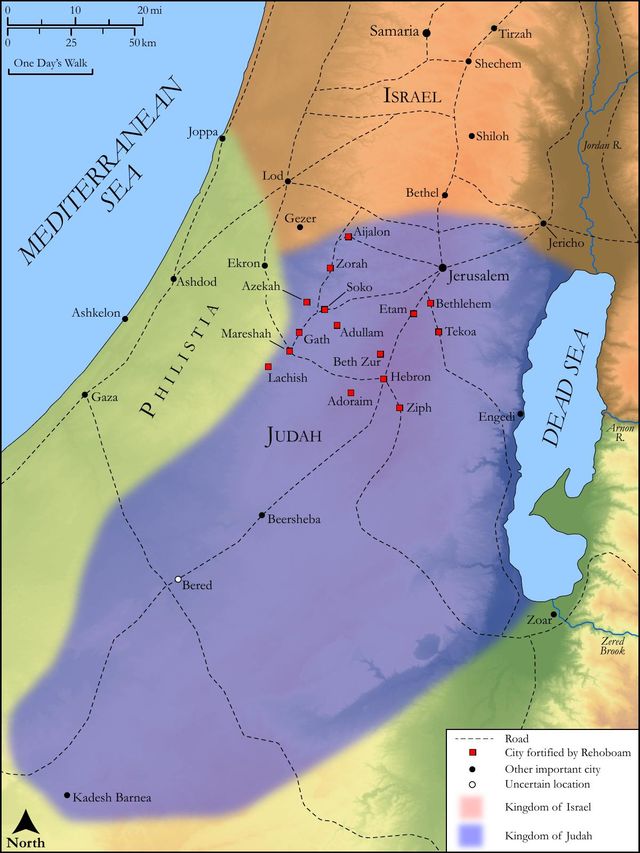
See on the biblical-era map
Study this verse
Public-domain commentary
Matthew Henry
From his Commentary on the Whole Bible. Henry comments on passages, not single verses — this entry covers 2 Chronicles 11:1–12.
How the ten tribes deserted the house of David we read in the foregoing chapter. They had formerly sat loose to that family (Sa2 20:1, Sa2 20:2), and now they quite threw it off, not considering how much it would weaken the common interest and take Israel down from that pitch of glory at which it had arrived in the last reign. But thus the kingdom must be corrected as well as the house of David. 1. Rehoboam at length, like a bold man, raises an army, with a design to reduce the revolters, Ch2 11:1. Judah and Benjamin were not only resolved to continue their allegiance to him, but ready to give him the best assistance they could for the recovery of his right. Judah was his own tribe, that owned him some years before the rest did; Benjamin was the tribe in which Jerusalem, or the greatest part of it, stood, which perhaps was one reason why that tribe clave to him. 2. Yet, like a conscientious man, when God forbade him to prosecute this design, in obedience to him he let it fall, either because he reverenced the divine authority or because he knew that he should not prosper if he should go contrary to God's command, but instead of retrieving what was lost would be in danger of losing what he had. It is dangerous undertaking any thing, but especially undertaking a war, contrary to the will of God. God calls him (Ch2 11:3), Rehoboam the son of Solomon, to intimate that this was determined for the sin of Solomon, and it would be to no purpose to oppose a decree that had gone forth. They obeyed the words of the Lord; and though it looked mean, and would turn to their reproach among their neighbours, yet, because God would have it so, they laid down their arms. 3. Like a discreet man, he fortified his own country. He saw it was to no purpose to think of reducing those that had revolted. A few good words might have prevented their defection, but now all the forces of his kingdom cannot bring them back. The think is done, and so it must rest; it is his wisdom to make the best of it. Perhaps the same young counsellors that had advised him to answer them roughly urged him to fight them, notwithstanding the divine inhibition; but he had paid dearly enough for being advised by them, and therefore now, we may suppose, his aged and experienced counsellors were hearkened to, and they advised him to submit to the will of God concerning what was lost, and to make it his business to keep what he had. It was probably by their advice that, (1.) He fortified his frontiers, and many of the principal cities of his kingdom, which, in Solomon's peaceable reign, no care had been taken for the defence of. (2.) He furnished them with good stores of victuals and arms, Ch2 11:11, Ch2 11:12. Because God forbade him to fight, he did not therefore sit down sullenly, and say that he would do nothing for the public safety if he might not do that, but prudently provided against an attack. Those that may not be conquerors, yet may be builders.
Continue studying 2 Chronicles 11:12 across the web’s major study libraries — every link below opens this exact verse, chapter, or book on the destination site.
Read & Compare
 BibleGatewayThis verse in more than 200 translations and 70 languages.
 Bible.comThe YouVersion reader — hundreds of translations, reading plans, and highlights.
 ESV.orgCrossway's official English Standard Version reader.
 NET BibleThe NET translation with 60,000+ translators' notes on every rendering decision.
 STEP BibleTyndale House's free study tool — original text, vocabulary, and scholarly resources.
 BibliaLogos Bible Software's free web reader.
 USCCBThe New American Bible (Revised Edition) with the U.S. bishops' study notes.
Commentaries
 BibleHub CommentariesDozens of classic commentaries on this verse, gathered on one page.
 StudyLightMore than 100 commentary sets — the largest collection on the web.
 BibleRefPlain-English commentary on what this verse means, verse by verse.
 Enduring WordDavid Guzik's free commentary on this chapter, widely used by Bible teachers.
 Bible Study ToolsVerse commentary alongside Greek and Hebrew study aids.
Original Language & Research
- BibleHub InterlinearThe verse word by word — original language, transliteration, and English.
- BibleHub LexiconEvery word's original-language definition and Strong's entry.
 Blue Letter BibleDeep-study tools — Strong's numbers, concordance, and word studies.
 SefariaThe Hebrew text with Rashi and centuries of Jewish commentary.
Sermons, Hymns & Audio


TrulyRandomVerse is not affiliated with these sites and doesn’t control their content. They’re linked because they’re genuinely useful.
Summary
Following the traumatic division of the united kingdom of Israel, King Rehoboam, rather than engaging in a divinely forbidden war against the northern tribes, strategically focused on strengthening his remaining southern kingdom. This verse details his comprehensive program of fortifying every city within the territories of Judah and Benjamin, equipping them with essential military armaments like shields and spears, thereby making them exceedingly strong. This defensive posture underscored the loyalty of Judah and Benjamin, providing Rehoboam with a stable and unified base from which to govern and secure the future of the Davidic dynasty.
Context
ShowHideLiterary Context
2 Chronicles 11:12 is situated immediately after the pivotal event of the kingdom's division, as narrated in 1 Kings 12 and 2 Chronicles 10-11. After the ten northern tribes seceded under Jeroboam, Rehoboam initially intended to wage war to reclaim them. However, he was divinely commanded through the prophet Shemaiah not to fight against his brethren, the people of Israel, because the division was from the Lord (2 Chronicles 11:4). Obedient to this divine directive, Rehoboam shifted his focus from offensive warfare to defensive fortification. Verses 2 Chronicles 11:5-10 meticulously list the fifteen specific cities he fortified, strategically located throughout Judah and Benjamin. Verse 11 then mentions placing commanders in these strongholds and storing provisions. Verse 12 serves as a summary statement, emphasizing the comprehensive arming of "every several city" and the consolidated loyalty of the two remaining tribes, solidifying the southern kingdom's defensive posture and internal unity.
Historical & Cultural Context
The period immediately following Solomon's reign was marked by significant political instability and the tragic fracturing of a once-united kingdom. Rehoboam inherited a kingdom already strained by Solomon's heavy taxation and forced labor, which ultimately led to the northern tribes' rebellion. The division created two distinct entities: the Northern Kingdom of Israel (often referred to as Ephraim or Samaria) and the Southern Kingdom of Judah. In this volatile environment, defensive measures were paramount. Ancient Near Eastern warfare relied heavily on fortified cities, which served as administrative centers, refuges for the populace, and strategic military outposts. Shields (tsinnah) were large body shields, offering substantial protection, while spears (romach) were primary thrusting weapons for close combat. Equipping "every several city" with these basic but crucial armaments indicates a thorough and widespread defensive strategy, essential for a kingdom now significantly reduced in size and power, facing potential threats from its northern neighbor or other surrounding nations.
Key Themes
ShowHideThis verse contributes to several key themes within 2 Chronicles and the broader biblical narrative. Firstly, it highlights strategic preparedness and prudent leadership in the face of adversity. Rehoboam, rather than succumbing to despair or pursuing a futile war, wisely invested in the security of his remaining domain, demonstrating a practical application of divine guidance. Secondly, it underscores the importance of loyalty and unity, as the phrase "having Judah and Benjamin on his side" emphasizes the cohesive foundation of the southern kingdom, a stark contrast to the fragmented north. This loyalty was crucial for the survival of the Davidic dynasty and the continuation of the covenant promises associated with it, particularly the promise of an enduring line from David (2 Samuel 7:16). Thirdly, it subtly points to divine sovereignty and human responsibility. While Rehoboam acted, his actions were a direct response to God's command not to fight, illustrating how human effort, when aligned with divine will, leads to stability and strength. The fortification also foreshadows the eventual identity of the southern kingdom as "Judah," the inheritor of the Davidic covenant and the line through which the Messiah would come (Genesis 49:10). This period of strengthening laid the groundwork for the kingdom's survival through subsequent centuries.
Exposition and Analysis
ShowHideKey Word Analysis
ShowHideWhile the KJV translates "every several city," the Hebrew term ʻîyr refers to a "city" or "town" in its broadest sense, often implying a guarded or watched place. The preceding Hebrew word kol (not listed in Strong's for this specific verse but implied by "every several") means "all" or "every." This emphasizes the comprehensive nature of Rehoboam's fortification efforts, indicating that he did not merely fortify a few strategic points, but systematically secured all significant urban centers within his diminished territory. This suggests a thorough and meticulous approach to national security, ensuring no city was left vulnerable.
The Hebrew word tsinnâh refers specifically to a large, full-body shield, typically rectangular or oval, designed to offer substantial protection to the entire person. These were heavy, substantial pieces of defensive equipment, often made of wood covered with leather or metal. Their explicit mention signifies a serious commitment to defensive warfare, indicating that these cities were not merely walled but also properly garrisoned with soldiers equipped for battle, capable of withstanding sieges or direct assaults. The presence of such significant defensive armaments underscores the gravity of the post-division political landscape.
The Hebrew verb châzaq is a primitive root meaning "to fasten upon," and thus "to seize," "be strong," "courageous," or "to fortify." When used in the causative sense, as here, it means "to strengthen" or "to make strong." The KJV's "exceeding strong" (incorporating mᵉʼôd, "very" or "exceedingly") highlights the intensity and effectiveness of Rehoboam's efforts. This word encapsulates the outcome of his strategic program: the cities were rendered highly impregnable and militarily capable, encompassing both the physical fortifications and the readiness of their garrisons.
Verse Breakdown
ShowHide"And in every several city"
This phrase emphasizes the systematic and comprehensive nature of Rehoboam's defensive strategy. It implies a deliberate, widespread effort to secure his entire remaining kingdom, rather than just a few key strongholds. This thoroughness suggests a wise and proactive leader who understood the gravity of his situation and the need for robust security across the board. The use of "every" underscores the diligence applied to national defense.
"[he put] shields and spears"
This specifies the practical measures taken to arm the fortified cities. The mention of these two primary armaments—the defensive shield and the offensive/defensive spear—symbolizes the equipping of garrisons within each city. It indicates that these were not just empty fortresses but operational military outposts, manned by soldiers ready for combat. This detail underscores the immediate and tangible steps Rehoboam took for national defense and military preparedness.
"and made them exceeding strong"
This clause describes the outcome and quality of Rehoboam's efforts. The cities were not merely fortified or equipped; they were rendered "exceeding strong," implying a high degree of impregnability and defensive capability. This strength encompassed both the physical fortifications (walls, gates) and the military readiness of the garrisons, creating a formidable network of defenses across Judah and Benjamin, designed to withstand external threats.
"having Judah and Benjamin on his side"
This final clause provides the crucial political and social context for Rehoboam's strength. It emphasizes the loyalty and unity of these two tribes, which remained faithful to the Davidic dynasty and the Jerusalem temple. This internal cohesion was as vital as the physical fortifications, providing a stable human and political foundation for the southern kingdom's survival and future. It signifies that Rehoboam's strength was not just military but also deeply rooted in the allegiance of his people, a stark contrast to the fragmented northern kingdom.
Literary Devices
ShowHideThe verse employs several literary devices to convey its meaning effectively. Merism is evident in the phrase "shields and spears," where two distinct but related items are used to represent the entire category of military armaments, signifying a complete and comprehensive equipping of the garrisons. This is a form of synecdoche, where a part (specific weapons) stands for the whole (military readiness and defensive might). The repetition of the idea of strength, first implied in the act of "putting shields and spears" and then explicitly stated in "made them exceeding strong," serves as emphasis, underscoring the thoroughness and effectiveness of Rehoboam's defensive strategy. Furthermore, the verse functions as a contrast to Rehoboam's initial desire for war, highlighting his obedience to God's command to pursue peace and fortification instead. This shift in focus demonstrates a practical wisdom that is implicitly commended.
Theological and Thematic Connections
ShowHideThis verse, detailing Rehoboam's strategic fortification, offers profound theological and thematic insights. It illustrates the principle of wise stewardship and responsible leadership, even in the face of significant loss and adversity. Rehoboam's obedience to God's command not to fight (2 Chronicles 11:4) led him to channel his energy into constructive defense, demonstrating that true strength often lies in prudent preparation and reliance on divine guidance rather than aggressive human ambition. The loyalty of Judah and Benjamin underscores the importance of covenant faithfulness and unity within God's people, providing a stable foundation for the continuation of the Davidic line. Spiritually, this passage encourages believers to be proactive in building their "spiritual defenses," recognizing that while ultimate victory belongs to God, human diligence and preparedness are essential.
Reflection and Application
ShowHideRehoboam's response to the division of his kingdom provides a powerful model for navigating personal and collective adversity. Faced with a devastating loss, he did not succumb to despair or reckless action but instead engaged in strategic, proactive strengthening of what remained. This teaches us the importance of assessing our spiritual landscape, identifying vulnerabilities, and diligently building up our defenses. Just as Rehoboam equipped his cities with "shields and spears," we are called to arm ourselves with the "full armor of God" (Ephesians 6:11)—the belt of truth, the breastplate of righteousness, the readiness of the gospel of peace, the shield of faith, the helmet of salvation, and the sword of the Spirit, which is the Word of God. This involves cultivating spiritual disciplines, nurturing our relationship with Christ through prayer and study, and actively participating in the community of believers. Moreover, the loyalty of Judah and Benjamin reminds us of the strength found in unity and allegiance within the body of Christ. When we stand together, committed to Christ and to one another, our collective strength becomes a formidable defense against the challenges of the world, enabling us to stand firm in the day of evil.
Questions for Reflection
ShowHideFAQ
ShowHideWhy did Rehoboam fortify cities instead of fighting to reclaim the northern tribes?
ShowHideRehoboam initially desired to wage war against the northern tribes to reclaim his lost kingdom, assembling a large army for this purpose (2 Chronicles 11:1). However, he was divinely commanded through the prophet Shemaiah not to fight against his brethren, the people of Israel, because the division was from the Lord (2 Chronicles 11:4). Obedient to this divine word, Rehoboam wisely turned his efforts from offensive warfare to defensive fortification. This strategic shift allowed him to consolidate his power, secure the remaining loyal tribes of Judah and Benjamin, and ensure the stability and survival of the Davidic dynasty, rather than engaging in a destructive and divinely forbidden civil war. His action demonstrated prudent leadership in alignment with divine will.
What was the significance of Judah and Benjamin remaining loyal to Rehoboam?
ShowHideThe loyalty of Judah and Benjamin was profoundly significant for several reasons. Firstly, it preserved the Davidic dynasty, ensuring that the covenant promise of an enduring kingship through David's line would continue (2 Samuel 7:16). Secondly, it meant that Jerusalem, with the Temple and the Ark of the Covenant, remained the spiritual and political capital of the southern kingdom, maintaining the central place of worship and the priesthood. This was crucial for the continuation of true worship in Israel, especially as the northern kingdom quickly fell into idolatry under Jeroboam (1 Kings 12:28-33). Thirdly, these two tribes formed the core of what would become known simply as "Judah," the kingdom from which the Messiah would ultimately descend, fulfilling the prophecies concerning the tribe of Judah (Genesis 49:10). Their steadfast loyalty provided the stability and continuity necessary for the unfolding of God's redemptive plan.
Christ-Centered Fulfillment
ShowHideRehoboam's diligent fortification of his kingdom, equipping it with shields and spears and securing the loyalty of Judah and Benjamin, serves as a powerful Old Testament shadow pointing to the ultimate, perfect fortification provided by Jesus Christ. While Rehoboam built physical strongholds to protect a temporal kingdom, Christ establishes a spiritual kingdom that is eternally secure and impregnable. He is the true King who gathers His loyal remnant, not merely two tribes, but people from every tribe and tongue and nation, bringing them into His unshakeable kingdom (Revelation 7:9-10). Jesus Himself declared that the gates of Hades would not prevail against His church, signifying an eternally strong and divinely protected spiritual fortress built upon His own divine authority and redemptive work (Matthew 16:18). He provides His followers with divine "shields and spears"—the full armor of God, which includes the shield of faith to extinguish the flaming darts of the evil one and the sword of the Spirit, which is the Word of God, for both defense and offense (Ephesians 6:16-17). Through His atoning sacrifice on the cross, Christ has disarmed the powers of darkness, establishing a peace and security far greater than any physical fortification could offer, triumphing over them in Him (Colossians 2:15). We, His people, are not merely fortified cities but living stones built into a spiritual house, with Christ as the cornerstone, eternally strong and secure in Him, a dwelling place for God by the Spirit (1 Peter 2:5-6).