


2 Chronicles 26:15
- וַיַּעַשׂvai·Ya·'asand he madeH6213Conj-w ¦ V-Qal-ConsecImperf-3msVerb Qal Consecutive Imperfect 3rd Singular Masculineוַandיַּעַשׂhe made
- בִּירוּשָׁלִַםbi·ru·sha·Limin JerusalemH3389Prep-b ¦ N-properNoun Proper LocationבִּinירוּשָׁלִַםJerusalem
- חִשְּׁבֹנוֹתchi·she·vo·Notwar engines ofH2810N-fpcNoun Plural Feminine Construct
- מַחֲשֶׁבֶתma·cha·She·vetinvention ofH4284N-fscNoun Singular Feminine Construct
- חוֹשֵׁבcho·Shevan inventorH2803V-Qal-Prtcpl-msVerb Qal Participle Singular Masculine Absolute
- לִהְיוֹתlih·Yotto beH1961Prep-l ¦ V-Qal-InfVerb Qal Infinitive Constructלִtoהְיוֹתbe
- עַל'alonH5921PrepPreposition
- הַמִּגְדָּלִיםha·mig·da·Limthe towersH4026Art ¦ N-mpNoun Plural Masculine Absoluteהַtheמִּגְדָּלִיםtowers
- וְעַלve·'aland onH5921Conj-w ¦ PrepPrepositionוְandעַלon
- הַפִּנּוֹתha·pi·Notthe cornersH6438Art ¦ N-fpNoun Plural Feminine Absoluteהַtheפִּנּוֹתcorners
- לִירוֹאli·rO'to shootH3384Prep-l ¦ V-Qal-InfVerb Qal Infinitive Constructלִtoירוֹאshoot
- בַּחִצִּיםba·chi·Tzimwith <the> arrowsH2671Prep-b ¦ N-mpNoun Plural Masculine Absoluteבַּwith <the>חִצִּיםarrows
- וּבָאֲבָנִיםu·va·'a·va·Nimand with <the> stonesH68Conj-w ¦ Prep-b ¦ N-fpNoun Plural Feminine Absoluteוּandבָwith <the>אֲבָנִיםstones
- גְּדֹלוֹתge·do·LotlargeH1419Adj-fpAdjective Plural Feminine Absolute
- וַיֵּצֵאvai·ye·Tze'and it went outH3318Conj-w ¦ V-Qal-ConsecImperf-3msVerb Qal Consecutive Imperfect 3rd Singular Masculineוַandיֵּצֵאit went out
- שְׁמוֹshe·Mohis nameH8034N-msc ¦ 3msNoun Singular Masculine Constructשְׁמnameוֹhis
- עַד'adtoH5704PrepPreposition
- לְמֵרָחוֹקle·Me·ra·Chok<to> from a distanceH7350Prep-l ¦ Prep-m ¦ Adj-msAdjective Singular Masculine Absoluteלְ<to>מֵfromרָחוֹקa distance
- כִּיkiforH3588PrtParticle Conditional
- הִפְלִיאhif·Li'he made wonderfulH6381V-Hiphil-Perf-3msVerb Hiphil Perfect 3rd Singular Masculine
- לְהֵעָזֵרle·he·'a·Zerto be helpedH5826Prep-l ¦ V-Niphal-InfVerb Niphal Infinitive Constructלְtoהֵעָזֵרbe helped
- עַד'aduntilH5704PrepPreposition
- כִּיkiforH3588PrtParticle Conditional
- חָזָקcha·Zakhe was strongH2388V-Qal-Perf-3msVerb Qal Perfect 3rd Singular Masculine
English is a literal word-by-word gloss of the Hebrew, not the KJV's wording. Why?
This is the original text the KJV's translators worked from — each Hebrew word with its own literal English meaning in this verse, prepared by scholars at Tyndale House, Cambridge. The KJV translates whole sentences, not word by word, so its wording differs: one Hebrew word can become several English words, and the KJV may choose “the LORD” where the gloss reads “Yahweh”. Both are faithful — they answer different questions. For the KJV's own rendering, switch to the KJV text.
Details
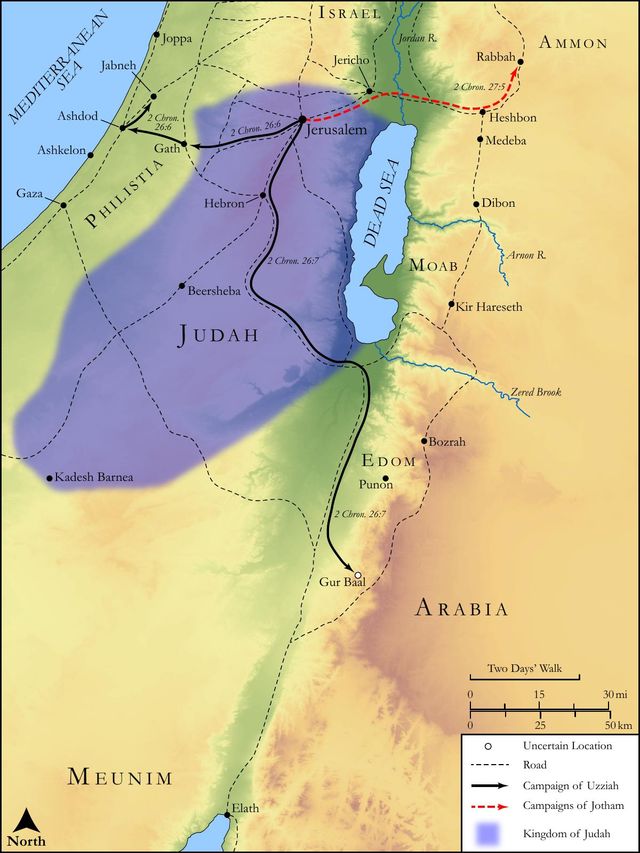
See on the biblical-era map
Study this verse
Public-domain commentary
Matthew Henry
From his Commentary on the Whole Bible. Henry comments on passages, not single verses — this entry covers 2 Chronicles 26:1–15. His three-level outline is real structure in the source text, so it is rendered as structure.
We have here an account of two things concerning Uzziah: -
I.His piety.
In this he was not very eminent or zealous; yet he did that which was right in the sight of the Lord. He kept up the pure worship of the true God as his father did, and was better than his father, inasmuch as we have no reason to think he ever worshipped idols as his father did, no, not in his latter days, when his heart was lifted up. It is said (Ch2 26:5), He sought God in the days of Zechariah, who, some think, was the son of the Zechariah whom his grandfather Joash slew. This Zechariah was one that had understanding in the visions of God, either the visions which he himself was favoured with or the visions of the preceding prophets. He was well versed in prophecy, and conversed much with the upper world, was an intelligent, devout, good man; and, it seems, had great influence with Uzziah. Happy are the great men who have such about them and are willing to be advised by them; but unhappy those who seek God only while they have such with them and have not a principle in themselves to bear them out to the end.
II.His prosperity.
1.In general, as long as he sought the Lord, and minded religion, God made him to prosper. Note,
(1.)Those only prosper whom God makes to prosper; for prosperity is his gift.
(2.)Religion and piety are very friendly to outward prosperity. Many have found and owned this, that as long as they sought the Lord and kept close to their duty they prospered; but since they forsook God every thing has gone cross.
2.Here are several particular instances of his prosperity: - (1.) His success in his wars: God helped him (Ch2 26:7), and then he triumphed over the Philistines (those old enemies of God's people), demolished the fortifications of their cities, and put garrisons of his own among them, Ch2 26:6. He obliged the Ammonites to pay him tribute, Ch2 26:8. He made all quiet about him, and kept them in awe. (2.) The greatness of his fame and reputation. His name was celebrated throughout all the neighbouring countries (Ch2 26:8) and it was a good name, a name for good things with God and good people. This is true fame, and makes a man truly honourable. (3.) His buildings. While he acted offensively abroad, he did not neglect the defence of his kingdom at home, but built towers in Jerusalem and fortified them, Ch2 26:9. Much of the wall of Jerusalem was in his father's time broken down, particularly at the corner gate. But his best fortification of Jerusalem was his close adherence to the worship of God: if his father had not forsaken this the wall of Jerusalem would not have been broken down. While he fortified the city, he did not forget the country, but built towers in the desert too (Ch2 26:10), to protect the country people from the inroads of the plunderers, bands of whom sometimes alarmed them and plundered them, as Ch2 21:16. (4.) His husbandry. He dealt much in cattle and corn, employed many hands, and got much wealth by his dealing; for he took a pleasure in it: he loved husbandry (Ch2 21:10), and probably did himself inspect his affairs in the country, which was no disparagement to him, but an advantage, as it encouraged industry among his subjects. It is an honour to the husbandman's calling that one of the most illustrious princes of the house of David followed it and loved it. He was not one of those that delight in war, nor did he addict himself to sport and pleasure, but delighted in the innocent and quiet employments of the husbandman. (5.) His standing armies. He had, as it should seem, two military establishments. [1.] A host of fighting men that were to make excursions abroad. These went out to war by bands, Ch2 21:11. They fetched in spoil from the neighbouring countries by way of reprisal for the depredations they had so often made upon Judah, [2.] Another army for guards and garrisons, that were ready to defend the country in case it should be invaded, Ch2 21:12, Ch2 21:13. So great were their number and valour that they made war with mighty power; no enemy durst face them, or, at least, could stand before them. Men unarmed can do little in war. Uzziah therefore furnished himself with a great armoury, whence his soldiers were supplied with arms offensive and defensive (Ch2 21:14), spears, bows, and slings, shields, helmets, and habergeons: swords are not mentioned, because it is probable that every man had a sword of his own, which he wore constantly. Engines were invented, in his time, for annoying besiegers with darts and stones shot from the towers and bulwarks, Ch2 21:15. What a pity it is that the wars and fightings which come from men's lusts have made it necessary for cunning men to employ their skill in inventing instruments of death.
Continue studying 2 Chronicles 26:15 across the web’s major study libraries — every link below opens this exact verse, chapter, or book on the destination site.
Read & Compare
 BibleGatewayThis verse in more than 200 translations and 70 languages.
 Bible.comThe YouVersion reader — hundreds of translations, reading plans, and highlights.
 ESV.orgCrossway's official English Standard Version reader.
 NET BibleThe NET translation with 60,000+ translators' notes on every rendering decision.
 STEP BibleTyndale House's free study tool — original text, vocabulary, and scholarly resources.
 BibliaLogos Bible Software's free web reader.
 USCCBThe New American Bible (Revised Edition) with the U.S. bishops' study notes.
Commentaries
 BibleHub CommentariesDozens of classic commentaries on this verse, gathered on one page.
 StudyLightMore than 100 commentary sets — the largest collection on the web.
 BibleRefPlain-English commentary on what this verse means, verse by verse.
 Enduring WordDavid Guzik's free commentary on this chapter, widely used by Bible teachers.
 Bible Study ToolsVerse commentary alongside Greek and Hebrew study aids.
Original Language & Research
- BibleHub InterlinearThe verse word by word — original language, transliteration, and English.
- BibleHub LexiconEvery word's original-language definition and Strong's entry.
 Blue Letter BibleDeep-study tools — Strong's numbers, concordance, and word studies.
 SefariaThe Hebrew text with Rashi and centuries of Jewish commentary.
Sermons, Hymns & Audio


TrulyRandomVerse is not affiliated with these sites and doesn’t control their content. They’re linked because they’re genuinely useful.
Summary
King Uzziah of Judah achieved remarkable success, particularly in fortifying Jerusalem with groundbreaking military technology. This verse highlights his inventive genius in commissioning "engines" for defense, which led to his widespread fame. Crucially, the text attributes his extraordinary strength and renown not merely to human ingenuity or military prowess, but directly to divine intervention, stating he "was marvellously helped, till he was strong," thereby underscoring God's active and enabling role in his prosperity.
Context
ShowHideLiterary Context
2 Chronicles 26:15 is situated within a detailed account of King Uzziah's (also known as Azariah) 52-year reign over Judah, extensively chronicled in 2 Chronicles 26. The preceding verses, such as 2 Chronicles 26:5, establish that Uzziah's early prosperity, military victories against the Philistines, Arabians, and Meunites, and his extensive building efforts were a direct consequence of his seeking God. This verse marks the pinnacle of his accomplishments, particularly in defensive innovation, portraying him as a powerful and respected monarch. However, it functions as a critical narrative pivot, immediately preceding the tragic account of his pride and subsequent downfall due to his unlawful attempt to burn incense in the temple, as recorded in 2 Chronicles 26:16-21. Thus, 2 Chronicles 26:15 serves as the high point of his divinely blessed reign, emphasizing that even abundant divine favor requires sustained humility and obedience.
Historical & Cultural Context
Uzziah reigned in the 8th century BCE (c. 792-740 BCE), a period characterized by relative stability and prosperity for the Kingdom of Judah, following the more turbulent reigns of some of his predecessors. Jerusalem, as the capital city, was a vital strategic stronghold, and the strength of its fortifications was paramount for national security. The "engines" mentioned in the text were likely sophisticated siege weapons, such as early forms of catapults or ballistas, capable of launching arrows and large stones. While similar devices were known in the ancient Near East (e.g., Assyrian siege engines), Uzziah's innovation suggests a significant advancement or adaptation for defensive purposes, positioning Judah at the forefront of military technology for its time. This technological prowess, coupled with the expansion of Judah's territory and agricultural development (as noted in 2 Chronicles 26:8-10), illustrates a kingdom experiencing a golden age under a divinely favored king.
Key Themes
ShowHideThis verse powerfully encapsulates several key themes prevalent throughout the book of Chronicles. Firstly, it highlights the principle of divine help and blessing as the ultimate source of strength and success for righteous kings. Uzziah's remarkable achievements are explicitly attributed to God's "marvelous help," reinforcing the Chronicler's overarching theological message that obedience to God leads to prosperity, while disobedience brings judgment. Secondly, the verse showcases innovation and human ingenuity being employed for the kingdom's welfare. Uzziah's commissioning of "cunning men" for advanced weaponry demonstrates a king who was forward-thinking and invested in the practical security of his people. Lastly, the spreading of Uzziah's "name far abroad" illustrates the theme of reputation and influence that can accompany divine favor. This widespread renown, however, implicitly carries the danger of pride, which becomes a crucial counter-theme in the subsequent verses, serving as a cautionary tale about the perils of self-reliance even after experiencing God's profound blessings, as seen in 2 Chronicles 26:16.
Exposition and Analysis
ShowHideKey Word Analysis
ShowHideThis noun refers to a "contrivance" or "invention," specifically a "warlike machine." In this context, it denotes sophisticated mechanical devices designed for military purposes, likely early forms of artillery used for defense. The term emphasizes that these were not simple tools but products of deliberate thought, intricate design, and advanced engineering for their era, reflecting a high level of technological sophistication.
This primitive root means "to plait or interpenetrate," and figuratively, "to plot or contrive," "to think," "regard," or "invent." While the KJV translates it as "cunning men," it implies individuals who are "designers," "inventors," or "skilled craftsmen" capable of intricate thought and fabrication. This highlights Uzziah's wisdom in employing highly intelligent and skilled individuals to conceptualize and construct complex defensive mechanisms.
This primitive root means "to separate," "distinguish," or "to be (causatively, make) great, difficult, wonderful." When used in conjunction with "helped" (H5826, ʻâzar), as in "marvellously helped," it indicates that the assistance Uzziah received was extraordinary, miraculous, or divinely wonderful. This strongly implies supernatural intervention and divine favor as the ultimate, enabling source of his strength and success, making his achievements truly exceptional and beyond ordinary human capability.
Verse Breakdown
ShowHide"And he made in Jerusalem engines, invented by cunning men"
This clause details King Uzziah's innovative military initiative. He commissioned the creation of advanced defensive weaponry within the capital city. The "engines" were not simple tools but complex devices, the product of intellectual design and skilled craftsmanship by highly intelligent and inventive individuals, demonstrating Uzziah's foresight and investment in cutting-edge technology for his kingdom's security.
"to be on the towers and upon the bulwarks, to shoot arrows and great stones withal."
This specifies the purpose and strategic placement of these inventions. They were installed on Jerusalem's defensive structures—its high towers and reinforced walls (bulwarks)—to provide a formidable advantage in siege warfare. Their function was to project powerful projectiles, both arrows and large stones, over long distances, making Jerusalem exceptionally difficult to assault and deterring potential invaders, thus enhancing the city's impregnability.
"And his name spread far abroad;"
This clause describes the direct consequence of Uzziah's military and administrative successes. His reputation, stemming from his innovative defenses, strategic building projects, and overall strength, extended widely beyond the borders of Judah. This indicates significant international recognition and respect, cementing his status as a powerful and formidable ruler in the ancient Near East.
"for he was marvellously helped, till he was strong."
This final, pivotal clause provides the theological explanation for Uzziah's extraordinary success and renown. His strength and achievements were not merely the result of human ingenuity or military might, but fundamentally because he received extraordinary, supernatural assistance from God. This divine aid was the enabling factor that allowed him to grow in power and establish such a formidable kingdom, serving as the ultimate cause behind all his accomplishments.
Literary Devices
ShowHideThe verse employs several literary devices to convey its profound message. Divine Causation is the most prominent, explicitly stating that Uzziah's strength and success were due to God's "marvelous help." This theological framing elevates God as the primary agent behind human achievements, a recurring motif in the Chronicler's work. Metonymy is present in the phrase "his name spread far abroad," where "name" stands in for Uzziah's reputation, fame, and influence. This effectively communicates the widespread recognition he achieved. While not strictly Hyperbole, the phrase "far abroad" suggests a significant, almost unparalleled, reach of his renown, emphasizing the extent of his power and the impact of God's blessing. The description of the "engines" and "cunning men" also evokes a sense of Technological Advancement, highlighting Uzziah's progressive and strategic approach to governance and defense, which was itself enabled by divine favor.
Theological and Thematic Connections
ShowHide2 Chronicles 26:15 serves as a powerful testament to the principle that all true strength, wisdom, and success ultimately originate from God. Uzziah's innovative military technology and widespread fame are not presented as achievements of human genius alone, but as direct outcomes of God's extraordinary assistance. This aligns perfectly with the Chronicler's consistent theological message: when a king (or any individual) genuinely seeks and obeys God, divine favor and prosperity follow. It underscores the idea that human ingenuity, while valuable, reaches its fullest potential only when empowered and blessed by the Creator. The verse also implicitly sets up a critical theological tension, as the very strength and renown given by God would later become the catalyst for Uzziah's pride and subsequent downfall, illustrating the constant human temptation to claim divine blessings as self-generated achievements.
Reflection and Application
ShowHide2 Chronicles 26:15 offers profound insights for contemporary believers. It challenges us to recognize the true source of our capabilities and successes. While Uzziah employed "cunning men" and innovative "engines," the narrative unequivocally states that his strength and fame were a result of being "marvellously helped" by God. This calls us to cultivate a posture of humility and dependence, acknowledging that our talents, opportunities, and achievements are ultimately gifts from above. It reminds us that even our most brilliant ideas and diligent efforts are empowered by divine grace. Furthermore, the verse encourages us to use our God-given abilities and resources, whether intellectual, material, or relational, for the good of others and the advancement of God's purposes, just as Uzziah used his ingenuity for the defense of Jerusalem. However, it also serves as a subtle, yet crucial, prelude to the danger of pride. When we forget the source of our strength and begin to attribute success solely to ourselves, we risk falling from grace, as Uzziah tragically did. Therefore, the application is not just to seek God's help, but to remain perpetually grateful and humble in prosperity, understanding that God's blessings are meant to draw us closer to Him, not away.
Questions for Reflection
ShowHideFAQ
ShowHideWhat exactly were these "engines" that King Uzziah made?
ShowHideWhile the Bible doesn't provide specific blueprints, the term "engines" (מַחֲשָׁבֹת, machashavot) refers to sophisticated military devices or machines. Based on the context of their use "on the towers and upon the bulwarks, to shoot arrows and great stones," scholars generally understand them to be early forms of siege weaponry, similar to ballistas or catapults. These were not simple bows and arrows but complex, engineered mechanisms designed to hurl projectiles with significant force and range, making Jerusalem's defenses formidable and highly advanced for the 8th century BCE. They were a testament to Uzziah's strategic foresight and the skill of his "cunning men."
What does "marvellously helped" truly signify in this verse?
ShowHideThe phrase "marvellously helped" (הֻעֲזַר לְהִפָּלֵא, hu'azar l'hippa'le) is a key theological statement. The Hebrew indicates that Uzziah "was helped" (passive voice) in a way that was "wonderful" or "extraordinary." This is not merely a statement about good fortune or Uzziah's inherent abilities. Instead, it strongly implies divine, supernatural intervention and assistance from God. It means that God actively empowered Uzziah, providing him with the wisdom, resources, and strategic advantage that led to his unprecedented strength and success. This divine enablement was the ultimate reason for his achievements, setting him apart and making his reign truly remarkable.
How does this verse, which speaks of Uzziah's strength and success, relate to his later downfall?
ShowHideThis verse serves as a crucial setup for Uzziah's tragic downfall, which is detailed immediately in 2 Chronicles 26:16. The Chronicler highlights that Uzziah "was marvellously helped, till he was strong." The phrase "till he was strong" is often interpreted as a point of transition. Once he reached the pinnacle of his power and renown, his heart "was lifted up to his destruction." The very strength and success that God had given him became the catalyst for his pride, leading him to transgress by attempting to burn incense in the temple, an act reserved for priests. Thus, 2 Chronicles 26:15 underscores that God's blessings bring strength, but that strength must be stewarded with humility and continued obedience, lest it become a snare.
Christ-Centered Fulfillment
ShowHide2 Chronicles 26:15, with its emphasis on divine help as the source of strength and success, finds its ultimate fulfillment and reinterpretation in the person and work of Jesus Christ. Uzziah's strength was "marvellously helped" by God, enabling him to build and defend his earthly kingdom. In contrast, Jesus, the true King of kings, embodies divine strength and wisdom not for the defense of a physical city, but for the establishment of an eternal, spiritual kingdom. The "engines" and "cunning men" of Uzziah's reign foreshadow the perfect wisdom and power of God manifested in Christ, who is himself the wisdom and power of God (1 Corinthians 1:24). While Uzziah's strength was given to him, Christ's strength is inherent, for "in him all the fullness of God was pleased to dwell" (Colossians 1:19). Uzziah's "name spread far abroad" due to his accomplishments, but Jesus' name is "the name that is above every name" (Philippians 2:9), through which all salvation comes (Acts 4:12). Uzziah's strength ultimately led to pride and leprosy, but Christ, though "strong," humbled himself to the point of death on a cross, becoming the perfect sacrifice that takes away the sin of the world (Philippians 2:8; John 1:29). His strength is not for self-exaltation, but for the redemption and spiritual fortification of His people, building a spiritual temple not made with human hands (Ephesians 2:20-22). Thus, Uzziah's divinely enabled strength points forward to the infinitely greater, humble, and redemptive power of Christ, the ultimate King who truly helps His people "marvellously" and eternally.