


2 Chronicles 26:16
- וּכְחֶזְקָתוֹu·khe·chez·ka·Toand according to his strengtheningH2393Conj-w ¦ Prep-k ¦ N-fsc ¦ 3msNoun Singular Feminine Constructוּandכְaccording toחֶזְקָתstrengtheningוֹhis
- גָּבַהּga·Vahit was haughtyH1361V-Qal-Perf-3msVerb Qal Perfect 3rd Singular Masculine
- לִבּוֹli·Bohis heartH3820N-msc ¦ 3msNoun Singular Masculine Constructלִבּheartוֹhis
- עַד'aduntilH5704PrepPreposition
- לְהַשְׁחִיתle·hash·Chit<to> behaved corruptlyH7843Prep-l ¦ V-Hiphil-InfVerb Hiphil Infinitive Constructלְ<to>הַשְׁחִיתbehaved corruptly
- וַיִּמְעַלvai·yim·'Aland he acted unfaithfullyH4603Conj-w ¦ V-Qal-ConsecImperf-3msVerb Qal Consecutive Imperfect 3rd Singular Masculineוַandיִּמְעַלhe acted unfaithfully
- בַּיהוָהba·Yah·wehagainst YahwehH3068Prep-b ¦ N-properNoun Proper TitleבַּagainstיהוָהYahweh
- אֱלֹהָיו'e·lo·Havhis GodH430N-mpc ¦ 3msNoun Plural Masculine ConstructאֱלֹהָיGodוhis
- וַיָּבֹאvai·ya·Vo'and he wentH935Conj-w ¦ V-Qal-ConsecImperf-3msVerb Qal Consecutive Imperfect 3rd Singular Masculineוַandיָּבֹאhe went
- אֶל'elintoH413PrepPreposition
- הֵיכַלhei·Khal[the] temple ofH1964N-mscNoun Singular Masculine Construct
- יְהוָהYah·wehYahwehH3068N-properNoun Proper Title
- לְהַקְטִירle·hak·Tirto make smokeH6999Prep-l ¦ V-Hiphil-InfVerb Hiphil Infinitive Constructלְtoהַקְטִירmake smoke
- עַל'alonH5921PrepPreposition
- מִזְבַּחmiz·Bach[the] altar ofH4196N-mscNoun Singular Masculine Construct
- הַקְּטֹרֶתha·ke·To·ret<the> incenseH7004Art ¦ N-fsNoun Singular Feminine Absoluteהַ<the>קְּטֹרֶתincense
English is a literal word-by-word gloss of the Hebrew, not the KJV's wording. Why?
This is the original text the KJV's translators worked from — each Hebrew word with its own literal English meaning in this verse, prepared by scholars at Tyndale House, Cambridge. The KJV translates whole sentences, not word by word, so its wording differs: one Hebrew word can become several English words, and the KJV may choose “the LORD” where the gloss reads “Yahweh”. Both are faithful — they answer different questions. For the KJV's own rendering, switch to the KJV text.
Details
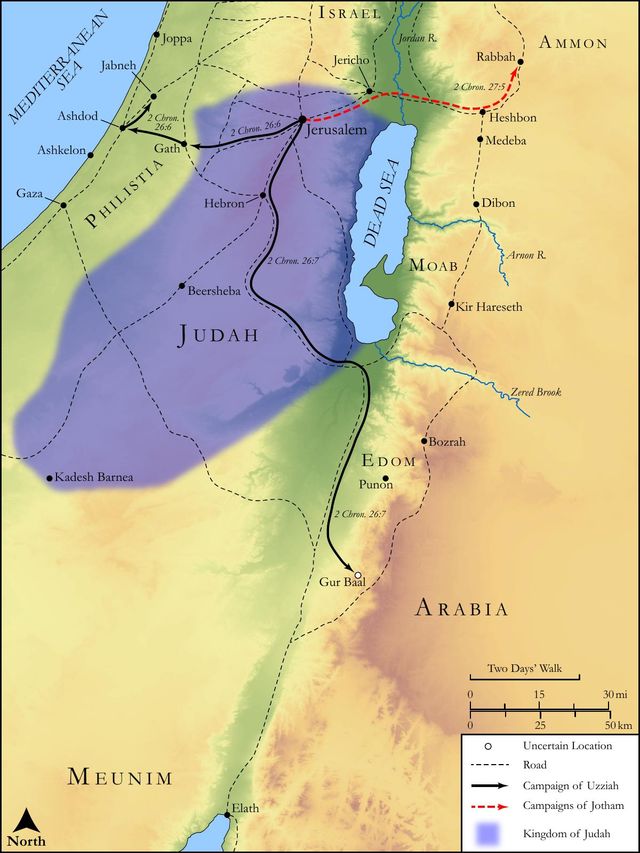
See on the biblical-era map
Study this verse
Public-domain commentary
Matthew Henry
From his Commentary on the Whole Bible. Henry comments on passages, not single verses — this entry covers 2 Chronicles 26:16–23. His three-level outline is real structure in the source text, so it is rendered as structure.
Here is the only blot we find on the name of king Uzziah, and it is such a one as lies not on any other of the kings. Whoredom, murder, oppression, persecution, and especially idolatry, gave characters to the bad kings and some of them blemishes to the good ones, David himself not excepted, witness the matter of Uriah. But we find not Uzziah charged with any of these; and yet he transgressed against the Lord his God, and fell under the marks of his displeasure in consequence, not, as other kings, in vexatious wars or rebellions, but an incurable disease.
I.His sin was invading the priest's office.
The good way is one; by-paths are many. The transgression of his predecessors was forsaking the temple of the Lord, flying off from it (Ch2 24:18), and burning incense upon idolatrous altars, Ch2 25:14. His was intruding into the temple of the Lord further than was allowed him, and attempting him to burn incense upon the altar of God, for which, it is likely, he pretended an extraordinary zeal and affection. See how hard it is to avoid one extreme and not run into another.
1.That which was at the bottom of his sin was pride of heart, a lust that ruins more than any other whatsoever (Ch2 26:16): When he was strong (and he was marvellously helped by the good providence of God till he was so, Ch2 26:15), when he had grown very great and considerable in wealth, interest, and power, instead of lifting up the name of God in gratitude to him who had done so much for him, his heart was lifted up to his destruction. Thus the prosperity of fools, by puffing them up with pride, destroys them. Now that he had done so much business, and won so much honour, he began to think no business, no honour, too great or too good for him, no, not that of the priesthood Men's pretending to forbidden knowledge, and exercising themselves in things too high for them, are owing to the pride of their heart, and the fleshly mind they are vainly puffed up with.
2.His sin was going into the temple of the Lord to burn incense, probably on some solemn feast day, or when he himself had some special occasion for supplicating the divine favour. What could move him to this piece of presumption, or put it into his head, I cannot conjecture. None of all his predecessors, not the best, not the worst, attempted it. The law, he knew, was express against him, and there was no usage or precedent for him. He could not pretend any necessity, as there was for David's eating the show-bread.
(1.)Perhaps he fancied the priests did not do their office so dexterously, decently, and devoutly, as they ought, and he could do it better. Or,
(2.)He observed that the idolatrous kings did themselves burn incense at the altars of their gods; his father did so, and Jeroboam (Kg1 13:1), an ambition of which honour was perhaps one thing that tempted them from the house of God, where it was not permitted them; and he, being resolved to cleave to God's altar, would try to break through this restraint and come as near it as the idolatrous kings did to their altars. But it is called a transgression against the Lord his God. He was not content with the honours God had put upon him, but would usurp those that were forbidden him, like our first parents.
3.He was opposed in this attempt by the chief priest and other priests that attended and assisted him, Ch2 26:17, Ch2 26:18. They were ready to burn incense for the king, according to the duty of their place; but, when he offered to do it himself, they plainly let him know that he meddled with that which did not belong to him, and that it was at his peril. They did not resist him by laying violent hands on him, though they were valiant men, but by reasoning with him and showing him,
(1.)That it was not lawful for him to burn incense: "It appertaineth not to thee, O Uzziah! but to the priests, whose birthright it is, as sons of Aaron, and who are consecrated to the service." Aaron and his sons were appointed by the law to burn incense, Exo 30:7. See Deu 33:10; Ch1 23:13. David had blessed the people and Solomon and Jehoshaphat had prayed with them and preached to them. Uzziah might have done this, and it would have been to his praise; but as for burning incense, that service was to be performed by the priests only. The kingly and priestly offices were separated by the law of Moses, not to be united again but in the person of the Messiah. If Uzziah did intend to honour God, and gain acceptance with him, in what he did, he was quite out in his aim; for, being a service purely of divine institution, he could not expect it should be accepted unless it were done in the way and by the hands that God had appointed.
(2.)That it was not safe. It shall not be for thy honour from the Lord God. More is implied: "It will be thy disgrace, and it is at thy peril." The law runs expressly against all strangers that came nigh (Num 3:10, Num 18:7), that is, all that were not priests. Korah and his accomplices, though Levites, paid dearly for offering to burn incense, which was the work of the priests only, Num 16:35. The incense of our prayers must be by faith put into the hands of our Lord Jesus, the great high priest of our profession, else we cannot expect it should be accepted by God, Rev 8:3.
4.He fell into a passion with the priests that reproved him, and would push forward to do what he intended notwithstanding (Ch2 26:19): Uzziah was wroth, and would not part with the censer out of his hand. He took it ill to be checked, and would not bear interference. Nitimur in vetitum - We are prone to do what is forbidden.
II.His punishment was an incurable leprosy, which rose up in his forehead while he was contending with the priests.
If he had submitted to the priests' admonition, acknowledged his error, and gone back, all would have been well; but when he was wroth with the priests, and fell foul upon them, then God was wroth with him and smote him with a plague of leprosy. Josephus says that he threatened the priests with death if they opposed him, and that then the earth shook, the roof of the temple opened, and through the cleft a beam of the sun darted directly upon the king's face, wherein immediately the leprosy appeared. And some conjecture that that was the earthquake in the days of Uzziah which we read of Amo 1:1 and Zac 14:5. Now this sudden stroke,
1.Ended the controversy between him and the priests; for, when the leprosy appeared, they were emboldened to thrust him out of the temple; nay, he himself hasted to go out, because the Lord had smitten him with a disease which was in a particular manner a token of his displeasure, and which he knew secluded him from common converse with men, much more from the altar of God. He would not be convinced by what the priests said, but God took an effectual course to convince him. If presumptuous men will not be made to see their error by the judgments of God's mouth, they shall be made to see it by the judgments of his hand. It evinced some religious fear of God in the heart of this king, even in the midst of his transgression, that, as soon as he found God was angry with him, he not only let fall his attempt, but retired with the utmost precipitation. Though he strove with the priests, he would not strive with his Maker.
2.It remained a lasting punishment of his transgression; for he continued a leper to the day of his death, shut up in confinement, and shut out from society, and forced to leave it to his son to manage all his business, Ch2 26:21. Thus God gave an instance of his resisting the proud and of his jealousy for the purity and honour of his own institutions; thus he gave fair warning even to great and good men to know and keep their distance, and not to intrude into those things which they have not seen; and thus he gave Uzziah a loud and constant call to repentance, and a long space to repent, which we have reason to hope he improved. He had been a man of much business in the world; but being taken off from that, and confined to a separate house, he had leisure to think of another world and prepare for it. By this judgment upon the king God intended to possess the people with a great veneration for the temple, the priesthood, and other sacred things, which they had been apt to think meanly of. While the king was a leper, he was as good as dead, dead while he lived, and buried alive; and so the law was, in effect, answered, that the stranger who cometh nigh shall be put to death. The disgrace survived him; for, when he was dead, they would not bury him in the sepulchres of the kings because he was a leper, which stained all his other glory.
3.It was a punishment that answered the sin as face does face in a glass.
(1.)Pride was at the bottom of his transgression, and thus God humbled him and put dishonour upon him.
(2.)He invaded the office of the priests in contempt of them, and God struck him with a disease which in a particular manner made him subject to the inspection and sentence of the priests; for to them pertained the judgment of the leprosy, Deu 24:8.
(3.)He thrust himself into the temple of God, whither the priests only had admission, and for that was thrust out of the very courts of the temple, into which the meanest of his subjects that was ceremonially clean had free access.
(4.)He confronted the priests that faced him and opposed his presumption, and for that the leprosy rose in his forehead, which, in Miriam's case, is compared to her father's spitting in her face, Num 12:14.
(5.)He invaded the dignity of the priesthood, which he had no right to, and for that he was deprived even of his royal dignity, which he had a right to. Those that covet forbidden honours forfeit allowed ones. Adam, by catching at the tree of knowledge of which he might not eat, debarred himself from the tree of life, of which he might have eaten. Let all that read it say, The Lord is righteous.
Historical interpretation
Two Centuries of Reception
7 surviving comments on this verse. Each one is dated, so this reads as a timeline rather than a list.
Select a marker to jump to its quote. Markers stagger vertically where authors wrote within a few decades of each other.
When King Uzziah carried a censer and violently took on himself to sacrifice, against the law of God, and refused to submit or give place, despite the opposition of Azariah the priest, he was confounded by God’s indignation and defiled with the markings of leprosy on his forehead, branded by the Lord’s anger on that part of the body on which those who win the Lord’s favor are sealed.
Uzziah is described as at first having been righteous, and then it is related that he was lifted up in mind and dared to offer sacrifice to God himself, and his face became leprous in consequence. But Josephus carefully studied the additional comments of the expounders as well, and a Hebrew of the Hebrews as he was, hear his description of the events of those times. He tells: “Though the priests urged Uzziah to go out of the temple and not to break the law of God, he angrily threatened them with death unless they held their peace. And meanwhile an earthquake shook the earth, and a bright light shone through a breach in the temple and struck the king’s face, so that at once it became leprous. And before the city at the place called Eroga, the western half of the Mount was split asunder and rolling four stadia stopped at the eastern mountain, so as to block up the royal approach and gardens.” This I take from the work of Josephus on Jewish antiquities. And I found in the beginning of the prophet Amos the statement that he began to prophecy “in the days of Uzziah, king of Judah, two years before the earthquake.” What earthquake he does not clearly say. But I think the same prophet further on suggests this earthquake when he says, “I saw the Lord standing on the altar. And he said, Strike the altar, and the doors shall be shaken, and strike the heads of all, and the remnant I will slay with the sword.”Here I understand a prediction of the earthquake, and of the destruction of the ancient solemnities of the Jewish race and of the worship practiced by them in Jerusalem, the ruin that should overtake them after the coming of our Savior, when, since they rejected the Christ of God, the true High Priest, leprosy infected their souls, as in the days of Uzziah, when the Lord himself standing on the altar gave leave to him that struck, saying, “Strike the altar.”
Remember Uzziah, how he entered the sanctuary; by seeking to seize the priesthood he lost his kingdom. Adam, by wishing to enrich himself, incurred a double loss. Recognize in the sanctuary the Tree, in the censer the fruit and in the leprosy the nakedness. From these two treasures there proceeded harm in both cases.
In the midst of paradise God had planted the Tree of Knowledge to separate off, above and below, sanctuary from Holy of Holies. Adam made bold to touch and was smitten like Uzziah: the king became leprous, Adam was tripped. Being struck like Uzziah, he hastened to leave: both kings fled and hid, in shame of their bodies.
As, therefore, it was not lawful for one of another tribe that was not a Levite to offer anything or to approach the altar without the priest, so also do you do nothing without the bishop; for if anyone does anything without the bishop, he does it to no purpose. For it will not be esteemed as of any avail to him.… For as Uzziah the king, who was not a priest and yet would exercise the functions of the priests, was smitten with leprosy for his transgression; so every lay person shall not be unpunished who despises God, and is so mad as to affront his priests and unjustly to snatch that honor to himself: not imitating Christ, “who glorified not himself to be made an high priest” but waited till he heard from his Father, “The Lord swore and will not repent, You are a priest forever, after the order of Melchizedek.” If, therefore, Christ did not glorify himself without the Father, how dare anyone thrust himself into the priesthood who has not received that dignity from his superior and do such things that it is lawful only for the priests to do?
Neither do we permit the laity to perform any of the offices belonging to the priesthood, as, for instance, neither the sacrifice, nor baptism, nor the laying on of hands nor the blessing, whether the smaller or the greater, for “no one takes this honor to himself, but he that is called of God.” For such sacred offices are conferred by the laying on of the hands of the bishop. But a person to whom such an office is not committed but seizes on it for himself, he shall undergo the punishment of Uzziah.
Of Uzziah, the ancestor of this king of whom we have been speaking, himself also praised in all things by the witness of the Scripture, after great commendation for his virtue, after countless triumphs that he achieved by the merit of his devotion and faith, learn how he was cast down by the pride of vainglory. “And,” we are told, “the name of Uzziah went forth, for the Lord helped him and had strengthened him. But when he was made strong, his heart was lifted up to his destruction, and he neglected the Lord his God.” … You see how dangerous the successes of prosperity generally are, so that those who could not be injured by adversity are ruined, unless they are careful, by prosperity; and those who in the conflict of battle have escaped the danger of death fall before their own trophies and triumphs.
Continue studying 2 Chronicles 26:16 across the web’s major study libraries — every link below opens this exact verse, chapter, or book on the destination site.
Read & Compare
 BibleGatewayThis verse in more than 200 translations and 70 languages.
 Bible.comThe YouVersion reader — hundreds of translations, reading plans, and highlights.
 ESV.orgCrossway's official English Standard Version reader.
 NET BibleThe NET translation with 60,000+ translators' notes on every rendering decision.
 STEP BibleTyndale House's free study tool — original text, vocabulary, and scholarly resources.
 BibliaLogos Bible Software's free web reader.
 USCCBThe New American Bible (Revised Edition) with the U.S. bishops' study notes.
Commentaries
 BibleHub CommentariesDozens of classic commentaries on this verse, gathered on one page.
 StudyLightMore than 100 commentary sets — the largest collection on the web.
 BibleRefPlain-English commentary on what this verse means, verse by verse.
 Enduring WordDavid Guzik's free commentary on this chapter, widely used by Bible teachers.
 Bible Study ToolsVerse commentary alongside Greek and Hebrew study aids.
Original Language & Research
- BibleHub InterlinearThe verse word by word — original language, transliteration, and English.
- BibleHub LexiconEvery word's original-language definition and Strong's entry.
 Blue Letter BibleDeep-study tools — Strong's numbers, concordance, and word studies.
 SefariaThe Hebrew text with Rashi and centuries of Jewish commentary.
Sermons, Hymns & Audio


TrulyRandomVerse is not affiliated with these sites and doesn’t control their content. They’re linked because they’re genuinely useful.
Summary
2 Chronicles 26:16 marks the tragic turning point in the otherwise prosperous and divinely blessed reign of King Uzziah of Judah. After achieving unprecedented strength and success, Uzziah's heart became inflated with pride, leading him to commit a grave transgression against the LORD his God. This pivotal verse encapsulates his downfall, revealing that his very strength became the catalyst for his spiritual and physical destruction, as he presumptuously entered the sacred temple to perform the priestly duty of burning incense, an act explicitly forbidden to kings.
Context
ShowHideLiterary Context
This verse serves as an abrupt and somber pivot in the narrative, following a detailed and glowing account of Uzziah's remarkable success and divine favor. Chapters 26:1-15 meticulously chronicle his military victories, architectural achievements, agricultural innovations, and the strengthening of Jerusalem's defenses, all explicitly attributed to his diligent seeking of the LORD 2 Chronicles 26:5. The preceding verses build a compelling picture of a king who, by God's grace, became "exceedingly strong" 2 Chronicles 26:8-15. Verse 16, however, shatters this positive trajectory, introducing the fatal flaw—pride—that would mar his legacy and lead to his ruin. It sets the immediate stage for the divine judgment described in the subsequent verses 2 Chronicles 26:17-21, where he is swiftly struck with leprosy, a direct consequence of his transgression, leading to his isolation, abdication of duties, and eventual death. This narrative structure powerfully emphasizes the direct and devastating link between unchecked pride, disobedience, and divine retribution, serving as a stark and tragic contrast to his earlier piety and prosperity.
Historical & Cultural Context
King Uzziah reigned in Judah during the 8th century BC (c. 792-740 BC), a period marked by significant stability and renewed prosperity for the Southern Kingdom. His exceptionally long reign of 52 years 2 Chronicles 26:3 saw Judah regain much of its former glory and influence. Culturally, the distinction between the roles of king and priest was not merely a matter of tradition but a divinely ordained and sacrosanct principle in ancient Israel, established through the Mosaic Law. The Aaronic priesthood held exclusive rights and responsibilities for performing sacred temple rites, including the burning of incense on the golden altar Exodus 30:7-8; Numbers 18:7. Kings, though divinely appointed and possessing significant temporal authority, were explicitly forbidden from encroaching upon these spiritual duties. This rigid separation of powers was a unique feature of Israelite governance, designed to prevent the concentration of absolute spiritual and temporal authority in one individual, thereby ensuring that even the monarch remained subject to God's law and the spiritual authority embodied by the priesthood. Uzziah's act was not a minor breach of etiquette but a direct, audacious challenge to this divinely established order and the very holiness of God's sanctuary.
Key Themes
ShowHideUzziah's story powerfully illustrates several enduring and critical biblical themes. Firstly, it highlights the profound danger of pride and spiritual arrogance. His great strength and success, instead of fostering deeper humility and dependence on God, led to self-exaltation and a belief that he was above divine law. This serves as a potent illustration of the biblical warning found in Proverbs 16:18, that "Pride goes before destruction, and a haughty spirit before a fall." Secondly, the narrative underscores the absolute necessity of obedience to divine law and established boundaries. Uzziah's transgression was a deliberate and public violation of God's clear directives regarding the distinct roles of king and priest, demonstrating that even a history of faithfulness or good intentions does not excuse direct disobedience to God's commands. This emphasizes the sanctity of God's word and the severe consequences of violating His ordinances. Finally, the account serves as a cautionary tale about the corrupting influence of unchecked power. It demonstrates that divine blessing, if not stewarded with profound humility and reverence, can paradoxically become the very instrument of one's downfall, leading to divine judgment and personal ruin, as dramatically seen in Uzziah's subsequent affliction with leprosy 2 Chronicles 26:19-21.
Exposition and Analysis
ShowHideKey Word Analysis
ShowHideThe word translated "strong" (H2393, chezqâh) signifies prevailing power or strength. Throughout the preceding verses of 2 Chronicles 26, this term, or its root, is used positively to describe Uzziah's growing military might, the fortifications he built, and his overall prosperity, all attributed to God's help. However, in verse 16, its positive connotation takes a dark turn. His strength, rather than being a means to serve God more effectively and humbly, became the very foundation for his pride. It implies a dangerous sense of self-sufficiency and invincibility that led him to believe he was above divine law and established order.
The phrase "his heart was lifted up" comes from the Hebrew verb (H1361, gâbahh), meaning "to soar, be lofty, or be high." While gâbahh can be used positively to describe God being exalted, in this context, when applied to the human heart, it carries a distinctly negative connotation of arrogance, haughtiness, or self-exaltation. It signifies a spiritual pride that causes one to disregard God's authority and established order, believing oneself to be superior to accountability. This internal elevation of self directly preceded and precipitated his "destruction."
The noun (H7843, shâchath) derives from a primitive root meaning "to decay, spoil, corrupt, ruin, or destroy." Here, it indicates the comprehensive undoing of Uzziah's reign, his reputation, and his physical well-being. His pride did not merely lead to a minor setback; it led to a devastating and comprehensive ruin, culminating in a severe divine judgment in the form of leprosy, which forced him into isolation and effectively ended his active kingship. This word highlights the severe and all-encompassing nature of the consequences of his sin.
Verse Breakdown
ShowHide"But when he was strong"
This opening clause immediately signals a sharp contrast and a tragic irony. The conjunction "But" pivots the narrative from Uzziah's remarkable successes and divine blessings to his catastrophic downfall. It directly links his prosperity and power to the genesis of his sin, underscoring the paradoxical truth that the very strength God had granted him became the breeding ground for his pride and eventual ruin.
"his heart was lifted up to [his] destruction"
This is the central indictment of Uzziah's character and the root of his sin. "His heart was lifted up" is a vivid idiom for spiritual arrogance, haughtiness, and self-exaltation. It implies an internal shift from humble dependence on God to self-reliance and a presumptuous sense of superiority. The phrase "to his destruction" immediately establishes the direct, causal link between this internal pride and the catastrophic consequences that inevitably followed, indicating that his pride was not merely a character flaw but a destructive force leading to ruin.
"for he transgressed against the LORD his God"
This clause explicitly names Uzziah's action as a "transgression" (Hebrew: ma'al - H4603, meaning "to act unfaithfully, trespass, commit a sacrilege"). It highlights that his sin was not merely against human protocol or tradition but a direct violation of his covenant relationship with God. The phrase "against the LORD his God" emphasizes the personal betrayal of the very God who had blessed and empowered him, underscoring the gravity of his unfaithfulness.
"and went into the temple of the LORD to burn incense upon the altar of incense"
This final clause details the specific, sacrilegious act of transgression. Entering the temple (specifically the Holy Place, where the altar of incense stood) and attempting to burn incense was an exclusive privilege and duty reserved solely for the consecrated Aaronic priests. By performing this act, Uzziah usurped a sacred role, directly challenging God's established order, the authority of the priesthood, and the holiness of the sanctuary. This was a bold, presumptuous, and sacrilegious overstepping of his divinely appointed boundaries as king.
Literary Devices
ShowHideThe narrative of 2 Chronicles 26:16 employs several potent literary devices to convey its profound theological message. Irony is prominently featured, as Uzziah's great strength, initially a sign of divine favor and a tool for national flourishing, becomes the very catalyst for his downfall. The king who was "exceedingly strong" 2 Chronicles 26:15 is paradoxically brought to "destruction" by that very strength, highlighting the deceptive nature of pride. This creates a powerful Contrast between his earlier righteousness and later arrogance, and between his outward success and inward spiritual decay. The phrase "his heart was lifted up" functions as a striking Metaphor for pride and haughtiness, vividly portraying an internal state of self-exaltation that leads to external transgression. The entire account functions as an Exemplum or Didactic Narrative, serving as a potent cautionary tale for all future leaders and believers about the perils of pride and the inviolability of God's commands. Furthermore, Uzziah's act of burning incense is deeply Symbolic of his desire to usurp spiritual authority, blurring the divinely ordained lines between king and priest and challenging God's sovereign order.
Theological and Thematic Connections
ShowHideThe account of Uzziah's downfall in 2 Chronicles 26:16 serves as a profound theological statement on the insidious nature of pride and the inviolable sanctity of divine order. It unequivocally underscores that even great success, abundant strength, and prolonged divine blessing do not grant immunity from God's law or His judgment. Instead, prosperity often presents the greatest temptation to self-sufficiency and arrogance, which God actively opposes. The divinely established separation of kingly and priestly roles in Israel was a deliberate design to prevent the concentration of absolute power and to maintain the purity and distinctiveness of worship. Uzziah's transgression was not merely a procedural error or a lapse in judgment; it was an act of sacrilege, a direct challenge to God's sovereign authority and the established boundaries of His covenant. This narrative powerfully reinforces the biblical principle that true strength, wisdom, and lasting blessing are found not in self-exaltation or the usurpation of sacred duties, but in humble submission to God's revealed will and a reverent adherence to His divine parameters.
Reflection and Application
ShowHideUzziah's story in 2 Chronicles 26:16 is a timeless mirror, powerfully reflecting the persistent human tendency to allow success and strength to breed pride. It challenges each of us to conduct a rigorous examination of our own hearts, especially when we experience prosperity, recognition, or a season of great personal or professional strength. Are we quick to attribute our achievements solely to our own abilities, wisdom, or effort, or do we humbly acknowledge God as the ultimate source of all blessing and empowerment? The narrative serves as a stark warning that unchecked pride can lead to a dangerous sense of entitlement, causing us to overstep boundaries—whether in our personal lives, professional roles, or spiritual walk within the community of faith. It reminds us that God has established order, authority, and distinct roles within His creation and His church, and true wisdom lies in respecting these divine parameters, rather than presumptuously encroaching upon responsibilities or privileges not given to us. Our greatest and most enduring strength is found not in self-sufficiency, but in consistent humility and unwavering obedience to the One who grants all power and success.
Questions for Reflection
ShowHideFAQ
ShowHideWhat was King Uzziah's specific sin in 2 Chronicles 26:16?
ShowHideKing Uzziah's specific sin was the usurpation of priestly duties, an act of profound sacrilege. He presumptuously entered the temple of the LORD with the intention of burning incense upon the altar of incense, a sacred ritual explicitly reserved for the consecrated Aaronic priesthood by divine command (e.g., Exodus 30:7-8). As king, he had no divine authority to perform this sacred ritual. His act was a direct transgression against God's established order, a blatant disregard for the holiness of the temple, and a clear manifestation of spiritual pride, believing himself to be above the divine law that delineated the distinct roles of king and priest.
Why was burning incense such a serious offense for a king?
ShowHideBurning incense was a highly symbolic and sacred act of worship in ancient Israel, representing the prayers of the saints ascending to God (e.g., Revelation 8:3-4). It was an integral part of the daily temple service performed exclusively by God's consecrated priests. For a king to perform this ritual was a grave offense for several critical reasons: it constituted a direct violation of God's specific commands regarding the priesthood and their exclusive duties (e.g., Numbers 18:7); it blurred and defied the divinely ordained lines between civil and religious authority, a unique feature of Israelite governance; and it demonstrated a profound lack of reverence for God's holiness and the sanctity of His temple. It was an act of audacious sacrilege, presumptuously claiming a role and authority that God had not assigned to him, thereby challenging God's sovereign design.
Christ-Centered Fulfillment
ShowHideThe tragic account of Uzziah's pride and priestly usurpation in 2 Chronicles 26:16 finds its ultimate and perfect Christ-centered fulfillment in the person and work of Jesus Christ. Uzziah, a king who presumptuously sought to become a priest, stands in stark contrast to Jesus, who is both our perfect and eternal King and our eternal High Priest, not by human ambition or transgression, but by divine appointment and inherent right. Unlike Uzziah, who was struck down by leprosy for his prideful act, Jesus, "though he was in the form of God, did not count equality with God a thing to be grasped, but emptied himself, by taking the form of a servant, being born in the likeness of men" Philippians 2:6-7. He did not usurp authority but humbly submitted to the Father's will, even to the point of death on a cross Philippians 2:8. Furthermore, while Uzziah's act defiled the earthly temple and brought judgment upon himself, Jesus, our great High Priest, entered the true, heavenly sanctuary, not with the blood of goats and calves, but with his own precious blood, securing an eternal redemption for us Hebrews 9:11-12. He perfectly fulfills both the kingly and priestly offices, reigning from heaven and continually interceding for us, a High Priest who is "holy, innocent, unstained, separated from sinners, and exalted above the heavens" Hebrews 7:26. Uzziah's failure highlights the human inability to perfectly bridge the gap between God and humanity or to perfectly administer divine roles, a gap that only Christ, our perfectly humble and divinely appointed King-Priest, could perfectly bridge through His sinless life, atoning death, and glorious resurrection.