


Zechariah 14:5
Bible text: King James Version (1769 Blayney text) · Public domain
Bible text: King James Version with Strong's numbers · Public domain
Bible text: Berean Standard Bible · Public domain
Bible text: American Standard Version (1901) · Public domain
Bible text: World English Bible, Messianic edition · Public domain
Bible text: Geneva Bible (1599) · Public domain
Bible text: Young's Literal Translation · Public domain
- וְנַסְתֶּםve·nas·Temand you will fleeH5127Conj-w ¦ V-Qal-ConsecPerf-2mpVerb Qal Consecutive Perfect 2nd Plural Masculineוְandנַסְתֶּםyou will flee
- גֵּיאgei'[the] valley ofH1516N-cscNoun Singular common gender Construct
- הָרַיha·Raimy mountainsH2022N-mpc ¦ 1csNoun Plural Masculine Constructהָרַmountainsיmy
- כִּיkiforH3588PrtParticle Conditional
- יַגִּיעַya·Gi·a'it will reachH5060V-Hiphil-Imperf-3msVerb Hiphil Imperfect 3rd Singular Masculine
- גֵּיgei[the] valley ofH1516N-cscNoun Singular common gender Construct
- הָרִיםha·RimmountainsH2022N-mpNoun Plural Masculine Absolute
- אֶל'eltoH413PrepPreposition
- אָצַל'a·TzalAzalH682N-properNoun Proper Location
- וְנַסְתֶּםve·nas·Temand you will fleeH5127Conj-w ¦ V-Qal-ConsecPerf-2mpVerb Qal Consecutive Perfect 2nd Plural Masculineוְandנַסְתֶּםyou will flee
- כַּאֲשֶׁרka·'a·Sherjust asH834Prep-k ¦ RelParticle Relativeכַּjustאֲשֶׁרas
- נַסְתֶּםnas·Temyou fledH5127V-Qal-Perf-2mpVerb Qal Perfect 2nd Plural Masculine
- מִפְּנֵיmi·pe·Neifrom beforeH6440Prep-m ¦ N-mpcNoun Plural Masculine Constructמִfromפְּנֵיbefore
- הָרַעַשׁha·Ra·'ashthe earthquakeH7494Art ¦ N-msNoun Singular Masculine Absoluteהָtheרַעַשׁearthquake
- בִּימֵיbi·Meiin [the] days ofH3117Prep-b ¦ N-mpcNoun Plural Masculine Constructבִּinימֵי[the] days of
- עֻזִּיָּה'u·zi·YahUzziahH5818N-proper-mNoun Proper Masculine
- מֶלֶךְMe·lekh[the] king ofH4428N-mscNoun Singular Masculine Construct
- יְהוּדָהye·hu·DahJudahH3063N-properNoun Proper Location
- וּבָאu·Va'and he will comeH935Conj-w ¦ V-Qal-ConsecPerf-3msVerb Qal Consecutive Perfect 3rd Singular Masculineוּandבָאhe will come
- יְהוָהYah·wehYahwehH3068N-properNoun Proper Title
- אֱלֹהַי'e·lo·Haimy GodH430N-mpc ¦ 1csNoun Plural Masculine ConstructאֱלֹהַGodיmy
- כָּלkolallH3605N-mscNoun Singular Masculine Construct
- קְדֹשִׁיםke·do·Shimholy [ones]H6918Adj-mpAdjective Plural Masculine Absolute
- עִמָּךְ'i·Makh[will be] with youH5973Prep ¦ 2msPrepositionעִמָּ[will be] withךְyou
English is a literal word-by-word gloss of the Hebrew, not the KJV's wording. Why?
This is the original text the KJV's translators worked from — each Hebrew word with its own literal English meaning in this verse, prepared by scholars at Tyndale House, Cambridge. The KJV translates whole sentences, not word by word, so its wording differs: one Hebrew word can become several English words, and the KJV may choose “the LORD” where the gloss reads “Yahweh”. Both are faithful — they answer different questions. For the KJV's own rendering, switch to the KJV text.
Details
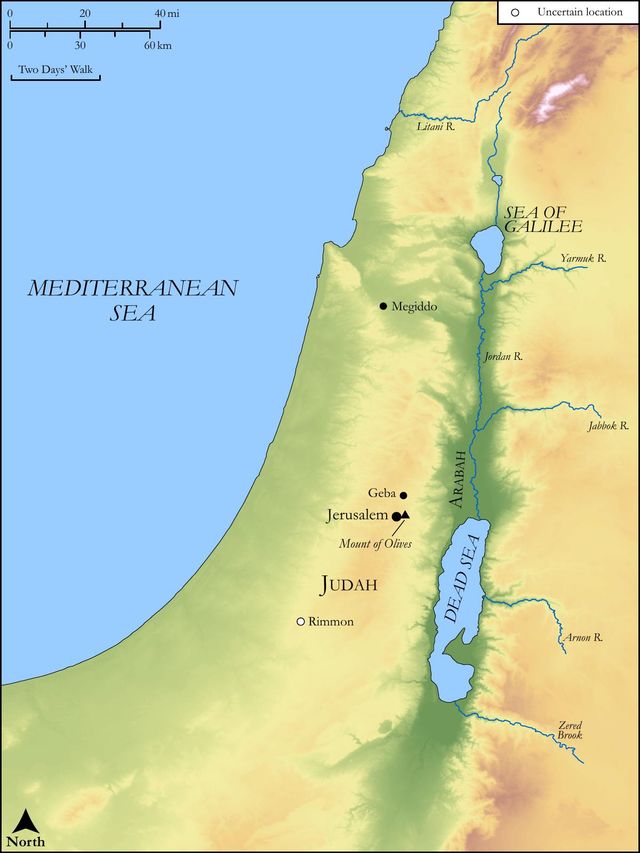
See on the biblical-era map
Study this verse
Public-domain commentary
Matthew Henry
From his Commentary on the Whole Bible. Henry comments on passages, not single verses — this entry covers Zechariah 14:1–7. His four-level outline is real structure in the source text, so it is rendered as structure.
God's providences concerning his church are here represented as strangely changing and strangely mixed.
I.As strangely changing.
Sometimes the tide runs high and strong against them, but presently it turns, and comes to be in favour of them; and God has, for wise and holy ends, set the one over against the other.
1.God here appears against Jerusalem; judgment begins at the house of God. When the day of the Lord comes (Zac 14:1) Jerusalem must pass through the fire to be refined. God himself gathers all nations against Jerusalem to battle (Zac 14:2); he gives them a charge, as he did Sennacherib, to take the spoil and to take the prey (Isa 10:6), for the people of Jerusalem have now become the people of his wrath. And who can stand before him or before nations gathered by him? Where he gives commission he will give success. The city shall be taken by the Romans, who have nations at command; the houses shall be rifled, and all the riches of them taken away, by the enemy; and, to gratify an insatiable lust of uncleanness as well as avarice, the women shall be ravished, as if victory were a license to the worst of villanies, jusque datum sceleri - and crimes were sanctioned by law. One-half of the city shall then be carried into captivity, to be sold or enslaved, and shall not be able to help itself, such is the destruction that shall be made in the great and terrible day of the Lord.
2.He presently changes his way, and appears for Jerusalem; for, though judgment begin at the house of God, yet, as it shall not end there, so it shall not make a full end there, Jer 4:27; Jer 30:11.
(1.)A remnant shall be spared, the same with that third part spoken of, Zac 13:8. One-half shall go into captivity, whence they may hereafter be fetched back, and the residue of the people shall not be cut off, as one would have feared, from the city. Many of the Jews shall receive the gospel, and so shall prevent their being cut off from the city of God, his church upon earth. In it shall be a tenth, Isa 6:13; See Eze 5:3.
(2.)Their cause shall be pleaded against their enemies (Zac 14:3): Then, when God has made use of these nations as a scourge to his people, he shall go forth and fight against them by his judgments, as when he fought against the enemies of his church formerly in the day of battle, with the Egyptians, Canaanites, and others. Note, The instruments of God's wrath will themselves be made the objects of it; for it will come to their turn to drink of the cup of trembling; and whom God fights against he will be sure to overcome and be too hard for. And every former day of battle, which God has made to his people a day of triumph, as it is an engagement to God to appear for his people, because he is the same, so it is an encouragement to them to trust in him. It is observable that the Roman empire never flourished, after the destruction of Jerusalem as it had done before, but in many instances God fought against it.
(3.)Though Jerusalem and the temple be destroyed, yet God will have a church in the world, into which Gentiles shall be admitted, and with whom the believing Jews shall be incorporated, Zac 14:4, Zac 14:5. These verses are dark and hard to be understood; but divers good expositors take this to be the meaning of them.
[1.]God will carefully inspect Jerusalem, even then when the enemies of it are laying it waste: His feet shall stand in that day upon the mount of Olives, whence he may take a full view of the city and temple, Mar 13:3. When the refiner puts his gold into the furnace he stands by it, and has his eye upon it, to see that it receive no damage; so when Jerusalem, God's gold, is to be refined, he will have the oversight of it. He will stand by upon the mount of Olives; this was literally fulfilled when our Lord Jesus was often upon this mountain, especially when thence he ascended up into heaven, Act 1:12. It was the last place on which his feet stood on this earth, the place from which he took rise.
[2.]The partition-wall between Jews and Gentiles shall be taken away. The mountains about Jerusalem, and particularly this, signified it to be an enclosure, and that it stood in the way of those who would approach to it. Between the Gentiles and Jerusalem this mountain of Bether, of division, stood, Sol 2:17. But by the destruction of Jerusalem this mountain shall be made to cleave in the midst, and so the Jewish pale shall be taken down, and the church laid in common with the Gentiles, who were made one with the Jews by the breaking down of this middle wall of partition, Eph 2:14. Who art thou, O great mountain? And a great mountain the ceremonial law was in the way of the Jews' conversion, which, one would think, could never have been got over; yet before Christ and his gospel it was made plain. This mountain departs, this hill removes, but the covenant of peace cannot be broken; for peace is still preached to him that is afar off and to those that are nigh.
[3.]A new and living way shall be opened to the new Jerusalem, both to see it and to come into it. The mountain being divided, one-half towards the north and the other half towards the south, there shall be a very great valley, that is, a broad way of communication opened between Jerusalem and the Gentile world, by which the Gentiles shall have free admission into the gospel-Jerusalem, and the word of the Lord, that goes forth from Jerusalem, shall have a free course into the Gentile world. Thus the way of the Lord is prepared, for every mountain and hill shall be brought low, and plain and pleasant valleys shall come in the room of them, Isa 40:4.
[4.]Those of the Jews that believe shall come in, and join themselves to the Gentiles, and incorporate with them in the gospel-church: You shall flee to the valley of the mountains, that valley that is opened between the divided halves of the mount of Olives; they shall hasten into the church with the Gentiles, as formerly the Gentiles with them, Zac 8:23. The valley of the mountains is the gospel-church, to which there were added of the Jews daily such as should be saved, who fled to that valley as to their refuge. This valley of the mountains is said to reach unto Azal, or to the separate place, that is, to all those whom God has set apart for himself. When God makes his mountains a way (Isa 49:11), by making them a valley, the way shall be opened to all the way-faring men (Isa 35:8), and, though fools, they shall not err therein. Or, to those that are now separated from God this valley shall reach; for the Gentiles, who are afar off, shall be made nigh, with the Jews, who are a people near unto him, and both have an access, a mutual access to each other and a joint access to God as a Father by one Spirit, Eph 2:18.
[5.]They shall flee to the valley of the mountains, to the gospel-church, under dreadful apprehensions of their danger from the curse of the law. They shall flee from the wrath to come, from the avenger of blood, who is in pursuit of them, to the church as to a city of refuge, or as doves to their windows, as they fled from before the earthquake in the days of Uzziah, Amo 1:1. Therefore the gospel reveals the wrath of God from heaven (Rom 1:18) that we might be awakened to escape for our lives, to flee as from an earthquake, for we feel the earth ready to sink under us, and we can find no firm footing in it, and therefore must flee to Christ, in whom alone we can stand fast and be easy.
(4.)God shall appear in his glory for the accomplishing of all this: The Lord my God shall come, and all the saints with thee, which may refer to his coming to destroy Jerusalem, or to destroy the enemies of Jerusalem, or his coming to set up his kingdom in the world, which is called the coming of the Son of man (Mat 24:37), or to his last coming, at the end of time; however, it teaches us,
[1.]That the Lord will come; it has been the faith of all the saints, Behold, the Lord comes to fulfil every word that he has spoken in its season.
[2.]When he comes all his saints come with him; they attend his motions and are ready to serve his interests. Christ will come at the end of time with ten thousands of his saints, as when he came to give the law upon Mount Sinai.
[3.]Every particular believer, being related to God as his God, may triumph in the expectation of his coming and speak of it with pleasure, The Lord my God shall come, shall come to the comfort of all that are his; for, "Blessed Lord, all the saints shall be with thee, and it shall be their everlasting happiness to dwell in thy presence; and therefore come, Lord Jesus." And some think that this may be read as a prayer, Yet, O Lord my God! come, and bring all the saints with thee.
II.God's providences appear here strangely mixed (Zac 14:6, Zac 14:7):
In that day of the Lord the light shall not be clear nor dark, not day nor night; but at evening time it shall be light. Some refer this to all the time from hence to the coming of the Messiah; the Jewish church had neither perfect peace nor constant trouble, but a cloudy day, neither rain nor sunshine. But it may be taken more generally, as designed to represent the method God usually takes in the administration of the kingdom both of providence and grace. Here is,
1.An idea of the usual course and tenour of God's dispensations; the day of his grace and the day of his providence are neither clear nor dark, not day nor night. It is so with the church of God in this world; where the Sun of righteousness has risen it cannot be dark night, and yet short of heaven it will not be clear day. It is so with particular saints; they are not darkness, but light in the Lord, and yet, while there is so much error and corruption remaining in them, it is not perfect day. So it is as to the providences of God that relate to his church; in general the affairs of the church are neither good nor bad in any extremity, but there is a mixture of both; we are singing both of mercy and judgment, and are uncertain which will prevail, whether it be an evening or a morning twilight. We are between hope and fear, not knowing what to make of things.
2.An intimation of comfort with reference hereunto: It shall be one day which shall be known to the Lord. This intimates,
(1.)The beauty and harmony of such mixed events; there is one and the same design and tendency in all; all the wheels make but one wheel, all the revolutions but one day.
(2.)The brevity of them; it is, as it were, but for one day, for a little moment; the cloud that darkens the light will soon blow over.
(3.)The eye God has upon all these events, and the hand he has in them all; they are known to the Lord; he takes notice of them, and orders and disposes of all for the best, according to the counsel of his will.
3.An issue very joyful secured at last: At evening-time it shall be light: it shall be clear light, and no longer dark; we are sure of it in the other world, and we hope for it in this world - at evening-time, when our hopes are quite spent with waiting all day to no purpose, nay, when we fear it will be quite dark, when things are at the worst and the case of the church is most deplorable. As to the church's enemies the sun goes down at noon, so to the church it rises at night; unto the upright springs light out of darkness (Psa 112:4); deliverance comes when the tale of bricks is doubled, and when God's people have done looking for it, and so it comes with a pleasing surprise.
Historical interpretation
Historical reception
3 surviving comments on this verse. Each one is dated, so this reads as a timeline rather than a list.
Select a marker to jump to its quote. Markers stagger vertically where authors wrote within a few decades of each other.
Christ, then, was crucified for us; he was judged in the night, when it was cold, and therefore a fire of coal was laid. He was crucified in the third hour, and “from the sixth hour there was darkness until the ninth hour,” but from the ninth hour there was light again. Are these details written down? Let us inquire. Zechariah says, “And it shall come to pass in that day, and there shall be no light but cold and frost through one day (the cold on account of which Peter warmed himself), and that day shall be known to the Lord.” (What? Did he not know the other days? There are many days, but “this is the day [of the Lord’s patience] the Lord has made.”)6 “And that day shall be known to the Lord, and not day nor night.” What dark saying does the prophet utter? That day is neither day nor night. What then shall we call it? The gospel interprets it, telling of the event. It was not day, for the sun did not shine without interruption from rising to setting, but from the sixth hour to the ninth there was darkness. The darkness was interposed, but God called the darkness night. Therefore it was neither all light, so as to be called day, nor all darkness, so as to be called night; but after the ninth hour the sun shone forth. This also the prophet foretells; for after saying “not day nor night,” he adds, “And in the time of the evening there shall be light.” Do you see the truth of the events foretold?
Yet learn that the Son knows the day of judgment. We read in Zechariah: “And the Lord my God shall come, and all the saints with him. In that day there shall not be light but cold and frost, and it shall be one day, and that day is known to the Lord.” This day, then, was known unto the Lord, who shall come with his saints to enlighten us by his second advent. But let us continue the point that we have commenced concerning the Spirit: “He shall glorify me.” So then the Spirit glorifies the Son, as the Father also glorifies him, but the Son of God also glorifies the Spirit, as we said. He then is not weak who is the cause of the mutual glory through the unity of the eternal light, nor is he inferior to the Spirit, of whom this is true that he is glorified by the Spirit.
(Verse 5) And the middle of the mountain will be separated to the north, and its middle to the south. And you will flee to the valley of my mountains, for the valley of the mountains will reach to the next, and you will flee as you fled from the earthquake in the days of King Oshea of Judah, and the Lord my God will come, and all the holy ones with him. LXX: And the middle part of the mountain will incline to the north, and its middle part to the south. And the valley of my mountains will be closed off, and the valley of the mountains will reach Asael. And it will be filled as it was filled from the face of the earthquake in the days of King Oshea of Judah, and the Lord my God will come, and all the holy ones with him. Therefore, as we have said, you will flee, which the seventy and the other interpreters have translated as 'will be blocked' or 'will be filled'. And as we have stated, because the valley of the mountains will be joined up to the next one; for the next one, the seventy translators have rendered it as Asael. Aquila put the Hebrew word Asel, using the letter 'e' instead of 'i'. Theodotion used the extended form, Azel. Only Symmachus translated it as 'the next one', whom we have also followed. Let us say in a paraphrastic manner how the things that are written can come to pass: When the mountain of Olivet has been broken by a large chasm, so that one part of the chasm looks towards the East and the other towards the West, suddenly, in the very chasm itself, high cliffs on both sides will break away, and another chasm will be formed towards the North and another towards the South, and a square cliff will be made, so that the chasm stretches in four directions, towards the East and the West, the North and the South. And you will flee, he says, to the valley that is between the temple and Zion. For these two mountains, the temple and Zion, are called God's mountains; because that valley of the Mount of Olives, which is surrounded by steep mountains on both sides, will extend to the mountain of the temple, which is holy. However, the earthquake in the days of King Uzziah of Judah, is mentioned from that time, when Uzziah, who is also called Azariah in another name, attempted to claim the priesthood for himself and was struck with leprosy on his forehead (2 Chronicles 26), which we read about in the beginning of Amos (Amos 1): The words of Amos, who was among the shepherds of Tekoa, which he saw concerning Israel in the days of Uzziah king of Judah, and in the days of Jeroboam son of Joash, king of Israel, two years before the earthquake (Isaiah 1). Finally, after this wicked king died, at whose impiety the whole world was shaken, Isaiah saw a great vision, which he interwove into his book. Let us now turn to the spiritual interpretation. After the Mount of Olives has been separated by the calling of the Gentiles to the East and the rejection of the Jews, there will again be another division of the North and the South. The North will join the West, the South to the Eastern regions; Circumcision will stand to the left, the Christian people to the right. The Church speaks of these two winds: 'Arise, O North wind, and come, O South wind' (Canticles 4:16), so that when the cold wind of the North, which represents the devil, retreats, the warm wind of the South, which the bride seeks, may come. She asks: 'Where do you feed, where do you rest at noon?' (Ibid. 1:16). Concerning this, Habakkuk speaks mystically: 'God will come from Teman' (Habakkuk 3:3), for which it is written in Hebrew: 'God from the South,' that is, from the fullest light. From which the Psalmist elsewhere exclaims: You illuminate wonderfully from the eternal mountains (Psalm 76). But when there is such a great division of two peoples in the whole world, that some are to the East and South, that is, to the right: others to the North and West, that is, to the left, then whoever is holy will flee to the valley of the mountains of God, of which we have spoken above, the temple and Zion, namely the two Testaments: because that whirlpool which before was of both mountains, extends up to Asael, that is, up to the house of God, which is near paradise, and heavenly Jerusalem, and the holy mountain, where the temple is situated. And just as at that time when under King Osias a violent earthquake terrified the hearts of mortals and scattered them in all directions, so the separation of the two peoples and again the society of believers in one faith will rest in a reconcilable place between two mountains: because both the old and the new Covenant are joined together. But what is said, 'up to Asael,' that is, 'up to the nearest,' signifies this, that indeed the two Instruments of the Law and the Gospel are joined together, but in such a way that they are more neighboring than united: for we have lost many things of the old Law, and have received the new grace. But when this has been accomplished by perfect reason, then the Lord my God will come, he says, and all the saints with him. But if we desire what we have said, you will flee, pursuing that which other interpreters have rendered, it will be closed off, or the valley of their mountains will be filled. We will say that the coming of the Savior Lord, separating two peoples, will close off and fill that chasm which divided the two peoples, so that they may walk on a level path towards each other.
Continue studying Zechariah 14:5 across the web’s major study libraries — every link below opens this exact verse, chapter, or book on the destination site.
Read & Compare
 BibleGatewayThis verse in more than 200 translations and 70 languages.
 Bible.comThe YouVersion reader — hundreds of translations, reading plans, and highlights.
 ESV.orgCrossway's official English Standard Version reader.
 NET BibleThe NET translation with 60,000+ translators' notes on every rendering decision.
 STEP BibleTyndale House's free study tool — original text, vocabulary, and scholarly resources.
 BibliaLogos Bible Software's free web reader.
 USCCBThe New American Bible (Revised Edition) with the U.S. bishops' study notes.
Commentaries
 BibleHub CommentariesDozens of classic commentaries on this verse, gathered on one page.
 StudyLightMore than 100 commentary sets — the largest collection on the web.
 BibleRefPlain-English commentary on what this verse means, verse by verse.
 Enduring WordDavid Guzik's free commentary on this chapter, widely used by Bible teachers.
 Bible Study ToolsVerse commentary alongside Greek and Hebrew study aids.
Original Language & Research
- BibleHub InterlinearThe verse word by word — original language, transliteration, and English.
- BibleHub LexiconEvery word's original-language definition and Strong's entry.
 Blue Letter BibleDeep-study tools — Strong's numbers, concordance, and word studies.
 SefariaThe Hebrew text with Rashi and centuries of Jewish commentary.
Sermons, Hymns & Audio


TrulyRandomVerse is not affiliated with these sites and doesn’t control their content. They’re linked because they’re genuinely useful.
Summary
Zechariah 14:5 is a pivotal eschatological prophecy describing the dramatic events surrounding the Day of the LORD, specifically the divine intervention that creates a miraculous escape route for the inhabitants of Jerusalem. It foretells a future, cataclysmic geological event, reminiscent of a historical earthquake, which will facilitate the flight of God's people, culminating in the glorious arrival of the LORD God accompanied by all His holy ones.
Context
ShowHideLiterary Context
This verse is situated within the climactic final chapter of Zechariah, which serves as the grand finale to the prophet's visions, focusing on the ultimate triumph of God and the establishment of His kingdom. The preceding verses (Zechariah 14:1-4) vividly portray the gathering of all nations against Jerusalem, the city's capture, and the LORD's dramatic appearance on the Mount of Olives. This divine intervention causes the mountain to split in two, creating an immense valley. Verse 5 then describes the immediate purpose and effect of this topographical change: to provide a means of escape for God's people, drawing a parallel to a past historical flight from a significant earthquake, and culminating in the majestic arrival of God with His holy ones. The entire chapter moves from global conflict and judgment to divine deliverance and the universal reign of God from Jerusalem.
Historical & Cultural Context
The reference to "the earthquake in the days of Uzziah king of Judah" grounds this future, prophetic event in a tangible historical memory. This earthquake, likely occurring around 760 BC, was a profoundly significant and memorable natural disaster, so much so that it served as a chronological marker for dating other prophetic messages, as seen in Amos 1:1. For Zechariah's original audience, this historical event would have evoked a vivid picture of sudden, overwhelming natural upheaval and the urgent need for flight. The mention of "Azal" (Hebrew: 'Atsel) is debated; it could refer to a specific, though unidentified, location near Jerusalem, or it might be a general term meaning "beside" or "near," indicating the valley's extensive reach. The cultural understanding of divine judgment often included natural phenomena like earthquakes, reinforcing the idea that God controls both history and creation to fulfill His purposes.
Key Themes
ShowHideZechariah 14:5 contributes significantly to several major themes found throughout the book and broader prophetic literature. Divine Sovereignty is paramount, as God Himself orchestrates the geological changes and the timing of His coming. The theme of Eschatological Deliverance is central, highlighting God's commitment to saving His remnant even amidst global tribulation. This is intertwined with the theme of Divine Refuge, where the newly formed valley serves as a literal and symbolic place of safety. Furthermore, the verse powerfully anticipates a Theophany, the visible manifestation of God's presence, specifically "the LORD my God shall come," which is a recurring motif in Old Testament prophecy, often associated with judgment and the establishment of His kingdom (e.g., Isaiah 40:10). The "Day of the LORD," a dominant theme in Zechariah 14, is here depicted as a day of both judgment for the nations and salvation for God's people.
Exposition and Analysis
ShowHideKey Word Analysis
ShowHideThis primitive root describes the act of "flitting," "vanishing away," or "escaping." In this context, it emphasizes a rapid, urgent, and perhaps even desperate flight, highlighting the suddenness and magnitude of the events that necessitate such an escape. The repetition of the word underscores the urgency and certainty of this flight.
This term refers to a "gorge" or "valley," specifically one characterized by "lofty sides," implying a narrow yet significant geological feature. Here, it denotes the miraculous new topographical feature created by God's intervention, serving as the designated escape route. It is distinct from a mere gully or seasonal wadi.
Meaning "sacred" or "holy," this term, when used as a noun, refers to "holy ones." In prophetic contexts, "saints" or "holy ones" accompanying the LORD often refer to celestial beings (angels) or, in an eschatological sense, the resurrected and glorified people of God who return with Him. Their presence signifies the divine majesty and authority of the LORD's coming.
Verse Breakdown
ShowHide"And ye shall flee to the valley of the mountains"
This is a prophetic command and promise. The people of Jerusalem are instructed or foretold to escape into a specific geographical feature—the valley created by the splitting of the Mount of Olives. This flight is not out of panic but into a divinely provided refuge.
"for the valley of the mountains shall reach unto Azal"
This clause provides geographical detail about the newly formed valley. Its extension "unto Azal" signifies its substantial length and accessibility, ensuring it serves as a viable and extensive escape route, reaching a point of safety or a specific landmark.
"yea, ye shall flee, like as ye fled from before the earthquake in the days of Uzziah king of Judah"
This powerful simile draws a direct parallel to a well-known historical event. The urgency, scale, and suddenness of the future flight are likened to the panic and flight associated with the severe earthquake during King Uzziah's reign. This comparison emphasizes the dramatic and unforgettable nature of the coming event.
"and the LORD my God shall come, and all the saints with thee."
This is the climactic declaration of the verse. The flight of the people is immediately followed by, or concurrent with, the majestic arrival of God Himself, referred to personally as "the LORD my God." He is not alone but is accompanied by "all the saints" or "holy ones," signifying a divine entourage that underscores the glory and power of His advent.
Literary Devices
ShowHideZechariah 14:5 employs several potent literary devices to convey its prophetic message. The most prominent is Simile, explicitly stated in "like as ye fled from before the earthquake in the days of Uzziah king of Judah." This comparison vividly connects a future, unprecedented event to a past, well-remembered historical disaster, making the scale and urgency of the prophecy comprehensible to the audience. Prophecy itself is the overarching device, as the entire verse foretells future events, detailing divine intervention and the ultimate destiny of Jerusalem. The creation of the "valley of the mountains" serves as Symbolism, representing God's active provision of refuge and deliverance amidst judgment. Finally, the declaration "the LORD my God shall come, and all the saints with thee" is a clear instance of Theophany, depicting a direct and powerful manifestation of God's presence, often associated with the establishment of His sovereign rule.
Theological and Thematic Connections
ShowHideZechariah 14:5 profoundly illustrates God's unwavering commitment to His covenant people, even amidst the most severe global judgments. It reveals a God who not only judges the nations but also actively provides a miraculous way of escape and refuge for His own. The "valley of the mountains" is not merely a geographical feature but a tangible symbol of divine protection and intervention. The climactic declaration of "the LORD my God shall come, and all the saints with thee" points to the ultimate culmination of God's redemptive plan, where His presence brings both judgment to His enemies and salvation to His faithful. This coming signifies the establishment of His righteous reign and the full realization of His kingdom, offering a powerful message of hope and assurance to those who await His return.
Reflection and Application
ShowHideZechariah 14:5 offers profound spiritual encouragement for believers living in a world often characterized by chaos and uncertainty. It reminds us that even when global events seem overwhelming and threatening, God remains sovereign and actively involved in the affairs of humanity. Just as He provided a way of escape for His people in the past and promises to do so in the future, we can trust in His provision and protection in our present trials. This verse calls us to live with an eschatological hope, recognizing that the "Day of the LORD" is not just a distant prophecy but a certain future reality that will bring about the ultimate triumph of God's kingdom. It encourages us to find our refuge in Him and to anticipate with joy the glorious return of our God, accompanied by His holy ones, knowing that His coming will bring final deliverance and the establishment of perfect justice.
Questions for Reflection
ShowHideFAQ
ShowHideWhat is the "valley of the mountains" mentioned in this verse?
ShowHideThe "valley of the mountains" refers to a new, immense valley that will be supernaturally created when the Mount of Olives splits in two during the Day of the LORD. This geological transformation is not a natural occurrence but a divine act designed to provide a specific escape route for the inhabitants of Jerusalem, extending "unto Azal," which implies a significant and accessible passage.
Who are "the saints" that accompany the LORD when He comes?
ShowHideThe Hebrew word for "saints" (qâdôwsh) literally means "holy ones." In the context of the LORD's eschatological coming, these "holy ones" are generally understood to refer to either angels, who frequently accompany divine manifestations and judgments in Scripture (e.g., Deuteronomy 33:2), or resurrected and glorified believers who return with Christ at His Second Coming (e.g., 1 Thessalonians 4:14). Both interpretations align with biblical imagery of God's glorious retinue.
Christ-Centered Fulfillment
ShowHideZechariah 14:5 finds its ultimate and profound fulfillment in the person and work of Jesus Christ. The "coming of the LORD my God" is a clear foreshadowing of the Second Coming of Jesus Christ, who is Yahweh incarnate. Just as the LORD will come to deliver His people and establish His kingdom in Zechariah, so too will Jesus return triumphantly to earth. The "saints" accompanying the LORD are beautifully illuminated in the New Testament as the holy angels and the resurrected and glorified believers who have been made holy through Christ's atoning work (e.g., Colossians 3:4). The miraculous provision of a "valley of the mountains" for escape points to Christ Himself as the ultimate refuge and deliverer for His people from the wrath to come (e.g., 1 Thessalonians 1:10). His return will not only bring judgment upon the nations but also the final, complete salvation and establishment of His eternal kingdom, fulfilling all the ancient prophecies of God's glorious advent.