


Zechariah 14:7
Bible text: King James Version (1769 Blayney text) · Public domain
Bible text: Berean Standard Bible · Public domain
Bible text: American Standard Version (1901) · Public domain
Bible text: World English Bible, Messianic edition · Public domain
Bible text: Geneva Bible (1599) · Public domain
Bible text: Young's Literal Translation · Public domain
- וְהָיָהve·ha·Yahand it will beH1961Conj-w ¦ V-Qal-ConsecPerf-3msVerb Qal Consecutive Perfect 3rd Singular Masculineוְandהָיָהit will be
- יוֹםyoma dayH3117N-msNoun Singular Masculine Absolute
- אֶחָד'e·ChadoneH259N-fsNoun Singular Feminine Absolute
- הוּאhu'itH1931Pro-3msPronoun Personal 3rd Singular Masculine
- יִוָּדַעyi·va·Da'it will be knownH3045V-Niphal-Imperf-3msVerb Niphal Imperfect 3rd Singular Masculine
- לַיהוָהla·Yah·wehto YahwehH3068Prep-l ¦ N-properNoun Proper TitleלַtoיהוָהYahweh
- לֹאlo'notH3808NegParticle Negative
- יוֹםYomdayH3117N-msNoun Singular Masculine Absolute
- וְלֹאve·lo'and notH3808Conj-w ¦ NegParticle Negativeוְandלֹאnot
- לָיְלָהLa·ye·lahnightH3915N-msNoun Singular Masculine Absolute
- וְהָיָהve·ha·Yahand it will beH1961Conj-w ¦ V-Qal-ConsecPerf-3msVerb Qal Consecutive Perfect 3rd Singular Masculineוְandהָיָהit will be
- לְעֵתle·'etto [the] time ofH6256Prep-l ¦ N-cscNoun Singular common gender Constructלְtoעֵת[the] time of
- עֶרֶב'E·reveveningH6153N-msNoun Singular Masculine Absolute
- יִהְיֶהyih·yehit will beH1961V-Qal-Imperf-3msVerb Qal Imperfect 3rd Singular Masculine
- אוֹר'orlightH216N-fsNoun Singular Feminine Absolute
English is a literal word-by-word gloss of the Hebrew, not the KJV's wording. Why?
This is the original text the KJV's translators worked from — each Hebrew word with its own literal English meaning in this verse, prepared by scholars at Tyndale House, Cambridge. The KJV translates whole sentences, not word by word, so its wording differs: one Hebrew word can become several English words, and the KJV may choose “the LORD” where the gloss reads “Yahweh”. Both are faithful — they answer different questions. For the KJV's own rendering, switch to the KJV text.
Details
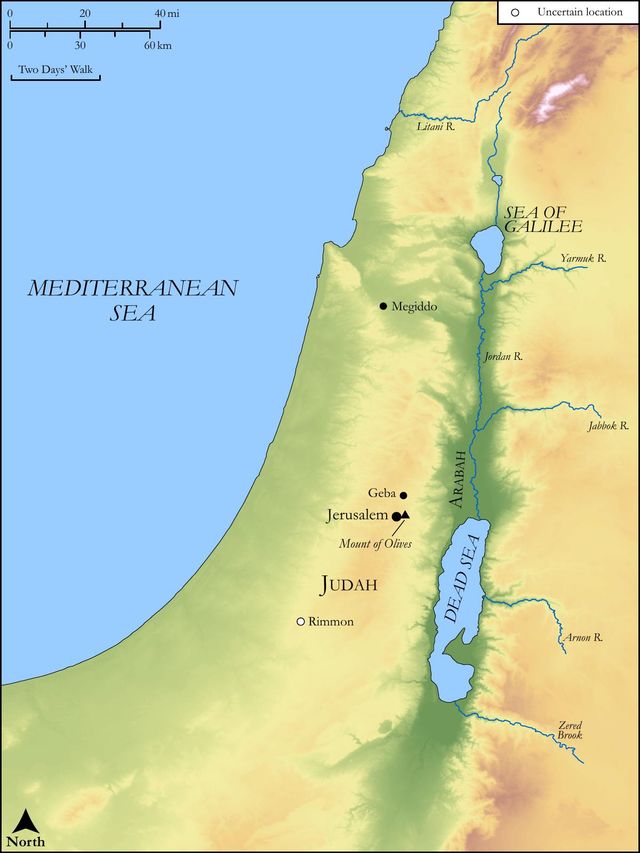
See on the biblical-era map
Study this verse
Public-domain commentary
Matthew Henry
From his Commentary on the Whole Bible. Henry comments on passages, not single verses — this entry covers Zechariah 14:1–7. His four-level outline is real structure in the source text, so it is rendered as structure.
God's providences concerning his church are here represented as strangely changing and strangely mixed.
I.As strangely changing.
Sometimes the tide runs high and strong against them, but presently it turns, and comes to be in favour of them; and God has, for wise and holy ends, set the one over against the other.
1.God here appears against Jerusalem; judgment begins at the house of God. When the day of the Lord comes (Zac 14:1) Jerusalem must pass through the fire to be refined. God himself gathers all nations against Jerusalem to battle (Zac 14:2); he gives them a charge, as he did Sennacherib, to take the spoil and to take the prey (Isa 10:6), for the people of Jerusalem have now become the people of his wrath. And who can stand before him or before nations gathered by him? Where he gives commission he will give success. The city shall be taken by the Romans, who have nations at command; the houses shall be rifled, and all the riches of them taken away, by the enemy; and, to gratify an insatiable lust of uncleanness as well as avarice, the women shall be ravished, as if victory were a license to the worst of villanies, jusque datum sceleri - and crimes were sanctioned by law. One-half of the city shall then be carried into captivity, to be sold or enslaved, and shall not be able to help itself, such is the destruction that shall be made in the great and terrible day of the Lord.
2.He presently changes his way, and appears for Jerusalem; for, though judgment begin at the house of God, yet, as it shall not end there, so it shall not make a full end there, Jer 4:27; Jer 30:11.
(1.)A remnant shall be spared, the same with that third part spoken of, Zac 13:8. One-half shall go into captivity, whence they may hereafter be fetched back, and the residue of the people shall not be cut off, as one would have feared, from the city. Many of the Jews shall receive the gospel, and so shall prevent their being cut off from the city of God, his church upon earth. In it shall be a tenth, Isa 6:13; See Eze 5:3.
(2.)Their cause shall be pleaded against their enemies (Zac 14:3): Then, when God has made use of these nations as a scourge to his people, he shall go forth and fight against them by his judgments, as when he fought against the enemies of his church formerly in the day of battle, with the Egyptians, Canaanites, and others. Note, The instruments of God's wrath will themselves be made the objects of it; for it will come to their turn to drink of the cup of trembling; and whom God fights against he will be sure to overcome and be too hard for. And every former day of battle, which God has made to his people a day of triumph, as it is an engagement to God to appear for his people, because he is the same, so it is an encouragement to them to trust in him. It is observable that the Roman empire never flourished, after the destruction of Jerusalem as it had done before, but in many instances God fought against it.
(3.)Though Jerusalem and the temple be destroyed, yet God will have a church in the world, into which Gentiles shall be admitted, and with whom the believing Jews shall be incorporated, Zac 14:4, Zac 14:5. These verses are dark and hard to be understood; but divers good expositors take this to be the meaning of them.
[1.]God will carefully inspect Jerusalem, even then when the enemies of it are laying it waste: His feet shall stand in that day upon the mount of Olives, whence he may take a full view of the city and temple, Mar 13:3. When the refiner puts his gold into the furnace he stands by it, and has his eye upon it, to see that it receive no damage; so when Jerusalem, God's gold, is to be refined, he will have the oversight of it. He will stand by upon the mount of Olives; this was literally fulfilled when our Lord Jesus was often upon this mountain, especially when thence he ascended up into heaven, Act 1:12. It was the last place on which his feet stood on this earth, the place from which he took rise.
[2.]The partition-wall between Jews and Gentiles shall be taken away. The mountains about Jerusalem, and particularly this, signified it to be an enclosure, and that it stood in the way of those who would approach to it. Between the Gentiles and Jerusalem this mountain of Bether, of division, stood, Sol 2:17. But by the destruction of Jerusalem this mountain shall be made to cleave in the midst, and so the Jewish pale shall be taken down, and the church laid in common with the Gentiles, who were made one with the Jews by the breaking down of this middle wall of partition, Eph 2:14. Who art thou, O great mountain? And a great mountain the ceremonial law was in the way of the Jews' conversion, which, one would think, could never have been got over; yet before Christ and his gospel it was made plain. This mountain departs, this hill removes, but the covenant of peace cannot be broken; for peace is still preached to him that is afar off and to those that are nigh.
[3.]A new and living way shall be opened to the new Jerusalem, both to see it and to come into it. The mountain being divided, one-half towards the north and the other half towards the south, there shall be a very great valley, that is, a broad way of communication opened between Jerusalem and the Gentile world, by which the Gentiles shall have free admission into the gospel-Jerusalem, and the word of the Lord, that goes forth from Jerusalem, shall have a free course into the Gentile world. Thus the way of the Lord is prepared, for every mountain and hill shall be brought low, and plain and pleasant valleys shall come in the room of them, Isa 40:4.
[4.]Those of the Jews that believe shall come in, and join themselves to the Gentiles, and incorporate with them in the gospel-church: You shall flee to the valley of the mountains, that valley that is opened between the divided halves of the mount of Olives; they shall hasten into the church with the Gentiles, as formerly the Gentiles with them, Zac 8:23. The valley of the mountains is the gospel-church, to which there were added of the Jews daily such as should be saved, who fled to that valley as to their refuge. This valley of the mountains is said to reach unto Azal, or to the separate place, that is, to all those whom God has set apart for himself. When God makes his mountains a way (Isa 49:11), by making them a valley, the way shall be opened to all the way-faring men (Isa 35:8), and, though fools, they shall not err therein. Or, to those that are now separated from God this valley shall reach; for the Gentiles, who are afar off, shall be made nigh, with the Jews, who are a people near unto him, and both have an access, a mutual access to each other and a joint access to God as a Father by one Spirit, Eph 2:18.
[5.]They shall flee to the valley of the mountains, to the gospel-church, under dreadful apprehensions of their danger from the curse of the law. They shall flee from the wrath to come, from the avenger of blood, who is in pursuit of them, to the church as to a city of refuge, or as doves to their windows, as they fled from before the earthquake in the days of Uzziah, Amo 1:1. Therefore the gospel reveals the wrath of God from heaven (Rom 1:18) that we might be awakened to escape for our lives, to flee as from an earthquake, for we feel the earth ready to sink under us, and we can find no firm footing in it, and therefore must flee to Christ, in whom alone we can stand fast and be easy.
(4.)God shall appear in his glory for the accomplishing of all this: The Lord my God shall come, and all the saints with thee, which may refer to his coming to destroy Jerusalem, or to destroy the enemies of Jerusalem, or his coming to set up his kingdom in the world, which is called the coming of the Son of man (Mat 24:37), or to his last coming, at the end of time; however, it teaches us,
[1.]That the Lord will come; it has been the faith of all the saints, Behold, the Lord comes to fulfil every word that he has spoken in its season.
[2.]When he comes all his saints come with him; they attend his motions and are ready to serve his interests. Christ will come at the end of time with ten thousands of his saints, as when he came to give the law upon Mount Sinai.
[3.]Every particular believer, being related to God as his God, may triumph in the expectation of his coming and speak of it with pleasure, The Lord my God shall come, shall come to the comfort of all that are his; for, "Blessed Lord, all the saints shall be with thee, and it shall be their everlasting happiness to dwell in thy presence; and therefore come, Lord Jesus." And some think that this may be read as a prayer, Yet, O Lord my God! come, and bring all the saints with thee.
II.God's providences appear here strangely mixed (Zac 14:6, Zac 14:7):
In that day of the Lord the light shall not be clear nor dark, not day nor night; but at evening time it shall be light. Some refer this to all the time from hence to the coming of the Messiah; the Jewish church had neither perfect peace nor constant trouble, but a cloudy day, neither rain nor sunshine. But it may be taken more generally, as designed to represent the method God usually takes in the administration of the kingdom both of providence and grace. Here is,
1.An idea of the usual course and tenour of God's dispensations; the day of his grace and the day of his providence are neither clear nor dark, not day nor night. It is so with the church of God in this world; where the Sun of righteousness has risen it cannot be dark night, and yet short of heaven it will not be clear day. It is so with particular saints; they are not darkness, but light in the Lord, and yet, while there is so much error and corruption remaining in them, it is not perfect day. So it is as to the providences of God that relate to his church; in general the affairs of the church are neither good nor bad in any extremity, but there is a mixture of both; we are singing both of mercy and judgment, and are uncertain which will prevail, whether it be an evening or a morning twilight. We are between hope and fear, not knowing what to make of things.
2.An intimation of comfort with reference hereunto: It shall be one day which shall be known to the Lord. This intimates,
(1.)The beauty and harmony of such mixed events; there is one and the same design and tendency in all; all the wheels make but one wheel, all the revolutions but one day.
(2.)The brevity of them; it is, as it were, but for one day, for a little moment; the cloud that darkens the light will soon blow over.
(3.)The eye God has upon all these events, and the hand he has in them all; they are known to the Lord; he takes notice of them, and orders and disposes of all for the best, according to the counsel of his will.
3.An issue very joyful secured at last: At evening-time it shall be light: it shall be clear light, and no longer dark; we are sure of it in the other world, and we hope for it in this world - at evening-time, when our hopes are quite spent with waiting all day to no purpose, nay, when we fear it will be quite dark, when things are at the worst and the case of the church is most deplorable. As to the church's enemies the sun goes down at noon, so to the church it rises at night; unto the upright springs light out of darkness (Psa 112:4); deliverance comes when the tale of bricks is doubled, and when God's people have done looking for it, and so it comes with a pleasing surprise.
Historical interpretation
Fourteen Centuries of Reception
3 surviving comments on this verse. Each one is dated, so this reads as a timeline rather than a list.
Select a marker to jump to its quote. Markers stagger vertically where authors wrote within a few decades of each other.
And in another place: “And I was reckoned with the transgressors.” Then there was darkness for three hours, from the sixth to the ninth, and again light in the evening; as it is written: “It shall not be day or night, and at the evening there shall be light.” All [these] things, when those malefactors saw that they were crucified with him, the one of them reproached him as though he was weak and unable to deliver himself. But the other rebuked the ignorance of his fellow, and turning to the Lord, as being enlightened by him, and acknowledging who he was that suffered, he prayed that he would remember him in his kingdom hereafter. He then presently granted him the forgiveness of his former sins and brought him into paradise to enjoy the mystical good things. He also cried about the ninth hour, and said to his Father, “My God! My God! Why have you forsaken me?” And a little afterward, when he had cried with a loud voice, “Father, forgive them, for they know not what they do,” and had added, “into your hands I commit my spirit,” he gave up his spirit and was buried before sunset in a new sepulcher. But when the first day of the week dawned, he arose from the dead and fulfilled those things that before his passion he foretold to us, saying, “The Son of man must continue in the heart of the earth three days and three nights.” And when he was risen from the dead, he appeared first to Mary Magdalene and Mary the mother of James, then to Cleopas in the way, and after that to us his disciples, who had fled away for fear of the Jews but privately were very inquisitive about him. But these things are also written in the Gospels.
(Vers. 6, 7.) And it shall come to pass in that day, there shall be no light, but cold and frost. And there shall be one day, which is known to the Lord, neither day nor night, and in the evening time there shall be light. LXX: In that day there shall be no light, but cold and frost shall be one day, and that day shall be known to the Lord: neither day nor night, and in the evening there shall be light. Clearly it is preached about the second coming of the Savior, about whom even John speaks in his Apocalypse: Behold, he cometh with clouds, and every eye shall see him, and they also who pierced him (Apoc. I, 7). And the Lord in the Gospel pronounces that the Son of Man will come in the clouds of heaven with power and great glory (Matthew XXIV). He will come with clouds, that is, with angels, who are ministers of the Spirit, and are sent for various tasks, and with prophets and apostles, of whom it is written: Your truth reaches to the clouds (Psalm XXXV, 6). And when the day of His coming shall be fulfilled, there will be no light, but cold and frost, with the love of all growing cold, and due to the multitude of evils that are to come, everyone will grow cold, and those who lose the warmth of their former faith. But after all the sinners have contracted their cold and frost, there will be one day and eternal: neither light nor darkness, day and night succeeding; but the Lord himself will be the light of all: of whom Isaiah says more clearly: There will be no sun for you in the light of day, nor will the rising of the moon illuminate you at night; but the Lord will be your eternal light, and your God will be your glory (Isaiah 60:19). He also shouts in another place to Jerusalem: Arise, shine, Jerusalem; for your light has come, and the glory of your God has risen upon you. For behold, darkness and gloom shall cover the earth upon the peoples: but upon you the Lord shall arise, and his glory shall be seen upon you. And kings shall walk in the light of you, and nations in the splendor of you (Verse 1 and following). If darkness and gloom shall cover the earth upon the peoples, how then shall the nations walk again in the splendor of the Lord? But those nations shall be in darkness which frost and chill shall have contracted: and they shall walk in the light of the Lord, who have followed kings, apostles and prophets, of whom it is written: The heart of the king is in the hand of the Lord (Prov. XXI, 1). Finally, at the time of evening, that is, the darkness and sadness of all sins, there will be light for the saints, and it will be a single and eternal day, which, if it will be known by the Lord (for He cannot be ignorant of what He created), it must be considered how He says in the Gospel that neither the angels nor the Son will know that day, except the Father alone (Matthew 24).
In the time of the evening there shall be light: An unexpected light shall arise by the means of the Machabees, when things shall seem to be at the worst.
Continue studying Zechariah 14:7 across the web’s major study libraries — every link below opens this exact verse, chapter, or book on the destination site.
Read & Compare
 BibleGatewayThis verse in more than 200 translations and 70 languages.
 Bible.comThe YouVersion reader — hundreds of translations, reading plans, and highlights.
 ESV.orgCrossway's official English Standard Version reader.
 NET BibleThe NET translation with 60,000+ translators' notes on every rendering decision.
 STEP BibleTyndale House's free study tool — original text, vocabulary, and scholarly resources.
 BibliaLogos Bible Software's free web reader.
 USCCBThe New American Bible (Revised Edition) with the U.S. bishops' study notes.
Commentaries
 BibleHub CommentariesDozens of classic commentaries on this verse, gathered on one page.
 StudyLightMore than 100 commentary sets — the largest collection on the web.
 BibleRefPlain-English commentary on what this verse means, verse by verse.
 Enduring WordDavid Guzik's free commentary on this chapter, widely used by Bible teachers.
 Bible Study ToolsVerse commentary alongside Greek and Hebrew study aids.
Original Language & Research
- BibleHub InterlinearThe verse word by word — original language, transliteration, and English.
- BibleHub LexiconEvery word's original-language definition and Strong's entry.
 Blue Letter BibleDeep-study tools — Strong's numbers, concordance, and word studies.
 SefariaThe Hebrew text with Rashi and centuries of Jewish commentary.
Sermons, Hymns & Audio


TrulyRandomVerse is not affiliated with these sites and doesn’t control their content. They’re linked because they’re genuinely useful.
Summary
Zechariah 14:7 offers a profound and enigmatic prophecy concerning a singular, divinely appointed future day, often associated with the "Day of the Lord." This day transcends normal temporal cycles, being neither conventional day nor night, yet it culminates in a striking paradox: at the time of evening, light will miraculously appear. The verse paints a vivid picture of God's ultimate sovereignty over creation and time, foreshadowing a radical transformation that will usher in an era of continuous divine illumination and presence, marking the full establishment of His kingdom.
Context
ShowHideLiterary Context
Zechariah 14 serves as the climactic conclusion to the book of Zechariah, a prophetic work delivered to the post-exilic community in Jerusalem. The entire chapter describes the dramatic culmination of God's redemptive plan, often interpreted as prophecies concerning the final collision of kingdoms and the glorious establishment of God's kingdom on earth. It begins with a depiction of Jerusalem under siege by all nations, followed by God's miraculous intervention, the splitting of the Mount of Olives, and the transformation of the land into a plain. Verse 7 specifically focuses on the atmospheric and temporal conditions of this prophesied "Day of the Lord," highlighting its unique, supernatural character that defies normal human experience. It sets the stage for a period of unparalleled divine presence and blessing, where the very fabric of creation is altered to reflect God's glory and absolute control.
Historical & Cultural Context
Zechariah prophesied during the Persian period, after the return of the Jewish exiles from Babylon. The people were engaged in rebuilding the temple and re-establishing their national identity, often facing discouragement and opposition. The prophecies in Zechariah, particularly chapters Zechariah 9-14, shift from immediate post-exilic concerns to eschatological visions, offering hope for a future global triumph of God's kingdom. The concept of the "Day of the Lord" was a well-established prophetic theme, signifying a time of divine judgment and salvation, but Zechariah's portrayal in Zechariah 14 adds unique dimensions touching the heavens themselves, emphasizing God's direct intervention in the natural order. The cultural understanding of "day" and "night" as fundamental, unchanging cycles makes the prophecy of their alteration all the more striking and indicative of a supernatural event.
Key Themes
ShowHideZechariah 14:7 contributes significantly to several major theological and narrative themes within the book and broader biblical prophecy. Firstly, it underscores The Unique "Day of the Lord," emphasizing that this day is singular and distinct, "known to the LORD." This signifies a period entirely under God's exclusive control and revelation, unlike any other day in history, speaking to God's ultimate sovereignty over time and creation, particularly in the unfolding of end-times prophecy (Joel 3:14). Secondly, it highlights Supernatural Light and Divine Presence. The absence of a clear distinction between day and night, coupled with light appearing at evening, signifies a miraculous alteration of the natural order. This continuous illumination is often interpreted as a manifestation of God's own glory and presence, dispelling all forms of darkness, both literal and spiritual. Lastly, the verse powerfully illustrates the Reversal of Natural Order. The most striking image, "at evening time it shall be light," is a profound paradox. Evening is typically when darkness descends. This reversal symbolizes God's power to transcend and transform natural laws, bringing light and hope even in what would normally be a time of obscurity or despair. It indicates a complete and decisive triumph over darkness.
Exposition and Analysis
ShowHideKey Word Analysis
ShowHideMeaning "united, i.e. one; or (as an ordinal) first." In this context, it emphasizes the singular, unique, and unparalleled nature of this specific day. It is a day set apart, distinct from all other days in history, highlighting its divine appointment and exceptional characteristics.
A primitive root meaning "to know (properly, to ascertain by seeing); used in a great variety of senses, figuratively, literally, euphemistically and inferentially (including observation, care, recognition; and causatively, instruction, designation, punishment, etc.)." Here, "known to the LORD" signifies that this day is exclusively understood, appointed, and orchestrated by God. Its qualities and timing are beyond human comprehension or control, residing solely within the divine counsel.
Meaning "illumination or (concrete) luminary (in every sense, including lightning, happiness, etc.); bright, clear." This word denotes not just physical light but also spiritual clarity, joy, and the manifestation of divine presence. Its appearance at evening time signifies a miraculous, supernatural illumination that defies the natural order, symbolizing God's ultimate triumph over darkness and the establishment of His glorious presence.
Verse Breakdown
ShowHide"But it shall be one day"
This phrase immediately establishes the unique and singular nature of the prophesied event. It is not an ordinary day but a distinct, unparalleled period in history, set apart by divine decree and possessing extraordinary characteristics.
"which shall be known to the LORD"
This clause emphasizes God's exclusive knowledge and sovereign control over this day. Its timing, its nature, and its unfolding are entirely within God's purview, hidden from human understanding until its appointed time. It underscores divine prerogative and mystery.
"not day, nor night"
This striking statement describes a temporal reality that transcends the normal cycle of light and darkness. It implies a continuous, unbroken state of illumination, suggesting a removal of the natural distinctions that govern earthly time. This is a supernatural condition, indicative of a new order.
"but it shall come to pass, that at evening time it shall be light"
This final clause presents a profound paradox and the climactic revelation of the verse. Evening is the natural time for darkness to descend, yet here, it is precisely when light appears. This signifies a miraculous reversal of the natural order, where divine light triumphs over expected obscurity, bringing an ultimate and perpetual clarity.
Literary Devices
ShowHideZechariah 14:7 is rich in literary devices that amplify its prophetic message. The most prominent is Paradox, evident in the phrases "not day, nor night" and especially "at evening time it shall be light." These statements defy conventional logic and natural experience, creating a sense of wonder and highlighting the supernatural nature of the prophesied day. This paradox emphasizes God's ability to transcend and transform the established order. Symbolism is also heavily employed, with "light" representing God's presence, glory, truth, and salvation, while "darkness" (implied by "night" and "evening") symbolizes absence, judgment, and despair. The triumph of light over evening darkness thus symbolizes God's ultimate victory over all forms of spiritual and physical obscurity. Furthermore, the description leans into Hyperbole or Supernaturalism, portraying a reality that goes beyond mere natural phenomena, underscoring the extraordinary, divine intervention that will characterize this future day.
Theological and Thematic Connections
ShowHideZechariah 14:7 speaks powerfully to the eschatological hope of God's people, pointing to a future where divine presence permeates all reality, dispelling all forms of darkness. It underscores God's ultimate sovereignty over creation and time, assuring believers that His plan culminates in a glorious display of His light and truth. This continuous illumination signifies not merely physical light but the full manifestation of God's glory, wisdom, and righteousness, bringing an end to spiritual confusion and moral ambiguity. It is a vision of perfect clarity and unhindered communion with the Divine.
Reflection and Application
ShowHideZechariah 14:7 offers profound hope and assurance to believers, reminding us that God's ultimate plan culminates in an era of perfect clarity and divine presence. Even when life seems to be entering its "evening time"—a period of increasing darkness, difficulty, or uncertainty—this verse assures us that God has the power to bring forth light, transforming despair into hope. It encourages us to trust in God's ultimate plan and sovereignty, knowing that He is in control of all times and seasons. This prophecy points to a future where all shadows are dispelled by His glorious presence, urging us to live with anticipation for that day, embracing the light of His truth even now in the midst of the world's darkness. It challenges us to reflect God's light in our own lives, knowing that His ultimate triumph guarantees the dispelling of all spiritual and physical obscurity.
Questions for Reflection
ShowHideFAQ
ShowHideWhat is the "Day of the Lord" mentioned in Zechariah 14:7?
ShowHideThe "Day of the Lord" is a prominent biblical theme referring to a future period when God will directly intervene in human history to judge evil and establish His righteous kingdom. In Zechariah 14, it describes a climactic series of events involving the siege of Jerusalem, divine intervention, the transformation of the earth, and the establishment of God's reign over all nations. Verse 7 specifically describes the unique temporal and atmospheric conditions of this day, emphasizing its supernatural character where natural cycles are superseded by continuous divine light. This day signifies God's ultimate triumph and the full manifestation of His glory.
Christ-Centered Fulfillment
ShowHideZechariah 14:7 finds its ultimate and most profound fulfillment in Jesus Christ, who is the very embodiment of the divine light that dispels all darkness. While the verse speaks of a future eschatological day, the reality it describes—a world bathed in God's perpetual light—is inaugurated through Christ. Jesus declared Himself to be "the light of the world; whoever follows me will not walk in darkness, but will have the light of life." He is the "true light, which gives light to everyone," coming into the world (John 1:9). The paradox of "at evening time it shall be light" is resolved in Christ, who brings hope and illumination even into the darkest moments of human existence and the deepest shadows of sin and death. His death and resurrection represent the ultimate triumph of light over darkness, securing the promise of a new creation where "there will be no more night" because "the Lord God will give them light" (Revelation 22:5). Thus, the prophetic vision of Zechariah 14:7 points directly to the person and work of Jesus, who brings about the eternal day of God's presence and glory.