


Daniel 12:4
- וְאַתָּהve·'a·Tahand youH859Conj-w ¦ Pro-2msPronoun Personal 2nd Singular Masculineוְandאַתָּהyou
- דָנִיֵּאלda·ni·YelO DanielH1840N-proper-mNoun Proper Masculine
- סְתֹםse·Tomkeep secretH5640V-Qal-Imp-2msVerb Qal Imperative 2nd Singular Masculine
- הַדְּבָרִיםha·de·va·Rimthe wordsH1697Art ¦ N-mpNoun Plural Masculine Absoluteהַtheדְּבָרִיםwords
- וַחֲתֹםva·cha·Tomand seal upH2856Conj-w ¦ V-Qal-Imp-2msVerb Qal Imperative 2nd Singular Masculineוַandחֲתֹםseal up
- הַסֵּפֶרha·Se·ferthe scrollH5612Art ¦ N-msNoun Singular Masculine Absoluteהַtheסֵּפֶרscroll
- עַד'aduntilH5704PrepPreposition
- עֵת'et[the] time ofH6256N-cscNoun Singular common gender Construct
- קֵץKetz[the] endH7093N-msNoun Singular Masculine Absolute
- יְשֹׁטְטוּye·sho·te·Tuthey will rove aboutH7751V-Piel-Imperf-3mpVerb Piel Imperfect 3rd Plural Masculine
- רַבִּיםra·Bimmany [people]H7227Adj-mpAdjective Plural Masculine Absolute
- וְתִרְבֶּהve·tir·Behso it may increaseH7235Conj-w ¦ V-Qal-ConjImperf-3fsVerb Qal Conjunction+Imperfect 3rd Singular Feminineוְsoתִרְבֶּהit may increase
- הַדָּעַתha·Da·'at<the> knowledgeH1847Art ¦ N-fsNoun Singular Feminine Absoluteהַ<the>דָּעַתknowledge
English is a literal word-by-word gloss of the Hebrew, not the KJV's wording. Why?
This is the original text the KJV's translators worked from — each Hebrew word with its own literal English meaning in this verse, prepared by scholars at Tyndale House, Cambridge. The KJV translates whole sentences, not word by word, so its wording differs: one Hebrew word can become several English words, and the KJV may choose “the LORD” where the gloss reads “Yahweh”. Both are faithful — they answer different questions. For the KJV's own rendering, switch to the KJV text.
Details
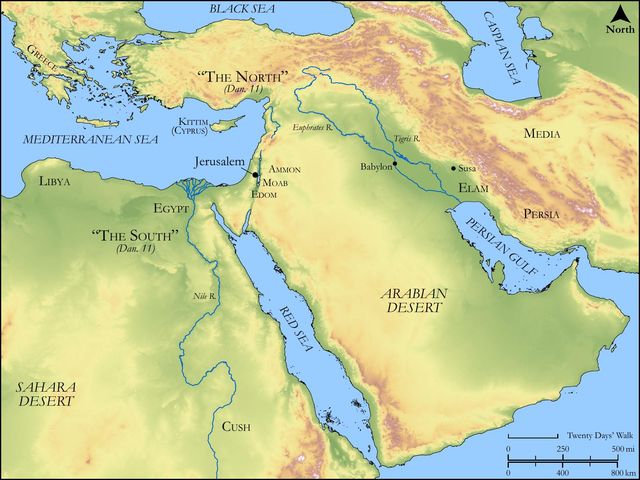
See on the biblical-era map
Study this verse
Public-domain commentary
Matthew Henry
From his Commentary on the Whole Bible. Henry comments on passages, not single verses — this entry covers Daniel 12:1–4. His two-level outline is real structure in the source text, so it is rendered as structure.
It is usual with the prophets, when they foretel the grievances of the church, to furnish it at the same time with proper antidotes, a remedy for every malady. And no relief is so sovereign, of such general application, so easily accommodated to every case, and of such powerful efficacy, as those that are fetched from Christ and the future state; thence the comforts here are fetched.
I.Jesus Christ shall appear his church's patron and protector:
At that time, when the persecution is at the hottest, Michael shall stand up, Dan 12:1. The angel had told Daniel what a firm friend Michael was to the church, Dan 10:21. He all along showed this friendship in the upper world; the angels knew it; but now Michael shall stand up in his providence, and work deliverance for the Jews, when he sees that their power is gone, Deu 32:36. Christ is that great prince, for he is the prince of the kings of the earth, Rev 1:5. And, if he stand up for his church, who can be against it? But this is not all: At that time (that is, soon after) Michael shall stand up for the working out of our eternal salvation; the Son of God shall be incarnate, shall be manifested to destroy the works of the devil. Christ stood for the children of our people when he was made sin and a curse for them, stood in their stead as a sacrifice, bore the cure for them, to bear it from them. He stands for them in the intercession he ever lives to make within the veil, stands up for them, and stands their friend. And after the destruction of antichrist, of whom Antiochus was a type, Christ shall stand at the latter day upon the earth, shall appear for the complete redemption of all his.
II.When Christ appears he will recompense tribulation to those that trouble his people.
There shall be a time of trouble, threatening to all, but ruining to all the implacable enemies of God's kingdom among men, such trouble as never was since there was a nation. This is applicable.
1.To the destruction of Jerusalem, which Christ calls (perhaps with an eye to this prediction) such a great tribulation as was not since the beginning of the world to this time, Mat 24:21. This the angel had spoken much of (Dan 9:26, Dan 9:27); and it happened about the same time that Christ set up the gospel-kingdom in the world, that Michael our prince stands up. Or,
2.To the judgment of the great day, that day that shall burn as an oven, and consume the proud and all that do wickedly; that will be such a day of trouble as never was to all those whom Michael our prince stands against.
III.He will work salvation for his people:
"At that time thy people shall be delivered, delivered from the mischief and ruin designed them by Antiochus, even all those that were marked for preservation, that were written among the living," Isa 4:3. When Christ comes into the world he will save his spiritual Israel from sin and hell, and will, at his second coming, complete their salvation, even the salvation of as many as were given him, as many as have their names in the book of life, Rev 20:15. They were written there before the world, and will be found written there at the end of the world, when the books shall be opened.
IV.There shall be a distinguishing resurrection of those that sleep in the dust, Dan 12:2.
1.When God works deliverance for his people from persecution it is a kind of resurrection; so the Jews' release out of Babylon was represented in vision (Eze. 37) and so the deliverance of the Jews from Antiochus, and other restorations of the church to outward prosperity; they were as life from the dead. Many of those who had long slept in the dust of obscurity and calamity shall then awake, some to that life, and honour, and comfort which will be lasting, everlasting; but to others, who, when they return to their prosperity, will return to their iniquity, it will be a resurrection to shame and contempt, for the prosperity of fools will but expose them and destroy them.
2.When, upon the appearing of Michael our prince, his gospel is preached, many of those who sleep in the dust, both Jews and Gentiles, shall be awakened by it to take upon them a profession of religion, and shall rise out of their heathenism or Judaism; but, since there will be always a mixture of hypocrites with true saints, it is but some of those who are raised to life to whom the gospel is a savour of life unto life, but others will be raised by it to shame and contempt, to whom the gospel of Christ will be a savour of death unto death, and Christ himself set for their fall. The net of the gospel encloses both good and bad. But,
3.It must be meant of the general resurrection at the last day: The multitude of those that sleep in the dust shall awake, that is, all, which shall be a great many. Or, Of those that sleep in the dust many shall arise to life and many to shame. The Jews themselves understand this of the resurrection of the dead at the end of time; and Christ seems to have an eye to it when he speaks of the resurrection of life and the resurrection of damnation (Joh 5:29); and upon this the Jews are said by St. Paul to expect a resurrection of the dead both of the just and of the unjust, Act 24:15. And nothing could come in more seasonably here, for, under Antiochus's persecution, some basely betrayed their religion, others bravely adhered to it. Now it would be a trouble to them that, when the storm was over, they could neither reward the one nor punish the other; this therefore would be a satisfaction to them, that they would both be recompensed according to their works in the resurrection. And the apostle, speaking of the pious Jews that suffered martyrdom under Antiochus, tells us that though they were tortured yet they accepted not deliverance, because they hoped to obtain this better resurrection, Heb 11:35.
V.There shall be a glorious reward conferred on those who, in the day of trouble and distress, being themselves wise, did instruct many.
Such were taken particular notice of in the prophecy of the persecution (Dan 11:33), that they should do eminent service, and yet should fall by the sword and by flame; now, if there were not another life after this, they would be of all men most miserable, and therefore we are here assured that they shall be recompensed in the resurrection of the just (Dan 12:3): Those that are wise (that are teachers, so some read it, for teachers have need of wisdom, and those that have wisdom themselves should communicate it to others) shall shine as the brightness of the firmament, shall shine in glory, heavenly glory, the glory of the upper world; and those that by the wisdom they have, and the instructions they give, are instrumental to turn any, especially to turn many to righteousness, shall shine as the stars for ever and ever. Note,
1.There is a glory reserved for all the saints in the future state, for all that are wise, wise for their souls and eternity. A man's wisdom now makes his face to shine (Ecc 8:1), but much more will it do so in that state where its power shall be perfected and its services rewarded.
2.The more good any do in this world, especially to the souls of men, the greater will be their glory and reward in the other world. Those that turn men to righteousness, that turn sinners from the errors of their ways and help to save their souls from death (Jam 5:20), will share in the glory of those they have helped to heaven, which will be a great addition to their own glory.
3.Ministers of Christ, who have obtained mercy of him to be faithful and successful, and so are made burning and shining lights in this world, shall shine very brightly in the other world, shall shine as the stars. Christ is the sun, the fountain, of the lights both of grace and glory; ministers, as stars, shine in both, with a light derived from him, and a diminutive light in comparison of him; yet to those that are earthen vessels it will be a glory infinitely transcending their deserts. They shall shine as the stars of different magnitudes, some in less, others in greater lustre; but, whereas the day is coming when the stars shall fall from heaven as leaves in autumn, these stars shall shine for ever and ever, shall never set, never be eclipsed.
VI.That this prophecy of those times, though sealed up now, would be of great use to those that should live then, Dan 12:4.
Daniel must now shut up the words and seal the book because the time would be long ere these things would be accomplished: and it was some comfort that the Jewish nation, though, in the infancy of their return from Babylon, while they were few and weak, they met with obstructions in their work, were not persecuted for their religion till a long time after, when they had grown to some strength and maturity. He must seal the book because it would not be understood, and therefore would not be regarded, till the things contained in it were accomplished; but he must keep it safely, as a treasure of great value, laid up for the ages to come, to whom it would be of great service; for many shall then run to and fro, and knowledge shall be increased. Then this hidden treasure shall be opened, and many shall search into it, and dig for the knowledge of it, as for silver. They shall run to and fro, to enquire out copies of it, shall collate them, and see that they be true and authentic. They shall read it over and over, shall meditate upon it, and run it over in their minds; discurrent - they shall discourse of it, and talk it over among themselves, and compare notes about it, if by any means they may sift out the meaning of it; and thus knowledge shall be increased. By consulting this prophecy on this occasion they shall be led to search other scriptures, which shall contribute much to their advancement in useful knowledge; for then shall we know if we follow on to know the Lord, Hos 6:3. Those that would have their knowledge increased must take pains, must not sit still in slothfulness and bare wishes but run to and fro, must make use of all the means of knowledge and improve all opportunities of getting their mistakes rectified, their doubts resolved, and their acquaintance with the things of God improved, to know more and to know better what they do know. And let us here see reason to hope that,
1.Those things of God which are now dark and obscure will hereafter be made clear, and easy to be understood. Truth is the daughter of time. Scripture prophecies will be expounded by the accomplishment of them; therefore they are given, and for that explication they are reserved. Therefore they are told us before, that, when they do come to pass, we may believe.
2.Those things of God which are despised and neglected, and thrown by as useless, shall be brought into reputation, shall be found to be of great service, and be brought into request; for divine revelation, however slighted for a time, shall be magnified and made honourable, and, above all, in the judgment of the great day, when the books shall be opened, and that book among the rest.
Historical interpretation
Six Centuries of Reception
5 surviving comments on this verse. Each one is dated, so this reads as a timeline rather than a list.
Select a marker to jump to its quote. Markers stagger vertically where authors wrote within a few decades of each other.
And Jeremiah also says, “In the last days they shall understand these things.” For every prophecy, before its fulfillment, appears to people to be full of enigmas and ambiguities. But when the time has arrived and the prediction has come to pass, the prophecies have a clear and certain meaning.
Verse 4. "But Thou, O Daniel, shut up the words and seal the book, even to the time appointed. Many shall pass over, and knowledge shall be manifold." He who had revealed manifold truth to Daniel now signifies that the things he has said are matters of secrecy, and he orders him to roll up the scroll containing his words and set a seal upon the book, with the result that many shall read it and inquire as to its fulfilment in history, differing in their opinions because of its great obscurity. And as for the statement, "Many shall pass over" or "go through," this indicates that it will be read by many people. For it is a familiar expression to say: "I have gone through a book," or, "I have passed through an historical account." Indeed this is the idea which Isaiah also expressed in regard to the obscurity of his own book: "And the sayings of that book shall be like the words of a book that is sealed. And if they shall give it to an illiterate man, saying, 'Read it,' he will reply, 'I do not know how to read.' But if they give it to a man who does know how to read and say, 'Read the book,' he will reply, 'I cannot read it, because it is sealed up'" (Isaiah 29:11-12). Also in the Revelation of John, there is a book seen which is sealed with seven seals inside and outside. And when no one proves able to break its seals, John says, "I wept sore; and a voice came to me, saying, 'Weep not: behold the Lion of the tribe of Judah, the Root of David, has prevailed to open the book and break its seals'" (Revelation 5:1-5). But that book can be opened by one who has learned the mysteries of Scripture and understands its hidden truths, and its words which seem dark because of the greatness of the secrets they contain. He it is who can interpret the parables and transmute the letter which killeth into the spirit which quickeneth.
He says, “Add to the book the seals of obscurity, and do not make matters clear to all until knowledge is increased and the whole earth is filled with the knowledge of the Lord,” like deep water covering the seas, in accordance with the prophecy. The grace of the divine Spirit along with the appearance of our Savior has removed the seals and has made clear to believers what had been unclear.
The same knowledge from which Scripture itself was originally composed is always increased and never ceases to be multiplied.… Moses acquired more knowledge than the patriarchs.… Likewise the Lord himself declares the apostles to have known greater things than the prophets.… “Many prophets … desired to see the things you see and did not see them.…” But he also promises them still greater grace of knowledge after his resurrection and ascension.
He orders him to “seal the book,” that is, with the seal of obscurity, and to avoid revealing it to anybody, so that its memory may not be lost and the nations may not be overwhelmed with fear and renounce to ascend to the promised land; and, at the same time, in order that the weak ones of the people, by learning about the affliction that will befall them, may not be held back from going up from Babylon to Jerusalem. “Many will look for” God, “and the knowledge will increase” and will abound all over the world.
Continue studying Daniel 12:4 across the web’s major study libraries — every link below opens this exact verse, chapter, or book on the destination site.
Read & Compare
 BibleGatewayThis verse in more than 200 translations and 70 languages.
 Bible.comThe YouVersion reader — hundreds of translations, reading plans, and highlights.
 ESV.orgCrossway's official English Standard Version reader.
 NET BibleThe NET translation with 60,000+ translators' notes on every rendering decision.
 STEP BibleTyndale House's free study tool — original text, vocabulary, and scholarly resources.
 BibliaLogos Bible Software's free web reader.
 USCCBThe New American Bible (Revised Edition) with the U.S. bishops' study notes.
Commentaries
 BibleHub CommentariesDozens of classic commentaries on this verse, gathered on one page.
 StudyLightMore than 100 commentary sets — the largest collection on the web.
 BibleRefPlain-English commentary on what this verse means, verse by verse.
 Enduring WordDavid Guzik's free commentary on this chapter, widely used by Bible teachers.
 Bible Study ToolsVerse commentary alongside Greek and Hebrew study aids.
Original Language & Research
- BibleHub InterlinearThe verse word by word — original language, transliteration, and English.
- BibleHub LexiconEvery word's original-language definition and Strong's entry.
 Blue Letter BibleDeep-study tools — Strong's numbers, concordance, and word studies.
 SefariaThe Hebrew text with Rashi and centuries of Jewish commentary.
Sermons, Hymns & Audio


TrulyRandomVerse is not affiliated with these sites and doesn’t control their content. They’re linked because they’re genuinely useful.
Summary
Daniel 12:4 is a pivotal prophetic command given to the prophet Daniel, instructing him to preserve and obscure the profound visions he received until a designated future period, referred to as "the time of the end." This verse highlights the divine timing of revelation, indicating that a comprehensive understanding of these prophecies would not be fully accessible in Daniel's era but would become increasingly clear as humanity approached the culmination of history, marked by an unprecedented surge in global movement and an exponential increase in knowledge.
Context
ShowHideLiterary Context
Daniel 12:4 serves as the concluding instruction within Daniel's final and most extensive prophetic vision, which spans chapters 10-12. This vision, initiated by a divine messenger, delves into intricate details concerning the future, encompassing the rise and fall of various kingdoms, periods of intense tribulation, and culminating in the resurrection of the dead and the ultimate judgment. The command to "shut up the words, and seal the book" acts as a divine closure to this particular revelation, emphasizing that its full import and clarity are not for immediate comprehension but are reserved for a specific eschatological epoch. It underscores the profound nature of these prophecies, indicating their significance is such that they require a divinely appointed time for their unveiling.
Historical & Cultural Context
Daniel received these visions during the Babylonian exile and the subsequent Persian period, a time of significant political upheaval and cultural flux for the Jewish people. The concept of "sealing" a document was a common practice in the ancient Near East, signifying authenticity, security, and often, restricted access until a specific time or event. Royal decrees, legal documents, and important records were frequently sealed to ensure their preservation and to prevent unauthorized alteration or premature disclosure. In this context, the divine command to seal Daniel's book implies that the prophecies contained within it are authentic and divinely preserved, yet their full meaning is to remain inaccessible or obscure until God's appointed time. This reflects a broader biblical pattern of progressive revelation, where God unveils truths in accordance with His sovereign timetable, as seen in the gradual unfolding of His redemptive plan throughout history.
Key Themes
ShowHideThis verse contributes significantly to several overarching themes within the book of Daniel and biblical prophecy. The primary theme is Divine Sovereignty over Revelation and Time. The instruction to "seal the book" underscores that God alone controls the timing and understanding of His prophetic word, revealing it when and how He deems fit. This aligns with the broader biblical principle that God reveals His secrets to His servants at His appointed time, as mentioned in Amos 3:7. Another crucial theme is Eschatology and the "Time of the End." The phrase "time of the end" is a recurring motif in Daniel, pointing to a distinct period leading up to the culmination of human history and the establishment of God's eternal kingdom. This period is characterized by specific global developments, including the increase in "running to and fro" and "knowledge," which are hallmarks of the modern era, suggesting that we may be living in, or approaching, this prophesied epoch. Finally, the theme of Progressive Understanding is evident. While Daniel was commanded to seal the words, the implication is that they will be understood later, suggesting that diligent study and divine illumination will lead to greater clarity as the "time of the end" approaches, allowing believers to discern the signs of the times.
Exposition and Analysis
ShowHideKey Word Analysis
ShowHideThis primitive root means "to stop up" or "to keep secret." In the context of Daniel 12:4, it conveys the idea of divine concealment or preservation, ensuring that the words are not fully grasped or widely disseminated until the appointed time. It implies a deliberate act of withholding complete understanding.
This primitive root means "to close up" or "especially to seal." Similar to "shut up," sealing a document in the ancient world indicated authenticity, security, and often, restricted access. Here, it reinforces the divine decree that the prophecies are to be securely preserved, their full meaning locked away until the "time of the end."
This noun signifies "knowledge" or "cunning." In this verse, its increase refers to a significant expansion in understanding, information, and intellectual capacity. This can encompass scientific, technological, and informational advancements, but also, crucially, a deeper comprehension of biblical prophecy itself as the "time of the end" draws near.
Verse Breakdown
ShowHide"But thou, O Daniel, shut up the words, and seal the book"
This is a direct imperative from the divine messenger to Daniel. It instructs him not to widely disseminate or fully explain the intricate prophecies he has received. The "words" refer to the specific prophetic utterances, and "the book" refers to the written compilation of these visions. The dual command to "shut up" and "seal" emphasizes the security and divine restriction placed upon the full understanding of these revelations.
"[even] to the time of the end"
This phrase specifies the duration of the sealing and obscurity. It indicates that the full comprehension and widespread understanding of these prophecies are not meant for Daniel's immediate context but are reserved for a future, divinely appointed period. This "time of the end" is a significant eschatological epoch in biblical prophecy, pointing to the culmination of God's redemptive plan.
"many shall run to and fro"
This clause describes a characteristic activity of "the time of the end." The Hebrew verb (shûwṭ) can imply physical movement, such as extensive travel or exploration, or it can metaphorically refer to a diligent searching for understanding, a rapid dissemination of information, or even a restless, unsettled state of humanity. In the context of increasing knowledge, it often suggests a widespread pursuit and exchange of information.
"and knowledge shall be increased"
This final clause describes a profound intellectual and informational explosion that will be a hallmark of "the time of the end." This increase in "knowledge" (Hebrew, daʻath) is broadly understood to encompass advancements in science, technology, communication, and information processing. Crucially, within a prophetic context, it also implies an increase in the understanding and interpretation of biblical prophecy itself, as the previously "sealed" words become clearer.
Literary Devices
ShowHideDaniel 12:4 employs several potent literary devices. The most prominent is Imperative Mood, seen in the direct commands "shut up" and "seal," which underscore the divine authority behind the instruction and the prophet's obedience. Symbolism is also central, with "the book" symbolizing the entirety of Daniel's prophecies, and "the seal" representing divine preservation, restricted access, and the pre-determined timing of revelation. The phrase "time of the end" functions as a Theological Marker, signaling a specific eschatological period. Furthermore, the verse presents a stark Juxtaposition between the initial obscurity and sealing of the prophecies ("shut up the words, and seal the book") and the later clarity and widespread understanding ("many shall run to and fro, and knowledge shall be increased"). This contrast highlights God's sovereign control over the unfolding of His prophetic word, unveiling it precisely when His purposes are to be fulfilled.
Theological and Thematic Connections
ShowHideDaniel 12:4 profoundly illustrates God's sovereign control over history and revelation. The command to "seal the book" signifies that God's prophetic timetable is precise and that certain truths are reserved for specific epochs. This concept of progressive revelation assures us that while some aspects of God's plan may remain obscure for a time, they will be unveiled when His purposes deem it necessary. The "time of the end" is not merely a chronological marker but a period of intensified divine activity and human experience, where the increase in movement and knowledge serves as a signpost, prompting believers to discern the times and prepare for the culmination of God's plan. This verse encourages both patient trust in God's timing and diligent pursuit of understanding as His word becomes increasingly illuminated.
Reflection and Application
ShowHideDaniel 12:4 offers profound insights for contemporary believers, living in an era that undeniably exhibits the characteristics of increased global movement and an explosion of knowledge. This verse serves as a powerful reminder that God's prophetic word is unfolding according to His perfect plan, and we are called to be attentive observers and diligent students. The very fact that we can now access vast amounts of information, including biblical commentaries and scholarly resources, and travel globally with unprecedented ease, suggests that we are indeed living in a time when the "sealed" words of Daniel are becoming more accessible and understandable. This should not lead to speculative date-setting but to a sober and hopeful awareness of God's imminent work. It compels us to engage with prophecy not out of curiosity alone, but out of a desire to understand God's heart and prepare for the future He has ordained. Our response should be one of spiritual discernment, using the abundance of information to confirm biblical truth and to live with greater intentionality, anticipating the Lord's return and the establishment of His eternal kingdom.
Questions for Reflection
ShowHideFAQ
ShowHideWhat does "shut up the words and seal the book" mean in Daniel 12:4?
ShowHideThis command signifies that the detailed prophecies Daniel received were to be preserved securely but their full understanding would remain obscure or inaccessible until a specific, divinely appointed future time. It implies that the clarity and widespread comprehension of these profound visions were not intended for Daniel's immediate historical context. The act of "sealing" was a common ancient practice to authenticate a document and restrict its contents until a designated moment or by an authorized person, emphasizing God's sovereign control over the timing of His revelation. This ensures that the prophecies would not be fully understood until the "time of the end," when God's plan would begin to unfold more clearly.
What is "the time of the end" as mentioned in Daniel 12:4?
ShowHide"The time of the end" is an eschatological phrase that appears multiple times in the book of Daniel (e.g., Daniel 8:17, Daniel 11:35). It refers to a distinct period leading up to the culmination of human history, the final judgment, and the establishment of God's eternal kingdom. While its precise commencement is debated, the characteristics described in Daniel 12:4—namely, increased global movement and an explosion of knowledge—suggest a period that bears striking resemblance to the modern era. It is a time when God's purposes are brought to a climax, and His previously "sealed" prophetic word becomes increasingly discernible.
Christ-Centered Fulfillment
ShowHideWhile Daniel 12:4 speaks of a "sealed book" to be understood in the "time of the end," the ultimate unveiling and fulfillment of all prophecy find their apex in Jesus Christ. The very concept of a sealed book that no one is worthy to open until the appointed time powerfully foreshadows the scene in Revelation 5, where only the Lamb who was slain is found worthy to break the seals and open the scroll of God's redemptive plan. Thus, the "knowledge" that is increased in the time of the end is not merely scientific or technological, but crucially, the knowledge of God's unfolding plan centered on Christ. The "running to and fro" can be seen as the global spread of the Gospel and the diligent searching of the Scriptures, leading to a deeper understanding of Christ's first and second comings. Ultimately, the "time of the end" culminates in the glorious return of Jesus Christ, the Alpha and the Omega, when every prophecy will be perfectly fulfilled in His reign, and the knowledge of the Lord will cover the earth as the waters cover the sea.