


Revelation 22:10
Bible text: King James Version (1769 Blayney text) · Public domain
Bible text: Berean Standard Bible · Public domain
Bible text: American Standard Version (1901) · Public domain
Bible text: World English Bible, Messianic edition · Public domain
Bible text: Geneva Bible (1599) · Public domain
Bible text: Young's Literal Translation · Public domain
- ΚαὶKaiAndG2532CONJConjunction
- λέγειlegeihe saysG3004V-PAI-3SVerb Present Active Indicative 3rd Singular
- μοι·moito meG3165P-1DSPersonal pronoun Dative 1st Singular
- μὴmēNotG3361PRT-NNegative Particle Negative
- σφραγίσῃςsphragisēsmay sealG4972V-AAS-2SVerb Aorist Active Subjunctive 2nd Singular
- τοὺςtoustheG3588T-APMDefinite article Accusative Plural Masculine
- λόγουςlogouswordsG3056N-APMNoun Accusative Plural Masculine
- τῆςtēsof theG3588T-GSFDefinite article Genitive Singular Feminine
- προφητείαςprophēteiasprophecyG4394N-GSFNoun Genitive Singular Feminine
- τοῦtouof theG3588T-GSNDefinite article Genitive Singular Neuter
- βιβλίουbiblioubookG975N-GSNNoun Genitive Singular Neuter
- τούτουtoutouthisG3778D-GSNDemonstrative pronoun Genitive Singular Neuter
- ὅτιhotithatG3754CONJConjunction
- ὁhotheG3588T-NSMDefinite article Nominative Singular Masculine
- καιρὸςkairostimeG2540N-NSMNoun Nominative Singular Masculine
- γὰρgarforG1063CONJConjunction
- ἐγγύςengusnearG1451PREPPreposition
- ἐστινestinisG1510V-PAI-3SVerb Present Active Indicative 3rd Singular
English is a literal word-by-word gloss of the Greek, not the KJV's wording. Why?
This is the original text the KJV's translators worked from — each Greek word with its own literal English meaning in this verse, prepared by scholars at Tyndale House, Cambridge. The KJV translates whole sentences, not word by word, so its wording differs: one Greek word can become several English words, and the KJV may choose “charity” where the gloss reads “love”. Both are faithful — they answer different questions. For the KJV's own rendering, switch to the KJV text.
Details
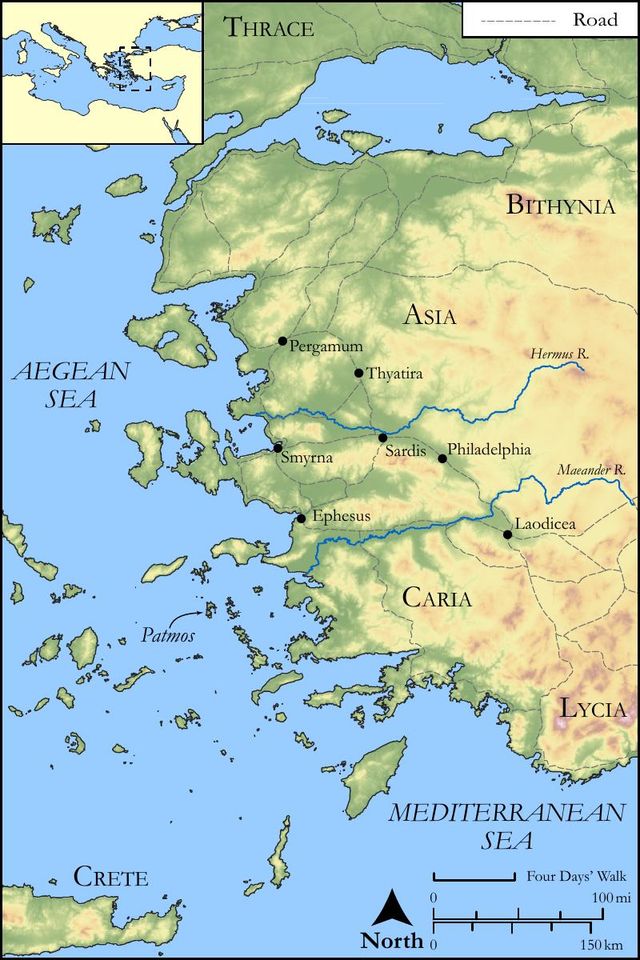
See on the biblical-era maps

Study this verse
Public-domain commentary
Matthew Henry
From his Commentary on the Whole Bible. Henry comments on passages, not single verses — this entry covers Revelation 22:6–19.
We have here a solemn ratification of the contents of this book, and particularly of this last vision (though some think it may not only refer to the whole book, but to the whole New Testament, yea, to the whole Bible, completing and confirming the canon of scripture); and here, 1. This is confirmed by the name and nature of that God who gave out these discoveries: he is the Lord God, faithful and true, and so are all his sayings. 2. By the messengers he chose, to reveal these things to the world; the holy angels showed them to holy men of God; and God would not employ his saints and angels in deceiving the world. 3. They will soon be confirmed by their accomplishment: they are things that must shortly be done; Christ will make haste, he will come quickly, and put all things out of doubt; and then those will prove the wise and happy men who have believed and kept his words. 4. By the integrity of that angel who had been the apostle's guide and interpreter in these visions; this integrity was such that he not only refused to accept religious adoration from John, but once and again reproved him for it. He who was so tender of the honour of God, and so displeased with what was a wrong to God, would never come in his name to lead the people of God into mere dreams and delusions; and it is a still further confirmation of the sincerity of this apostle that he confesses his own sin and folly, into which he had now again relapsed, and he leaves this his failing on perpetual record: this shows he was a faithful and an impartial writer. 5. By the order given to leave the book of the prophecy open, to be perused by all, that they might labour to understand it, that they might make their objections against it, and compare the prophecy with the events. God here deals freely and openly with all; he does not speak in secret, but calls every one to witness to the declarations here made, Rev 22:10. 6. By the effect this book, thus kept open, will have upon men; those that are filthy and unjust will take occasion thence to be more so, but it will confirm, strengthen, and further sanctify those that are upright with God; it will be a savour of life to some and of death to others, and so will appear to be from God, Rev 22:12. 7. It will be Christ's rule of judgment at the great day; he will dispense rewards and punishments to men according as their works agree or disagree with the word of God; and therefore that word itself must needs be faithful and true. 8. It is the word of him who is the author, finisher, and rewarder of the faith and holiness of his people, Rev 22:13, Rev 22:14. He is the first and the last, and the same from first to last, and so is his word too; and he will by this word give to his people, who conform themselves to it, a right to the tree of life, and an entrance into heaven; and this will be a full confirmation of the truth and authority of his word, since it contains the title and evidence of that confirmed state of holiness and happiness that remains for his people in heaven. 9. It is a book that condemns and excludes from heaven all wicked, unrighteous persons, and particularly those that love and make lies (Rev 22:15), and therefore can never be itself a lie. 10. It is confirmed by the testimony of Jesus, which is the Spirit of prophecy. And this Jesus, as God, is the root of David, though, as man, his offspring - a person in whom all uncreated and created excellencies meet, too great and too good to deceive his churches and the world. He is the fountain of all light, the bright and the morning star, and as such has given to his churches this morning light of prophecy, to assure them of the light of that perfect day which is approaching. 11. It is confirmed by an open and general invitation to all to come and partake of the promises and privileges of the gospel, those streams of the water of life; these are tendered to all who feel in their souls a thirst which nothing in this world can quench. 12. It is confirmed by the joint testimony of the Spirit of God, and that gracious Spirit that is in all the true members of the church of God; the Spirit and the bride join in testifying the truth and excellency of the gospel. 13. It is confirmed by a most solemn sanction, condemning and cursing all who should dare to corrupt or change the word of God, either by adding to it or taking from it, Rev 22:18, Rev 22:19. He that adds to the word of God draws down upon himself all the plagues written in this book; and he who takes any thing away from it cuts himself off from all the promises and privileges of it. This sanction is like a flaming sword, to guard the canon of the scripture from profane hands. Such a fence as this God set about the law (Deu 4:2), and the whole Old Testament (Mal 4:4), and now in the most solemn manner about the whole Bible, assuring us that it is a book of the most sacred nature, divine authority, and of the last importance, and therefore the peculiar care of the great God.
Historical interpretation
Seven Centuries of Reception
7 surviving comments on this verse. Each one is dated, so this reads as a timeline rather than a list.
Select a marker to jump to its quote. Markers stagger vertically where authors wrote within a few decades of each other.
That evil is not to be returned for evil. In the Epistle of Paul to the Romans: "Rendering to no man evil for evil." Also in the same place: "Not to be overcome of evil, but overcome evil with good." Of this same thing in the Apocalypse: "And He said unto me, Seal not the words of the prophecy of this book; because now the time is at hand. And let those who persist in hurting, hurt: and let him who is filthy, be filthy still: but let the righteous do still more righteousness: and in like manner, let him that is holy do still more holiness. Behold, I come quickly; and my reward is with me, to render to every man according to his deeds."
But since I know, beloved brethren, that very many are eager, either on account of the burden or the pain of smarting wrongs, to be quickly avenged of those who act harshly and rage against them, we must not withhold the fact in the furthest particular, that placed as we are in the midst of these storms of a jarring world, and, moreover, the persecutions both of Jews or Gentiles, and heretics, we may patiently wait for the day of (God's) vengeance, and not hurry to revenge our suffering with a querulous haste, since it is written, "Wait ye upon me, saith the Lord, in the day of my rising up for a testimony; for my judgment is to the congregations of the nations, that I may take hold on the kings, and pour out upon them my fury." The Lord commands us to wait, and to bear with brave patience the day of future vengeance; and He also speaks in the Apocalypse, saying, "Seal not the sayings of the prophecy of this book: for now the time is at hand for them that persevere in injuring to injure, and for him that is filthy to be filthy still; but for him that is righteous to do things still more righteous, and likewise for him that is holy to do things still more holy. Behold, I come quickly; and my reward is with me, to render to every man according to his deeds." Whence also the martyrs, crying out and hastening with grief breaking forth to their revenge, are bidden still to wait, and to give patience for the times to be fulfilled and the martyrs to be completed. "And when He had opened," says he, "the fifth seal, I saw under the altar of God the souls of them that were slain for the word of God, and for their testimony; and they cried with a loud voice, saying, How long, O Lord, holy and true, dost Thou not judge and avenge our blood on them that dwell on the earth? And there were given to them each white robes; and it was said unto them that they should rest yet for a little season, until the number of their fellow-servants and brethren is fulfilled, who afterwards shall be slain after their example."
Just as the divine Scriptures are sealed for those who are proud and who love the world more than God, so are they opened for those who are humble and who fear God.
He says that the time of retribution and of the end is near. With heavenly words he indicates the dire reason why those things that were commanded and spoken ought not be left in silence. Rather, they were written for the admonition of all.
Until now he has presented the words of the angel, but here he changes to the person of the Lord Christ, saying, “Do not seal up the words of the prophecy.” Indeed, the book is worthy to be read by the faithful. In view of the punishment prepared for the sinners and of the rest promised to the saints, it guides those who read it to the true life.
Do not seal up the words of the prophecy of this book, etc. As the future judgment approaches, it was necessary for the divine precepts, judgments, and promises to be revealed, by the observance of which the meek may acquire reward, and the disobedient, having neglected them, may incur punishment.
Do not seal, he says, these words, that is, do not keep them to yourself, nor lock them away and guard them in the treasury of your mind, but reveal them to all.
For he says the time is near. He speaks something like this: the time until their fulfillment is not very long, as before. But do not think it necessary that they be heard now; for it is not personal, as if their omission were unnecessary. For what need is there of exhortation to those who are from now tried by evils or by goods? For it is by deeds, not by untimely words, that those learning by action are instructed. But what does he mean by saying the time is near, neither long to come nor already present?
Continue studying Revelation 22:10 across the web’s major study libraries — every link below opens this exact verse, chapter, or book on the destination site.
Read & Compare
 BibleGatewayThis verse in more than 200 translations and 70 languages.
 Bible.comThe YouVersion reader — hundreds of translations, reading plans, and highlights.
 ESV.orgCrossway's official English Standard Version reader.
 NET BibleThe NET translation with 60,000+ translators' notes on every rendering decision.
 STEP BibleTyndale House's free study tool — original text, vocabulary, and scholarly resources.
 BibliaLogos Bible Software's free web reader.
 USCCBThe New American Bible (Revised Edition) with the U.S. bishops' study notes.
Commentaries
 BibleHub CommentariesDozens of classic commentaries on this verse, gathered on one page.
 StudyLightMore than 100 commentary sets — the largest collection on the web.
 BibleRefPlain-English commentary on what this verse means, verse by verse.
 Enduring WordDavid Guzik's free commentary on this chapter, widely used by Bible teachers.
 Bible Study ToolsVerse commentary alongside Greek and Hebrew study aids.
Original Language & Research
- BibleHub InterlinearThe verse word by word — original language, transliteration, and English.
- BibleHub LexiconEvery word's original-language definition and Strong's entry.
 Blue Letter BibleDeep-study tools — Strong's numbers, concordance, and word studies.
 CNTR CollationThe earliest Greek manuscripts of this verse, collated letter by letter.
Sermons, Hymns & Audio


TrulyRandomVerse is not affiliated with these sites and doesn’t control their content. They’re linked because they’re genuinely useful.
Summary
Revelation 22:10 delivers a crucial divine injunction to the Apostle John, commanding him not to seal the prophetic words contained within the book. This instruction stands in stark contrast to earlier prophetic mandates, underscoring the immediate relevance and accessibility of Revelation's message. It emphasizes that the time for its understanding, proclamation, and application is not a distant future, but is "at hand," signaling the urgency and readiness of God's final purposes to unfold.
Context
ShowHideLiterary Context
This verse is situated at a pivotal moment near the conclusion of the Book of Revelation, specifically within the final dialogue between John and the angel who has guided him through the apocalyptic visions. It immediately follows the glorious descriptions of the New Jerusalem (Revelation 21:9-22:5) and precedes the angel's final affirmations of the truth and imminence of these prophecies (Revelation 22:6-9). The command to "seal not" serves as a direct counterpoint to earlier divine instructions given to prophets like Daniel, whose visions were to be sealed until the "time of the end" as recorded in Daniel 12:4 and Daniel 12:9. This contrast highlights a shift in dispensational understanding: Revelation's message is not for a distant, hidden future, but for the immediate understanding and application of its contemporary and future audiences.
Historical & Cultural Context
The command to "seal" or "unseal" a document carried significant weight in that day. Sealing a scroll or letter (often with wax and a signet ring) signified its authenticity, authority, and, crucially, its confidentiality or a future time for its opening. Unsealing, conversely, meant making its contents public, accessible, and immediately relevant. In the Roman world, prophecies or decrees might be sealed until a specific event or date. For John and the early Christian communities, facing persecution under the Roman Empire (likely Domitian's reign, c. 95 AD), the message of an unsealed prophecy would have provided immediate hope, warning, and guidance. It affirmed that God's plan was not hidden but revealed, offering assurance of divine sovereignty and ultimate victory in their present struggles. The urgency implied by "the time is at hand" would resonate with a community longing for deliverance and the fulfillment of God's promises.
Key Themes
ShowHideRevelation 22:10 contributes significantly to several overarching themes within the book. Firstly, it reinforces the theme of Divine Revelation and Accessibility of Truth. Unlike prophecies that are veiled, Revelation's message is meant to be read, heard, and understood by all, as explicitly stated in the book's opening blessing in Revelation 1:3. Secondly, the verse underscores the Imminence and Urgency of God's Plan. The phrase "the time is at hand" signals that the era for the fulfillment of these prophecies has begun or is rapidly approaching, demanding immediate attention and faithful response from believers. This theme echoes throughout the New Testament, emphasizing the need for watchfulness and readiness for the Lord's return, as seen in passages like James 5:8 and Romans 13:11-12. Finally, it speaks to the Authority and Finality of God's Word, as the divine command ensures that this ultimate prophetic revelation is fully disclosed, leaving no room for human alteration or suppression, a point further emphasized in Revelation 22:18-19.
Exposition and Analysis
ShowHideKey Word Analysis
ShowHideThis verb means to stamp with a signet or private mark for security or preservation. By implication, it means to keep secret or to attest. In this context, the command "seal not" directly opposes the act of keeping the prophecy hidden or reserved for a future, distant unveiling. It signifies that the contents of the book are to be openly revealed and understood.
This word refers to something said, including the thought, a topic, or discourse. Here, it specifically denotes the words, messages, and pronouncements of the prophecy. The use of lógos emphasizes the verbal and intellectual content of the revelation, highlighting that it is a coherent and meaningful message to be comprehended.
This term means prediction, whether scriptural or otherwise. It refers to the divinely inspired foretelling of future events and the declaration of God's will. The "sayings of the prophecy" collectively refer to the entire revealed content of the Book of Revelation, affirming its nature as a divinely inspired message concerning future events and God's ultimate plan.
This word signifies an occasion, a set or proper time, or a season, distinct from chronos which denotes chronological duration. The use of kairós here indicates that the opportune, appointed, or decisive moment for the understanding and unfolding of these prophecies is not merely approaching but is already present or "at hand."
This adverb means near, close, or imminent, whether literally (of place) or figuratively (of time). When combined with kairós, it powerfully conveys a sense of immediate readiness or proximity. It does not necessarily mean instant fulfillment of every detail, but rather that the era in which these prophecies become relevant and begin to unfold has arrived, demanding present attention and response.
Verse Breakdown
ShowHide"And he saith unto me,"
This phrase identifies the speaker as the angel who has been guiding John through the visions, emphasizing the divine authority behind the ensuing command. It highlights a direct, personal communication from a heavenly messenger to the human recipient of the revelation.
"Seal not the sayings of the prophecy of this book:"
This is the central command, a direct negative imperative. It explicitly forbids the sealing of the scroll, contrasting with the instructions given to Daniel. This signifies that the Book of Revelation is not to be hidden or reserved for a distant future, but is intended for immediate and open dissemination and understanding. The "sayings of the prophecy of this book" refer to the entirety of the revealed message within the Apocalypse.
"for the time is at hand."
This clause provides the crucial rationale for the command not to seal. The Greek term for "time" (kairós) denotes an appointed or opportune season, while "at hand" (engýs) signifies proximity or imminence. Together, they convey that the decisive era for the fulfillment and relevance of these prophecies has arrived or is very near, necessitating immediate attention and open understanding rather than concealment.
Literary Devices
ShowHideRevelation 22:10 employs several literary devices to convey its profound message. The most prominent is Contrast, specifically with the Old Testament prophetic tradition, particularly the book of Daniel. While Daniel was instructed to "seal up the words and seal the book until the time of the end" (Daniel 12:4), John is explicitly commanded to "seal not." This stark contrast highlights the unique nature and immediate relevance of Revelation's prophecy. The phrase "the time is at hand" functions as Hyperbole or a strong statement of Imminence, emphasizing not necessarily an immediate chronological fulfillment of every detail, but rather the urgent proximity and readiness of God's final plans to unfold, demanding immediate attention and response from the audience. This creates a sense of Urgency, compelling the reader to engage with the text and its implications for their present lives. The entire verse also serves as a Divine Command, carrying the weight of God's authority and underscoring the imperative nature of its message for all generations.
Theological and Thematic Connections
ShowHideRevelation 22:10 is a profound theological statement about the nature of God's final revelation and its accessibility to humanity. It underscores the divine intention for the Book of Revelation to be an open book, a source of understanding and guidance for believers living in the "last days." This unsealing signifies that God's ultimate plan, though mysterious in its unfolding, is not to remain hidden but is revealed for the encouragement, warning, and instruction of His people. The imminence expressed by "the time is at hand" serves as a perpetual call to vigilance, holiness, and faithful endurance, reminding believers that they live in an era where the consummation of all things is perpetually near. This divine transparency and urgency compel the church to actively engage with eschatological truths, shaping their worldview and mission.
Reflection and Application
ShowHideRevelation 22:10 serves as a powerful reminder that the prophecies of God's Word, particularly those concerning the end times, are not meant to be obscure or irrelevant. Instead, they are given to us with divine intent for immediate understanding and application. The command to "seal not" challenges any tendency to dismiss or ignore the book of Revelation as too complex or too distant. It calls us to engage with its profound truths, recognizing that we live in a period where the "time is at hand" for God's redemptive plan to culminate. This urgency should not incite fear or speculative date-setting, but rather a sober, hopeful, and active faith. It compels us to live with an eternal perspective, prioritizing God's kingdom, pursuing holiness, and faithfully participating in His mission, knowing that the Lord's return and the establishment of His eternal reign are ever-present realities on the horizon. Our lives should reflect the hope of Christ's victory and the coming new creation, motivating us to be watchful, prayerful, and prepared.
Questions for Reflection
ShowHideFAQ
ShowHideWhy was Daniel told to seal his prophecy, but John was told not to seal Revelation?
ShowHideThe differing commands to Daniel and John highlight a significant shift in God's redemptive timeline and the nature of His revelation. Daniel's prophecies, given centuries before Christ's first coming, contained details that would only be fully understood as history unfolded, particularly concerning the Messiah and the "time of the end." Thus, they were to be sealed up until the time of the end, meaning their full significance was reserved for a later era. In contrast, Revelation, given after Christ's resurrection and ascension, unveils the culmination of God's plan, the victory of the Lamb, and the establishment of His eternal kingdom. The command to "seal not" signifies that the era for these prophecies to be understood and to begin unfolding has arrived. The "time is at hand" means the events and truths described are imminent in a spiritual and eschatological sense, demanding immediate attention and application from all generations of believers living between Christ's first and second comings.
Christ-Centered Fulfillment
ShowHideRevelation 22:10, with its command not to seal the prophecy because "the time is at hand," finds its ultimate Christ-centered fulfillment in the person and work of Jesus Christ. The very act of unsealing points to Christ as the one who has opened up all divine revelation, for He is the "faithful witness, the firstborn from the dead, and the ruler of the kings of the earth" (Revelation 1:5). He is uniquely qualified to open the scroll of God's purposes, as depicted earlier in the vision of the Lamb who alone is worthy to open the scroll with seven seals. The "sayings of the prophecy" are not abstract future events but are intrinsically tied to Christ's ongoing reign, His ultimate triumph over evil, and His establishment of the New Heavens and New Earth. The "time is at hand" because Christ has already inaugurated the kingdom of God through His death and resurrection, making the consummation of all things a present reality in God's unfolding plan. His return is not a distant possibility but an ever-imminent reality, echoing His own promise, "Surely I am coming quickly" (Revelation 22:20). Thus, the unsealed prophecy is a testament to Christ's finished work and His sovereign control over history, inviting believers to live in light of His accomplished victory and His soon return, as they await the full realization of the new creation where God dwells with His people.