


Revelation 22:11
whoever is filthy, let him go on being made filthy.
“Also, whoever is righteous, let him go on doing what is righteous;
and whoever is holy, let him go on being made holy.”
- ὁhoThe [one]G3588T-NSMDefinite article Nominative Singular Masculine
- ἀδικῶνadikōnbeing unrighteousG91V-PAP-NSMVerb Present Active Participle Nominative Singular Masculine
- ἀδικησάτωadikēsatōhe should be unrighteousG91V-AAM-3SVerb Aorist Active Imperative 3rd Singular
- ἔτιetistillG2089ADVAdverb
- καὶkaiandG2532CONJConjunction
- ὁhohe whoG3588T-NSMDefinite article Nominative Singular Masculine
- ῥυπαρὸςrhuparosfilthyG4508A-NSMAdjective Nominative Singular Masculine
- ῥυπανθήτωrhupanthētōhe should be defiledG4510V-APM-3SVerb Aorist Passive Imperative 3rd Singular
- ἔτιetistillG2089ADVAdverb
- καὶkaiandG2532CONJConjunction
- ὁhohe whoG3588T-NSMDefinite article Nominative Singular Masculine
- δίκαιοςdikaios[is] righteousG1342A-NSMAdjective Nominative Singular Masculine
- δικαιοσύνηνdikaiosunēnrighteousnessG1343N-ASFNoun Accusative Singular Feminine
- ἔτι·etistillG2089ADVAdverb
- καὶkaiandG2532CONJConjunction
- ὁhohe who [is]G3588T-NSMDefinite article Nominative Singular Masculine
- ἅγιοςhagiosholyG40A-NSMAdjective Nominative Singular Masculine
- ἁγιασθήτωhagiasthētōhe should be holyG37V-APM-3SVerb Aorist Passive Imperative 3rd Singular
- ἔτιetistillG2089ADVAdverb
English is a literal word-by-word gloss of the Greek, not the KJV's wording. Why?
This is the original text the KJV's translators worked from — each Greek word with its own literal English meaning in this verse, prepared by scholars at Tyndale House, Cambridge. The KJV translates whole sentences, not word by word, so its wording differs: one Greek word can become several English words, and the KJV may choose “charity” where the gloss reads “love”. Both are faithful — they answer different questions. For the KJV's own rendering, switch to the KJV text.
Details
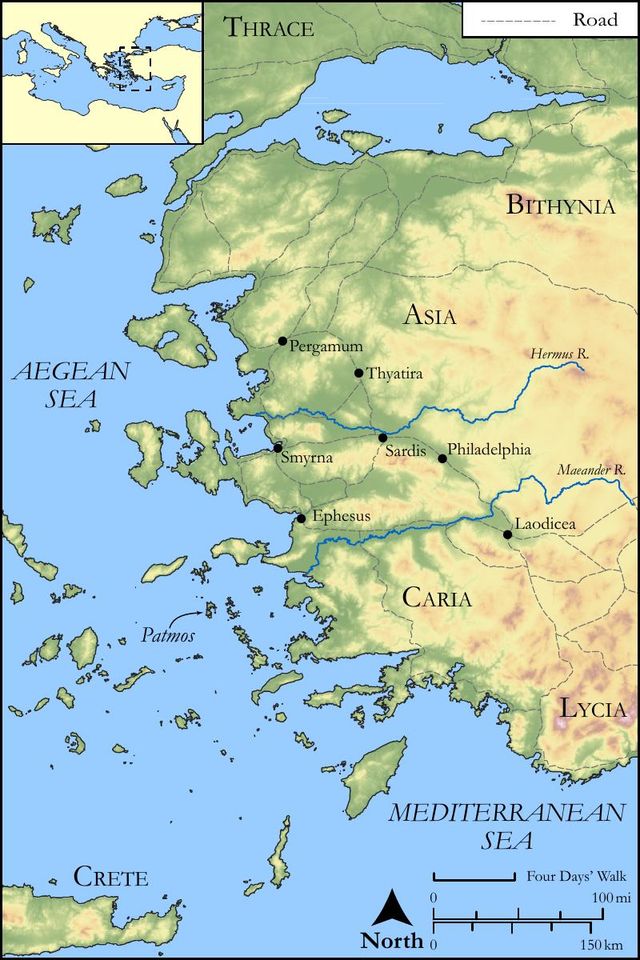
See on the biblical-era map

Study this verse
Public-domain commentary
Matthew Henry
From his Commentary on the Whole Bible. Henry comments on passages, not single verses — this entry covers Revelation 22:6–19.
We have here a solemn ratification of the contents of this book, and particularly of this last vision (though some think it may not only refer to the whole book, but to the whole New Testament, yea, to the whole Bible, completing and confirming the canon of scripture); and here, 1. This is confirmed by the name and nature of that God who gave out these discoveries: he is the Lord God, faithful and true, and so are all his sayings. 2. By the messengers he chose, to reveal these things to the world; the holy angels showed them to holy men of God; and God would not employ his saints and angels in deceiving the world. 3. They will soon be confirmed by their accomplishment: they are things that must shortly be done; Christ will make haste, he will come quickly, and put all things out of doubt; and then those will prove the wise and happy men who have believed and kept his words. 4. By the integrity of that angel who had been the apostle's guide and interpreter in these visions; this integrity was such that he not only refused to accept religious adoration from John, but once and again reproved him for it. He who was so tender of the honour of God, and so displeased with what was a wrong to God, would never come in his name to lead the people of God into mere dreams and delusions; and it is a still further confirmation of the sincerity of this apostle that he confesses his own sin and folly, into which he had now again relapsed, and he leaves this his failing on perpetual record: this shows he was a faithful and an impartial writer. 5. By the order given to leave the book of the prophecy open, to be perused by all, that they might labour to understand it, that they might make their objections against it, and compare the prophecy with the events. God here deals freely and openly with all; he does not speak in secret, but calls every one to witness to the declarations here made, Rev 22:10. 6. By the effect this book, thus kept open, will have upon men; those that are filthy and unjust will take occasion thence to be more so, but it will confirm, strengthen, and further sanctify those that are upright with God; it will be a savour of life to some and of death to others, and so will appear to be from God, Rev 22:12. 7. It will be Christ's rule of judgment at the great day; he will dispense rewards and punishments to men according as their works agree or disagree with the word of God; and therefore that word itself must needs be faithful and true. 8. It is the word of him who is the author, finisher, and rewarder of the faith and holiness of his people, Rev 22:13, Rev 22:14. He is the first and the last, and the same from first to last, and so is his word too; and he will by this word give to his people, who conform themselves to it, a right to the tree of life, and an entrance into heaven; and this will be a full confirmation of the truth and authority of his word, since it contains the title and evidence of that confirmed state of holiness and happiness that remains for his people in heaven. 9. It is a book that condemns and excludes from heaven all wicked, unrighteous persons, and particularly those that love and make lies (Rev 22:15), and therefore can never be itself a lie. 10. It is confirmed by the testimony of Jesus, which is the Spirit of prophecy. And this Jesus, as God, is the root of David, though, as man, his offspring - a person in whom all uncreated and created excellencies meet, too great and too good to deceive his churches and the world. He is the fountain of all light, the bright and the morning star, and as such has given to his churches this morning light of prophecy, to assure them of the light of that perfect day which is approaching. 11. It is confirmed by an open and general invitation to all to come and partake of the promises and privileges of the gospel, those streams of the water of life; these are tendered to all who feel in their souls a thirst which nothing in this world can quench. 12. It is confirmed by the joint testimony of the Spirit of God, and that gracious Spirit that is in all the true members of the church of God; the Spirit and the bride join in testifying the truth and excellency of the gospel. 13. It is confirmed by a most solemn sanction, condemning and cursing all who should dare to corrupt or change the word of God, either by adding to it or taking from it, Rev 22:18, Rev 22:19. He that adds to the word of God draws down upon himself all the plagues written in this book; and he who takes any thing away from it cuts himself off from all the promises and privileges of it. This sanction is like a flaming sword, to guard the canon of the scripture from profane hands. Such a fence as this God set about the law (Deu 4:2), and the whole Old Testament (Mal 4:4), and now in the most solemn manner about the whole Bible, assuring us that it is a book of the most sacred nature, divine authority, and of the last importance, and therefore the peculiar care of the great God.
Historical interpretation
Seven Centuries of Reception
7 surviving comments on this verse. Each one is dated, so this reads as a timeline rather than a list.
Select a marker to jump to its quote. Markers stagger vertically where authors wrote within a few decades of each other.
The blessed Blandina … rejoiced in her death as though she had been invited to a bridal banquet instead of being a victim of the beasts. After the scourges, the animals and the hot griddle, she was at last tossed into a net and exposed to a bull. After being tossed a good deal by the animal, she no longer perceived what was happening because of the hope and possession of all she believed in and because of her intimacy with Christ. Thus she too was offered in sacrifice.… But not even this was enough to satisfy their madness and their viciousness toward the Christians. For these wild and barbarous people once stirred up by the wild beast were difficult to satisfy, and their wickedness found another special form in what they did to the bodies of the dead. The [pagans] were not humiliated by their defeat, because they lacked human comprehension; rather, it enflamed their bestial anger, so that both the governor and the populace showed toward us the same undeserved hatred, that the Scriptures might be fulfilled: “Let the wicked be wicked and the righteous perform righteousness.”
“Let the wickedness of sinners be consummated.” In this context, “consummated” means “brought to completion,” in tune with what is said in the Apocalypse, “Let the righteous become more righteous yet, and the filthy still wallow in their filth.” The wickedness of those who crucified the Son of God seems to be complete, but greater still is the wickedness of those who do not wish to live uprightly and hate the commandments of truth for which the Son of God was crucified. The psalmist said, therefore, “Let the wickedness of sinners be consummated,” that is, let it come to the pinnacle of wickedness, so that the righteous judgment can come immediately.
He shows that the judgments of God by which evil people are allowed to become even more evil are hidden yet just. Yet here we ought not think that evil persons harm only others; they harm especially themselves. And therefore it continues, “Let him who is filthy be filthy still.” For to whom will that person be good who is harmful to himself?
The angel does not desire that sinners perish. He rather warns those who do iniquity so that hearing the sound of a celestial threat, they might wish to abstain from evil works. Moreover, that the righteous might be made even better, he says, “Let the righteous still do right, and the holy still be holy.” [He says this] that they might realize the imminent coming of the Lord and that they might more easily keep themselves from sin and from that time forward always devote themselves to holiness and righteousness.
[Herod knew that John the Baptist was a just man and kept him safe]. But his love for the woman prevailed, and she forced him to lay his hands on a man whom he knew to be holy and just. Since he was unwilling to restrain his lust, he incurred the guilt of homicide. What was a lesser sin for him became the cause of a greater sin. By God’s strict judgment it happened to him that, as a result of his craving for the adulteress whom he knew he ought to reject, he caused the shedding of the blood of the prophet, who he knew was pleasing to God. Now this is [an illustration of] the divine dispensation of judgment, of which it is said, “Let the evildoer still do evil, and the filthy still be filthy.” But what follows, “Let the holy still be holy,” is appropriate to the person of blessed John. Already holy, he became more holy still when, through his office of spreading the good news, he reached the palm of martyrdom.
He who is unjust, let him be unjust still; and he who is filthy, let him be filthy still. Here he shows the hidden, yet just, judgments of God, by which wicked men are allowed to progress to worse, that is, to reach the height of iniquity, so that a just judgment may be found. This is similar to: Either make the tree good and its fruit good, or else make the tree bad and its fruit bad (Matt. XII).
He says, let the unjust continue to do injustice still, and the filthy be filthy still. He does not command or order that they be unjust or be filthy, but says this: a little more time is still allowed to men; therefore let each one act as he pleases, and use his own free will as he wishes, whether for evil or for good. Therefore he further enjoins the righteous to continue to do righteousness, and the holy be holy still.
Continue studying Revelation 22:11 across the web’s major study libraries — every link below opens this exact verse, chapter, or book on the destination site.
Read & Compare
 BibleGatewayThis verse in more than 200 translations and 70 languages.
 Bible.comThe YouVersion reader — hundreds of translations, reading plans, and highlights.
 ESV.orgCrossway's official English Standard Version reader.
 NET BibleThe NET translation with 60,000+ translators' notes on every rendering decision.
 STEP BibleTyndale House's free study tool — original text, vocabulary, and scholarly resources.
 BibliaLogos Bible Software's free web reader.
 USCCBThe New American Bible (Revised Edition) with the U.S. bishops' study notes.
Commentaries
 BibleHub CommentariesDozens of classic commentaries on this verse, gathered on one page.
 StudyLightMore than 100 commentary sets — the largest collection on the web.
 BibleRefPlain-English commentary on what this verse means, verse by verse.
 Enduring WordDavid Guzik's free commentary on this chapter, widely used by Bible teachers.
 Bible Study ToolsVerse commentary alongside Greek and Hebrew study aids.
Original Language & Research
- BibleHub InterlinearThe verse word by word — original language, transliteration, and English.
- BibleHub LexiconEvery word's original-language definition and Strong's entry.
 Blue Letter BibleDeep-study tools — Strong's numbers, concordance, and word studies.
 CNTR CollationThe earliest Greek manuscripts of this verse, collated letter by letter.
Sermons, Hymns & Audio


TrulyRandomVerse is not affiliated with these sites and doesn’t control their content. They’re linked because they’re genuinely useful.
Summary
Revelation 22:11 delivers a profound and solemn declaration regarding the ultimate and unchangeable nature of human spiritual states. Far from being a command, this verse is a prophetic pronouncement that at a decisive, future moment, the opportunity for repentance and transformation will cease, and the moral and spiritual character of every individual will be eternally fixed. It underscores the finality of God's judgment and the permanent consequences of choices made during one's earthly life, highlighting the stark division between those who persist in unrighteousness and those who are found righteous and holy.
Context
ShowHideLiterary Context
This verse is situated within the concluding chapters of the book of Revelation, specifically in the final messages and warnings delivered by Jesus Christ Himself. It follows the glorious descriptions of the new heavens and new earth and the New Jerusalem, setting the stage for the book's ultimate climax. The immediate preceding verses include Jesus' repeated affirmation, "Behold, I come quickly!" found in Revelation 22:7 and Revelation 22:12, which frames this declaration as a declaration of what will occur at His imminent return. This declaration of fixed states precedes the final, gracious invitation to "take the water of life freely" in Revelation 22:17, creating a powerful juxtaposition between the present opportunity for salvation and the future cessation of that opportunity.
Historical & Cultural Context
The book of Revelation was written by John during a period of intense persecution of Christians under the Roman Empire, likely during the reign of Emperor Domitian (c. AD 95). Believers faced immense pressure to conform to imperial cult worship, which demanded allegiance to the emperor as a deity. This context of testing and tribulation informs the book's emphasis on perseverance, divine judgment, and the ultimate vindication of God's people. The concept of a fixed, eternal state, while deeply theological, would have resonated with a community grappling with the immediate consequences of their faith choices. The stark contrast between "unjust/filthy" and "righteous/holy" would have served as a powerful encouragement to remain steadfast in their moral and spiritual purity, knowing that their faithfulness, or lack thereof, would have eternal ramifications. The cultural backdrop of Roman power and its demands highlighted the urgency of choosing allegiance to Christ.
Key Themes
ShowHideThis verse powerfully contributes to several overarching themes found throughout Revelation and the broader biblical narrative. Firstly, it underscores the Finality of Moral State, proclaiming that at a specific eschatological point, the spiritual and moral condition of humanity will become irrevocably fixed, ending the period of grace and decision. Secondly, it highlights the Consequences of Choice, emphasizing the eternal weight of decisions made during one's earthly life, whether leading to unrighteousness and defilement or to righteousness and holiness. This aligns with the biblical principle that individuals are accountable for their actions, as seen in passages like Romans 2:6. Thirdly, it speaks to Divine Justice and Sovereignty, revealing God's ultimate authority to declare and establish the immutable state of all humanity, reflecting His perfect righteousness and judgment. Finally, while a declaration of finality, the verse implicitly serves as an Urgency of Repentance in the present, emphasizing the critical importance of responding to God's invitation for salvation and living righteously now, while the door of grace is still open, echoing the sentiment of 2 Corinthians 6:2.
Exposition and Analysis
ShowHideKey Word Analysis
ShowHideFrom adikos, meaning to be unjust, to do wrong, or to injure. In this context, it refers to a moral state of unrighteousness, actively engaging in or being characterized by injustice and wickedness, failing to conform to God's righteous standards.
From dikē, meaning equitable in character or act, innocent, or holy. It describes someone who is just, upright, and conforms to God's divine standard of righteousness, reflecting a state of moral integrity and alignment with God's will.
Meaning "yet" or "still" in terms of time or degree. In this verse, it emphasizes the continuation and permanence of the described states. It is not a command for individuals to remain as they are, but a prophetic declaration that at a certain point, these established character states will persist eternally without change.
Verse Breakdown
ShowHide"He that is unjust, let him be unjust still:"
This clause declares that those who have persistently chosen a path of unrighteousness and injustice will have that state permanently fixed. It signifies the cessation of the opportunity for repentance and change for those who have refused God's grace, sealing their character as unrighteous for eternity.
"and he which is filthy, let him be filthy still:"
Parallel to the first clause, this pronounces the eternal fixation of moral defilement for those who have embraced spiritual impurity. It underscores the lasting consequences of a life lived in rebellion against God's purity, where their state of spiritual uncleanness becomes irreversible.
"and he that is righteous, let him be righteous still:"
In stark contrast, this clause affirms the eternal security and permanence of righteousness for those who have been justified by faith and have pursued a life of uprightness. It assures believers that their standing before God, established through Christ, will be eternally preserved and confirmed.
"and he that is holy, let him be holy still."
Completing the parallel, this declaration guarantees the perpetual state of holiness for those who have been sanctified and set apart for God. It speaks to the enduring nature of their consecrated character, assuring them that their purity and devotion to God will be eternally maintained and perfected.
Literary Devices
ShowHideRevelation 22:11 employs several powerful literary devices to convey its solemn message. The most prominent is Parallelism, specifically Antithetical Parallelism, where contrasting ideas are presented in a similar structure. The verse juxtaposes "unjust" and "filthy" with "righteous" and "holy," highlighting the binary and mutually exclusive nature of these spiritual states. This stark contrast underscores the definitive separation between those who reject God and those who embrace Him. The repeated phrase "let him be... still" functions as an Anaphora, emphasizing the finality and immutability of these conditions. It is not an imperative command but a declarative Prophetic Pronouncement, signaling a future point of no return. The use of Chiasmus can also be observed in the structure, where the first two clauses ("unjust," "filthy") mirror the last two ("righteous," "holy") in their emphasis on fixed states, creating a balanced yet stark declaration of ultimate destinies.
Theological and Thematic Connections
ShowHideRevelation 22:11 stands as a profound theological statement on eschatological finality and divine justice. It reveals that God's patience and the season of grace, while expansive, are not infinite. There will come a definitive moment when the moral and spiritual trajectory of every human life is irrevocably sealed. This declaration is not about God actively making people unjust or righteous at that moment, but rather affirming the permanence of the choices they have already made. It underscores the biblical truth of human accountability and the ultimate realization of God's righteous judgment, where character formed in life becomes destiny in eternity. This verse serves as a powerful reminder of the urgency of repentance and faith in the present, for the opportunity to change will not last forever.
Reflection and Application
ShowHideRevelation 22:11 serves as a deeply sobering yet profoundly motivating verse for personal reflection and application. It forces us to confront the reality of eternal consequences and the finite nature of our time to respond to God's grace. For those who have not yet committed their lives to Christ or who persist in patterns of sin, this verse is an urgent call to immediate repentance and faith. The "still" implies a fixed state, not an ongoing opportunity for change. It reminds us that procrastination in spiritual matters carries eternal peril. For believers, it is both an affirmation and a challenge. It affirms the security of our salvation and the permanence of our righteous standing in Christ, encouraging us to persevere in holiness. Simultaneously, it challenges us to live out our righteous and holy identity with greater intentionality, recognizing that our present choices are shaping our eternal character. It compels us to examine our lives: are we actively pursuing righteousness and holiness, or are we drifting towards spiritual indifference and defilement? The verse underscores the immense value of the present moment as the "acceptable time" for salvation and sanctification.
Questions for Reflection
ShowHideFAQ
ShowHideDoes Revelation 22:11 mean God wants people to remain in their sin?
ShowHideNo, absolutely not. This verse is not a divine command for people to remain in their current moral or spiritual state. Instead, it is a prophetic declaration about a future, decisive point in time when the opportunity for repentance and change will cease. It describes the ultimate consequence of choices made during one's lifetime. God's desire is always for all people to come to repentance and be saved, as expressed in 2 Peter 3:9. The verse highlights the finality of human decisions, not a divine preference for unrighteousness.
When will this "fixed state" occur?
ShowHideThe verse does not specify an exact chronological moment, but the context of Revelation 22 suggests it is intimately connected with the second coming of Christ and the final judgment. Passages like Revelation 22:7 and Revelation 22:12, where Jesus declares, "Behold, I come quickly," immediately surround this verse. This implies that the sealing of destinies will occur at or around the time of His return, marking the end of the age of grace and the beginning of eternal states. It aligns with the broader biblical teaching that judgment follows death or Christ's return, as seen in Hebrews 9:27.
Christ-Centered Fulfillment
ShowHideWhile Revelation 22:11 declares a future reality of fixed spiritual states, its profound Christ-centered fulfillment lies in how believers achieve the "righteous" and "holy" state that is eternally sealed. Humanity's natural state is "unjust" and "filthy" due to sin, as affirmed by Romans 3:23. However, the gospel reveals that through faith in Jesus Christ, the "unjust" can be declared "righteous." Christ Himself became sin for us so that "in Him we might become the righteousness of God," as powerfully stated in 2 Corinthians 5:21. His atoning sacrifice on the cross cleanses us from all "filthiness," making us holy and blameless before God, a truth echoed in Ephesians 1:4. Therefore, the eternal sealing of the righteous and holy is not based on human merit but on the finished work of Christ, who justifies and sanctifies His people. He is the source of our righteousness (Philippians 3:9) and the one who sets us apart as holy (Hebrews 10:10). Thus, Revelation 22:11 ultimately points to the glorious and permanent security found in Christ, whose work ensures that those who are "in Him" will indeed be "righteous still" and "holy still" for eternity.