


1 Peter 4:7
Bible text: King James Version (1769 Blayney text) · Public domain
Bible text: Berean Standard Bible · Public domain
Bible text: American Standard Version (1901) · Public domain
Bible text: World English Bible, Messianic edition · Public domain
Bible text: Geneva Bible (1599) · Public domain
Bible text: Young's Literal Translation · Public domain
- ΠάντωνPantōnOf allG3956A-GPNAdjective Genitive Plural Neuter
- δὲdenowG1161CONJConjunction
- τὸtotheG3588T-NSNDefinite article Nominative Singular Neuter
- τέλοςtelosendG5056N-NSNNoun Nominative Singular Neuter
- ἤγγικεν·ēngikenhas drawn nearG1448V-RAI-3SVerb Perfect Active Indicative 3rd Singular
- σωφρονήσατεsōphronēsatedo be clear-mindedG4993V-AAM-2PVerb Aorist Active Imperative 2nd Plural
- οὖνounthereforeG3767CONJConjunction
- καὶkaiandG2532CONJConjunction
- νήψατεnēpsatedo soberG3525V-AAM-2PVerb Aorist Active Imperative 2nd Plural
- εἰςeisfor the purpose ofG1519PREPPreposition
- τὰςtas<the>G3588T-APFDefinite article Accusative Plural Feminine
- προσευχάςproseuchasprayersG4335N-APFNoun Accusative Plural Feminine
English is a literal word-by-word gloss of the Greek, not the KJV's wording. Why?
This is the original text the KJV's translators worked from — each Greek word with its own literal English meaning in this verse, prepared by scholars at Tyndale House, Cambridge. The KJV translates whole sentences, not word by word, so its wording differs: one Greek word can become several English words, and the KJV may choose “charity” where the gloss reads “love”. Both are faithful — they answer different questions. For the KJV's own rendering, switch to the KJV text.
Details
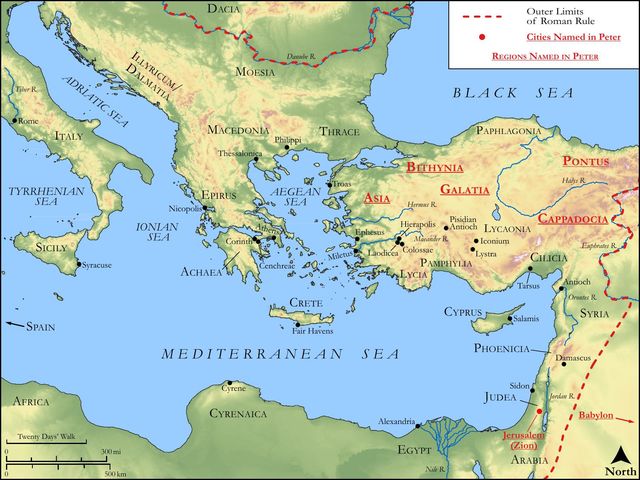
See on the biblical-era maps

Study this verse
Public-domain commentary
Matthew Henry
From his Commentary on the Whole Bible. Henry comments on passages, not single verses — this entry covers 1 Peter 4:7–11. His four-level outline is real structure in the source text, so it is rendered as structure.
We have here an awful position or doctrine, and an inference drawn from it. The position is that the end of all things is at hand. The miserable destruction of the Jewish church and nation foretold by our Saviour is now very near; consequently, the time of their persecution and your sufferings is but very short. Your own life and that of your enemies will soon come to their utmost period. Nay, the world itself will not continue very long. The conflagration will put an end to it; and all things must be swallowed up in an endless eternity. The inference from this comprises a series of exhortations.
1.To sobriety and watchfulness: "Be you therefore sober, Pe1 4:7. Let the frame and temper of your minds be grave, stayed, and solid; and observe strict temperance and sobriety in the use of all worldly enjoyments. Do not suffer yourselves to be caught with your former sins and temptations, Pe1 4:3. An watch unto prayer. Take care that you be continually in a calm sober disposition, fit for prayer; and that you be frequent in prayers, lest this end come upon you unawares," Luk 21:34; Mat 26:40, Mat 26:41. Learn,
(1.)The consideration of our approaching end is a powerful argument to make us sober in all worldly matters, and earnest in religious affairs.
(2.)Those who would pray to purpose must watch unto prayer. They must watch over their own spirits, watch all fit opportunities, and do their duty in the best manner they can.
(3.)The right ordering of the body is of great use to promote the good of the soul. When the appetites and inclinations of the body are restrained and governed by God's word and true reason, and the interests of the body are submitted to the interests and necessities of the soul, then it is not the soul's enemy, but its friend and helper.
2.To charity: And above all things have fervent charity among yourselves, Pe1 4:8. Here is a noble rule in Christianity. Christians ought to love one another, which implies an affection to their persons, a desire of their welfare, and a hearty endeavour to promote it. This mutual affection must not be cold, but fervent, that is, sincere, strong, and lasting. This sort of earnest affection is recommended above all things, which shows the importance of it, Col 3:14. It is greater than faith or hope, Co1 13:13. One excellent effect of it is that it will cover a multitude of sins. Learn,
(1.)There ought to be in all Christians a more fervent charity towards one another than towards other men: Have charity among yourselves. He does not say for pagans, for idolaters, or for apostates, but among yourselves. Let brotherly love continue, Heb 13:1. There is a special relation between all sincere Christians, and a particular amiableness and good in them, which require special affection.
(2.)It is not enough for Christians not to bear malice, nor to have common respect for one another, they must intensely and fervently love each other.
(3.)It is the property of true charity to cover a multitude of sins. It inclines people to forgive and forget offences against themselves, to cover and conceal the sins of others, rather than aggravate them and spread them abroad. It teaches us to love those who are but weak, and who have been guilty of many evil things before their conversion; and it prepares for mercy at the hand of God, who hath promised to forgive those that forgive others, Mat 6:14.
3.To hospitality, Pe1 4:9. The hospitality here required is a free and kind entertainment of strangers and travellers. The proper objects of Christian hospitality are one another. The nearness of their relation, and the necessity of their condition in those times of persecution and distress, obliged Christians to be hospitable one to another. Sometimes Christians were spoiled of all they had, and were driven away to distant countries for safety. In this case they must starve if their fellow-christians would not receive them. Therefore it was a wise and necessary rule which the apostle here laid down. It is elsewhere commanded, Heb 13:1, Heb 13:2; Rom 12:13. The manner of performing this duty is this: it must be done in an easy, kind, handsome manner, without grudging or grumbling at the expense or trouble. Learn,
(1.)Christians ought not only to be charitable, but hospitable, one to another.
(2.)Whatever a Christian does by way of charity or of hospitality, he ought to do it cheerfully, and without grudging. Freely you have received, freely give.
4.To the improvement of talents, Pe1 4:11.
(1.)The rule is that whatever gift, ordinary or extraordinary, whatever power, ability, or capacity of doing good is given to us, we should minister, or do service, with the same one to another, accounting ourselves not masters, but only stewards of the manifold grace, or the various gifts, of God. Learn,
[1.]Whatever ability we have of doing good we must own it to be the gift of God and ascribe it to his grace.
[2.]Whatever gifts we have received, we ought to look upon them as received for the use one of another. We must not assume them to ourselves, nor hide them in a napkin, but do service with them one to another in the best manner we are able.
[3.]In receiving and using the manifold gifts of God we must look upon ourselves as stewards only, and act accordingly. The talents we are entrusted with are our Lord's goods, and must be employed as he directs. And it is required in a steward that he be found faithful.
(2.)The apostle exemplifies his direction about gifts in two particulars - speaking and ministering, concerning which he gives these rules: - [1.] If any man, whether a minister in public or a Christian in private conference, speak or teach, he must do it as the oracles of God, which direct us as to the matter of our speech. What Christians in private, or ministers in public, teach and speak must be the pure word and oracles of God. As to the manner of speaking, it must be with the seriousness, reverence, and solemnity, that become those holy and divine oracles. [2.] If any man minister, either as a deacon, distributing the alms of the church and taking care of the poor, or as a private person, by charitable gifts and contributions, let him do it as of the ability which God giveth. He who has received plenty and ability from God ought to minister plentifully, and according to his ability. These rules ought to be followed and practised for this end, that God in all things, in all your gifts, ministrations, and services, may be glorified, that others may see your good works, and glorify your Father who is in heaven (Mat 5:16), through Jesus Christ, who has procured and given these gifts to men (Eph 4:8), and through whom alone we and our services are accepted of God (Heb 13:15), to whom, Jesus Christ, be praise and dominion for ever and ever. Amen. Learn, First, It is the duty of Christians in private, as well as ministers in public, to speak to one another of the things of God, Mal 3:16; Eph 4:29; Psa 145:10-12. Secondly, It highly concerns all preachers of the gospel to keep close to the word of God, and to treat that word as becomes the oracles of God. Thirdly, Christians must not only do the duty of their place, but they must do it with vigour, and according to the best of their abilities. The nature of a Christian's work, which is high work and hard work, the goodness and kindness of the Master, and the excellency of the reward, all require that our endeavours should be serious and vigorous, and that whatever we are called to do for the honour of God and the good of others we should do it with all our might. Fourthly, In all the duties and services of life we should aim at the glory of God as our chief end; all other views must be subservient to this, which would sanctify our common actions and affairs, Co1 10:31. Fifthly, God is not glorified by any thing we do if we do not offer it to him through the mediation and merits of Jesus Christ. God in all things must be glorified through Jesus Christ, who is the only way to the Father. Sixthly, The apostle's adoration of Jesus Christ, and ascribing unlimited and everlasting praise and dominion to him, prove that Jesus Christ is the most high God, over all blessed for evermore. Amen.
Historical interpretation
Nine Centuries of Reception
6 surviving comments on this verse. Each one is dated, so this reads as a timeline rather than a list.
Select a marker to jump to its quote. Markers stagger vertically where authors wrote within a few decades of each other.
And let us imitate the Lord, "who, when He was reviled, reviled not again ; " when He was crucified, He answered not; "when He suffered, He threatened not ; " but prayed for His enemies, "Father, forgive them; they know not what they do." If any one, the more he is injured, displays the more patience, blessed is he. If any one is defrauded, if any one is despised, for the name of the Lord, he truly is the servant of Christ. Take heed that no plant of the devil be found among you, for such a plant is bitter and salt. "Watch ye, and be ye sober," in Christ Jesus.
"For whosoever does not confess that Jesus Christ has come in the flesh, is antichrist;" and whosoever does not confess the testimony of the cross, is of the devil; and whosoever perverts the oracles of the Lord to his own lusts, and says that there is neither a resurrection nor a judgment, he is the first-born of Satan. Wherefore, forsaking the vanity of many, and their false doctrines, let us return to the word which has been handed down to us from the beginning; "watching unto prayer," and persevering in fasting; beseeching in our supplications the all-seeing God "not to lead us into temptation," as the Lord has said: "The spirit truly is willing, but the flesh is weak."
Peter is saying that once the gospel has been preached to the Gentiles the end will have come.
Be therefore prudent, etc. And the Lord in the Gospel has commanded us to always pray and watch, in view of the uncertain end. For he says, speaking of the day of judgment: Watch therefore, praying continually, that you may be accounted worthy to escape all these things that shall come to pass, and to stand before the Son of Man (Luke XXI). But we are rightly ordered to watch in prayers, so that when we stand for prayer, all carnal and secular thought may depart, nor should the mind then think of anything except what it is praying for. For often the enemy sneaks in and subtly deceiving, distracts our prayers so that we both have one thing in our heart and utter another with our voice, whereas with sincere intention, it is not the sound of the voice but the sense of the soul that ought to pray to God.
The end of all things is near. Let no one soothe themselves with the delay of the future judgment, in which he said that the living and the dead were to be judged; he prudently warns, for although the coming of the final judgment is uncertain, it is certain to all that in this mortal life they cannot long endure.
The end of all things is at hand. Therefore, be sober and watchful in prayer. Above all, keep fervent in your love for one another, because love covers a multitude of sins. Be hospitable to one another without complaint.
The end, that is, completion, consummation or the end of all the prophets is said to be imminent: however, the true word is Christ, for He is the perfection of all. And not as the Greeks rave, who indeed say that pleasure is the end, like Epicurus, while others say wisdom or contemplation or virtue. Therefore, since perfection has come in Christ, Peter also says, having been made conformable to this perfection, present yourselves in all things without defect in sobriety, in vigilance for prayers (for the prayer of the sober or the watchful, and not of those who are held by the drunkenness of worldly things), in love for one another. Paul, however, says that this is the change of the law (Rom. 13:10): here indeed that it may cover sins. For mercy towards one's neighbor makes God merciful to us. This mercy would never proceed to what is righteous, unless it is out of great love. But where he mentions love, he also adds that those who are endowed with love, namely hospitality, which he commands to be shown without complaint; for this is the essence of true love.
"love covers a multitude." This means persevering and enduring and stretched out over a long period.
Continue studying 1 Peter 4:7 across the web’s major study libraries — every link below opens this exact verse, chapter, or book on the destination site.
Read & Compare
 BibleGatewayThis verse in more than 200 translations and 70 languages.
 Bible.comThe YouVersion reader — hundreds of translations, reading plans, and highlights.
 ESV.orgCrossway's official English Standard Version reader.
 NET BibleThe NET translation with 60,000+ translators' notes on every rendering decision.
 STEP BibleTyndale House's free study tool — original text, vocabulary, and scholarly resources.
 BibliaLogos Bible Software's free web reader.
 USCCBThe New American Bible (Revised Edition) with the U.S. bishops' study notes.
Commentaries
 BibleHub CommentariesDozens of classic commentaries on this verse, gathered on one page.
 StudyLightMore than 100 commentary sets — the largest collection on the web.
 BibleRefPlain-English commentary on what this verse means, verse by verse.
 Enduring WordDavid Guzik's free commentary on this chapter, widely used by Bible teachers.
 Bible Study ToolsVerse commentary alongside Greek and Hebrew study aids.
Original Language & Research
- BibleHub InterlinearThe verse word by word — original language, transliteration, and English.
- BibleHub LexiconEvery word's original-language definition and Strong's entry.
 Blue Letter BibleDeep-study tools — Strong's numbers, concordance, and word studies.
 CNTR CollationThe earliest Greek manuscripts of this verse, collated letter by letter.
Sermons, Hymns & Audio


TrulyRandomVerse is not affiliated with these sites and doesn’t control their content. They’re linked because they’re genuinely useful.
Summary
The Apostle Peter, writing to believers undergoing trials, shifts focus from suffering to practical living in light of ultimate realities. He declares the imminent "end of all things" as the urgent motivation for Christians to cultivate spiritual discipline: to be clear-headed and self-controlled (sober-minded), and to remain vigilant and devoted to prayer, preparing themselves spiritually for the culmination of God's redemptive plan.
Context
ShowHideLiterary Context
This verse marks a significant transition in Peter's epistle. In 1 Peter 4:1-6, Peter has just exhorted his readers to adopt Christ's mindset regarding suffering, urging them to cease from sin and live for the will of God rather than human passions. He contrasts their past pagan lifestyle with their new life in Christ, even noting the judgment awaiting those who persecute believers. 1 Peter 4:7 then introduces the eschatological motive for such a transformed life, providing the ultimate impetus for the practical instructions that follow concerning spiritual gifts and Christian community in 1 Peter 4:8-11. The "therefore" (οὖν, oûn) explicitly links the commands that follow to the preceding declaration of the end's nearness.
Historical & Cultural Context
Peter's audience consisted primarily of scattered believers in Asia Minor (modern-day Turkey), facing various forms of social ostracism and nascent persecution (1 Peter 1:1). The Roman Empire, while generally tolerant of diverse religions, viewed Christianity with suspicion due to its exclusive claims and refusal to participate in emperor worship or pagan rituals. This put Christians in a precarious position, often leading to public slander and social pressure. In this environment, the call to "be sober" and "watch unto prayer" was not merely a general spiritual admonition but a vital directive for survival and faithfulness amidst external pressures and internal temptations. The early church lived with a keen awareness of Christ's imminent return and the consummation of history, a perspective that shaped their ethics and endurance.
Key Themes
ShowHideThe verse powerfully contributes to several overarching themes in 1 Peter. Firstly, Eschatological Urgency is paramount; the declaration that "the end of all things is at hand" (Greek: engízō, G1448) underscores the New Testament's consistent emphasis on living in light of Christ's return and the final judgment, a theme echoed by Christ Himself in Matthew 24:36-44. Secondly, Holiness and Self-Control are central, as the command to "be sober" (Greek: sōphronéō, G4993) calls believers to a disciplined, clear-minded lifestyle, free from worldly intoxication and distraction, aligning with the call to be holy as God is holy in 1 Peter 1:15-16. Lastly, Dependence on God through Prayer is highlighted; "watch unto prayer" (Greek: nḗphō G3525 and proseuchḗ G4335) emphasizes the necessity of vigilant, fervent prayer as the means by which believers sustain their spiritual vitality and discernment in a challenging world, a theme consistently found throughout the New Testament, as seen in Ephesians 6:18.
Exposition and Analysis
ShowHideKey Word Analysis
ShowHideFrom a primary (to set out for a definite point or goal); properly, the point aimed at as a limit, i.e. (by implication) the conclusion of an act or state (termination (literally, figuratively or indefinitely), result (immediate, ultimate or prophetic), purpose); specially, an impost or levy (as paid). This word signifies not merely a chronological termination but the consummation, goal, or ultimate purpose of all things. It points to the divinely ordained conclusion of history and God's redemptive plan.
From ἐγγύς; to make near, i.e. (reflexively) approach:--approach, be at hand, come (draw) near, be (come, draw) nigh. This verb conveys a sense of imminence and nearness, not necessarily immediate arrival, but a state of drawing close. It implies that the decisive events leading to the consummation have already begun with Christ's first coming, and the final stages are perpetually approaching.
From σώφρων; to be of sound mind, i.e. sane, (figuratively) moderate:--be in right mind, be sober (minded), soberly. This term calls for mental clarity, self-control, sound judgment, and moderation. It implies a disciplined mind, free from the intoxicating influences of worldly anxieties, sinful desires, or spiritual lethargy, allowing for discernment and right action.
Of uncertain affinity; to abstain from wine (keep sober), i.e. (figuratively) be discreet:--be sober, watch. While literally meaning to abstain from wine, here it is used figuratively to mean spiritual vigilance and alertness. It is a call to be clear-headed, awake, and attentive to spiritual realities, guarding against spiritual drowsiness or distraction.
Verse Breakdown
ShowHide"But the end of all things is at hand"
This opening clause establishes the foundational motivation for the commands that follow. The conjunction "But" (G1161 dé) introduces a shift in focus, linking the preceding discussion of suffering and judgment to the urgent reality of the eschatological climax. The "end of all things" (G5056 télos of G3956 pâs) refers to the divinely appointed consummation of history, the final stage of God's redemptive plan. The phrase "is at hand" (G1448 engízō) emphasizes its nearness and urgency, indicating that the decisive period has begun and is continually drawing closer, demanding a specific response from believers.
"be ye therefore sober"
The particle "therefore" (G3767 oûn) logically connects the command to the preceding declaration. Because the end is near, believers are called to be "sober" (G4993 sōphronéō). This is an imperative for mental and spiritual discipline, urging believers to exercise self-control, clear thinking, and sound judgment. It implies a state of mind unclouded by worldly distractions, anxieties, or sinful excesses, enabling them to discern God's will and live righteously amidst the pressures of the world.
"and watch unto prayer"
This second imperative, linked by "and" (G2532 kaí), specifies another crucial response to the impending end. "Watch" (G3525 nḗphō) means to be vigilant, alert, and spiritually awake, guarding against spiritual drowsiness or complacency. This vigilance is specifically directed "unto prayer" (G1519 eis G4335 proseuchḗ), indicating that fervent, focused prayer is the primary means by which believers maintain their spiritual alertness, strength, and communion with God as they await the consummation of all things. It underscores prayer as an active, vigilant engagement with the divine.
Literary Devices
ShowHidePeter employs several powerful literary devices to convey his urgent message. The verse begins with a stark declarative statement ("But the end of all things is at hand"), immediately establishing a sense of eschatological urgency that serves as the bedrock for the subsequent commands. The use of the imperative mood ("be ye therefore sober, and watch") directly and forcefully calls the readers to action, highlighting the non-negotiable nature of these spiritual disciplines. The connecting particle "therefore" (οὖν) functions as a strong logical connector, creating a clear cause-and-effect relationship: because the end is near, therefore these actions are necessary. There is a subtle parallelism between "sober" and "watch," as both terms relate to a state of mental and spiritual alertness, with "watch" specifically channeling that alertness into "prayer," creating a focused trajectory for spiritual discipline. The entire verse functions as a concise exhortation, urging believers to live with intentionality and spiritual preparedness in light of ultimate realities.
Theological and Thematic Connections
ShowHide1 Peter 4:7 encapsulates a core New Testament theological principle: eschatology shapes ethics. The belief in the imminent return of Christ and the consummation of God's kingdom is not merely a doctrinal point but a profound motivator for righteous living. Peter teaches that an awareness of the "end of all things" should not lead to fear or idleness, but to heightened spiritual discipline, self-control, and an intensified prayer life. This sober vigilance is essential for navigating the challenges of a fallen world and for enduring persecution, ensuring that believers remain faithful and prepared for their Lord's coming. It underscores the active, ongoing responsibility of the Christian to live in light of eternity, cultivating a deep dependence on God through constant communion.
Reflection and Application
ShowHideIn a world increasingly marked by uncertainty, distraction, and spiritual apathy, 1 Peter 4:7 serves as a timeless call to spiritual intentionality. The "end of all things" is not just a distant theological concept but a present reality that should shape our daily choices. Whether it refers to the ultimate return of Christ or the conclusion of our individual lives, the brevity of time demands a life lived with purpose and spiritual focus. Being "sober" means cultivating a mind that is clear, discerning, and self-controlled, resisting the intoxicating influences of consumerism, fleeting pleasures, or overwhelming anxieties. This mental clarity then fuels our "watchfulness unto prayer," transforming prayer from a mere ritual into a vital lifeline—a constant, vigilant communion with God that strengthens us, guides us, and prepares us for whatever the future holds. This verse challenges us to re-evaluate our priorities, ensuring that our lives are aligned with eternal values and marked by a fervent pursuit of God.
Questions for Reflection
ShowHideFAQ
ShowHideWhat does "the end of all things is at hand" truly mean? Does it imply an immediate, literal end?
ShowHideThe phrase "the end of all things is at hand" (Greek: télos G5056 and engízō G1448) signifies a profound sense of imminence and nearness, rather than a precise chronological prediction of an immediate, literal end. In New Testament eschatology, "the end" refers to the consummation of God's redemptive plan, which was inaugurated with Christ's first coming, His death, resurrection, and ascension. The decisive battle against sin and death has been won, and the final stages of God's kingdom are continually drawing closer. This perspective creates an urgent motivation for believers to live righteously, as the culmination of history is perpetually approaching, whether through Christ's ultimate return or their own individual passing. It's a call to live with an eternal perspective, always prepared.
Is "sober" in this verse only about abstaining from alcohol?
ShowHideWhile the Greek word nḗphō (G3525), translated as "watch" here, can literally mean to abstain from wine, the primary term "sober" (Greek: sōphronéō G4993) in 1 Peter 4:7 has a much broader, figurative meaning. It refers to a state of mental and spiritual clarity, self-control, and sound judgment. It means to be "of sound mind," free from the intoxicating influences of worldly anxieties, sinful desires, emotional excesses, or any spiritual drowsiness that would hinder one's discernment and faithfulness. While it certainly includes physical sobriety, its main emphasis is on a disciplined, clear-headed approach to life in all its aspects, enabling one to live wisely and righteously in light of God's truth.
Christ-Centered Fulfillment
ShowHide1 Peter 4:7 finds its ultimate fulfillment and deepest meaning in Christ. The "end of all things" is at hand precisely because Christ has come, inaugurating the new covenant and setting in motion the final stages of God's redemptive plan. His first advent was the decisive turning point in history, and His promised return (John 14:3) is the ultimate consummation towards which all creation groans. Christ Himself perfectly exemplified "sober-mindedness" and "watchfulness unto prayer." He lived with unparalleled clarity of purpose, unswayed by worldly temptations or distractions, always focused on His Father's will (John 4:34). His life was characterized by fervent prayer, often withdrawing to solitary places to commune with God (Mark 1:35). Therefore, the commands in this verse are not merely abstract disciplines but a call to imitate Christ, to live in Him and through Him, empowered by His Spirit, as we await His glorious appearing (Titus 2:11-14). Our sobriety and prayerfulness are a participation in His own vigilant and purposeful life, preparing us to stand blameless on the day of His return (Philippians 1:9-10).