


Revelation 22:9
Bible text: King James Version (1769 Blayney text) · Public domain
Bible text: King James Version with Strong's numbers · Public domain
Bible text: Berean Standard Bible · Public domain
Bible text: American Standard Version (1901) · Public domain
Bible text: World English Bible, Messianic edition · Public domain
Bible text: Geneva Bible (1599) · Public domain
Bible text: Young's Literal Translation · Public domain
- καὶkaiAndG2532CONJConjunction
- λέγειlegeihe saysG3004V-PAI-3SVerb Present Active Indicative 3rd Singular
- μοι·moito meG3165P-1DSPersonal pronoun Dative 1st Singular
- ὅραhorado see that youG3708V-PAM-2SVerb Present Active Imperative 2nd Singular
- μήmē[do] notG3361PRT-NNegative Particle Negative
- σύνδουλόςsundoulosFellow servantG4889N-NSMNoun Nominative Singular Masculine
- σούsouof youG4771P-2GSPersonal pronoun Genitive 2nd Singular
- γὰρgarforG1063CONJConjunction
- εἰμιeimiI amG1510V-PAI-1SVerb Present Active Indicative 1st Singular
- καὶkaiandG2532CONJConjunction
- τῶνtōnwith theG3588T-GPMDefinite article Genitive Plural Masculine
- ἀδελφῶνadelphōnbrothersG80N-GPMNoun Genitive Plural Masculine
- σουsouof youG4771P-2GSPersonal pronoun Genitive 2nd Singular
- τῶνtōntheG3588T-GPMDefinite article Genitive Plural Masculine
- προφητῶνprophētōnprophetsG4396N-GPMNoun Genitive Plural Masculine
- καὶkaiandG2532CONJConjunction
- τῶνtōnwith thoseG3588T-GPMDefinite article Genitive Plural Masculine
- τηρούντωνtērountōnkeepingG5083V-PAP-GPMVerb Present Active Participle Genitive Plural Masculine
- τοὺςtoustheG3588T-APMDefinite article Accusative Plural Masculine
- λόγουςlogouswordsG3056N-APMNoun Accusative Plural Masculine
- τοῦtouof theG3588T-GSNDefinite article Genitive Singular Neuter
- βιβλίουbiblioubookG975N-GSNNoun Genitive Singular Neuter
- τούτου·toutouthisG3778D-GSNDemonstrative pronoun Genitive Singular Neuter
- τῷtō<the>G3588T-DSMDefinite article Dative Singular Masculine
- θεῷtheōGodG2316N-DSM-TNoun Dative Singular Masculine Title
- προσκύνησονproskunēsondo worshipG4352V-AAM-2SVerb Aorist Active Imperative 2nd Singular
English is a literal word-by-word gloss of the Greek, not the KJV's wording. Why?
This is the original text the KJV's translators worked from — each Greek word with its own literal English meaning in this verse, prepared by scholars at Tyndale House, Cambridge. The KJV translates whole sentences, not word by word, so its wording differs: one Greek word can become several English words, and the KJV may choose “charity” where the gloss reads “love”. Both are faithful — they answer different questions. For the KJV's own rendering, switch to the KJV text.
Details
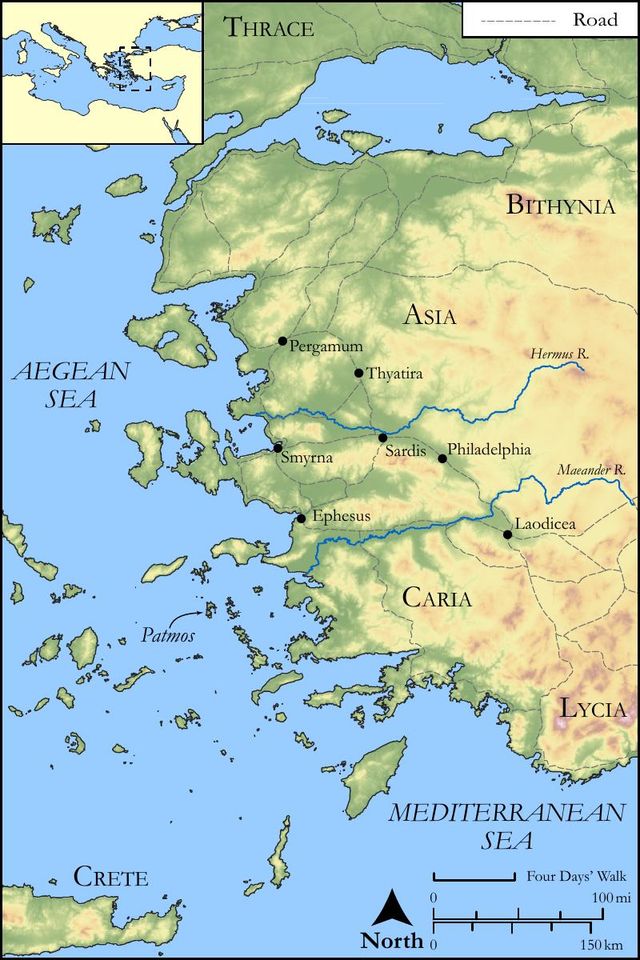
See on the biblical-era maps

Study this verse
Public-domain commentary
Matthew Henry
From his Commentary on the Whole Bible. Henry comments on passages, not single verses — this entry covers Revelation 22:6–19.
We have here a solemn ratification of the contents of this book, and particularly of this last vision (though some think it may not only refer to the whole book, but to the whole New Testament, yea, to the whole Bible, completing and confirming the canon of scripture); and here, 1. This is confirmed by the name and nature of that God who gave out these discoveries: he is the Lord God, faithful and true, and so are all his sayings. 2. By the messengers he chose, to reveal these things to the world; the holy angels showed them to holy men of God; and God would not employ his saints and angels in deceiving the world. 3. They will soon be confirmed by their accomplishment: they are things that must shortly be done; Christ will make haste, he will come quickly, and put all things out of doubt; and then those will prove the wise and happy men who have believed and kept his words. 4. By the integrity of that angel who had been the apostle's guide and interpreter in these visions; this integrity was such that he not only refused to accept religious adoration from John, but once and again reproved him for it. He who was so tender of the honour of God, and so displeased with what was a wrong to God, would never come in his name to lead the people of God into mere dreams and delusions; and it is a still further confirmation of the sincerity of this apostle that he confesses his own sin and folly, into which he had now again relapsed, and he leaves this his failing on perpetual record: this shows he was a faithful and an impartial writer. 5. By the order given to leave the book of the prophecy open, to be perused by all, that they might labour to understand it, that they might make their objections against it, and compare the prophecy with the events. God here deals freely and openly with all; he does not speak in secret, but calls every one to witness to the declarations here made, Rev 22:10. 6. By the effect this book, thus kept open, will have upon men; those that are filthy and unjust will take occasion thence to be more so, but it will confirm, strengthen, and further sanctify those that are upright with God; it will be a savour of life to some and of death to others, and so will appear to be from God, Rev 22:12. 7. It will be Christ's rule of judgment at the great day; he will dispense rewards and punishments to men according as their works agree or disagree with the word of God; and therefore that word itself must needs be faithful and true. 8. It is the word of him who is the author, finisher, and rewarder of the faith and holiness of his people, Rev 22:13, Rev 22:14. He is the first and the last, and the same from first to last, and so is his word too; and he will by this word give to his people, who conform themselves to it, a right to the tree of life, and an entrance into heaven; and this will be a full confirmation of the truth and authority of his word, since it contains the title and evidence of that confirmed state of holiness and happiness that remains for his people in heaven. 9. It is a book that condemns and excludes from heaven all wicked, unrighteous persons, and particularly those that love and make lies (Rev 22:15), and therefore can never be itself a lie. 10. It is confirmed by the testimony of Jesus, which is the Spirit of prophecy. And this Jesus, as God, is the root of David, though, as man, his offspring - a person in whom all uncreated and created excellencies meet, too great and too good to deceive his churches and the world. He is the fountain of all light, the bright and the morning star, and as such has given to his churches this morning light of prophecy, to assure them of the light of that perfect day which is approaching. 11. It is confirmed by an open and general invitation to all to come and partake of the promises and privileges of the gospel, those streams of the water of life; these are tendered to all who feel in their souls a thirst which nothing in this world can quench. 12. It is confirmed by the joint testimony of the Spirit of God, and that gracious Spirit that is in all the true members of the church of God; the Spirit and the bride join in testifying the truth and excellency of the gospel. 13. It is confirmed by a most solemn sanction, condemning and cursing all who should dare to corrupt or change the word of God, either by adding to it or taking from it, Rev 22:18, Rev 22:19. He that adds to the word of God draws down upon himself all the plagues written in this book; and he who takes any thing away from it cuts himself off from all the promises and privileges of it. This sanction is like a flaming sword, to guard the canon of the scripture from profane hands. Such a fence as this God set about the law (Deu 4:2), and the whole Old Testament (Mal 4:4), and now in the most solemn manner about the whole Bible, assuring us that it is a book of the most sacred nature, divine authority, and of the last importance, and therefore the peculiar care of the great God.
Historical interpretation
Seven Centuries of Reception
7 surviving comments on this verse. Each one is dated, so this reads as a timeline rather than a list.
Select a marker to jump to its quote. Markers stagger vertically where authors wrote within a few decades of each other.
This is the Judge and the Avenger, beloved brothers, that we are to await who, when he revenges himself, is destined to revenge us, the people of his church, and the number of all the just from the beginning of the world. Let him who hastens and hurries too much to his own revenge consider that he alone who avenges has not yet avenged himself.… In the Apocalypse, when John wishes to adore him, the angel resists him and says, “You must not do this because I am a fellow servant of you and of your brothers. Adore Jesus the Lord.” How wonderful then is Jesus our Lord, and what great patience this is that he who is adored in heaven is not yet avenged on earth! Let us think of his patience, beloved brothers, in our persecutions and sufferings. Let us show the full obedience that is inspired by our expectation of his coming, and let us not hasten with the impious and shameless haste of a servant to defend ourselves before the Lord. Let us rather persevere and let us labor, and [let us] be watchful with all our heart and steadfast even to total resignation; let us guard the precepts of the Lord, so that when the day of wrath and vengeance comes, we may not be punished with the impious and sinners but may be honored with the just and those who fear God.
The Father shows [the Son] to be his own proper and only Son, saying, “You are my Son,” and “This is my beloved Son, in whom I am well pleased.” Accordingly the angels ministered to him, as being one beyond themselves; and they worship him, not as being greater in glory but as being some one beyond all the creatures, and beyond themselves, and alone the Father’s proper Son according to essence. For if he was worshiped as excelling them in glory, each of the things subservient ought to worship what excels itself. But this is not the case; for creature does not worship creature, but servant [worships the] Lord, and creature God. Thus Peter the apostle hinders Cornelius, who would worship him, saying, “I myself also am a man.” And an angel, when John would worship him in the Apocalypse, hinders him, saying, “See that you do not do it; … worship God.” Therefore, to God alone appertains worship, and this the very angels know, that though they excel other beings in glory, yet they are all creatures and not to be worshiped but worship the Lord.
Since there is no pride in the servant nor any vanity in the saints, [the angel] immediately exhorts him [not to worship him].… The angel proclaims that nothing is equal to the Creator, and he declares that nothing can be offered to another that is owed to the Lord God only.
This is why Lot and Joshua worshipped angels and were not forbidden to worship; but John in his Apocalypse wished to worship an angel, yet that same angel restrained him from worshipping him, saying: See that you do not do this, for I am your fellow servant and of your brethren. Why is it that before the Redeemer's coming angels are worshipped by men and remain silent, but afterward they refuse to be worshipped, unless it is that our nature, which they had previously despised, they now fear to see prostrate before them after they behold it assumed above themselves? Nor do they now dare to scorn as weak what is beneath them, since they venerate it above themselves in the King of heaven. Nor do they disdain to have man as a companion, since they adore man as God above themselves.
He shows the piety of the angel who has described and interpreted the vision, indicating that [the angel] would not allow himself to be worshiped by a fellow servant. Rather, with a good conscience we are to give homage to [our] common Lord.
I am a fellow servant, etc. Note how often he names both John the prophet and this book as prophecy; for there is much agreement with the prophets, not only in the senses but also in the words. For how many verses from Isaiah, how many from Zechariah, and other prophets do you find here!
And when he says I heard and saw, I fell down to worship before the feet of the angel. These things are interpreted in those that have arrived, when we also have demonstrated that the doctrines of the atheistic Greeks about their national leaders have nothing in common with the purest doctrines of the church.
Continue studying Revelation 22:9 across the web’s major study libraries — every link below opens this exact verse, chapter, or book on the destination site.
Read & Compare
 BibleGatewayThis verse in more than 200 translations and 70 languages.
 Bible.comThe YouVersion reader — hundreds of translations, reading plans, and highlights.
 ESV.orgCrossway's official English Standard Version reader.
 NET BibleThe NET translation with 60,000+ translators' notes on every rendering decision.
 STEP BibleTyndale House's free study tool — original text, vocabulary, and scholarly resources.
 BibliaLogos Bible Software's free web reader.
 USCCBThe New American Bible (Revised Edition) with the U.S. bishops' study notes.
Commentaries
 BibleHub CommentariesDozens of classic commentaries on this verse, gathered on one page.
 StudyLightMore than 100 commentary sets — the largest collection on the web.
 BibleRefPlain-English commentary on what this verse means, verse by verse.
 Enduring WordDavid Guzik's free commentary on this chapter, widely used by Bible teachers.
 Bible Study ToolsVerse commentary alongside Greek and Hebrew study aids.
Original Language & Research
- BibleHub InterlinearThe verse word by word — original language, transliteration, and English.
- BibleHub LexiconEvery word's original-language definition and Strong's entry.
 Blue Letter BibleDeep-study tools — Strong's numbers, concordance, and word studies.
 CNTR CollationThe earliest Greek manuscripts of this verse, collated letter by letter.
Sermons, Hymns & Audio


TrulyRandomVerse is not affiliated with these sites and doesn’t control their content. They’re linked because they’re genuinely useful.
Summary
Revelation 22:9 records a pivotal moment at the climax of John's apocalyptic vision, where the guiding angel firmly rebukes John's attempt to worship him, redirecting all adoration to God alone. This final, emphatic command underscores the foundational truth that worship is exclusively reserved for the Creator, reinforcing the humility of heavenly beings and establishing a profound unity among all who serve God by keeping His word.
Context
ShowHideLiterary Context
This verse appears at the very end of the Book of Revelation, following the breathtaking descriptions of the New Jerusalem, the river of life, and the tree of life (Revelation 21:9-22:5). It is a deliberate echo of an earlier scene in Revelation 19:10, where John similarly prostrates himself before the angel and receives an identical rebuke. This repetition, occurring just before the book's concluding blessings and warnings, serves as a powerful, final emphasis on the singular object of true worship, solidifying it as a non-negotiable truth for all who encounter the divine. It brings the grand narrative of God's redemptive plan to a close with a clear theological imperative.
Historical & Cultural Context
Among the Greeks and Romans, various forms of worship, including emperor worship and the veneration of divine intermediaries or heroes, were common. Within early Judaism and nascent Christianity, while monotheism was central, there were sometimes tendencies towards veneration of angels (as evidenced by concerns in Colossians 2:18). The angel's stern correction in Revelation 22:9 firmly aligns with the strict monotheistic tradition of Israel and the early church, which reserved worship exclusively for Yahweh. This command served as a vital bulwark against syncretism and idolatry, ensuring that believers understood the unique and unshareable glory of God amidst a polytheistic environment.
Key Themes
ShowHideThe most prominent theme in this verse is the Exclusive Worship of God. It unequivocally declares that only God is worthy of ultimate adoration, a truth that permeates all of Scripture from the first commandment onward. Secondly, the verse highlights the Humility of Heavenly Beings, as the powerful angel identifies himself as a "fellowservant," placing himself on the same level of service to God as John and other believers. This counters any notion of angels as objects of worship. Thirdly, there is a strong theme of Unity in Service and Obedience, as the angel groups himself with "brethren the prophets" and "them which keep the sayings of this book," emphasizing a shared calling and devotion to God's word. This reinforces the importance of Obedience to God's Word, as those who "keep the sayings of this book" are held in high regard, echoing the blessing found in Revelation 1:3.
Exposition and Analysis
ShowHideKey Word Analysis
ShowHideThis compound word literally means "co-slave" or "one who serves along with." It powerfully conveys the idea of shared servitude under a common master. By identifying himself as a sýndoulos, the angel emphatically places himself in the same position of humble service to God as John, the prophets, and all believers. This term underscores the profound truth that all creation, whether human or angelic, ultimately serves the one true God, and none are worthy of worship other than Him.
This verb describes the act of prostrating oneself in homage, doing reverence to, or adoring. It implies a posture of deep respect, submission, and adoration, often involving physical bowing or kneeling. The angel's command, "worship God," specifies the exclusive and proper recipient of this profound act of devotion, prohibiting its application to any created being.
This term refers to a deity, and specifically, with the definite article (implied in context), the supreme Divinity. In the biblical worldview, theós refers to the one true God, the Creator and Sovereign of the universe. The angel's directive clarifies that the act of proskynéō (worship) must be directed solely to theós, reinforcing the absolute monotheism that is foundational to the Judeo-Christian faith.
Verse Breakdown
ShowHide"Then saith he unto me, See [thou do it] not:"
The angel's immediate response is a firm and direct prohibition. John, overwhelmed by the revelation, falls down in an act of reverence, likely bordering on worship, towards the angelic messenger. The angel's command, "See thou do it not," is an imperative, a strong warning against misdirected worship. It highlights the critical distinction between reverence for a divine messenger and worship due only to God.
"for I am thy fellowservant,"
This clause provides the reason for the prohibition. The angel humbles himself, stating his identity not as a divine being to be worshipped, but as a "fellowservant" (Greek: sýndoulos). This emphasizes that despite his glorious appearance and role as a divine messenger, he is a created being, just like John, serving the same Master. This declaration immediately removes any justification for John's misdirected adoration.
"and of thy brethren the prophets,"
The angel further clarifies his shared status by identifying with human prophets. This connection bridges the gap between the heavenly messenger and the earthly recipients of divine revelation. It suggests a unity of purpose and service among all who are called to deliver or receive God's word, underscoring that their authority comes from God, not from themselves.
"and of them which keep the sayings of this book:"
This phrase broadens the scope of shared servitude to include all believers who obey and live by the truths revealed in the Book of Revelation. The angel identifies with the entire community of faith, emphasizing that all who genuinely follow God and His word are united in their service to Him. This highlights the importance of obedience as a defining characteristic of true faith.
"worship God."
This is the ultimate, unequivocal command and the culmination of the angel's rebuke. After clearly stating who he is not (an object of worship) and who he is (a fellowservant), the angel directs John—and by extension, all readers—to the sole worthy recipient of worship: God. This imperative serves as the central theological point of the verse, encapsulating the essence of biblical monotheism and proper devotion.
Literary Devices
ShowHideRevelation 22:9 employs several potent literary devices. The most prominent is Repetition, as this scene directly mirrors Revelation 19:10, where John also attempts to worship an angel and receives the same firm rebuke. This recurrence serves to underscore the absolute paramount importance of the message: worship belongs to God alone. The angel's words also utilize Direct Command and Imperative Mood ("See thou do it not," "worship God"), conveying an urgent and non-negotiable directive. There is a clear Contrast established between the created angelic being and the uncreated God, highlighting the infinite qualitative difference between them and why worship must be exclusively directed to the latter. Finally, the angel's self-identification as a "fellowservant" and his inclusion of "thy brethren the prophets" and "them which keep the sayings of this book" employs Identification or Solidarity, creating a sense of unity and shared purpose among all who serve God, whether heavenly or earthly.
Theological and Thematic Connections
ShowHideRevelation 22:9 serves as a powerful theological anchor, grounding the entire apocalyptic vision in the fundamental truth of God's sole worthiness of worship. It is a stark reminder that no created being, however glorious or instrumental in divine revelation, can ever usurp the unique position of the Creator. This principle safeguards against all forms of idolatry, whether overt worship of other gods, veneration of spiritual entities, or the more subtle idolatry of human achievements, material possessions, or even spiritual experiences. The angel's humility underscores that true greatness in God's kingdom is found in humble service, not in seeking or accepting adoration. This verse provides a definitive statement on the nature of true worship and the absolute distinction between the Creator and creation.
Reflection and Application
ShowHideRevelation 22:9 offers a profound and timeless lesson for believers today. In a world saturated with distractions and temptations to place ultimate value, trust, or adoration on created things—be it fame, wealth, human wisdom, political power, or even spiritual leaders—this verse firmly redirects our focus. It calls us to examine our hearts and ensure that our praise, adoration, and ultimate devotion are reserved for God alone, for He is the only One truly worthy. This means cultivating a posture of humility in all our service and recognizing that any gifts, positions, or insights we possess are given by God for His glory, not for our own. Our highest calling is to be faithful "fellowservants" who not only hear but actively obey God's revealed word, allowing it to shape our lives and priorities. This passage challenges us to constantly re-evaluate who or what truly occupies the throne of our hearts, ensuring that God remains supreme.
Questions for Reflection
ShowHideFAQ
ShowHideWhy did John attempt to worship the angel twice, even after being corrected the first time?
ShowHideJohn's repeated attempt to worship the angel (first in Revelation 19:10 and again in Revelation 22:9) highlights the overwhelming nature of the apocalyptic visions he was experiencing. The glory and authority of the angelic messenger, who was revealing such profound divine truths, were so immense that John, a human prophet, was naturally overcome with awe and reverence. His actions likely stemmed from an instinctive, albeit misdirected, response to such a powerful manifestation of the divine presence. The repetition serves a crucial pedagogical purpose for the reader, emphasizing the absolute necessity of directing worship solely to God, even when confronted with extraordinary spiritual phenomena.
What does the angel's declaration, "I am thy fellowservant," imply about the nature of heavenly beings?
ShowHideThe angel's statement, "I am thy fellowservant" (Greek: sýndoulos), profoundly implies that even the most glorious and powerful heavenly beings are not divine themselves but are created beings, just like humanity. They serve the same ultimate Master, God. This declaration underscores the humility inherent in true service to God, even for those in exalted positions within the spiritual realm. It establishes a solidarity between heavenly messengers and human believers, united in their common devotion and obedience to the Creator. This distinction is vital for maintaining proper theological boundaries, preventing the worship of angels or any other created entity.
Is it ever permissible to worship angels, saints, or other spiritual figures in Christianity?
ShowHideBased on Revelation 22:9 and numerous other biblical passages, it is unequivocally not permissible to worship angels, saints, or any other spiritual figures in Christianity. The Bible consistently teaches that worship is due to God alone. Jesus Himself, when tempted by Satan, declared, "You shall worship the Lord your God, and Him only you shall serve" (Matthew 4:10). The angel's repeated rebuke to John serves as a clear and final warning against any form of creature worship, reinforcing the absolute monotheism that defines biblical faith. All honor, reverence, and devotion ultimately belong to the Triune God: Father, Son, and Holy Spirit.
Christ-Centered Fulfillment
ShowHideRevelation 22:9, while a direct command to worship God alone, finds its ultimate and profound fulfillment in Jesus Christ. The angel's humility as a "fellowservant" starkly contrasts with the divine nature of Christ, who, though truly God, willingly took on the form of a servant (Philippians 2:7). Unlike the angel who must refuse worship, Jesus receives worship throughout the Gospels (Matthew 2:11; 14:33; 28:9, 17) because He is God incarnate, the very Word made flesh. He is the one whom all angels are commanded to worship (Hebrews 1:6). Furthermore, Jesus perfectly embodies the "brethren the prophets" and "them which keep the sayings of this book." He is the supreme Prophet, the one to whom all previous prophets pointed (Deuteronomy 18:15; Acts 3:22), and He perfectly kept all the sayings of God's book, living a life of absolute obedience (John 15:10). Thus, the command "worship God" is fulfilled in the worship of Christ, for in Him, the fullness of God dwells bodily (Colossians 2:9), and He is the ultimate object of all creation's adoration (Philippians 2:9-11; Revelation 5:11-14).