


Colossians 2:19
- καὶkaiandG2532CONJConjunction
- οὐounotG3756PRT-NNegative Particle Negative
- κρατῶνkratōnholding fastG2902V-PAP-NSMVerb Present Active Participle Nominative Singular Masculine
- τὴνtēnto theG3588T-ASFDefinite article Accusative Singular Feminine
- κεφαλὴνkephalēnheadG2776N-ASFNoun Accusative Singular Feminine
- ἐξexfromG1537PREPPreposition
- οὗhouwhomG3739R-GSMRelative pronoun Genitive Singular Masculine
- πᾶνpanallG3956A-NSNAdjective Nominative Singular Neuter
- τὸtotheG3588T-NSNDefinite article Nominative Singular Neuter
- σῶμαsōmabodyG4983N-NSNNoun Nominative Singular Neuter
- διὰdiathroughG1223PREPPreposition
- τῶνtōntheG3588T-GPFDefinite article Genitive Plural Feminine
- ἁφῶνhaphōnjointsG860N-GPFNoun Genitive Plural Feminine
- καὶkaiandG2532CONJConjunction
- συνδέσμωνsundesmōnligamentsG4886N-GPMNoun Genitive Plural Masculine
- ἐπιχορηγούμενονepichorēgoumenonbeing suppliedG2023V-PPP-NSNVerb Present Passive Participle Nominative Singular Neuter
- καὶkaiandG2532CONJConjunction
- συμβιβαζόμενονsumbibazomenonbeing knit togetherG4822V-PPP-NSNVerb Present Passive Participle Nominative Singular Neuter
- αὔξειauxeiit increasesG837V-PAI-3SVerb Present Active Indicative 3rd Singular
- τὴνtēnwith theG3588T-ASFDefinite article Accusative Singular Feminine
- αὔξησινauxēsinincreaseG838N-ASFNoun Accusative Singular Feminine
- τοῦtou<the>G3588T-GSMDefinite article Genitive Singular Masculine
- θεοῦtheouof GodG2316N-GSM-TNoun Genitive Singular Masculine Title
English is a literal word-by-word gloss of the Greek, not the KJV's wording. Why?
This is the original text the KJV's translators worked from — each Greek word with its own literal English meaning in this verse, prepared by scholars at Tyndale House, Cambridge. The KJV translates whole sentences, not word by word, so its wording differs: one Greek word can become several English words, and the KJV may choose “charity” where the gloss reads “love”. Both are faithful — they answer different questions. For the KJV's own rendering, switch to the KJV text.
Details
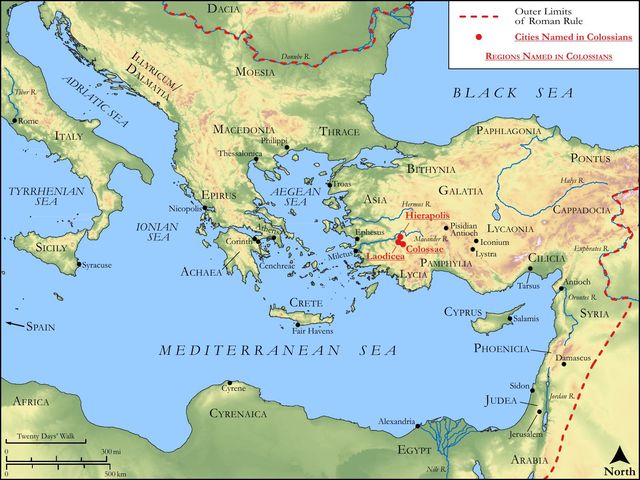
See on the biblical-era maps

Study this verse
Public-domain commentary
Matthew Henry
From his Commentary on the Whole Bible. Henry comments on passages, not single verses — this entry covers Colossians 2:16–23. His two-level outline is real structure in the source text, so it is rendered as structure.
The apostle concludes the chapter with exhortations to proper duty, which he infers from the foregoing discourse.
I.Here is a caution to take heed of judaizing teachers, or those who would impose upon Christians the yoke of the ceremonial law:
Let no man therefore judge you in meat nor drink, etc., Col 2:16. Much of the ceremonies of the law of Moses consisted in the distinction of meats and days. It appears by Rom. 14 that there were those who were for keeping up those distinctions: but here the apostle shows that since Christ has come, and has cancelled the ceremonial law, we ought not to keep it up. "Let no man impose those things upon you, for God has not imposed them: if God has made you free, be not you again entangled in that yoke of bondage." And this the rather because these things were shadows of things to come (Col 2:17), intimating that they had no intrinsic worth in them and that they are now done away. But the body is of Christ: the body, of which they were shadows, has come; and to continue the ceremonial observances, which were only types and shadows of Christ and the gospel, carries an intimation that Christ has not yet come and the gospel state has not yet commenced. Observe the advantages we have under the gospel, above what they had under the law: they had the shadows, we have the substance.
II.He cautions them to take heed of those who would introduce the worship of angels as mediators between God and them, as the Gentile philosophers did: Let no man beguile you of your reward, in a voluntary humility and worshipping of angels, Col 2:18. It looked like a piece of modesty to make use of the mediation of angels, as conscious to ourselves of our unworthiness to speak immediately to God; but, though it has a show of humility, it is a voluntary, not a commanded humility; and therefore it is not acceptable, yea, it is not warrantable: it is taking that honour which is due to Christ only and giving it to a creature. Besides, the notions upon which this practice was grounded were merely the inventions of men and not by divine revelation, - the proud conceits of human reason, which make a man presume to dive into things, and determine them, without sufficient knowledge and warrant: Intruding into those things which he hath not seen, vainly puffed up by his fleshly mind - pretending to describe the order of angels, and their respective ministries, which God has hidden from us; and therefore, though there was a show of humility in the practice, there was a real pride in the principle. They advanced those notions to gratify their own carnal fancy, and were fond of being thought wiser than other people. Pride is at the bottom of a great many errors and corruptions, and even of many evil practices, which have great show and appearance of humility. Those who do so do not hold the head, Col 2:19. They do in effect disclaim Christ, who is the only Mediator between God and man. It is the highest disparagement to Christ, who is the head of the church, for any of the members of it to make use of any intercessors with God but him. When men let go their hold of Christ, they catch at that which is next them and will stand them in no stead. - From which all the body, by joints and bands, having nourishment ministered, and knit together, increaseth with the increase of God. Observe,
1.Jesus Christ is not only a head of government over the church, but a head of vital influence to it. They are knit to him by joints and bands, as the several members of the body are united to the head, and receive life and nourishment from him.
2.The body of Christ is a growing body: it increaseth with the increase of God. The new man is increasing, and the nature of grace is to grow, where there is not an accidental hindrance. - With the increase of God, with an increase of grace which is from God as its author; or, in a usual Hebraism, with a large and abundant increase. - That you may be filled with all the fulness of God, Eph 3:19. See a parallel expression, Which is the head, even Christ, from whom the whole body, fitly joined together, maketh increase of the body, Eph 4:15, Eph 4:16.
III.He takes occasion hence to warn them again:
"Wherefore, if you be dead with Christ from the rudiments of the world, why, as though living in the world, are you subject to ordinances? Col 2:20. If as Christians you are dead to the observances of the ceremonial law, why are you subject to them? Such observances as, Touch not, taste not, handle not," Col 2:21, Col 2:22. Under the law there was a ceremonial pollution contracted by touching a dead body, or any thing offered to an idol; or by tasting any forbidden meats, etc., which all are to perish with the using, having no intrinsic worth in themselves to support them, and those who used them saw them perishing and passing away; or, which tend to corrupt the Christian faith, having no other authority than the traditions and injunctions of men. - Which things have indeed a show of wisdom in will-worship and humility. They thought themselves wiser than their neighbours, in observing the law of Moses together with the gospel of Christ, that they might be sure in the one, at least, to be in the right; but, alas! it was but a show of wisdom, a mere invention and pretence. So they seem to neglect the body, by abstaining from such and such meats, and mortifying their bodily pleasures and appetites; but there is nothing of true devotion in these things, for the gospel teaches us to worship God in spirit and truth and not by ritual observances, and through the mediation of Christ alone and not of any angels. Observe,
1.Christians are freed by Christ from the ritual observances of Moses's law, and delivered from that yoke of bondage which God himself had laid upon them.
2.Subjection to ordinances, or human appointments in the worship of God, is highly blamable, and contrary to the freedom and liberty of the gospel. The apostle requires Christians to stand fast in the liberty with which Christ hath made them free, and not to be entangled again with the yoke of bondage, Gal 5:1. And the imposition of them is invading the authority of Christ, the head of the church, and introducing another law of commandments contained in ordinances, when Christ has abolished the old one, Eph 2:15.
3.Such things have only a show of wisdom, but are really folly. It is true wisdom to keep close to the appointments of the gospel, and an entire subjection to Christ, the only head of the church.
Historical interpretation
Two Centuries of Reception
4 surviving comments on this verse. Each one is dated, so this reads as a timeline rather than a list.
Select a marker to jump to its quote. Markers stagger vertically where authors wrote within a few decades of each other.
-this man will first of all "hold the head, from which the whole body is compacted and bound together, and, through means of every joint according to the measure of the ministration of each several part, maketh increase of the body to the edification of itself in love.".
by His blood; and "holding the Head, from which the whole body of the Church, having been fitted together, takes increase"
"And not holding fast the Head," he saith, "from whom all the body." All the body thence hath its being, and its well-being. Why, letting go the Head, dost thou cling to the members? If thou art fallen off from it, thou art lost. "From whom all the body." Every one, be he who he may, thence has not life only, but also even connection. All the Church, so long as she holds The Head, increaseth; because here is no more passion of pride and vainglory, nor invention of human fancy.
Mark that "from whom," meaning the Son. "Through the joints and bands," he says, "being supplied, and knit together, increases with the increase of God"; he means, that which is according to God, that of the best life.
What is meant is the same as the Apostle writes to the Colossians: Let no man seduce you, willing in humility, and religion of angels, walking in the things which he hath not seen, in vain puffed up by the sense of his flesh, And not holding the head, from which the whole body, by joints and bands being supplied with nourishment and compacted, groweth unto the increase of God (Colossians 2:18-19). We approve that which we frequently say: And if I should be rude in speech, yet not in knowledge (2 Corinthians 11:6), this, we now declare, is what Paul said, not concerning humility, but of the truth of conscience. For language does not explain profound and hidden feelings. And although he feels himself what he says, he cannot express in words, pure enough for the ears of others, what those feelings are. When he tries to interpret himself, who had been very eloquent in his native language (for he was a Hebrew, born from Hebrews and educated at the feet of Gamaliel, the most learned of men in the law), he becomes entangled. However, if this happens to him in the Greek language, which he had imbibed from his childhood while being raised in Tarsus of Cilicia, what should be said of the Latins who, attempting to express word for word, make his thoughts more obscure, and like weeds growing, stifle the abundance of fruits? Therefore, we will try to unfold the meaning in a paraphrased way, and bring back the tricks of the involved language to their order and connection, so that the threads of words run on a simple warp: and under a plain cover, the texture of the Apostolic speech may grow. Let no one surpass you, that is, let no one take the prize from you: this is said in Greek, καταβραβευέτω when someone who is in the contest, due to the unfairness of the judge or the tricks of the masters, loses the prize and the palm that is due to him. There are many words that the Apostle uses in a more familiar manner according to the custom of his city and province. From these (for example) a few should be mentioned. But to me it is a small thing to be judged by (1 Cor. 1), that is, ἀπὸ ἀνθρωπίνης ἡμέρας: And, I speak in a human sense (Rom. 6), that is, ἀνθρώπινον λέγω: And, I did not burden you (2 Cor. 12): and what is now said, μηδεὶς ὑμᾶς καταβραβευέτω that is, no one take the prize from you. They use these and many other words up until today, the Cilicians. We should not be amazed by this in regard to the Apostle if he uses the customs of his language, in which he was born and raised, since Virgil, the other Homer among us, following the customs of his homeland, called the wicked chill (Georgics 2). So let no one surpass and conquer you, willing to follow the humility of the letter, and the religion and culture of the angels; so that you do not serve spiritual intelligence, but rather the examples of the future, which he, who wants to surpass you, has neither seen nor perceives (for both are held in Greek), especially when he walks arrogantly, and walks puffed up, and exhibits the pride of his own spirit in the gesture of his body, for this is what ἐμβατεύων signifies. But in vain, he is inflated and swells with the sense of his own flesh, understanding everything carnally, and seeking the delirium of Jewish traditions, and not holding the head of all the Scriptures, that which is written: The head of the man is Christ (1 Cor. 2, 3; Eph. 1, and 4 and 5; Coloss. 1). But the head and beginning of the whole body, and of those who believe, and of all spiritual understanding. From which head the body of the Church takes the vital juice of heavenly doctrine through its connections and joints, so that all its parts may gradually be enlivened, and through the secret channels of its veins, the exhausted blood of foods is founded, ministered, and increased; indeed, so that temperance of the body may be maintained, so that the members, watered from the source of the head, may grow into the perfection of God, and the prayer of the Savior may be fulfilled: "Father, I will that they may be one as we also are one" (John 17:21), so that when Christ has delivered us to the Father, God may be all things to all men (1 Cor. 15:28). He writes such things, both in words and in meanings, and in the style of speech most obscurely to the Ephesians. But speaking truth in love, let us grow in all things into him who is the head, even Christ, from whom the whole body is joined together, and connected by every joint of supply, according to the working in its measure of each individual part. It makes increase of the body for the edifying of itself in love (Ephesians 4:25, 16). And we have said more fully about this subject even in his Commentaries on the same Epistle. But he speaks throughout against those who, believing in Christ the Savior, desired to observe Jewish ceremonies. About this matter, a not insignificant controversy was raised, not even in the Acts of the Apostles (chapter 15). Whence Paul also says above, concerning those who boast that they are teachers of the Law: Let no one judge you in food and drink (Colossians 2:16), as if some were clean and some unclean; or with respect to a part of a festival day, as if some days were festivals and others not. For us who believe in the risen Christ, there is a judgment and an eternal festival. Or in the part of the new moon, that is, of the calendar, and of the new month, when the waning moon ends, and is covered by the shadows of the night. For the light of Christians is eternal, and is always illuminated by the rays of the Sun of righteousness. Or on a part of the sabbaths, so that they do not do servile work and do not bear burdens, because we have been given the liberty of Christ, and we have ceased to bear the burdens of sins. All these things," he said, "are shadows of things to come, and images of future happiness, in which the Jews hold fast to the letter and are bound to the earth; but we, according to the spirit, shall pass over to Christ who is now called the body in contrast to the shadows. For just as in the body truth is and in the body's shadow there is falsehood, so in spiritual understanding all food and drink and all festivities and perpetual calendars and eternal rest are to be expected. We seek to know what he meant by this, either in the humility and religion of the angels or in what sense. "From where the Lord spoke to the disciples: Rise, let us go hence (John 14:31): And, Your house shall be left desolate to you (Matthew 23:38): And, The place where the Lord was crucified, is spiritually called Egypt and Sodom (Apocalypse 11:8), all the customs of the Jews are destroyed and whatever they offer in sacrifices, they offer not to God, but to fleeing angels and unclean spirits. Nor is it surprising if they do this after the passion of the Lord, since it is also said to them by the Prophet Amos: Have you offered me victims and sacrifices, O house of Israel, forty years in the desert, and have you taken up the tabernacle of Moloch, and the star of your god Rempham, figures which you have made to adore them (Amos 5:25-26)?” Moreover, Stephen the martyr expounding more fully in the Jewish congregation and reviewing the old history, spoke thus: And in those days they made a calf, and offered sacrifices to the idol, and were rejoicing in their works. But God turned, and delivered them up, to serve the host of heaven, as it is written in the book of the prophets. (Acts 7:41-42) But the host of heaven is not only called the sun, and the moon, and the stars that glow; but also includes all the angelic multitude and their armies who are called in Hebrew Sabaoth, meaning powers or armies. As we also read in the Gospel according to Luke: And suddenly there was with the angel a multitude of the heavenly host, praising God and saying, Glory to God in the highest, and on earth peace to men of good will. (Luke 2:13-14) For God makes His angels spirits and His ministers a flaming fire. (Psalm 103:4) And in order that we may know that they who worshiped idols, although they seemed to offer sacrifices to God in the temple, did not offer them to God, but to angels, more fully we learn by Ezekiel: I gave them bad precepts and judgments (Ezek. 20. 25). For God does not seek the blood of goats or of bulls; but a contrite spirit, a contrite and humble heart O God you will not despise (Psalm 50). And therefore, they who made the calf in Horeb, and worshiped the idol of Rempham, of which we shall speak more fully in the prophet Amos, worshiped the images which they had made; and God delivered them up to the service of the host of heaven, which is now called the religion of angels by the Apostle. For humility is read in Greek as ταπεινοφροσύνη, that is, humility of mind or sense. For truly humble sense, and pitiable superstition it is, to believe that God delights in the blood of goats and bulls and the smell of incense, which we often shun. But what follows: If you have died with Christ from the elements of the world, why do you still decree as if living in the world? Do not touch, do not taste, do not handle: all which things are unto destruction by the very use, according to the precepts and doctrines of men, having indeed a show of wisdom in superstition, and humility, and not sparing the body; not in any honor for the satisfying of the flesh (Colossians 2:20 and following). It seems to us that this is the meaning. Let us run through all things and, with Christ disclosing, reveal the darkness of perceptions and words. If you have been baptized in Christ and buried with Christ in baptism, dead to the elements of this world, why do you not say to me, but far be it from me to boast, except in the cross of our Lord Jesus Christ, through whom the world is crucified to me, and I to the world (Galatians 6:14)? And have you not heard the Lord saying to the Father: They are not of the world: just as I am not of the world, and the world hates them because they are not of the world; just as I am not of the world (John 17:16 and 15:19). But on the contrary, as if living in the world, you decide [to] not touch [the] body of a dead man, nor [their] clothing, nor bench on which [a] menstruating woman has sat, nor taste pork, hare, cuttlefish, squid, moray, eel, and all fish which do not have scales and fins. All these, by their use, are corrupted and pass into decay and waste material. For food is for the belly, and the belly for foods; and God will destroy both it and them. But the body is not for fornication, but for the Lord, and the Lord is for the body. And, "Every one," says He, "shall give account of himself before God" (Rom. 14. 12) . "But in vain do they worship me, teaching for doctrines the commandments of men. And the Lord rebukes the Pharisees, saying: You have made void the commandment of God, that you may keep your own tradition. For Moses said: Honor thy father and thy mother; and He that shall curse father or mother, let him die the death. But you say, if a man shall say to his father or mother, Corban, (which is a gift,) whatsoever is from me, shall profit thee. And further you suffer him not to do anything for his father or mother, Making the word of God of no effect through your tradition." (Matthew 15:8-9, Mark 7:4-6) I cannot unroll how many traditions of the Pharisees there are, which today they call 'δευτερὼσεις,' and how many old wives' tales; for the bulkiness of the books does not allow it, and most of them are so disgraceful that I am ashamed to say. However, I will say one thing to the dishonor of the hostile nation. They put in charge of the synagogues whichever wise men they select and delegate unsavory work to them, like proving (or tasting beforehand) whether the blood of a virgin, whether menstruating or not, is clean, or unclean, if they cannot tell by sight. Furthermore, because it has been ordered that on the Sabbath each person should sit in his own house and not go out (Exod. 16. 29), or walk from where he lives; if we ever find it necessary to restrain them according to the letter, so that they do not lie down, do not walk, do not stand, but only sit, if they want to observe the precepts, they are accustomed to reply and say: Barachibas, Simeon, and Hellel our masters taught us that we should walk two thousand feet on the Sabbath, and other such doctrines, preferring the teachings of men to the doctrine of God. Not that we say that we must always sit on the Sabbath and not leave the place where one was occupied; but that that which is impossible in the Law, in which it is weakened by the flesh, must be fulfilled by spiritual observation.
It follows: Which things indeed have the reasoning of wisdom. In this place, indeed, the conjunction is superfluous: which we find the apostle to have done in most places because of his lack of skill in the art of grammar. For it does not follow but, or another conjunction, which is accustomed to respond to the preposition wherever it may be placed. Therefore, Jewish observations seem to have an image of reason and human wisdom among the unskilled and vulgar population. Hence, their teachers are called σοφοὶ, that is, wise. And if at certain times they expose their traditions, they are accustomed to say to their disciples "οἱ σοφοὶ δευτερῶσιν", that is, wise men teach the traditions. "Superstition" is derived from the Greek "ἐθελοθρησκεία" and means false religion, and for "humility" or "ταπεινοφροσύνε", which usually sounds like virtue rather than vice, it must be understood as feeling lowly and earthly. On the other hand, "Ἀφειδία" regarding the body, whose Latin name the language does not explain, is called in our language not sparing one's body. The Jews do not spare their bodies in taking food, sometimes despising what they have and seeking what they do not have, from which sometimes they become weak and contract diseases. And they do not honor themselves, when all things are clean for the clean (Tit. 1.15), and nothing can be polluted, which is received with thanksgiving, and therefore created by the Lord, to nourish and sustain human limbs with satiety and fullness of flesh. But the elements of the world, by which, or rather by which we are dead, the Law of Moses and every old Instrument must be understood: with which, as if with elements, and beginnings of religion, we learn about God. For just as the elements are called letters by which we combine syllables and words, and proceed with long meditation to weave a speech: so music also has its elements, and Geometry begins with the elements of lines, and Dialectic and Medicine have their introductions: thus with the elements of the Old Testament, that it might come to the fullness of the Gospel, the holy infant is educated by learned men. Whence the one hundred eighteenth Psalm, and all the others that are marked with letters, lead us from Ethics to Theory, and cause us to pass from the elements of the western letters, which are destroyed, to the vivifying spirit. Therefore, those of us who are dead to the world and its elements, should not observe those things which are of the world, because in one there is a beginning, in the other there is perfection.
The purpose and view of the epistle is here, as Paul mentions, to respond to the emphasis on angels urged by some. Christ is the head of all, just as the soul is the head of the body. Christ is head of all the cosmic elements. It makes no sense to be in submission to anything else. .
Continue studying Colossians 2:19 across the web’s major study libraries — every link below opens this exact verse, chapter, or book on the destination site.
Read & Compare
 BibleGatewayThis verse in more than 200 translations and 70 languages.
 Bible.comThe YouVersion reader — hundreds of translations, reading plans, and highlights.
 ESV.orgCrossway's official English Standard Version reader.
 NET BibleThe NET translation with 60,000+ translators' notes on every rendering decision.
 STEP BibleTyndale House's free study tool — original text, vocabulary, and scholarly resources.
 BibliaLogos Bible Software's free web reader.
 USCCBThe New American Bible (Revised Edition) with the U.S. bishops' study notes.
Commentaries
 BibleHub CommentariesDozens of classic commentaries on this verse, gathered on one page.
 StudyLightMore than 100 commentary sets — the largest collection on the web.
 BibleRefPlain-English commentary on what this verse means, verse by verse.
 Enduring WordDavid Guzik's free commentary on this chapter, widely used by Bible teachers.
 Bible Study ToolsVerse commentary alongside Greek and Hebrew study aids.
Original Language & Research
- BibleHub InterlinearThe verse word by word — original language, transliteration, and English.
- BibleHub LexiconEvery word's original-language definition and Strong's entry.
 Blue Letter BibleDeep-study tools — Strong's numbers, concordance, and word studies.
 CNTR CollationThe earliest Greek manuscripts of this verse, collated letter by letter.
Sermons, Hymns & Audio


TrulyRandomVerse is not affiliated with these sites and doesn’t control their content. They’re linked because they’re genuinely useful.
Summary
Colossians 2:19 stands as a profound declaration of Jesus Christ's absolute supremacy and essential role as the Head of His body, the church. It warns against any philosophy or teaching that would diminish Christ's all-sufficiency, emphasizing that true spiritual life, nourishment, and growth for every believer and the collective body originate solely from Him. The verse portrays the church as an organically connected entity, receiving its vitality and experiencing divine increase only by maintaining a steadfast and direct connection to Christ, the ultimate source of life and truth.
Context
ShowHideLiterary Context
Colossians 2:19 is situated within Paul's fervent polemic against a syncretistic heresy threatening the Colossian church. Following his robust affirmation of Christ's cosmic supremacy and redemptive work in Colossians 1, Paul transitions in Colossians 2 to directly confront the false teachings. He warns against being "taken captive through philosophy and empty deceit" in Colossians 2:8, asserting that in Christ "all the fullness of Deity dwells bodily" (Colossians 2:9). The preceding verses (Colossians 2:16-18) specifically condemn legalistic adherence to dietary laws and festivals, ascetic practices, and the worship of angels, which were components of this heresy. Verse 19 then pinpoints the core issue: the failure to "hold the Head," which is Christ, thereby severing the source of true spiritual life and growth.
Historical & Cultural Context
The "Colossian heresy" was not a single, easily identifiable system but a blend of various influences. It likely incorporated elements of Jewish mysticism and legalism, evidenced by the emphasis on dietary restrictions, festivals, and circumcision (Colossians 2:16). Additionally, there was a strong ascetic component, promoting severe self-denial and harsh treatment of the body (Colossians 2:21-23). The mention of "worship of angels" and "visions" (Colossians 2:18) suggests a mystical, perhaps Gnostic-leaning, element that sought spiritual enlightenment through angelic mediation rather than direct access to God through Christ. Geographically, Colossae was a city in Phrygia, a region known for its syncretistic religious tendencies. Paul's letter directly addresses the danger of these external influences undermining the unique and all-sufficient mediatorial role of Jesus Christ.
Key Themes
ShowHideThis verse powerfully contributes to several overarching themes in Colossians. Firstly, Christ's Supremacy and Sufficiency is paramount, as Christ is explicitly identified as the "Head" from whom all life and growth flow. This directly counters any teaching that would introduce other mediators or sources of spiritual vitality. Secondly, the Organic Unity and Interdependence of the Church is highlighted through the body metaphor. Just as a physical body functions cohesively through its various parts connected to the head, the church thrives as a unified entity, nourished and knit together by Christ. This theme is also robustly developed in Ephesians 4:15-16. Thirdly, the verse underscores the nature of True Spiritual Growth, distinguishing divine, Christ-centered increase from human-driven, self-willed religiosity. Growth that is "of God" is contrasted with the "increase" sought through human regulations or mystical experiences, which Paul dismisses as having "no value in checking sensual indulgence" (Colossians 2:23).
Exposition and Analysis
ShowHideKey Word Analysis
ShowHideThis term signifies not merely leadership or authority, but the very source and origin of life and direction. In the context of the body, the head is the controlling center from which all impulses, nourishment, and coordination originate. To "not hold the Head" means to lose connection with the essential source of life and truth, thereby rendering the body dysfunctional and incapable of true growth.
This compound verb literally means "to furnish besides" or "to fully supply." The root chorēgéō referred to the ancient Greek practice where a wealthy citizen (a chorēgos) would fully fund and equip a chorus for public performance. Thus, "having nourishment ministered" conveys the idea of an abundant, comprehensive, and continuous supply of all that is necessary for life and health, provided by Christ to His body. It emphasizes Christ's generous and complete provision.
This word means "to drive together," "to unite," or "to compact." It describes the process by which the various parts of the body are firmly joined and held in cohesion. In the context of the church, it speaks to the organic unity and structural integrity that Christ provides, ensuring that the members are not disparate but intricately connected and functioning as one unified whole.
Verse Breakdown
ShowHide"And not holding the Head,"
This phrase identifies the fundamental error of the Colossian heretics. Their false teachings, whether legalistic, ascetic, or mystical, ultimately failed to grasp or uphold Christ as the exclusive and all-sufficient source of spiritual life and authority. To "not hold" Him implies a failure to cling to, acknowledge, or draw from Him as the sole Head.
"from which all the body"
This clause establishes Christ as the singular origin point. Just as the physical head directs and sustains the entire body, so Christ is the unique source of life, direction, and sustenance for the church, His spiritual body. There is no other legitimate source for the body's vitality.
"by joints and bands having nourishment ministered,"
This imagery highlights the intricate and organic connection within the body. "Joints" (Greek: haphḗ) refer to the points of articulation, while "bands" (Greek: sýndesmos) refer to ligaments or tendons that bind and hold parts together. Through these connecting structures, Christ, the Head, continually supplies (or "ministers nourishment") all that is needed for the body's health and function. This implies both individual spiritual sustenance and the means by which members are nourished through their connection to one another in Christ.
"and knit together,"
This reinforces the idea of the body's cohesion and unity. The body is not a loose collection of parts but a tightly integrated and harmoniously functioning organism, held together by Christ. This "knitting together" speaks to the structural integrity and mutual interdependence of believers as they are united in Him.
"increaseth with the increase of God."
This final phrase describes the result of holding the Head and receiving His nourishment. True growth ("increaseth") is not a result of human effort, self-imposed rules, or external rituals, but it is "the increase of God" (Greek: aúxēsis tou Theou). This signifies growth that originates from God, is empowered by God, and is directed by God, manifesting as genuine spiritual maturity and expansion of the church in a way that is divinely ordained and pleasing to Him.
Literary Devices
ShowHidePaul employs a powerful Analogy in this verse, comparing the church to a human body and Christ to its head. This Organic Metaphor effectively conveys the vital, interdependent relationship between Christ and His followers, emphasizing His role as the sole source of life, direction, and growth. The imagery of "joints and bands" further develops this metaphor, illustrating the intricate connections and mutual support within the body, all facilitated by the Head. The phrase "increase of God" functions as a Contrast to any false or human-driven growth, highlighting the divine origin and nature of genuine spiritual progress. This Figurative Language makes complex theological truths accessible and memorable, underscoring the absolute necessity of Christ's headship for the church's health and vitality.
Theological and Thematic Connections
ShowHideColossians 2:19 profoundly articulates the theological truth of Christ's absolute headship over the church, His body. This truth is foundational to understanding the nature of the church as an organic, living entity entirely dependent on Christ for its existence, nourishment, and growth. It underscores that any spiritual system or practice that bypasses or diminishes Christ's unique role as the source of life is fundamentally flawed and will lead to spiritual barrenness rather than genuine increase. The verse thus serves as a powerful theological safeguard against syncretism, legalism, and mysticism that seek spiritual vitality from sources other than the crucified and resurrected Christ. It also highlights God's design for the church as a unified, interconnected body, where each member plays a role in the overall health and "increase of God" through their connection to the Head.
Reflection and Application
ShowHideColossians 2:19 calls every believer and the church as a whole to a profound and unwavering commitment to Jesus Christ as the sole Head. In a world constantly offering alternative paths to fulfillment, spiritual enlightenment, or self-improvement, this verse serves as an enduring reminder that true spiritual nourishment and growth come exclusively from Him. It challenges us to examine where we are seeking our spiritual vitality: Is it in human wisdom, religious rituals, self-discipline, or popular trends, or is it in a deep, abiding, and dependent relationship with Christ? For individuals, this means consistently drawing from His Word, communing with Him in prayer, and submitting to His Lordship. For the church, it means prioritizing Christ-centered worship, teaching, and fellowship, ensuring that all activities and doctrines genuinely flow from and point back to Him. Our "increase" is not measured by human metrics of success but by the divine growth that God Himself produces when we remain firmly connected to our Head.
Questions for Reflection
ShowHideFAQ
ShowHideWhat does it mean to "not hold the Head" in Colossians 2:19?
ShowHideTo "not hold the Head" means to fail to maintain a vital, dependent, and exclusive connection to Jesus Christ as the supreme authority and singular source of all spiritual life, truth, and nourishment. In the context of the Colossian heresy, it refers to turning away from Christ's all-sufficiency by seeking spiritual fulfillment through human philosophies, legalistic rules, ascetic practices, or the worship of angels, thereby diminishing His unique role. Paul emphasizes that true spiritual growth and health for the church, His body, are impossible without this direct and unwavering connection to Christ, as He is the ultimate source from whom all blessings flow, as highlighted in Ephesians 1:22-23.
How does the analogy of the "body by joints and bands" relate to the church?
ShowHideThe analogy of the "body by joints and bands" beautifully illustrates the organic unity and interdependence within the church, the body of Christ. Just as a physical body functions cohesively because its various parts are connected by joints (points of articulation) and bands (ligaments/tendons) that enable movement and hold it together, so too is the church. Christ, the Head, supplies all necessary "nourishment" and enables the "knitting together" of believers. This means that individual believers are not isolated but are intricately connected to one another and to Christ, mutually supporting and contributing to the health and growth of the whole body. This concept is further elaborated in 1 Corinthians 12:12-27, where Paul describes the diverse gifts and essential roles of each member within the unified body.
Christ-Centered Fulfillment
ShowHideColossians 2:19 finds its ultimate fulfillment in the person and work of Jesus Christ, who is unequivocally declared the "Head" of the church. This verse anticipates and reinforces the New Testament's consistent portrayal of Christ as the unique and all-sufficient source of life for His people. He is the Vine from whom all branches draw their life (John 15:5), the Good Shepherd who provides for His sheep (John 10:11), and the one in whom all the "fullness of God was pleased to dwell" (Colossians 1:19). The "nourishment ministered" from the Head foreshadows the Holy Spirit, whom Christ sends to indwell and empower believers, guiding them into all truth (John 16:13). The "increase of God" is ultimately the growth of His kingdom and the spiritual maturation of His people, a work initiated, sustained, and perfected by Christ Himself, who is "the author and perfecter of our faith" (Hebrews 12:2). Thus, Colossians 2:19 is a powerful Christological statement, asserting that every aspect of the believer's life and the church's existence is entirely dependent on and flows from the crucified, resurrected, and ascended Lord Jesus Christ.