


Revelation 10:4
Bible text: King James Version (1769 Blayney text) · Public domain
Bible text: King James Version with Strong's numbers · Public domain
Bible text: Berean Standard Bible · Public domain
Bible text: American Standard Version (1901) · Public domain
Bible text: World English Bible, Messianic edition · Public domain
Bible text: Geneva Bible (1599) · Public domain
Bible text: Young's Literal Translation · Public domain
- καὶkaiAndG2532CONJConjunction
- ὅτεhotewhenG3753CONJConjunction
- ἐλάλησανelalēsanspokeG2980V-AAI-3PVerb Aorist Active Indicative 3rd Plural
- αἱhaitheG3588T-NPFDefinite article Nominative Plural Feminine
- ἑπτὰheptasevenG2033A-NUIAdjective
- βρονταίbrontaithundersG1027N-NPFNoun Nominative Plural Feminine
- τὰςtastheG3588T-APFDefinite article Accusative Plural Feminine
- φωνὰςphōnasvoicesG5456N-APFNoun Accusative Plural Feminine
- ἑαυτῶνhe'autōnof themselvesG1438F-3GPFReflexive pronoun Genitive 3rd Plural Feminine
- ἤμελλονēmellonI was aboutG3195V-IAI-1SVerb Imperfect Active Indicative 1st Singular
- γράφεινgrapheinto writeG1125V-PANVerb Present Active Infinitive
- καὶkaiButG2532CONJConjunction
- ἤκουσαēkousaI heardG191V-AAI-1SVerb Aorist Active Indicative 1st Singular
- φωνὴνphōnēna voiceG5456N-ASFNoun Accusative Singular Feminine
- ἐκekout ofG1537PREPPreposition
- τοῦtou<the>G3588T-GSMDefinite article Genitive Singular Masculine
- οὐρανοῦouranouheavenG3772N-GSMNoun Genitive Singular Masculine
- λέγουσανlegousansayingG3004V-PAP-ASFVerb Present Active Participle Accusative Singular Feminine
- μοιmoito meG3165P-1DSPersonal pronoun Dative 1st Singular
- σφράγισονsphragisondo sealG4972V-AAM-2SVerb Aorist Active Imperative 2nd Singular
- ἃhawhatG3739R-APNRelative pronoun Accusative Plural Neuter
- ἐλάλησανelalēsanspokeG2980V-AAI-3PVerb Aorist Active Indicative 3rd Plural
- αἱhaitheG3588T-NPFDefinite article Nominative Plural Feminine
- ἑπτὰheptasevenG2033A-NUIAdjective
- βρονταίbrontaithundersG1027N-NPFNoun Nominative Plural Feminine
- καὶkaiandG2532CONJConjunction
- μὴmēnotG3361PRT-NNegative Particle Negative
- αὐτὰautathemG846P-APNPersonal pronoun Accusative Plural Neuter
- γράψῃςgrapsēsmay writeG1125V-AAS-2SVerb Aorist Active Subjunctive 2nd Singular
English is a literal word-by-word gloss of the Greek, not the KJV's wording. Why?
This is the original text the KJV's translators worked from — each Greek word with its own literal English meaning in this verse, prepared by scholars at Tyndale House, Cambridge. The KJV translates whole sentences, not word by word, so its wording differs: one Greek word can become several English words, and the KJV may choose “charity” where the gloss reads “love”. Both are faithful — they answer different questions. For the KJV's own rendering, switch to the KJV text.
Details
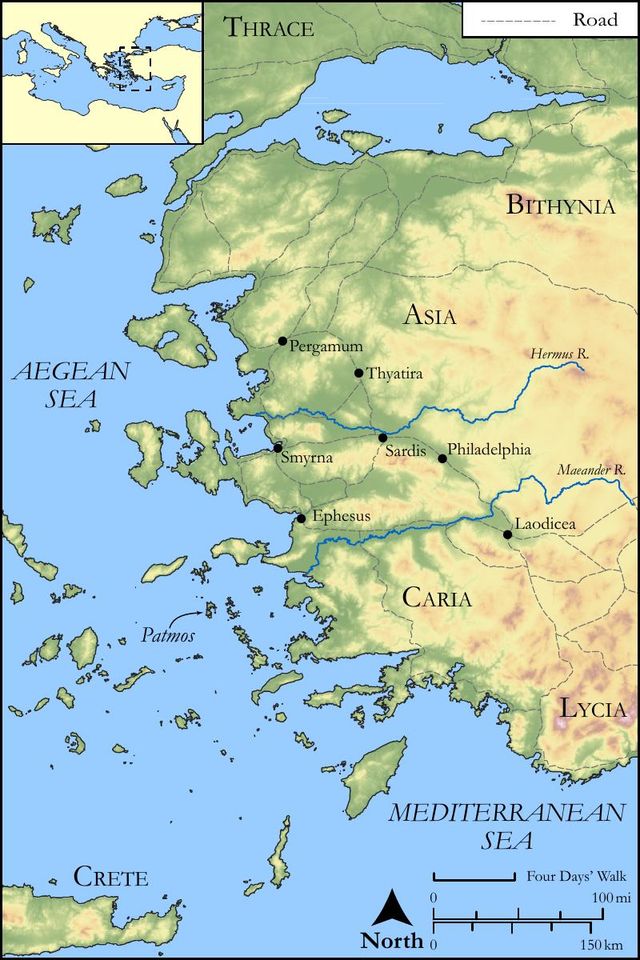
See on the biblical-era maps

Study this verse
Public-domain commentary
Matthew Henry
From his Commentary on the Whole Bible. Henry comments on passages, not single verses — this entry covers Revelation 10:1–7. His three-level outline is real structure in the source text, so it is rendered as structure.
Here we have an account of another vision the apostle was favoured with, between the sounding of the sixth trumpet and that of the seventh. And we observe,
I.The person who was principally concerned in communicating this discovery to John - an angel from heaven, another mighty angel, who is so set forth as would induce one to think it could be no other than our Lord and Saviour Jesus Christ!
1.He was clothed with a cloud: he veils his glory, which is too great for mortality to behold; and he throws a veil upon his dispensations. Clouds and darkness are round about him.
2.A rainbow was upon his head; he is always mindful of his covenant, and, when his conduct is most mysterious, yet it is perfectly just and faithful.
3.His face was as the sun, all bright, and full of lustre and majesty, Rev 1:16.
4.His feet were as pillars of fire; all his ways, both of grace and providence, are pure and steady.
II.His station and posture:
He set his right foot upon the sea and his left foot upon the earth, to show the absolute power and dominion he had over the world. And he held in his hand a little book opened, probably the same that was before sealed, but was now opened, and gradually fulfilled by him.
III.His awful voice:
He cried aloud, as when a lion roareth (Rev 10:3), and his awful voice was echoed by seven thunders, seven solemn and terrible ways of discovering the mind of God.
IV.The prohibition given to the apostle, that he should not publish, but conceal what he had learned from the seven thunders, Rev 10:4.
The apostle was for preserving and publishing every thing he saw and heard in these visions, but the time had not yet come.
V.The solemn oath taken by this mighty angel.
1.The manner of his swearing: He lifted up his hand to heaven, and swore by him that liveth for ever, by himself, as God often has done, or by God as God, to whom he, as Lord, Redeemer, and ruler of the world, now appeals.
2.The matter of the oath: that there shall be time no longer; either,
(1.)That there shall be now no longer delay in fulfilling the predictions of this book than till the last angel should sound; then every thing should be put into speedy execution: the mystery of God shall be finished, Rev 10:7. Or,
(2.)That when this mystery of God is finished time itself shall be no more, as being the measure of things that are in a mutable changing state; but all things shall be at length for ever fixed, and so time itself swallowed up in eternity.
Historical interpretation
Seven Centuries of Reception
6 surviving comments on this verse. Each one is dated, so this reads as a timeline rather than a list.
Select a marker to jump to its quote. Markers stagger vertically where authors wrote within a few decades of each other.
"Seven thunders uttered their voices." The seven thunders uttering their voices signify, the Holy Spirit of sevenfold power, who through the prophets announced all things to come, and by His voice John gave his testimony in the world; but because he says that he was about to write the things which the thunders had uttered, that is, whatever things had been obscure in the announcements of the Old Testament; he is forbidden to write them, but he was charged to leave them sealed, because he is an apostle, nor was it fitting that the grace of the subsequent stage should be given in the first. "The time," says he, "is at hand."45 For the apostles, by powers, by signs, by portents, and by mighty works, have overcome unbelief. After them there is now given to the same completed Churches the comfort of having the prophetic Scriptures subsequently interpreted, for I said that after the apostles there would be interpreting prophets.
For the apostle says: "And he placed in the Church indeed, first, apostles; secondly, prophets; thirdly, teachers,"46 and the rest. And in another place he says: "Let the prophets speak two or three, and let the others judge."47 And he says: "Every woman that prayeth or prophesieth with her head uncovered, dishonoureth her head"48 And when he says, "Let the prophets speak two or three, and let the others judge," he is not speaking in respect of the Catholic prophecy of things unheard and unknown, but of things both announced and known. But let them judge whether or not the interpretation is consistent with the testimonies of the prophetic utterance.49 It is plain, therefore, that to John, armed as he was with superior virtue, this was not necessary, although the body of Christ, which is the Church, adorned with His members, ought to respond to its position.
It was said to him, “Do not write” that which you have heard, so that what is in mystery and is reserved to the church would not be revealed to those who are unworthy and faithless.… [Elsewhere] he says, “Do not seal up the words of the prophecy of this book, for the time is near.” He shows that there are those to whom the mystery ought to be sealed and those to whom it ought to be opened. As the Lord himself said, “To you”—he is speaking to his disciples—“it has been given to know the secret of the kingdom of God, but for others it is in parables.” It says, “Let him who continues to do evil, do evil still, and him who is filthy, be filthy still, and let him who is righteous still perform more righteous deeds, and likewise the holy more holy deeds.” This is to say, “This is why I speak to them in parables, that they who do not see may see and they who see might become blind.” And again, “Blessed are your eyes, for they see, and your ears, for they hear.” Daniel likewise said, “Seal the book until the time of the consummation.” And [John] explains why he was commanded to seal the book in the following words, “Let the unrighteous transgress so that all the wicked and the sinners might not know, but let those who understand understand.”
This shows that what is now undisclosed is to be explained through experience and the course of the events themselves. And from the heavenly voice the Evangelist learned that the voices are to be imprinted on the mind but that the final understanding and the clear interpretation of them is reserved for the last times.
Seal up what the seven thunders have spoken, and do not write it down. The mysteries of the Christian faith are neither to be shown to all indiscriminately, lest they become cheap, nor hidden from the worthy, lest they be entirely unknown. Hence, later he heard: Do not seal up the words of the prophecy of this book (Revelation XXII). Both are comprehended in one verse in Daniel, where it is said to him through the angel: Seal the book and shut up the words until the appointed time (Daniel XII).
And he cried with a loud voice as when a lion roareth. Just as the lion's cry inspires beasts with fear, so does Christ inspire beastlike men with fear by threatening through the holy preachers, according to this: The lion roareth, who will not fear? [Variant of Amos 3:8] And when he had cried, the seven thunders spoke their voices. The seven thunders signify the same thing as the lion's voice, namely the preaching of the Word, as in The voice of thy thunder in a wheel. [Ps. 76:19] Note also that the seven thunders are said to have spoken after the lion's voice because the sevenfold Spirit also taught the apostles to preach what the Lord taught, whence they are called the sons of thunder. [Mark 3:17] They spoke their voices because the holy doctrine does not receive the fables of the Jews or the rubbish of philosophers into its dogmas. However, a very complicated question arises for us in what is said after that: And I was about to write the things which the seven thunders spoke: and I heard a voice from heaven, saying: Seal up the things which the seven thunders have spoken; and write them not. If the holy preaching had not been written, how would it have come to us? It seems therefore that we should understand in this place only a specific kind of writing; for one should know that the reason why we shut something under seal is in order that it should not be open to all, but that it may be loosed in due time for those we trust; whereas what we write openly, we bring to the knowledge of all. Therefore we are ordered not to divulge the mysteries of God's words to everyone indiscriminately, but to supply them with measure and as though from under a seal, according to how able we see people are to receive them; and we are ordered to give milk to drink to some people, and solid food to others. [Ref. to 1 Cor. 3:1-2] The divine mysteries are also shut under a protective seal in order that they should not be disclosed to people who were not going to believe in them at all, because when they do not accept them, they start laughing at them.
He says that he was about to write what was spoken to the seven spirits. And I heard a voice from heaven saying, "Seal up what the seven thunders have spoken, and do not write it down." The act of sealing, in one sense, involved impressing the memory firmly upon your mind; but the prohibition against writing it down was a matter of divine economy, for which God knows the reason. Perhaps the punishments that are glorified are actually lighter, and worthy of the goodness of the one who punishes, making them shameful to humans.
What do Gregory the Divine and Evagrius, the great authority on Gnostic matters, say about these things? Gregory asserts that "the punishment surrounding Adam is an act of generosity, for therefore I believe God punishes." And in another context, "neither mercy is indiscriminate nor is judgment merciless." Evagrius, however, declares that "the more recent and worldly thinkers should be forgotten regarding the superior discourse on judgment; for they do not understand the suffering of the rational soul condemned to ignorance."
Continue studying Revelation 10:4 across the web’s major study libraries — every link below opens this exact verse, chapter, or book on the destination site.
Read & Compare
 BibleGatewayThis verse in more than 200 translations and 70 languages.
 Bible.comThe YouVersion reader — hundreds of translations, reading plans, and highlights.
 ESV.orgCrossway's official English Standard Version reader.
 NET BibleThe NET translation with 60,000+ translators' notes on every rendering decision.
 STEP BibleTyndale House's free study tool — original text, vocabulary, and scholarly resources.
 BibliaLogos Bible Software's free web reader.
 USCCBThe New American Bible (Revised Edition) with the U.S. bishops' study notes.
Commentaries
 BibleHub CommentariesDozens of classic commentaries on this verse, gathered on one page.
 StudyLightMore than 100 commentary sets — the largest collection on the web.
 BibleRefPlain-English commentary on what this verse means, verse by verse.
 Enduring WordDavid Guzik's free commentary on this chapter, widely used by Bible teachers.
 Bible Study ToolsVerse commentary alongside Greek and Hebrew study aids.
Original Language & Research
- BibleHub InterlinearThe verse word by word — original language, transliteration, and English.
- BibleHub LexiconEvery word's original-language definition and Strong's entry.
 Blue Letter BibleDeep-study tools — Strong's numbers, concordance, and word studies.
 CNTR CollationThe earliest Greek manuscripts of this verse, collated letter by letter.
Sermons, Hymns & Audio


TrulyRandomVerse is not affiliated with these sites and doesn’t control their content. They’re linked because they’re genuinely useful.
Summary
Revelation 10:4 presents a pivotal moment in John's apocalyptic vision where, after hearing the mysterious "seven thunders" utter their voices, he is about to record their message. However, a direct divine command from heaven intervenes, instructing him to "seal up" what the thunders proclaimed and to refrain from writing it down. This striking interdiction highlights God's absolute sovereignty over divine revelation, emphasizing that not all truths are meant for human comprehension or immediate disclosure, and underscores the profound mystery inherent in God's unfolding purposes.
Context
ShowHideLiterary Context
Revelation 10:4 is situated within a significant interlude in John's vision, specifically occurring between the sounding of the sixth trumpet judgment and the seventh trumpet judgment. The preceding verses (Revelation 10:1-3) describe the descent of a "mighty angel" of immense power and majesty, who holds a small, open scroll. This angel cries out, and in response, the "seven thunders" utter their distinct voices. John, as the divinely appointed visionary and scribe, instinctively prepares to record these utterances, a natural response given his commission to write down what he sees and hears throughout the book (e.g., Revelation 1:11). The command to seal up the thunders' message stands in stark contrast to the earlier command to open the seven-sealed scroll in Revelation 5, signifying a deliberate withholding of information rather than its revelation.
Historical & Cultural Context
Apocalyptic literature, common in the intertestamental period and early Christianity, often features divine messengers, symbolic imagery, and the revelation of hidden truths. However, it also sometimes includes elements of partial or deferred revelation, as seen in the book of Daniel, where Daniel is instructed to seal up certain prophecies until "the time of the end." The concept of "sealing" could imply not only secrecy but also preservation for a future time or divine authentication. In that day, official documents were often sealed to ensure their authenticity and to prevent tampering, and sometimes to keep their contents secret until an appointed time. John, writing from exile on Patmos, would have been familiar with such practices, giving the divine command a clear, authoritative weight.
Key Themes
ShowHideThe most striking theme in this verse is Divine Secrecy and Unrevealed Truths. God's deliberate decision to withhold specific prophetic information from John, and by extension from humanity, underscores that not all divine truth is meant for human comprehension or disclosure at a given time. This highlights the unsearchable nature of God's judgments and ways. Closely related is the theme of God's Sovereignty in Revelation. This act powerfully reminds us that divine revelation is dispensed according to God's perfect will and timing, not according to human curiosity or desire for complete knowledge. It establishes God as the sole authority over what is revealed and what remains hidden. Finally, John's Obedience to Divine Command is a crucial theme. Despite his natural inclination and prophetic duty to record, John immediately obeys the command to seal up the thunders' message. His swift submission emphasizes the importance of obedience to divine instruction, even when it means foregoing understanding or recording potentially vital information, demonstrating a model of trust in God's wisdom.
Exposition and Analysis
ShowHideKey Word Analysis
ShowHideThis word (G1027) is akin to a verb meaning "to roar," directly translating to "thunder" or "thundering." In biblical contexts, thunder often accompanies divine manifestations, judgment, or the voice of God, signifying immense power, awe, and sometimes mystery (e.g., Exodus 19:16, Psalm 29:3-9). Here, the "seven thunders" are distinct from God's voice, yet their utterances are significant enough to warrant sealing, implying a powerful, perhaps ominous, but ultimately unrevealed message related to divine action.
This primary verb (G1125) means "to grave," especially "to write," and figuratively "to describe." John's role throughout Revelation is that of a scribe, commanded to "write the things which thou hast seen, and the things which are, and the things which shall be hereafter" (Revelation 1:19). His immediate impulse to write down the thunders' message underscores his diligence and understanding of his prophetic commission, making the subsequent command to not write all the more impactful.
Derived from "sphragis" (a signet or private mark), this verb (G4972) means "to stamp" for security or preservation, and by implication, "to keep secret" or "to attest." While it certainly means to conceal or keep hidden, it also carries connotations of divine preservation and setting apart. These utterances are not lost or forgotten, but are reserved by God, perhaps for a future time known only to Him, or simply as part of His own unrevealed knowledge. The command "write them not" (G1125, G3361) is a firm, negative imperative, leaving no ambiguity about John's instruction to refrain from recording the message.
Verse Breakdown
ShowHide"And when the seven thunders had uttered their voices"
This clause introduces a mysterious and powerful phenomenon. The "seven thunders" are not explicitly identified, adding to the enigmatic nature of the scene. Their "voices" imply articulate communication, suggesting they convey a message of profound significance, likely related to divine judgment or revelation. The number seven, ubiquitous in Revelation, typically signifies completeness or perfection, suggesting these thunders represent a full and complete set of divine pronouncements.
"I was about to write"
This reveals John's immediate and natural response as the visionary scribe. Having been commanded to record all that he sees and hears, his instinct is to document the utterances of the thunders, recognizing their importance within the unfolding prophetic narrative. This highlights his obedience and diligence in his prophetic office.
"and I heard a voice from heaven saying unto me"
This signifies a direct, authoritative divine intervention. The "voice from heaven" indicates that the command originates from God Himself or His immediate presence, superseding any previous instructions or John's own prophetic impulse. This underscores the ultimate authority of God over the scope and timing of revelation.
"Seal up those things which the seven thunders uttered, and write them not."
This is the core command of the verse. "Seal up" denotes concealment and preservation, indicating that the message is not to be revealed at this time, if ever, to humanity. The explicit negative imperative "write them not" leaves no room for ambiguity, directly countermanding John's intention and emphasizing God's prerogative to keep certain knowledge hidden. This serves as a powerful reminder that not all of God's counsel is revealed to humanity.
Literary Devices
ShowHideRevelation 10:4 employs several powerful literary devices. Symbolism is evident in the "seven thunders," which are not literal meteorological phenomena but rather symbolic entities whose "voices" convey an unrevealed divine message. Their number, "seven," reinforces the pervasive numerology in Revelation, often signifying completeness or divine perfection. The phrase "uttered their voices" could be seen as a form of anthropomorphism, attributing human-like speech to the thunders, though it more broadly implies a discernible, albeit mysterious, communication. The entire scene creates a sense of dramatic irony and suspense: a powerful revelation is hinted at, only to be immediately and deliberately withheld. This builds tension and emphasizes the profound mystery surrounding God's plans. Finally, the direct divine command to "Seal up... and write them not" serves as a powerful imperative, highlighting God's absolute authority and control over the flow of prophetic information, effectively drawing a boundary around human knowledge.
Theological and Thematic Connections
ShowHideRevelation 10:4 profoundly illustrates the principle of divine sovereignty over revelation. It teaches us that God, in His infinite wisdom, chooses what to reveal, when to reveal it, and what to keep hidden. This is not arbitrary secrecy, but a demonstration of His perfect knowledge and control over all things. The sealed message of the seven thunders serves as a powerful reminder that human understanding is finite, and there will always be aspects of God's plan and knowledge that remain mysteries to us. Our faith is called to trust God's character and purposes even when we do not fully comprehend His methods or His timeline, acknowledging that "the secret things belong to the Lord our God." This passage encourages humility before the vastness of divine wisdom and redirects our focus from what is unrevealed to the abundant truths God has graciously made known.
Reflection and Application
ShowHideRevelation 10:4 offers profound lessons for believers today, primarily encouraging a posture of humility and trust in the face of divine mystery. In an age where information is readily accessible and there's often a desire for complete knowledge, this verse serves as a crucial counter-cultural reminder that God's ways and thoughts are infinitely higher than our own (Isaiah 55:8-9). We are called to trust God's character and purposes even when we do not fully comprehend His methods or His timeline, understanding that some truths are withheld for reasons known only to Him. Instead of fixating on what is not revealed or engaging in endless speculation about unknown prophecies, believers are encouraged to diligently study and apply the truths that God has graciously made known through Scripture. The Bible contains all that is necessary for salvation, knowing God's character, and understanding His will for our lives, providing a sufficient guide for faith and practice. This passage teaches us to accept that some information is beyond our grasp for now, and to rest in the assurance that God's plan is perfect, even when it includes unrevealed elements, fostering a deeper reliance on His wisdom rather than our own limited understanding.
Questions for Reflection
ShowHideFAQ
ShowHideWhat are the "seven thunders" and why are their messages sealed?
ShowHideThe Bible does not explicitly identify the "seven thunders," which contributes to their mysterious nature. They are generally understood to be symbolic, representing powerful, perhaps final, divine pronouncements or judgments that God chooses to keep secret. The command to "seal up" their message signifies that this particular revelation is not intended for human knowledge or disclosure at this time. This act underscores God's absolute sovereignty over what He reveals and what He withholds, demonstrating that not all of His plans or judgments are meant for human comprehension. It serves as a reminder that some aspects of divine truth remain hidden, either for a future time or simply as part of God's unsearchable wisdom (Romans 11:33).
Does this verse imply that God keeps important secrets from His people, and if so, why?
ShowHideYes, Revelation 10:4 clearly indicates that God intentionally withholds certain information, even from His most trusted prophets like John. This is not an act of malice or an attempt to deceive, but rather a demonstration of God's perfect wisdom and timing. There are "secret things" that "belong unto the Lord our God" (Deuteronomy 29:29), while "those things which are revealed belong unto us and to our children." The reasons for withholding information can include: protecting humanity from knowledge it is not yet ready to receive, preserving divine prerogatives, or simply because some truths are beyond human capacity to fully grasp. This passage encourages humility and trust in God's perfect plan, reminding us that He has revealed all that is necessary for salvation and for living a life pleasing to Him through His Word.
Christ-Centered Fulfillment
ShowHideWhile Revelation 10:4 highlights God's sovereignty in withholding certain revelations, it paradoxically points to the ultimate and complete revelation found in Jesus Christ. In the Old Testament, prophets like Daniel were commanded to seal up their prophecies until the "time of the end." However, in the New Testament, Jesus Christ is presented as the one who opens what was sealed, the Lamb who is worthy to open the scroll in Revelation 5, thus inaugurating the full revelation of God's redemptive plan. Jesus Himself is the Word made flesh, the very embodiment of God's self-disclosure, through whom no one has seen God at any time; the only begotten Son, who is in the bosom of the Father, He has declared Him. The mystery of God, hidden for ages, has now been revealed in Christ through the Gospel, which proclaims salvation to all who believe. Thus, while some prophetic details remain veiled, the most crucial truth—God's love and redemptive purpose—is fully unveiled in Jesus, calling us to trust in the one who is the Alpha and the Omega, the beginning and end of all revelation. Our knowledge remains in part, but we anticipate the day when we shall see Him face to face and know fully, even as we are fully known.