


Isaiah 30:26
Bible text: King James Version (1769 Blayney text) · Public domain
Bible text: King James Version with Strong's numbers · Public domain
Bible text: Berean Standard Bible · Public domain
Bible text: American Standard Version (1901) · Public domain
Bible text: World English Bible, Messianic edition · Public domain
Bible text: Geneva Bible (1599) · Public domain
Bible text: Young's Literal Translation · Public domain
- וְהָיָהve·ha·Yahand it will beH1961Conj-w ¦ V-Qal-ConsecPerf-3msVerb Qal Consecutive Perfect 3rd Singular Masculineוְandהָיָהit will be
- אוֹר'or[the] light ofH216N-fscNoun Singular Feminine Construct
- הַלְּבָנָהha·le·va·Nahthe moonH3842Art ¦ N-fsNoun Singular Feminine Absoluteהַtheלְּבָנָהmoon
- כְּאוֹרke·'orlike [the] light ofH216Prep-k ¦ N-fscNoun Singular Feminine Constructכְּlikeאוֹר[the] light of
- הַחַמָּהha·cha·Mahthe sunH2535Art ¦ N-fsNoun Singular Feminine Absoluteהַtheחַמָּהsun
- וְאוֹרve·'orand [the] light ofH216Conj-w ¦ N-fscNoun Singular Feminine Constructוְandאוֹר[the] light of
- הַחַמָּהha·cha·Mahthe sunH2535Art ¦ N-fsNoun Singular Feminine Absoluteהַtheחַמָּהsun
- יִהְיֶהyih·Yehit will beH1961V-Qal-Imperf-3msVerb Qal Imperfect 3rd Singular Masculine
- שִׁבְעָתַיִםshiv·'a·Ta·yimsevenfoldH7659Adj-fdAdjective Numerical Dual Feminine Absolute
- כְּאוֹרke·'orlike [the] light ofH216Prep-k ¦ N-fscNoun Singular Feminine Constructכְּlikeאוֹר[the] light of
- שִׁבְעַתshiv·'AtsevenH7651Adj-cscAdjective Numerical Singular common gender Construct
- הַיָּמִיםhai·ya·Mim<the> daysH3117Art ¦ N-mpNoun Plural Masculine Absoluteהַ<the>יָּמִיםdays
- בְּיוֹםbe·Yomon [the] dayH3117Prep-b ¦ N-msNoun Singular Masculine Absoluteבְּonיוֹם[the] day
- חֲבֹשׁcha·Voshbinds upH2280V-Qal-InfVerb Qal Infinitive Construct
- יְהוָהYah·wehYahwehH3068N-properNoun Proper Title
- אֶת'et<obj.>H853DirObjMParticle Object Indicator
- שֶׁבֶרShe·ver[the] fracture ofH7667N-mscNoun Singular Masculine Construct
- עַמּוֹa·Mohis peopleH5971N-msc ¦ 3msNoun Singular Masculine Constructעַמּpeopleוֹhis
- וּמַחַץu·Ma·chatzand [the] wound ofH4273Conj-w ¦ N-mscNoun Singular Masculine Constructוּandמַחַץ[the] wound of
- מַכָּתוֹma·ka·Tohis blowH4347N-fsc ¦ 3msNoun Singular Feminine Constructמַכָּתblowוֹhis
- יִרְפָּאyir·Pa'he will healH7495V-Qal-Imperf-3msVerb Qal Imperfect 3rd Singular Masculine
English is a literal word-by-word gloss of the Hebrew, not the KJV's wording. Why?
This is the original text the KJV's translators worked from — each Hebrew word with its own literal English meaning in this verse, prepared by scholars at Tyndale House, Cambridge. The KJV translates whole sentences, not word by word, so its wording differs: one Hebrew word can become several English words, and the KJV may choose “the LORD” where the gloss reads “Yahweh”. Both are faithful — they answer different questions. For the KJV's own rendering, switch to the KJV text.
Details
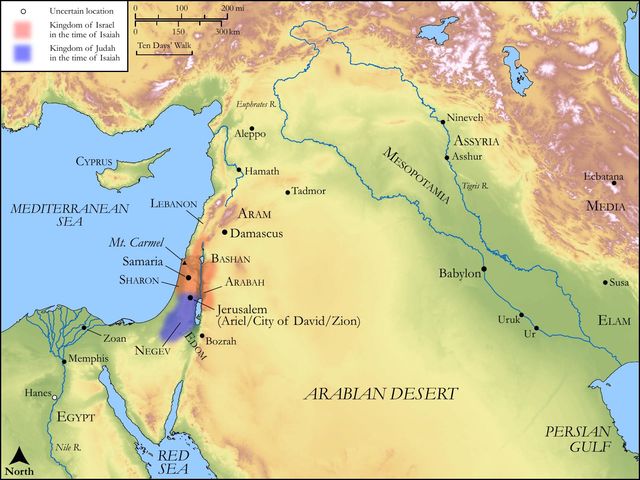
See on the biblical-era map
Study this verse
Public-domain commentary
Matthew Henry
From his Commentary on the Whole Bible. Henry comments on passages, not single verses — this entry covers Isaiah 30:18–26. His three-level outline is real structure in the source text, so it is rendered as structure.
The closing words of the foregoing paragraph (You shall be left as a beacon upon a mountain) some understand as a promise that a remnant of them should be reserved as monuments of mercy; and here the prophet tells them what good times should succeed these calamities. Or the first words in this paragraph may be read by way of antithesis, Notwithstanding this, yet will the Lord wait that he may be gracious. The prophet, having shown that those who made Egypt their confidence would be ashamed of it, here shows that those who sat still and made God alone their confidence would have the comfort of it. It is matter of comfort to the people of God, when the times are very bad, that all will be well yet, well with those that fear God, when we say to the wicked, It shall be ill with you.
I.God will be gracious to them and will have mercy on them.
This is the foundation of all good. If we find favour with God, and he have mercy upon us, we shall have comfort according to the time that we have been afflicted.
1.The mercy in store for them is very affectingly expressed. (1.) "He will wait to be gracious (Isa 30:18); he will wait till you return to him and seek his face, and then he will be ready to meet you with mercy. He will wait, that he may do it in the best and fittest time, when it will be most for his glory, when it will come to you with the most pleasing surprise. He will continually follow you with his favours, and not let slip any opportunity of being gracious to you." (2.) "He will stir up himself to deliver you, will be exalted, will be raised up out of his holy habitation (Zac 2:13), that he may appear for you in more than ordinary instances of power and goodness; and thus he will be exalted, that is, he will glorify his own name. This is what he aims at in having mercy on his people." (3.) He will be very gracious (Isa 30:19), and this in answer to prayer, which makes his kindness doubly kind: "He will be gracious to thee, at the voice of thy cry, the cry of thy necessity, when that is most urgent - the cry of thy prayer, when that is most fervent. When he shall hear it, there needs no more; at the first word he will answer thee, and say, Here I am." Herein he is very gracious indeed. In particular, [1.] Those who were disturbed in the possession of their estates shall again enjoy them quietly. When the danger is over the people shall dwell in Zion, at Jerusalem, as they used to do; they shall dwell safely, free from the fear of evil. [2.] Those who were all in tears shall have cause to rejoice, and shall weep no more; and those who dwell in Zion, the holy city, will find enough there to wipe away tears from their eyes.
2.This is grounded upon two great truths:
(1.)That the Lord is a God of judgment; he is both wise and just in all the disposals of his providence, true to his word and tender of his people. If he correct his children, it is with judgment (Jer 10:24), with moderation and discretion, considering their frame. We think we may safely refer ourselves to a man of judgment; and shall we not commit our way to a God of judgment?
(2.)That therefore all those are blessed who wait for him, who not only wait on him with their prayers, but wait for him with their hopes, who will not take any indirect course to extricate themselves out of their straits, or anticipate their deliverance, but patiently expect God's appearances for them in his own way and time. Because God is infinitely wise, those are truly happy who refer their cause to him.
II.They shall not again know the want of the means of grace, Isa 30:20, Isa 30:21. Here,
1.It is supposed that they might be brought into straits and troubles after this deliverance was wrought for them. It was promised (Isa 30:19), that they should weep no more and that God would be gracious to them; and yet here it is taken for granted that God may give them the bread of adversity and the water of affliction, prisoners' fare (Kg1 22:27), coarse and sorry food, such as the poor use. When one trouble is over we know not how soon another may succeed; and we may have an interest in the favour of God, and such consolations as are sufficient to prohibit weeping, and yet may have bread of adversity given us to eat and water of affliction to drink. Let us therefore not judge of love or hatred by what is before us.
2.It is promised that their eyes should see their teachers, that is, that they should have faithful teachers among them, and should have hearts to regard them and not slight them as they had done; and then they might the better be reconciled to the bread of adversity and the water of affliction. It was a common saying among the old Puritans, Brown bread and the gospel are good fare. A famine of bread is not so great a judgment as a famine of the word of God, Amo 8:11, Amo 8:12. It seems that their teachers had been removed into corners (probably being forced to shift for their safety in the reign of Ahaz), but it shall be so no more. Veritas non quaerit angulos - Truth seeks no corners for concealment. But the teachers of truth may sometimes be driven into corners for shelter; and it goes ill with the church when it is so, when the woman with her crown of twelve stars is forced to flee into the wilderness (Rev 12:6), when the prophets are hidden by fifty in a cave, Kg1 18:4. But God will find a time to call the teachers out of their corners again, and to replace them in their solemn assemblies, which shall see their own teachers, the eyes of all the synagogue being fastened on them, Luk 4:20. And it will be the more pleasing because of the restraint they have been for some time under, as light out of darkness, as life from the dead. To all that love God and their own souls this return of faithful teachers out of their corners, especially with a promise that they shall not be removed into corners any more, is the most acceptable part of any deliverance, and has comfort enough in it to sweeten even the bread of adversity and the water of affliction. But this is not all:
3.It is promised that they shall have the benefit, not only of the public ministry, but of private and particular admonition and advice (Isa 30:21): "Thy ears shall hear a word behind thee, calling after thee as a man calls after a traveller that he sees going out of his road." Observe, (1.) Whence this word shall come - from behind thee, from some one whom thou dost not see, but who sees thee. "Thy eyes see thy teachers; but this is a teacher out of sight, it is thy own conscience, which shall now by the grace of God be awakened to do its office." (2.) What the word shall be: "This is the way, walk you in it. When thou art doubting, conscience shall direct thee to the way of duty; when thou art dull and trifling, conscience shall quicken thee in that way." As God has not left himself without witness, so he has not left us without guides to show us our way. (3.) The seasonableness of this word: It shall come when you turn to the right hand or to the left. We are very apt to miss our way; there are turnings on both hands, and those so tracked and seemingly straight that they may easily be mistaken for the right way. There are right-hand and left-hand errors, extremes on each side virtue; the tempter is busy courting us into the by-paths. It is happy then if by the particular counsels of a faithful minister or friend, or the checks of conscience and the strivings of God's Spirit, we be set right and prevented from going wrong. (4.) The success of this word: "It shall not only be spoken, but thy ears shall hear it; whereas God has formerly spoken once, yea, twice, and thou hast not perceived it (Job 33:14), now thou shalt listen attentively to these secret whispers, and hear them with an obedient ear." If God gives us not only the word, but the hearing ear, not only the means of grace, but a heart to make a good use of those means, we have reason to say, He is very gracious to us, and reason to hope he has yet further mercy in store for us.
III.They shall be cured of their idolatry, shall fall out with their idols, and never be reconciled to them again, Isa 30:22.
The deliverance God shall work for them shall convince them that it is their interest, as well as duty, to serve him only; and they shall own that, as their trouble was brought upon them for their idolatries, so it was removed upon condition that they should not return to them. This is also the good effect of their seeing their teachers and hearing the word behind them; by this it shall appear that they are the better for the means of grace they enjoy - they shall break off from their best-beloved sin. Observe,
1.How foolishly mad they had formerly been upon their idols, in the day of their apostasy. Idolaters are said to be mad upon their idols (Jer 50:38), doatingly fond of them. They had graven images of silver, and molten images of gold, and, though gold needs no painting, they had coverings and ornaments on these; they spared no cost in doing honour to their idols.
2.How wisely mad (if I may so speak) they now were at their idols, what a holy indignation they conceived against them in the day of their repentance. They not only degraded their images, but defaced them, not only defaced them, but defiled them; they not only spoiled the shape of them, but in a pious fury threw away the gold and silver they were made of, though otherwise valuable and convertible to a good use. They could not find in their hearts to make any vessel of honour of them. The rich clothes wherewith their images were dressed up they cast away as a filthy cloth which rendered those that touched it unclean until the evening, Lev 15:23. Note, To all true penitents sin has become very odious; they loathe it, and loathe themselves because of it; they cast it away to the dunghill, the fittest place for it, nay, to the cross, for they crucify the flesh; their cry against it is, Crucify it, crucify it. They say unto it, Abi hinc in malam rem - Get thee hence. They are resolved never to harbour it any more. They put as far from as they can all the occasions of sin and temptations to it, though they are as a right eye or a right hand, and protest against it as Ephraim did (Hos 14:8), What have I to do any more with idols? Probably this was fulfilled in many particular persons, who, by the deliverance of Jerusalem from Sennacherib's army, were convinced of the folly of their idolatry and forsook it. It was fulfilled in the body of the Jewish nation at their return from their captivity in Babylon, for they abhorred idols ever after; and it is accomplished daily in the conversion of souls, by the power of divine grace, from spiritual idolatry to the fear and love of God. Those that join themselves to the Lord must abandon every sin, and say unto it, Get thee hence.
IV.God will then give them plenty of all good things.
When he gives them their teachers, and they give him their hearts, so that they begin to seek the kingdom of God and the righteousness thereof, then all other things shall be added to them Mat 6:33. And when the people are brought to praise God then shall the earth yield her increase, and with it God, even our own God, shall bless us, Psa 67:5, Psa 67:6. So it follows here: "When you shall have abandoned your idols, then shall God give the rain of your seed," Isa 30:23. When we return to God in a way of duty he will meet us with his favours.
1.God will give you rain of your seed, rain to water the seed you sow, just at the time that it calls for it, as much as it needs and no more. Observe, How man's industry and God's blessing concur to the good things we enjoy relating to the life that now is: Thou shalt sow the ground, that is thy part, and then God will give the rain of thy seed, that is his part. It is so in spiritual fruit; we must take pains with our hearts and then wait on God for his grace.
2.The increase of the earth shall be rich and good, and every thing the best of the kind; it shall be fat and fat, very fat and very good, fat and plenteous (so we read it), good and enough of it. Your land shall be Canaan indeed; it was remarkably so after the defeat of Sennacherib, by the special blessing of God, Isa 37:30. God would thus repair the losses they sustained by that devastation.
3.Not only the tillage, but the pasture-ground should be remarkably fruitful: The cattle shall feed in large pastures; those that are at grass shall have room enough, and the oxen and asses that are kept up for use, to ear the ground, which must be the better fed for their being worked, shall eat clean provender. The corn shall not be given them in the chaff as usual, to make it go the further, but they shall have good clean corn fit for man's use, being winnowed with the fan. The brute-creatures shall share in the abundance; it is fit they should, for they groan under the burden of the curse which man's sin has brought upon the earth.
4.Even the tops of the mountains, that used to be barren, shall be so well watered with the rain of heaven that there shall be rivers and streams there, and running down thence to the valleys (Isa 30:25), and this in the day of the great slaughter that should be made by the angel in the camp of the Assyrians, when the towers and batteries they had erected for the carrying on of the siege of Jerusalem, the army being slain, should fall of course. It is probable that this was fulfilled in the letter of it, and that about the same time that that army was cut off there were extraordinary rains in mercy to the land.
V.The effect of all this should be extraordinary comfort and joy to the people of God, Isa 30:26.
Light shall increase; that is, knowledge shall increase (when the prophecies are accomplished they shall be fully understood) or rather triumph shall: the light of the joy that is sown for the righteous shall now come up with a great increase. The light of the moon shall become as bright and as strong as that of the sun, and that of the sun shall increase proportionably and be as the light of seven days; every one shall be much more cheerful and appear much more pleasant than usual. There shall be a high spring-tide of joy in Judah and Jerusalem, upon occasion of the ruin of the Assyrian army, when the Lord binds up the breach of his people, not only saves them from being further wounded, but heals the wounds that have been given them by this invasion and makes up all their losses. The great distress they were reduced to, their despair of relief, and the suddenness of their deliverance, would much augment their joy. This is not unfitly applied by many to the light which the gospel brought into the world to those that sat in darkness, which has far exceeded the Old Testament light as that of the sun does that of the moon, and which proclaims healing to the broken-hearted, and the binding up of their wounds.
Historical interpretation
Three Centuries of Reception
5 surviving comments on this verse. Each one is dated, so this reads as a timeline rather than a list.
Select a marker to jump to its quote. Markers stagger vertically where authors wrote within a few decades of each other.
(Verse 26) And there will be the light of the moon, like the light of the sun, and the light of the sun will be seven times brighter, like the light of seven days, on the day when the Lord binds up the wounds of his people and heals the bruises inflicted by his blow. LXX: And the light of the moon will be like the light of the sun, and the light of the sun will be seven times brighter, on the day when the Lord heals the brokenness of his people and cures the pain of your wound. I wonder how in this present place the Hebrew words Labana () and Hamma (), which Aquila translates as whiteness and heat, by which it signifies the moon and the sun above the same LXX, have been rendered as brick and wall, in that place where it is written: And the moon shall blush, and the sun shall be confounded. For as they have been interpreted, the bricks will melt and the wall will fall, and now those who follow the Hebrew have translated the moon and the sun. Hence I am suspicious that they did not err from the beginning, but gradually corrupted by the fault of the scribes. For it cannot happen that those who have interpreted the same words correctly in this place have erred in the previous ones. Therefore, on the day of the killing of many, when the arrogant and proud have fallen, and those who have put their mouth in the sky have learned that they are of the earth, there will be light of the moon, just as the light of the sun: when the Lord gives a new heaven and a new earth, and the current state of this world passes away, so that the moon and the sun may obtain the rewards of their toil and their course. For the expectation of the creature waiteth for the revelation of the sons of God. For the creature was made subject to vanity, not willingly, but by reason of him that made it subject, in hope: Because the creature also itself shall be delivered from the servitude of corruption, into the liberty of the glory of the children of God. For we know that every creature groaneth and travaileth in pain, even till now. And not only it, but ourselves also, who have the firstfruits of the Spirit, even we ourselves groan within ourselves, waiting for the adoption of the sons of God, the redemption of our body. For we are saved by hope. But hope that is seen, is not hope. For what a man seeth, why doth he hope for? But if we hope for that which we see not, we wait for it with patience. Likewise the Spirit also helpeth our infirmity. For we know not what we should pray for as we ought; but the Spirit himself asketh for us with unspeakable groanings. And he that searcheth the hearts, knoweth what the Spirit desireth; because he asketh for the saints according to God. And we know that to them that love God, all things work together unto good, to such as, according to his purpose, are called to be saints. And the sun will receive sevenfold light: just as there was light for seven days when the world was created from the beginning (although the Septuagint did not transfer seven days), when the Lord bound up the wound of his people, or healed the bruise of his people: when that which is written will be fulfilled: Sorrow and mourning and groaning will flee away (Isa. 35:10): when with the influx of the fullness of the Gentiles, all Israel will be saved; or certainly when vengeance comes upon those whose souls cry out under the altar: How long will you not avenge our blood on those who dwell on the earth (Rev. 6:9)? And consider this, that it does not say, 'when he heals the brokenness of his people Israel, or Jacob;' but absolutely, 'his people,' in order to signify all who serve God. Some interpret this place and all that is contained in this chapter of promises as referring to heavenly Jerusalem, and to the return of its people, when what is written will be fulfilled: 'Heaven and earth will pass away' (Matthew 24:35). Others interpret it as referring to the time of Elijah, and they say it is he of whom it is written above: 'Your eyes will see your teacher' and 'your ears will hear a word behind you, saying: This is the way, walk in it' (Isaiah 30:20-21). Then, according to the fables of the poets, rivers of golden milk will flow from the mountains and hills, and the purest honey will drip from the leaves of the trees. Those who receive these things will also receive a tale of a thousand years and will embrace the earthly kingdom of the Savior, misunderstanding the Apocalypse of John on the surface of the letter, weaving the sacraments of the Church into their marrow.
Does not Scripture say universally of all the things that were created by God, “Behold, everything that God made was very good”? … The things that belong to the present, then, are not declared good in a merely minimal sense but are emphatically “very good.” For, in fact, they are useful for us while we are living in this world, whether to sustain life or as medicine for the body or on account of some benefit unknown to us. Or else they are very good in that they let us “see the invisible things of God, his eternal power and his divinity, from the creation of the world, through things that have been made graspable”23—that is, from the great and well-ordered construction and arrangement of the world—and let us contemplate them from the existence of everything that is in it. Yet all of these will be unable to maintain their title to goodness if they are compared with the future age, where no mutability in good things and no corruption of true blessedness is to be feared. The blessedness of this world is described as follows: “The light of the moon shall be as the light of the sun, and the light of the sun shall be sevenfold, as the light of seven days.” The things that are great, then, and splendid and marvelous to behold will immediately seem empty if they are compared with the future promises in faith.
Why should the lunar reckoning be calculated from the noontide hours, seeing that the moon had not yet been placed in the heavens or gone forth over the earth? On the contrary, none of the feast days of the law began and ended at noon or in the afternoon, but all did so in the evening. Or else perchance it is because sinful Adam was reproached by the Lord “in the cool of the afternoon” and thrust out from the joys of Paradise. In remembrance of that heavenly life which we changed for the tribulation of this world, the change of the moon, which imitates our toil by its everlasting waxing and waning, ought specifically to be observed at the hour in which we began our exile. In this way every day we may be reminded by the hour of the moon’s changing of that verse, “a fool changes as the moon” while the wise man “shall live as long as the sun,” and that we may sigh more ardently for that life, supremely blessed in eternal peace, when “the light of the moon shall be as the light of the sun, and the light of the sun shall be sevenfold, as the light of seven days.” Indeed, because (as it is written) “from the moon is the sign of the feast day,” and just as the first light of the moon was shed upon the world at eventide, so in the law it is compulsory that every feast day begin in the evening and end in the evening.
Moreover, when the day of judgment has been completed and the glory of the future life has become evident with the new heaven and the new earth, then will come to pass what the same prophet announced elsewhere: “The light of the moon will be as the light of the sun, and the light of the sun will be increased sevenfold, like the light of seven days.”
But when there will be a new heaven and a new earth after the judgment—which is not one heaven and earth replacing another but these very same ones which will shine forth, having been renewed by fire and glorified by the power of the resurrection—then, as Isaiah predicts, “The light of the moon will be as the light of the sun, and the light of the sun will be sevenfold, as the light of seven days.”
Continue studying Isaiah 30:26 across the web’s major study libraries — every link below opens this exact verse, chapter, or book on the destination site.
Read & Compare
 BibleGatewayThis verse in more than 200 translations and 70 languages.
 Bible.comThe YouVersion reader — hundreds of translations, reading plans, and highlights.
 ESV.orgCrossway's official English Standard Version reader.
 NET BibleThe NET translation with 60,000+ translators' notes on every rendering decision.
 STEP BibleTyndale House's free study tool — original text, vocabulary, and scholarly resources.
 BibliaLogos Bible Software's free web reader.
 USCCBThe New American Bible (Revised Edition) with the U.S. bishops' study notes.
Commentaries
 BibleHub CommentariesDozens of classic commentaries on this verse, gathered on one page.
 StudyLightMore than 100 commentary sets — the largest collection on the web.
 BibleRefPlain-English commentary on what this verse means, verse by verse.
 Enduring WordDavid Guzik's free commentary on this chapter, widely used by Bible teachers.
 Bible Study ToolsVerse commentary alongside Greek and Hebrew study aids.
Original Language & Research
- BibleHub InterlinearThe verse word by word — original language, transliteration, and English.
- BibleHub LexiconEvery word's original-language definition and Strong's entry.
 Blue Letter BibleDeep-study tools — Strong's numbers, concordance, and word studies.
 SefariaThe Hebrew text with Rashi and centuries of Jewish commentary.
Sermons, Hymns & Audio


TrulyRandomVerse is not affiliated with these sites and doesn’t control their content. They’re linked because they’re genuinely useful.
Summary
Isaiah 30:26 unveils a breathtaking vision of eschatological hope, where the created order itself is magnified to reflect the glory of God's redemptive work. In a single, powerful image, the prophet connects a supernatural increase in celestial light—the moon shining like the sun, and the sun shining with the brilliance of seven days—to a specific, divine act: the day the LORD tenderly binds the wounds and heals the brokenness of His people. This verse serves as a climactic promise following a chapter filled with warnings against faithless alliances, assuring Israel that God's ultimate intention is not punitive destruction but glorious, comprehensive restoration. It encapsulates the transition from judgment to grace, painting a future where God's presence is not only healing but also luminously and undeniably manifest.
Context
ShowHideLiterary Context
This verse serves as the stunning climax of a pivotal section in Isaiah (Isaiah 30:18-26) that dramatically shifts from pronouncements of judgment to declarations of grace. The preceding verses (Isaiah 30:1-17) deliver a scathing oracle against Judah for their rebellious decision to seek an alliance with Egypt, rather than trusting in the LORD. This path is condemned as futile and faithless. However, the tone shifts profoundly at verse 18, where Isaiah declares God's patient readiness to show mercy: "Therefore the LORD waits to be gracious to you." What follows is a series of rich promises for a repentant remnant, including the return of their "Teacher," abundant provision, and clear divine guidance. Isaiah 30:26 is the apex of this promised restoration, moving beyond earthly provision to a renewal of sun and moon that accompanies the spiritual and national healing of God's people. It concludes this specific oracle of hope before the next "Woe" oracle begins in Isaiah 31.
Historical & Cultural Context
Isaiah prophesied during a period of immense geopolitical turmoil in the 8th century BC, primarily under the looming shadow of the aggressive Neo-Assyrian Empire. King Hezekiah of Judah, to whom much of this prophecy is addressed, faced intense pressure to join a coalition with Egypt to rebel against Assyrian domination. This historical reality forms the backdrop for God's condemnation of Judah's misplaced trust in human power and foreign alliances, a theme central to the first half of Isaiah. In Hebrew thought, light and darkness were potent, pervasive symbols. Light represented life, security, divine favor, knowledge, and blessing, while darkness signified chaos, judgment, ignorance, and death. The promise of impossibly brilliant light would have been a profoundly resonant cultural symbol of God's ultimate triumph, blessing, and the dawn of a new age of unparalleled divine presence and security for His people.
Key Themes
ShowHideThis verse powerfully synthesizes several of Isaiah's major theological themes. First is the theme of Divine Sovereignty and Grace, demonstrating that even amidst judgment for sin (the "breach" and "wound"), God's ultimate intention for His covenant people is not punitive destruction but glorious, comprehensive restoration. Second is the theme of Divine Healing and Restoration. God is not a distant, angry deity but the Great Physician who personally "bindeth up" and "healeth" the injuries His people have sustained, many of which were self-inflicted through rebellion. This echoes the prophetic promise that the Messiah would bear our griefs and carry our sorrows. Finally, it contributes to the theme of Eschatological Glory, pointing to a future day when creation itself will be renewed, reflecting the perfected state of God's redeemed people and the unfiltered manifestation of His glory, a concept later expanded in passages like Isaiah 60:19-20.
Exposition and Analysis
ShowHideKey Word Analysis
ShowHideThis word (H216), appearing four times in the verse, signifies far more than mere physical brightness. It denotes illumination in every sense: divine presence, truth, joy, prosperity, and life itself. By using ʼôwr for both the moon and sun, Isaiah places them in the same category of brilliance, and then multiplies the sun's light, suggesting a reality where God's glorious presence completely transforms and elevates the natural order.
This is a tender, intimate verb (H2280). While it can mean to govern or saddle, its primary sense here is to wrap firmly, like a physician carefully dressing a wound or applying a compress. It portrays the LORD not as a distant king issuing a decree of healing, but as a compassionate healer who personally and gently mends the fractures of His people, demonstrating intimate care and restorative action.
This word (H7667) denotes a fracture, a breaking, or ruin. It powerfully describes the national and spiritual devastation of Israel and Judah. Their society was fractured by sin, their security was broken by foreign invasion, and their relationship with God was ruptured by idolatry and faithlessness. God's act of binding this sheber is an act of complete and total restoration of that which was shattered, making whole what was broken.
Verse Breakdown
ShowHide"Moreover the light of the moon shall be as the light of the sun, and the light of the sun shall be sevenfold, as the light of seven days"
This opening clause uses vivid hyperbole to describe a future state of unimaginable blessing and glory. The moon, a mere reflector of light, will shine with the intensity of the sun. The sun itself will be amplified sevenfold, with the number seven symbolizing divine perfection, completeness, and abundance. This isn't merely an increase in quantity of light; it signifies a qualitative transformation of reality, where darkness, a symbol of sin, ignorance, and despair, is virtually eradicated in a world saturated by the manifest glory and presence of God.
"in the day that the LORD bindeth up the breach of his people, and healeth the stroke of their wound."
This clause provides the theological foundation and precise timing for the transformation of sun and moon. The magnificent increase in light is the direct result and visible manifestation of God's specific redemptive action. The phrase "in the day" indicates a definitive, divinely appointed time when God acts as the Divine Physician. The "breach" (Hebrew, sheber) and "wound" (Hebrew, makkâh) refer to the cumulative damage of Israel's sin and the resulting divine judgment, likely manifested in political collapse, social fragmentation, and spiritual alienation. God's healing is comprehensive: He "bindeth up" the fracture, suggesting structural, national, and relational restoration, and "healeth" the wound, suggesting personal, spiritual, and emotional renewal.
Literary Devices
ShowHideThe verse is rich with literary artistry, enhancing its prophetic message. The most prominent device is Symbolism, where light represents God's glory, presence, truth, blessing, and ultimate salvation. The moon and sun are symbols of the current created order, which will be gloriously transformed and superseded by an even greater divine illumination. Hyperbole is powerfully employed to express the inexpressible magnitude of this future glory; the "sevenfold" light is not a literal calculation but a poetic depiction of ultimate perfection, intensity, and divine fullness. The entire verse functions as a work of Prophetic Imagery, painting a vivid, almost surreal word-picture of a future reality designed to inspire profound hope in a suffering audience. Finally, the verse employs Parallelism, specifically synonymous parallelism, where the act of "binding up the breach" is paired with "healing the stroke of their wound." This reinforces the single, comprehensive concept of God's complete and thorough restoration from two slightly different angles—mending the broken structure and curing the inflicted injury.
Theological and Thematic Connections
ShowHideThis prophecy of renewed and intensified light connects to a grand biblical theme of God's glorious presence, which begins in Eden and culminates in the New Jerusalem. The light described here is a restoration and amplification of the perfect world God intended. It recalls the light of God's glory—the Shekinah—that filled the Tabernacle and the Temple, a visible sign of His presence among His people. Isaiah 30:26 promises a day when that glorious light will not be confined to a sanctuary but will permeate all of creation. It is a promise that God will reverse the curse of sin, healing not only His people but all creation itself, making it a fitting habitation for a redeemed community living in His unveiled presence. This verse stands as a vital link between the memory of God's past glorious manifestations and the ultimate hope of a world filled with His light, a world where the very atmosphere testifies to His complete and perfect work of redemption.
Reflection and Application
ShowHideIsaiah 30:26 offers a profound and enduring source of hope for anyone experiencing a season of darkness, brokenness, or pain. It assures us that our present reality, no matter how dire, is not our final destination. The verse invites us to lift our eyes from our immediate wounds—be they personal failures, relational fractures, communal strife, or global suffering—and fix them on the God who promises not just to patch things up, but to bring about a restoration so complete and glorious that it will transform the very atmosphere around us. The connection between God's healing and the increase of light is crucial; as God mends our deepest hurts, His light of truth, joy, and presence shines more brightly in and through us, illuminating our path and our purpose. This passage challenges us to trust in God's perfect timing ("in the day that the LORD...") and to believe in the boundless magnitude of His restorative power, which far exceeds our limited imagination. It calls us to live as people of unwavering hope, anticipating the day when all shadows will flee and every wound will be healed forever by His glorious light.
Questions for Reflection
ShowHideFAQ
ShowHideIs the "sevenfold" light of the sun to be taken literally?
ShowHideIt is highly unlikely that this prophecy is meant to be interpreted as a literal, scientific prediction about the future luminosity of the sun. The number seven in Hebrew thought and biblical literature consistently symbolizes perfection, completeness, and divine fullness. By stating the sun's light will be "sevenfold," Isaiah is using powerful, poetic language to convey the idea of a perfect, complete, and overwhelmingly glorious illumination. It signifies a new era where the blessing and presence of God are experienced in their absolute fullness, in the same way that the number seven represents the completion of the creation week in the Genesis account. Therefore, "sevenfold" should be understood as a theological and symbolic statement of ultimate perfection and divine intensity, pointing to the quality and source of the light—the manifest glory of God—rather than its mere quantity.
Christ-Centered Fulfillment
ShowHideIsaiah's breathtaking prophecy finds its ultimate and personal fulfillment in the Lord Jesus Christ. Jesus Himself declared, "I am the light of the world. Whoever follows me will not walk in darkness, but will have the light of life.". He is the true Light, infinitely brighter than the sun, whose coming into the world inaugurated the dawn of this promised age. The profound healing described by Isaiah is perfectly accomplished in Christ's atoning work. He is the Great Physician who came to preach good news to the poor and to bind up the brokenhearted. The "breach" of our sin that separated us from God was bound up on the cross, where Jesus healed the "stroke" of the divine judgment we deserved. The full realization of Isaiah's vision, reaching to all creation, points to Christ's second coming and the creation of the new heavens and new earth. In that glorious day, as the Apostle John saw in his vision of the New Jerusalem, the city will have no need for the sun or moon, for "the glory of God gives it light, and the Lamb is its lamp.". Thus, Isaiah 30:26 is a magnificent prophecy of the gospel: the glorious light of Christ breaking into our world to heal our deepest wounds and bring us into an eternity illuminated by His radiant presence.