


Isaiah 30:27
Bible text: King James Version (1769 Blayney text) · Public domain
Bible text: King James Version with Strong's numbers · Public domain
Bible text: Berean Standard Bible · Public domain
Bible text: American Standard Version (1901) · Public domain
Bible text: World English Bible, Messianic edition · Public domain
Bible text: Geneva Bible (1599) · Public domain
Bible text: Young's Literal Translation · Public domain
- הִנֵּהhi·Nehthere!H2009PrtParticle Interjection
- שֵׁםshem[the] name ofH8034N-mscNoun Singular Masculine Construct
- יְהוָהYah·wehYahwehH3068N-properNoun Proper Title
- בָּאba'[is] comingH935V-Qal-Perf-3msVerb Qal Perfect 3rd Singular Masculine
- מִמֶּרְחָקmi·mer·Chakfrom a distanceH4801Prep-m ¦ N-msNoun Singular Masculine Absoluteמִfromמֶּרְחָקa distance
- בֹּעֵרbo·'Er[is] burningH1197V-Qal-Prtcpl-msVerb Qal Participle Singular Masculine Absolute
- אַפּוֹ'a·Pohis angerH639N-msc ¦ 3msNoun Singular Masculine Constructאַפּangerוֹhis
- וְכֹבֶדve·Khoedand [is] heaviness ofH3514Conj-w ¦ N-mscNoun Singular Masculine Constructוְandכֹבֶד[is] heaviness of
- מַשָּׂאָהma·sa·'Ahlifting upH4858N-fsNoun Singular Feminine Absolute
- שְׂפָתָיוse·fa·Tavhis lipsH8193N-fdc ¦ 3msNoun Dual Feminine Constructשְׂפָתָיlipsוhis
- מָלְאוּMal·'uthey are fullH4390V-Qal-Perf-3cpVerb Qal Perfect 3rd Plural common gender
- זַעַםZa·'amindignationH2195N-msNoun Singular Masculine Absolute
- וּלְשׁוֹנוֹu·le·sho·Noand his tongueH3956Conj-w ¦ N-csc ¦ 3msNoun Singular common gender Constructוּandלְשׁוֹנtongueוֹhis
- כְּאֵשׁke·'Esh[is] like a fireH784Prep-k ¦ N-csNoun Singular common gender Absoluteכְּ[is] likeאֵשׁa fire
- אֹכָלֶת'o·Kha·letconsumingH398V-Qal-Prtcpl-fsVerb Qal Participle Singular Feminine Absolute
English is a literal word-by-word gloss of the Hebrew, not the KJV's wording. Why?
This is the original text the KJV's translators worked from — each Hebrew word with its own literal English meaning in this verse, prepared by scholars at Tyndale House, Cambridge. The KJV translates whole sentences, not word by word, so its wording differs: one Hebrew word can become several English words, and the KJV may choose “the LORD” where the gloss reads “Yahweh”. Both are faithful — they answer different questions. For the KJV's own rendering, switch to the KJV text.
Details
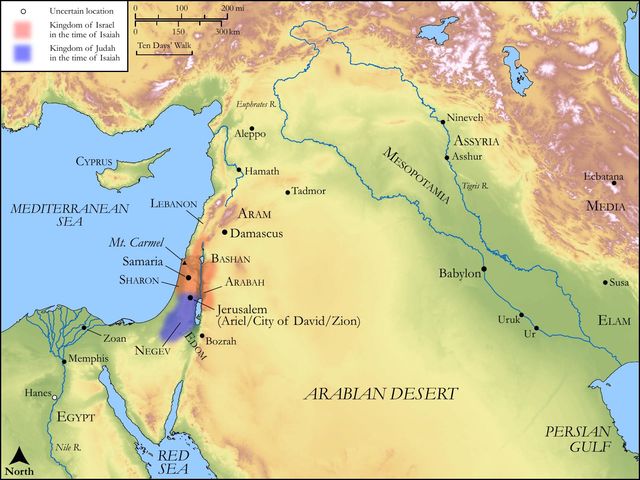
See on the biblical-era map
Study this verse
Public-domain commentary
Matthew Henry
From his Commentary on the Whole Bible. Henry comments on passages, not single verses — this entry covers Isaiah 30:27–33.
This terrible prediction of the ruin of the Assyrian army, though it is a threatening to them, is part of the promise to the Israel of God, that God would not only punish the Assyrians for the mischief they had done to the Israel of God, but would disable and deter them from doing the like again; and this prediction, which would now shortly be accomplished, would ratify and confirm the foregoing promises, which should be accomplished in the latter days. Here is,
I.God Almighty angry, and coming forth in anger against the Assyrians.
He is here introduced in all the power and all the terror of his wrath, Isa 30:27. The name of Jehovah, which the Assyrians disdain and set at a distance from them, as if they were out of its reach and it could do them no harm, behold, it comes from far. A messenger in the name of the Lord comes from as far off as heaven itself. He is a messenger of wrath, burning with his anger. God's lips are full of indignation at the blasphemy of Rabshakeh, who compared the God of Israel with the gods of the heathen; his tongue is as a devouring fire, for he can speak his proud enemies to ruin; his very breath comes with as much force as an overflowing stream, and with it he shall slay the wicked, Isa 11:4. He does not stifle or smother his resentments, as men do theirs when they are either causeless or impotent; but he shall cause his glorious voice to be heard when he proclaims war with an enemy that sets him at defiance, Isa 30:30. He shall display the indignation of his anger, anger in the highest degree; it shall be as the flame of a devouring fire, which carries and consumes all before it, with lightning or dissipation, and with tempest and hailstones, all which are the formidable phenomena of nature, and therefore expressive of the terror of the Almighty God of nature.
II.The execution done by this anger of the Lord.
Men are often angry when they can only threaten and talk big; but when God causes his glorious voice to be heard that shall not be all: he will show the lighting down of his arm too, Isa 30:30. The operations of his providence shall accomplish the menaces of his word. Those that would not see the lifting up of his arm (Isa 26:11) shall feel the lighting down of it, and find, to their cost, that the burden thereof is heavy (Isa 30:27), so heavy that they cannot bear it, nor bear up against it, but must unavoidably sink and be crushed under it. Who knows the power of his anger or imagines what an offended God can do? Five things are here prepared for the execution: - 1. Here is an overflowing stream, that shall reach to the midst of the neck, shall quite overwhelm the whole body of the army, and Sennacherib only, the head of it, shall keep above water and escape this stroke, while yet he is reserved for another in the house of Nisroch his god. The Assyrian army had been to Judah as an overflowing stream, reaching even to the neck (Isa 8:7, Isa 8:8), and now the breath of God's wrath will be so to it. 2. Here is a sieve of vanity, with which God would sift those nations of which the Assyrian army was composed, Isa 30:28. The great God can sift nations, for they are all before him as the small dust of the balance; he will sift them, not to gather out of them any that should be preserved, but so as to shake them one against another, put them into great consternation, and shake them all away at last; for it is a sieve of vanity (which retains nothing) that they are shaken with, and they are found all chaff. 3. Here is a bridle, which God has in their jaws, to curb and restrain them from doing the mischief they would do, and to force and constrain them to serve his purposes against their own will, Isa 10:7. God particularly says of Sennacherib (Isa 37:29) that he will put a hook in his nose and a bridle in his lips. It is a bridle causing them to err, forcing them to such methods as will certainly be destructive to themselves and their interest and in which they will be infatuated. God with a word guides his people into the right way (Isa 30:21), but with a bridle he turns his enemies headlong upon their own ruin. 4. Here is a rod and a staff, even the voice of the Lord, his word giving orders concerning it, with which the Assyrian shall be beaten down, Isa 30:31. The Assyrian had been himself a rod in God's hand for the chastising of his people, and had smitten them, Isa 10:5. That was a transient rod; but against the Assyrian shall go forth a grounded staff, that shall give a steady blow, shall stick close to him and strike home, so as to leave an impression upon him. It is a staff with a foundation, founded upon the enemies' deserts and God's determinate counsel. It is a consumption determined (Isa 10:23), and therefore there is no escaping it, no getting out of the reach of it; it shall pass in every place where an Assyrian is found, and the Lord shall lay it upon him, and cause it to rest, Isa 30:32. Such is the woeful case of those that persist in enmity to God: the wrath of God abides on them. 5. Here is Tophet ordained and prepared for them, Isa 30:33. The valley of the son of Hinnom, adjoining to Jerusalem, was called Tophet. In that valley, it is supposed, many of the Assyrian regiments lay encamped, and were there slain by the destroying angel; or there the bodies of those that were so slain were burned. Hezekiah had lately, and from yesterday (so the word is) ordained it; that is, say some, he had cleared it of the images that were set up in it, to which they there burnt their children, and so prepared it to be a receptacle for the dead bodies of their enemies, for the king of Assyria (that is, for his army) it is prepared, and there is fuel enough ready to burn them all; and they shall be consumed as suddenly and effectually as if the fire were kept burning by a continual stream of brimstone, for such the breath of the Lord, his word and his wrath, will be to it. Now as the prophet, in the foregoing promises, slides insensibly into the promises of gospel graces and comforts, so here, in the threatening of the ruin of Sennacherib's army, he points at the final and everlasting destruction of all impenitent sinners. Our Saviour calls the future misery of the damned Gehenna, in allusion to the valley of Hinnom, which gives some countenance to the applying of this to that misery, as also that in the Apocalypse it is so often called the lake that burns with fire and brimstone. This is said to be prepared of old for the devil and his angels, for the greatest of sinners, the proudest, and that think themselves not accountable to any for what they say and do; even for kings it is prepared. It is deep and large, sufficient to receive the world of the ungodly; the pile thereof is fire and much wood. God's wrath is the fire, and sinners make themselves fuel to it; and the breath of the Lord (the power of his anger) kindles it, and will keep it ever burning. See Isa 66:24. Wherefore stand in awe and sin not.
III.The great joy which this should occasion to the people of God.
The Assyrian's fall is Jerusalem's triumph (Isa 30:29): You shall have a song as in the night, a psalm of praise such as those sing who by night stand in the house of the Lord, and sing to his glory who gives songs in the night. It shall not be a song of vain mirth, but a sacred song, such as was sung when a holy solemnity was kept in a grave and religious manner. Our joy in the fall of the church's enemies must be a holy joy, gladness of heart, as when one goes, with a pipe (such as the sons of the prophets used when they prophesied, Sa1 10:5), to the mountain of the Lord, there to celebrate the praises of the Mighty One of Israel. Nay, in every place where the divine vengeance shall pursue the Assyrians they shall not only fall unlamented, but all their neighbours shall attend their fall with tabrets and harps, pleased to see how God, in battles of shaking, such as shake them out of the world, fights with them (Isa 30:32); for when the wicked perish there is shouting; and it is with a particular satisfaction that wise and good men see the ruin of those who, like the Assyrians, have insolently bidden defiance to God and trampled upon all mankind.
Historical interpretation
Historical reception
1 surviving comment on this verse from the historical church.
(Vers. 27 seqq.) Behold, the name of the Lord comes from afar: His burning anger and heaviness to bear. His lips are filled with indignation, and his tongue is like a devouring fire. His breath is like a torrent overflowing to the middle of the neck, to destroy nations for nothing, and the bridle of error that was in the jaws of the people. It shall be a song to you, like the night of a holy solemnity, and the joy of the heart, like one who goes with a flute, to enter the mount of the Lord, to the mighty one of Israel. LXX: Behold, the name of the Lord comes after a long time: burning wrath with glory, the speech of his lips, full of anger, and the anger of fury like fire will devour, and his spirit like water in a valley, drawing will come up to the neck, and it will be divided to disturb the nations with vain error, and error will be cast aside, and it will take them in their sight. Should you always rejoice and enter into my holy things constantly, as if celebrating and rejoicing at feasts, to enter with a pipe to the mountain of the Lord to the God of Israel? Let us first speak according to the Hebrew. They depend on the preceding things which are said. The prophetic word had caught those who, despising the help of God, were fleeing to the Egyptians because of fear of the Babylonians, and it threatened that those who went down there would die. And again, after the punishments, he promises that those who wanted (or rather, didn't want) to hear him would not only dwell in Jerusalem under Zerubbabel, Ezra, and Nehemiah, but also that he would promise greater blessedness to all who believe in the word of God, in the consummation of the world, when the rivers of waters will run through all the mountains and hills, and many will be killed, and towers will fall. The moon and the sun will also receive a brighter light when the Lord binds up and heals the wounds of his people. Some may argue that these things were accomplished to an excessive degree in the times of Cyrus, who released the captivity of the people and filled the land of Judah. Therefore, because rewards have been promised to the good and obedient, now on the contrary, punishments are declared for the wicked and contemptuous, so that the Lord may fulfill his plan and come to punish sinners after a long time, and pronounce judgment upon all, and destroy the impious with the breath of his mouth, whom he calls the bridle of the peoples: not to rule over them, but to draw those subject to him to ruin. He also uses the analogy of a river overflowing and reaching up to the neck to testify that the end of all things has come. Just as the river suffocates the one it reaches up to the neck, so too the judgment of God will not allow anyone to escape unpunished. But when He loses the bridle that was on the jaws of all nations, and has brought them to nothing, then, He says, there will be a song for you, O saints, who obey my commands, like the night of a holy solemnity, when you came out of Egypt and threw off the yoke of Egyptian slavery in the solemnity of the Passover, saying at the Red Sea when Pharaoh was drowned: 'Let us sing to the Lord, for He is gloriously magnified' (Exodus 15:1). And with such great joy in your hearts that you imitate those who, carrying the first fruits to the temple and offering gifts in the presses of God, go with their pipes, demonstrating the joys of their heart through song. I have briefly explained these things according to the Hebrew language. However, it should be noted in both editions that it is not the Lord, but the name of the Lord that comes after a long time, as it is said in the Psalms: 'Blessed is he who comes in the name of the Lord, the Lord God, and he has shined upon us' (Ps. CXVII, 26). And he himself speaks in the Gospel: 'I have come in my Father's name, and you have not received me' (John V, 43). It is said to come after a long time, with human impatience speaking: 'How long, O Lord, will you forget me? Forever?' How long will you turn your face away from me? (Ps. XII, 1). His burning fury also comes with glory, so that the one we despise in humility, we may fear in majesty. This very thing is also written in the psalms: God will come manifestly, our God will not keep silent. Fire will burn before him, and there will be a mighty tempest around him (Ps. L, 3, 4). He himself speaks in the Gospel (Luke XII, 49): I have come to cast fire on the earth, and how I wish it were already kindled! Again in another psalm it is read: The voice of the Lord cutting through the flame of fire (Ps. XXVIII, 7), so that whatever is in the manner of hay, wood, and straw, the flame would consume. Hence, God is also said to be a consuming fire (Deut. IV). And it is inferred: The fury of his wrath will devour like fire, and many of our people interpret the fury of the Lord's wrath as the devil, to whom we are handed over for punishment, who, according to the book of Samuel, incited David to number the people of God (II Reg. XXIV). And the Apostle says: to deliver such a Satan to the destruction of the flesh, that the spirit may be saved (I Cor. V, 5). But this same fury, and so the fury of the Lord will do nothing by his own will, but what has been commanded to him. Hence it follows: The speech of his lips is full of wrath. His spirit also like water in a valley, drawing near even to the neck, to make punishments overflow upon sinners. He will be divided according to the quality of his merits, to destroy and trouble the nations which false error had deceived, so that they may understand themselves to be overthrown. When it is said of such people, who prevailed in the power of this world and delighted in their own error, that they will not always do this. And certain of our people think that this place and the whole content of the chapter is against heretics and all dogmas that are contrary to the truth, because when the time of judgment comes, they will not enter his holy mountain, that is, the Church of the Lord, so that they may not gather riches under the name of religion and indulge in luxury, as if celebrating the feasts of the Lord. The Jews understand concerning the nations of Gog and Magog, which they believe will come from the North, that is, from the regions of Scythia, about which Ezekiel speaks more fully (Ezek. 19).
Continue studying Isaiah 30:27 across the web’s major study libraries — every link below opens this exact verse, chapter, or book on the destination site.
Read & Compare
 BibleGatewayThis verse in more than 200 translations and 70 languages.
 Bible.comThe YouVersion reader — hundreds of translations, reading plans, and highlights.
 ESV.orgCrossway's official English Standard Version reader.
 NET BibleThe NET translation with 60,000+ translators' notes on every rendering decision.
 STEP BibleTyndale House's free study tool — original text, vocabulary, and scholarly resources.
 BibliaLogos Bible Software's free web reader.
 USCCBThe New American Bible (Revised Edition) with the U.S. bishops' study notes.
Commentaries
 BibleHub CommentariesDozens of classic commentaries on this verse, gathered on one page.
 StudyLightMore than 100 commentary sets — the largest collection on the web.
 BibleRefPlain-English commentary on what this verse means, verse by verse.
 Enduring WordDavid Guzik's free commentary on this chapter, widely used by Bible teachers.
 Bible Study ToolsVerse commentary alongside Greek and Hebrew study aids.
Original Language & Research
- BibleHub InterlinearThe verse word by word — original language, transliteration, and English.
- BibleHub LexiconEvery word's original-language definition and Strong's entry.
 Blue Letter BibleDeep-study tools — Strong's numbers, concordance, and word studies.
 SefariaThe Hebrew text with Rashi and centuries of Jewish commentary.
Sermons, Hymns & Audio


TrulyRandomVerse is not affiliated with these sites and doesn’t control their content. They’re linked because they’re genuinely useful.
Summary
Isaiah 30:27 delivers a potent and awe-inspiring prophetic vision of the LORD's imminent and decisive intervention. It dramatically portrays God's righteous anger as an overwhelming, consuming force, emphasizing His transcendent power and the absolute certainty of His judgment against those who persist in rebellion and self-reliance rather than trusting in His divine counsel. The vivid imagery underscores the weighty and inescapable consequences of defying the Holy One of Israel, revealing a God whose justice is as fervent and unyielding as His steadfast love and mercy.
Context
ShowHideLiterary Context
Isaiah 30:27 is strategically positioned within a significant prophetic section of Isaiah (chapters 28-33), which primarily denounces Judah's spiritual apostasy and their misguided political alliances. Specifically, this chapter opens with a severe "woe" pronounced against "rebellious children" who seek security in an alliance with Egypt rather than relying on the LORD, as articulated in Isaiah 30:1-7. The preceding verses highlight Judah's obstinate refusal to heed God's word, preferring to trust in human military strength and worldly wisdom over divine promises. Verse 27, therefore, serves as a climactic declaration of the LORD's inevitable response to this persistent disobedience, portraying His coming judgment as a powerful, unavoidable, and consuming manifestation of His holy character. The subsequent verses in chapter 30 (e.g., Isaiah 30:28-33) continue to describe the devastating impact of this divine wrath upon the unrighteous, while simultaneously contrasting it with the ultimate restoration and blessing that awaits those who truly turn to God in repentance.
Historical & Cultural Context
The historical setting for Isaiah 30 is the tumultuous late 8th century BCE, a period marked by immense geopolitical instability. The formidable Assyrian Empire, under the reign of Sennacherib, posed an existential threat to the kingdom of Judah. In response to this looming danger, King Hezekiah and the leaders of Judah, despite Isaiah's fervent warnings and prophetic counsel, chose to pursue a military alliance with Egypt, a traditional rival of Assyria. This decision represented a profound theological failure, as it demonstrated a critical lack of faith in the LORD, who had repeatedly proven Himself as Israel's sovereign deliverer. Culturally, forming such alliances was common practice among the nations round about for strategic defense. However, for the covenant people of God, it constituted a direct violation of their unique relationship with Yahweh, who demanded exclusive trust, allegiance, and reliance. The imagery of God's "anger" and "indignation" would have resonated deeply within a culture that understood divine retribution as a just and necessary response to covenant unfaithfulness, idolatry, and rebellion against the supreme deity.
Key Themes
ShowHideThis verse powerfully contributes to several overarching themes prominent within the book of Isaiah and the broader prophetic literature. First and foremost is the theme of Divine Judgment and Wrath. The vivid imagery of "burning anger," "indignation," and "devouring fire" underscores the intensity, certainty, and consuming nature of God's righteous response to sin and rebellion, particularly against His covenant people who have strayed from His path. Secondly, it highlights God's Sovereignty and Majesty. The declaration that "the name of the LORD cometh from far" emphasizes His transcendent authority and His ability to intervene decisively in human affairs, demonstrating that His plans and purposes will ultimately prevail regardless of human schemes or opposition. This also ties into the theme of the Consequences of Disobedience, serving as a solemn warning that rejecting God's counsel and seeking alternative sources of security inevitably leads to severe divine repercussions, contrasting sharply with the blessings promised to those who wait upon the LORD in quietness and trust. The verse also subtly touches on the theme of God's Word as Power, as His "lips" and "tongue" are the instruments of His consuming judgment.
Exposition and Analysis
ShowHideKey Word Analysis
ShowHideA primitive root meaning "to kindle" or "to consume," often specifically by fire. In the context of divine anger, it conveys an active, intense, and destructive force. It is not a passive emotion but an active, consuming flame that emanates from God's holy character, indicating a thorough and complete judgment that will "burn up" or "waste" all that stands against Him.
Derived from a root meaning "froth at the mouth," this word powerfully describes fury, especially God's intense displeasure with sin. It conveys a deep, righteous wrath that is provoked by human rebellion and unfaithfulness. It's a strong term indicating divine abhorrence for evil and a resolute determination to address it, suggesting a boiling, overflowing rage against unrighteousness.
A primitive root meaning "to eat" or "to consume," literally or figuratively. When applied to fire, as in "devouring fire," it emphasizes the complete and destructive nature of the flame, leaving nothing behind. It portrays God's judgment as utterly consuming, implying that nothing can withstand its power or escape its reach, much like a fire that "eats up" everything in its path.
Verse Breakdown
ShowHide"Behold, the name of the LORD cometh from far"
This opening exclamation, "Behold," demands immediate attention, signaling a profound and impending divine manifestation. "The name of the LORD" (Hebrew: Shem Yᵉhôvâh) signifies not merely a title, but the full revealed character, authority, active presence, and very essence of God Himself. His "coming from far" emphasizes His transcendent nature, His sovereign power to intervene from beyond human limitations, and the deliberate, inevitable nature of His approach. It suggests an arrival that is both distant in its origin (from heaven, from eternity) and yet certain in its arrival, demonstrating His ultimate control over time and space.
"burning with his anger, and the burden thereof is heavy"
This clause immediately introduces the formidable nature of God's coming: it is an act of intense, consuming wrath. "Burning with his anger" depicts divine fury as a tangible, fiery force, underscoring its ferocity and destructive potential. This is not a fleeting emotion but a holy, purifying fire. The phrase "the burden thereof is heavy" (Hebrew: kôbed) emphasizes the immense weight, gravity, and seriousness of this divine judgment. It is not a light matter but a weighty, inescapable consequence, reflecting the profound offense of human sin against a holy God and the significant impact of His intervention.
"his lips are full of indignation, and his tongue as a devouring fire"
This powerful anthropomorphic imagery attributes human features (lips, tongue) to God to convey the intensity and certainty of His righteous displeasure. "His lips are full of indignation" means His very utterances, His decrees, are saturated with divine wrath, indicating that His judgment is declared and executed by His authoritative word. The comparison of "his tongue as a devouring fire" further reinforces the destructive and consuming power of His spoken word, which acts as an irresistible force, consuming all that opposes His holiness. This imagery connects His judgment with the very essence of His being and His pronouncements, highlighting that His word is not just spoken but acts with consuming power.
Literary Devices
ShowHideIsaiah 30:27 is profoundly rich with powerful Imagery, painting a vivid and terrifying picture of divine judgment. The descriptions of "burning anger," a "heavy burden," and a "devouring fire" appeal directly to the senses, allowing the reader to viscerally grasp the intensity and destructive nature of God's wrath. Anthropomorphism is prominently employed, attributing human body parts and actions—specifically "lips" being "full of indignation" and a "tongue" acting "as a devouring fire"—to God. This device makes the abstract concept of divine anger more relatable and impactful, emphasizing God's active, personal, and decisive involvement in judgment. Furthermore, the verse employs strong Metaphor and Simile, particularly in comparing God's tongue to a "devouring fire." This is not a literal description but a figurative one, conveying the consuming, irresistible, and annihilating power of God's word and judgment. The cumulative effect of these literary techniques creates an overwhelming sense of divine power, inescapable consequence, and holy terror, designed to evoke profound awe and reverent fear of the LORD.
Theological and Thematic Connections
ShowHideIsaiah 30:27 serves as a profound theological statement about the character of God, particularly His absolute holiness and unwavering justice. It reveals that while God is infinitely patient, merciful, and slow to anger, His very nature also demands a righteous and decisive response to sin and rebellion. His "anger" and "indignation" are not capricious human emotions but a holy, consuming fire that purifies and judges, flowing directly from His absolute moral perfection and His covenant faithfulness. This verse underscores the biblical principle that God is not to be trifled with; His warnings are serious, and His justice is certain and inescapable. It reminds us that true security and salvation lie not in human alliances, political schemes, or military strength, but in humble, obedient, and exclusive trust in the LORD alone.
Reflection and Application
ShowHideIsaiah 30:27 calls us to a profound re-evaluation of our trust, allegiance, and obedience. In a world that constantly tempts us to rely on human ingenuity, political solutions, technological advancements, or financial security, this verse starkly reminds us that ultimate power and authority reside solely with the LORD. It challenges us to examine where our true confidence lies, especially in times of crisis, uncertainty, or perceived threat. Do we, like ancient Judah, seek comfort and deliverance in "chariots and horses" (human strength and worldly strategies) rather than turning wholeheartedly to God, who alone is our refuge and strength? The "devouring fire" of God's judgment is a solemn warning against spiritual complacency, self-reliance, and a call to genuine repentance and humble dependence. It compels us to live in awe of His holiness, recognizing that His justice is as real and inevitable as His boundless mercy. This verse encourages us to cultivate a life of deep reverence, ensuring that our trust is firmly placed in the One whose "name" embodies all power and whose word is a consuming, irresistible force.
Questions for Reflection
ShowHideFAQ
ShowHideWhat does "the name of the LORD cometh from far" signify?
ShowHide"The name of the LORD" (Hebrew: Shem Yᵉhôvâh) is a profound theological concept that represents God's entire revealed character, His authority, His active presence, and His very being. When it is said that His name "cometh from far," it emphasizes God's transcendence – He is not limited by human space or time. It signifies that His intervention is sovereign, deliberate, and originates from His heavenly dwelling, beyond the immediate human sphere. This phrase underscores the inevitability and certainty of His coming, highlighting that His judgment is not a sudden, rash outburst but a predetermined, weighty act of His divine will, executed from His eternal throne. It communicates His absolute control and His ability to act decisively from a position of ultimate authority, much like when He descended on Mount Sinai to reveal His law and presence to Israel.
Is God's anger a human-like emotion?
ShowHideWhile the Bible uses anthropomorphic language (attributing human characteristics to God) to help us understand divine attributes, God's anger is fundamentally different from human anger. Human anger is often tainted by sin, impulsiveness, selfishness, or a lack of control. God's "anger" (Hebrew: ʼaph or zaʻam) is a holy, righteous indignation that stems from His perfect justice and His absolute opposition to sin and evil. It is a controlled, purposeful, and consistent response to rebellion, unfaithfulness, and injustice, never irrational or out of control. It is always in perfect alignment with His holy character and His redemptive purposes, ultimately serving to uphold His moral order and to bring about either repentance or righteous judgment. This divine wrath is a manifestation of His holiness, which cannot tolerate evil, as Psalm 7:11 states, "God is a righteous judge, and a God who feels indignation every day."
Christ-Centered Fulfillment
ShowHideIsaiah 30:27, with its vivid imagery of the LORD's coming in fiery judgment, finds its ultimate fulfillment and profound reinterpretation in the person and work of Jesus Christ. While the Old Testament often depicts God's wrath against sin, the New Testament reveals that the execution of this judgment is fully entrusted to the Son. Jesus Himself declared that the Father "judges no one, but has given all judgment to the Son" (John 5:22). At His first coming, Christ, as the spotless Lamb of God, bore the full "burden" of God's wrath against sin on the cross, becoming the atoning sacrifice that consumed the indignation due to humanity (Romans 3:25). He is the Lamb of God who takes away the sin of the world, offering a path to escape the "devouring fire" of divine judgment through faith in His substitutionary sacrifice. However, the imagery of a coming, consuming fire also powerfully foreshadows Christ's glorious second advent. He will return not only as Savior but also as the righteous Judge, with "eyes like a flame of fire" (Revelation 1:14) and a "sharp sword coming out of his mouth" to strike down the nations (Revelation 19:15), embodying the very "tongue as a devouring fire" described by Isaiah. Thus, Isaiah 30:27 points to the comprehensive work of Christ, who both absorbs God's wrath for believers and executes it against unrepentant rebellion, demonstrating the full spectrum of divine justice and mercy.