


Isaiah 30:28
Bible text: King James Version (1769 Blayney text) · Public domain
Bible text: King James Version with Strong's numbers · Public domain
Bible text: Berean Standard Bible · Public domain
Bible text: American Standard Version (1901) · Public domain
Bible text: World English Bible, Messianic edition · Public domain
Bible text: Geneva Bible (1599) · Public domain
Bible text: Young's Literal Translation · Public domain
- וְרוּחוֹve·ru·Choand his breathH7307Conj-w ¦ N-fsc ¦ 3msNoun Singular Feminine Constructוְandרוּחbreathוֹhis
- כְּנַחַלke·Na·chal[is] like a torrentH5158Prep-k ¦ N-msNoun Singular Masculine Absoluteכְּ[is] likeנַחַלa torrent
- שׁוֹטֵףsho·TefoverflowingH7857V-Qal-Prtcpl-msVerb Qal Participle Singular Masculine Absolute
- עַד'adtoH5704PrepPreposition
- צַוָּארtza·Var[the] neckH6677N-msNoun Singular Masculine Absolute
- יֶחֱצֶהye·che·Tzehit reachesH2673V-Qal-Imperf-3msVerb Qal Imperfect 3rd Singular Masculine
- לַהֲנָפָהla·ha·na·Fahfor shakingH5130Prep-l ¦ N-fsNoun Singular Feminine Absoluteלַforהֲנָפָהshaking
- גוֹיִםgo·YimnationsH1471N-mpNoun Plural Masculine Absolute
- בְּנָפַתbe·Na·fatin a sieve ofH5299Prep-b ¦ N-fscNoun Singular Feminine Constructבְּinנָפַתa sieve of
- שָׁוְאShav'worthlessnessH7723N-msNoun Singular Masculine Absolute
- וְרֶסֶןve·Re·senand a halterH7448Conj-w ¦ N-msNoun Singular Masculine Absoluteוְandרֶסֶןa halter
- מַתְעֶהmat·'Eh[which] leads astrayH8582V-Hiphil-Prtcpl-msVerb Hiphil Participle Singular Masculine Absolute
- עַל'al[is] onH5921PrepPreposition
- לְחָיֵיle·cha·Yei[the] jaws ofH3895N-mdcNoun Dual Masculine Construct
- עַמִּים'a·MimpeoplesH5971N-mpNoun Plural Masculine Absolute
English is a literal word-by-word gloss of the Hebrew, not the KJV's wording. Why?
This is the original text the KJV's translators worked from — each Hebrew word with its own literal English meaning in this verse, prepared by scholars at Tyndale House, Cambridge. The KJV translates whole sentences, not word by word, so its wording differs: one Hebrew word can become several English words, and the KJV may choose “the LORD” where the gloss reads “Yahweh”. Both are faithful — they answer different questions. For the KJV's own rendering, switch to the KJV text.
Details
See on the biblical-era map
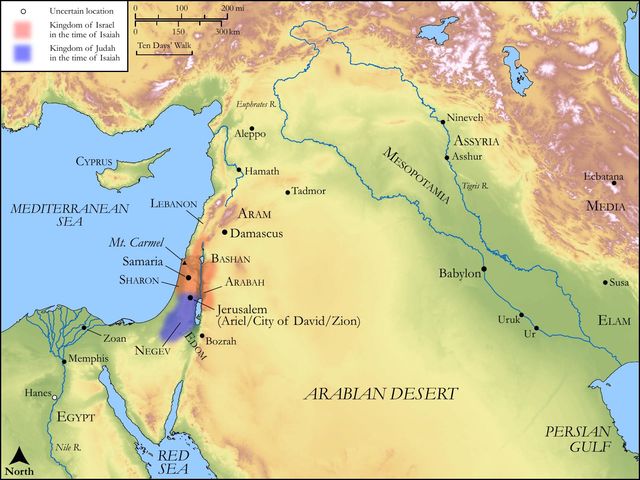
Study this verse
Public-domain commentary
Matthew Henry
From his Commentary on the Whole Bible. Henry comments on passages, not single verses — this entry covers Isaiah 30:27–33.
This terrible prediction of the ruin of the Assyrian army, though it is a threatening to them, is part of the promise to the Israel of God, that God would not only punish the Assyrians for the mischief they had done to the Israel of God, but would disable and deter them from doing the like again; and this prediction, which would now shortly be accomplished, would ratify and confirm the foregoing promises, which should be accomplished in the latter days. Here is,
I.God Almighty angry, and coming forth in anger against the Assyrians.
He is here introduced in all the power and all the terror of his wrath, Isa 30:27. The name of Jehovah, which the Assyrians disdain and set at a distance from them, as if they were out of its reach and it could do them no harm, behold, it comes from far. A messenger in the name of the Lord comes from as far off as heaven itself. He is a messenger of wrath, burning with his anger. God's lips are full of indignation at the blasphemy of Rabshakeh, who compared the God of Israel with the gods of the heathen; his tongue is as a devouring fire, for he can speak his proud enemies to ruin; his very breath comes with as much force as an overflowing stream, and with it he shall slay the wicked, Isa 11:4. He does not stifle or smother his resentments, as men do theirs when they are either causeless or impotent; but he shall cause his glorious voice to be heard when he proclaims war with an enemy that sets him at defiance, Isa 30:30. He shall display the indignation of his anger, anger in the highest degree; it shall be as the flame of a devouring fire, which carries and consumes all before it, with lightning or dissipation, and with tempest and hailstones, all which are the formidable phenomena of nature, and therefore expressive of the terror of the Almighty God of nature.
II.The execution done by this anger of the Lord.
Men are often angry when they can only threaten and talk big; but when God causes his glorious voice to be heard that shall not be all: he will show the lighting down of his arm too, Isa 30:30. The operations of his providence shall accomplish the menaces of his word. Those that would not see the lifting up of his arm (Isa 26:11) shall feel the lighting down of it, and find, to their cost, that the burden thereof is heavy (Isa 30:27), so heavy that they cannot bear it, nor bear up against it, but must unavoidably sink and be crushed under it. Who knows the power of his anger or imagines what an offended God can do? Five things are here prepared for the execution: - 1. Here is an overflowing stream, that shall reach to the midst of the neck, shall quite overwhelm the whole body of the army, and Sennacherib only, the head of it, shall keep above water and escape this stroke, while yet he is reserved for another in the house of Nisroch his god. The Assyrian army had been to Judah as an overflowing stream, reaching even to the neck (Isa 8:7, Isa 8:8), and now the breath of God's wrath will be so to it. 2. Here is a sieve of vanity, with which God would sift those nations of which the Assyrian army was composed, Isa 30:28. The great God can sift nations, for they are all before him as the small dust of the balance; he will sift them, not to gather out of them any that should be preserved, but so as to shake them one against another, put them into great consternation, and shake them all away at last; for it is a sieve of vanity (which retains nothing) that they are shaken with, and they are found all chaff. 3. Here is a bridle, which God has in their jaws, to curb and restrain them from doing the mischief they would do, and to force and constrain them to serve his purposes against their own will, Isa 10:7. God particularly says of Sennacherib (Isa 37:29) that he will put a hook in his nose and a bridle in his lips. It is a bridle causing them to err, forcing them to such methods as will certainly be destructive to themselves and their interest and in which they will be infatuated. God with a word guides his people into the right way (Isa 30:21), but with a bridle he turns his enemies headlong upon their own ruin. 4. Here is a rod and a staff, even the voice of the Lord, his word giving orders concerning it, with which the Assyrian shall be beaten down, Isa 30:31. The Assyrian had been himself a rod in God's hand for the chastising of his people, and had smitten them, Isa 10:5. That was a transient rod; but against the Assyrian shall go forth a grounded staff, that shall give a steady blow, shall stick close to him and strike home, so as to leave an impression upon him. It is a staff with a foundation, founded upon the enemies' deserts and God's determinate counsel. It is a consumption determined (Isa 10:23), and therefore there is no escaping it, no getting out of the reach of it; it shall pass in every place where an Assyrian is found, and the Lord shall lay it upon him, and cause it to rest, Isa 30:32. Such is the woeful case of those that persist in enmity to God: the wrath of God abides on them. 5. Here is Tophet ordained and prepared for them, Isa 30:33. The valley of the son of Hinnom, adjoining to Jerusalem, was called Tophet. In that valley, it is supposed, many of the Assyrian regiments lay encamped, and were there slain by the destroying angel; or there the bodies of those that were so slain were burned. Hezekiah had lately, and from yesterday (so the word is) ordained it; that is, say some, he had cleared it of the images that were set up in it, to which they there burnt their children, and so prepared it to be a receptacle for the dead bodies of their enemies, for the king of Assyria (that is, for his army) it is prepared, and there is fuel enough ready to burn them all; and they shall be consumed as suddenly and effectually as if the fire were kept burning by a continual stream of brimstone, for such the breath of the Lord, his word and his wrath, will be to it. Now as the prophet, in the foregoing promises, slides insensibly into the promises of gospel graces and comforts, so here, in the threatening of the ruin of Sennacherib's army, he points at the final and everlasting destruction of all impenitent sinners. Our Saviour calls the future misery of the damned Gehenna, in allusion to the valley of Hinnom, which gives some countenance to the applying of this to that misery, as also that in the Apocalypse it is so often called the lake that burns with fire and brimstone. This is said to be prepared of old for the devil and his angels, for the greatest of sinners, the proudest, and that think themselves not accountable to any for what they say and do; even for kings it is prepared. It is deep and large, sufficient to receive the world of the ungodly; the pile thereof is fire and much wood. God's wrath is the fire, and sinners make themselves fuel to it; and the breath of the Lord (the power of his anger) kindles it, and will keep it ever burning. See Isa 66:24. Wherefore stand in awe and sin not.
III.The great joy which this should occasion to the people of God.
The Assyrian's fall is Jerusalem's triumph (Isa 30:29): You shall have a song as in the night, a psalm of praise such as those sing who by night stand in the house of the Lord, and sing to his glory who gives songs in the night. It shall not be a song of vain mirth, but a sacred song, such as was sung when a holy solemnity was kept in a grave and religious manner. Our joy in the fall of the church's enemies must be a holy joy, gladness of heart, as when one goes, with a pipe (such as the sons of the prophets used when they prophesied, Sa1 10:5), to the mountain of the Lord, there to celebrate the praises of the Mighty One of Israel. Nay, in every place where the divine vengeance shall pursue the Assyrians they shall not only fall unlamented, but all their neighbours shall attend their fall with tabrets and harps, pleased to see how God, in battles of shaking, such as shake them out of the world, fights with them (Isa 30:32); for when the wicked perish there is shouting; and it is with a particular satisfaction that wise and good men see the ruin of those who, like the Assyrians, have insolently bidden defiance to God and trampled upon all mankind.
Historical interpretation
Historical reception
1 surviving comment on this verse from the historical church.
(Vers. 27 seqq.) Behold, the name of the Lord comes from afar: His burning anger and heaviness to bear. His lips are filled with indignation, and his tongue is like a devouring fire. His breath is like a torrent overflowing to the middle of the neck, to destroy nations for nothing, and the bridle of error that was in the jaws of the people. It shall be a song to you, like the night of a holy solemnity, and the joy of the heart, like one who goes with a flute, to enter the mount of the Lord, to the mighty one of Israel. LXX: Behold, the name of the Lord comes after a long time: burning wrath with glory, the speech of his lips, full of anger, and the anger of fury like fire will devour, and his spirit like water in a valley, drawing will come up to the neck, and it will be divided to disturb the nations with vain error, and error will be cast aside, and it will take them in their sight. Should you always rejoice and enter into my holy things constantly, as if celebrating and rejoicing at feasts, to enter with a pipe to the mountain of the Lord to the God of Israel? Let us first speak according to the Hebrew. They depend on the preceding things which are said. The prophetic word had caught those who, despising the help of God, were fleeing to the Egyptians because of fear of the Babylonians, and it threatened that those who went down there would die. And again, after the punishments, he promises that those who wanted (or rather, didn't want) to hear him would not only dwell in Jerusalem under Zerubbabel, Ezra, and Nehemiah, but also that he would promise greater blessedness to all who believe in the word of God, in the consummation of the world, when the rivers of waters will run through all the mountains and hills, and many will be killed, and towers will fall. The moon and the sun will also receive a brighter light when the Lord binds up and heals the wounds of his people. Some may argue that these things were accomplished to an excessive degree in the times of Cyrus, who released the captivity of the people and filled the land of Judah. Therefore, because rewards have been promised to the good and obedient, now on the contrary, punishments are declared for the wicked and contemptuous, so that the Lord may fulfill his plan and come to punish sinners after a long time, and pronounce judgment upon all, and destroy the impious with the breath of his mouth, whom he calls the bridle of the peoples: not to rule over them, but to draw those subject to him to ruin. He also uses the analogy of a river overflowing and reaching up to the neck to testify that the end of all things has come. Just as the river suffocates the one it reaches up to the neck, so too the judgment of God will not allow anyone to escape unpunished. But when He loses the bridle that was on the jaws of all nations, and has brought them to nothing, then, He says, there will be a song for you, O saints, who obey my commands, like the night of a holy solemnity, when you came out of Egypt and threw off the yoke of Egyptian slavery in the solemnity of the Passover, saying at the Red Sea when Pharaoh was drowned: 'Let us sing to the Lord, for He is gloriously magnified' (Exodus 15:1). And with such great joy in your hearts that you imitate those who, carrying the first fruits to the temple and offering gifts in the presses of God, go with their pipes, demonstrating the joys of their heart through song. I have briefly explained these things according to the Hebrew language. However, it should be noted in both editions that it is not the Lord, but the name of the Lord that comes after a long time, as it is said in the Psalms: 'Blessed is he who comes in the name of the Lord, the Lord God, and he has shined upon us' (Ps. CXVII, 26). And he himself speaks in the Gospel: 'I have come in my Father's name, and you have not received me' (John V, 43). It is said to come after a long time, with human impatience speaking: 'How long, O Lord, will you forget me? Forever?' How long will you turn your face away from me? (Ps. XII, 1). His burning fury also comes with glory, so that the one we despise in humility, we may fear in majesty. This very thing is also written in the psalms: God will come manifestly, our God will not keep silent. Fire will burn before him, and there will be a mighty tempest around him (Ps. L, 3, 4). He himself speaks in the Gospel (Luke XII, 49): I have come to cast fire on the earth, and how I wish it were already kindled! Again in another psalm it is read: The voice of the Lord cutting through the flame of fire (Ps. XXVIII, 7), so that whatever is in the manner of hay, wood, and straw, the flame would consume. Hence, God is also said to be a consuming fire (Deut. IV). And it is inferred: The fury of his wrath will devour like fire, and many of our people interpret the fury of the Lord's wrath as the devil, to whom we are handed over for punishment, who, according to the book of Samuel, incited David to number the people of God (II Reg. XXIV). And the Apostle says: to deliver such a Satan to the destruction of the flesh, that the spirit may be saved (I Cor. V, 5). But this same fury, and so the fury of the Lord will do nothing by his own will, but what has been commanded to him. Hence it follows: The speech of his lips is full of wrath. His spirit also like water in a valley, drawing near even to the neck, to make punishments overflow upon sinners. He will be divided according to the quality of his merits, to destroy and trouble the nations which false error had deceived, so that they may understand themselves to be overthrown. When it is said of such people, who prevailed in the power of this world and delighted in their own error, that they will not always do this. And certain of our people think that this place and the whole content of the chapter is against heretics and all dogmas that are contrary to the truth, because when the time of judgment comes, they will not enter his holy mountain, that is, the Church of the Lord, so that they may not gather riches under the name of religion and indulge in luxury, as if celebrating the feasts of the Lord. The Jews understand concerning the nations of Gog and Magog, which they believe will come from the North, that is, from the regions of Scythia, about which Ezekiel speaks more fully (Ezek. 19).
Continue studying Isaiah 30:28 across the web’s major study libraries — every link below opens this exact verse, chapter, or book on the destination site.
Read & Compare
 BibleGatewayThis verse in more than 200 translations and 70 languages.
 Bible.comThe YouVersion reader — hundreds of translations, reading plans, and highlights.
 ESV.orgCrossway's official English Standard Version reader.
 NET BibleThe NET translation with 60,000+ translators' notes on every rendering decision.
 STEP BibleTyndale House's free study tool — original text, vocabulary, and scholarly resources.
 BibliaLogos Bible Software's free web reader.
 USCCBThe New American Bible (Revised Edition) with the U.S. bishops' study notes.
Commentaries
 BibleHub CommentariesDozens of classic commentaries on this verse, gathered on one page.
 StudyLightMore than 100 commentary sets — the largest collection on the web.
 BibleRefPlain-English commentary on what this verse means, verse by verse.
 Enduring WordDavid Guzik's free commentary on this chapter, widely used by Bible teachers.
 Bible Study ToolsVerse commentary alongside Greek and Hebrew study aids.
Original Language & Research
- BibleHub InterlinearThe verse word by word — original language, transliteration, and English.
- BibleHub LexiconEvery word's original-language definition and Strong's entry.
 Blue Letter BibleDeep-study tools — Strong's numbers, concordance, and word studies.
 SefariaThe Hebrew text with Rashi and centuries of Jewish commentary.
Sermons, Hymns & Audio


TrulyRandomVerse is not affiliated with these sites and doesn’t control their content. They’re linked because they’re genuinely useful.
Summary
Isaiah 30:28 vividly portrays the Lord's overwhelming and inescapable judgment against nations that oppose His divine will, particularly those who rely on their own strength rather than trusting in Him. Through the potent imagery of an overflowing torrent and a meticulous sifting process, the prophet reveals God's absolute sovereignty, exposing the inherent futility of human pride and directing the course of history to fulfill His righteous purposes, ultimately causing nations to stumble according to His sovereign design.
Context
ShowHideLiterary Context
Isaiah 30:28 is situated within a significant prophetic section of Isaiah (chapters 28-33) often referred to as the "Oracles against Judah and Jerusalem" or "Woes." This broader section primarily addresses Judah's spiritual rebellion, their lack of faith in Yahweh, and their misguided attempts to secure political alliances, specifically with Egypt, to counter the looming threat of the Assyrian Empire. While earlier verses in chapter 30 (verses 18-26) offer promises of restoration, blessing, and divine teaching for those who return to the Lord, verse 28 shifts focus to the inevitable and devastating manifestation of God's wrath against those who persist in their defiance and against the very instruments of His discipline, like Assyria, once their purpose is served. This verse, therefore, serves as a stark reminder of God's absolute power to execute judgment, even as He offers grace to those who repent.
Historical & Cultural Context
The historical backdrop for Isaiah 30 is the late 8th century BCE, a period of intense geopolitical instability. The mighty Assyrian Empire was expanding its dominion, threatening the smaller nations of the Levant, including Judah. King Hezekiah of Judah, despite Isaiah's repeated warnings to trust in the Lord alone, was tempted to form an alliance with Egypt, a traditional rival of Assyria, for military protection. Such alliances were common but often proved unreliable and displeasing to God, who desired His people's complete dependence on Him. The imagery of a "sieve" and a "bridle" would have resonated deeply with an agrarian and pastoral society, conveying concepts of separation (grain from chaff) and absolute control (a rider over an animal), illustrating God's meticulous and sovereign management of nations.
Key Themes
ShowHideThis verse powerfully contributes to several overarching themes in Isaiah. Firstly, it underscores the Divine Judgment and Overwhelming Power of God, portraying His wrath as an unstoppable force that will engulf those who defy Him, far surpassing any human or national might. This aligns with themes seen throughout Isaiah 2:12-22, which describes the coming "Day of the Lord" against all human pride. Secondly, the "sieve of vanity" highlights the theme of Sifting and Exposure of Futility. Nations, with all their human-devised plans and prideful strength, will be meticulously sifted, and their inherent emptiness and reliance on false security will be exposed and discarded. This emphasizes the ultimate worthlessness of human endeavors apart from God's will, a concept profoundly echoed in Ecclesiastes 1:2, where all is declared "vanity of vanities." Thirdly, the "bridle in the jaws of the people" vividly illustrates God's Sovereign Control Over Nations. Even when nations pursue their own agendas, God directs their paths, often leading them into error or self-destruction as part of His greater plan of judgment and purification, demonstrating that He is the ultimate ruler, as profoundly declared in Daniel 4:17, where it states that "the Most High rules in the kingdom of men and gives it to whom he will."
Exposition and Analysis
ShowHideKey Word Analysis
ShowHideThis word is rich in meaning, encompassing "wind," "spirit," or "breath." In this context, it emphasizes the powerful, active, and effortless nature of God's decree or judgment. It is not a physical exertion but a divine pronouncement that carries irresistible, tempestuous force, akin to a mighty wind or storm, signifying a sensible or even violent exhalation.
This term denotes emptiness, futility, falsehood, or worthlessness. It is famously used in the Ten Commandments regarding taking the Lord's name "in vain." Here, when applied to the "sieve of vanity," it underscores that the nations' strength, pride, idolatrous practices, and self-reliant schemes are ultimately empty, deceptive, and will be revealed as such during God's judgment, being discarded like chaff. It signifies evil as destructive, guile, or uselessness.
This word refers to a halter or bridle, an instrument used to curb and control an animal. Its use here serves as a powerful metaphor for God's absolute control over the actions and destinies of nations. It implies that God can direct, restrain, or even mislead nations according to His sovereign will, just as a rider controls a horse, ensuring they err or stumble in a way that serves His ultimate purposes.
Verse Breakdown
ShowHide"And his breath, as an overflowing stream"
This clause introduces the agent and the nature of God's judgment. "His breath" (referring to the Lord) signifies divine power, decree, or spirit. The simile "as an overflowing stream" vividly portrays this power as an irresistible, surging, and destructive force, like a flash flood or winter torrent that sweeps away everything in its path.
"shall reach to the midst of the neck"
This phrase intensifies the imagery of the overflowing stream, indicating that the flood of judgment will rise to a critical, life-threatening level. It suggests an inescapable, overwhelming engulfment that threatens to drown, signifying a complete and perilous subjugation of the targeted entities.
"to sift the nations with the sieve of vanity"
This clause explains the purpose and method of God's judgment. The "sieve" (H5299, nâphâh) is an agricultural tool used to separate grain from chaff. Here, it metaphorically represents God's precise and purposeful judgment. The "nations" (H1471, gôwy) are the targets, and the "sieve of vanity" implies that God will meticulously expose and discard their inherent emptiness, worthlessness, and reliance on false strength or idolatry.
"and [there shall be] a bridle in the jaws of the people, causing [them] to err"
This final clause introduces another powerful metaphor for divine control. The "bridle" (H7448, reçen) signifies God's absolute dominion over the "people" (H5971, ʻam - referring to the nations). God will direct their paths, even causing them to "err" (H8582, tâʻâh - to wander, stray, or be led astray), demonstrating His sovereign ability to guide their actions, even their missteps, to fulfill His greater plan of judgment and purification.
Literary Devices
ShowHideIsaiah 30:28 is rich in Imagery and Metaphor, creating a vivid picture of divine judgment. The phrase "his breath, as an overflowing stream" employs a Simile, comparing God's powerful decree or spirit to an unstoppable, destructive torrent. This stream is then implicitly Personified as it "shall reach to the midst of the neck," suggesting an active, encroaching force that threatens to consume. The "sieve of vanity" is a potent Metaphor for God's discerning judgment, where the "vanity" (futility, emptiness) of nations is the very material being sifted out, revealing their inherent worthlessness. Finally, the "bridle in the jaws of the people" is another powerful Metaphor, illustrating God's absolute control and direction over the nations, even to the point of causing them to stumble or stray according to His sovereign will.
Theological and Thematic Connections
ShowHideIsaiah 30:28 stands as a profound declaration of God's absolute sovereignty over all creation, particularly over the rise and fall of nations. It reveals that no human power, alliance, or scheme can ultimately thwart the divine will. The imagery of an overwhelming flood and a controlling bridle underscores that God is not merely an observer but an active participant in history, meticulously sifting and directing the destinies of peoples to achieve His righteous ends. This verse serves as a powerful reminder that all earthly authority is subordinate to the heavenly King, and His judgment, though terrifying for the rebellious, is a testament to His justice and ultimate control, providing comfort for those who trust in Him alone.
Reflection and Application
ShowHideIsaiah 30:28 offers a dual perspective: a sobering warning for the proud and a profound reassurance for the humble. For those who place their trust in human strength, political maneuvering, or worldly systems, this verse serves as a stark reminder that all such foundations are ultimately "vanity" and will be exposed and swept away by God's irresistible judgment. It challenges us to examine where our true security lies – in fleeting human power or in the unshakeable sovereignty of the Almighty. For believers, this passage provides immense comfort and stability. In a world often characterized by chaos, geopolitical turmoil, and seemingly uncontrollable forces, Isaiah 30:28 declares that God is absolutely in control. He is actively working His purposes, judging evil, and orchestrating the course of history, even the missteps of nations, to bring about His righteous kingdom. This calls us to a deeper trust and reliance on Him, knowing that our ultimate hope and security are found not in worldly alliances or human ingenuity, but in the steadfast power and wisdom of the Lord, who oversees the rise and fall of all peoples.
Questions for Reflection
ShowHideFAQ
ShowHideWhat does "his breath, as an overflowing stream" signify in this verse?
ShowHideThis powerful imagery refers to the Lord's divine power, decree, or spirit. The "breath" (Hebrew rûwach) signifies an active, irresistible force, much like a mighty wind or storm. The comparison to an "overflowing stream" (a flash flood or torrent) emphasizes the overwhelming, inescapable, and destructive nature of God's judgment. It illustrates that when God acts, His will is executed with an unstoppable force that sweeps away all opposition, reaching a critical, life-threatening level, "to the midst of the neck."
What is the meaning of "the sieve of vanity" and how does it relate to the nations?
ShowHideThe "sieve of vanity" is a potent metaphor for God's precise and purposeful judgment of the nations. A sieve is an agricultural tool used to separate valuable grain from worthless chaff. Here, "vanity" (Hebrew shâvᵉʼ) signifies emptiness, futility, falsehood, or worthlessness. Therefore, the "sieve of vanity" means that God will meticulously examine and expose the inherent emptiness, pride, and false strength of the nations. All their self-reliant schemes, idolatrous practices, and humanistic endeavors, which are ultimately worthless, will be sifted out and discarded, revealing their true, futile nature before God's righteous judgment. This process highlights the ultimate worthlessness of human endeavors apart from God's will, a theme echoed in Ecclesiastes 1:2.
How can God "cause them to err" if He is righteous?
ShowHideThe phrase "causing them to err" (Hebrew tâʻâh, to wander, stray, or be led astray) highlights God's absolute sovereignty over the actions and destinies of nations. It does not imply that God directly causes people to sin in a way that contradicts their free will or His holy character. Rather, it signifies that God, in His sovereign control, can allow or orchestrate circumstances, even the consequences of human sin and rebellion, to lead nations down paths that result in their own stumbling or self-destruction, ultimately serving His greater purposes of judgment or purification. This demonstrates that God is the ultimate ruler, setting limits and guiding the course of history, even using the actions of rebellious nations to fulfill His divine plan, as seen in Proverbs 21:1, which states, "The king's heart is in the hand of the Lord, like the rivers of water; He turns it wherever He wishes."
Christ-Centered Fulfillment
ShowHideIsaiah 30:28, with its powerful imagery of divine judgment and sovereign control over nations, finds its ultimate fulfillment and deepest meaning in the person and work of Jesus Christ. The "breath" of the Lord, which acts as an "overflowing stream" to judge the nations, foreshadows the authority and irresistible power of Christ, who is the very Word and Spirit of God incarnate. Just as God sifts the nations with the "sieve of vanity," Christ, at His return, will execute perfect judgment, separating the righteous from the unrighteous, exposing the futility of all human systems and ideologies that reject Him, as described in Matthew 25:31-33, where the Son of Man separates the sheep from the goats. The "bridle in the jaws of the people, causing them to err," speaks to God's absolute control over all earthly powers, a control fully vested in Christ, who has been given "all authority in heaven and on earth" (Matthew 28:18). Ultimately, the judgment described in Isaiah points to the coming Day of the Lord, where Christ will return as the righteous judge, establishing His eternal kingdom and bringing all things under His feet (Philippians 2:9-11). Thus, the terrifying power of God's judgment against rebellion in the Old Testament is fully realized in the victorious reign of the Lamb, who will ultimately conquer all enemies and usher in a new heavens and new earth where righteousness dwells (Revelation 19:11-16 and Revelation 21:1-4).