


Isaiah 30:32
Bible text: King James Version (1769 Blayney text) · Public domain
Bible text: King James Version with Strong's numbers · Public domain
Bible text: Berean Standard Bible · Public domain
Bible text: American Standard Version (1901) · Public domain
Bible text: World English Bible, Messianic edition · Public domain
Bible text: Geneva Bible (1599) · Public domain
Bible text: Young's Literal Translation · Public domain
- וְהָיָהve·ha·Yahand it will beH1961Conj-w ¦ V-Qal-ConsecPerf-3msVerb Qal Consecutive Perfect 3rd Singular Masculineוְandהָיָהit will be
- כֹּלkoleveryH3605N-mscNoun Singular Masculine Construct
- מַעֲבַרma·'a·Varblow ofH4569N-mscNoun Singular Masculine Construct
- מַטֵּהma·Teh[the] staff ofH4294N-mscNoun Singular Masculine Construct
- מוּסָדָהmu·sa·DahappointmentH4145N-fsNoun Singular Feminine Absolute
- אֲשֶׁר'a·SherwhichH834RelParticle Relative
- יָנִיחַya·Ni·achhe will placeH5117V-Hiphil-Imperf-3msVerb Hiphil Imperfect 3rd Singular Masculine
- יְהוָהYah·wehYahwehH3068N-properNoun Proper Title
- עָלָיו'a·Lavon itH5921Prep ¦ 3msPrepositionעָלָיonוit
- בְּתֻפִּיםbe·tu·Pim[will be] with tambourinesH8596Prep-b ¦ N-mpNoun Plural Masculine Absoluteבְּ[will be] withתֻפִּיםtambourines
- וּבְכִנֹּרוֹתu·ve·khi·no·Rotand with harpsH3658Conj-w ¦ Prep-b ¦ N-fpNoun Plural Feminine Absoluteוּandבְwithכִנֹּרוֹתharps
- וּבְמִלְחֲמוֹתu·ve·mil·cha·Motand with battles ofH4421Conj-w ¦ Prep-b ¦ N-fpcNoun Plural Feminine Constructוּandבְwithמִלְחֲמוֹתbattles of
- תְּנוּפָהte·nu·FahbrandishingH8573N-fsNoun Singular Feminine Absolute
- נִלְחַםnil·chamhe will fightH3898V-Niphal-Perf-3msVerb Niphal Perfect 3rd Singular Masculine
- בָּםbamagainst themPrep-b ¦ 3mpSuffix Personal 3rd Plural Masculineבָּagainstםthem
English is a literal word-by-word gloss of the Hebrew, not the KJV's wording. Why?
This is the original text the KJV's translators worked from — each Hebrew word with its own literal English meaning in this verse, prepared by scholars at Tyndale House, Cambridge. The KJV translates whole sentences, not word by word, so its wording differs: one Hebrew word can become several English words, and the KJV may choose “the LORD” where the gloss reads “Yahweh”. Both are faithful — they answer different questions. For the KJV's own rendering, switch to the KJV text.
Details
See on the biblical-era map
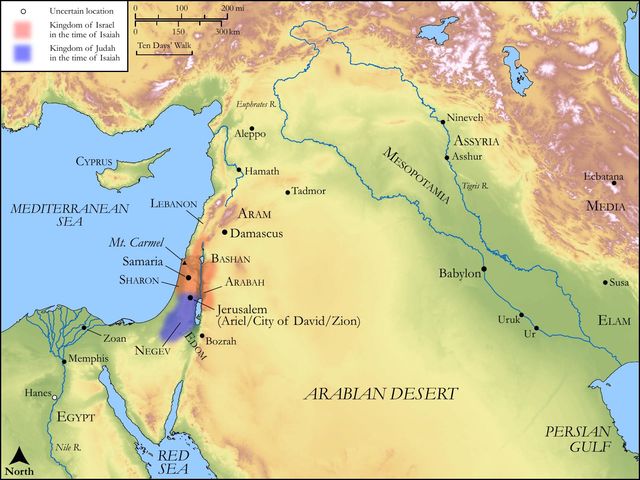
Study this verse
Public-domain commentary
Matthew Henry
From his Commentary on the Whole Bible. Henry comments on passages, not single verses — this entry covers Isaiah 30:27–33.
This terrible prediction of the ruin of the Assyrian army, though it is a threatening to them, is part of the promise to the Israel of God, that God would not only punish the Assyrians for the mischief they had done to the Israel of God, but would disable and deter them from doing the like again; and this prediction, which would now shortly be accomplished, would ratify and confirm the foregoing promises, which should be accomplished in the latter days. Here is,
I.God Almighty angry, and coming forth in anger against the Assyrians.
He is here introduced in all the power and all the terror of his wrath, Isa 30:27. The name of Jehovah, which the Assyrians disdain and set at a distance from them, as if they were out of its reach and it could do them no harm, behold, it comes from far. A messenger in the name of the Lord comes from as far off as heaven itself. He is a messenger of wrath, burning with his anger. God's lips are full of indignation at the blasphemy of Rabshakeh, who compared the God of Israel with the gods of the heathen; his tongue is as a devouring fire, for he can speak his proud enemies to ruin; his very breath comes with as much force as an overflowing stream, and with it he shall slay the wicked, Isa 11:4. He does not stifle or smother his resentments, as men do theirs when they are either causeless or impotent; but he shall cause his glorious voice to be heard when he proclaims war with an enemy that sets him at defiance, Isa 30:30. He shall display the indignation of his anger, anger in the highest degree; it shall be as the flame of a devouring fire, which carries and consumes all before it, with lightning or dissipation, and with tempest and hailstones, all which are the formidable phenomena of nature, and therefore expressive of the terror of the Almighty God of nature.
II.The execution done by this anger of the Lord.
Men are often angry when they can only threaten and talk big; but when God causes his glorious voice to be heard that shall not be all: he will show the lighting down of his arm too, Isa 30:30. The operations of his providence shall accomplish the menaces of his word. Those that would not see the lifting up of his arm (Isa 26:11) shall feel the lighting down of it, and find, to their cost, that the burden thereof is heavy (Isa 30:27), so heavy that they cannot bear it, nor bear up against it, but must unavoidably sink and be crushed under it. Who knows the power of his anger or imagines what an offended God can do? Five things are here prepared for the execution: - 1. Here is an overflowing stream, that shall reach to the midst of the neck, shall quite overwhelm the whole body of the army, and Sennacherib only, the head of it, shall keep above water and escape this stroke, while yet he is reserved for another in the house of Nisroch his god. The Assyrian army had been to Judah as an overflowing stream, reaching even to the neck (Isa 8:7, Isa 8:8), and now the breath of God's wrath will be so to it. 2. Here is a sieve of vanity, with which God would sift those nations of which the Assyrian army was composed, Isa 30:28. The great God can sift nations, for they are all before him as the small dust of the balance; he will sift them, not to gather out of them any that should be preserved, but so as to shake them one against another, put them into great consternation, and shake them all away at last; for it is a sieve of vanity (which retains nothing) that they are shaken with, and they are found all chaff. 3. Here is a bridle, which God has in their jaws, to curb and restrain them from doing the mischief they would do, and to force and constrain them to serve his purposes against their own will, Isa 10:7. God particularly says of Sennacherib (Isa 37:29) that he will put a hook in his nose and a bridle in his lips. It is a bridle causing them to err, forcing them to such methods as will certainly be destructive to themselves and their interest and in which they will be infatuated. God with a word guides his people into the right way (Isa 30:21), but with a bridle he turns his enemies headlong upon their own ruin. 4. Here is a rod and a staff, even the voice of the Lord, his word giving orders concerning it, with which the Assyrian shall be beaten down, Isa 30:31. The Assyrian had been himself a rod in God's hand for the chastising of his people, and had smitten them, Isa 10:5. That was a transient rod; but against the Assyrian shall go forth a grounded staff, that shall give a steady blow, shall stick close to him and strike home, so as to leave an impression upon him. It is a staff with a foundation, founded upon the enemies' deserts and God's determinate counsel. It is a consumption determined (Isa 10:23), and therefore there is no escaping it, no getting out of the reach of it; it shall pass in every place where an Assyrian is found, and the Lord shall lay it upon him, and cause it to rest, Isa 30:32. Such is the woeful case of those that persist in enmity to God: the wrath of God abides on them. 5. Here is Tophet ordained and prepared for them, Isa 30:33. The valley of the son of Hinnom, adjoining to Jerusalem, was called Tophet. In that valley, it is supposed, many of the Assyrian regiments lay encamped, and were there slain by the destroying angel; or there the bodies of those that were so slain were burned. Hezekiah had lately, and from yesterday (so the word is) ordained it; that is, say some, he had cleared it of the images that were set up in it, to which they there burnt their children, and so prepared it to be a receptacle for the dead bodies of their enemies, for the king of Assyria (that is, for his army) it is prepared, and there is fuel enough ready to burn them all; and they shall be consumed as suddenly and effectually as if the fire were kept burning by a continual stream of brimstone, for such the breath of the Lord, his word and his wrath, will be to it. Now as the prophet, in the foregoing promises, slides insensibly into the promises of gospel graces and comforts, so here, in the threatening of the ruin of Sennacherib's army, he points at the final and everlasting destruction of all impenitent sinners. Our Saviour calls the future misery of the damned Gehenna, in allusion to the valley of Hinnom, which gives some countenance to the applying of this to that misery, as also that in the Apocalypse it is so often called the lake that burns with fire and brimstone. This is said to be prepared of old for the devil and his angels, for the greatest of sinners, the proudest, and that think themselves not accountable to any for what they say and do; even for kings it is prepared. It is deep and large, sufficient to receive the world of the ungodly; the pile thereof is fire and much wood. God's wrath is the fire, and sinners make themselves fuel to it; and the breath of the Lord (the power of his anger) kindles it, and will keep it ever burning. See Isa 66:24. Wherefore stand in awe and sin not.
III.The great joy which this should occasion to the people of God.
The Assyrian's fall is Jerusalem's triumph (Isa 30:29): You shall have a song as in the night, a psalm of praise such as those sing who by night stand in the house of the Lord, and sing to his glory who gives songs in the night. It shall not be a song of vain mirth, but a sacred song, such as was sung when a holy solemnity was kept in a grave and religious manner. Our joy in the fall of the church's enemies must be a holy joy, gladness of heart, as when one goes, with a pipe (such as the sons of the prophets used when they prophesied, Sa1 10:5), to the mountain of the Lord, there to celebrate the praises of the Mighty One of Israel. Nay, in every place where the divine vengeance shall pursue the Assyrians they shall not only fall unlamented, but all their neighbours shall attend their fall with tabrets and harps, pleased to see how God, in battles of shaking, such as shake them out of the world, fights with them (Isa 30:32); for when the wicked perish there is shouting; and it is with a particular satisfaction that wise and good men see the ruin of those who, like the Assyrians, have insolently bidden defiance to God and trampled upon all mankind.
Historical interpretation
Historical reception
1 surviving comment on this verse from the historical church.
(Verse 30 and following) And the Lord will cause the glory of His voice to be heard, and He will show the terror of His arm in the threat of His fury and the devouring flame of fire. He will strike with whirlwind and hailstones. At the voice of the Lord, Assyria will tremble, struck down like a virgin, and there will be a passage firmly established by the rod: which the Lord will cause to rest upon him with timbrels and harps, and in battles He will conquer them in principal places. For Topheth has been prepared since yesterday, prepared by the king, deep and wide. Its fire is nourished, and there are many trees: the breath of the Lord, like a stream of burning sulfur, will set it ablaze. LXX: And the Lord will cause the glory of his voice to be heard, and he will show the fury of his arm with wrath and anger, and with a devouring flame of fire, he will strike vehemently, and like water and hail descending with force. For at the voice of the Lord the Assyrians will be overcome, with the blow with which he will strike them, and it will be all around him, that is, the place where he had hope of help, in which he trusted. They themselves will fight against him with tambourines and harps, in exchange. For you will be deceived before many days: is a kingdom also prepared for you? A deep valley, with wood placed, fire and the wood of many; the fury of the Lord, like a valley set on fire with sulfur. I could, in accordance with the Hebrew text, indicate to those who are reading what seems to me to be happening; but what shall I do, when some declare that I will have an incomplete work unless I also discuss the edition of the 70 interpreters? Therefore, I will follow the intended order of discussion. The voice of the Lord and his precept will become known to all, and the strength of his arm will be revealed to all when the time of retribution comes, when the flame and whirlwind, the size of hailstones, and the weight of stones will be abandoned. Indeed, in the prophecy of Ezekiel, as we have said, he writes at length about Gog and Magog (Ezek. XXXVIII, and Xxvix). At the command of his voice, Assur will tremble, struck with a rod. Every impious person, every imitator of the enemy nation: not that only the Assyrian will be struck on the day of judgment, but by the Assyrian we understand the devil. Finally, it follows: And the passage of the rod will be established, which the Lord will make to rest upon him. And this is the meaning: He will not strike him with a rod, and then lift him up again, as those who punish do; but rather, as if firmly rooted and firmly fixed, will cause him to remain in his punishments. And if it is understood in this way, where will be the repentance of the devil, especially when it is said to sinners: Go into eternal fire, which was prepared for the devil and his angels (Matthew 25:41). With timbrels and harps, and with principal weapons, the Lord will conquer them, namely the demons and all the wicked ones, with the joy of all. For from yesterday and from past time, Thopheth, that is, a broad and spacious hell, has been prepared by the Lord the King, which burns them with eternal fires. Its nourishment and fuel is fire, and many woods, that is, perpetual flame and the torments of sinners. And since, just as from a burning furnace and fire, the prophetic speech had foretold, it keeps the metaphor, so that by the breath and spirit and will of the Lord, we may know that it is set on fire, with mixed sulfur, which kindles the flames, to make the torments more fierce. Moreover, what is said in the Septuagint: 'At the voice of the Lord the Assyrians shall be overcome, when he shall strike them with the plague, and he shall be in a circle where he was before, and the hope of help, in which he trusted: they themselves with timbrels and harps shall fight against him out of sudden change,' signifies that they rise up against the devil, who had once been subject to him, and fight against him with joy and gladness out of sudden change, while understanding their own error, they destroy him by whom they had been deceived. And it is said to him, because he deceived himself from the beginning, thinking his kingdom to be eternal, for which hell and eternal punishments are prepared.
Continue studying Isaiah 30:32 across the web’s major study libraries — every link below opens this exact verse, chapter, or book on the destination site.
Read & Compare
 BibleGatewayThis verse in more than 200 translations and 70 languages.
 Bible.comThe YouVersion reader — hundreds of translations, reading plans, and highlights.
 ESV.orgCrossway's official English Standard Version reader.
 NET BibleThe NET translation with 60,000+ translators' notes on every rendering decision.
 STEP BibleTyndale House's free study tool — original text, vocabulary, and scholarly resources.
 BibliaLogos Bible Software's free web reader.
 USCCBThe New American Bible (Revised Edition) with the U.S. bishops' study notes.
Commentaries
 BibleHub CommentariesDozens of classic commentaries on this verse, gathered on one page.
 StudyLightMore than 100 commentary sets — the largest collection on the web.
 BibleRefPlain-English commentary on what this verse means, verse by verse.
 Enduring WordDavid Guzik's free commentary on this chapter, widely used by Bible teachers.
 Bible Study ToolsVerse commentary alongside Greek and Hebrew study aids.
Original Language & Research
- BibleHub InterlinearThe verse word by word — original language, transliteration, and English.
- BibleHub LexiconEvery word's original-language definition and Strong's entry.
 Blue Letter BibleDeep-study tools — Strong's numbers, concordance, and word studies.
 SefariaThe Hebrew text with Rashi and centuries of Jewish commentary.
Sermons, Hymns & Audio


TrulyRandomVerse is not affiliated with these sites and doesn’t control their content. They’re linked because they’re genuinely useful.
Summary
Isaiah 30:32 offers a vivid prophetic declaration of the Lord's decisive and terrifying intervention against His people's oppressors, specifically Assyria, portraying a divine battle that is both a consuming judgment for the enemy and a cause for exultant celebration for the delivered remnant. This verse encapsulates the dual themes of God's sovereign retribution and His unwavering commitment to the salvation of His covenant people, culminating in a joyous, divinely orchestrated triumph marked by the sounds of tabrets and harps.
Context
ShowHideLiterary Context
Isaiah chapter 30 forms a crucial part of a larger section (chapters 28-33) often referred to as "Woes" or oracles concerning Judah's reliance on foreign alliances rather than on Yahweh. The chapter begins with a severe condemnation of Judah's rebellious spirit and their foolish decision to seek protection from Egypt against the looming Assyrian threat, rather than trusting in the Lord's quiet strength (Isaiah 30:1-7). However, the tone dramatically shifts from judgment to a glorious promise of future restoration and divine intervention, particularly from verse 18 onwards. Verses 27-33 describe the Lord's terrifying and decisive judgment against Assyria, portraying God's wrath as a consuming fire and an overwhelming flood. Verse 32 specifically details the manner of this divine judgment—the "grounded staff" and "battles of shaking"—and the celebratory aftermath, serving as a climactic description of the Lord's direct, personal action, which stands in stark contrast to Judah's failed human strategies and provides the ultimate assurance of their deliverance (Isaiah 30:29-31).
Historical & Cultural Context
The historical setting for Isaiah 30 is the late 8th century BCE, a period dominated by the formidable Assyrian Empire. Under kings like Sennacherib, Assyria posed an existential threat to smaller nations in the Levant, including Judah. King Hezekiah of Judah, despite Isaiah's prophetic warnings, engaged in diplomatic and military alliances with Egypt, seeking human strength against the Assyrian juggernaut. This reliance on foreign powers was a profound act of faithlessness, violating the covenant relationship with Yahweh. Culturally, the "staff" or "rod" (maṭṭeh) was a potent symbol of authority, discipline, and judgment in Israel and among the nations round about, frequently associated with kings, shepherds, or warriors. The imagery of "tabrets and harps" (tôph and kinnôwr) evokes the common practice of musical celebration, particularly after military victories or during religious festivals, as seen in numerous Old Testament accounts, such as Miriam's song after the Red Sea deliverance (Exodus 15:20-21) or David's joyful procession of the ark (2 Samuel 6:5). The "battles of shaking" would have conjured images of the terror and chaos associated with divine warfare, a concept deeply rooted in Israel's historical memory of God's interventions.
Key Themes
ShowHideIsaiah 30:32, within its broader chapter, underscores several critical theological themes. Foremost is Divine Sovereignty and Judgment, emphasizing that Yahweh alone is the true source of power and justice, capable of executing His will against all opposing forces. The Lord's direct intervention against Assyria vividly demonstrates that human alliances are futile compared to God's might. Another prominent theme is Deliverance and Salvation, as the Lord's judgment upon the oppressor simultaneously brings about liberation and restoration for His people. This deliverance is not a result of Judah's strength but God's gracious act, leading to Joy and Celebration. The "tabrets and harps" symbolize the profound exultation and worship that follow God's triumphant acts of salvation, echoing the praise offered after the exodus from Egypt (Exodus 15). The chapter also powerfully highlights the theme of Trust vs. Rebellion, contrasting Judah's faithless reliance on human strength with the ultimate security found only in trusting the Lord (Isaiah 30:15).
Exposition and Analysis
ShowHideKey Word Analysis
ShowHideThis refers to the self-Existent or Eternal One; Jehovah, the Jewish national name of God. The use of this specific divine name emphasizes that the actions described are not random events or human machinations, but the direct, intentional, and sovereign work of the one true covenant God of Israel. It underscores the divine authority and power behind the "grounded staff" and the "battles of shaking," confirming that the judgment is divinely initiated and executed.
A feminine noun meaning a foundation; figuratively, an appointment. When applied to the staff, it suggests something firmly established, fixed, or appointed. This implies that the staff, as an instrument of judgment, is not wielded arbitrarily but is part of God's settled, determined plan. It signifies the certainty, immutability, and divine ordination of God's decree against the oppressor, rooted in His righteous character and unchangeable purpose.
A primitive root meaning to feed on; figuratively, to consume; by implication, to battle (as destruction). This word powerfully conveys God's active, personal engagement in warfare, not merely as an observer but as one who directly consumes or destroys the enemy. It highlights the ferocity, totality, and devastating efficacy of God's intervention, demonstrating that He personally wages war on behalf of His people, leading to the utter defeat of their adversaries.
Verse Breakdown
ShowHide"And in every place where the grounded staff shall pass"
This clause introduces the instrument of God's judgment—the "grounded staff." The phrase "every place" suggests the comprehensive and inescapable nature of this divine judgment; no corner will be untouched by its impact. The "grounded staff" signifies a divinely appointed and firmly established instrument of punishment, striking with certainty, authority, and unwavering resolve.
"which the LORD shall lay upon him"
This phrase directly attributes the action to Yahweh, the covenant God. It emphasizes His active, personal role in wielding this staff, making it clear that the judgment is not accidental or humanly initiated, but a deliberate act of God Himself. The "him" refers to the oppressor, specifically Assyria, indicating that the Lord directly inflicts this judgment upon the enemy.
"it shall be with tabrets and harps"
This clause introduces a striking and profound contrast. While the staff brings terror and destruction to the enemy, its passage is accompanied by sounds of joyous celebration—tabrets (tambourines) and harps. These are instruments typically associated with worship, praise, and festive occasions, particularly after a great victory or deliverance. This imagery signifies the profound joy, thanksgiving, and worship that will erupt among God's people as they witness His triumph over their oppressors.
"and in battles of shaking will he fight with it"
This final clause reiterates the Lord's active involvement in the conflict and describes the nature of the battle. "Battles of shaking" (Hebrew: milchâmôt tᵉnûwphâh) conveys a tumultuous, violent, and utterly overwhelming engagement, causing terror, trembling, and destruction for the enemy. The Lord Himself "will fight with it" (the staff), underscoring His direct, powerful, and decisive intervention, which results in a complete and devastating defeat for the adversary.
Literary Devices
ShowHideIsaiah 30:32 employs several potent literary devices to convey its multifaceted message. Symbolism is central, with the "grounded staff" representing God's firm, appointed, and decisive instrument of judgment and authority. It is not merely a physical object but a powerful symbol of divine decree and irresistible power. The "tabrets and harps" are potent symbols of Celebration and Triumph, creating a striking Juxtaposition with the destructive nature of the staff for the enemy. This contrast highlights the dual impact of God's actions: terror for the wicked, joy for the righteous. The phrase "battles of shaking" is a vivid example of Metonymy or Synecdoche, where "shaking" (referring to the trembling and terror of the enemy or the violent motion of the divine warrior) stands for the entire tumultuous, overwhelming, and terrifying nature of God's intervention. The entire verse also utilizes Anthropomorphism, attributing human-like actions (laying a staff, fighting) to God, making His divine intervention more relatable and impactful for the audience, emphasizing His personal and active involvement in history.
Theological and Thematic Connections
ShowHideIsaiah 30:32 profoundly illustrates the unwavering justice and redemptive power of God. It teaches that while God may allow His people to face trials and even chastisement for their disobedience, His ultimate commitment is to their deliverance and the defeat of their oppressors. The "grounded staff" signifies a judgment that is not arbitrary but divinely ordained and certain, executed by the Lord Himself. This divine intervention brings about a complete reversal of fortunes: terror and destruction for the enemy, and joyous celebration for the redeemed. This pattern of divine judgment leading to the salvation and celebration of God's people is a recurring theme throughout biblical history, assuring believers that God is actively engaged in the affairs of humanity, working out His sovereign plan for justice and redemption.
Reflection and Application
ShowHideThis verse offers a profound source of encouragement and a call to unwavering trust for believers today. In a world often marked by injustice, oppression, and seemingly insurmountable challenges, Isaiah 30:32 reminds us that the Lord remains sovereign and actively engaged in human history. It assures us that God is not a distant observer but a powerful warrior who fights for His people. When we face "battles of shaking"—whether personal struggles, societal injustices, or spiritual warfare—we are called to place our trust not in human strength, clever strategies, or fleeting alliances, but in the Lord's decisive power and unfailing faithfulness. Our appropriate response to His mighty acts of deliverance should be one of profound worship and celebratory joy, just as the "tabrets and harps" suggest. This passage encourages us to cultivate a faith that anticipates God's ultimate victory, knowing that His judgment against evil is certain, and His salvation for His faithful is sure, leading to true and lasting peace and an opportunity for unbridled praise.
Questions for Reflection
ShowHideFAQ
ShowHideWhat is the significance of the "grounded staff" in this verse?
ShowHideThe "grounded staff" (Hebrew: maṭṭeh mûwçâdâh) is highly significant. The word "grounded" (H4145, mûwçâdâh) implies something firmly established, fixed, or appointed. Therefore, the "grounded staff" symbolizes God's divinely appointed, firm, and certain instrument of judgment. It signifies that the punishment meted out to the oppressor (Assyria) is not arbitrary but a just, predetermined, and inescapable retribution from God Himself. It emphasizes the absolute authority and unwavering resolve with which the Lord executes His will. This imagery is consistent with other biblical uses of a staff or rod as a symbol of divine power and judgment, such as in Isaiah 10:5.
How can "tabrets and harps" be present during a battle of judgment?
ShowHideThe presence of "tabrets and harps" (H8596, tôph and H3658, kinnôwr) alongside the "battles of shaking" (H4421, milchâmâh and H8573, tᵉnûwphâh) creates a powerful contrast and highlights the dual nature of God's actions. While the "battles of shaking" signify a tumultuous and terrifying judgment for the enemy, the music indicates profound joy and celebration for God's people. This juxtaposition illustrates that God's judgment on the wicked is simultaneously an act of deliverance and salvation for the righteous. For the delivered, the Lord's victory is cause for exultant praise and worship, recalling the celebratory songs after the Red Sea deliverance in Exodus 15:20-21. It underscores that God's justice ultimately brings about the liberation and rejoicing of His faithful.
Christ-Centered Fulfillment
ShowHideIsaiah 30:32, with its vivid depiction of the Lord's decisive battle and the resulting celebration, finds its ultimate and most profound fulfillment in the person and work of Jesus Christ. The "grounded staff" of divine judgment, wielded by the Lord against the oppressor, foreshadows the ultimate judgment against sin and evil that was accomplished through Christ's death and resurrection. On the cross, Jesus, the Lamb of God who takes away the sin of the world, took upon Himself the full weight of God's righteous wrath against humanity's sin, becoming the "grounded staff" of judgment for us, so that we might be spared its terrifying impact. His victory over sin, death, and the powers of darkness through His resurrection was the definitive "battle of shaking" that utterly defeated the true oppressor, Satan, and his dominion (Colossians 2:15). This decisive triumph, though a judgment for evil, is the very foundation of the believer's joy and celebration. The "tabrets and harps" find their echo in the New Testament's call to worship and rejoice in the Lord always (Philippians 4:4) and in the heavenly chorus that celebrates the Lamb's victory and righteous judgments (Revelation 5:9-10). Thus, Isaiah 30:32 points forward to the definitive intervention of God in Christ, where judgment and salvation converge, leading to eternal worship for those redeemed by His sacrifice and ultimate victory.