


Genesis 31:27
Bible text: King James Version (1769 Blayney text) · Public domain
Bible text: King James Version with Strong's numbers · Public domain
Bible text: Berean Standard Bible · Public domain
Bible text: American Standard Version (1901) · Public domain
Bible text: World English Bible, Messianic edition · Public domain
Bible text: Geneva Bible (1599) · Public domain
Bible text: Young's Literal Translation · Public domain
- לָמָּהLa·mah<to> why?H4100Prep-l ¦ InterrogPronoun Interrogativeלָ<to>מָּהwhy?
- נַחְבֵּאתָnach·Be·tadid you hide yourselfH2244V-Niphal-Perf-2msVerb Niphal Perfect 2nd Singular Masculine
- לִבְרֹחַliv·Ro·achto fleeH1272Prep-l ¦ V-Qal-InfVerb Qal Infinitive Constructלִtoבְרֹחַflee
- וַתִּגְנֹבva·tig·Noand did you steal?H1589Conj-w ¦ V-Qal-ConsecImperf-2msVerb Qal Consecutive Imperfect 2nd Singular Masculineוַandתִּגְנֹבdid you steal?
- אֹתִי'o·Ti<obj.> meH853DirObjM ¦ 1csParticle Object Indicatorאֹתִ<obj.>יme
- וְלֹאve·lo'and notH3808Conj-w ¦ NegParticle Negativeוְandלֹאnot
- הִגַּדְתָּhi·Gad·tadid you tell?H5046V-Hiphil-Perf-2msVerb Hiphil Perfect 2nd Singular Masculine
- לִּיLito <the> mePrep-l ¦ 1csSuffix Personal 1st Singular common genderלִּto <the>יme
- וָאֲשַׁלֵּחֲךָva·'a·sha·le·cha·Khaand I sent away youH7971Conj-w ¦ V-Piel-ConsecImperf-1cs ¦ 2msVerb Piel Consecutive Imperfect 1st Singular common genderוָandאֲשַׁלֵּחֲI sent awayךָyou
- בְּשִׂמְחָהbe·sim·Chahwith gladnessH8057Prep-b ¦ N-fsNoun Singular Feminine Absoluteבְּwithשִׂמְחָהgladness
- וּבְשִׁרִיםu·ve·shi·Rimand with songsH7892Conj-w ¦ Prep-b ¦ N-mpNoun Plural Masculine Absoluteוּandבְwithשִׁרִיםsongs
- בְּתֹףbe·Tofwith tambourineH8596Prep-b ¦ N-msNoun Singular Masculine Absoluteבְּwithתֹףtambourine
- וּבְכִנּוֹרu·ve·khi·Norand with harpH3658Conj-w ¦ Prep-b ¦ N-msNoun Singular Masculine Absoluteוּandבְwithכִנּוֹרharp
English is a literal word-by-word gloss of the Hebrew, not the KJV's wording. Why?
This is the original text the KJV's translators worked from — each Hebrew word with its own literal English meaning in this verse, prepared by scholars at Tyndale House, Cambridge. The KJV translates whole sentences, not word by word, so its wording differs: one Hebrew word can become several English words, and the KJV may choose “the LORD” where the gloss reads “Yahweh”. Both are faithful — they answer different questions. For the KJV's own rendering, switch to the KJV text.
Details
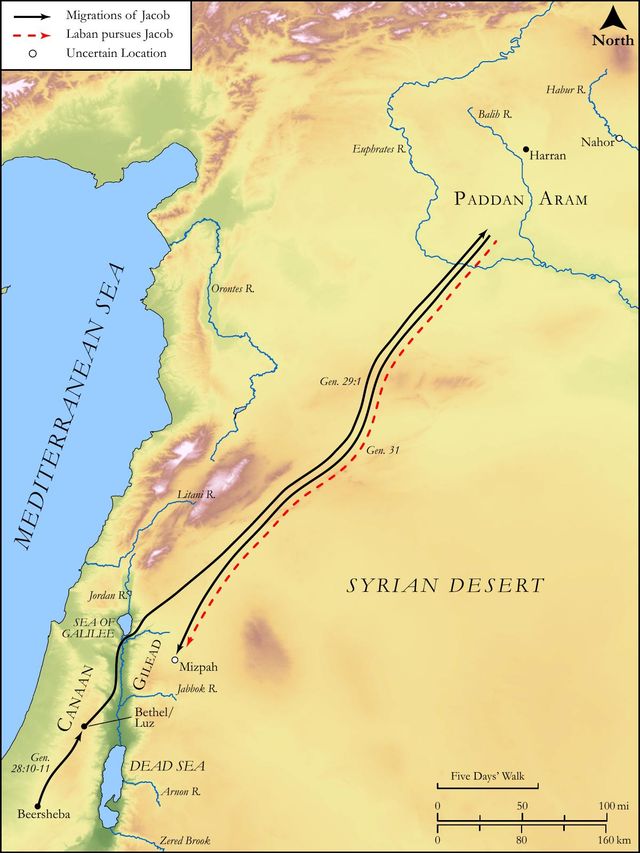
See on the biblical-era maps


Study this verse
Public-domain commentary
Matthew Henry
From his Commentary on the Whole Bible. Henry comments on passages, not single verses — this entry covers Genesis 31:25–35. His three-level outline is real structure in the source text, so it is rendered as structure.
We have here the reasoning, not to say the rallying, that took place between Laban and Jacob at their meeting, in that mountain which was afterwards called Gilead, Gen 31:25. Here is,
I.The high charge which Laban exhibited against him. He accuses him,
1.As a renegade that had unjustly deserted his service. To represent Jacob as a criminal, he will have it thought that he intended kindness to his daughters (Gen 31:27, Gen 31:28), that he would have dismissed them with all the marks of love and honour that could be, that he would have made a solemn business of it, would have kissed his little grandchildren (and that was all he would have given them), and, according to the foolish custom of the country, would have sent them away with mirth, and with songs, with tabret, and with harp: not as Rebekah was sent away out of the same family, above 120 years before, with prayers and blessings (Gen 24:60), but with sport and merriment, which was a sign that religion had very much decayed in the family, and that they had lost their seriousness. However, he pretends they would have been treated with respect at parting. Note, It is common for bad men, when they are disappointed in their malicious projects, to pretend that they designed nothing but what was kind and fair. When they cannot do the mischief they intended, they are loth it should be thought that they ever did intend it. When they have not done what they should have done they come off with this excuse, that they would have done it. Men may thus be deceived, but God cannot. He likewise suggests that Jacob had some bad design in stealing away thus (Gen 31:26), that he took his wives away as captives. Note, Those that mean ill themselves are most apt to put the worst construction upon what others do innocently. The insinuating and the aggravating of faults are the artifices of a designing malice, and those must be represented (though never so unjustly) as intending ill against whom ill is intended. Upon the whole matter,
(1.)He boasts of his own power (Gen 31:29): It is in the power of my hand to do you hurt. He supposes that he had both right on his side (a good action, as we say, against Jacob) and strength on his side, either to avenge the wrong or recover the right. Note, Bad people commonly value themselves much upon their power to do hurt, whereas a power to do good is much more valuable. Those that will do nothing to make themselves amiable love to be thought formidable. And yet,
(2.)He owns himself under the check and restraint of God's power; and, though it redounds much to the credit and comfort of Jacob, he cannot avoid telling him the caution God had given him the night before in a dream, Speak not to Jacob good nor bad. Note, As God has all wicked instruments in a chain, so when he pleases he can make them sensible of it, and force them to own it to his praise, as protector of the good, as Balaam did. Or we may look upon this as an instance of some conscientious regard felt by Laban for God's express prohibitions. As bad as he was he durst not injure one whom he saw to be the particular care of Heaven. Note, A great deal of mischief would be prevented if men would but attend to the caveats which their own consciences give them in slumberings upon the bed, and regard the voice of God in them.
2.As a thief, Gen 31:30. Rather than own that he had given him any colour of provocation to depart, he is willing to impute it to a foolish fondness for his father's house, which made him that he would needs begone; but then (says he) wherefore hast thou stolen my gods? Foolish man! to call those his gods that could be stolen! Could he expect protection from those that could neither resist nor discover their invaders? Happy are those who have the Lord for their God, for they have a God that they cannot be robbed of. Enemies may steal our goods, but not our God. Here Laban lays to Jacob's charge things that he knew not, the common distress of oppressed innocency.
II.Jacob's apology for himself.
Those that commit their cause to God, yet are not forbidden to plead it themselves with meekness and fear.
1.As to the charge of stealing away his own wives he clears himself by giving the true reason why he went away unknown to Laban, Gen 31:31. He feared lest Laban would by force take away his daughters, and so oblige him, by the bond of his affection to his wives, to continue in his service. Note, Those that are unjust in the least, it may be suspected, will be unjust also in much, Luk 16:10. If Laban deceive Jacob in his wages, it is likely he will make no conscience of robbing him of his wives, and putting those asunder whom God has joined together. What may not be feared from men that have no principle of honesty?
2.As to the charge of stealing Laban's gods he pleads not guilty, Gen 31:32. He not only did not take them himself (he was not so fond of them), but he did not know that they were taken. Yet perhaps he spoke too hastily and inconsiderately when he said, "Whoever had taken them, let him not live;" upon this he might reflect with some bitterness when, not long after, Rachel who had taken them died suddenly in travail. How just soever we think ourselves to be, it is best to forbear imprecations, lest they fall heavier than we imagine.
III.The diligent search Laban made for his gods (Gen 31:33-35), partly out of hatred to Jacob, whom he would gladly have an occasion to quarrel with, partly out of love to his idols, which he was loth to part with. We do not find that he searched Jacob's flocks for stolen cattle; but he searched his furniture for stolen gods. He was of Micah's mind, You have taken away my gods, and what have I more? Jdg 18:24. Were the worshippers of false gods so set upon their idols? did they thus walk in the name of their gods? and shall not we be as solicitous in our enquires after the true God? When he has justly departed from us, how carefully should we ask, Where is God my Maker? O that I knew where I might find him! Job 23:3. Laban, after all his searches, missed of finding his gods, and was baffled in his enquiry with a sham; but our God will not only by found of those that seek him, but they shall find him their bountiful rewarder.
Continue studying Genesis 31:27 across the web’s major study libraries — every link below opens this exact verse, chapter, or book on the destination site.
Read & Compare
 BibleGatewayThis verse in more than 200 translations and 70 languages.
 Bible.comThe YouVersion reader — hundreds of translations, reading plans, and highlights.
 ESV.orgCrossway's official English Standard Version reader.
 NET BibleThe NET translation with 60,000+ translators' notes on every rendering decision.
 STEP BibleTyndale House's free study tool — original text, vocabulary, and scholarly resources.
 BibliaLogos Bible Software's free web reader.
 USCCBThe New American Bible (Revised Edition) with the U.S. bishops' study notes.
Commentaries
 BibleHub CommentariesDozens of classic commentaries on this verse, gathered on one page.
 StudyLightMore than 100 commentary sets — the largest collection on the web.
 BibleRefPlain-English commentary on what this verse means, verse by verse.
 Enduring WordDavid Guzik's free commentary on this chapter, widely used by Bible teachers.
 Bible Study ToolsVerse commentary alongside Greek and Hebrew study aids.
Original Language & Research
- BibleHub InterlinearThe verse word by word — original language, transliteration, and English.
- BibleHub LexiconEvery word's original-language definition and Strong's entry.
 Blue Letter BibleDeep-study tools — Strong's numbers, concordance, and word studies.
 SefariaThe Hebrew text with Rashi and centuries of Jewish commentary.
Sermons, Hymns & Audio


TrulyRandomVerse is not affiliated with these sites and doesn’t control their content. They’re linked because they’re genuinely useful.
Summary
Genesis 31:27 records Laban's indignant confrontation with Jacob, who had secretly departed from Laban's household after twenty years of arduous service. Having pursued Jacob for seven days, Laban expresses his anger and perceived betrayal, questioning Jacob's clandestine flight and feigning regret that he was denied the opportunity to send Jacob away with customary festive celebrations, despite his own extensive history of deceit and exploitation towards Jacob.
Context
ShowHideLiterary Context
This verse is situated at a pivotal moment in the narrative of Jacob's return to Canaan. It immediately follows Laban's seven-day pursuit of Jacob, his daughters, and their extensive possessions, culminating in Laban catching up with Jacob in the hill country of Gilead. The preceding verses detail Jacob's decision to leave Laban, driven by God's command to return to his homeland (Genesis 31:3) and his growing unease with Laban's changing countenance and continued manipulation of his wages (Genesis 31:7). Jacob's secret departure, a necessary act given Laban's controlling nature, sets the stage for this tense confrontation, where Laban attempts to reassert control and justify his pursuit.
Historical & Cultural Context
In that day, a patriarch like Laban held significant authority over his household, including his sons-in-law and daughters. Jacob's secret departure, especially with Laban's daughters (his wives) and grandchildren, would have been considered a grave breach of patriarchal authority and familial custom, particularly if not properly announced or sanctioned. The mention of "mirth, and with songs, with tabret, and with harp" points to common celebratory customs for farewells or significant life events, where music and feasting were integral. Laban's invocation of these customs is an attempt to shame Jacob by implying he denied Laban the opportunity to fulfill a social obligation, thereby portraying Jacob as disrespectful and deceitful.
Key Themes
ShowHideThis verse contributes significantly to several overarching themes in Genesis. It highlights the pervasive theme of deception and manipulation, a recurring motif in the Jacob narrative, here exemplified by Laban's hypocrisy and Jacob's strategic, albeit secret, departure. It underscores God's sovereign protection and guidance over His covenant people, as Jacob's flight was divinely sanctioned and God intervened to prevent Laban from harming him (Genesis 31:24). Furthermore, it illustrates the breakdown of trust in human relationships when self-interest and exploitation dominate, leading to a situation where open communication becomes impossible and clandestine actions appear necessary.
Exposition and Analysis
ShowHideKey Word Analysis
ShowHideA primitive root meaning "to bolt, i.e., figuratively, to flee suddenly; to make haste, run away." Laban uses this term to emphasize the abruptness and perceived cowardice of Jacob's departure. Coupled with "secretly," it paints a picture of a hasty, unauthorized escape, rather than a planned, respectful farewell.
A primitive root meaning "to thieve (literally or figuratively); by implication, to deceive; to get by stealth." Laban's choice of this word is highly accusatory, implying Jacob's departure was not just secret but akin to theft, particularly of his daughters and grandchildren whom Laban still viewed as his property. This accusation is deeply ironic given Laban's own history of "stealing" Jacob's wages and deceiving him regarding his wives.
A primitive root meaning "to front, i.e., stand boldly out opposite; by implication, to manifest; figuratively, to announce (always by word of mouth to one present)." Laban's complaint that Jacob "didst not tell me" highlights the perceived lack of communication and respect. He frames it as a denial of his right to be informed and to perform a customary send-off, further emphasizing Jacob's alleged wrongdoing and secrecy.
Verse Breakdown
ShowHide"Wherefore didst thou flee away secretly, and steal away from me;"
Laban opens with a rhetorical question that is simultaneously an accusation. He challenges Jacob's motives and methods, framing his departure as an act of stealth and illicit removal. The pairing of "flee away secretly" and "steal away" intensifies the charge, suggesting not merely an unannounced departure but one executed with cunning and a disregard for Laban's rights and authority, implicitly accusing Jacob of taking what was not his to take (his daughters and grandchildren).
"and didst not tell me,"
This clause expresses Laban's feigned hurt and indignation at the lack of communication. He implies that Jacob's failure to inform him was disrespectful and prevented him from fulfilling a social obligation. This complaint, however, masks Laban's true character and the reality that an open departure would have likely been met with resistance, manipulation, or even violence, given his history of exploiting Jacob.
"that I might have sent thee away with mirth, and with songs, with tabret, and with harp?"
This is the most hypocritical part of Laban's statement. He paints a picture of a joyous, celebratory send-off, complete with musical instruments like the "tabret" (a tambourine or hand-drum) and "harp," which were common in the festivities of Israel and the nations. By claiming he would have provided such a farewell, Laban attempts to cast himself as a benevolent patriarch and Jacob as an ungrateful, suspicious runaway, thereby manipulating the narrative to justify his aggressive pursuit and to shame Jacob.
Literary Devices
ShowHideLaban's speech in this verse is rich with Irony, as his accusations of Jacob's "stealing" and "secrecy" directly mirror his own long-standing patterns of deceit and exploitation, such as changing Jacob's wages ten times or substituting Leah for Rachel. The entire utterance functions as a Rhetorical Question, not genuinely seeking an answer but serving as a veiled accusation and an expression of feigned grievance. Laban employs Hyperbole in his description of the elaborate, joyous send-off he claims he would have provided, exaggerating his goodwill to highlight Jacob's perceived offense and to manipulate the situation to his advantage. This creates a stark Contrast between Laban's stated intentions and his actual character and past actions, underscoring the deep-seated mistrust that had poisoned their relationship.
Theological and Thematic Connections
ShowHideThe tense encounter between Laban and Jacob, highlighted in this verse, serves as a powerful illustration of the consequences of broken trust and the outworking of divine sovereignty amidst human conflict. Despite Laban's manipulative rhetoric and Jacob's secretive departure, God's overarching plan for Jacob's return to the Promised Land is undeniably in motion. This narrative underscores that even when human relationships are fraught with deception and suspicion, God remains faithful to His covenant promises, actively protecting and guiding His chosen ones. The divine intervention preventing Laban from harming Jacob (Genesis 31:24) is a testament to God's unwavering commitment to His people, ensuring His purposes are fulfilled regardless of human failings.
Reflection and Application
ShowHideThis dramatic confrontation between Jacob and Laban offers profound insights into the complexities of human relationships, the corrosive power of deceit, and the necessity of discerning true motives. It vividly demonstrates how a history of manipulation and a lack of integrity can utterly erode trust, making genuine communication and honorable dealings impossible. Laban's feigned desire for a joyous send-off serves as a potent reminder to look beyond superficial pleasantries or performative gestures to discern the true intentions of others, especially those with a proven track record of duplicity. While open and honest communication is generally the cornerstone of healthy relationships and conflict resolution, this passage also pragmatically acknowledges that in situations involving persistent manipulation, threat, or divine command, a decisive and private separation may be a necessary and even divinely sanctioned course of action for one's well-being and to fulfill God's calling. Ultimately, it reassures us that even amidst human failings and strained relationships, God's sovereign plan will prevail.
Questions for Reflection
ShowHideFAQ
ShowHideWhy did Jacob flee secretly from Laban?
ShowHideJacob fled secretly primarily due to Laban's increasingly hostile demeanor, his consistent pattern of deceit regarding Jacob's wages (changing them ten times, as noted in Genesis 31:7), and a direct divine command from God to return to his homeland (Genesis 31:3). Jacob likely feared that if he announced his departure, Laban would either prevent him from leaving, seize his accumulated wealth, or attempt to retain his wives and children, given Laban's controlling and exploitative nature.
Was Laban's offer of a festive send-off genuine?
ShowHideGiven Laban's long history of manipulating and exploiting Jacob throughout their twenty-year relationship, his claim of wanting to send Jacob away with "mirth, and with songs, with tabret, and with harp" is widely interpreted by scholars as disingenuous and hypocritical. It was most likely a rhetorical tactic designed to portray himself as the wronged party, to shame Jacob, and to justify his aggressive pursuit, rather than a sincere expression of goodwill or a genuine desire for a celebratory farewell. His true motivation was likely to reclaim his "stolen" possessions and reassert control.
What is the significance of "tabret" and "harp" in this context?
ShowHideThe "tabret" (Hebrew: toph, a tambourine or hand-drum) and "harp" (Hebrew: kinnor, a lyre-like instrument) were common musical instruments used in the celebrations, festivals, and joyous occasions. Laban's specific mention of these instruments underscores the joyous, public, and culturally appropriate send-off he claimed he would have provided. By highlighting this, he aimed to emphasize the stark contrast between his supposed benevolence and the reality of Jacob's hurried, secretive escape, thereby exposing the perceived disrespect and suspicious nature of Jacob's actions in the eyes of any potential audience.
Christ-Centered Fulfillment
ShowHideThe narrative of Jacob's escape from Laban, marked by deep-seated mistrust, manipulation, and the erosion of familial bonds, finds its ultimate fulfillment and redemptive resolution in the person and work of Jesus Christ. Jacob's journey, though fraught with human failings and strategic secrecy, was divinely guided away from a deceptive master and towards the promised land. This prefigures the greater spiritual liberation offered by Christ, who delivers humanity not from an earthly Laban, but from the bondage of sin and the deceit of the spiritual adversary (John 8:34). Unlike the broken covenant between Jacob and Laban, which was riddled with conditional agreements and constant renegotiation, the New Covenant established in Christ is founded on God's unconditional grace, unwavering truth, and an unbreakable promise (Hebrews 8:6). Jesus, the Good Shepherd, faithfully guides His people through life's challenges, protecting them from harm and leading them into true freedom and their eternal inheritance (John 10:11). In Him, believers find the ultimate reconciliation and a relationship built on perfect trust, a reality far surpassing any earthly "send-off" or reunion, as He prepares a place for us in the Father's house (John 14:2-3).