


Genesis 31:5
Bible text: King James Version (1769 Blayney text) · Public domain
Bible text: Berean Standard Bible · Public domain
Bible text: American Standard Version (1901) · Public domain
Bible text: World English Bible, Messianic edition · Public domain
Bible text: Geneva Bible (1599) · Public domain
Bible text: Young's Literal Translation · Public domain
- וַיֹּאמֶרvai·Yo·merand he saidH559Conj-w ¦ V-Qal-ConsecImperf-3msVerb Qal Consecutive Imperfect 3rd Singular Masculineוַandיֹּאמֶרhe said
- לָהֶןla·Hento <the> themPrep-l ¦ 3fpSuffix Personal 3rd Plural Feminineלָto <the>הֶןthem
- רֹאֶהro·'Eh[am] seeingH7200V-Qal-Prtcpl-msVerb Qal Participle Singular Masculine Absolute
- אָנֹכִי'a·no·KhiIH595Pro-1csPronoun Personal 1st Singular common gender
- אֶת'et<obj.>H853DirObjMParticle Object Indicator
- פְּנֵיpe·Nei[the] face ofH6440N-mpcNoun Plural Masculine Construct
- אֲבִיכֶן'a·vi·Khenyour fatherH1N-msc ¦ 2fpNoun Singular Masculine Constructאֲבִיfatherכֶןyour
- כִּיkithatH3588PrtParticle Conditional
- אֵינֶנּוּ'ei·Ne·nunot [is] heH369N-msc ¦ 3msNoun Singular Masculine Constructאֵינֶnot [is]נּוּhe
- אֵלַי'e·Laito meH413Prep ¦ 1csPreposition Definiteאֵלַtoיme
- כִּתְמֹלkit·Molas yesterdayH8543Prep-k ¦ N-msNoun Singular Masculine Absoluteכִּasתְמֹלyesterday
- שִׁלְשֹׁםshil·Shomthree days agoH8032N-msNoun Singular Masculine Absolute
- וֵאלֹהֵיve·lo·Heiand [the] God ofH430Conj-w ¦ N-mpcNoun Plural Masculine Constructוֵandאלֹהֵי[the] God of
- אָבִי'a·Vimy fatherH1N-msc ¦ 1csNoun Singular Masculine Constructאָבִfatherיmy
- הָיָהha·Yahhe has beenH1961V-Qal-Perf-3msVerb Qal Perfect 3rd Singular Masculine
- עִמָּדִי'i·ma·Diwith meH5978Prep ¦ 1csPrepositionעִמָּדִwithיme
English is a literal word-by-word gloss of the Hebrew, not the KJV's wording. Why?
This is the original text the KJV's translators worked from — each Hebrew word with its own literal English meaning in this verse, prepared by scholars at Tyndale House, Cambridge. The KJV translates whole sentences, not word by word, so its wording differs: one Hebrew word can become several English words, and the KJV may choose “the LORD” where the gloss reads “Yahweh”. Both are faithful — they answer different questions. For the KJV's own rendering, switch to the KJV text.
Details
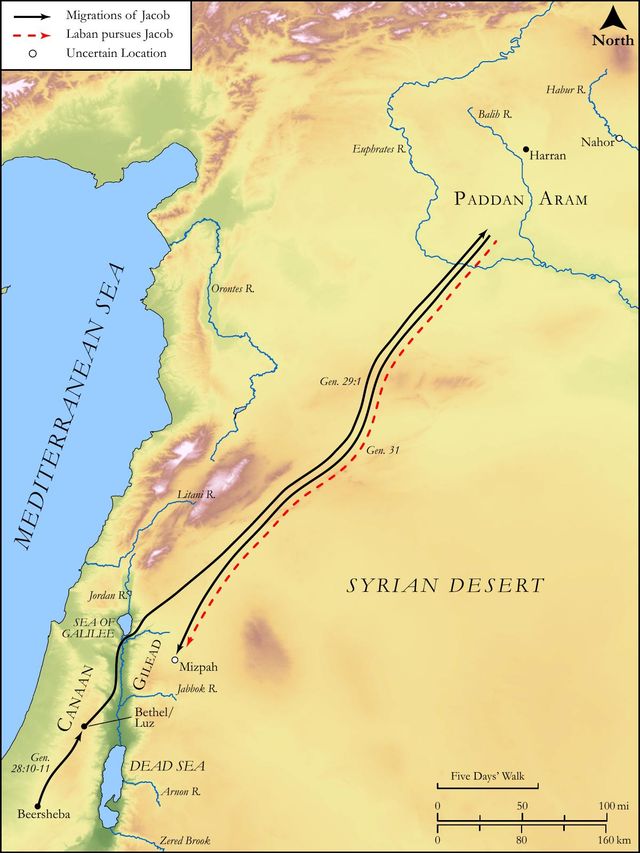
See on the biblical-era maps


Study this verse
Public-domain commentary
Matthew Henry
From his Commentary on the Whole Bible. Henry comments on passages, not single verses — this entry covers Genesis 31:1–16. His four-level outline is real structure in the source text, so it is rendered as structure.
Jacob is here taking up a resolution immediately to quit his uncle's service, to take what he had and go back to Canaan. This resolution he took up upon a just provocation, by divine direction, and with the advice and consent of his wives.
I.Upon a just provocation; for Laban and his sons had become very cross and ill-natured towards him, so that he could not stay among them with safety or satisfaction.
1.Laban's sons showed their ill-will in what they said, Gen 31:1. It should seem they said it in Jacob's hearing, with a design to vex him. The last chapter began with Rachel's envying Leah; this begins with Laban's sons envying Jacob. Observe,
(1.)How greatly they magnify Jacob's prosperity: He has gotten all this glory. And what was this glory that they made so much ado about? It was a parcel of brown sheep and speckled goats (and perhaps the fine colours made them seem more glorious), and some camels and asses, and such like trading; and this was all this glory. Note, Riches are glorious things in the eyes of carnal people, while to all those that are conversant with heavenly things they have no glory in comparison with the glory which excelleth. Men's over-valuing worldly wealth is that fundamental error which is the root of covetousness, envy, and all evil.
(2.)How basely they reflect upon Jacob's fidelity, as if what he had he had not gotten honestly: Jacob has taken away all that was our father's. Not all, surely. What had become of those cattle which were committed to the custody of Laban's sons, and sent three days' journey off? Gen 30:35, Gen 30:36. They mean all that was committed to him; but, speaking invidiously, they express themselves thus generally. Note,
[1.]Those that are ever so careful to keep a good conscience cannot always be sure of a good name.
[2.]This is one of the vanities and vexations which attend outward prosperity, that it makes a man to be envied of his neighbors (Ecc 4:4), and who can stand before envy? Pro 27:4. Whom Heaven blesses hell curses, and all its children on earth.
2.Laban himself said little, but his countenance was not towards Jacob as it used to be; and Jacob could not but take notice of it, Gen 31:2, Gen 31:5. He was but a churl at the best, but now he was more churlish than formerly. Note, Envy is a sin that often appears in the countenance; hence we read of an evil eye, Pro 23:6. Sour looks may do a great deal towards the ruin of peace and love in a family, and the making of those uneasy of whose comfort we ought to be tender. Laban's angry countenance lost him the greatest blessing his family ever had, and justly.
II.By divine direction and under the convoy of a promise:
The Lord said unto Jacob, Return, and I will be with thee, Gen 31:3. Though Jacob had met with very hard usage here, yet he would not quit his place till God bade him. He came thither by orders from Heaven, and there he would stay till he was ordered back. Note, It is our duty to set ourselves, and it will be our comfort to see ourselves, under God's guidance, both in our going out and in our coming in. The direction he had from Heaven is more fully related in the account he gives of it to his wives (Gen 31:10-13), where he tells them of a dream he had about the cattle, and the wonderful increase of those of his colour; and how the angel of God, in that dream (for I suppose the dream spoken of Gen 31:10 and that Gen 31:11 to be the same), took notice of the workings of his fancy in his sleep, and instructed him, so that it was not by chance, or by his own policy, that he obtained that great advantage; but, 1. by the providence of God, who had taken notice of the hardships Laban had put upon him, and took this way to recompense him: "For I have seen all the Laban doeth unto thee, and herein I have an eye to that." Note, There is more of equity in the distributions of the divine providence than we are aware of, and by them the injured are recompensed really, though perhaps insensibly. Nor was it only by the justice of providence that Jacob was thus enriched, but, 2. In performance of the promise intimated in what is said Gen 31:13, I am the God of Beth-el, This was the place where the covenant was renewed with him. Note, Worldly prosperity and success are doubly sweet and comfortable when we see them flowing, not from common providence, but from covenant-love, to perform the mercy promised - when we have them from God as the God of Beth-el, from those promises of the life which now is that belong to godliness. Jacob, even when he had this hopeful prospect of growing rich with Laban, must think of returning. When the world begins to smile upon us we must remember it is not our home. Now arise (Gen 31:13) and return, (1.) To thy devotions in Canaan, the solemnities of which had perhaps been much intermitted while he was with Laban. The times of this servitude God had winked at; but now, "Return to the place where thou anointedst the pillar and vowedst the vow. Now that thou beginnest to grow rich it is time to think of an altar and sacrifices again." (2.) To thy comforts in Canaan: Return to the land of thy kindred. He was here among his near kindred; but those only he must look upon as his kindred in the best sense, the kindred he must live and die with, to whom pertained the covenant. Note, The heirs of Canaan must never reckon themselves at home till they come thither, however they may seem to take root here.
III.With the knowledge and consent of his wives. Observe,
1.He sent for Rachel and Leah to him to the field (Gen 31:4), that he might confer with them more privately, or because one would not come to the other's apartment and he would willingly talk with them together, or because he had work to do in the field which he would not leave. Note, Husbands that love their wives will communicate their purposes and intentions to them. Where there is a mutual affection there will be a mutual confidence. And the prudence of the wife should engage the heart of her husband to trust in her, Pro 31:11. Jacob told his wives,
(1.)How faithfully he had served their father, Gen 31:6. Note, If others do not do their duty to us, yet we shall have the comfort of having done ours to them.
(2.)How unfaithfully their father had dealt with him Gen 31:7. He would never keep to any bargain that he made with him, but, after the first year, still as he saw Providence favour Jacob with the colour agreed on, every half year of the remaining five he changed it for some other colour, which made it ten times; as if he thought not only to deceive Jacob, but the divine Providence, which manifestly smiled upon him. Note, Those that deal honestly are not always honestly dealt with.
(3.)How God had owned him notwithstanding. He had protected him from Laban's ill-will: God suffered him not to hurt me. Note, Those that keep close to God shall be kept safely by him. He had also provided plentifully for him, notwithstanding Laban's design to ruin him: God has taken away the cattle of your father, and given them to me, Gen 31:9. Thus the righteous God paid Jacob for his hard service out of Laban's estate; as afterwards he paid the seed of Jacob for their serving the Egyptians, with their spoils. Note, God is not unrighteous to forget his people's work and labour of love, though men be so, Heb 6:10. Providence has ways of making those honest in the event that are not so in their design. Note, further, The wealth of the sinner is laid up for the just, Pro 13:22.
(4.)He told them of the command God had given him, in a dream, to return to his own country (Gen 31:13), that they might not suspect his resolution to arise from inconstancy, or any disaffection to their country or family, but might see it to proceed from a principle of obedience to his God, and dependence on him.
2.His wives cheerfully consented to his resolution. They also brought forward their grievances, complaining that their father had been not only unkind, but unjust, to them (Gen 31:14-16), that he looked upon them as strangers, and was without natural affection towards them; and, whereas Jacob had looked upon the wealth which God had transferred from Laban to him as his wages, they looked upon it as their portions; so that, both ways, God forced Laban to pay his debts, both to his servant and to his daughters. So then it seemed,
(1.)They were weary of their own people and their father's house, and could easily forget them. Note, This good use we should make of the unkind usage we meet with from the world, we should sit the more loose to it, and be willing to leave it and desirous to be at home.
(2.)They were willing to go along with their husband, and put themselves with him under the divine direction: Whatsoever God hath said unto thee do. Note, Those wives that ar their husband's meet helps will never be their hindrances in doing that to which God calls them.
Continue studying Genesis 31:5 across the web’s major study libraries — every link below opens this exact verse, chapter, or book on the destination site.
Read & Compare
 BibleGatewayThis verse in more than 200 translations and 70 languages.
 Bible.comThe YouVersion reader — hundreds of translations, reading plans, and highlights.
 ESV.orgCrossway's official English Standard Version reader.
 NET BibleThe NET translation with 60,000+ translators' notes on every rendering decision.
 STEP BibleTyndale House's free study tool — original text, vocabulary, and scholarly resources.
 BibliaLogos Bible Software's free web reader.
 USCCBThe New American Bible (Revised Edition) with the U.S. bishops' study notes.
Commentaries
 BibleHub CommentariesDozens of classic commentaries on this verse, gathered on one page.
 StudyLightMore than 100 commentary sets — the largest collection on the web.
 BibleRefPlain-English commentary on what this verse means, verse by verse.
 Enduring WordDavid Guzik's free commentary on this chapter, widely used by Bible teachers.
 Bible Study ToolsVerse commentary alongside Greek and Hebrew study aids.
Original Language & Research
- BibleHub InterlinearThe verse word by word — original language, transliteration, and English.
- BibleHub LexiconEvery word's original-language definition and Strong's entry.
 Blue Letter BibleDeep-study tools — Strong's numbers, concordance, and word studies.
 SefariaThe Hebrew text with Rashi and centuries of Jewish commentary.
Sermons, Hymns & Audio


TrulyRandomVerse is not affiliated with these sites and doesn’t control their content. They’re linked because they’re genuinely useful.
Summary
Jacob's declaration to his wives, Rachel and Leah, articulates his profound discernment of Laban's increasingly hostile disposition, contrasting this human fickleness with the steadfast and active presence of "the God of my father." This pivotal statement serves as Jacob's theological justification for his imminent departure, underscoring his reliance on divine faithfulness and guidance over the shifting sands of human favor and relational dynamics.
Context
ShowHideLiterary Context
Genesis 31:5 is nestled within a critical juncture of Jacob's life, marking the culmination of his twenty-year sojourn in Haran under the manipulative hand of Laban. Immediately preceding this verse, God explicitly commands Jacob to "return to the land of your fathers and to your kindred, and I will be with you" Genesis 31:3. This divine directive provides the overarching mandate for Jacob's actions. The verse itself opens a private, strategic conversation between Jacob and his wives, Rachel and Leah, where he lays out his observations and reasoning for the impending departure, setting the stage for their secretive flight from Laban. It highlights the tension that has been building due to Laban's repeated deceit and envy over Jacob's increasing prosperity, despite Jacob's faithful service, as detailed in the preceding chapters, particularly Genesis 30.
Historical & Cultural Context
The narrative unfolds in the household of Laban in Padanaram, a patriarchal society where family honor, contractual agreements (like Jacob's service for Rachel and Leah), and the accumulation of wealth (primarily livestock) were paramount. Laban's repeated changing of Jacob's wages (Genesis 31:7) was a significant breach of cultural and ethical norms, demonstrating his avarice and lack of integrity. The concept of "countenance" (Hebrew: panim) held deep cultural significance, representing not merely a facial expression but the full disposition, favor, or disfavor of an individual, especially a patriarch or authority figure. A change in countenance indicated a profound shift in relationship, often signaling hostility or withdrawal of protection, making Jacob's observation a culturally potent justification for his actions.
Key Themes
ShowHideThis verse powerfully contributes to several overarching themes in Genesis. It emphasizes Divine Providence, showcasing God's active involvement in the lives of His covenant people, protecting and prospering Jacob despite human treachery. It highlights the Continuity of God's Covenant Faithfulness, as Jacob appeals to "the God of my father," linking his present experience to the promises made to Abraham and Isaac. The theme of Human Deception vs. Divine Integrity is starkly presented through the contrast between Laban's shifting disposition and God's unwavering presence. Furthermore, Jacob's Discernment and Reliance on God emerges as a crucial theme, illustrating the importance of spiritual insight in navigating complex relationships and making pivotal life decisions, particularly when human support wanes. This entire episode serves as a testament to God's faithfulness in guiding His chosen ones through the challenges of their journey toward the promised land, a journey often fraught with human opposition, as seen throughout the book of Genesis.
Exposition and Analysis
ShowHideKey Word Analysis
ShowHideThis primitive root signifies more than mere physical sight; it implies a deep perception, discernment, or understanding. Jacob's use of "I see" indicates a keen spiritual and relational insight into Laban's true disposition, rather than a superficial observation. It suggests he has carefully considered Laban's actions and demeanor over time, leading to a firm conclusion about the change in their relationship.
While literally meaning "face," this plural noun (always treated as singular) carries a rich metaphorical weight. It represents one's presence, favor, disposition, or overall attitude. In Hebrew thought, the "face" was the seat of one's character and intentions. A change in Laban's pânîym signifies a fundamental shift in his attitude towards Jacob, from a semblance of favor to overt hostility or disfavor, reflecting his inner resentment and avarice.
This primitive root means "to exist, i.e., be or become, come to pass." In this context, it is emphatic, denoting God's active, continuous, and unwavering presence with Jacob. It's not merely that God was with him, but that God has consistently been with him, implying a sustained, dynamic, and effective divine companionship that contrasts sharply with Laban's fluctuating favor. This word underscores the reliability and constancy of God's covenant relationship.
Verse Breakdown
ShowHide"And said unto them"
This phrase initiates Jacob's private address to his wives, Rachel and Leah. The secrecy of this conversation, held "in the field" (Genesis 31:4), underscores the strained relationship with Laban and Jacob's need to justify his actions and secure his wives' cooperation before making a decisive move. It highlights Jacob's role as the head of his household, seeking to align his family with his divinely-directed path.
"I see your father's countenance, that it [is] not toward me as before"
Jacob articulates his discerning observation of Laban's changed disposition. The phrase "not toward me as before" indicates a clear decline in Laban's favor and an increase in hostility, envy, or ill will. Jacob is not acting impulsively but based on a careful assessment of Laban's behavior and attitude, which had become increasingly oppressive and deceitful over time, particularly concerning his wages and the well-being of his family.
"but the God of my father hath been with me"
This clause presents a profound contrast and serves as the theological bedrock for Jacob's decision. Over against Laban's human fickleness, Jacob confidently asserts the unwavering, active, and faithful presence of God. The appellation "the God of my father" emphasizes the continuity of God's covenant with Abraham and Isaac, reaffirming that Jacob is operating under divine protection and guidance, not merely human caprice. This divine presence is the ultimate source of Jacob's security, prosperity, and justification for his actions, transcending any human opposition.
Literary Devices
ShowHideThe verse primarily employs Contrast, setting the fickle and hostile disposition of Laban against the steadfast and faithful presence of God. This juxtaposition highlights the unreliability of human favor versus the unchanging nature of divine support. Metonymy is evident in the use of "countenance" (panim) to represent Laban's entire disposition or favor, where the part (face) stands for the whole (attitude/relationship). There is also an element of Irony in the narrative: Laban's attempts to exploit Jacob ultimately drive Jacob closer to God and prompt his divinely-ordained departure, leading to Jacob's greater blessing and the fulfillment of God's promises, despite Laban's malicious intentions. The verse also functions as a form of Justification, as Jacob presents his observations and theological conviction as the rationale for his significant decision to leave Laban.
Theological and Thematic Connections
ShowHideGenesis 31:5 offers a powerful theological statement about God's unwavering faithfulness amidst human instability and opposition. It underscores that while human relationships can be fickle and fraught with betrayal, God's presence and commitment to His covenant people remain constant. Jacob's reliance on "the God of my father" affirms the generational continuity of God's covenant promises, demonstrating that God actively oversees the lives of His chosen, ensuring their protection and prosperity even in adverse circumstances. This verse teaches us to discern the shifting tides of human favor but ultimately to anchor our trust in the immutable character and active providence of God, who is always "with us."
Reflection and Application
ShowHideGenesis 31:5 provides enduring wisdom for believers navigating the complexities of relationships and life transitions. Jacob's keen observation of Laban's "countenance" reminds us of the importance of spiritual discernment in recognizing shifts in human attitudes, intentions, and relational dynamics. We are called to be wise as serpents and innocent as doves, understanding that not all human interactions are benign or trustworthy. More profoundly, this verse challenges us to ground our security and direction not in human approval or fluctuating circumstances, but in the steadfast presence and unwavering faithfulness of God. When human favor wanes, or relationships become hostile, our ultimate refuge and source of guidance must be the "God of our fathers," who has promised to be with us always. This truth empowers us to make difficult, God-ordained decisions, trusting that His active providence will lead us through uncertainty and opposition to His intended destination for our lives.
Questions for Reflection
ShowHideFAQ
ShowHideWhat does "countenance" mean in this context?
ShowHideIn Genesis 31:5, "countenance" (Hebrew: panim) refers to Laban's facial expression, demeanor, and overall disposition. It signifies a profound shift in his attitude towards Jacob, indicating a withdrawal of favor and a growing sense of hostility or resentment. It's not merely a physical look but a reflection of his inner state and the changing nature of their relationship.
How does Jacob's statement, "the God of my father hath been with me," relate to God's promises?
ShowHideThis statement directly connects to God's covenant promises made to Abraham, Isaac, and specifically to Jacob himself. At Bethel, in Genesis 28:15, God explicitly promised Jacob, "Behold, I am with you and will keep you wherever you go, and will bring you back to this land." Jacob's declaration in Genesis 31:5 is a powerful testament to the faithful fulfillment of this divine promise, affirming God's constant presence and protection despite Laban's deceit and opposition.
Does this verse suggest that believers should always leave difficult situations?
ShowHideNot necessarily as a blanket command. While Jacob's departure was divinely directed and justified by Laban's persistent hostility and God's explicit instruction to return to Canaan (Genesis 31:3), the primary lesson is about prioritizing God's will and presence over human approval or comfort. It encourages believers to exercise discernment, seek God's specific guidance in challenging relationships, and trust in His active providence, rather than a general rule to abandon all difficult circumstances. Sometimes God calls us to endure, and other times He calls us to move.
Christ-Centered Fulfillment
ShowHideGenesis 31:5, with Jacob's profound reliance on "the God of my father" as his constant companion and protector, powerfully foreshadows the ultimate divine presence found in Jesus Christ. Just as God was faithfully "with" Jacob, guiding and sustaining him through the treachery of Laban and the uncertainties of his journey, so too does Christ embody the very essence of God's immanent presence among humanity. He is Immanuel, "God with us" Matthew 1:23, the Word made flesh who "dwelt among us" John 1:14. In Christ, believers find the unwavering faithfulness and constant companionship that Jacob experienced, but in a far greater and more personal way. He is the ultimate fulfillment of God's promise to be with His people, offering perfect provision, protection, and guidance that transcends any human fickleness or hostility. His High Priestly intercession ensures that we have a sympathetic advocate who understands our weaknesses Hebrews 4:15, and His final commission promises His perpetual presence "to the end of the age" Matthew 28:20, leading us to our true spiritual homeland.