


Genesis 31:6
Bible text: King James Version (1769 Blayney text) · Public domain
Bible text: Berean Standard Bible · Public domain
Bible text: American Standard Version (1901) · Public domain
Bible text: World English Bible, Messianic edition · Public domain
Bible text: Geneva Bible (1599) · Public domain
Bible text: Young's Literal Translation · Public domain
- וְאַתֵּנָהve·'a·Te·nahand youH859Conj-w ¦ Pro-2fpPronoun Personal 2nd Plural Feminineוְandאַתֵּנָהyou
- יְדַעְתֶּןye·da'·Tenyou knowH3045V-Qal-Perf-2fpVerb Qal Perfect 2nd Plural Feminine
- כִּיkithatH3588PrtParticle Conditional
- בְּכָלbe·kholwith allH3605Prep-b ¦ N-mscNoun Singular Masculine Constructבְּwithכָלall
- כֹּחִיko·Chimy strengthH3581N-msc ¦ 1csNoun Singular Masculine Constructכֹּחִstrengthיmy
- עָבַדְתִּי'a·Vad·tiI have servedH5647V-Qal-Perf-1csVerb Qal Perfect 1st Singular common gender
- אֶת'et<obj.>H853DirObjMParticle Object Indicator
- אֲבִיכֶן'a·vi·Khenyour fatherH1N-msc ¦ 2fpNoun Singular Masculine Constructאֲבִיfatherכֶןyour
English is a literal word-by-word gloss of the Hebrew, not the KJV's wording. Why?
This is the original text the KJV's translators worked from — each Hebrew word with its own literal English meaning in this verse, prepared by scholars at Tyndale House, Cambridge. The KJV translates whole sentences, not word by word, so its wording differs: one Hebrew word can become several English words, and the KJV may choose “the LORD” where the gloss reads “Yahweh”. Both are faithful — they answer different questions. For the KJV's own rendering, switch to the KJV text.
Details
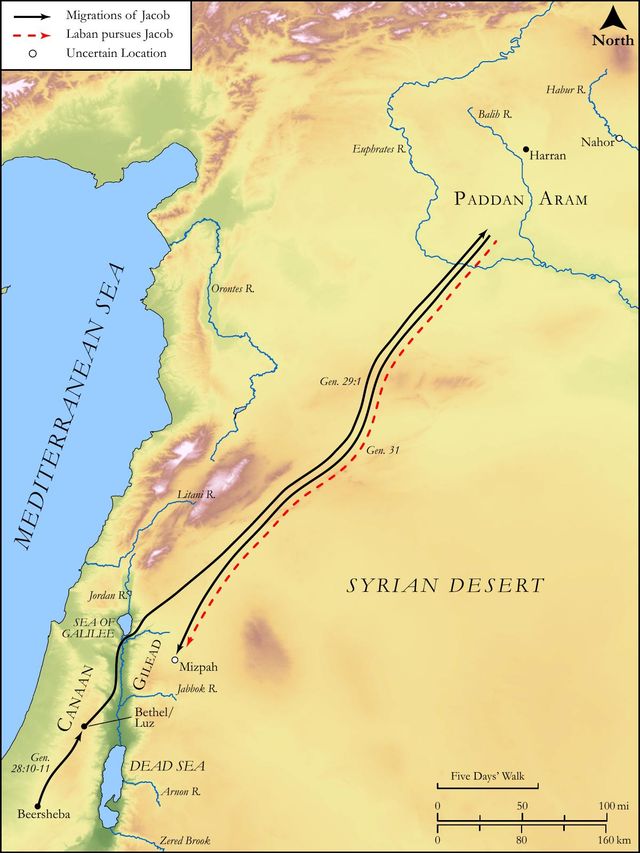
See on the biblical-era maps


Study this verse
Public-domain commentary
Matthew Henry
From his Commentary on the Whole Bible. Henry comments on passages, not single verses — this entry covers Genesis 31:1–16. His four-level outline is real structure in the source text, so it is rendered as structure.
Jacob is here taking up a resolution immediately to quit his uncle's service, to take what he had and go back to Canaan. This resolution he took up upon a just provocation, by divine direction, and with the advice and consent of his wives.
I.Upon a just provocation; for Laban and his sons had become very cross and ill-natured towards him, so that he could not stay among them with safety or satisfaction.
1.Laban's sons showed their ill-will in what they said, Gen 31:1. It should seem they said it in Jacob's hearing, with a design to vex him. The last chapter began with Rachel's envying Leah; this begins with Laban's sons envying Jacob. Observe,
(1.)How greatly they magnify Jacob's prosperity: He has gotten all this glory. And what was this glory that they made so much ado about? It was a parcel of brown sheep and speckled goats (and perhaps the fine colours made them seem more glorious), and some camels and asses, and such like trading; and this was all this glory. Note, Riches are glorious things in the eyes of carnal people, while to all those that are conversant with heavenly things they have no glory in comparison with the glory which excelleth. Men's over-valuing worldly wealth is that fundamental error which is the root of covetousness, envy, and all evil.
(2.)How basely they reflect upon Jacob's fidelity, as if what he had he had not gotten honestly: Jacob has taken away all that was our father's. Not all, surely. What had become of those cattle which were committed to the custody of Laban's sons, and sent three days' journey off? Gen 30:35, Gen 30:36. They mean all that was committed to him; but, speaking invidiously, they express themselves thus generally. Note,
[1.]Those that are ever so careful to keep a good conscience cannot always be sure of a good name.
[2.]This is one of the vanities and vexations which attend outward prosperity, that it makes a man to be envied of his neighbors (Ecc 4:4), and who can stand before envy? Pro 27:4. Whom Heaven blesses hell curses, and all its children on earth.
2.Laban himself said little, but his countenance was not towards Jacob as it used to be; and Jacob could not but take notice of it, Gen 31:2, Gen 31:5. He was but a churl at the best, but now he was more churlish than formerly. Note, Envy is a sin that often appears in the countenance; hence we read of an evil eye, Pro 23:6. Sour looks may do a great deal towards the ruin of peace and love in a family, and the making of those uneasy of whose comfort we ought to be tender. Laban's angry countenance lost him the greatest blessing his family ever had, and justly.
II.By divine direction and under the convoy of a promise:
The Lord said unto Jacob, Return, and I will be with thee, Gen 31:3. Though Jacob had met with very hard usage here, yet he would not quit his place till God bade him. He came thither by orders from Heaven, and there he would stay till he was ordered back. Note, It is our duty to set ourselves, and it will be our comfort to see ourselves, under God's guidance, both in our going out and in our coming in. The direction he had from Heaven is more fully related in the account he gives of it to his wives (Gen 31:10-13), where he tells them of a dream he had about the cattle, and the wonderful increase of those of his colour; and how the angel of God, in that dream (for I suppose the dream spoken of Gen 31:10 and that Gen 31:11 to be the same), took notice of the workings of his fancy in his sleep, and instructed him, so that it was not by chance, or by his own policy, that he obtained that great advantage; but, 1. by the providence of God, who had taken notice of the hardships Laban had put upon him, and took this way to recompense him: "For I have seen all the Laban doeth unto thee, and herein I have an eye to that." Note, There is more of equity in the distributions of the divine providence than we are aware of, and by them the injured are recompensed really, though perhaps insensibly. Nor was it only by the justice of providence that Jacob was thus enriched, but, 2. In performance of the promise intimated in what is said Gen 31:13, I am the God of Beth-el, This was the place where the covenant was renewed with him. Note, Worldly prosperity and success are doubly sweet and comfortable when we see them flowing, not from common providence, but from covenant-love, to perform the mercy promised - when we have them from God as the God of Beth-el, from those promises of the life which now is that belong to godliness. Jacob, even when he had this hopeful prospect of growing rich with Laban, must think of returning. When the world begins to smile upon us we must remember it is not our home. Now arise (Gen 31:13) and return, (1.) To thy devotions in Canaan, the solemnities of which had perhaps been much intermitted while he was with Laban. The times of this servitude God had winked at; but now, "Return to the place where thou anointedst the pillar and vowedst the vow. Now that thou beginnest to grow rich it is time to think of an altar and sacrifices again." (2.) To thy comforts in Canaan: Return to the land of thy kindred. He was here among his near kindred; but those only he must look upon as his kindred in the best sense, the kindred he must live and die with, to whom pertained the covenant. Note, The heirs of Canaan must never reckon themselves at home till they come thither, however they may seem to take root here.
III.With the knowledge and consent of his wives. Observe,
1.He sent for Rachel and Leah to him to the field (Gen 31:4), that he might confer with them more privately, or because one would not come to the other's apartment and he would willingly talk with them together, or because he had work to do in the field which he would not leave. Note, Husbands that love their wives will communicate their purposes and intentions to them. Where there is a mutual affection there will be a mutual confidence. And the prudence of the wife should engage the heart of her husband to trust in her, Pro 31:11. Jacob told his wives,
(1.)How faithfully he had served their father, Gen 31:6. Note, If others do not do their duty to us, yet we shall have the comfort of having done ours to them.
(2.)How unfaithfully their father had dealt with him Gen 31:7. He would never keep to any bargain that he made with him, but, after the first year, still as he saw Providence favour Jacob with the colour agreed on, every half year of the remaining five he changed it for some other colour, which made it ten times; as if he thought not only to deceive Jacob, but the divine Providence, which manifestly smiled upon him. Note, Those that deal honestly are not always honestly dealt with.
(3.)How God had owned him notwithstanding. He had protected him from Laban's ill-will: God suffered him not to hurt me. Note, Those that keep close to God shall be kept safely by him. He had also provided plentifully for him, notwithstanding Laban's design to ruin him: God has taken away the cattle of your father, and given them to me, Gen 31:9. Thus the righteous God paid Jacob for his hard service out of Laban's estate; as afterwards he paid the seed of Jacob for their serving the Egyptians, with their spoils. Note, God is not unrighteous to forget his people's work and labour of love, though men be so, Heb 6:10. Providence has ways of making those honest in the event that are not so in their design. Note, further, The wealth of the sinner is laid up for the just, Pro 13:22.
(4.)He told them of the command God had given him, in a dream, to return to his own country (Gen 31:13), that they might not suspect his resolution to arise from inconstancy, or any disaffection to their country or family, but might see it to proceed from a principle of obedience to his God, and dependence on him.
2.His wives cheerfully consented to his resolution. They also brought forward their grievances, complaining that their father had been not only unkind, but unjust, to them (Gen 31:14-16), that he looked upon them as strangers, and was without natural affection towards them; and, whereas Jacob had looked upon the wealth which God had transferred from Laban to him as his wages, they looked upon it as their portions; so that, both ways, God forced Laban to pay his debts, both to his servant and to his daughters. So then it seemed,
(1.)They were weary of their own people and their father's house, and could easily forget them. Note, This good use we should make of the unkind usage we meet with from the world, we should sit the more loose to it, and be willing to leave it and desirous to be at home.
(2.)They were willing to go along with their husband, and put themselves with him under the divine direction: Whatsoever God hath said unto thee do. Note, Those wives that ar their husband's meet helps will never be their hindrances in doing that to which God calls them.
Continue studying Genesis 31:6 across the web’s major study libraries — every link below opens this exact verse, chapter, or book on the destination site.
Read & Compare
 BibleGatewayThis verse in more than 200 translations and 70 languages.
 Bible.comThe YouVersion reader — hundreds of translations, reading plans, and highlights.
 ESV.orgCrossway's official English Standard Version reader.
 NET BibleThe NET translation with 60,000+ translators' notes on every rendering decision.
 STEP BibleTyndale House's free study tool — original text, vocabulary, and scholarly resources.
 BibliaLogos Bible Software's free web reader.
 USCCBThe New American Bible (Revised Edition) with the U.S. bishops' study notes.
Commentaries
 BibleHub CommentariesDozens of classic commentaries on this verse, gathered on one page.
 StudyLightMore than 100 commentary sets — the largest collection on the web.
 BibleRefPlain-English commentary on what this verse means, verse by verse.
 Enduring WordDavid Guzik's free commentary on this chapter, widely used by Bible teachers.
 Bible Study ToolsVerse commentary alongside Greek and Hebrew study aids.
Original Language & Research
- BibleHub InterlinearThe verse word by word — original language, transliteration, and English.
- BibleHub LexiconEvery word's original-language definition and Strong's entry.
 Blue Letter BibleDeep-study tools — Strong's numbers, concordance, and word studies.
 SefariaThe Hebrew text with Rashi and centuries of Jewish commentary.
Sermons, Hymns & Audio


TrulyRandomVerse is not affiliated with these sites and doesn’t control their content. They’re linked because they’re genuinely useful.
Summary
In this pivotal address to his wives, Rachel and Leah, Jacob articulates the unwavering dedication and immense effort he invested in serving their father, Laban, for two decades. This declaration is not merely a statement of fact but a foundational argument to justify his divinely commanded, yet clandestine, departure from Laban's household, highlighting his integrity and the righteousness of his decision despite years of exploitation.
Context
ShowHideLiterary Context
Genesis 31:6 is part of Jacob's carefully constructed argument to Rachel and Leah, convincing them to leave their father Laban's house with him. This conversation follows a divine directive for Jacob to return to the land of his fathers (Genesis 31:3), prompted by growing tension and Laban's increasingly hostile demeanor. Jacob first recounts Laban's repeated deceit regarding his wages (Genesis 31:7), then details God's miraculous intervention to bless him despite Laban's schemes (Genesis 31:8-12). His assertion of faithful service in Genesis 31:6 serves as a moral anchor, demonstrating his blameless conduct amidst Laban's treachery, thereby strengthening his case for departure and securing his wives' crucial support.
Historical & Cultural Context
In the patriarchal period, the relationship between a son-in-law and his father-in-law often involved a period of service as a form of bride-price, especially when the groom lacked substantial wealth. Jacob's twenty years of service (fourteen for his wives and six for his flocks, as detailed in Genesis 31:41) far exceeded typical expectations, underscoring Laban's exploitative nature. The cultural norm also granted the father significant authority over his daughters and their initial movements, making Jacob's secret departure a profound breach of custom. Jacob's appeal to his wives' direct observation of his labor was a powerful rhetorical strategy, as their testimony would be culturally significant in validating his claims and securing their loyalty over their father's.
Key Themes
ShowHideThis verse contributes significantly to several overarching themes in the book of Genesis. It highlights the theme of Divine Sovereignty and Providence, as God consistently intervenes to protect and prosper Jacob despite human injustice, fulfilling His covenant promises made to Abraham and Isaac. The narrative also explores the theme of Integrity Amidst Adversity, showcasing Jacob's steadfast diligence and ethical conduct even when exploited. Furthermore, it underscores the theme of Family Dynamics and Conflict, revealing the complex and often fraught relationships within the patriarchal household, particularly the tension between Jacob and Laban, and the ultimate necessity for Jacob to separate to fulfill God's plan for his lineage, as seen in the broader narrative of Genesis 29-31.
Exposition and Analysis
ShowHideThe declaration in Genesis 31:6 is a cornerstone of Jacob's argument to Rachel and Leah, asserting his unwavering commitment: "And ye know that with all my power I have served your father." This statement is not a mere boast but a factual appeal to their direct observation, intended to establish his integrity and the righteousness of his decision to leave Laban.
Key Word Analysis
ShowHideThis primitive root signifies "to ascertain by seeing," encompassing a wide range of meanings from simple observation to intimate acquaintance and understanding. Here, Jacob appeals to the wives' direct, experiential knowledge. They were eyewitnesses to his labor, implying an undeniable truth that they could not dispute. It suggests a deep, personal awareness of his diligence, not just a casual observation.
Derived from a root meaning "to be firm," this word denotes vigor, force, might, ability, or strength. When Jacob states he served "with all my power," he is emphasizing the totality and intensity of his exertion. It implies that he held nothing back, dedicating his full physical, mental, and emotional capacity to Laban's service, despite the lack of fair compensation or appreciation.
This primitive root means "to work" in any sense, by implication "to serve," "till," or even "enslave." In this context, it refers to the diligent, laborious work Jacob performed. The use of this verb underscores the nature of his relationship with Laban—one of a servant or laborer, despite being a family member—and highlights the demanding and extensive nature of his duties, which included tending flocks and managing Laban's household affairs.
Verse Breakdown
ShowHide"And ye know"
This opening phrase is a direct appeal to the shared experience and personal knowledge of Rachel and Leah. Jacob is not presenting new information but reminding them of a truth they have witnessed firsthand. It sets a tone of undeniable fact, leveraging their insider perspective on Laban's household and Jacob's labor within it.
"that with all my power"
This clause emphasizes the completeness and intensity of Jacob's service. The Hebrew phrase b'khol kochi (בְּכָל־כֹּחִ֛י) literally means "with all my strength/might." It conveys that Jacob held nothing back, investing his entire physical and mental energy into his work for Laban, demonstrating an exemplary work ethic even under exploitative conditions.
"I have served your father"
This final clause identifies the recipient of Jacob's diligent labor. The use of "your father" subtly aligns Jacob with Rachel and Leah, creating a shared perspective against Laban's injustice. It highlights the long duration and consistent nature of Jacob's service, establishing a moral high ground from which he can justify his subsequent actions.
Literary Devices
ShowHideJacob's statement employs Assertion and Appeal to Witness. The phrase "And ye know" functions as an Appeal to Witness, directly invoking Rachel and Leah as firsthand observers and therefore corroborators of his claim. This rhetorical strategy strengthens his argument by grounding it in undeniable, shared experience rather than mere subjective declaration. Furthermore, the entire verse is a powerful Assertion of Jacob's integrity and diligence. By stating he served "with all my power," Jacob emphasizes the totality of his effort, which stands in stark contrast to Laban's deceitful and exploitative practices. This assertion serves to justify his impending departure as a righteous act, not an abandonment of duty, but a response to divine command and persistent injustice.
Theological and Thematic Connections
ShowHideJacob's unwavering diligence in serving Laban, despite being repeatedly defrauded, powerfully illustrates the principle of faithfulness in the face of injustice. This narrative demonstrates that God observes and honors faithful labor, even when human masters do not. Jacob's perseverance, sustained by God's promises, reflects a deeper theological truth: God's covenant faithfulness to His people, even through their trials. This commitment to work "with all his power" can be seen as a precursor to the New Testament teaching that all work, when done with integrity and as unto the Lord, becomes an act of worship and obedience, regardless of the immediate circumstances or the character of the employer. God ultimately vindicates His servants, turning human schemes into opportunities for divine blessing and the fulfillment of His purposes.
Reflection and Application
ShowHideJacob's declaration in Genesis 31:6 offers profound lessons for contemporary believers regarding work ethic, integrity, and trust in divine providence. In a world where fair compensation and recognition are not always guaranteed, Jacob's example challenges us to perform our duties with diligence and integrity, as if serving God Himself, rather than merely human employers. His ability to confidently assert his faithful service underscores the value of maintaining a consistent record of hard work and ethical conduct, which builds credibility and inner peace. Ultimately, this verse encourages us to trust that God sees our faithful labor, even when others fail to appreciate it or act justly, and that He will ultimately bring about His purposes and vindication in our lives, transforming even difficult circumstances into pathways for His blessing and glory.
Questions for Reflection
ShowHideFAQ
ShowHideWhy did Jacob need to justify his departure to his wives?
ShowHideJacob needed to secure the understanding, consent, and cooperation of Rachel and Leah because they were Laban's daughters and integral members of his household. Their agreement was crucial for a smooth and secretive departure, especially given the cultural context where a father held significant authority over his daughters. By appealing to their direct knowledge of his faithful service, Jacob demonstrated the righteousness of his decision, aiming to ensure their loyalty and support over their father's claims, which was vital for the success of their journey back to Canaan, as outlined in Genesis 31:17-18.
What does "with all my power" imply about Jacob's character?
ShowHideThe phrase "with all my power" (Hebrew: b'khol kochi) implies that Jacob dedicated his complete physical, mental, and emotional energy to his work for Laban. It highlights his profound diligence, unwavering integrity, and exceptional commitment, demonstrating a strong work ethic even in the face of persistent exploitation and deception by Laban. This speaks to a character that honored his obligations fully, reflecting a deep sense of responsibility and perhaps an underlying trust that God would see his faithfulness, as later confirmed in Genesis 31:42.
How does Jacob's service to Laban relate to our service to God?
ShowHideJacob's diligent service to Laban, despite the injustice and lack of fair compensation, serves as a powerful example of working faithfully regardless of external circumstances. This parallels the biblical call for believers to work heartily "as unto the Lord" and not merely for human masters, as taught in Colossians 3:23-24. Our effort and integrity in all tasks should be motivated by our devotion to God, rather than solely by human recognition or reward. God sees and honors our faithful labor, and our work, when done with integrity, can become an act of worship, as also seen in Ephesians 6:7-8.
Christ-Centered Fulfillment
ShowHideJacob's diligent and faithful service "with all my power" to an unjust master, Laban, serves as a profound foreshadowing of the perfect and ultimate service of Jesus Christ. While Jacob's commendable service was still imperfect and driven by human necessity and the desire for blessing, Christ's obedience was absolute, unblemished, and entirely selfless. Jesus perfectly fulfilled the will of His Heavenly Father, serving humanity with His entire being, even unto the ignominious death on the cross, despite facing immense injustice, betrayal, and rejection from those He came to save (Philippians 2:8). Jacob's eventual vindication and blessing by God, despite Laban's schemes and attempts to defraud him, powerfully points to Christ's ultimate triumph over sin, death, and injustice through His resurrection (Romans 6:9-10). His perfect service establishes Him as the righteous King whose obedient life, sacrificial death, and glorious resurrection bring salvation and eternal life to all who believe, fulfilling God's covenant promises in a way far surpassing Jacob's experience (Hebrews 5:8-9).