


Genesis 31:42
Bible text: King James Version (1769 Blayney text) · Public domain
Bible text: King James Version with Strong's numbers · Public domain
Bible text: Berean Standard Bible · Public domain
Bible text: American Standard Version (1901) · Public domain
Bible text: World English Bible, Messianic edition · Public domain
Bible text: Geneva Bible (1599) · Public domain
Bible text: Young's Literal Translation · Public domain
- לוּלֵיlu·Leiif notH3884PrtParticle Conditional
- אֱלֹהֵי'e·lo·Hei[the] God ofH430N-mpcNoun Plural Masculine Construct
- אָבִי'a·Vimy fatherH1N-msc ¦ 1csNoun Singular Masculine Constructאָבִfatherיmy
- אֱלֹהֵי'e·lo·Hei[the] God ofH430N-mpcNoun Plural Masculine Construct
- אַבְרָהָם'av·ra·HamAbrahamH85N-proper-mNoun Proper Masculine
- וּפַחַדu·Fa·chadand [the] fear ofH6343Conj-w ¦ N-mscNoun Singular Masculine Constructוּandפַחַד[the] fear of
- יִצְחָקyitz·ChakIsaacH3327N-proper-mNoun Proper Masculine
- הָיָהHa·yahhe had beenH1961V-Qal-Perf-3msVerb Qal Perfect 3rd Singular Masculine
- לִיLito <the> mePrep-l ¦ 1csSuffix Personal 1st Singular common genderלִto <the>יme
- כִּיkiforH3588PrtParticle Conditional
- עַתָּה'a·TahnowH6258AdvAdverb
- רֵיקָםrei·KamemptyH7387AdvAdverb
- שִׁלַּחְתָּנִיshi·lach·Ta·niyou sent away meH7971V-Piel-Perf-2ms ¦ 1csVerb Piel Perfect 2nd Singular Masculineשִׁלַּחְתָּyou sent awayנִיme
- אֶת'et<obj.>H853DirObjMParticle Object Indicator
- עָנְיִי'a·ne·Yimy afflictionH6040N-msc ¦ 1csNoun Singular Masculine Constructעָנְיִafflictionיmy
- וְאֶתve·'Etand <obj.>H853Conj-w ¦ DirObjMParticle Object Indicatorוְandאֶת<obj.>
- יְגִיַעye·Gi·ya'[the] toil ofH3018N-mscNoun Singular Masculine Construct
- כַּפַּיka·Paimy handsH3709N-fdc ¦ 1csNoun Dual Feminine Constructכַּפַּhandsיmy
- רָאָהra·'Ahhe has seenH7200V-Qal-Perf-3msVerb Qal Perfect 3rd Singular Masculine
- אֱלֹהִים'E·lo·HimGodH430N-mpNoun Plural Masculine Absolute
- וַיּוֹכַחvai·Yo·khachand he decidedH3198Conj-w ¦ V-Hiphil-ConsecImperf-3msVerb Hiphil Consecutive Imperfect 3rd Singular Masculineוַandיּוֹכַחhe decided
- אָמֶשׁ'A·meshlast nightH570N-msNoun Singular Masculine Absolute
English is a literal word-by-word gloss of the Hebrew, not the KJV's wording. Why?
This is the original text the KJV's translators worked from — each Hebrew word with its own literal English meaning in this verse, prepared by scholars at Tyndale House, Cambridge. The KJV translates whole sentences, not word by word, so its wording differs: one Hebrew word can become several English words, and the KJV may choose “the LORD” where the gloss reads “Yahweh”. Both are faithful — they answer different questions. For the KJV's own rendering, switch to the KJV text.
Details
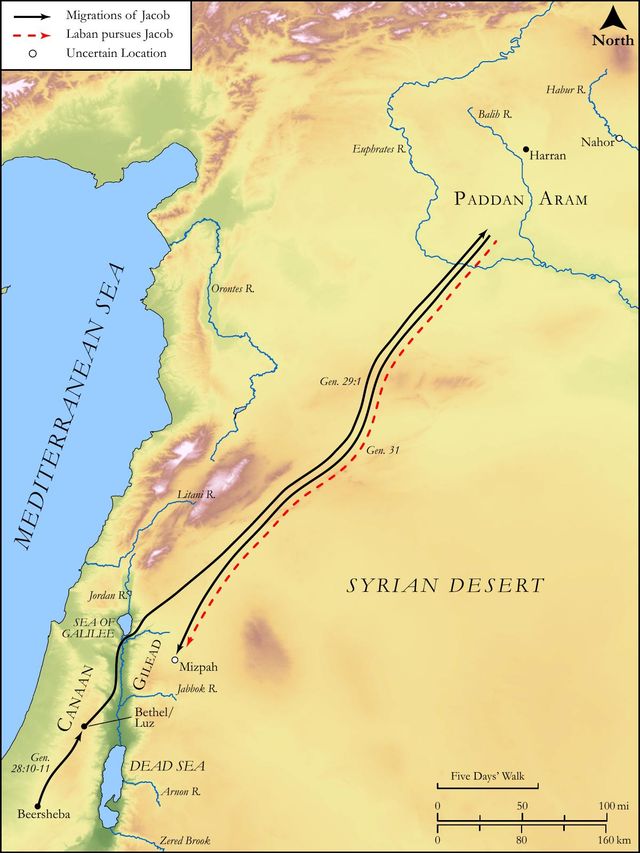
See on the biblical-era maps


Study this verse
Public-domain commentary
Matthew Henry
From his Commentary on the Whole Bible. Henry comments on passages, not single verses — this entry covers Genesis 31:36–42. His two-level outline is real structure in the source text, so it is rendered as structure.
See in these verses,
I.The power of provocation.
Jacob's natural temper was mild and calm, and grace had improved it; he was a smooth man, and a plain man; and yet Laban's unreasonable carriage towards him put him into a heat that transported him into a heat that transported him into some vehemence, Gen 31:36, Gen 31:37. His chiding with Laban, though it may admit of some excuse, was not justifiable, nor is it written for our imitation. Grievous words stir up anger, and commonly do but make bad worse. It is a very great affront to one that bears an honest mind to be charged with dishonesty, and yet even this we must learn to bear with patience, committing our cause to God.
II.The comfort of a good conscience.
This was Jacob's rejoicing, that when Laban accused him his own conscience acquitted him, and witnessed for him that he had been in all things willing and careful to live honestly, Heb 13:18. Note, Those that in any employment have dealt faithfully, if they cannot obtain the credit of it with men, yet shall have the comfort of it in their own bosoms.
III.The character of a good servant, and particularly of a faithful shepherd. Jacob had approved himself such a one, Gen 31:38-40.
1.He was very careful, so that, through his oversight or neglect, the ewes did not cast their young. His piety also procured a blessing upon his master's effects that were under his hands. Note, Servants should take no less care of what they are entrusted with for their masters than if they were entitled to it as their own.
2.He was very honest, and took none of that for his own eating which was not allowed him. He contented himself with mean fare, and coveted not to feast upon the rams of the flock. Note, Servants must not be dainty in their food, nor covet what is forbidden them, but in that, and other instances, show all good fidelity.
3.He was very laborious, Gen 31:40. He stuck to his business, all weathers; and bore both heat and cold with invincible patience. Note, Men of business, that intend to make something of it, must resolve to endure hardness. Jacob is here an example to ministers; they also are shepherds, of whom it is required that hey be true to their trust and willing to take pains.
IV.The character of a hard master. Laban had been such a one to Jacob. Those are bad masters,
1.Who exact from their servants that which is unjust, by obliging them to make good that which is not damaged by any default of theirs. This Laban did, Gen 31:39. Nay, if there has been a neglect, yet it is unjust to punish above the proportion of the fault. That may be an inconsiderable damage to the master which would go near to ruin a poor servant.
2.Those also are bad masters who deny to their servants that which is just and equal. This Laban did, Gen 31:41. It was unreasonable for him to make Jacob serve fro his daughters, when he had in reversion so great an estate secured to him by the promise of God himself; as it was also to give him his daughters without portions, when it was in the power of his hands to do well for them. Thus he robbed the poor because he was poor, as he did also by changing his wages.
V.The care of providence for the protection of injured innocence, Gen 31:42.
God took cognizance of the wrong done to Jacob, and repaid him whom Laban would otherwise have sent empty away, and rebuked Laban, who otherwise would have swallowed him up. Note, God is the patron of the oppressed; and those who are wronged and yet not ruined, cast down and yet not destroyed, must acknowledge him in their preservation and give him the glory of it. Observe,
1.Jacob speaks of god as the God of his father, intimating that he thought himself unworthy to be thus regarded, but was beloved for the father's sake.
2.He calls him the God of Abraham, and the fear of Isaac; for Abraham was dead, and had gone to that world where perfect love casts out fear; but Isaac was yet alive, sanctifying the Lord in his heart, as his fear and his dread
Continue studying Genesis 31:42 across the web’s major study libraries — every link below opens this exact verse, chapter, or book on the destination site.
Read & Compare
 BibleGatewayThis verse in more than 200 translations and 70 languages.
 Bible.comThe YouVersion reader — hundreds of translations, reading plans, and highlights.
 ESV.orgCrossway's official English Standard Version reader.
 NET BibleThe NET translation with 60,000+ translators' notes on every rendering decision.
 STEP BibleTyndale House's free study tool — original text, vocabulary, and scholarly resources.
 BibliaLogos Bible Software's free web reader.
 USCCBThe New American Bible (Revised Edition) with the U.S. bishops' study notes.
Commentaries
 BibleHub CommentariesDozens of classic commentaries on this verse, gathered on one page.
 StudyLightMore than 100 commentary sets — the largest collection on the web.
 BibleRefPlain-English commentary on what this verse means, verse by verse.
 Enduring WordDavid Guzik's free commentary on this chapter, widely used by Bible teachers.
 Bible Study ToolsVerse commentary alongside Greek and Hebrew study aids.
Original Language & Research
- BibleHub InterlinearThe verse word by word — original language, transliteration, and English.
- BibleHub LexiconEvery word's original-language definition and Strong's entry.
 Blue Letter BibleDeep-study tools — Strong's numbers, concordance, and word studies.
 SefariaThe Hebrew text with Rashi and centuries of Jewish commentary.
Sermons, Hymns & Audio


TrulyRandomVerse is not affiliated with these sites and doesn’t control their content. They’re linked because they’re genuinely useful.
Summary
Genesis 31:42 captures Jacob's fervent declaration to Laban, attributing his preservation and prosperity directly to the sovereign intervention and unwavering protection of the covenant God—the God of Abraham, his father Isaac, and his own personal experience. This powerful statement underscores God's active awareness of human suffering, His commitment to justly vindicate His servant against deceit and exploitation, and His providential care that prevented Jacob from being sent away destitute.
Context
ShowHideLiterary Context
This verse is the climactic point of Jacob's impassioned defense against Laban's accusations and pursuit, following Jacob's clandestine departure from Haran. For two decades, Jacob had served Laban under increasingly exploitative conditions, enduring repeated changes to his wages and manipulative schemes concerning his family and flocks. Jacob's sudden departure, prompted by a divine command to return to his homeland, ignited Laban's furious pursuit. The immediate preceding narrative describes Laban's search for his stolen household gods (teraphim) and his inability to find them, followed by Jacob's outburst, where he recounts the twenty years of hardship and injustice he suffered under Laban's hand (Genesis 31:36-41). Genesis 31:42 serves as Jacob's ultimate appeal to a higher authority—God Himself—who, as Jacob reveals, had already intervened the previous night by warning Laban in a dream not to harm Jacob (Genesis 31:24). This declaration solidifies Jacob's position, demonstrating that his prosperity and safety were not due to Laban's generosity but to divine favor and protection.
Historical & Cultural Context
In the households of the patriarchs, the relationship between a father-in-law and son-in-law, especially concerning marriage and labor agreements, was governed by specific customs. Laban's repeated changing of Jacob's wages (ten times, according to Genesis 31:7) was a severe breach of customary law and trust, highlighting his avarice and manipulative character. The concept of "sending away empty" (i.e., without accumulated property, flocks, or even family) was a grave injustice, leaving a man destitute and dishonored. A man's wealth, particularly his flocks and family, was his security and legacy. Jacob's appeal to "the God of my father, the God of Abraham, and the fear of Isaac" invokes the patriarchal covenant tradition, emphasizing the continuity of God's relationship with his family line and the divine promises of land, descendants, and blessing that were foundational to their identity and hope. Laban's pursuit and accusation of theft (of the teraphim) were serious, potentially leading to violence or even death, making God's intervention all the more critical.
Key Themes
ShowHideGenesis 31:42 powerfully contributes to several overarching themes within the book of Genesis and the broader biblical narrative. It highlights the theme of Divine Providence and Protection, demonstrating God's active and personal involvement in the lives of His covenant people, even when they face human treachery and injustice. Jacob's testimony underscores Covenant Faithfulness, as God honors His promises made to Abraham and Isaac by safeguarding their descendant. The verse also exemplifies God as a Righteous Judge and Vindicator, who sees the "affliction" and "labour" of the oppressed and intervenes to bring justice, as seen in God's direct "rebuke" of Laban (Genesis 31:24) and His subsequent blessing of Jacob's flocks (Genesis 30:27-43). Furthermore, it touches upon the theme of Human Deceit vs. Divine Integrity, contrasting Laban's manipulative character with God's unwavering righteousness and commitment to His word.
Exposition and Analysis
ShowHideJacob's declaration in Genesis 31:42 is a profound theological statement, asserting God's active and decisive role in his life and directly challenging Laban's attempts to exploit him. It serves as a testament to God's omnipresent watchfulness and His commitment to justice for His covenant people.
Key Word Analysis
ShowHideThis plural noun, frequently used with a singular verb, refers to the supreme God. In this context, Jacob emphasizes the continuity of the covenant God known by his ancestors, Abraham and Isaac. It signifies the powerful, sovereign, and ultimate authority to whom Jacob appeals, contrasting with Laban's lesser gods or human machinations.
From a root meaning "to dread" or "to be in awe," this term refers to a sudden alarm or, by implication, the object of profound reverence and dread. "The fear of Isaac" is a unique and deeply personal appellation for God, signifying not merely a theological concept but the very object of Isaac's worship, awe, and devotion. It highlights a relationship characterized by profound respect and submission to God's authority.
This word denotes depression, misery, or trouble. Jacob uses it to describe the hardship, oppression, and unjust treatment he endured under Laban's service for two decades. God's "seeing" of this affliction emphasizes His compassionate awareness and intimate knowledge of Jacob's suffering.
This primitive root means "to be right," "to argue," or "to decide." Causatively, it means "to justify" or "to convict," "to chasten," or "to reprove." Here, it signifies God's direct, authoritative, and decisive intervention to correct Laban's wrongdoing, serving as a divine verdict and warning against further harm.
Verse Breakdown
ShowHide"Except the God of my father, the God of Abraham, and the fear of Isaac, had been with me,"
Jacob begins by invoking the covenant God, emphasizing the continuity of divine faithfulness across generations. "The God of my father" refers to Isaac, establishing a personal lineage. "The God of Abraham" links to the foundational covenant promises. The unique phrase "the fear of Isaac" serves as a powerful metonymy, referring to the God whom Isaac worshipped with profound awe and reverence, underscoring a deeply personal and experiential relationship with the divine. This opening clause asserts that God's active presence was the sole reason for Jacob's survival and prosperity.
"surely thou hadst sent me away now empty."
This clause highlights God's protective hand. Jacob implies that without divine intervention, Laban would have succeeded in his exploitative intentions, leaving Jacob destitute, stripped of his family and the wealth he had rightfully earned through his labor. It underscores the severity of Laban's potential injustice and the completeness of God's preventative action.
"God hath seen mine affliction and the labour of my hands,"
This is the core of Jacob's appeal to divine justice. It speaks to God's omniscience and omnipresence, emphasizing His active awareness of human suffering, injustice, and diligent effort. God is portrayed as the righteous judge who observes every detail of His servant's life and the hardships endured.
"and rebuked [thee] yesternight."
This final clause serves as irrefutable proof of God's immediate and decisive intervention. Jacob directly references God's dream warning to Laban (recorded in Genesis 31:24), which occurred the previous night. This public declaration not only vindicates Jacob but also serves as a potent warning to Laban, confirming God's commitment to justice and His active protection of His people.
Literary Devices
ShowHideJacob's speech in Genesis 31:42 employs several powerful Literary Devices. The use of Apostrophe is evident as Jacob directly addresses Laban, yet his words are primarily a theological declaration, appealing to a higher, unseen authority. The phrase "the fear of Isaac" is a compelling example of Metonymy, where "fear" stands in for the object of that fear—God Himself. This unique expression emphasizes Isaac's profound reverence and worship, highlighting a deeply personal relationship with the divine rather than a mere theological concept. Jacob's assertion that Laban "surely thou hadst sent me away now empty" could be seen as Hyperbole, emphasizing the extreme destitution he would have faced without God's intervention, underscoring the completeness of divine protection. The repetition of "God" ("the God of my father, the God of Abraham... God hath seen...") serves as Anaphora or simple Repetition, reinforcing the central role and singular authority of God in Jacob's life and in the unfolding narrative. Finally, the entire verse functions as a powerful Testimony, a personal account of divine Intervention and Vindication, designed to both inform and warn Laban.
Theological and Thematic Connections
ShowHideGenesis 31:42 profoundly illustrates the active and personal nature of God's providence and justice within the covenant relationship. It reveals a God who is not distant or detached but intimately involved in the lives of His people, seeing their suffering, hearing their cries, and intervening on their behalf. Jacob's invocation of "the God of my father, the God of Abraham, and the fear of Isaac" underscores the continuity of God's covenant faithfulness across generations, demonstrating that His promises and protective care extend to all who are part of His chosen lineage. This verse serves as a powerful reminder that God is the ultimate arbiter of justice, who rebukes the oppressor and vindicates the oppressed, ensuring that His purposes for His people are fulfilled despite human treachery.
Reflection and Application
ShowHideGenesis 31:42 offers profound reassurance for believers today, reminding us that like Jacob, we can be confident that God is intimately aware of our "affliction and the labour of our hands." He sees every injustice, every hardship, and every diligent effort we make, assuring us that God is not distant from our suffering. When faced with unfair treatment, exploitation, or opposition, this verse serves as a powerful reminder that God is our ultimate protector and vindicator, capable of intervening to prevent harm and ensure justice, even when circumstances seem bleak or human efforts seem to fail. Jacob's faith was rooted in the covenant God made with his ancestors, encouraging us to similarly trust in God's unchanging character and His promises, knowing that He remains faithful across all generations. Finally, Jacob's public declaration to Laban acknowledges God's active role in his life, prompting us to recognize and give thanks for God's providential care in our own journeys, even through difficult seasons, and to testify to His goodness.
Questions for Reflection
ShowHideFAQ
ShowHideWhat does "the fear of Isaac" mean?
ShowHideThe phrase "the fear of Isaac" is a unique and poetic way of referring to God, found only here in Scripture. While "the God of Abraham" and "the God of my father" (Isaac) are common patriarchal appellations for the Lord, "the fear of Isaac" emphasizes the profound awe, reverence, and worship that characterized Isaac's personal relationship with God. It suggests that God was the very object of Isaac's deepest respect and devotion, effectively meaning "the God whom Isaac feared/revered." This expression highlights a deeply personal, experiential connection to God, rather than merely a theological concept, underscoring the intimate nature of Isaac's faith.
How does God's rebuke of Laban demonstrate His justice?
ShowHideGod's rebuke of Laban, specifically mentioned by Jacob as happening "yesterday night" (referencing God's dream warning in Genesis 31:24), directly demonstrates His justice by intervening to prevent further harm and exploitation of Jacob. For twenty years, Laban had repeatedly manipulated Jacob, changing his wages and deceiving him concerning his family and property. God's direct warning to Laban not to speak "good or bad" to Jacob was a divine intervention that protected Jacob from Laban's potential violence or further deceit. This act showcases God's commitment to seeing and addressing the affliction of His people, ensuring that those who oppress or act unjustly are held accountable, even if only through a divine warning that restrains their evil intentions. It underscores God's role as a righteous judge who defends the vulnerable.
Christ-Centered Fulfillment
ShowHideGenesis 31:42, with Jacob's appeal to God's protection and vindication against Laban's injustice, powerfully foreshadows the ultimate divine intervention and justice found in Christ. Just as God saw Jacob's "affliction and the labour of my hands" and delivered him from being sent away "empty," so too does Christ intimately see the suffering of His people and provides ultimate deliverance from the oppression of sin, the tyranny of the enemy, and the emptiness of a life without God. He is the faithful Son of the covenant, the true Seed of Abraham, who fulfills all the promises made to the patriarchs (Galatians 3:16). Through His atoning work on the cross, Christ ensures that those who are "in Him" are never sent away "empty" but are instead filled with every spiritual blessing (Ephesians 1:3), inheriting eternal life and an imperishable inheritance (1 Peter 1:3-4). Christ's resurrection is the ultimate "rebuke" of the powers of darkness and death (Colossians 2:15), securing justice for His people and guaranteeing their eternal vindication and protection, far surpassing Jacob's temporal deliverance. He is our ultimate Protector, Advocate, and the One who ensures we are never left wanting, but are eternally full in Him (John 10:10).