


Genesis 31:29
Bible text: King James Version (1769 Blayney text) · Public domain
Bible text: King James Version with Strong's numbers · Public domain
Bible text: Berean Standard Bible · Public domain
Bible text: American Standard Version (1901) · Public domain
Bible text: World English Bible, Messianic edition · Public domain
Bible text: Geneva Bible (1599) · Public domain
Bible text: Young's Literal Translation · Public domain
- יֶשׁyeshthereH3426Adj-csAdjective Numerical Singular common gender Absolute
- לְאֵלle·'El[is] to [the] power ofH410Prep-l ¦ N-mscNoun Singular Masculine Constructלְ[is] toאֵל[the] power of
- יָדִיya·Dimy handH3027N-csc ¦ 1csNoun Singular common gender Constructיָדִhandיmy
- לַעֲשׂוֹתla·'a·Sotto doH6213Prep-l ¦ V-Qal-InfVerb Qal Infinitive Constructלַtoעֲשׂוֹתdo
- עִמָּכֶם'i·ma·Khemwith youH5973Prep ¦ 2mpPreposition Definiteעִמָּwithכֶםyou
- רָעRa'harmH7451Adj-msAdjective Singular Masculine Absolute
- וֵאלֹהֵיve·lo·Heiand [the] God ofH430Conj-w ¦ N-mpcNoun Plural Masculine Constructוֵandאלֹהֵי[the] God of
- אֲבִיכֶם'a·vi·Khemyour fatherH1N-msc ¦ 2mpNoun Singular Masculine Constructאֲבִיfatherכֶםyour
- אֶמֶשׁ'E·meshlast nightH570N-msNoun Singular Masculine Absolute
- אָמַר'a·Marhe saidH559V-Qal-Perf-3msVerb Qal Perfect 3rd Singular Masculine
- אֵלַי'e·Laito meH413Prep ¦ 1csPreposition Definiteאֵלַtoיme
- לֵאמֹרle·Mor<to> sayingH559Prep-l ¦ V-Qal-InfVerb Qal Infinitive Constructלֵ<to>אמֹרsaying
- הִשָּׁמֶרhi·Sha·mertake heedH8104V-Niphal-Imp-2msVerb Niphal Imperative 2nd Singular Masculine
- לְךָle·Khato <the> yourselfPrep-l ¦ 2msSuffix Personal 2nd Singular Masculineלְto <the>ךָyourself
- מִדַּבֵּרmi·da·Berfrom speakingH1696Prep-m ¦ V-Piel-InfVerb Piel Infinitive Constructמִfromדַּבֵּרspeaking
- עִם'imwithH5973PrepPreposition
- יַעֲקֹבya·'a·KoJacobH3290N-proper-mNoun Proper Masculine
- מִטּוֹבmi·Tovfrom goodH2896Prep-m ¦ Adj-msAdjective Singular Masculine Absoluteמִfromטּוֹבgood
- עַד'aduntoH5704PrepPreposition
- רָעRa'badH7451Adj-msAdjective Singular Masculine Absolute
English is a literal word-by-word gloss of the Hebrew, not the KJV's wording. Why?
This is the original text the KJV's translators worked from — each Hebrew word with its own literal English meaning in this verse, prepared by scholars at Tyndale House, Cambridge. The KJV translates whole sentences, not word by word, so its wording differs: one Hebrew word can become several English words, and the KJV may choose “the LORD” where the gloss reads “Yahweh”. Both are faithful — they answer different questions. For the KJV's own rendering, switch to the KJV text.
Details
See on the biblical-era maps


Study this verse
Public-domain commentary
Matthew Henry
From his Commentary on the Whole Bible. Henry comments on passages, not single verses — this entry covers Genesis 31:25–35. His three-level outline is real structure in the source text, so it is rendered as structure.
We have here the reasoning, not to say the rallying, that took place between Laban and Jacob at their meeting, in that mountain which was afterwards called Gilead, Gen 31:25. Here is,
I.The high charge which Laban exhibited against him. He accuses him,
1.As a renegade that had unjustly deserted his service. To represent Jacob as a criminal, he will have it thought that he intended kindness to his daughters (Gen 31:27, Gen 31:28), that he would have dismissed them with all the marks of love and honour that could be, that he would have made a solemn business of it, would have kissed his little grandchildren (and that was all he would have given them), and, according to the foolish custom of the country, would have sent them away with mirth, and with songs, with tabret, and with harp: not as Rebekah was sent away out of the same family, above 120 years before, with prayers and blessings (Gen 24:60), but with sport and merriment, which was a sign that religion had very much decayed in the family, and that they had lost their seriousness. However, he pretends they would have been treated with respect at parting. Note, It is common for bad men, when they are disappointed in their malicious projects, to pretend that they designed nothing but what was kind and fair. When they cannot do the mischief they intended, they are loth it should be thought that they ever did intend it. When they have not done what they should have done they come off with this excuse, that they would have done it. Men may thus be deceived, but God cannot. He likewise suggests that Jacob had some bad design in stealing away thus (Gen 31:26), that he took his wives away as captives. Note, Those that mean ill themselves are most apt to put the worst construction upon what others do innocently. The insinuating and the aggravating of faults are the artifices of a designing malice, and those must be represented (though never so unjustly) as intending ill against whom ill is intended. Upon the whole matter,
(1.)He boasts of his own power (Gen 31:29): It is in the power of my hand to do you hurt. He supposes that he had both right on his side (a good action, as we say, against Jacob) and strength on his side, either to avenge the wrong or recover the right. Note, Bad people commonly value themselves much upon their power to do hurt, whereas a power to do good is much more valuable. Those that will do nothing to make themselves amiable love to be thought formidable. And yet,
(2.)He owns himself under the check and restraint of God's power; and, though it redounds much to the credit and comfort of Jacob, he cannot avoid telling him the caution God had given him the night before in a dream, Speak not to Jacob good nor bad. Note, As God has all wicked instruments in a chain, so when he pleases he can make them sensible of it, and force them to own it to his praise, as protector of the good, as Balaam did. Or we may look upon this as an instance of some conscientious regard felt by Laban for God's express prohibitions. As bad as he was he durst not injure one whom he saw to be the particular care of Heaven. Note, A great deal of mischief would be prevented if men would but attend to the caveats which their own consciences give them in slumberings upon the bed, and regard the voice of God in them.
2.As a thief, Gen 31:30. Rather than own that he had given him any colour of provocation to depart, he is willing to impute it to a foolish fondness for his father's house, which made him that he would needs begone; but then (says he) wherefore hast thou stolen my gods? Foolish man! to call those his gods that could be stolen! Could he expect protection from those that could neither resist nor discover their invaders? Happy are those who have the Lord for their God, for they have a God that they cannot be robbed of. Enemies may steal our goods, but not our God. Here Laban lays to Jacob's charge things that he knew not, the common distress of oppressed innocency.
II.Jacob's apology for himself.
Those that commit their cause to God, yet are not forbidden to plead it themselves with meekness and fear.
1.As to the charge of stealing away his own wives he clears himself by giving the true reason why he went away unknown to Laban, Gen 31:31. He feared lest Laban would by force take away his daughters, and so oblige him, by the bond of his affection to his wives, to continue in his service. Note, Those that are unjust in the least, it may be suspected, will be unjust also in much, Luk 16:10. If Laban deceive Jacob in his wages, it is likely he will make no conscience of robbing him of his wives, and putting those asunder whom God has joined together. What may not be feared from men that have no principle of honesty?
2.As to the charge of stealing Laban's gods he pleads not guilty, Gen 31:32. He not only did not take them himself (he was not so fond of them), but he did not know that they were taken. Yet perhaps he spoke too hastily and inconsiderately when he said, "Whoever had taken them, let him not live;" upon this he might reflect with some bitterness when, not long after, Rachel who had taken them died suddenly in travail. How just soever we think ourselves to be, it is best to forbear imprecations, lest they fall heavier than we imagine.
III.The diligent search Laban made for his gods (Gen 31:33-35), partly out of hatred to Jacob, whom he would gladly have an occasion to quarrel with, partly out of love to his idols, which he was loth to part with. We do not find that he searched Jacob's flocks for stolen cattle; but he searched his furniture for stolen gods. He was of Micah's mind, You have taken away my gods, and what have I more? Jdg 18:24. Were the worshippers of false gods so set upon their idols? did they thus walk in the name of their gods? and shall not we be as solicitous in our enquires after the true God? When he has justly departed from us, how carefully should we ask, Where is God my Maker? O that I knew where I might find him! Job 23:3. Laban, after all his searches, missed of finding his gods, and was baffled in his enquiry with a sham; but our God will not only by found of those that seek him, but they shall find him their bountiful rewarder.
Continue studying Genesis 31:29 across the web’s major study libraries — every link below opens this exact verse, chapter, or book on the destination site.
Read & Compare
 BibleGatewayThis verse in more than 200 translations and 70 languages.
 Bible.comThe YouVersion reader — hundreds of translations, reading plans, and highlights.
 ESV.orgCrossway's official English Standard Version reader.
 NET BibleThe NET translation with 60,000+ translators' notes on every rendering decision.
 STEP BibleTyndale House's free study tool — original text, vocabulary, and scholarly resources.
 BibliaLogos Bible Software's free web reader.
 USCCBThe New American Bible (Revised Edition) with the U.S. bishops' study notes.
Commentaries
 BibleHub CommentariesDozens of classic commentaries on this verse, gathered on one page.
 StudyLightMore than 100 commentary sets — the largest collection on the web.
 BibleRefPlain-English commentary on what this verse means, verse by verse.
 Enduring WordDavid Guzik's free commentary on this chapter, widely used by Bible teachers.
 Bible Study ToolsVerse commentary alongside Greek and Hebrew study aids.
Original Language & Research
- BibleHub InterlinearThe verse word by word — original language, transliteration, and English.
- BibleHub LexiconEvery word's original-language definition and Strong's entry.
 Blue Letter BibleDeep-study tools — Strong's numbers, concordance, and word studies.
 SefariaThe Hebrew text with Rashi and centuries of Jewish commentary.
Sermons, Hymns & Audio


TrulyRandomVerse is not affiliated with these sites and doesn’t control their content. They’re linked because they’re genuinely useful.
Summary
Genesis 31:29 captures Laban's frustrated declaration of his intent and capability to harm Jacob, immediately followed by his astonishing admission that "the God of your father" intervened supernaturally to forbid him from speaking anything, "either good or bad," to Jacob. This pivotal verse powerfully underscores God's active, personal protection over His covenant people and His absolute sovereignty over human intentions, ensuring Jacob's safe return to the promised land despite Laban's hostile pursuit.
Context
ShowHideLiterary Context
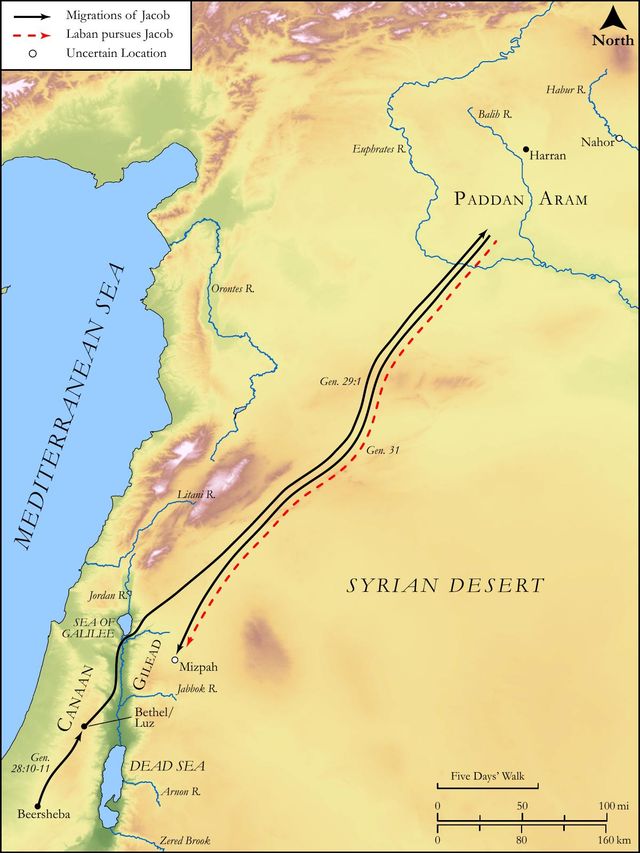
This verse is situated at a critical juncture in the narrative of Jacob's return to Canaan. Following twenty years of arduous service to Laban, during which Jacob's family and wealth grew significantly, he secretly departs from Laban's household, fearing Laban's reaction to his departure and the perceived injustice of his wages. Laban, upon discovering Jacob's flight and the theft of his household idols (teraphim, taken by Rachel), pursues him relentlessly for seven days across the Transjordan region. The confrontation in Genesis 31 is highly charged, with Laban initially expressing his anger and intent to harm Jacob, making this verse the dramatic turning point where divine intervention explicitly restrains Laban's wrath and reveals God's active hand in Jacob's journey.
Historical & Cultural Context
The cultural backdrop is one of patriarchal authority, family honor, and the binding nature of agreements, even if unwritten. Laban, as the elder patriarch and Jacob's father-in-law and employer, felt deeply wronged by Jacob's secret departure and the theft of his household gods, which could have represented family lineage, property deeds, or even a claim to inheritance. His pursuit was not merely for the idols but also to reassert his authority and potentially reclaim Jacob's wives and children, who were culturally considered his property as well. The journey from Haran to Gilead was long and dangerous, traversing tribal territories, making Laban's successful pursuit a testament to his determination and perceived right to confront Jacob. The mention of "yesterday" (KJV "yesternight") emphasizes the immediacy and directness of the divine encounter, highlighting the personal nature of God's communication within a culture that often sought divine omens or counsel.
Key Themes
ShowHideThis verse powerfully illustrates several overarching themes within the book of Genesis and the broader biblical narrative. Foremost is the theme of Divine Providence and Protection, where God actively intervenes to safeguard His chosen ones, even from seemingly insurmountable human threats, as seen in His protection of Abraham and Isaac (e.g., Genesis 12:17). It also emphasizes God's Faithfulness to His Covenant Promises, particularly those made to Jacob at Bethel, where God vowed to be with him and bring him back to the land (Genesis 28:15). The narrative also highlights the Sovereignty of God over Human Will, demonstrating that even the hostile intentions of powerful individuals like Laban are subject to God's ultimate control, ensuring His divine purposes are accomplished. This divine restraint on Laban also sets the stage for the subsequent covenant-making between Jacob and Laban, marking a peaceful, albeit tense, resolution to their conflict before Jacob's encounter with Esau in Genesis 32.
Exposition and Analysis
ShowHideKey Word Analysis
ShowHideThis word, literally meaning "hand," is used here idiomatically to signify "power," "ability," or "capability." Laban's declaration, "It is in the power of my hand," asserts his perceived strength and means to inflict harm upon Jacob. The hand, as an instrument of action, becomes a metaphor for one's capacity to act, highlighting Laban's conviction that he possessed the authority and physical ability to carry out his hostile intentions.
This primitive root means "to speak," but with a broad range of applications, including to command, declare, or appoint. In this context, it refers to a direct, verbal communication from God to Laban. The use of dâbar emphasizes the authoritative and intentional nature of God's message, which was not a mere suggestion but a divine imperative that Laban was compelled to obey, despite his own inclinations.
And bad (Hebrew, raʻ'): (H7451) These two words are used together as a merism (a figure of speech in which a pair of contrasting terms refers to a totality) to express "anything at all" or "nothing whatsoever." God's command to Laban, "Take thou heed that thou speak not to Jacob either good or bad," signifies a complete and absolute prohibition against any form of communication or interference—whether seemingly beneficial advice, persuasive arguments, threats, or even curses. This idiom underscores the comprehensive nature of God's protective decree over Jacob.
Verse Breakdown
ShowHide"It is in the power of my hand to do you hurt:"
Laban begins by asserting his perceived strength and capability. This clause reveals his hostile intent and his belief that he possesses the means and authority to inflict physical or material harm upon Jacob and his family. It sets up the dramatic tension, highlighting the danger Jacob was in and Laban's clear desire for retribution.
"but the God of your father spake unto me yesternight, saying,"
This is the pivotal turning point of the verse. The conjunction "but" introduces a stark contrast to Laban's stated intent. The phrase "the God of your father" is a significant theological identifier, connecting this divine intervention directly to the covenant God of Abraham and Isaac, thereby affirming God's continued faithfulness to Jacob. The timing, "yesternight," emphasizes the immediacy and directness of the divine encounter, indicating a recent and profound revelation that altered Laban's course of action.
"Take thou heed that thou speak not to Jacob either good or bad."
This is the direct divine command that restrains Laban. "Take thou heed" (Hebrew shâmar) implies a warning to be watchful and guard against transgression. The comprehensive prohibition "either good or bad" (a Hebrew idiom meaning "nothing at all") signifies that Laban was forbidden from any form of interaction that might influence Jacob's journey or decision-making. This ensured Jacob's unhindered return to the promised land, free from Laban's manipulation or aggression.
Literary Devices
ShowHideThe verse employs several significant literary devices. Irony is prominent, as Laban, who boasts of his power to harm, is immediately revealed to be utterly powerless against a divine decree. His stated intent is completely subverted by a higher authority. The phrase "the God of your father" functions as a powerful theological identifier, emphasizing the continuity of God's covenant with the patriarchs and affirming His active involvement in Jacob's life. The use of the idiom "either good or bad" is a merism, a rhetorical device where two contrasting parts represent a whole, highlighting the absolute and comprehensive nature of God's prohibition. This also serves as a form of hyperbole, emphasizing the totality of the forbidden communication. Finally, the entire encounter serves as foreshadowing of God's ongoing protection and guidance for Jacob, particularly in the impending, more dangerous encounter with Esau.
THEOLOGICAL AND THEMATIC CONNECTIONS
ShowHideGenesis 31:29 powerfully demonstrates God's active and personal involvement in the lives of His covenant people. Despite Laban's perceived power and hostile intentions, God directly intervenes, not through an intermediary or a general providence, but through a specific, verbal warning. This highlights God's unwavering commitment to His promises and His ability to supernaturally restrain human will to accomplish His divine purposes. It reaffirms that God's plans for His chosen ones cannot be thwarted by human opposition, showcasing His ultimate sovereignty and protective care over those He has called.
Reflection and Application
ShowHideThis profound account from Genesis 31:29 offers immense comfort and practical application for believers today. It serves as a powerful reminder that even when we find ourselves in vulnerable positions, facing potential adversaries or difficult circumstances that seem beyond our control, God is actively watching over us. He possesses the ultimate power to restrain the intentions and actions of others, even those who may wish us harm, to ensure His purposes for our lives are fulfilled. We can find peace in the knowledge that God's sovereign hand is at work, orchestrating events and protecting His children, often in ways unseen to us. This should cultivate a deeper trust in His providence, encouraging us to press forward in faith, knowing that our journey is ultimately secured by His unwavering faithfulness. It calls us to rest in His protective care, recognizing that our safety and destiny are ultimately in His hands, not contingent on the whims or power of others.
Questions for Reflection
ShowHideFAQ
ShowHideWhy did God forbid Laban from speaking "good or bad" to Jacob?
ShowHideThe phrase "either good or bad" (Hebrew: mīṭṭōḇ ʿaḏ-rāʿ) is a common Hebrew idiom meaning "nothing at all" or "in no way whatsoever." God's command was a comprehensive and absolute prohibition against any form of communication or interference from Laban. This was crucial to ensure Jacob's unhindered and independent return to the promised land, free from any attempts by Laban to persuade him to stay, to negotiate new terms, to threaten him, or even to offer seemingly helpful but ultimately manipulative advice. God's purpose was to remove any human obstacle to Jacob's journey, which was part of His sovereign plan for Jacob and the unfolding of the covenant promises, as He had previously promised to bring Jacob back to the land in Genesis 28:15.
Christ-Centered Fulfillment
ShowHideThe divine protection afforded to Jacob in Genesis 31:29 serves as a powerful foreshadowing of the ultimate protection and sovereign care found in Jesus Christ. Just as God the Father intervened to shield Jacob from Laban's wrath, so too does Christ, our Good Shepherd, actively protect His flock from spiritual adversaries and the schemes of the enemy. He is the embodiment of God's unwavering faithfulness, ensuring the safe passage of His people through this life to their eternal inheritance. In Christ, the promise of God's abiding presence and sovereign control over all circumstances finds its ultimate fulfillment. He assures His disciples, "I give them eternal life, and they shall never perish; neither shall anyone snatch them out of My hand" John 10:28. Through His atoning work, Christ has disarmed principalities and powers, triumphing over them Colossians 2:15. He is the one who delivers us from the domain of darkness and transfers us to His kingdom Colossians 1:13. Thus, the secure journey of Jacob to the promised land finds its ultimate spiritual parallel in the believer's secure journey to the heavenly promised land, guaranteed by the finished work and ongoing intercession of Christ Jesus, our Lord and Protector Hebrews 7:25.