


Genesis 31:38
Bible text: King James Version (1769 Blayney text) · Public domain
Bible text: Berean Standard Bible · Public domain
Bible text: American Standard Version (1901) · Public domain
Bible text: World English Bible, Messianic edition · Public domain
Bible text: Geneva Bible (1599) · Public domain
Bible text: Young's Literal Translation · Public domain
- זֶהzehthisH2088PrtParticle Demonstrative
- עֶשְׂרִים'es·RimtwentyH6242Adj-mpAdjective Numerical Plural Masculine Absolute
- שָׁנָהsha·Nahyear[s]H8141N-fsNoun Singular Feminine Absolute
- אָנֹכִי'a·no·KhiIH595Pro-1csPronoun Personal 1st Singular common gender
- עִמָּךְ'i·Makh[have been] with youH5973Prep ¦ 2msPreposition Definiteעִמָּ[have been] withךְyou
- רְחֵלֶיךָre·che·Lei·khayour ewesH7353N-mpc ¦ 2msNoun Plural Masculine Constructרְחֵלֶיewesךָyour
- וְעִזֶּיךָve·'i·Zei·khaand your female goatsH5795Conj-w ¦ N-mpc ¦ 2msNoun Plural Masculine Constructוְandעִזֶּיfemale goatsךָyour
- לֹאlo'notH3808NegParticle Negative
- שִׁכֵּלוּshi·Ke·luthey have miscarriedH7921V-Piel-Perf-3cpVerb Piel Perfect 3rd Plural common gender
- וְאֵילֵיve·'ei·Leiand [the] rams ofH352Conj-w ¦ N-mpcNoun Plural Masculine Constructוְandאֵילֵי[the] rams of
- צֹאנְךָtzo·ne·Khayour flockH6629N-csc ¦ 2msNoun Singular common gender Constructצֹאנְflockךָyour
- לֹאlo'notH3808NegParticle Negative
- אָכָלְתִּי'a·Khal·tiI have eatenH398V-Qal-Perf-1csVerb Qal Perfect 1st Singular common gender
English is a literal word-by-word gloss of the Hebrew, not the KJV's wording. Why?
This is the original text the KJV's translators worked from — each Hebrew word with its own literal English meaning in this verse, prepared by scholars at Tyndale House, Cambridge. The KJV translates whole sentences, not word by word, so its wording differs: one Hebrew word can become several English words, and the KJV may choose “the LORD” where the gloss reads “Yahweh”. Both are faithful — they answer different questions. For the KJV's own rendering, switch to the KJV text.
Details
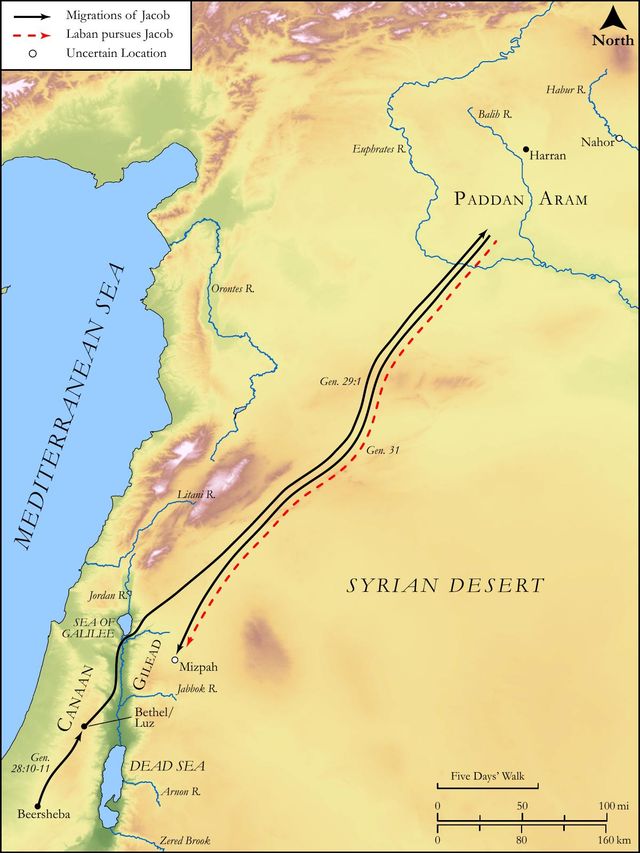
See on the biblical-era maps


Study this verse
Public-domain commentary
Matthew Henry
From his Commentary on the Whole Bible. Henry comments on passages, not single verses — this entry covers Genesis 31:36–42. His two-level outline is real structure in the source text, so it is rendered as structure.
See in these verses,
I.The power of provocation.
Jacob's natural temper was mild and calm, and grace had improved it; he was a smooth man, and a plain man; and yet Laban's unreasonable carriage towards him put him into a heat that transported him into a heat that transported him into some vehemence, Gen 31:36, Gen 31:37. His chiding with Laban, though it may admit of some excuse, was not justifiable, nor is it written for our imitation. Grievous words stir up anger, and commonly do but make bad worse. It is a very great affront to one that bears an honest mind to be charged with dishonesty, and yet even this we must learn to bear with patience, committing our cause to God.
II.The comfort of a good conscience.
This was Jacob's rejoicing, that when Laban accused him his own conscience acquitted him, and witnessed for him that he had been in all things willing and careful to live honestly, Heb 13:18. Note, Those that in any employment have dealt faithfully, if they cannot obtain the credit of it with men, yet shall have the comfort of it in their own bosoms.
III.The character of a good servant, and particularly of a faithful shepherd. Jacob had approved himself such a one, Gen 31:38-40.
1.He was very careful, so that, through his oversight or neglect, the ewes did not cast their young. His piety also procured a blessing upon his master's effects that were under his hands. Note, Servants should take no less care of what they are entrusted with for their masters than if they were entitled to it as their own.
2.He was very honest, and took none of that for his own eating which was not allowed him. He contented himself with mean fare, and coveted not to feast upon the rams of the flock. Note, Servants must not be dainty in their food, nor covet what is forbidden them, but in that, and other instances, show all good fidelity.
3.He was very laborious, Gen 31:40. He stuck to his business, all weathers; and bore both heat and cold with invincible patience. Note, Men of business, that intend to make something of it, must resolve to endure hardness. Jacob is here an example to ministers; they also are shepherds, of whom it is required that hey be true to their trust and willing to take pains.
IV.The character of a hard master. Laban had been such a one to Jacob. Those are bad masters,
1.Who exact from their servants that which is unjust, by obliging them to make good that which is not damaged by any default of theirs. This Laban did, Gen 31:39. Nay, if there has been a neglect, yet it is unjust to punish above the proportion of the fault. That may be an inconsiderable damage to the master which would go near to ruin a poor servant.
2.Those also are bad masters who deny to their servants that which is just and equal. This Laban did, Gen 31:41. It was unreasonable for him to make Jacob serve fro his daughters, when he had in reversion so great an estate secured to him by the promise of God himself; as it was also to give him his daughters without portions, when it was in the power of his hands to do well for them. Thus he robbed the poor because he was poor, as he did also by changing his wages.
V.The care of providence for the protection of injured innocence, Gen 31:42.
God took cognizance of the wrong done to Jacob, and repaid him whom Laban would otherwise have sent empty away, and rebuked Laban, who otherwise would have swallowed him up. Note, God is the patron of the oppressed; and those who are wronged and yet not ruined, cast down and yet not destroyed, must acknowledge him in their preservation and give him the glory of it. Observe,
1.Jacob speaks of god as the God of his father, intimating that he thought himself unworthy to be thus regarded, but was beloved for the father's sake.
2.He calls him the God of Abraham, and the fear of Isaac; for Abraham was dead, and had gone to that world where perfect love casts out fear; but Isaac was yet alive, sanctifying the Lord in his heart, as his fear and his dread
Continue studying Genesis 31:38 across the web’s major study libraries — every link below opens this exact verse, chapter, or book on the destination site.
Read & Compare
 BibleGatewayThis verse in more than 200 translations and 70 languages.
 Bible.comThe YouVersion reader — hundreds of translations, reading plans, and highlights.
 ESV.orgCrossway's official English Standard Version reader.
 NET BibleThe NET translation with 60,000+ translators' notes on every rendering decision.
 STEP BibleTyndale House's free study tool — original text, vocabulary, and scholarly resources.
 BibliaLogos Bible Software's free web reader.
 USCCBThe New American Bible (Revised Edition) with the U.S. bishops' study notes.
Commentaries
 BibleHub CommentariesDozens of classic commentaries on this verse, gathered on one page.
 StudyLightMore than 100 commentary sets — the largest collection on the web.
 BibleRefPlain-English commentary on what this verse means, verse by verse.
 Enduring WordDavid Guzik's free commentary on this chapter, widely used by Bible teachers.
 Bible Study ToolsVerse commentary alongside Greek and Hebrew study aids.
Original Language & Research
- BibleHub InterlinearThe verse word by word — original language, transliteration, and English.
- BibleHub LexiconEvery word's original-language definition and Strong's entry.
 Blue Letter BibleDeep-study tools — Strong's numbers, concordance, and word studies.
 SefariaThe Hebrew text with Rashi and centuries of Jewish commentary.
Sermons, Hymns & Audio


TrulyRandomVerse is not affiliated with these sites and doesn’t control their content. They’re linked because they’re genuinely useful.
Summary
Genesis 31:38 captures a pivotal moment in Jacob's impassioned confrontation with Laban, serving as a powerful testament to his unwavering diligence and integrity over two decades of service. In this verse, Jacob meticulously details his exemplary stewardship of Laban's flocks, emphasizing their sustained health and productivity under his care, and underscoring his personal probity by never exploiting the animals for his own benefit, thereby starkly contrasting his faithful commitment with Laban's repeated deceptions and injustices.
Context
ShowHideLiterary Context
This verse is embedded within Jacob's climactic verbal confrontation with Laban, following Jacob's surreptitious departure from Laban's household with his family and extensive possessions. Laban, having pursued Jacob for seven days, finally overtakes him in the region of Gilead. After Laban accuses Jacob of theft (specifically, his household gods) and of treating his daughters as captives, Jacob, emboldened by a divine warning given to Laban in a dream (as recounted in Genesis 31:24), unleashes a torrent of grievances. Genesis 31:38 is a key component of Jacob's detailed defense, where he systematically recounts the hardships, exploitation, and injustices he endured during his twenty years under Laban's employ, highlighting his own blameless and diligent service in stark contrast to Laban's avarice and deceit. The verses immediately preceding this one (e.g., Genesis 31:36-37) set the stage for Jacob's powerful rebuttal, and the verses following (e.g., Genesis 31:39-42) further elaborate on the specific trials he faced as a shepherd.
Historical & Cultural Context
In the days of the patriarchs, pastoralism was a primary economic activity, and a shepherd's integrity and skill were paramount. Agreements between employers and shepherds, often involving family members, were typically verbal but carried significant social and moral weight. Shepherds were responsible for the health, safety, and increase of the flock, often bearing personal liability for any losses not due to natural causes or wild animals (see Exodus 22:10-13). The practice of consuming animals from the flock, especially rams, for personal sustenance was a potential area for abuse, making Jacob's claim of abstinence a powerful assertion of his honesty. Furthermore, the concept of "wages" (as mentioned in Genesis 31:7) was often flexible, allowing for unscrupulous employers like Laban to repeatedly alter terms to their advantage, which Jacob explicitly complains about in Genesis 31:41. Jacob's detailed account reflects the common practices and ethical expectations within this pastoral society, emphasizing his adherence to an unspoken code of conduct despite Laban's transgressions.
Key Themes
ShowHideThis verse contributes significantly to several overarching themes within the book of Genesis and the broader biblical narrative. It prominently features the theme of Divine Sovereignty and Providence, demonstrating how God protects and prospers His covenant people (Jacob) even in exploitative circumstances, ultimately vindicating the righteous. The theme of Integrity and Diligence in Labor is central, as Jacob's meticulous care for Laban's flocks, despite the injustice he faced, serves as a model of faithful stewardship. This contrasts sharply with the theme of Deception and Conflict within Family, which is a recurring motif in Genesis, particularly between Jacob and Laban, and earlier between Jacob and Esau (as seen in Genesis 27). Ultimately, the verse underscores God's faithfulness to His covenant promises, ensuring the growth and preservation of Jacob's lineage, from whom the nation of Israel would descend, and through whom the Messiah would come (a theme woven throughout Genesis).
Exposition and Analysis
ShowHideKey Word Analysis
ShowHideMeaning "twenty." This numerical designation is crucial as it establishes the immense duration of Jacob's service, underscoring his unwavering commitment and endurance despite the challenging and often unjust circumstances. It highlights a significant portion of Jacob's adult life dedicated to Laban's prosperity, fourteen years for his wives and six for the flocks.
Meaning "to miscarry, i.e. suffer abortion; by analogy, to bereave (literally or figuratively)." In this context, it specifically refers to the ewes and she-goats not aborting or losing their offspring. Jacob's assertion that Laban's female livestock "have not cast their young" speaks volumes about his exceptional husbandry, the health of the flocks under his supervision, and implicitly, the divine blessing that rested upon his labor, ensuring productivity and preventing significant losses.
Meaning "properly, strength; hence, anything strong; specifically a chief (politically); also a ram (from his strength)." The ram, being a valuable male animal, was often kept for breeding or for specific sacrificial purposes. Jacob's declaration that he "have not eaten" the rams of Laban's flock emphasizes his personal integrity and self-restraint, demonstrating his refusal to exploit his position for personal gain, even when Laban was repeatedly altering his wages and dealing deceitfully.
Verse Breakdown
ShowHide"This twenty years have I been with thee;"
This opening phrase immediately establishes the immense duration of Jacob's service to Laban, setting the stage for his detailed account of diligence and hardship. The twenty years are meticulously accounted for in the narrative: fourteen years spent working for Laban's daughters, Leah and Rachel (Genesis 29:20 and Genesis 29:27), followed by six years dedicated to acquiring a share of the flocks (Genesis 31:41). This extended period underscores Jacob's remarkable endurance and the significant portion of his life invested in Laban's household, highlighting the depth of the exploitation he endured.
"thy ewes and thy she goats have not cast their young,"
This statement serves as a powerful testament to Jacob's exceptional skill as a shepherd and the divine blessing upon his work. By asserting that Laban's female sheep and goats did not miscarry or lose their offspring under his care, Jacob highlights the remarkable health and productivity of the flocks entrusted to him. This indicates meticulous attention to their well-being, skilled management of breeding cycles, and protection from environmental hazards. More profoundly, it suggests God's protective hand over the flocks, ensuring their increase despite Laban's deceitful practices, thereby demonstrating divine favor upon Jacob's labor.
"and the rams of thy flock have I not eaten."
This final clause emphasizes Jacob's personal integrity and self-restraint, contrasting sharply with the avarice of his employer. In a cultural context where shepherds might occasionally supplement their diet with a portion of the flock, Jacob's declaration that he abstained from consuming the rams demonstrates a high level of honesty and a commitment to preserving Laban's assets. This refusal to diminish Laban's wealth, even when Laban himself was repeatedly changing Jacob's wages and dealing dishonestly (as Jacob recounts in Genesis 31:7), underscores Jacob's blameless conduct and unwavering adherence to his duties.
Literary Devices
ShowHideGenesis 31:38 employs several literary devices to enhance Jacob's defense. The primary device is Testimony or Apologia, as Jacob presents a detailed, verifiable account of his blameless service, directly refuting any implicit or explicit accusations of wrongdoing from Laban. There is also a strong element of Contrast, as Jacob's diligent, honest, and productive stewardship is set against Laban's deceitful, exploitative, and avaricious nature. The specific details, such as "not cast their young" and "not eaten," function as Merism or Synecdoche, representing the totality of Jacob's careful and honest management of the flocks. Furthermore, the entire passage can be seen as a form of Rhetorical Questioning or Implied Challenge, where Jacob's undeniable record implicitly asks Laban, "How can you accuse me, given my faithful service?" The use of concrete, verifiable facts lends Credibility to Jacob's impassioned argument.
Theological and Thematic Connections
ShowHideGenesis 31:38 powerfully illustrates the biblical principle of faithful stewardship, demonstrating that one's commitment to duty should not be contingent on the fairness of the circumstances or the character of the master. Jacob's meticulous care for Laban's flocks, ensuring their health and productivity despite his employer's injustice, exemplifies a profound dedication to excellence rooted in a higher calling. This passage also highlights the theme of divine oversight and vindication: despite Laban's repeated exploitation and deceit, God observed Jacob's integrity and diligence. Jacob's prosperity and the remarkable health of the flocks were ultimately a testament to God's blessing and protection, illustrating that God sees and honors the righteous, even when human systems fail to provide justice. It underscores the importance of integrity in labor and business ethics, showing that honesty and diligence are paramount, even when one is not being directly supervised or when the employer is untrustworthy.
Reflection and Application
ShowHideGenesis 31:38 offers timeless lessons for contemporary life, encouraging believers to cultivate excellence and integrity in all their endeavors, regardless of the immediate reward or recognition. Jacob's example teaches us to perform our duties with diligence and honesty, even when circumstances are difficult, employers are unjust, or our efforts go unappreciated by others. It reminds us that our commitment to excellence should stem from a desire to honor God, knowing that He sees our struggles and honors our integrity, even when human systems fail to do so. This passage challenges us to consider our own work ethic and whether we are truly giving our best, not just to human masters, but to the Lord. Furthermore, Jacob's bold confrontation with Laban demonstrates the importance of standing up for oneself and speaking truth when wronged, especially when one has a clear conscience and a verifiable record of integrity, trusting that God will ultimately vindicate the righteous.
Questions for Reflection
ShowHideFAQ
ShowHideHow long did Jacob serve Laban in total, and what was the nature of this service?
ShowHideJacob served Laban for a total of twenty years. The initial fourteen years were spent working for Laban to marry his daughters, Leah and Rachel, with seven years for Rachel (as recounted in Genesis 29:20) and another seven years for Leah and then Rachel (as detailed in Genesis 29:27). The final six years were dedicated to working for a share of Laban's flocks, during which Laban repeatedly changed Jacob's wages, as Jacob himself testifies in Genesis 31:41.
What does Jacob mean by "thy ewes and thy she goats have not cast their young"?
ShowHideThis phrase means that under Jacob's care, Laban's female sheep and goats did not miscarry or suffer the loss of their offspring. The Hebrew word shakhol (שָׁכֹל) specifically refers to being bereaved or suffering loss of children/offspring. Jacob is asserting his exceptional skill and diligence as a shepherd, ensuring the health, productivity, and increase of the flocks, implying that his management prevented significant losses due to miscarriage or neglect, and that God's blessing was upon his work.
Why was it significant that Jacob "had not eaten" the rams of Laban's flock?
ShowHideJacob's claim that he had not eaten the rams from Laban's flock highlights his profound personal integrity and self-restraint. In ancient pastoral societies, a shepherd might sometimes consume a portion of the flock for sustenance, but Jacob's abstinence from eating the valuable rams demonstrated his commitment to preserving Laban's assets. This detail underscores his refusal to exploit his position for personal gain, even though he was working under an exploitative and dishonest employer who repeatedly changed his wages (as seen in Genesis 31:7). It serves as a powerful contrast to Laban's own avarice and deceit.
Christ-Centered Fulfillment
ShowHideWhile Genesis 31:38 does not directly prophesy Christ, it offers profound typological parallels to His life and ministry, particularly concerning faithful stewardship, unjust suffering, and ultimate divine vindication. Jacob, in his role as a diligent and exploited servant, meticulously cared for Laban's flock despite enduring repeated injustices, much as Christ, the ultimate faithful Shepherd, perfectly fulfilled the will of His Father, even when enduring unimaginable suffering and rejection from humanity. Christ's integrity was absolute; He never exploited His position or sought personal gain, but rather perfectly obeyed the Father, ultimately laying down His life for His "flock" (as declared in John 10:11). Just as God ultimately vindicated Jacob, blessing his labor and ensuring his prosperity despite Laban's deceit, so too was Christ, after His suffering, death, and resurrection, ultimately vindicated and exalted by the Father to the highest place (as described in Philippians 2:8-9). This passage foreshadows the truth that true righteousness, though it may endure hardship and injustice, will ultimately triumph through divine oversight and vindication, culminating in the glorious reign of the Lamb of God (as seen in Revelation 5:12-13).