


Genesis 30:29
Bible text: King James Version (1769 Blayney text) · Public domain
Bible text: Berean Standard Bible · Public domain
Bible text: American Standard Version (1901) · Public domain
Bible text: World English Bible, Messianic edition · Public domain
Bible text: Geneva Bible (1599) · Public domain
Bible text: Young's Literal Translation · Public domain
- וַיֹּאמֶרvai·Yo·merand he saidH559Conj-w ¦ V-Qal-ConsecImperf-3msVerb Qal Consecutive Imperfect 3rd Singular Masculineוַandיֹּאמֶרhe said
- אֵלָיו'e·Lavto himH413Prep ¦ 3msPreposition Definiteאֵלָיtoוhim
- אַתָּה'a·TahyouH859Pro-2msPronoun Personal 2nd Singular Masculine
- יָדַעְתָּya·Da'·tayou knowH3045V-Qal-Perf-2msVerb Qal Perfect 2nd Singular Masculine
- אֵת'et<obj.>H853DirObjMParticle Object Indicator
- אֲשֶׁר'a·SherhowH834RelParticle Relative
- עֲבַדְתִּיךָ'a·vad·Ti·khaI have served youH5647V-Qal-Perf-1cs ¦ 2msVerb Qal Perfect 1st Singular common genderעֲבַדְתִּיI have servedךָyou
- וְאֵתve·'Etand <obj.>H853Conj-w ¦ DirObjMParticle Object Indicatorוְandאֵת<obj.>
- אֲשֶׁר'a·SherhowH834RelParticle Relative
- הָיָהha·Yahit has beenH1961V-Qal-Perf-3msVerb Qal Perfect 3rd Singular Masculine
- מִקְנְךָmik·ne·Chayour livestockH4735N-msc ¦ 2msNoun Singular Masculine Constructמִקְנְlivestockךָyour
- אִתִּי'i·Tiwith meH854Prep ¦ 1csPreposition Definiteאִתִּwithיme
English is a literal word-by-word gloss of the Hebrew, not the KJV's wording. Why?
This is the original text the KJV's translators worked from — each Hebrew word with its own literal English meaning in this verse, prepared by scholars at Tyndale House, Cambridge. The KJV translates whole sentences, not word by word, so its wording differs: one Hebrew word can become several English words, and the KJV may choose “the LORD” where the gloss reads “Yahweh”. Both are faithful — they answer different questions. For the KJV's own rendering, switch to the KJV text.
Details
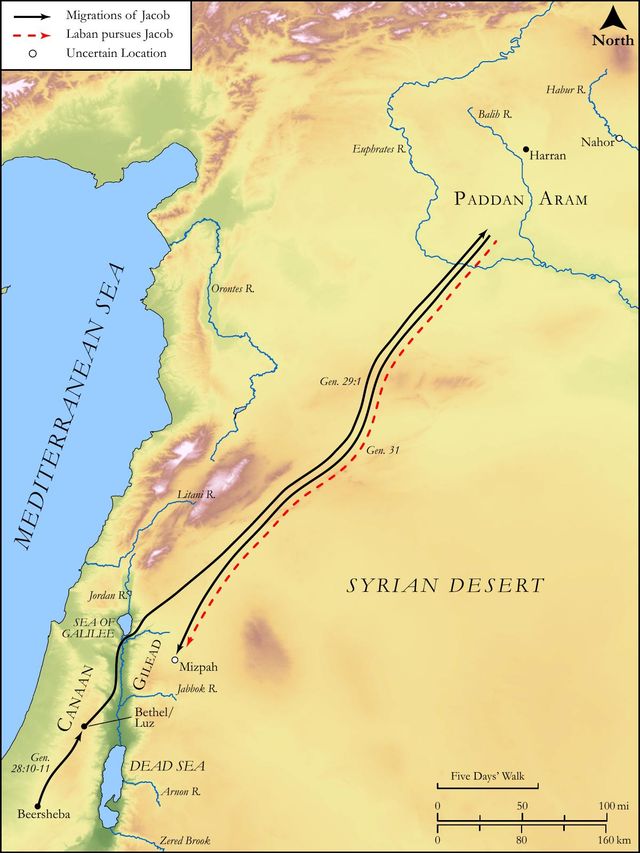
See on the biblical-era maps


Study this verse
Public-domain commentary
Matthew Henry
From his Commentary on the Whole Bible. Henry comments on passages, not single verses — this entry covers Genesis 30:25–36. His three-level outline is real structure in the source text, so it is rendered as structure.
We have here,
I.Jacob's thoughts of home.
He faithfully served his time out with Laban, even his second apprenticeship, though he was an old man, had a large family to provide for, and it was high time for him to set up for himself. Though Laban's service was hard, and he had cheated him in the first bargain he had made, yet Jacob honestly performs his engagements. Note, A good man, though he swear to his own hurt, will not change. And though others have deceived us this will not justify us in deceiving them. Our rule is to do as we would be done by, not as we are done by. Jacob's term having expired, he begs leave to be gone, Gen 30:25. Observe,
1.He retained his affection for the land of Canaan, not only because it was the land of his nativity, and his father and mother were there, whom he longed to see, but because it was the land of promise; and, in token of his dependence upon the promise of it, though he sojourn in Haran he can by no means think of settling there. Thus should we be affected towards our heavenly country, looking upon ourselves as strangers here, viewing the heavenly country as our home, and longing to be there, as soon as the days of our service upon earth are numbered and finished. We must not think of taking root here, for this is not our place and country, Heb 13:14.
2.He was desirous to go to Canaan, though he had a great family to take with him, and no provision yet made for them. He had got wives and children with Laban, but nothing else; yet he does not solicit Laban to give him either a portion with his wives or the maintenance of some of his children. No, all his request is, Give me my wives and my children, and send me away, Gen 30:25, Gen 30:26. Note, Those that trust in God, in his providence and promise, though they have great families and small incomes, can cheerfully hope that he who sends mouths will send meat. He who feeds the brood of the ravens will not starve the seed of the righteous.
II.Laban's desire of his stay, Gen 30:27.
In love to himself, not to Jacob or to his wives or children, Laban endeavours to persuade him to continue his chief shepherd, entreating him, by the regard he bore him, not to leave him: If I have found favour in thy eyes, tarry. Note, Churlish selfish men know how to give good words when it is to serve their own ends. Laban found that his stock had wonderfully increased with Jacob's good management, and he owns it, with very good expressions of respect both to God and Jacob: I have learned by experience that the Lord has blessed me for thy sake. Observe,
1.Laban's learning: I have learned by experience. Note, There is many a profitable good lesson to be learned by experience. We are very unapt scholars if we have not learned by experience the evil of sin, the treachery of our own hearts, the vanity of the world, the goodness of God, the gains of godliness, and the like.
2.Laban's lesson. He owns, (1.) That his prosperity was owing to God's blessing: The Lord has blessed me. Note, worldly men, who choose their portion in this life, are often blessed with an abundance of this world's goods. Common blessings are given plentifully to many that have no title to covenant-blessings. (3.) That Jacob's piety had brought that blessing upon him: The Lord has blessed me, not for my own sake (let not such a man as Laban, that lives without God in the world, think that he shall receive any thing of the Lord, Jam 1:7), but for thy sake. Note, [1.] Good men are blessings to the places where they live, even where they live meanly and obscurely, as Jacob in the field, and Joseph in the prison, Gen 39:23. [2.] God often blesses bad men with outward mercies for the sake of their godly relations, though it is seldom that they have either the wit to see it or the grace to own it, as Laban did here.
III.The new bargain they came upon.
Laban's craft and covetousness took advantage of Jacob's plainness, honesty, and good-nature; and, perceiving that Jacob began to be won upon by his fair speeches, instead of making him a generous offer and bidding high, as he ought to have done, all things considered, he puts it upon him to make his demands (Gen 30:28): Appoint me thy wages, knowing he would be very modest in them, and would ask less than he could for shame offer. Jacob accordingly makes a proposal to him, in which,
1.He shows what reason he had to insist upon so much, considering,
(1.)That Laban was bound in gratitude to do well for him, because he had served him not only faithfully, but very successfully, Gen 30:30. Yet here observe how he speaks, like himself, very modestly. Laban had said, The Lord has blessed me for thy sake; Jacob will not say so, but, The Lord has blessed thee since my coming. Note, Humble saints take more pleasure in doing good than in hearing of it again.
(2.)That he himself was bound in duty to take care of his own family: Now, when shall I provide for my own house also? Note, Faith and charity, though they are excellent things, must not take us off from making necessary provisions for our own support, and the support of our families. We must, like Jacob, trust in the Lord and do good, and yet we must, like him, provide for our own houses also; he that does not the latter is worse than an infidel, Ti1 5:8.
2.He is willing to refer himself to the providence of God, which, he knew, extends itself to the smallest things, even the colour of the cattle; and he will be content to have for his wages the sheep and goats of such and such a colour, speckled, spotted, and brown, which should hereafter be brought forth, Gen 30:32, Gen 30:33. This, he thinks, will be a most effectual way both to prevent Laban's cheating him and to secure himself from being suspected of cheating Laban. Some think he chose this colour because in Canaan it was generally most desired and delighted in; their shepherds in Canaan are called Nekohim (Amo 1:1), the word here used for speckled; and Laban was willing to consent to this bargain because he thought if the few he has that were now speckled and spotted were separated from the rest, which by agreement was to be done immediately, the body of the flock which Jacob was to tend, being of one colour, either all black or all white, would produce few or none of mixed colours, and so he should have Jacob's service for nothing, or next to nothing. According to this bargain, those few that were party-coloured were separated, and put into the hands of Laban's sons, and sent three days' journey off; so great was Laban's jealously lest any of them should mix with the rest of the flock, to the advantage of Jacob. And now a fine bargain Jacob has made for himself! Is this his providing for his own house, to put it upon such an uncertainty? If these cattle bring forth, as usually cattle do, young ones of the same colour with themselves, he must still serve for nothing, and be a drudge and a beggar all the days of his life; but he knows whom he has trusted, and the event showed,
(1.)That he took the best way that could be taken with Laban, who otherwise would certainly have been too hard for him. And,
(2.)That it was not in vain to rely upon the divine providence, which owns and blesses honest humble diligence. Those that find men whom they deal with unjust and unkind shall not find God so, but, some way or other, he will recompense the injured, and be a good pay-master to those that commit their cause to him.
Continue studying Genesis 30:29 across the web’s major study libraries — every link below opens this exact verse, chapter, or book on the destination site.
Read & Compare
 BibleGatewayThis verse in more than 200 translations and 70 languages.
 Bible.comThe YouVersion reader — hundreds of translations, reading plans, and highlights.
 ESV.orgCrossway's official English Standard Version reader.
 NET BibleThe NET translation with 60,000+ translators' notes on every rendering decision.
 STEP BibleTyndale House's free study tool — original text, vocabulary, and scholarly resources.
 BibliaLogos Bible Software's free web reader.
 USCCBThe New American Bible (Revised Edition) with the U.S. bishops' study notes.
Commentaries
 BibleHub CommentariesDozens of classic commentaries on this verse, gathered on one page.
 StudyLightMore than 100 commentary sets — the largest collection on the web.
 BibleRefPlain-English commentary on what this verse means, verse by verse.
 Enduring WordDavid Guzik's free commentary on this chapter, widely used by Bible teachers.
 Bible Study ToolsVerse commentary alongside Greek and Hebrew study aids.
Original Language & Research
- BibleHub InterlinearThe verse word by word — original language, transliteration, and English.
- BibleHub LexiconEvery word's original-language definition and Strong's entry.
 Blue Letter BibleDeep-study tools — Strong's numbers, concordance, and word studies.
 SefariaThe Hebrew text with Rashi and centuries of Jewish commentary.
Sermons, Hymns & Audio


TrulyRandomVerse is not affiliated with these sites and doesn’t control their content. They’re linked because they’re genuinely useful.
Summary
Genesis 30:29 captures Jacob's forceful declaration to Laban, asserting his unwavering diligence and the undeniable prosperity he brought to Laban's household through his faithful service. This statement serves as a strategic and foundational prelude to Jacob's demand for fair compensation, highlighting his integrity and the tangible results of his labor over years of often exploited work, setting the stage for a critical negotiation in their strained relationship.
Context
ShowHideLiterary Context
This verse immediately follows Jacob's completion of his fourteen years of service for Laban, during which he married Leah and Rachel, fulfilling the deceptive terms imposed by Laban. Having endured Laban's repeated trickery and fulfilled his contractual obligations, Jacob now seeks to establish his own independent household and secure wealth for his growing family. Laban, keenly aware that divine blessing has accompanied Jacob's presence, resulting in the significant increase of his own flocks (as acknowledged in Genesis 30:27), is reluctant to release such a valuable asset. Jacob's statement in this verse serves as a powerful and direct preamble to his subsequent proposal for a new wage agreement, appealing directly to Laban's personal knowledge of his diligent work and the undeniable growth of Laban's livestock under his care, a period that followed the initial seven years Jacob served for Rachel.
Historical & Cultural Context
Among the shepherds of the patriarchal age, livestock represented the primary form of wealth and economic security for nomadic and semi-nomadic peoples. The management of flocks was a labor-intensive and highly skilled occupation, requiring constant vigilance against predators, disease, and theft, as well as knowledge of breeding and pasturing. Master-servant relationships, often familial or quasi-familial, were common, with terms of service frequently involving marriage and the accumulation of property. Jacob's role as a shepherd was central to Laban's prosperity, a fact recognized by both men. The cultural expectation was that diligent and effective service would eventually lead to fair compensation or the opportunity for the servant to establish their own wealth, a principle Jacob now invokes.
Key Themes
ShowHideThis verse contributes to several overarching themes within Genesis and the broader biblical narrative. It highlights the theme of Divine Providence, as God's blessing is evident in the prosperity of Laban's flocks because Jacob is present, despite Laban's manipulative nature. It underscores the theme of Justice and Fair Compensation, as Jacob implicitly demands equitable reward for his faithful labor, a principle foundational to righteous dealings. Furthermore, it exemplifies Diligent Stewardship, showcasing Jacob's commitment to his work even under duress, and setting a precedent for how God often blesses through the hands of His faithful servants, as seen later with Joseph's management in Egypt. The ongoing Covenant Fidelity of God to Jacob is also subtly present, as God is working to prosper Jacob even through challenging circumstances, ensuring the fulfillment of His promises to Abraham's descendants.
Exposition and Analysis
ShowHideKey Word Analysis
ShowHideThis primitive root means "to know," often implying an ascertainment by seeing, or a deep, experiential understanding. Jacob's use of "thou knowest" is a powerful rhetorical device, appealing to Laban's personal, undeniable observation of Jacob's service and the resulting prosperity of his flocks. It suggests that Laban cannot truthfully deny the facts, as he has witnessed them firsthand.
This primitive root signifies "to work" in any sense, and by implication, "to serve," "till," or even "enslave." Jacob's choice of this word emphasizes not merely contractual obligation but a deep, active commitment to labor. It highlights the physical and mental exertion, the diligent effort, and the practical application of skill he invested over fourteen years, demonstrating a comprehensive and dedicated form of service.
This term refers to "something bought," specifically "livestock" or "property" in the form of animals. The phrase "how thy cattle was with me" directly underscores Jacob's effective management and the resulting increase in Laban's material wealth. It is a direct claim of responsibility for the significant, measurable growth and well-being of Laban's flocks, implying that their flourishing state was directly attributable to Jacob's diligent care and oversight.
Verse Breakdown
ShowHide"And he said unto him, Thou knowest"
This opening phrase sets a confrontational yet factual tone. Jacob is not asking a question but making a declarative statement, appealing to Laban's inherent knowledge and conscience. It implies that the truth of Jacob's service is so evident that Laban himself cannot deny it, serving as a powerful rhetorical foundation for Jacob's subsequent demands.
"how I have served thee"
This clause emphasizes the manner and quality of Jacob's labor. It points to the diligence, faithfulness, and perhaps the extraordinary effort Jacob put into his work for Laban, going beyond mere obligation. It highlights Jacob's personal investment and dedication, despite the often unfair and exploitative conditions.
"and how thy cattle was with me"
This second clause provides the tangible evidence of Jacob's effective service. The prosperity and increase of Laban's livestock are directly attributed to Jacob's stewardship. It implies that under Jacob's care, the flocks thrived, multiplied, and were well-maintained, demonstrating his skill and the blessing that accompanied his presence. This serves as irrefutable proof of his value to Laban.
Literary Devices
ShowHideJacob's statement employs several key literary devices. Primarily, it uses Assertion, presenting a truth as undeniable fact rather than a debatable point. The phrase "Thou knowest" functions as a powerful Rhetorical Appeal, directly engaging Laban's personal experience and knowledge, making it difficult for him to feign ignorance or deny the reality of Jacob's contributions. There's also an element of Understatement or Irony in Jacob's calm declaration, given the years of Laban's deceit and exploitation; Jacob's simple statement of fact subtly highlights Laban's moral failing by contrasting it with Jacob's undeniable integrity and the tangible results of his labor. This strategic use of language lays the essential groundwork for Jacob's demand for fair wages, positioning him not as a supplicant but as a valuable asset deserving of equitable compensation.
Theological and Thematic Connections
ShowHideJacob's declaration in Genesis 30:29 resonates with profound theological and thematic truths, illustrating how divine blessing often flows through human diligence, even in the face of adversity. While Jacob emphasizes his own efforts, the broader narrative consistently reveals God's providential hand at work, ensuring the prosperity of His covenant people. Jacob's faithful labor, despite Laban's deceptions, became a channel for God's blessing, demonstrating that God can use even exploitative circumstances to fulfill His purposes and bless those who are faithful. This passage implicitly champions the principle of just compensation for labor, a foundational ethical teaching in the Bible, affirming that diligent work deserves equitable reward.
Reflection and Application
ShowHideGenesis 30:29 offers profound insights for contemporary life, emphasizing the enduring value of diligence and integrity in all our endeavors. Jacob's example reminds us that faithful and diligent work, even when serving others or facing unfair treatment, does not go unnoticed, whether by human employers or by God. Our work ethic and the quality of our stewardship are powerful testimonies, reflecting our character and, by extension, the God we serve. This passage encourages believers to approach their work with excellence and faithfulness, knowing that our labor, when done unto the Lord, has eternal significance. Furthermore, this passage implicitly champions the principle of fair compensation for labor, urging us to pursue justice and equity in all our dealings, both as employers and employees, trusting that God sees and rewards faithfulness, and that His providence can turn even adverse situations into opportunities for blessing and growth.
Questions for Reflection
ShowHideFAQ
ShowHideWas Jacob's service to Laban purely contractual, or was there a deeper commitment?
ShowHideWhile Jacob's initial service for Rachel was indeed a contractual agreement, his statement in Genesis 30:29 strongly suggests a commitment that extended beyond mere obligation. The emphasis on "how I have served thee" and the undeniable prosperity of Laban's flocks under his care indicates a diligent, hands-on, and highly effective stewardship that demonstrated a deep dedication to the task. Jacob's later recounting of his service in Genesis 31:38-40 further details the extreme conditions and personal sacrifices he endured, such as guarding the flocks by day and night and bearing the loss of animals, which points to a commitment far exceeding a simple contractual duty. This level of dedication, even in the face of Laban's repeated deceit, speaks volumes about Jacob's character and his desire to fulfill his duties faithfully, despite the challenging circumstances.
Christ-Centered Fulfillment
ShowHideJacob's faithful service and ultimate prosperity, despite being unjustly treated and exploited by Laban, powerfully foreshadows the perfect and ultimate service of Jesus Christ. Unlike Jacob, whose service, though diligent, was imperfect and driven in part by personal gain and the desire for his own household, Christ offered Himself as the perfectly obedient Servant, fulfilling all righteousness and enduring immense injustice for the sake of His people. The Gospels consistently portray Jesus as the one who "came not to be served but to serve, and to give his life as a ransom for many" (Mark 10:45). While Jacob sought earthly compensation for his labor in the form of flocks, Christ's service was a selfless sacrifice, leading not to personal material gain, but to the redemption of humanity and the establishment of His eternal kingdom. His ultimate reward is not a portion of flocks, but the glory of the Father and the salvation of all who believe (Philippians 2:5-11), demonstrating that true fulfillment and ultimate blessing come through perfect, self-giving service unto God, culminating in His triumph over sin and death (Hebrews 5:8-9).