


Genesis 31:40
Bible text: King James Version (1769 Blayney text) · Public domain
Bible text: Berean Standard Bible · Public domain
Bible text: American Standard Version (1901) · Public domain
Bible text: World English Bible, Messianic edition · Public domain
Bible text: Geneva Bible (1599) · Public domain
Bible text: Young's Literal Translation · Public domain
- הָיִיתִיha·Yi·tiI wasH1961V-Qal-Perf-1csVerb Qal Perfect 1st Singular common gender
- בַיּוֹםvai·Yomin the dayH3117Prep-b ¦ N-msNoun Singular Masculine Absoluteבַin theיּוֹםday
- אֲכָלַנִי'a·kha·La·niit consumed meH398V-Qal-Perf-3ms ¦ 1csVerb Qal Perfect 3rd Singular Masculineאֲכָלַit consumedנִיme
- חֹרֶבCho·revheatH2721N-msNoun Singular Masculine Absolute
- וְקֶרַחve·Ke·rachand frostH7140Conj-w ¦ N-msNoun Singular Masculine Absoluteוְandקֶרַחfrost
- בַּלָּיְלָהba·La·ye·lahin the nightH3915Prep-b ¦ N-msNoun Singular Masculine Absoluteבַּin theלָּיְלָהnight
- וַתִּדַּדva·ti·Dadand it fledH5074Conj-w ¦ V-Qal-ConsecImperf-3fsVerb Qal Consecutive Imperfect 3rd Singular Feminineוַandתִּדַּדit fled
- שְׁנָתִיshe·na·Timy sleepH8142N-fsc ¦ 1csNoun Singular Feminine Constructשְׁנָתִsleepיmy
- מֵעֵינָיMe·'ei·Naifrom my eyesH5869Prep-m ¦ N-fdc ¦ 1csNoun Dual Feminine Constructמֵfromעֵינָeyesיmy
English is a literal word-by-word gloss of the Hebrew, not the KJV's wording. Why?
This is the original text the KJV's translators worked from — each Hebrew word with its own literal English meaning in this verse, prepared by scholars at Tyndale House, Cambridge. The KJV translates whole sentences, not word by word, so its wording differs: one Hebrew word can become several English words, and the KJV may choose “the LORD” where the gloss reads “Yahweh”. Both are faithful — they answer different questions. For the KJV's own rendering, switch to the KJV text.
Details
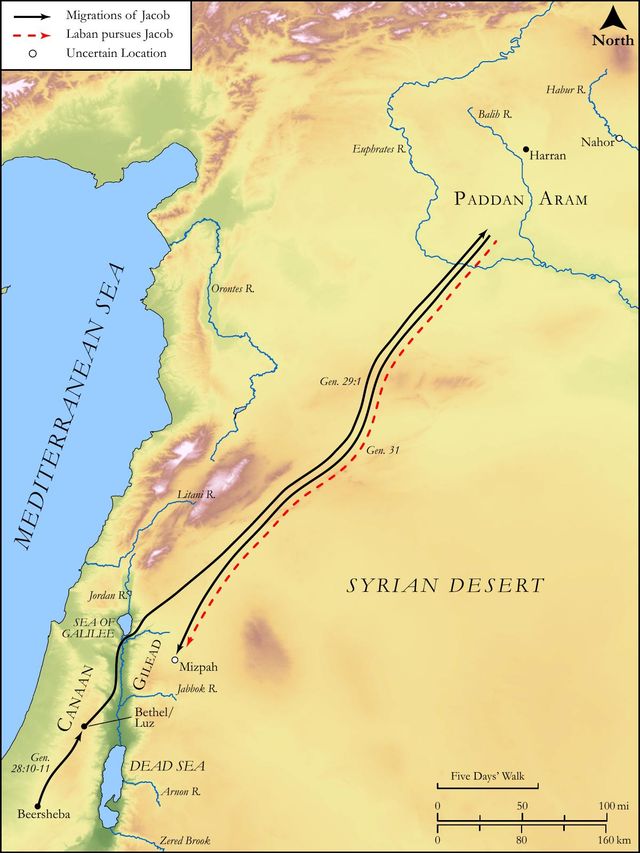
See on the biblical-era maps


Study this verse
Public-domain commentary
Matthew Henry
From his Commentary on the Whole Bible. Henry comments on passages, not single verses — this entry covers Genesis 31:36–42. His two-level outline is real structure in the source text, so it is rendered as structure.
See in these verses,
I.The power of provocation.
Jacob's natural temper was mild and calm, and grace had improved it; he was a smooth man, and a plain man; and yet Laban's unreasonable carriage towards him put him into a heat that transported him into a heat that transported him into some vehemence, Gen 31:36, Gen 31:37. His chiding with Laban, though it may admit of some excuse, was not justifiable, nor is it written for our imitation. Grievous words stir up anger, and commonly do but make bad worse. It is a very great affront to one that bears an honest mind to be charged with dishonesty, and yet even this we must learn to bear with patience, committing our cause to God.
II.The comfort of a good conscience.
This was Jacob's rejoicing, that when Laban accused him his own conscience acquitted him, and witnessed for him that he had been in all things willing and careful to live honestly, Heb 13:18. Note, Those that in any employment have dealt faithfully, if they cannot obtain the credit of it with men, yet shall have the comfort of it in their own bosoms.
III.The character of a good servant, and particularly of a faithful shepherd. Jacob had approved himself such a one, Gen 31:38-40.
1.He was very careful, so that, through his oversight or neglect, the ewes did not cast their young. His piety also procured a blessing upon his master's effects that were under his hands. Note, Servants should take no less care of what they are entrusted with for their masters than if they were entitled to it as their own.
2.He was very honest, and took none of that for his own eating which was not allowed him. He contented himself with mean fare, and coveted not to feast upon the rams of the flock. Note, Servants must not be dainty in their food, nor covet what is forbidden them, but in that, and other instances, show all good fidelity.
3.He was very laborious, Gen 31:40. He stuck to his business, all weathers; and bore both heat and cold with invincible patience. Note, Men of business, that intend to make something of it, must resolve to endure hardness. Jacob is here an example to ministers; they also are shepherds, of whom it is required that hey be true to their trust and willing to take pains.
IV.The character of a hard master. Laban had been such a one to Jacob. Those are bad masters,
1.Who exact from their servants that which is unjust, by obliging them to make good that which is not damaged by any default of theirs. This Laban did, Gen 31:39. Nay, if there has been a neglect, yet it is unjust to punish above the proportion of the fault. That may be an inconsiderable damage to the master which would go near to ruin a poor servant.
2.Those also are bad masters who deny to their servants that which is just and equal. This Laban did, Gen 31:41. It was unreasonable for him to make Jacob serve fro his daughters, when he had in reversion so great an estate secured to him by the promise of God himself; as it was also to give him his daughters without portions, when it was in the power of his hands to do well for them. Thus he robbed the poor because he was poor, as he did also by changing his wages.
V.The care of providence for the protection of injured innocence, Gen 31:42.
God took cognizance of the wrong done to Jacob, and repaid him whom Laban would otherwise have sent empty away, and rebuked Laban, who otherwise would have swallowed him up. Note, God is the patron of the oppressed; and those who are wronged and yet not ruined, cast down and yet not destroyed, must acknowledge him in their preservation and give him the glory of it. Observe,
1.Jacob speaks of god as the God of his father, intimating that he thought himself unworthy to be thus regarded, but was beloved for the father's sake.
2.He calls him the God of Abraham, and the fear of Isaac; for Abraham was dead, and had gone to that world where perfect love casts out fear; but Isaac was yet alive, sanctifying the Lord in his heart, as his fear and his dread
Continue studying Genesis 31:40 across the web’s major study libraries — every link below opens this exact verse, chapter, or book on the destination site.
Read & Compare
 BibleGatewayThis verse in more than 200 translations and 70 languages.
 Bible.comThe YouVersion reader — hundreds of translations, reading plans, and highlights.
 ESV.orgCrossway's official English Standard Version reader.
 NET BibleThe NET translation with 60,000+ translators' notes on every rendering decision.
 STEP BibleTyndale House's free study tool — original text, vocabulary, and scholarly resources.
 BibliaLogos Bible Software's free web reader.
 USCCBThe New American Bible (Revised Edition) with the U.S. bishops' study notes.
Commentaries
 BibleHub CommentariesDozens of classic commentaries on this verse, gathered on one page.
 StudyLightMore than 100 commentary sets — the largest collection on the web.
 BibleRefPlain-English commentary on what this verse means, verse by verse.
 Enduring WordDavid Guzik's free commentary on this chapter, widely used by Bible teachers.
 Bible Study ToolsVerse commentary alongside Greek and Hebrew study aids.
Original Language & Research
- BibleHub InterlinearThe verse word by word — original language, transliteration, and English.
- BibleHub LexiconEvery word's original-language definition and Strong's entry.
 Blue Letter BibleDeep-study tools — Strong's numbers, concordance, and word studies.
 SefariaThe Hebrew text with Rashi and centuries of Jewish commentary.
Sermons, Hymns & Audio


TrulyRandomVerse is not affiliated with these sites and doesn’t control their content. They’re linked because they’re genuinely useful.
Summary
Jacob's poignant declaration in Genesis 31:40 vividly portrays the severe physical hardships and relentless toil he endured during his twenty years serving Laban. This verse, part of Jacob's impassioned defense against Laban's deceit and exploitation, details the extreme environmental conditions—scorching drought by day and freezing frost by night—coupled with constant vigilance that deprived him of sleep, underscoring his unwavering dedication and the immense injustice he suffered.
Context
ShowHideLiterary Context
Genesis 31 is a pivotal chapter marking the culmination of Jacob's twenty-year sojourn with Laban and his strategic, divinely-prompted departure. The immediate context of Genesis 31:40 is Jacob's direct confrontation with Laban, following Laban's pursuit and accusation that Jacob had stolen his household gods. Jacob, having been unjustly treated and exploited for two decades, finally unleashes his pent-up frustration and righteous indignation. His words in this verse are part of a detailed account of his faithful service, contrasting his integrity and immense suffering with Laban's repeated deceit and avarice. This powerful monologue, spanning Genesis 31:36-42, serves as Jacob's defense and a testament to his character, ultimately leading to a covenant between the two men before Jacob continues his journey back to Canaan.
Historical & Cultural Context
Shepherding was an arduous and dangerous occupation, especially in lands like Paddan-Aram (Mesopotamia), where Laban resided, and the semi-arid lands Jacob traversed. Shepherds were responsible for the entire well-being of the flock, including finding pasture and water, protecting against predators (wild animals like wolves, bears, and lions, as well as human bandits), assisting with births, and tending to sick animals. The climate in these regions is characterized by extreme diurnal temperature variations—scorching heat during the day and often freezing temperatures at night—as described by Jacob. Furthermore, the cultural practice of working for a father-in-law for a bride-price, often involving years of labor, was common, but Laban's repeated changing of Jacob's wages (Genesis 31:7) highlights a severe breach of customary ethics and hospitality.
Key Themes
ShowHideGenesis 31:40 contributes significantly to several overarching themes within the book of Genesis and the broader biblical narrative. It powerfully illustrates the theme of divine providence and protection, as God sustains Jacob through incredible hardship despite human exploitation, ultimately fulfilling His covenant promises made at Bethel (Genesis 28:15). The verse also underscores the theme of human injustice and exploitation, vividly portraying Laban's avarice and deceit in contrast to Jacob's diligent and faithful labor. Furthermore, it highlights perseverance and faithfulness in the face of adversity, showcasing Jacob's enduring commitment to his responsibilities even when unfairly treated, a quality that God blesses and vindicates.
Exposition and Analysis
ShowHideGenesis 31:40 offers a stark illustration of the physical demands placed upon Jacob as a shepherd under Laban, painting a vivid picture of his relentless dedication and suffering under Laban's exploitative hand.
Key Word Analysis
ShowHideThis term describes intense dryness, desolation, and scorching heat. It conveys not merely a lack of rain but an oppressive, parched environment that consumes and exhausts, directly impacting both the shepherd and the flock by making the search for sustenance and water a constant, desperate struggle.
This word refers to ice or freezing conditions. It highlights the drastic and dangerous diurnal temperature shifts common in arid climates, where intensely hot days give way to nights that can plummet below freezing, posing a significant threat to the health and survival of both the shepherd and the vulnerable livestock.
This term simply means "sleep." Its mention here, in conjunction with "departed" (H5074, meaning to wave to and fro, to flee, or to drive away), underscores a severe and chronic deprivation of rest. This signifies Jacob's constant wakefulness and vigilance, indicating the ceaseless nature of a shepherd's duty in protecting the flock from predators and thieves, and tending to their needs, leaving no time for genuine repose.
Verse Breakdown
ShowHide"Thus I was;"
This opening phrase serves as Jacob's emphatic declaration of his state and experience. It sets the stage for a detailed recounting of his arduous life under Laban, asserting the truth of his suffering and diligence as a direct counterpoint to Laban's false accusations and ungratefulness.
"in the day the drought consumed me,"
This clause vividly describes the oppressive daytime conditions Jacob endured. The "drought" (chôreb) signifies not just a lack of water but an intense, consuming heat that physically drained him, reflecting the severe environmental challenges of shepherding in those lands. The verb "consumed" (ʼâkal, H398) implies a devouring, emphasizing the exhausting and debilitating effect of the relentless heat on his body and spirit.
"and the frost by night;"
This phrase highlights the extreme temperature contrasts characteristic of the region. While days were scorching, nights brought bitter cold and "frost" (qerach), forcing Jacob to endure freezing conditions. This constant exposure to drastic thermal shifts further underscores the physical toll and the relentless nature of his outdoor labor, demanding constant vigilance against the elements.
"and my sleep departed from mine eyes."
This powerful idiom signifies a severe and chronic lack of rest. Jacob's "sleep departed" (nâdad, H5074) from his "eyes" (ʻayin, H5869), indicating a state of perpetual wakefulness. This was due to the ceaseless demands of protecting the flock from predators and thieves, and tending to their needs, illustrating the profound personal sacrifice and the relentless nature of his toil.
Literary Devices
ShowHideJacob's statement in Genesis 31:40 is rich with Imagery, painting a vivid picture of his suffering through sensory details of extreme heat ("drought consumed me") and cold ("frost by night"). The phrase "my sleep departed from mine eyes" is a powerful Idiom for chronic sleeplessness, effectively conveying the relentless nature of his vigilance and toil. The cumulative effect of these descriptions creates a strong sense of Pathos, evoking sympathy for Jacob's plight and highlighting the injustice he endured. Furthermore, the stark contrast between the "day" and "night" conditions serves as a form of Antithesis, emphasizing the continuous, unremitting nature of his hardship.
Theological and Thematic Connections
ShowHideJacob's lament in Genesis 31:40 is more than a personal grievance; it is a profound testament to the divine oversight of human suffering and injustice. It underscores the biblical principle that God sees and remembers the faithful labor of His servants, even when they are exploited or forgotten by human masters. Jacob's endurance, despite the extreme physical and emotional toll, points to a deeper reliance on God's sustaining power, even if unstated in this specific verse. His subsequent affirmation of God's presence and protection in Genesis 31:42 reveals that his perseverance was rooted in faith, demonstrating that God's covenant faithfulness extends to providing strength and vindication in the face of adversity. This narrative serves as a powerful reminder that God is a righteous judge who cares deeply about justice and the well-being of His people, ultimately bringing about their deliverance and blessing.
Reflection and Application
ShowHideJacob's arduous experience in Genesis 31:40 offers profound lessons for believers facing hardship and injustice today. It reminds us that God observes our diligent labor and integrity, even when human employers or circumstances are unfair, assuring us that our efforts are never unseen by Him. Jacob's steadfastness in the face of extreme adversity underscores the value of perseverance; his long years of difficult service ultimately led to his independence and the growth of his family and wealth, all under God's blessing. When confronted with exploitation or injustice, we are called to trust in divine justice, knowing that God is a righteous judge who will ultimately bring about vindication and provide for His own, as Romans 12:19 reminds us: "Vengeance is mine; I will repay, saith the Lord." Furthermore, Jacob's plight fosters empathy for all who labor under difficult conditions or face unfair treatment, reinforcing the dignity of honest work and the biblical call to treat others justly, reflecting God's heart for the oppressed.
Questions for Reflection
ShowHideFAQ
ShowHideHow could Jacob endure such extreme conditions for so long?
ShowHideJacob's remarkable endurance was a testament to his unwavering commitment to his family and, more importantly, to God's sustaining grace and covenant promises. While the physical toll was immense, the biblical narrative emphasizes that God was with him, protecting and prospering him despite Laban's deceit. Jacob himself acknowledged that without "the God of my father, the God of Abraham, and the fear of Isaac," Laban would have sent him away empty (Genesis 31:42). His perseverance was fueled by divine promise and provision, demonstrating that God equips His servants for the tasks and trials He calls them to.
Christ-Centered Fulfillment
ShowHideJacob's suffering and endurance in Genesis 31:40 foreshadow the ultimate Servant who would endure far greater hardship and injustice for the sake of His people: Jesus Christ. Like Jacob, who toiled tirelessly under unjust conditions, Christ "made himself of no reputation, and took upon him the form of a servant" (Philippians 2:7). He experienced the full spectrum of human suffering—rejection, betrayal, and immense physical and spiritual agony (Isaiah 53:3-5). While Jacob's sleepless nights were for earthly flocks, Christ's agony in Gethsemane (Matthew 26:36-46) and His ultimate sacrifice on the cross were to secure the eternal inheritance for His spiritual flock, the Church. Where Jacob's suffering led to his own earthly prosperity and independence, Christ's suffering led to the spiritual prosperity, redemption, and reconciliation of all who believe (2 Corinthians 5:21), demonstrating God's perfect justice and ultimate vindication through the Servant who truly knew no rest until His work of salvation was finished.