


Hosea 12:12
Bible text: King James Version (1769 Blayney text) · Public domain
Bible text: Berean Standard Bible · Public domain
Bible text: American Standard Version (1901) · Public domain
Bible text: World English Bible, Messianic edition · Public domain
Bible text: Geneva Bible (1599) · Public domain
Bible text: Young's Literal Translation · Public domain
- וַיִּבְרַחvai·yiv·Rachand he fledH1272Conj-w ¦ V-Qal-ConsecImperf-3msVerb Qal Consecutive Imperfect 3rd Singular Masculineוַandיִּבְרַחhe fled
- יַעֲקֹבya·'a·KoJacobH3290N-proper-mNoun Proper Masculine
- שְׂדֵהse·Deh[the] region ofH7704N-mscNoun Singular Masculine Construct
- אֲרָם'a·RamAramH758N-properNoun Proper Location
- וַיַּעֲבֹדvai·ya·'a·Vodand he servedH5647Conj-w ¦ V-Qal-ConsecImperf-3msVerb Qal Consecutive Imperfect 3rd Singular Masculineוַandיַּעֲבֹדhe served
- יִשְׂרָאֵלYis·ra·'ElIsraelH3478N-properNoun Proper Location
- בְּאִשָּׁהbe·'i·Shahfor a wifeH802Prep-b ¦ N-fsNoun Singular Feminine Absoluteבְּforאִשָּׁהa wife
- וּבְאִשָּׁהu·ve·'i·Shahand for a wifeH802Conj-w ¦ Prep-b ¦ N-fsNoun Singular Feminine Absoluteוּandבְforאִשָּׁהa wife
- שָׁמָרsha·Marhe kept [flocks]H8104V-Qal-Perf-3msVerb Qal Perfect 3rd Singular Masculine
English is a literal word-by-word gloss of the Hebrew, not the KJV's wording. Why?
This is the original text the KJV's translators worked from — each Hebrew word with its own literal English meaning in this verse, prepared by scholars at Tyndale House, Cambridge. The KJV translates whole sentences, not word by word, so its wording differs: one Hebrew word can become several English words, and the KJV may choose “the LORD” where the gloss reads “Yahweh”. Both are faithful — they answer different questions. For the KJV's own rendering, switch to the KJV text.
Details
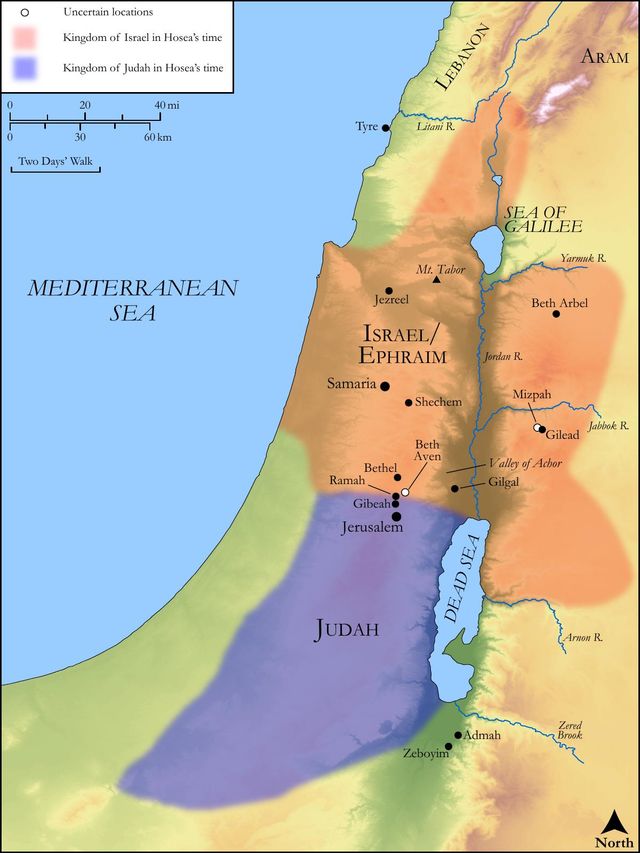
See on the biblical-era map
Study this verse
Public-domain commentary
Matthew Henry
From his Commentary on the Whole Bible. Henry comments on passages, not single verses — this entry covers Hosea 12:7–14. His four-level outline is real structure in the source text, so it is rendered as structure.
Here are intermixed, in these verses,
I.Reproofs for sin.
When God is coming forth to contend with a people, that he may demonstrate his own righteousness, he will demonstrate their unrighteousness. Ephraim was called to turn to his God and keep judgment (Hos 12:6); now, to show that he had need of that call, he is charged with turning from his God by idolatry, and breaking the laws of justice and judgment.
1.He is here charged with injustice against the precepts of the second table, Hos 12:7, Hos 12:8. Here observe,
(1.)What the sin is wherewith he is charged: He is a merchant. The margin reads it as a proper name, He is Canaan, or a Canaanite, unworthy to be denominated from Jacob and Israel, and worthy to be cast out with a curse from this good land, as the Canaanites were. See Amo 9:7. But Canaan sometimes signifies a merchant, and therefore is most likely to do so here, where Ephraim is charged with deceit in trade. Though God had given his people a land flowing with milk and honey, yet he did not forbid them to enrich themselves by merchandise, and they succeeded the Canaanites in that as well as in their husbandry; they sucked the abundance of the seas and the treasures hidden in the sand, Deu 33:19. And, if they had been fair merchants, it would have been no reproach at all to them, but an honour and a blessing. But he is such a merchant as the Canaanites were, who were honest only with good looking to, and, if they could, cheated all they dealt with. Ephraim does so; he deceives and thereby oppresses. Note, There is oppression by fraud as well as oppression by force. It is not only princes, lords, and masters, that oppress their subjects, tenants, and servants, but merchants and traders are often guilty of oppressing those they deal with, when they impose upon their ignorance, or take advantage of their necessity, to make hard bargains with them, or are rigorous and severe in exacting their debts. Ephraim cheated,
[1.]With a great deal of art and cunning: The balances of deceit are in his hand. He uses balances, and delivers his goods by weight and measure, as if he would be very exact, but they are balances of deceit, false weights and false measures, and thus, under colour of doing right, he does the greatest wrong. Note, God has his eye upon merchants and traders, when they are weighing their goods and paying their money, whether they do honestly or deceitfully. He observes what balances they have in their hand, and how they hold them; and, though those they deal with may not be aware of that sleight of hand with which they make them balances of deceit, God sees it, and knows it. Trades by the wit of man are made mysteries, but it is a pity that by the sin of man they should ever be made mysteries of iniquity.
[2.]With a great deal of pleasure and pride: He loves to oppress. To oppress is bad enough, but to love to do so is much worse. His conscience does not check and reprove him for it, as it ought to do; if it did, though he committed the sin, he could not delight in it; but his corruptions are so strong, and have so triumphed over his convictions, that he not only loves the gain of oppression, but he loves to oppress, sins for sinning-sake, and takes a pleasure in out-witting and over-reaching those that suspect him not.
(2.)How he justifies himself in this sin, Hos 12:8. Wicked men will have something to say for themselves now when they are told of their faults, some frivolous turn-off or other wherewith to evade the convictions of the word. Ephraim stands indicted for a common cheat. Now see what he pleads to the indictment. He does not deny the charge, nor plead, Not guilty, yet does not make a penitent confession of it and ask pardon, but insists upon his own justification. Suppose it were so that he did use balances of deceit, yet,
[1.]He pleads that he had got a good estate. Let the prophet say what he pleased of his deceit, of the sin of it and the curse of God that attended it, he could not be convinced there was any harm or danger in it, for this he was sure of that he had thriven in it: "Yet I have become rich, I have found me out substance. Whatever you make of it, I have made a good hand of it." Note, Carnal hearts are often confirmed in a good opinion of their evil ways by their worldly prosperity and success in those ways. But it is a great mistake. Every word in what Ephraim says here proclaims his folly. First, It is folly to call the riches of this world substance, for they are things that are not, Pro 23:5. Secondly, It is folly to think that we have them of ourselves, to say (as some read it), I have made myself rich; what substance I have is owing purely to my ingenuity and industry - I have found it; my might and the power of my hand have gotten me this wealth. Thirdly, It is folly to think that what we have is for ourselves. I have found me out substance, as if we had it for our own proper use and behoof, whereas we hold it in trust, only as stewards. Fourthly, It is folly to think that riches are things to be gloried in, and to say with exultation, I have become rich. Riches are not the honours of the soul, are not peculiar to the best men, nor sure to us; and therefore let not the rich man glory in his riches, Jam 1:9, Jam 1:10. Fifthly, It is folly to think that growing rich in a sinful way makes us innocent, or will make us safe, or may make us easy, in that way; for the prosperity of fools deceives and destroys them. See Isa 47:10; Pro 1:32.
[2.]He pleads that he had kept a good reputation. It is common for sinners, when they are justly reproved by their ministers, to appeal to their neighbours, and because they know no ill of them, or will say none, or think well of what the prophets charge them with as bad, fly in the face of their reprovers: In all my labours (says Ephraim) they shall find no iniquity in me that were sin. Note, Carnal hearts are apt to build a good opinion of themselves upon the fair character they have among their neighbours. Ephraim was very secure; for, First, All his neighbours knew him to be diligent in his business; they had an eye upon all his labours, and commended him for them. Men will praise thee when thou doest well for thyself. Secondly, None of them knew him to be deceitful in his business. He acted with so much policy that nobody could say to the contrary but that he acted with integrity. For either, 1. He concealed the fraud, so that none discovered it: "Whatever iniquity there is, they shall find none;" as if no iniquity were displeasing to God, and damning to the soul, but that which is open and scandalous before men. What will it avail us that men shall find no iniquity in us, when God finds a great deal, and will bring every secret work, even secret frauds, into judgment? Or, 2. He excused the fraud, so that none condemned it: "They shall find no iniquity in me that were sin, nothing very bad, nothing but what is very excusable, only some venial sins, sins not worth speaking of," which they think God will make nothing of because they do not. It is a fashionable iniquity; it is customary; it is what every body does; it is pleasant; it is gainful; and this, they think, is no iniquity that is sin; nobody will think the worse of them for it. But God sees not as man sees; he judges not as man judges.
2.He is here charged with idolatry, against the precepts of the first table, with that iniquity which is in a special manner vanity, the making and worshipping of images, which are vanities (Hos 12:11): Surely they are vanity; they do not profit, but deceive. Now the prophet mentions two places notorious for idolatry: - (1.) Gilead on the other side Jordan, which had been branded for it before (Hos 6:8): Is there iniquity in Gilead? It is a thing to be wondered at; it is a thing to be sadly lamented. What! iniquity in Gilead? idolatry there? Gilead was a fruitful pleasant country (pleasant to a proverb, Jer 22:6), and does it so ill requite the Lord? It was a frontier-country, and lay much exposed to the insults of enemies, and therefore stood in special need of the divine protection; what! and yet by iniquity throw itself out of that protection? Is there iniquity in Gilead? Yea, (2.) And in Gilgal too; there they sacrifice bullocks (Hos 9:15), and there their altars which they have set up, either to strange gods in opposition to his own appointed altar, are as thick as heaps of manure in the furrows of the field that is to be sown, Hos 8:11. Is there iniquity in Gilead only? so some. Is it only in those remote parts of the nation that people are so superstitious, where they border upon other nations? No; they are as bad at Gilgal. In Gilead God protected Jacob their father (of whom he had been speaking) from the rage of Laban; and will you there commit iniquity?
II.Here are threatenings of wrath for sin.
Some make that to be so (Hos 12:9), I will make thee to dwell in tabernacles as in the days of the appointed time, that is, I will bring thee into such a condition as the Israelites were in when they dwelt in tents and wandered for forty years; that was the time appointed in the wilderness. Ephraim forgot that God brought him out of Egypt and brought him up to be what he was, and was proud of his wealth, and took sinful courses to increase it; and therefore God threatens to bring him to a tabernacle-state again, to a poor, mean, desolate, unsettled condition. Note, It is just with God, when men have by their sins turned their tents into houses, by his judgments to turn their houses into tents again. However, that is certainly a threatening (Hos 12:14), Ephraim provoked him to anger most bitterly. See how men are deceived in their opinion of themselves, and how they will one day be undeceived. Ephraim thought that there was no iniquity in him that deserved to be called sin (Hos 12:8); but God told him that there was that in him which was sin, and would be found so if he did not repent and reform; for,
1.It was extremely offensive to his God: Ephraim provoked him to anger most bitterly with his iniquities, which were so distasteful to God, and to him too would be bitterness in the latter end. He was so wilful in sinning against his knowledge and convictions that any one might see, and say, that he designed no other than to provoke God in the highest degree.
2.It would certainly be destructive to himself; that cannot be otherwise which provokes God against him, and kindles the fire of his wrath. Therefore,
(1.)He shall take away his forfeited life: He shall leave his blood upon him, that is, he shall not hold him guiltless, but bring upon him that death which is the wages of sin. His blood shall be upon his own head (Sa2 1:16), for his own iniquity has testified against him and he alone shall bear it. Note, When sinners perish their blood is left upon them.
(2.)He shall take away his forfeited honour: His reproach shall his Lord return upon him. God is his Lord; he had by idolatry and other sins reproached the Lord, and done dishonour to him, and to his name and family, and had given occasion to others to reproach him; and now God will return the reproach upon him, according to the word he has spoken, that those who despise him shall be lightly esteemed. Note, Shameful sins shall have shameful punishments. If Ephraim put contempt on his God, he shall be so reduced that all his neighbours shall look with contempt upon him.
III.Here are memorials of former mercy, which come in to convict them of base ingratitude in revolting from God. Let them blush to remember,
1.That God had raised them from meanness. When Ephraim had become rich, and was proud of that, he forgot that which God (that he might not forget it) obliged them every year to acknowledge (Deu 26:5), A Syrian ready to perish was my father. But God here puts them in mind of it, Hos 12:12. Let them remember, not only the honours of their father Jacob, what a mighty prince he was with God, Hos 12:3 (an honour which they had no share in while they were in rebellion against God), but what a poor servant he was to Laban, which was sufficient to mortify those that were puffed up with the estates they had raised. Jacob fled into Syria from a malicious brother, and there served a covetous uncle for a wife, and for a wife he kept sheep, because he had not estate to endow a wife with. Jacob was poor, and low, and a fugitive; therefore his posterity ought not to be proud. He was a plain man, dwelling in tents, and keeping sheep; therefore balances of deceit ill became them. He served for a wife that was not a Canaanitess, as Esau's wives were; therefore it was a shame for them to degenerate into Canaanites, and mingle with the nations. God wonderfully preserved him in his flight and preserved him in his service, so that he multiplied exceedingly, and from that root in a dry ground sprang an illustrious nation, that bore his name, which magnifies the goodness of God both to him and them and leaves them under the stain of base ingratitude to that God who was their founder and benefactor.
2.That God had rescued them from misery, had raised them to what they were, not only out of poverty, but out of slavery (Hos 12:13), which laid them under much stronger obligations to serve him and under a yet deeper guilt in serving other gods.
(1.)God brought Israel out of Egypt on purpose that they might serve him, and by redeeming them out of bondage acquired a special title to them and to their service.
(2.)He preserved them, as sheep are kept by the shepherd's care. He preserved them from Pharaoh's rage at the sea, even at the Red Sea, protected them from all the perils of the wilderness, and provided for them.
(3.)He did this by a prophet, Moses, who, though he is called king in Jeshurun (Deu 33:5), yet did what he did for Israel as a prophet, by direction from God and by the power of his word. The ensign of his authority was not a royal sceptre, but the rod of God; with that he summoned both Egypt's plagues and Israel's blessings. Moses, as a prophet, was a type of Christ (Act 3:22), and it is by Christ as a prophet that we are brought out of the Egypt of sin and Satan by the power of his truth. Now this shows how very unworthy and ungrateful this people were,
[1.]In rejecting their God, who had brought them out of Egypt, which, in the preface to the commandments, is particularly mentioned as a reason for the first, why they should have no other gods before him.
[2.]In despising and persecuting his prophets, whom they should have loved and valued, and have studied to answer God's end in sending them, for the sake of that prophet by whom God had brought them out of Egypt and preserved them in the wilderness. Note, The benefit we have had by the word of God greatly aggravates our sin and folly if we put any slight upon the word of God.
3.That God had taken care of their education as they grew up. This instance of God's goodness we have, Hos 12:10. As by a prophet he delivered them, so by prophets he still continued to speak to them. Man, who is formed out of the earth, is fed out of the earth; so that nation, that was formed by prophecy, by prophecy was fed and taught; beginning at Moses, and so going on to all the prophets through the several ages of that church, we find that divine revelation was all along their tuition.
(1.)They had prophets raised up among themselves (Amo 2:11), a succession of them, were scarcely ever without a Spirit of prophecy among them more or less, from Moses to Malachi.
(2.)These prophets were seers; they had visions, and dreams, in which God discovered his mind to them immediately, with a full assurance that it was his mind, Num 12:6.
(3.)These visions were multiplied; God spoke not only once, yea, twice, but many a time; if one vision was not regarded, he sent another. The prophets had variety of visions, and frequent repetitions of the same.
(4.)God spoke to them by the prophets. What the prophets received from the Lord they plainly and faithfully delivered to them. The people at Mount Sinai begged that God would speak to them by men like themselves, and he did so.
(5.)In speaking to them by the prophets he used similitudes, to make the messages he sent by them intelligible, more affecting, and more likely to be remembered. The visions they saw were often similitudes, and their discourses were embellished with very apt comparisons. And, as God by his prophets, so by his Son, he used similitudes, for he opened his mouth in parables. Note, God keeps an account, whether we do or no, of the sermons we hear; and those that have long enjoyed the means of grace in purity, plenty, and power, that have been frequently, faithfully, and familiarly, told the mind of God, will have a great deal to answer for another day if they persist in a course of iniquity.
IV.Here are intimations of further mercy, and this remembered too in the midst of sin and wrath (as some understand Hos 12:9):
"I that am the Lord thy God from the land of Egypt, who then and there took thee to be my people, and have approved myself thy God ever since, in a constant series of merciful providences, have yet a kindness for thee, bad as thou art; and I will make thee to dwell in tabernacles, not as in the wilderness, but as in the days of the solemn feast," the feast of tabernacles, which was celebrated with great joy, Lev 23:40.
1.They shall be made to see, by the grace of God, that though they are rich, and have found out substance, yet they are but in a tabernacle-state, and have in their worldly wealth no continuing city.
2.They shall yet have cause to rejoice in God, and have opportunity to do it in public ordinances. The feast of tabernacles was the first solemn feast the Jews kept after their return out of Babylon, Ezr 3:4.
3.This, as other promises, was to have its full accomplishment in the grace of the gospel, which provides tabernacles for believers in their way to heaven, and furnishes them with matter of joy, holy joy, joy in God, such as was in the feast of tabernacles, Zac 14:18, Zac 14:19.
Historical interpretation
Historical reception
1 surviving comment on this verse from the historical church.
Jacob fled into the region of Syria and served for Israel in his wife, and he kept watch over his wife. In the prophet, the Lord led Israel out of Egypt, and in the prophet, he was saved. The seventy interpreters [translators] say: And Jacob went into the plain of Syria and served for Israel in his wife, and he kept watch over his wife, and in the prophet, the Lord led Israel out of Egypt, and in the prophet, he was saved. It seems that arbitrarily and without order or reason the narrative of Genesis concerning Jacob was inserted here after the idol of Gilead and Galgal and the altars similar to heaps of stones, but this is immediately solved by the one who remembers having read about Jacob previously: "He supplanted his brother in the womb, and he was upright with his angel in his strength, and was able with the angel he struggled with and was strengthened, he wept and implored him, he found him in Bethel and spoke with us." This Jacob, therefore, was comforted by an angel not in vain, but because he wrestled all night and conquered his adversary, so he learned not to fear his brother, from whom he fled to Syria to his uncle Laban (Genesis 27), and he served for Rachel his wife seven years, and preserved his father-in-law Laban's sheep for the same amount of years. And since once Jacob named Israel, he has united father and his sons, and remembers the following history, when the Lord led Israel out of Egypt through the prophet Moses, and the twelve tribes which have come from Israel were saved. He will not be mistaken who says that the supplanter of Jacob and Israel, who sees God, prefigures the Lord, and that Rachel, at first barren and whom Jacob loved very much, signifies the Church; Leah, however, with bleary eyes and fruitful, shows the mysteries of the Synagogue, and that he himself has led the people of believers out of the darkness of this age, and that he has come to the sweetest waters of the Jordan, that is, the streams of baptism.
Continue studying Hosea 12:12 across the web’s major study libraries — every link below opens this exact verse, chapter, or book on the destination site.
Read & Compare
 BibleGatewayThis verse in more than 200 translations and 70 languages.
 Bible.comThe YouVersion reader — hundreds of translations, reading plans, and highlights.
 ESV.orgCrossway's official English Standard Version reader.
 NET BibleThe NET translation with 60,000+ translators' notes on every rendering decision.
 STEP BibleTyndale House's free study tool — original text, vocabulary, and scholarly resources.
 BibliaLogos Bible Software's free web reader.
 USCCBThe New American Bible (Revised Edition) with the U.S. bishops' study notes.
Commentaries
 BibleHub CommentariesDozens of classic commentaries on this verse, gathered on one page.
 StudyLightMore than 100 commentary sets — the largest collection on the web.
 BibleRefPlain-English commentary on what this verse means, verse by verse.
 Enduring WordDavid Guzik's free commentary on this chapter, widely used by Bible teachers.
 Bible Study ToolsVerse commentary alongside Greek and Hebrew study aids.
Original Language & Research
- BibleHub InterlinearThe verse word by word — original language, transliteration, and English.
- BibleHub LexiconEvery word's original-language definition and Strong's entry.
 Blue Letter BibleDeep-study tools — Strong's numbers, concordance, and word studies.
 SefariaThe Hebrew text with Rashi and centuries of Jewish commentary.
Sermons, Hymns & Audio


TrulyRandomVerse is not affiliated with these sites and doesn’t control their content. They’re linked because they’re genuinely useful.
Summary
Hosea 12:12 serves as a poignant prophetic reminder to the northern kingdom of Israel (Ephraim) of their humble and challenging origins through their patriarch, Jacob. The verse highlights Jacob's flight from danger and his arduous servitude in a foreign land for the sake of love and family, contrasting his initial vulnerability and dependence on God with the nation's contemporary pride, self-reliance, and unfaithfulness. It calls Israel to remember the divine providence that guided their forefather through hardship, urging them to return to the humility and trust that characterized the beginnings of their covenant relationship with God.
Context
ShowHideLiterary Context
Hosea 12 is a powerful indictment against Israel (often referred to as Ephraim) for their spiritual apostasy, deceit, and reliance on foreign alliances rather than on the Lord. The prophet frequently employs historical allusions, particularly to the life of Jacob, to underscore Israel's current moral and spiritual failures by contrasting them with the formative experiences of their ancestor. Earlier in the chapter, Hosea recalls Jacob's wrestling with the angel at Peniel, emphasizing Jacob's desperate weeping and supplication for divine favor, highlighting a profound dependence on God even in his struggles. This sets the stage for verse 12, which further delves into Jacob's early life of humility and hardship, serving as a stark historical parallel and a rebuke to Israel's present arrogance and self-sufficiency, reminding them of the true nature of their covenant beginnings.
Historical & Cultural Context
The verse refers to Jacob's flight "into the country of Syria," which in Hebrew is Aram (specifically Paddan-Aram), the region where his maternal uncle Laban resided. This was a significant journey from Canaan, undertaken by Jacob to escape the wrath of his brother Esau after deceiving him for the birthright and blessing (Genesis 27). Culturally, marriage customs of the ancient Near East often involved a period of service or a bride-price paid by the groom to the bride's family. Jacob's fourteen years of service for Leah and Rachel (Genesis 29) were an extended and often exploitative period, yet they were foundational to the formation of the twelve tribes of Israel. This historical reality underscores the theme of humble beginnings and the divine hand at work even in circumstances of hardship and human deceit.
Key Themes
ShowHideHosea 12:12 contributes to several overarching themes within the book of Hosea and the broader prophetic tradition. First, it emphasizes Humble Beginnings, reminding Israel that their illustrious lineage began not in power or wealth, but in flight, deception's consequence, and arduous servitude. Jacob, the father of their nation, was a refugee and a laborer. Second, it highlights Divine Providence in Hardship, illustrating that even in Jacob's difficult circumstances—fleeing for his life and serving years for his wives—God's hand was at work, shaping him and preparing him to be the father of a nation, much as God continued to work with Israel despite their struggles. Third, the verse subtly points to The Cost of Disobedience, as Jacob's flight was a direct consequence of his deception of Esau, and his servitude to Laban was often marked by Laban's own deceit, serving as a cautionary tale for Israel regarding their own unfaithfulness. Finally, it implicitly reaffirms God's Enduring Covenant Faithfulness, as despite Jacob's flaws and hardships, God remained faithful to His promises, establishing a family that would become the nation of Israel, paralleling God's continued faithfulness to His covenant with Israel despite their rebellion.
Exposition and Analysis
ShowHideKey Word Analysis
ShowHideThis primitive root means "to bolt, i.e. figuratively, to flee suddenly." It conveys a sense of urgency and necessity, indicating Jacob's hasty departure from his homeland due to fear and the consequences of his actions. It paints a picture of vulnerability and dependence, far from the image of a powerful patriarch.
This root signifies "to work (in any sense); by implication, to serve, till, (causatively) enslave." In this context, it highlights Jacob's laborious and prolonged service to Laban. It underscores the idea of being in bondage or performing diligent labor, emphasizing the humility and hardship of Jacob's early adult life, a stark contrast to Israel's current desire for ease and autonomy.
This primitive root properly means "to hedge about (as with thorns), i.e. guard; generally, to protect, attend to." Here, it describes Jacob's role as a shepherd, diligently guarding and caring for Laban's sheep. This word further emphasizes his dedicated and humble labor, a role often associated with vulnerability and dependence on God for provision and protection.
Verse Breakdown
ShowHide"And Jacob fled into the country of Syria"
This clause immediately sets a scene of flight and displacement. "Jacob" (Yaʻăqôb), the patriarch whose name was later changed to "Israel," is depicted not in a position of strength but as a fugitive. His destination, "the country of Syria" (Aram/Paddan-Aram), signifies a foreign land, a place of exile and vulnerability, far from the promised land of Canaan. This highlights the humble and difficult beginnings of the nation.
"and Israel served for a wife"
The shift from "Jacob" to "Israel" within the same verse is significant, linking the patriarch's personal experience directly to the national identity. "Served" (ʻâbad) underscores the arduous labor and subservience Jacob endured under Laban. The motivation, "for a wife," specifically Rachel, highlights a period of profound personal longing and commitment that led to prolonged and often deceptive servitude, emphasizing the cost and effort involved in establishing his family.
"and for a wife he kept [sheep]."
The repetition of "for a wife" powerfully emphasizes the singular focus and immense sacrifice Jacob made. The phrase "he kept [sheep]" (shâmar) details the specific nature of his labor, portraying him as a shepherd, a humble occupation. This imagery further reinforces the theme of diligent, often unrewarded, service and the contrast between the nation's present pride and their founder's humble, laborious beginnings.
Literary Devices
ShowHideHosea 12:12 masterfully employs several literary devices to convey its message. The most prominent is Allusion, specifically to the detailed narrative of Jacob's life found in the book of Genesis. By referencing Jacob's flight and servitude, Hosea taps into a foundational story of Israel's identity, assuming his audience's familiarity with the hardships and divine interventions in their patriarch's life. The Repetition of "for a wife, and for a wife" serves as an emphatic device, underscoring the prolonged and arduous nature of Jacob's service to Laban, highlighting the depth of his commitment and the extent of his labor. This repetition also creates a sense of the passage of time and the cost involved. Furthermore, there is a clear Contrast established between the humble, dependent Jacob of the past and the proud, self-reliant Israel of Hosea's present. Jacob's flight and servitude serve as a historical mirror reflecting Israel's current spiritual state, implicitly rebuking their forgetfulness of their origins. Finally, the imagery of Jacob keeping sheep carries Symbolism, representing not only a humble occupation but also the diligent, watchful care that God, the ultimate shepherd, exercises over His flock, Israel, despite their wandering.
Theological and Thematic Connections
ShowHideHosea 12:12 powerfully reminds Israel, and by extension, all believers, that God's redemptive plan often begins in humility and hardship, not in strength or self-sufficiency. Jacob's flight and servitude underscore the theological truth that God works through flawed individuals and difficult circumstances to accomplish His sovereign purposes. The nation's history, rooted in Jacob's struggles, serves as a perpetual call to remember divine providence and to cultivate humility, rejecting the pride and self-reliance that lead to spiritual apostasy. This verse implicitly teaches that true strength and blessing come from dependence on God, not from human schemes or worldly alliances, a core message throughout Hosea.
Reflection and Application
ShowHideHosea 12:12 offers profound lessons for contemporary believers, urging us to cultivate a posture of humility and dependence on God, regardless of our present circumstances. Just as Israel was called to remember Jacob's humble beginnings and God's unwavering faithfulness through them, we are invited to reflect on our own spiritual journeys, acknowledging that any blessings or achievements are ultimately derived from God's grace, not solely from our own strength or merit. This verse challenges the human tendency towards self-sufficiency and pride, reminding us that even in seasons of hardship, labor, or perceived exile, God is actively at work, shaping our character, refining our faith, and fulfilling His purposes. It encourages us to embrace humility, trust in divine providence, and remember our spiritual heritage, drawing strength and lessons from the stories of faith and perseverance in the Bible and in our own lives. Our true strength and identity are found in a humble reliance on God, not in worldly achievements or self-reliance.
Questions for Reflection
ShowHideFAQ
ShowHideWhy does Hosea reference Jacob's story so frequently in chapter 12?
ShowHideHosea frequently references Jacob's story in Hosea 12 because Jacob (whose name was changed to Israel) is the patriarch and symbolic father of the nation. By recalling Jacob's life—his deception, flight, wrestling with God (Hosea 12:3-4), and servitude—Hosea draws direct parallels to the nation of Israel's current spiritual state. Jacob's early life was marked by deceit, struggle, and dependence on God in weakness, yet God faithfully worked through him. This serves as a powerful contrast to Israel's present pride, idolatry, and self-reliance. Hosea uses Jacob's story to remind Israel of their true origins, their covenant relationship with God, and to call them back to the humility and faith that characterized their forefather's transformative encounters with God. It's a prophetic call to remember their roots and repent.
Christ-Centered Fulfillment
ShowHideHosea 12:12, while rooted in the historical narrative of Jacob, finds profound Christ-centered fulfillment in the person and work of Jesus Christ. Jacob's "flight into the country of Syria" and his subsequent "service for a wife" foreshadow the ultimate humility and self-emptying of Christ. Just as Jacob left his home and endured hardship for the sake of his bride, so too did Christ, the eternal Son of God, "flee" the glory of heaven in the incarnation, taking on the form of a servant. He did not come in power or earthly splendor, but in profound humility, born in a humble stable and living a life of self-sacrifice. His entire earthly ministry was a "service" for His "wife," the Church, for whom He ultimately laid down His life (Ephesians 5:25). The arduous labor Jacob endured for his beloved Rachel pales in comparison to the suffering and cross-work of Christ, who "kept" (guarded and sustained) His people through His perfect obedience and atoning sacrifice. Jacob's journey of exile and return, marked by divine faithfulness, points to Christ's journey from heaven to earth, His redemptive work, and His ultimate return to glory, having secured His bride, the Church, through His costly love and service. In Christ, the humble beginnings and providential care seen in Jacob's life are perfectly fulfilled, demonstrating God's ultimate plan to redeem a people for Himself through the self-sacrificing love of His Son.