


Genesis 27:43
Bible text: King James Version (1769 Blayney text) · Public domain
Bible text: Berean Standard Bible · Public domain
Bible text: American Standard Version (1901) · Public domain
Bible text: World English Bible, Messianic edition · Public domain
Bible text: Geneva Bible (1599) · Public domain
Bible text: Young's Literal Translation · Public domain
- וְעַתָּהve·'a·Tahand thereforeH6258Conj-w ¦ AdvAdverbוְandעַתָּהtherefore
- בְנִיve·Nimy O sonH1121N-msc ¦ 1csNoun Singular Masculine ConstructבְנִO sonיmy
- שְׁמַעshe·Ma'listenH8085V-Qal-Imp-2msVerb Qal Imperative 2nd Singular Masculine
- בְּקֹלִיbe·ko·Lito my voiceH6963Prep-b ¦ N-msc ¦ 1csNoun Singular Masculine Constructבְּtoקֹלִvoiceיmy
- וְקוּםve·Kumand ariseH6965Conj-w ¦ V-Qal-Imp-2msVerb Qal Imperative 2nd Singular Masculineוְandקוּםarise
- בְּרַחbe·rachfleeH1272V-Qal-Imp-2msVerb Qal Imperative 2nd Singular Masculine
- לְךָle·Khafor <the> yourselfPrep-l ¦ 2msSuffix Personal 2nd Singular Masculineלְfor <the>ךָyourself
- אֶל'eltoH413PrepPreposition
- לָבָןla·VanLabanH3837N-proper-mNoun Proper Masculine
- אָחִי'a·Chimy brotherH251N-msc ¦ 1csNoun Singular Masculine Constructאָחִbrotherיmy
- חָרָנָהcha·Ra·nahHaran towardsH2771N-proper ¦ SfxNoun Proper LocationחָרָנָHaranהtowards
English is a literal word-by-word gloss of the Hebrew, not the KJV's wording. Why?
This is the original text the KJV's translators worked from — each Hebrew word with its own literal English meaning in this verse, prepared by scholars at Tyndale House, Cambridge. The KJV translates whole sentences, not word by word, so its wording differs: one Hebrew word can become several English words, and the KJV may choose “the LORD” where the gloss reads “Yahweh”. Both are faithful — they answer different questions. For the KJV's own rendering, switch to the KJV text.
Details
See on the biblical-era maps


Study this verse
Public-domain commentary
Matthew Henry
From his Commentary on the Whole Bible. Henry comments on passages, not single verses — this entry covers Genesis 27:41–46. His three-level outline is real structure in the source text, so it is rendered as structure.
Here is, I. The malice Esau bore to Jacob upon account of the blessing which he had obtained, Gen 27:41. Thus he went in the way of Cain, who slew his brother because he had gained that acceptance with God of which he had rendered himself unworthy. Esau's hatred of Jacob was, 1. A causeless hatred. He hated him for no other reason but because his father blessed him and God loved him. Note, The happiness of saints is the envy of sinners. Whom Heaven blesses, hell curses. 2. It was a cruel hatred. Nothing less would satisfy him than to slay his brother. It is the blood of the saints that persecutors thirst after: I will slay my brother. How could he say that word without horror? How could he call him brother, and yet vow his death? Note, The rage of persecutors will not be tied up by any bonds, no, not the strongest and most sacred. 3. It was a politic hatred. He expected his father would soon die, and then titles must be tried and interests contested between the brothers, which would give him a fair opportunity for revenge. He thinks it not enough to live by his sword himself (Gen 27:40), unless his brother die by it. He is loth to grieve his father while he lives, and therefore puts off the intended murder till his death, not caring how much he then grieved his surviving mother. Note, (1.) Those are bad children to whom their good parents are a burden, and who, upon any account, long for the days of mourning for them. (2.) Bad men are long held in by external restraints from doing the mischief they would do, and so their wicked purposes come to nought. (3.) Those who think to defeat God's purposes will undoubtedly be disappointed themselves. Esau aimed to prevent Jacob, or his seed, from having the dominion, by taking away his life before he was married; but who can disannul what God has spoken? Men may fret at God's counsels, but cannot change them.
II.The method Rebekah took to prevent the mischief.
1.She gave Jacob warning of his danger, and advised him to withdraw for a while, and shift for his own safety. She tells him what she heard of Esau's design, that he comforted himself with the hope of an opportunity to kill his brother, Gen 27:42. Would one think that such a bloody barbarous thought as this could be a comfort to a man? If Esau could have kept his design to himself his mother would not have suspected it; but men's impudence in sin is often their infatuation; and they cannot accomplish their wickedness because their rage is too violent to be concealed, and a bird of the air carries the voice. Observe here,
(1.)What Rebekah feared - lest she should be deprived of them both in one day (Gen 27:45), deprived, not only of the murdered, but of the murderer, who either by the magistrate, or by the immediate hand of God, would by sacrificed to justice, which she herself must acquiesce in, and not obstruct: or, if not so, yet thenceforward she would be deprived of all joy and comfort in him. Those that are lost to virtue are in a manner lost to all their friends. With what pleasure can a child be looked upon that can be looked upon as no other than a child of the devil?
(2.)What Rebekah hoped - that, if Jacob for a while kept out of sight, the affront which his brother resented so fiercely would by degrees go out of mind. The strength of passions is weakened and taken off by the distances both of time and place. She promised herself that his brother's anger would turn away. Note, Yielding pacifies great offences; and even those that have a good cause, and God on their side, must yet use this with other prudent expedients for their own preservation.
2.She impressed Isaac with an apprehension of the necessity of Jacob's going among her relations upon another account, which was to take a wife, Gen 27:46. She would not tell him of Esau's wicked design against the life of Jacob, lest it should trouble him; but prudently took another way to gain her point. Isaac saw as uneasy as he was to Esau's being unequally yoked with Hittites; and therefore, with a very good colour of reason, she moves to have Jacob married to one that was better principled. Note, One miscarriage should serve as a warning to prevent another; those are careless indeed that stumble twice at the same stone. Yet Rebekah seems to have expressed herself somewhat too warmly in the matter, when she said, What good will my life do me if Jacob marry a Canaanite? Thanks be to God, all our comfort is not lodged in one hand; we may do the work of life, and enjoy the comforts of life, though every thing do not fall out to our mind, and though our relations be not in all respects agreeable to us. Perhaps Rebekah spoke with this concern because she saw it necessary, for the quickening of Isaac, to give speedy orders in this matter. Observe, Though Jacob was himself very towardly, and well fixed in his religion, yet he had need to be put out of the way of temptation. Even he was in danger both of following the bad example of his brother and of being drawn into a snare by it. We must not presume too far upon the wisdom and resolution, no, not of those children that are most hopeful and promising; but care must be taken to keep them out of harm's way.
Historical interpretation
Three Centuries of Reception
3 surviving comments on this verse. Each one is dated, so this reads as a timeline rather than a list.
Select a marker to jump to its quote. Markers stagger vertically where authors wrote within a few decades of each other.
Every kind of honour and happiness was bestowed upon you, and then was fulfilled that which is written, "My beloved ate and drank, and was enlarged and became fat, and kicked." [Deuteronomy 32:15] Hence flowed emulation and envy, strife and sedition, persecution and disorder, war and captivity. So the worthless rose up against the honoured, those of no reputation against such as were renowned, the foolish against the wise, the young against those advanced in years. For this reason righteousness and peace are now far departed from you, inasmuch as every one abandons the fear of God, and has become blind in His faith, neither walks in the ordinances of His appointment, nor acts a part becoming a Christian, but walks after his own wicked lusts, resuming the practice of an unrighteous and ungodly envy, by which death itself entered into the world. [Wisdom 2:24]
For thus it is written: "And it came to pass after certain days, that Cain brought of the fruits of the earth a sacrifice unto God; and Abel also brought of the firstlings of his sheep, and of the fat thereof. And God had respect to Abel and to his offerings, but Cain and his sacrifices He did not regard. And Cain was deeply grieved, and his countenance fell. And God said to Cain, Why are you grieved, and why is your countenance fallen? If you offer rightly, but do not divide rightly, have you not sinned? Be at peace: your offering returns to yourself, and you shall again possess it. And Cain said to Abel his brother, Let us go into the field. And it came to pass, while they were in the field, that Cain rose up against Abel his brother, and slew him." [Genesis 4:3-8] You see, brethren, how envy and jealousy led to the murder of a brother. Through envy, also, our father Jacob fled from the face of Esau his brother [Genesis 27:41-45]. Envy made Joseph be persecuted unto death, and to come into bondage. [Genesis 37:18-28] Envy compelled Moses to flee from the face of Pharaoh king of Egypt, when he heard these words from his fellow-countryman, "Who made you a judge or a ruler over us? Will you kill me, as you killed the Egyptian yesterday?" [Exodus 2:14] On account of envy, Aaron and Miriam had to make their abode without the camp. [Numbers 12:14-15] Envy brought down Dathan and Abiram alive to Hades, through the sedition which they excited against God's servant Moses. [Numbers 16:33] Through envy, David not only underwent the hatred of foreigners, but was also persecuted by Saul king of Israel. [1 Samuel 21:10-15]
But if needs be, let us learn from Rebekah how to make provision so that enmity does not provoke wrath and wrath rush headlong into fratricide. Let Rebekah come—that is, let us put on patience, the good guardian of blamelessness—and let her persuade us not to give in to our anger. Let us withdraw somewhat further, until our anger is softened by time and we are taken by surprise at having forgotten the wrong done us. Therefore patience is not much afraid of exile but readily enters upon it, not so much to avoid the danger to salvation as to escape giving incitement to wrongdoing. The loving mother too endures the absence of her dearly beloved son and purposes to give more to the one whom she has harmed, while still consulting the interests of both, to render the one safe against fratricide and the other blameless of crime.
We have heard the words of an intemperance that is drunk with bodily desires; let us consider the deeds of true virtue. Virtue needs nothing but the grace of God. It pursues the only and supreme good, and it is content with that only good from which we receive all things but on which we bestow nothing because it has no need of anything, just as David says, “I have said to the Lord, ‘You are my Lord, for you have no need of my goods.’ ” And what does the Lord need, when he abounds in all things and imparts everything to us, while providing all things without deficiency?
Continue studying Genesis 27:43 across the web’s major study libraries — every link below opens this exact verse, chapter, or book on the destination site.
Read & Compare
 BibleGatewayThis verse in more than 200 translations and 70 languages.
 Bible.comThe YouVersion reader — hundreds of translations, reading plans, and highlights.
 ESV.orgCrossway's official English Standard Version reader.
 NET BibleThe NET translation with 60,000+ translators' notes on every rendering decision.
 STEP BibleTyndale House's free study tool — original text, vocabulary, and scholarly resources.
 BibliaLogos Bible Software's free web reader.
 USCCBThe New American Bible (Revised Edition) with the U.S. bishops' study notes.
Commentaries
 BibleHub CommentariesDozens of classic commentaries on this verse, gathered on one page.
 StudyLightMore than 100 commentary sets — the largest collection on the web.
 BibleRefPlain-English commentary on what this verse means, verse by verse.
 Enduring WordDavid Guzik's free commentary on this chapter, widely used by Bible teachers.
 Bible Study ToolsVerse commentary alongside Greek and Hebrew study aids.
Original Language & Research
- BibleHub InterlinearThe verse word by word — original language, transliteration, and English.
- BibleHub LexiconEvery word's original-language definition and Strong's entry.
 Blue Letter BibleDeep-study tools — Strong's numbers, concordance, and word studies.
 SefariaThe Hebrew text with Rashi and centuries of Jewish commentary.
Sermons, Hymns & Audio


TrulyRandomVerse is not affiliated with these sites and doesn’t control their content. They’re linked because they’re genuinely useful.
Summary
Genesis 27:43 records Rebekah's urgent command to her son Jacob to flee to her brother Laban in Haran, a desperate measure to protect him from the murderous wrath of his twin brother Esau. This pivotal instruction marks the immediate consequence of Jacob's deception of Isaac and initiates a significant period of exile and spiritual formation, setting the stage for the unfolding of God's covenant purposes through a flawed but chosen patriarch.
Context
ShowHideLiterary Context
This verse immediately follows the dramatic climax of Jacob's deception of his blind father, Isaac, orchestrated by Rebekah. Jacob, disguised as Esau, successfully secured the blessing of the firstborn, which Isaac had intended for Esau. Upon discovering this profound treachery, Esau's anger reached a murderous intensity, leading him to declare his intention to kill Jacob once their father Isaac had died, as recorded in Genesis 27:41. Rebekah, having been informed of Esau's vengeful plot, swiftly intervenes to protect her favored son. Her imperative command in Genesis 27:43 is the direct consequence of this familial betrayal and the immediate catalyst for Jacob's prolonged absence from the promised land, propelling the narrative into the next significant phase of his life and the development of the covenant family.
Historical & Cultural Context
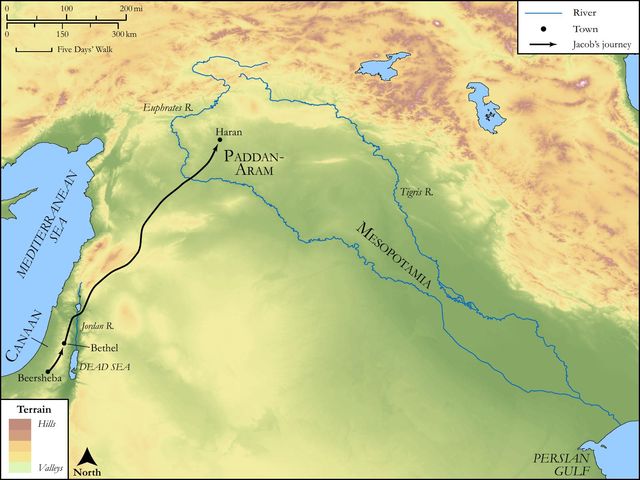
In the family of Isaac, the patriarchal blessing was a deeply significant and binding pronouncement, carrying both spiritual and material implications for inheritance and destiny. The firstborn son typically received a double portion of the inheritance and the primary blessing. Deception to gain such a blessing, as Jacob perpetrated, was a severe transgression, often leading to deep-seated family feuds and even bloodshed, as evidenced by Esau's murderous intent. Haran, located in Paddan-Aram (northwestern Mesopotamia), was the ancestral homeland of Abraham's family, where Rebekah's brother Laban resided. Sending Jacob there was a culturally appropriate choice for refuge, as it offered kinship protection and the potential for Jacob to find a wife from within their extended family, a common practice to maintain lineage purity and strengthen tribal ties.
Key Themes
ShowHideGenesis 27:43 contributes significantly to several overarching themes within the book of Genesis. It highlights the pervasive theme of human sin and its consequences, demonstrating how Jacob's deceit leads directly to his forced exile and family estrangement. Simultaneously, it powerfully illustrates God's unwavering sovereignty and providence, showing how even through the flawed actions and dysfunctional dynamics of His chosen family, God's ultimate plan for the covenant's unfolding remains on track. The verse also introduces the theme of exile as a crucible for spiritual formation, as Jacob's journey to Haran marks the beginning of a transformative period where he will encounter God directly, mature in faith, and lay the foundation for the twelve tribes of Israel, as seen in subsequent narratives such as Jacob's dream at Bethel.
Exposition and Analysis
ShowHideRebekah's words in Genesis 27:43 are direct, urgent, and authoritative, setting in motion a critical phase in Jacob's life and the biblical narrative: "Now therefore, my son, obey my voice; and arise, flee thou to Laban my brother to Haran;"
Key Word Analysis
ShowHideThis word is derived from a root meaning "to build," signifying a son as a builder or continuer of the family name. In this context, Rebekah addresses Jacob as her "son," emphasizing their close familial bond and her maternal concern for his life. The term also carries the weight of his role as the chosen heir, despite his actions, through whom the family line and divine promises are to continue.
This primitive root means "to hear intelligently," often implying attention, understanding, and crucially, obedience. Rebekah's command "obey my voice" is not merely an instruction to listen, but an imperative to act in accordance with her warning, highlighting the urgency and non-negotiable nature of her directive in the face of imminent danger.
This primitive root means "to bolt" or "to flee suddenly." The use of this verb underscores the immediate and desperate necessity of Jacob's departure. It is not a leisurely journey but an urgent flight for survival, directly indicative of the grave threat posed by Esau's murderous intent and the profound consequences of Jacob's deceit.
Verse Breakdown
ShowHide"Now therefore, my son, obey my voice;"
This opening phrase establishes the immediate context of Rebekah's command. The "Now therefore" acts as a logical consequence of the preceding events—Esau's murderous vow. Rebekah addresses Jacob intimately as "my son," indicating both her affection and her maternal authority. The imperative "obey my voice" signifies the critical importance of her instruction, demanding immediate and unquestioning compliance from Jacob, who is in mortal danger.
"and arise, flee thou to Laban my brother"
The verbs "arise" (qûwm, H6965) and "flee" (bârach, H1272) convey a sense of urgency and swift action. "Arise" implies getting ready for immediate departure, while "flee" emphasizes the necessity of a rapid escape from the present danger. Rebekah specifies the destination as her brother Laban, indicating a pre-determined safe haven within her own extended family, a culturally appropriate choice for refuge and protection.
"to Haran;"
Haran is the specific geographical location within Paddan-Aram where Laban resides. By naming this distant city, Rebekah not only provides a precise destination but also implies a prolonged separation for Jacob, far from Esau's immediate reach. This destination sets the stage for a significant twenty-year period of Jacob's life, during which he will marry, father children, and accumulate wealth, shaping him into the patriarch of a nascent nation.
Literary Devices
ShowHideThe verse employs several significant Literary Devices. The use of Imperative Verbs ("obey," "arise," "flee") creates a sense of immediate urgency and highlights Rebekah's decisive authority in a moment of crisis. This direct address underscores the gravity of Jacob's situation. The phrase "my son" functions as Terms of Endearment and Appeals to Authority, simultaneously conveying Rebekah's deep maternal concern and her expectation of Jacob's obedience. The Foreshadowing of Jacob's long journey and stay in Haran is also present, as this seemingly desperate flight initiates a pivotal period of his life, setting the stage for his marriages, the birth of his children, and his spiritual maturation, all of which are crucial to the unfolding of God's covenant promises.
Theological and Thematic Connections
ShowHideGenesis 27:43 powerfully illustrates the immediate and painful consequences of human sin, as Jacob's deceit forces him into exile. Yet, it simultaneously showcases God's remarkable sovereignty, demonstrating His ability to orchestrate His divine purposes even through the moral failings and dysfunctional choices of His people. Rebekah's desperate act of protection, though born of favoritism and fear, paradoxically aligns with God's overarching plan to preserve the covenant lineage through Jacob. This forced journey to Haran becomes a providential crucible for Jacob's spiritual growth, character development, and the eventual formation of the family that will become the nation of Israel. It underscores that God's faithfulness to His promises transcends human imperfection and that difficult circumstances can often be instrumental in His redemptive work.
Reflection and Application
ShowHideGenesis 27:43 serves as a poignant reminder that our choices, particularly those involving deception or compromise, carry significant consequences that can ripple through our lives and relationships. Jacob's immediate exile highlights the painful repercussions of his actions, demonstrating that even when our intentions might seem to align with a perceived "greater good" (like securing a blessing), God never condones sin. For us today, this narrative calls for a deep commitment to integrity and truthfulness in all our dealings. However, the passage also offers profound hope: even in the midst of self-inflicted difficulties or forced separations, God remains sovereign. Just as Jacob's exile became a period of profound spiritual formation and the foundation for his family, our own challenging circumstances, whether self-imposed or divinely ordained, can be crucibles for growth, purification, and the unfolding of God's purposes in our lives. We are invited to trust in God's faithfulness, knowing that He can redeem our mistakes and use even our brokenness to advance His perfect plan.
Questions for Reflection
ShowHideFAQ
ShowHideWhy did Rebekah specifically send Jacob to Laban in Haran?
ShowHideRebekah sent Jacob to Laban, her brother, for several strategic and culturally significant reasons. Primarily, it provided a safe refuge far from Esau's immediate, murderous wrath, ensuring Jacob's physical survival. Beyond mere safety, Haran was the ancestral homeland of Abraham's family, and sending Jacob there was a culturally appropriate way to ensure he could find a wife from within their extended kin, a practice vital for maintaining lineage purity and strengthening tribal ties. This is seen later when Jacob marries Leah and Rachel, Laban's daughters, as detailed in Genesis 29.
Was Jacob's deception justified since God's plan for him to receive the blessing was ultimately fulfilled?
ShowHideNo, Jacob's deception was not justified, even though God's sovereign plan for him to receive the blessing was ultimately fulfilled. The Bible consistently portrays deception as sin, and Jacob's actions led to immediate and long-lasting negative consequences, including his forced exile, family estrangement, and future troubles with Laban. While God is sovereign and can work through human sin and imperfection to achieve His purposes, as seen in Joseph's story, He does not endorse or justify the sin itself. His faithfulness to His promises does not negate the moral responsibility or the painful repercussions of human actions.
What is the significance of Haran in the biblical narrative?
ShowHideHaran holds immense significance in the biblical narrative. It was the place where Abraham's family settled after leaving Ur of the Chaldeans, and where Terah, Abraham's father, died before Abraham continued his journey to Canaan, as recorded in Genesis 11:31-32. For Jacob, Haran became a pivotal location for his personal and familial development. During his twenty-year stay there, he married Leah and Rachel, fathered eleven of his twelve sons, and accumulated significant wealth, transforming from a solitary fugitive into the patriarch of a large family, laying the foundational framework for the twelve tribes of Israel, as chronicled throughout Genesis 29-31.
Christ-Centered Fulfillment
ShowHideJacob's flight from Esau to Haran, though a direct consequence of his sin and a period of personal exile, paradoxically serves as a crucial step in the unfolding of God's redemptive plan that ultimately culminates in Christ. Jacob, the deceiver, is sent away from the promised land, a poignant foreshadowing of humanity's spiritual exile due to sin, yet God's unwavering promise to him at Bethel—"I am with you and will watch over you wherever you go" (Genesis 28:15)—ensures the continuation of the covenant line. This journey highlights God's faithfulness to His promises despite human imperfection, demonstrating that His purposes cannot be thwarted by sin but are ultimately achieved through His sovereign grace. Christ is the ultimate "seed" of Abraham and Jacob, the one through whom all nations are truly blessed, as promised in Galatians 3:16. Unlike Jacob, who fled due to his own sin, Jesus perfectly obeyed the Father's voice, even to the point of death on a cross (Philippians 2:8). His journey to the cross involves a profound "exile" from the Father for humanity's sake, bearing the weight of our sin, ultimately leading to the restoration and fulfillment of all God's promises made to the patriarchs, offering true refuge and reconciliation for all who believe, as described in 2 Corinthians 5:18-19.