


Genesis 27:44
- וְיָשַׁבְתָּve·ya·shav·Taand you will remainH3427Conj-w ¦ V-Qal-ConsecPerf-2msVerb Qal Consecutive Perfect 2nd Singular Masculineוְandיָשַׁבְתָּyou will remain
- עִמּוֹi·Mowith himH5973Prep ¦ 3msPreposition Definiteעִמּwithוֹhim
- יָמִיםya·MimdaysH3117N-mpNoun Plural Masculine Absolute
- אֲחָדִים'a·cha·Dimone<s>H259Adj-mpAdjective Numerical Plural Masculine Absolute
- עַד'aduntilH5704PrepPreposition
- אֲשֶׁר'a·SherthatH834RelParticle Relative
- תָּשׁוּבta·Shuvit will turn backH7725V-Qal-Imperf-3fsVerb Qal Imperfect 3rd Singular Feminine
- חֲמַתcha·Mat[the] anger ofH2534N-fscNoun Singular Feminine Construct
- אָחִיךָ'a·Chi·khayour brotherH251N-msc ¦ 2msNoun Singular Masculine Constructאָחִיbrotherךָyour
English is a literal word-by-word gloss of the Hebrew, not the KJV's wording. Why?
This is the original text the KJV's translators worked from — each Hebrew word with its own literal English meaning in this verse, prepared by scholars at Tyndale House, Cambridge. The KJV translates whole sentences, not word by word, so its wording differs: one Hebrew word can become several English words, and the KJV may choose “the LORD” where the gloss reads “Yahweh”. Both are faithful — they answer different questions. For the KJV's own rendering, switch to the KJV text.
Details
See on the biblical-era maps


Study this verse
Public-domain commentary
Matthew Henry
From his Commentary on the Whole Bible. Henry comments on passages, not single verses — this entry covers Genesis 27:41–46. His three-level outline is real structure in the source text, so it is rendered as structure.
Here is, I. The malice Esau bore to Jacob upon account of the blessing which he had obtained, Gen 27:41. Thus he went in the way of Cain, who slew his brother because he had gained that acceptance with God of which he had rendered himself unworthy. Esau's hatred of Jacob was, 1. A causeless hatred. He hated him for no other reason but because his father blessed him and God loved him. Note, The happiness of saints is the envy of sinners. Whom Heaven blesses, hell curses. 2. It was a cruel hatred. Nothing less would satisfy him than to slay his brother. It is the blood of the saints that persecutors thirst after: I will slay my brother. How could he say that word without horror? How could he call him brother, and yet vow his death? Note, The rage of persecutors will not be tied up by any bonds, no, not the strongest and most sacred. 3. It was a politic hatred. He expected his father would soon die, and then titles must be tried and interests contested between the brothers, which would give him a fair opportunity for revenge. He thinks it not enough to live by his sword himself (Gen 27:40), unless his brother die by it. He is loth to grieve his father while he lives, and therefore puts off the intended murder till his death, not caring how much he then grieved his surviving mother. Note, (1.) Those are bad children to whom their good parents are a burden, and who, upon any account, long for the days of mourning for them. (2.) Bad men are long held in by external restraints from doing the mischief they would do, and so their wicked purposes come to nought. (3.) Those who think to defeat God's purposes will undoubtedly be disappointed themselves. Esau aimed to prevent Jacob, or his seed, from having the dominion, by taking away his life before he was married; but who can disannul what God has spoken? Men may fret at God's counsels, but cannot change them.
II.The method Rebekah took to prevent the mischief.
1.She gave Jacob warning of his danger, and advised him to withdraw for a while, and shift for his own safety. She tells him what she heard of Esau's design, that he comforted himself with the hope of an opportunity to kill his brother, Gen 27:42. Would one think that such a bloody barbarous thought as this could be a comfort to a man? If Esau could have kept his design to himself his mother would not have suspected it; but men's impudence in sin is often their infatuation; and they cannot accomplish their wickedness because their rage is too violent to be concealed, and a bird of the air carries the voice. Observe here,
(1.)What Rebekah feared - lest she should be deprived of them both in one day (Gen 27:45), deprived, not only of the murdered, but of the murderer, who either by the magistrate, or by the immediate hand of God, would by sacrificed to justice, which she herself must acquiesce in, and not obstruct: or, if not so, yet thenceforward she would be deprived of all joy and comfort in him. Those that are lost to virtue are in a manner lost to all their friends. With what pleasure can a child be looked upon that can be looked upon as no other than a child of the devil?
(2.)What Rebekah hoped - that, if Jacob for a while kept out of sight, the affront which his brother resented so fiercely would by degrees go out of mind. The strength of passions is weakened and taken off by the distances both of time and place. She promised herself that his brother's anger would turn away. Note, Yielding pacifies great offences; and even those that have a good cause, and God on their side, must yet use this with other prudent expedients for their own preservation.
2.She impressed Isaac with an apprehension of the necessity of Jacob's going among her relations upon another account, which was to take a wife, Gen 27:46. She would not tell him of Esau's wicked design against the life of Jacob, lest it should trouble him; but prudently took another way to gain her point. Isaac saw as uneasy as he was to Esau's being unequally yoked with Hittites; and therefore, with a very good colour of reason, she moves to have Jacob married to one that was better principled. Note, One miscarriage should serve as a warning to prevent another; those are careless indeed that stumble twice at the same stone. Yet Rebekah seems to have expressed herself somewhat too warmly in the matter, when she said, What good will my life do me if Jacob marry a Canaanite? Thanks be to God, all our comfort is not lodged in one hand; we may do the work of life, and enjoy the comforts of life, though every thing do not fall out to our mind, and though our relations be not in all respects agreeable to us. Perhaps Rebekah spoke with this concern because she saw it necessary, for the quickening of Isaac, to give speedy orders in this matter. Observe, Though Jacob was himself very towardly, and well fixed in his religion, yet he had need to be put out of the way of temptation. Even he was in danger both of following the bad example of his brother and of being drawn into a snare by it. We must not presume too far upon the wisdom and resolution, no, not of those children that are most hopeful and promising; but care must be taken to keep them out of harm's way.
Historical interpretation
Historical reception
1 surviving comment on this verse from the historical church.
Every kind of honour and happiness was bestowed upon you, and then was fulfilled that which is written, "My beloved ate and drank, and was enlarged and became fat, and kicked." [Deuteronomy 32:15] Hence flowed emulation and envy, strife and sedition, persecution and disorder, war and captivity. So the worthless rose up against the honoured, those of no reputation against such as were renowned, the foolish against the wise, the young against those advanced in years. For this reason righteousness and peace are now far departed from you, inasmuch as every one abandons the fear of God, and has become blind in His faith, neither walks in the ordinances of His appointment, nor acts a part becoming a Christian, but walks after his own wicked lusts, resuming the practice of an unrighteous and ungodly envy, by which death itself entered into the world. [Wisdom 2:24]
For thus it is written: "And it came to pass after certain days, that Cain brought of the fruits of the earth a sacrifice unto God; and Abel also brought of the firstlings of his sheep, and of the fat thereof. And God had respect to Abel and to his offerings, but Cain and his sacrifices He did not regard. And Cain was deeply grieved, and his countenance fell. And God said to Cain, Why are you grieved, and why is your countenance fallen? If you offer rightly, but do not divide rightly, have you not sinned? Be at peace: your offering returns to yourself, and you shall again possess it. And Cain said to Abel his brother, Let us go into the field. And it came to pass, while they were in the field, that Cain rose up against Abel his brother, and slew him." [Genesis 4:3-8] You see, brethren, how envy and jealousy led to the murder of a brother. Through envy, also, our father Jacob fled from the face of Esau his brother [Genesis 27:41-45]. Envy made Joseph be persecuted unto death, and to come into bondage. [Genesis 37:18-28] Envy compelled Moses to flee from the face of Pharaoh king of Egypt, when he heard these words from his fellow-countryman, "Who made you a judge or a ruler over us? Will you kill me, as you killed the Egyptian yesterday?" [Exodus 2:14] On account of envy, Aaron and Miriam had to make their abode without the camp. [Numbers 12:14-15] Envy brought down Dathan and Abiram alive to Hades, through the sedition which they excited against God's servant Moses. [Numbers 16:33] Through envy, David not only underwent the hatred of foreigners, but was also persecuted by Saul king of Israel. [1 Samuel 21:10-15]
Continue studying Genesis 27:44 across the web’s major study libraries — every link below opens this exact verse, chapter, or book on the destination site.
Read & Compare
 BibleGatewayThis verse in more than 200 translations and 70 languages.
 Bible.comThe YouVersion reader — hundreds of translations, reading plans, and highlights.
 ESV.orgCrossway's official English Standard Version reader.
 NET BibleThe NET translation with 60,000+ translators' notes on every rendering decision.
 STEP BibleTyndale House's free study tool — original text, vocabulary, and scholarly resources.
 BibliaLogos Bible Software's free web reader.
 USCCBThe New American Bible (Revised Edition) with the U.S. bishops' study notes.
Commentaries
 BibleHub CommentariesDozens of classic commentaries on this verse, gathered on one page.
 StudyLightMore than 100 commentary sets — the largest collection on the web.
 BibleRefPlain-English commentary on what this verse means, verse by verse.
 Enduring WordDavid Guzik's free commentary on this chapter, widely used by Bible teachers.
 Bible Study ToolsVerse commentary alongside Greek and Hebrew study aids.
Original Language & Research
- BibleHub InterlinearThe verse word by word — original language, transliteration, and English.
- BibleHub LexiconEvery word's original-language definition and Strong's entry.
 Blue Letter BibleDeep-study tools — Strong's numbers, concordance, and word studies.
 SefariaThe Hebrew text with Rashi and centuries of Jewish commentary.
Sermons, Hymns & Audio


TrulyRandomVerse is not affiliated with these sites and doesn’t control their content. They’re linked because they’re genuinely useful.
Summary
Genesis 27:44 captures Rebekah's urgent and deceptive instruction to Jacob, commanding him to flee to her brother Laban in Haran. She advises him to "tarry with him a few days, until thy brother's fury turn away," a desperate measure to protect her favored son from the murderous rage of Esau, whose birthright and blessing Jacob had just stolen through an elaborate ruse. This verse marks the immediate, profound consequences of Jacob's deceit, initiating a long period of exile and family separation.
Context
ShowHideLiterary Context
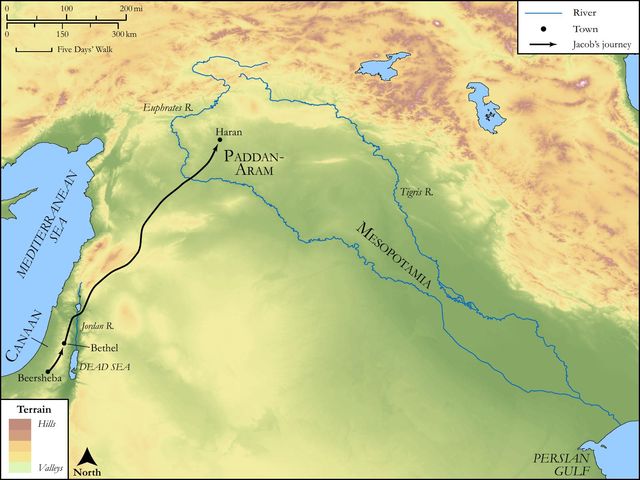
This verse is situated at a critical turning point in the patriarchal narrative of Genesis, immediately following Jacob's audacious deception of his blind father, Isaac, to usurp the blessing intended for his elder twin brother, Esau. The preceding verses Genesis 27:1-29 detail the elaborate plot orchestrated by Rebekah. Upon discovering the betrayal, Esau erupts in a profound and murderous rage, vowing to kill Jacob once their father Isaac had passed away Genesis 27:41. Rebekah, alerted to Esau's deadly intent Genesis 27:42, swiftly devises a plan for Jacob's escape, which begins with the instruction given in Genesis 27:43 and elaborated in Genesis 27:44. This moment sets the stage for Jacob's long exile and the subsequent narratives of his life in Haran.
Historical & Cultural Context
In the ancient Near East, the patriarchal blessing was a solemn, irrevocable pronouncement carrying immense spiritual, social, and economic weight, often determining the recipient's future standing and inheritance. The firstborn son typically received a double portion of the inheritance and the primary blessing, making Esau's loss particularly devastating. Family honor and vengeance were deeply ingrained cultural values, meaning Esau's vow to kill Jacob was not an idle threat but a culturally understood and expected response to such a profound betrayal. The concept of "tarrying" or sojourning (living as a temporary resident) was common in nomadic and semi-nomadic societies, highlighting the temporary nature of Jacob's intended stay, though Rebekah's estimation of its duration proved tragically inaccurate.
Key Themes
ShowHideGenesis 27 is rich with themes that resonate throughout the book and beyond. Deception is central, as Jacob, aided by Rebekah, employs elaborate trickery to gain the blessing. This act highlights the destructive nature of favoritism, a recurring issue in the patriarchal narratives, as Rebekah's preference for Jacob directly contributes to the family strife. The immediate and severe consequences of sin are vividly portrayed, as Jacob's action leads directly to his forced exile and a long period of separation from his family. Despite the human failings and manipulation, the narrative subtly underscores divine sovereignty, as God's ultimate plan for Jacob to inherit the covenant promises, first given to Abraham and Isaac, continues to unfold, even through flawed human agents. This chapter also introduces the theme of reconciliation, though it will take many years and much personal growth for Jacob and Esau to eventually meet again, as seen in Genesis 33.
Exposition and Analysis
ShowHideRebekah's instruction, "And tarry with him a few days, until thy brother's fury turn away," encapsulates the immediate fallout of Jacob's deceit and the desperate measures taken to preserve his life.
Key Word Analysis
ShowHideMeaning "to sit down... to dwell, to remain; causatively, to settle, to marry." In this context, it conveys the idea of staying or residing. Rebekah intends for Jacob to "remain" or "abide" with Laban, but critically, her use implies a temporary, rather than permanent, dwelling. The choice of this verb underscores her expectation of a brief sojourn, a "sitting down" that would quickly conclude.
("one" or "a few") and H3117 ("day"). Literally, "one day" or "a day," but contextually meaning "a few days" or "a short time." This phrase is pivotal, revealing Rebekah's profound underestimation of the depth and longevity of Esau's rage. Her hope for a swift resolution—that a short period of separation would allow Esau's anger to dissipate—contrasts sharply with the reality of Jacob's two-decade exile, highlighting the unpredictable and long-lasting consequences of sin and deep family strife.
Meaning "heat; figuratively, anger, poison (from its fever); hot displeasure, furious(-ly, -ry), heat, indignation, poison, rage, wrath(-ful)." This is a powerful term, indicating an intense, burning anger, far beyond mere annoyance. Esau's "fury" is not a fleeting emotion but a deep-seated, potentially murderous rage, likened to a fever or poison, reflecting the profound sense of betrayal he experienced. Rebekah's hope that such an intense emotion would simply "turn away" in a few days was naive.
Verse Breakdown
ShowHide"And tarry with him a few days,"
This clause conveys Rebekah's immediate command to Jacob. The urgency is implicit, as she is sending him away from immediate danger. Her instruction for a "few days" reveals her strategic yet ultimately flawed attempt to control the situation and manage the severe consequences of her own instigation of the deception. She believes a short period of separation will be sufficient for Esau's anger to subside.
"until thy brother's fury turn away;"
This second clause states the condition for Jacob's return. Rebekah's hope is that Esau's intense "fury" (as described above) will "turn away" or dissipate. The verb "turn away" (H7725, shûwb) implies a reversal or turning back, suggesting a return to a calmer state. This highlights Rebekah's miscalculation of the depth of Esau's indignation, which would prove to be a long-lasting and deeply rooted animosity, stretching the "few days" into two decades of separation.
Literary Devices
ShowHideThe verse employs Irony, particularly in Rebekah's optimistic assessment of "a few days." What she anticipates as a brief cooling-off period stretches into two decades of separation, demonstrating the unpredictable and far-reaching consequences of deceptive actions. This temporal discrepancy serves as a form of Foreshadowing, hinting at the long and arduous journey Jacob is about to undertake, filled with his own trials and deceptions while in Haran. There is also an element of Contrast between Rebekah's hope for a swift resolution and the deep, enduring nature of Esau's "fury," which is described with a word implying intense heat and poison. This contrast underscores the profound damage inflicted by Jacob's deceit and the difficulty of healing such deep wounds.
Theological and Thematic Connections
ShowHideGenesis 27:44 profoundly illustrates the destructive ripple effect of sin within a family. Jacob's deception, though successful in securing the blessing, immediately precipitates a life-threatening crisis, forcing him into exile and causing deep familial rifts. This narrative serves as a stark reminder that even seemingly successful acts of manipulation carry severe, often unforeseen, consequences that impact not only the perpetrators but also innocent bystanders and future generations. Despite this human brokenness and the flawed means employed, God's overarching plan for Jacob to inherit the covenant promises remains steadfast, demonstrating divine sovereignty working through and often in spite of human imperfections.
Reflection and Application
ShowHideGenesis 27:44 serves as a potent reminder of the far-reaching consequences of deceptive actions and unresolved family conflict. It illustrates that sin creates dangerous rifts, often requiring significant time and effort to heal, and impacting not just the immediate parties but entire family structures. While Rebekah hoped for a swift resolution, the prolonged separation emphasizes that deep-seated anger and betrayal rarely dissipate quickly, often necessitating space and a cooling-off period before any true reconciliation can begin. For believers, this narrative underscores the importance of honesty, the need to address conflict proactively and with integrity, and the understanding that true peace often requires patience, humility, and a reliance on God's timing rather than human manipulation. It challenges us to consider the long-term repercussions of our choices and to seek reconciliation rooted in genuine repentance and forgiveness.
Questions for Reflection
ShowHideFAQ
ShowHideWhy did Rebekah believe Esau's fury would "turn away" in just "a few days"?
ShowHideRebekah's assessment of "a few days" was a significant miscalculation, likely stemming from a combination of factors. First, it reflects a mother's optimistic hope that intense family anger, especially between brothers, would naturally subside with time and distance. She may have underestimated the profound depth of Esau's betrayal, which involved the theft of both his birthright and his patriarchal blessing, a double blow to his identity and future. Her desire for a quick resolution was undoubtedly driven by her protective love for Jacob and her desire to see him return home swiftly. However, her plan failed to account for the enduring nature of such deep-seated resentment and the spiritual damage inflicted, leading to a separation that stretched into two decades, as recounted in Genesis 31:41. This highlights the unpredictable and often long-lasting repercussions of sin and broken trust.
Christ-Centered Fulfillment
ShowHideWhile Genesis 27:44 primarily details human sin and its immediate consequences, it subtly points to Christ in several profound ways. Jacob's desperate flight from Esau's wrath foreshadows the ultimate refuge found in Christ, who offers escape from the righteous wrath of God against sin Romans 5:9. Just as Jacob became a sojourner, seeking a temporary dwelling away from danger, believers are called to live as sojourners and exiles in this world, looking to Christ as their eternal dwelling and ultimate protector 1 Peter 2:11. The long-awaited, though imperfect, reconciliation between Jacob and Esau after two decades of separation prefigures the perfect and ultimate reconciliation and peace that Christ brings between God and humanity, and among people, through His atoning work on the cross Colossians 1:20. Ultimately, the narrative of human brokenness, the devastating effects of sin, and the need for a mediator points to Jesus as the true reconciler, the one who perfectly fulfills God's promises and brings about true peace, despite human failings and the deep divisions caused by sin Ephesians 2:14-16.