


Genesis 27:45
- עַד'aduntilH5704PrepPreposition
- שׁוּבshuvturns backH7725V-Qal-InfVerb Qal Infinitive Construct
- אַף'af[the] anger ofH639N-mscNoun Singular Masculine Construct
- אָחִיךָ'a·Chi·khayour brotherH251N-msc ¦ 2msNoun Singular Masculine Constructאָחִיbrotherךָyour
- מִמְּךָmi·me·Khafrom youH4480Prep ¦ 2msPreposition Definiteמִמְּfromךָyou
- וְשָׁכַחve·sha·Khachand he will forgetH7911Conj-w ¦ V-Qal-ConsecPerf-3msVerb Qal Consecutive Perfect 3rd Singular Masculineוְandשָׁכַחhe will forget
- אֵת'et<obj.>H853DirObjMParticle Object Indicator
- אֲשֶׁר'a·Sher[that] whichH834RelParticle Relative
- עָשִׂיתָ'a·Si·tayou didH6213V-Qal-Perf-2msVerb Qal Perfect 2nd Singular Masculine
- לּוֹloto <the> himPrep-l ¦ 3msSuffix Personal 3rd Singular Masculineלּto <the>וֹhim
- וְשָׁלַחְתִּיve·sha·lach·Tiand I will sendH7971Conj-w ¦ V-Qal-ConsecPerf-1csVerb Qal Consecutive Perfect 1st Singular common genderוְandשָׁלַחְתִּיI will send
- וּלְקַחְתִּיךָu·le·kach·Ti·khaand I will fetch youH3947Conj-w ¦ V-Qal-ConsecPerf-1cs ¦ 2msVerb Qal Consecutive Perfect 1st Singular common genderוּandלְקַחְתִּיI will fetchךָyou
- מִשָּׁםmi·Shamfrom thereH8033Prep-m ¦ AdvAdverbמִfromשָּׁםthere
- לָמָהla·Mah<to> why?H4100Prep-l ¦ InterrogPronoun Interrogativeלָ<to>מָהwhy?
- אֶשְׁכַּל'esh·Kalwill I be bereavedH7921V-Qal-Imperf-1csVerb Qal Imperfect 1st Singular common gender
- גַּםgamalsoH1571AdvAdverb
- שְׁנֵיכֶםshe·nei·Khemboth of youH8147Adj-cdc ¦ 2mpAdjective Numerical Dual common gender Constructשְׁנֵיboth ofכֶםyou
- יוֹםYoma dayH3117N-msNoun Singular Masculine Absolute
- אֶחָד'e·ChadoneH259Adj-fsAdjective Numerical Singular Feminine Absolute
English is a literal word-by-word gloss of the Hebrew, not the KJV's wording. Why?
This is the original text the KJV's translators worked from — each Hebrew word with its own literal English meaning in this verse, prepared by scholars at Tyndale House, Cambridge. The KJV translates whole sentences, not word by word, so its wording differs: one Hebrew word can become several English words, and the KJV may choose “the LORD” where the gloss reads “Yahweh”. Both are faithful — they answer different questions. For the KJV's own rendering, switch to the KJV text.
Details
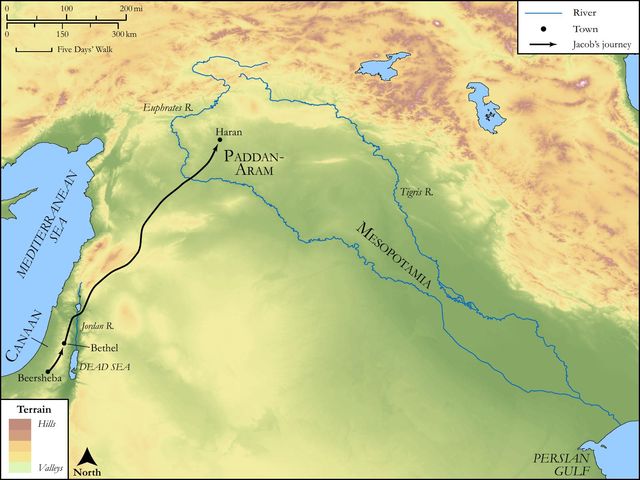
See on the biblical-era maps


Study this verse
Public-domain commentary
Matthew Henry
From his Commentary on the Whole Bible. Henry comments on passages, not single verses — this entry covers Genesis 27:41–46. His three-level outline is real structure in the source text, so it is rendered as structure.
Here is, I. The malice Esau bore to Jacob upon account of the blessing which he had obtained, Gen 27:41. Thus he went in the way of Cain, who slew his brother because he had gained that acceptance with God of which he had rendered himself unworthy. Esau's hatred of Jacob was, 1. A causeless hatred. He hated him for no other reason but because his father blessed him and God loved him. Note, The happiness of saints is the envy of sinners. Whom Heaven blesses, hell curses. 2. It was a cruel hatred. Nothing less would satisfy him than to slay his brother. It is the blood of the saints that persecutors thirst after: I will slay my brother. How could he say that word without horror? How could he call him brother, and yet vow his death? Note, The rage of persecutors will not be tied up by any bonds, no, not the strongest and most sacred. 3. It was a politic hatred. He expected his father would soon die, and then titles must be tried and interests contested between the brothers, which would give him a fair opportunity for revenge. He thinks it not enough to live by his sword himself (Gen 27:40), unless his brother die by it. He is loth to grieve his father while he lives, and therefore puts off the intended murder till his death, not caring how much he then grieved his surviving mother. Note, (1.) Those are bad children to whom their good parents are a burden, and who, upon any account, long for the days of mourning for them. (2.) Bad men are long held in by external restraints from doing the mischief they would do, and so their wicked purposes come to nought. (3.) Those who think to defeat God's purposes will undoubtedly be disappointed themselves. Esau aimed to prevent Jacob, or his seed, from having the dominion, by taking away his life before he was married; but who can disannul what God has spoken? Men may fret at God's counsels, but cannot change them.
II.The method Rebekah took to prevent the mischief.
1.She gave Jacob warning of his danger, and advised him to withdraw for a while, and shift for his own safety. She tells him what she heard of Esau's design, that he comforted himself with the hope of an opportunity to kill his brother, Gen 27:42. Would one think that such a bloody barbarous thought as this could be a comfort to a man? If Esau could have kept his design to himself his mother would not have suspected it; but men's impudence in sin is often their infatuation; and they cannot accomplish their wickedness because their rage is too violent to be concealed, and a bird of the air carries the voice. Observe here,
(1.)What Rebekah feared - lest she should be deprived of them both in one day (Gen 27:45), deprived, not only of the murdered, but of the murderer, who either by the magistrate, or by the immediate hand of God, would by sacrificed to justice, which she herself must acquiesce in, and not obstruct: or, if not so, yet thenceforward she would be deprived of all joy and comfort in him. Those that are lost to virtue are in a manner lost to all their friends. With what pleasure can a child be looked upon that can be looked upon as no other than a child of the devil?
(2.)What Rebekah hoped - that, if Jacob for a while kept out of sight, the affront which his brother resented so fiercely would by degrees go out of mind. The strength of passions is weakened and taken off by the distances both of time and place. She promised herself that his brother's anger would turn away. Note, Yielding pacifies great offences; and even those that have a good cause, and God on their side, must yet use this with other prudent expedients for their own preservation.
2.She impressed Isaac with an apprehension of the necessity of Jacob's going among her relations upon another account, which was to take a wife, Gen 27:46. She would not tell him of Esau's wicked design against the life of Jacob, lest it should trouble him; but prudently took another way to gain her point. Isaac saw as uneasy as he was to Esau's being unequally yoked with Hittites; and therefore, with a very good colour of reason, she moves to have Jacob married to one that was better principled. Note, One miscarriage should serve as a warning to prevent another; those are careless indeed that stumble twice at the same stone. Yet Rebekah seems to have expressed herself somewhat too warmly in the matter, when she said, What good will my life do me if Jacob marry a Canaanite? Thanks be to God, all our comfort is not lodged in one hand; we may do the work of life, and enjoy the comforts of life, though every thing do not fall out to our mind, and though our relations be not in all respects agreeable to us. Perhaps Rebekah spoke with this concern because she saw it necessary, for the quickening of Isaac, to give speedy orders in this matter. Observe, Though Jacob was himself very towardly, and well fixed in his religion, yet he had need to be put out of the way of temptation. Even he was in danger both of following the bad example of his brother and of being drawn into a snare by it. We must not presume too far upon the wisdom and resolution, no, not of those children that are most hopeful and promising; but care must be taken to keep them out of harm's way.
Historical interpretation
Historical reception
1 surviving comment on this verse from the historical church.
Every kind of honour and happiness was bestowed upon you, and then was fulfilled that which is written, "My beloved ate and drank, and was enlarged and became fat, and kicked." [Deuteronomy 32:15] Hence flowed emulation and envy, strife and sedition, persecution and disorder, war and captivity. So the worthless rose up against the honoured, those of no reputation against such as were renowned, the foolish against the wise, the young against those advanced in years. For this reason righteousness and peace are now far departed from you, inasmuch as every one abandons the fear of God, and has become blind in His faith, neither walks in the ordinances of His appointment, nor acts a part becoming a Christian, but walks after his own wicked lusts, resuming the practice of an unrighteous and ungodly envy, by which death itself entered into the world. [Wisdom 2:24]
For thus it is written: "And it came to pass after certain days, that Cain brought of the fruits of the earth a sacrifice unto God; and Abel also brought of the firstlings of his sheep, and of the fat thereof. And God had respect to Abel and to his offerings, but Cain and his sacrifices He did not regard. And Cain was deeply grieved, and his countenance fell. And God said to Cain, Why are you grieved, and why is your countenance fallen? If you offer rightly, but do not divide rightly, have you not sinned? Be at peace: your offering returns to yourself, and you shall again possess it. And Cain said to Abel his brother, Let us go into the field. And it came to pass, while they were in the field, that Cain rose up against Abel his brother, and slew him." [Genesis 4:3-8] You see, brethren, how envy and jealousy led to the murder of a brother. Through envy, also, our father Jacob fled from the face of Esau his brother [Genesis 27:41-45]. Envy made Joseph be persecuted unto death, and to come into bondage. [Genesis 37:18-28] Envy compelled Moses to flee from the face of Pharaoh king of Egypt, when he heard these words from his fellow-countryman, "Who made you a judge or a ruler over us? Will you kill me, as you killed the Egyptian yesterday?" [Exodus 2:14] On account of envy, Aaron and Miriam had to make their abode without the camp. [Numbers 12:14-15] Envy brought down Dathan and Abiram alive to Hades, through the sedition which they excited against God's servant Moses. [Numbers 16:33] Through envy, David not only underwent the hatred of foreigners, but was also persecuted by Saul king of Israel. [1 Samuel 21:10-15]
Continue studying Genesis 27:45 across the web’s major study libraries — every link below opens this exact verse, chapter, or book on the destination site.
Read & Compare
 BibleGatewayThis verse in more than 200 translations and 70 languages.
 Bible.comThe YouVersion reader — hundreds of translations, reading plans, and highlights.
 ESV.orgCrossway's official English Standard Version reader.
 NET BibleThe NET translation with 60,000+ translators' notes on every rendering decision.
 STEP BibleTyndale House's free study tool — original text, vocabulary, and scholarly resources.
 BibliaLogos Bible Software's free web reader.
 USCCBThe New American Bible (Revised Edition) with the U.S. bishops' study notes.
Commentaries
 BibleHub CommentariesDozens of classic commentaries on this verse, gathered on one page.
 StudyLightMore than 100 commentary sets — the largest collection on the web.
 BibleRefPlain-English commentary on what this verse means, verse by verse.
 Enduring WordDavid Guzik's free commentary on this chapter, widely used by Bible teachers.
 Bible Study ToolsVerse commentary alongside Greek and Hebrew study aids.
Original Language & Research
- BibleHub InterlinearThe verse word by word — original language, transliteration, and English.
- BibleHub LexiconEvery word's original-language definition and Strong's entry.
 Blue Letter BibleDeep-study tools — Strong's numbers, concordance, and word studies.
 SefariaThe Hebrew text with Rashi and centuries of Jewish commentary.
Sermons, Hymns & Audio


TrulyRandomVerse is not affiliated with these sites and doesn’t control their content. They’re linked because they’re genuinely useful.
Summary
Rebekah, in a moment of urgent maternal concern, counsels her favored son Jacob to flee from the murderous wrath of his brother Esau. Following Jacob's deceptive acquisition of the patriarchal blessing, Esau's rage threatens his life. She instructs Jacob to seek refuge with her brother Laban in Haran, promising to send for him once Esau's intense anger has subsided and his grievance has been released. Her profound fear is articulated in the desperate rhetorical question, "why should I be deprived also of you both in one day?", revealing her dread of losing Jacob to Esau's vengeance and potentially Esau himself to judicial consequence or permanent estrangement.
Context
ShowHideLiterary Context
This verse is spoken by Rebekah at a pivotal and highly charged moment in the patriarchal narrative, immediately following Jacob's successful deception of his blind father Isaac to steal the blessing intended for Esau. The preceding verses Genesis 27:30-40 detail Esau's profound anguish and bitter cry upon realizing he has been cheated, culminating in his murderous vow against Jacob in Genesis 27:41. Rebekah, having been the architect of the deception, is keenly aware of Esau's deadly intent. Her words in verse 45 are part of her urgent strategy to protect Jacob, sending him away to her brother Laban in Haran, a journey that marks a significant turning point in Jacob's life and the narrative, initiating his long period of exile and formation.
Historical & Cultural Context
In the ancient Near East, patriarchal blessings were considered binding and irrevocable, carrying immense spiritual, social, and economic weight. The firstborn son typically received a double portion of the inheritance and the primary blessing, signifying leadership and the continuation of the family line. Deception to acquire such a blessing, as perpetrated by Jacob with Rebekah's connivance, was a grave offense, often meriting severe punishment or even death at the hands of the wronged party or the community. Blood vengeance was a recognized, though often destructive, means of resolving such deep grievances. Traveling to Haran, a distant region in Mesopotamia, was a common practice for seeking refuge or finding a spouse within one's extended family, as Abraham had sent his servant there to find a wife for Isaac Genesis 24. Rebekah's plan leverages these cultural norms, albeit under duress.
Key Themes
ShowHideThis verse encapsulates several major themes prevalent in the book of Genesis and the broader biblical narrative. It highlights the consequences of sin and deception, demonstrating how Jacob's actions, despite being part of God's sovereign plan, immediately lead to familial fracture, personal exile, and deep emotional pain, underscoring the painful ripple effects of dishonesty. It also subtly reinforces the theme of divine sovereignty amidst human flaws, as God's promise to Jacob (initially given in Genesis 25:23) will be fulfilled despite the deceptive means employed. Furthermore, Rebekah's desperate plea underscores the destructive nature of unresolved conflict and anger within kinship ties, a recurring motif in Genesis, from Cain and Abel Genesis 4 to the later strife among Jacob's own sons.
Exposition and Analysis
ShowHideRebekah's words in Genesis 27:45 are a poignant expression of a mother's love and fear, revealing the immediate and devastating consequences of Jacob's deception. Her counsel is both practical and deeply emotional, driven by the desire to preserve her family from further tragedy.
Key Word Analysis
ShowHideProperly, the nose or nostril; hence, the face, and occasionally a person; also (from the rapid breathing in passion) ire. This word denotes a strong, intense, and often visible emotional outburst, indicative of Esau's furious wrath that is palpable and dangerous. It's not a fleeting irritation but a deep-seated, passionate rage that threatens violence.
To mislay, i.e., to be oblivious of, from want of memory or attention; to cause to forget. This term implies more than a mere lapse of memory; it signifies a complete letting go of the offense, a ceasing to remember or hold onto the grievance. Rebekah hopes for a profound emotional and mental release from Esau's anger, indicating the deep wound inflicted by Jacob's deceit. It's a desire for Esau to truly put the offense behind him, not just suppress it.
Properly, to miscarry, i.e., suffer abortion; by analogy, to bereave (literally or figuratively); to make childless, to lose children. This powerful word conveys the deepest form of loss, specifically the loss of children. Rebekah's use of it here emphasizes the profound, unbearable tragedy she envisions—the simultaneous loss of both her sons, either through death, permanent exile, or judicial consequence.
Verse Breakdown
ShowHide"Until thy brother's anger turn away from thee,"
This clause sets a condition and implies a duration for Jacob's exile. Rebekah understands the depth of Esau's rage and knows it will not dissipate quickly. The Hebrew verb for "turn away" (H7725, shûwb) suggests a complete reversal or turning back from his current state of fury, indicating that Jacob's return is contingent upon a significant change in Esau's emotional disposition and violent intent.
"and he forget [that] which thou hast done to him:"
This further elaborates on the necessary change in Esau. It's not enough for his anger to subside; he must also "forget" the offense. As analyzed above, this "forgetting" implies a profound release of the grievance, a cessation of holding the betrayal against Jacob. This highlights the severity of Jacob's actions and the deep wound they inflicted, requiring a complete emotional and mental healing for reconciliation to be possible.
"then I will send, and fetch thee from thence:"
This is Rebekah's solemn promise to Jacob, a maternal assurance that his exile is intended to be temporary. It reflects her hope for future reconciliation and reunion, and her active role in orchestrating Jacob's flight underscores her determination to protect her favored son. This promise, however, would tragically remain unfulfilled by Rebekah herself, as Jacob's exile would last for twenty years, and she likely died before his return.
"why should I be deprived also of you both in one day?"
This desperate rhetorical question encapsulates Rebekah's profound anguish and the double tragedy she envisions. She fears losing Jacob, either through Esau's vengeance (murder) or through his permanent flight and estrangement. Simultaneously, she fears losing Esau, either through judicial punishment for fratricide (murdering Jacob) or through the permanent alienation and unresolved conflict that would shatter the family. The phrase "in one day" emphasizes the immediacy and simultaneous nature of the potential loss, highlighting the devastating impact of unresolved anger and the potential for irreparable damage within kinship ties.
Literary Devices
ShowHideRebekah's urgent plea in this verse employs several powerful literary devices. The phrase "why should I be deprived also of you both in one day?" is a potent Rhetorical Question, not seeking an answer but expressing profound fear, anguish, and the perceived inevitability of a double tragedy. This question also functions as Hyperbole, emphasizing the catastrophic nature of losing both sons simultaneously, whether through death, exile, or permanent estrangement. There is also a strong element of Foreshadowing, as the long separation of Jacob from his family and the eventual, dramatic reconciliation with Esau in Genesis 33 are implicitly hinted at. Furthermore, a subtle Irony exists in Rebekah's promise to "send, and fetch thee from thence," as the narrative indicates she never saw Jacob again, highlighting the unpredictable and often painful long-term consequences of human actions, even those intended to protect.
Theological and Thematic Connections
ShowHideGenesis 27:45 profoundly illustrates the immediate and painful consequences of sin and deception, even when God's sovereign plan is at work. Jacob's cunning actions, though ultimately leading to the fulfillment of the divine promise regarding the elder serving the younger, immediately fractured his family, initiated his prolonged exile, and inflicted deep emotional wounds, underscoring the painful ripple effects of dishonesty within human relationships. Rebekah's desperate fear highlights the profound cost of unresolved conflict and the destructive nature of bitterness, demonstrating how personal grievances can threaten the very fabric of family and community. Despite the human failings and the ensuing chaos, the narrative implicitly points to God's steadfastness in working through imperfect means to accomplish His purposes, even as it clearly condemns the deceptive actions themselves.
Reflection and Application
ShowHideGenesis 27:45 serves as a powerful and poignant reminder that our actions, particularly those involving deception, betrayal, or the stirring of anger, have far-reaching and often painful consequences. Rebekah's desperate plea underscores the destructive nature of unresolved anger and the vital importance of seeking reconciliation and forgiveness in our relationships. While Jacob's story ultimately points to God's sovereign hand in fulfilling His promises, this verse highlights the profound human cost of choosing paths of deceit and the deep pain that family conflict can inflict. It encourages us to consider the long-term impact of our decisions, to value peace and unity within our relationships, and to actively strive for healing and forgiveness where division has occurred. We are called to be peacemakers, to address grievances with humility and honesty, and to trust in God's power to mend broken bonds, rather than allowing bitterness and resentment to fester and destroy.
Questions for Reflection
ShowHideFAQ
ShowHideWhy was Rebekah so afraid of losing both sons "in one day"?
ShowHideRebekah's fear was multi-layered and deeply profound. She feared losing Jacob to Esau's murderous vengeance, which could result in his death, or to a permanent, distant exile from which he might never return. Simultaneously, she feared losing Esau either to the consequences of fratricide (murdering Jacob), which could lead to his execution or banishment under ancient legal codes, or to a permanent, irreconcilable estrangement from the family. The phrase "in one day" emphasizes the immediate and devastating double tragedy she envisioned, highlighting the profound and simultaneous impact of the family conflict that threatened to shatter her family completely.
Did Esau ever truly "forget" what Jacob did, as Rebekah hoped?
ShowHideThe Hebrew word shakach (שָׁכַח) implies more than a simple forgetting; it suggests a letting go of the grievance or ceasing to hold onto the offense. While Esau likely never completely erased the memory of the deception, his intense anger did subside significantly. The narrative in Genesis 33:4 shows a profound reconciliation where Esau runs to meet Jacob, embraces him, and weeps. This emotional reunion indicates that his intense anger had indeed "turned away," allowing for forgiveness and renewed relationship, even if the memory of the past injustice remained. This demonstrates the power of grace and the possibility of healing from deep wounds.
Was Rebekah's plan to send Jacob away successful in saving him?
ShowHideYes, Rebekah's immediate action did save Jacob from Esau's murderous intent, fulfilling her primary objective of protecting her son's life. However, the separation proved to be far longer and more profound than she likely anticipated. Jacob spent twenty years with Laban, marrying and raising a large family, and it is widely believed that Rebekah died before Jacob's eventual return to Canaan. This means her personal promise to "send, and fetch thee from thence" was never physically fulfilled by her, underscoring the often unforeseen and painful long-term consequences of the initial deception.
Christ-Centered Fulfillment
ShowHideWhile Genesis 27:45 vividly portrays the brokenness of human relationships due to sin and deception, it subtly points towards the ultimate reconciliation found in Christ. The deep chasm of anger and betrayal between Jacob and Esau, and Rebekah's desperate hope for it to "turn away" and be "forgotten," foreshadows humanity's profound need for reconciliation with God and with one another. Christ, through His atoning work on the cross, is the ultimate peacemaker who bridges the gap created by sin, turning away God's righteous wrath and enabling true forgiveness and reconciliation (Romans 5:10-11). He provides the means for us to "forget" (let go of) the grievances of the past by offering new life and a new covenant, fulfilling the longing for peace and unity that Rebekah so desperately sought for her sons. Just as Jacob's exile eventually led to a surprising reunion with Esau, so too does Christ's sacrifice bring estranged humanity into a reconciled relationship with God and offers the hope for genuine peace and forgiveness among believers (Ephesians 2:14-16). He is the one who truly takes away the sin of the world (John 1:29), making true spiritual and relational healing possible.