


Genesis 27:41
- וַיִּשְׂטֹםvai·yis·Tomand he bore a grudge againstH7852Conj-w ¦ V-Qal-ConsecImperf-3msVerb Qal Consecutive Imperfect 3rd Singular Masculineוַandיִּשְׂטֹםhe bore a grudge against
- עֵשָׂו'e·SavEsauH6215N-proper-mNoun Proper Masculine
- אֶת'et<obj.>H853DirObjMParticle Object Indicator
- יַעֲקֹבya·'a·KoJacobH3290N-proper-mNoun Proper Masculine
- עַל'alonH5921PrepPreposition
- הַבְּרָכָהha·be·ra·Khahthe blessingH1293Art ¦ N-fsNoun Singular Feminine Absoluteהַtheבְּרָכָהblessing
- אֲשֶׁר'a·SherwhichH834RelParticle Relative
- בֵּרֲכוֹbe·ra·Khohe had blessed himH1288V-Piel-Perf-3ms ¦ 3msVerb Piel Perfect 3rd Singular Masculineבֵּרֲכhe had blessedוֹhim
- אָבִיו'a·Vivhis fatherH1N-msc ¦ 3msNoun Singular Masculine Constructאָבִיfatherוhis
- וַיֹּאמֶרvai·Yo·merand he saidH559Conj-w ¦ V-Qal-ConsecImperf-3msVerb Qal Consecutive Imperfect 3rd Singular Masculineוַandיֹּאמֶרhe said
- עֵשָׂו'e·SavEsauH6215N-proper-mNoun Proper Masculine
- בְּלִבּוֹbe·li·Boin his heartH3820Prep-b ¦ N-msc ¦ 3msNoun Singular Masculine Constructבְּinלִבּheartוֹhis
- יִקְרְבוּyik·re·Vuthey will draw nearH7126V-Qal-Imperf-3mpVerb Qal Imperfect 3rd Plural Masculine
- יְמֵיye·Mei[the] days ofH3117N-mpcNoun Plural Masculine Construct
- אֵבֶל'E·vel[the] mourning ofH60N-mscNoun Singular Masculine Construct
- אָבִי'a·Vimy fatherH1N-msc ¦ 1csNoun Singular Masculine Constructאָבִfatherיmy
- וְאַהַרְגָהve·'a·har·Gahand I will killH2026Conj-w ¦ V-Qal-Imperf-1csVerb Qal Imperfect 1st Singular common genderוְandאַהַרְגָהI will kill
- אֶת'et<obj.>H853DirObjMParticle Object Indicator
- יַעֲקֹבya·'a·KoJacobH3290N-proper-mNoun Proper Masculine
- אָחִי'a·Chimy brotherH251N-msc ¦ 1csNoun Singular Masculine Constructאָחִbrotherיmy
English is a literal word-by-word gloss of the Hebrew, not the KJV's wording. Why?
This is the original text the KJV's translators worked from — each Hebrew word with its own literal English meaning in this verse, prepared by scholars at Tyndale House, Cambridge. The KJV translates whole sentences, not word by word, so its wording differs: one Hebrew word can become several English words, and the KJV may choose “the LORD” where the gloss reads “Yahweh”. Both are faithful — they answer different questions. For the KJV's own rendering, switch to the KJV text.
Details
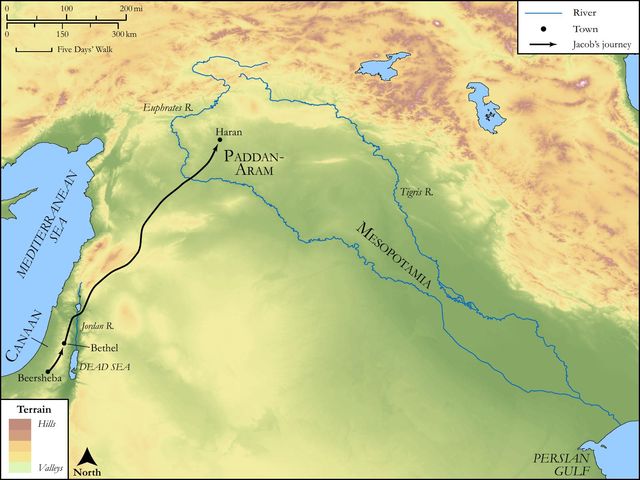
See on the biblical-era map


Study this verse
Public-domain commentary
Matthew Henry
From his Commentary on the Whole Bible. Henry comments on passages, not single verses — this entry covers Genesis 27:41–46. His three-level outline is real structure in the source text, so it is rendered as structure.
Here is, I. The malice Esau bore to Jacob upon account of the blessing which he had obtained, Gen 27:41. Thus he went in the way of Cain, who slew his brother because he had gained that acceptance with God of which he had rendered himself unworthy. Esau's hatred of Jacob was, 1. A causeless hatred. He hated him for no other reason but because his father blessed him and God loved him. Note, The happiness of saints is the envy of sinners. Whom Heaven blesses, hell curses. 2. It was a cruel hatred. Nothing less would satisfy him than to slay his brother. It is the blood of the saints that persecutors thirst after: I will slay my brother. How could he say that word without horror? How could he call him brother, and yet vow his death? Note, The rage of persecutors will not be tied up by any bonds, no, not the strongest and most sacred. 3. It was a politic hatred. He expected his father would soon die, and then titles must be tried and interests contested between the brothers, which would give him a fair opportunity for revenge. He thinks it not enough to live by his sword himself (Gen 27:40), unless his brother die by it. He is loth to grieve his father while he lives, and therefore puts off the intended murder till his death, not caring how much he then grieved his surviving mother. Note, (1.) Those are bad children to whom their good parents are a burden, and who, upon any account, long for the days of mourning for them. (2.) Bad men are long held in by external restraints from doing the mischief they would do, and so their wicked purposes come to nought. (3.) Those who think to defeat God's purposes will undoubtedly be disappointed themselves. Esau aimed to prevent Jacob, or his seed, from having the dominion, by taking away his life before he was married; but who can disannul what God has spoken? Men may fret at God's counsels, but cannot change them.
II.The method Rebekah took to prevent the mischief.
1.She gave Jacob warning of his danger, and advised him to withdraw for a while, and shift for his own safety. She tells him what she heard of Esau's design, that he comforted himself with the hope of an opportunity to kill his brother, Gen 27:42. Would one think that such a bloody barbarous thought as this could be a comfort to a man? If Esau could have kept his design to himself his mother would not have suspected it; but men's impudence in sin is often their infatuation; and they cannot accomplish their wickedness because their rage is too violent to be concealed, and a bird of the air carries the voice. Observe here,
(1.)What Rebekah feared - lest she should be deprived of them both in one day (Gen 27:45), deprived, not only of the murdered, but of the murderer, who either by the magistrate, or by the immediate hand of God, would by sacrificed to justice, which she herself must acquiesce in, and not obstruct: or, if not so, yet thenceforward she would be deprived of all joy and comfort in him. Those that are lost to virtue are in a manner lost to all their friends. With what pleasure can a child be looked upon that can be looked upon as no other than a child of the devil?
(2.)What Rebekah hoped - that, if Jacob for a while kept out of sight, the affront which his brother resented so fiercely would by degrees go out of mind. The strength of passions is weakened and taken off by the distances both of time and place. She promised herself that his brother's anger would turn away. Note, Yielding pacifies great offences; and even those that have a good cause, and God on their side, must yet use this with other prudent expedients for their own preservation.
2.She impressed Isaac with an apprehension of the necessity of Jacob's going among her relations upon another account, which was to take a wife, Gen 27:46. She would not tell him of Esau's wicked design against the life of Jacob, lest it should trouble him; but prudently took another way to gain her point. Isaac saw as uneasy as he was to Esau's being unequally yoked with Hittites; and therefore, with a very good colour of reason, she moves to have Jacob married to one that was better principled. Note, One miscarriage should serve as a warning to prevent another; those are careless indeed that stumble twice at the same stone. Yet Rebekah seems to have expressed herself somewhat too warmly in the matter, when she said, What good will my life do me if Jacob marry a Canaanite? Thanks be to God, all our comfort is not lodged in one hand; we may do the work of life, and enjoy the comforts of life, though every thing do not fall out to our mind, and though our relations be not in all respects agreeable to us. Perhaps Rebekah spoke with this concern because she saw it necessary, for the quickening of Isaac, to give speedy orders in this matter. Observe, Though Jacob was himself very towardly, and well fixed in his religion, yet he had need to be put out of the way of temptation. Even he was in danger both of following the bad example of his brother and of being drawn into a snare by it. We must not presume too far upon the wisdom and resolution, no, not of those children that are most hopeful and promising; but care must be taken to keep them out of harm's way.
Historical interpretation
Three Centuries of Reception
2 surviving comments on this verse. Each one is dated, so this reads as a timeline rather than a list.
Select a marker to jump to its quote. Markers stagger vertically where authors wrote within a few decades of each other.
Every kind of honour and happiness was bestowed upon you, and then was fulfilled that which is written, "My beloved ate and drank, and was enlarged and became fat, and kicked." [Deuteronomy 32:15] Hence flowed emulation and envy, strife and sedition, persecution and disorder, war and captivity. So the worthless rose up against the honoured, those of no reputation against such as were renowned, the foolish against the wise, the young against those advanced in years. For this reason righteousness and peace are now far departed from you, inasmuch as every one abandons the fear of God, and has become blind in His faith, neither walks in the ordinances of His appointment, nor acts a part becoming a Christian, but walks after his own wicked lusts, resuming the practice of an unrighteous and ungodly envy, by which death itself entered into the world. [Wisdom 2:24]
For thus it is written: "And it came to pass after certain days, that Cain brought of the fruits of the earth a sacrifice unto God; and Abel also brought of the firstlings of his sheep, and of the fat thereof. And God had respect to Abel and to his offerings, but Cain and his sacrifices He did not regard. And Cain was deeply grieved, and his countenance fell. And God said to Cain, Why are you grieved, and why is your countenance fallen? If you offer rightly, but do not divide rightly, have you not sinned? Be at peace: your offering returns to yourself, and you shall again possess it. And Cain said to Abel his brother, Let us go into the field. And it came to pass, while they were in the field, that Cain rose up against Abel his brother, and slew him." [Genesis 4:3-8] You see, brethren, how envy and jealousy led to the murder of a brother. Through envy, also, our father Jacob fled from the face of Esau his brother [Genesis 27:41-45]. Envy made Joseph be persecuted unto death, and to come into bondage. [Genesis 37:18-28] Envy compelled Moses to flee from the face of Pharaoh king of Egypt, when he heard these words from his fellow-countryman, "Who made you a judge or a ruler over us? Will you kill me, as you killed the Egyptian yesterday?" [Exodus 2:14] On account of envy, Aaron and Miriam had to make their abode without the camp. [Numbers 12:14-15] Envy brought down Dathan and Abiram alive to Hades, through the sedition which they excited against God's servant Moses. [Numbers 16:33] Through envy, David not only underwent the hatred of foreigners, but was also persecuted by Saul king of Israel. [1 Samuel 21:10-15]
But we shouldn’t leave his parents without excuse for having preferred their younger son to the elder. At the same time we must take care so that no one, in turning to their example, would make an unfair judgment between his sons or suppose that he should love the one and esteem the other less. From this line of conduct fraternal hatreds are aroused and the crime of fratricide is contrived to gain a worthless sum of money. Let children be nurtured with an equal measure of devotion. Granted that one’s love may fasten more upon some trait in a child who is more agreeable or similar to oneself, the exercise of justice ought to be the same in regard to all. The more that is given to the child that is loved and who seeks his brother’s love, the more is taken away from the one who is burdened with jealousy at the unfair preferment. Esau threatened that he would kill his brother. Neither the fact of brotherhood nor respect for their parents kept him from his fratricidal madness, and he grieved that the blessing had been snatched away from him, whereas he should have proved himself worthy of it by forbearance rather than by crime.However, Rebekah did not prefer one son to another son but a just son to an unjust one. And indeed, with that pious mother, God’s mysterious plan was more important than her offspring. She did not so much prefer Jacob to his brother; rather, she offered him to the Lord, for she knew that he could protect the gift that the Lord had bestowed. In the Lord she took counsel also for her other son; she withdrew him from God’s disfavor, lest he incur graver culpability if he lost the grace of the blessing he did receive.
Continue studying Genesis 27:41 across the web’s major study libraries — every link below opens this exact verse, chapter, or book on the destination site.
Read & Compare
 BibleGatewayThis verse in more than 200 translations and 70 languages.
 Bible.comThe YouVersion reader — hundreds of translations, reading plans, and highlights.
 ESV.orgCrossway's official English Standard Version reader.
 NET BibleThe NET translation with 60,000+ translators' notes on every rendering decision.
 STEP BibleTyndale House's free study tool — original text, vocabulary, and scholarly resources.
 BibliaLogos Bible Software's free web reader.
 USCCBThe New American Bible (Revised Edition) with the U.S. bishops' study notes.
Commentaries
 BibleHub CommentariesDozens of classic commentaries on this verse, gathered on one page.
 StudyLightMore than 100 commentary sets — the largest collection on the web.
 BibleRefPlain-English commentary on what this verse means, verse by verse.
 Enduring WordDavid Guzik's free commentary on this chapter, widely used by Bible teachers.
 Bible Study ToolsVerse commentary alongside Greek and Hebrew study aids.
Original Language & Research
- BibleHub InterlinearThe verse word by word — original language, transliteration, and English.
- BibleHub LexiconEvery word's original-language definition and Strong's entry.
 Blue Letter BibleDeep-study tools — Strong's numbers, concordance, and word studies.
 SefariaThe Hebrew text with Rashi and centuries of Jewish commentary.
Sermons, Hymns & Audio


TrulyRandomVerse is not affiliated with these sites and doesn’t control their content. They’re linked because they’re genuinely useful.
Summary
Genesis 27:41 records the immediate and profound consequence of Jacob's deception: Esau's deep-seated hatred for his brother, fueled by the stolen blessing. This verse reveals Esau's secret, premeditated intent to murder Jacob after their father Isaac's death, setting a chilling tone for the ongoing familial conflict and foreshadowing the long separation of the twin brothers.
Context
ShowHideLiterary Context
This verse immediately follows the dramatic climax of Genesis 27, where Jacob, at his mother Rebekah's instigation, cunningly impersonates Esau to receive the patriarchal blessing from their blind father, Isaac. Esau's return from hunting, his discovery of the deception, and his anguished cries (Genesis 27:34) set the stage for the intense animosity expressed in Genesis 27:41. The "blessing wherewith his father blessed him" refers specifically to the pronouncement of dominion, prosperity, and spiritual favor that Isaac mistakenly bestowed upon Jacob, believing him to be Esau (Genesis 27:28-29). This betrayal, compounded by Jacob's earlier acquisition of the birthright for a mere bowl of stew (Genesis 25:29-34), pushes Esau to the brink of murderous rage, making this verse a pivotal turning point that necessitates Jacob's flight and the subsequent narrative of his sojourn with Laban.
Historical & Cultural Context
In the ancient Near East, the patriarchal blessing was far more than a mere wish; it was considered an irrevocable, divinely empowered pronouncement that shaped a son's destiny and determined his inheritance, status, and future lineage. Such blessings often carried legal and spiritual weight, akin to a last will and testament, and were believed to be binding. The firstborn son typically received the primary blessing, along with a double portion of the inheritance. Esau, as the firstborn, expected this privilege. His intense reaction underscores the profound cultural significance of this blessing, making Jacob's deception an unforgivable act of theft in Esau's eyes. Furthermore, the concept of "blood vengeance" was deeply ingrained in ancient societies, where a grave offense against honor or property could warrant a retaliatory killing, especially within tribal or familial structures, though fratricide was universally condemned. Esau's plan to wait until Isaac's death also reflects a cultural respect for the patriarch, avoiding an act that would bring immediate grief or dishonor upon his father.
Key Themes
ShowHideGenesis 27:41 powerfully illustrates several key themes prevalent throughout the book of Genesis. It highlights the recurring theme of sibling rivalry and conflict, a pattern seen from Cain and Abel (Genesis 4:8) to Joseph and his brothers (Genesis 37:4). The verse also underscores the destructive consequences of deception and sin, demonstrating how human manipulation, even when seemingly aligned with divine prophecy (as in Genesis 25:23), leads to broken relationships and bitter animosity rather than peaceful fulfillment. Furthermore, it touches upon the theme of divine sovereignty versus human agency, showing that while God's purposes will ultimately prevail, human choices and sinful actions carry their own painful repercussions, often necessitating divine intervention or long periods of separation and hardship for the characters involved.
Exposition and Analysis
ShowHideKey Word Analysis
ShowHideThis primitive root signifies "to lurk for" or "to persecute," implying a deep-seated, active animosity rather than a fleeting emotion. It suggests a hostile intent that goes beyond mere dislike, pointing towards a desire for harm or revenge. In this context, Esau's hatred is not a passive feeling but an internal resolve to act against Jacob.
Derived from the root "to kneel," this word refers to a "benediction" or "prosperity." It encapsulates the full weight of the patriarchal pronouncement—a bestowal of spiritual favor, material wealth, and future dominion, which was considered irrevocable and foundational to one's destiny. The theft of this blessing was, therefore, an attack on Esau's very identity and future.
This primitive root means "to smite with deadly intent," "to kill," or "to murder." It leaves no ambiguity about Esau's intention; he planned a premeditated act of fratricide. The term underscores the extreme and violent nature of his hatred, transforming it from an emotion into a concrete, deadly resolution.
Verse Breakdown
ShowHide"And Esau hated Jacob because of the blessing wherewith his father blessed him"
This opening clause establishes the core conflict and its immediate cause. Esau's hatred is not superficial but a profound, festering resentment. The catalyst for this intense animosity is explicitly stated: Jacob's fraudulent acquisition of the patriarchal blessing, which Esau believed was his rightful inheritance as the firstborn son. This betrayal ignited a deep sense of injustice and fury in Esau's heart.
"and Esau said in his heart"
This phrase reveals the private, internal nature of Esau's deliberation. The Hebrew idiom "said in his heart" (or "thought in his heart") indicates a secret plotting, a hidden resolve that was not yet vocalized or acted upon. This suggests a calculated and deliberate decision rather than an impulsive outburst of rage, making his intent all the more chilling and dangerous.
"The days of mourning for my father are at hand; then will I slay my brother Jacob"
This final clause lays bare Esau's chillingly pragmatic and patient plan for vengeance. He resolves to wait until Isaac's death, anticipating a period of mourning when his actions might be less scrutinized or when he would be free from the immediate presence and potential intervention of his revered father. The explicit declaration "then will I slay my brother Jacob" confirms his premeditated intent to commit fratricide, highlighting the extreme and destructive power of his unchecked bitterness.
Literary Devices
ShowHideThe verse employs several powerful literary devices. Foreshadowing is prominent, as Esau's murderous intent sets the stage for Jacob's flight and the long period of separation, creating narrative tension that will only be resolved much later in the book. The phrase "said in his heart" utilizes internal monologue or thought revelation, granting the reader direct access to Esau's hidden, malevolent intentions, thereby deepening the psychological portrayal of his character. The contrast between the sacred act of "blessing" and the profane act of "slaying" creates a stark irony, highlighting how a divine promise can become entangled with human sin and lead to tragic outcomes. Additionally, the pathos of Esau's situation, having been twice defrauded, evokes a degree of sympathy, even as his murderous intent condemns him.
Theological and Thematic Connections
ShowHideGenesis 27:41 serves as a stark reminder of the devastating consequences of unchecked bitterness and the ripple effects of sin within families. Esau's hatred, born of perceived injustice and compounded by his own earlier disregard for his birthright, escalates to a murderous intent, demonstrating how unresolved anger can corrupt the heart and lead to destructive plans. This narrative underscores the profound truth that while God's sovereign purposes will always prevail, human sin and manipulation carry painful and far-reaching consequences, often leading to broken relationships, forced separations, and prolonged suffering for all involved. It highlights the tension between divine promise and human responsibility, showing that even when God's will is accomplished, the means by which it is pursued matter significantly.
Reflection and Application
ShowHideGenesis 27:41 offers a sobering reflection on the dangers of allowing resentment and bitterness to take root in our hearts. Esau's internal plotting reminds us that hatred, even when unspoken, is a corrosive force that can lead to destructive intentions and actions. This narrative compels us to examine our own hearts for any lingering anger or unforgiveness, urging us to address conflict and perceived wrongs through reconciliation and forgiveness, rather than allowing them to fester into malice. It also challenges us to trust in God's perfect timing and methods, rather than resorting to deceitful or manipulative means to achieve desired outcomes, even if those outcomes appear to align with God's will. Ultimately, this passage calls us to cultivate a spirit of peace, love, and righteousness in our relationships, recognizing that the consequences of sin are far-reaching and that true blessedness comes through walking in integrity and faith.
Questions for Reflection
ShowHideFAQ
ShowHideWhy did Esau delay his revenge until his father's death?
ShowHideEsau's decision to wait until "The days of mourning for my father are at hand" suggests a calculated and pragmatic approach to his vengeance. He likely wished to avoid causing further grief or distress to his aging and blind father, Isaac, who was deeply beloved by Esau. Additionally, waiting until after Isaac's death would prevent immediate discovery and potential intervention or punishment from the family patriarch. This calculated delay indicates a cold, premeditated intent rather than a spontaneous outburst of rage, highlighting the depth and dangerous nature of his hatred.
Was Jacob's deception justified since God had already prophesied that the elder would serve the younger?
ShowHideNo, Jacob's deception was not justified, despite God's prophecy that "the elder shall serve the younger" found in Genesis 25:23. While God's sovereign plan would ultimately prevail, Jacob and Rebekah acted out of human cunning and impatience rather than trusting God to fulfill His promise in His own way and time. The Bible consistently condemns deceit and manipulation. Their actions led to significant familial strife, Jacob's forced exile, years of separation from his family, and ongoing tension, demonstrating that even when God's will is accomplished, sinful means have painful and far-reaching consequences for all involved.
How does Esau's hatred in this verse relate to the broader theme of sibling rivalry in the Bible?
ShowHideEsau's hatred for Jacob is a stark and potent example of the recurring biblical theme of sibling rivalry, which often stems from jealousy, perceived injustice, and a struggle for dominance or favor. This theme is tragically introduced with Cain and Abel in Genesis 4:8 and continues with Abraham's sons (Ishmael and Isaac), Isaac's sons (Jacob and Esau), and Jacob's own sons (Joseph and his brothers, as seen in Genesis 37:4). These narratives consistently highlight the destructive nature of sin within the family unit and underscore humanity's fallen condition, demonstrating the profound need for reconciliation, forgiveness, and the transforming power of God's grace to heal broken relationships.
Christ-Centered Fulfillment
ShowHideThe deep-seated hatred and division between Esau and Jacob, born of deception and a stolen blessing, powerfully foreshadow the profound need for a divine reconciler. In Christ, we find the true and ultimate inheritor of all blessings, who secures them not through cunning or force, but through perfect obedience, sacrificial love, and His atoning death on the cross. He is the one who perfectly fulfills the patriarchal blessings, offering a spiritual inheritance far greater than any earthly one. Unlike Jacob, who fled from his brother's wrath, Christ willingly faced the wrath of God and humanity, offering Himself as the ultimate sacrifice to reconcile humanity to God and to each other. Through His blood, the enmity that plagues human relationships, exemplified by Esau's murderous intent, is overcome, and true peace, forgiveness, and brotherhood become possible for all who believe, as He breaks down "the dividing wall of hostility" (Ephesians 2:14). His work transforms hearts of hatred into hearts of love, making possible the reconciliation that Jacob and Esau eventually experienced, albeit imperfectly, in Genesis 33:4.