


Romans 8:15
- οὐouNotG3756PRT-NNegative Particle Negative
- γὰρgarforG1063CONJConjunction
- ἐλάβετεelabeteyou have receivedG2983V-2AAI-2PVerb 2nd Aorist Active Indicative 2nd Plural
- πνεῦμαpneumaa spiritG4151N-ASNNoun Accusative Singular Neuter
- δουλείαςdouleiasof bondageG1397N-GSFNoun Genitive Singular Feminine
- πάλινpalinagainG3825ADVAdverb
- εἰςeistoG1519PREPPreposition
- φόβονphobonfearG5401N-ASMNoun Accusative Singular Masculine
- ἀλλ᾽all᾽butG235CONJConjunction
- ἐλάβετεelabeteyou have receivedG2983V-2AAI-2PVerb 2nd Aorist Active Indicative 2nd Plural
- πνεῦμαpneuma[the] SpiritG4151N-ASNNoun Accusative Singular Neuter
- υἱοθεσίαςhuiothesiasof divine adoption as sonsG5206N-GSFNoun Genitive Singular Feminine
- ἐνenbyG1722PREPPreposition
- ᾧhōwhomG3739R-DSNRelative pronoun Dative Singular Neuter
- κράζομεν·krazomenwe cryG2896V-PAI-1PVerb Present Active Indicative 1st Plural
- αββαabbaAbbaG5N-VSM-TNoun Vocative Singular Masculine Person Gentilic
- ὁhoOG3588T-VSMDefinite article Vocative Singular Masculine
- πατήρpatērFather!G3962N-VSM-TNoun Vocative Singular Masculine Person Gentilic
English is a literal word-by-word gloss of the Greek, not the KJV's wording. Why?
This is the original text the KJV's translators worked from — each Greek word with its own literal English meaning in this verse, prepared by scholars at Tyndale House, Cambridge. The KJV translates whole sentences, not word by word, so its wording differs: one Greek word can become several English words, and the KJV may choose “charity” where the gloss reads “love”. Both are faithful — they answer different questions. For the KJV's own rendering, switch to the KJV text.
Details
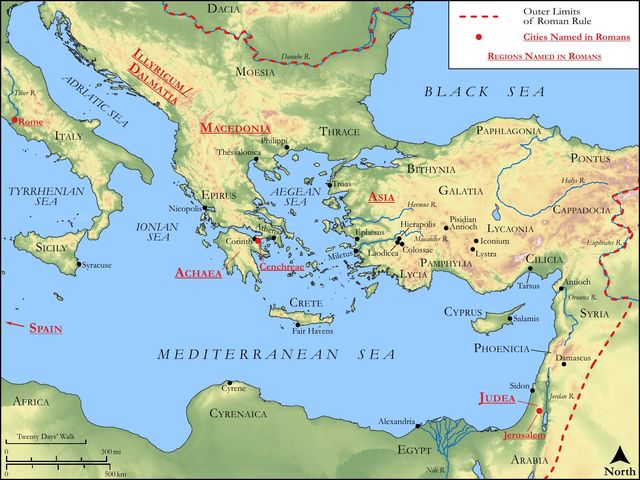
See on the biblical-era map

Study this verse
Public-domain commentary
Matthew Henry
From his Commentary on the Whole Bible. Henry comments on passages, not single verses — this entry covers Romans 8:10–16. His four-level outline is real structure in the source text, so it is rendered as structure.
In these verses the apostle represents two more excellent benefits, which belong to true believers.
I.Life.
The happiness is not barely a negative happiness, not to be condemned; but it is positive, it is an advancement to a life that will be the unspeakable happiness of the man (Rom 8:10, Rom 8:11): If Christ be in you. Observe, If the Spirit be in us, Christ is in us. He dwells in the heart by faith, Eph 3:17. Now we are here told what becomes of the bodies and souls of those in whom Christ is.
1.We cannot say but that the body is dead; it is a frail, mortal, dying body, and it will be dead shortly; it is a house of clay, whose foundation is in the dust. The life purchased and promised does not immortalize the body in its present state. It is dead, that is, it is appointed to die, it is under a sentence of death: as we say one that is condemned is a dead man. In the midst of life we are in death: be our bodies ever so strong, and healthful, and handsome, they are as good as dead (Heb 11:12), and this because of sin. It is sin that kills the body. This effect the first threatening has (Gen 3:19): Dust thou art. Methinks, were there no other argument, love to our bodies should make us hate sin, because it is such an enemy to our bodies. The death even of the bodies of the saints is a remaining token of God's displeasure against sin.
2.But the spirit, the precious soul, that is life; it is now spiritually alive, nay, it is life. Grace in the soul is its new nature; the life of the saint lies in the soul, while the life of the sinner goes no further than the body. When the body dies, and returns to the dust, the spirit if life; not only living and immortal, but swallowed up of life. Death to the saints is but the freeing of the heaven-born spirit from the clog and load of this body, that it may be fit to partake of eternal life. When Abraham was dead, yet God was the God of Abraham, for even then his spirit was life, Mat 22:31, Mat 22:32. See Psa 49:15. And this because of righteousness. The righteousness of Christ imputed to them secures the soul, the better part, from death; the righteousness of Christ inherent in them, the renewed image of God upon the soul, preserves it, and, by God's ordination, at death elevates it, and improves it, and makes it meet to partake of the inheritance of the saints in light. The eternal life of the soul consists in the vision and fruition of God, and both assimilating, for which the soul is qualified by the righteousness of sanctification. I refer to Psa 17:15, I will behold thy face in righteousness.
3.There is a life reserved too for the poor body at last: He shall also quicken your mortal bodies, Rom 8:11. The Lord is for the body; and though at death it is cast aside as a despised broken vessel, a vessel in which is no pleasure, yet God will have a desire to the work of his hands (Job 14:15), will remember his covenant with the dust, and will not lose a grain of it; but the body shall be reunited to the soul, and clothed with a glory agreeable to it. Vile bodies shall be newly fashioned, Phi 3:21; Co1 15:42. Two great assurances of the resurrection of the body are mentioned: - (1.) The resurrection of Christ: He that raised up Christ from the dead shall also quicken. Christ rose as the head, and first-fruits, and forerunner of all the saints, Co1 15:20. The body of Christ lay in the grave, under the sin of all the elect imputed, and broke through it. O grave, then, where is thy victory? It is in the virtue of Christ's resurrection that we shall rise. (2.) The indwelling of the Spirit. The same Spirit that raiseth the soul now will raise the body shortly: By his Spirit that dwelleth in you. The bodies of the saints are the temples of the Holy Ghost, Co1 3:16; Co1 6:19. Now, though these temples may be suffered for awhile to lie in ruins, yet they shall be rebuilt. The tabernacle of David, which has fallen down, shall be repaired, whatever great mountains may be in the way. The Spirit, breathing upon dead and dry bones, will make them live, and the saints even in their flesh shall see God. Hence the apostle by the way infers how much it is our duty to walk not after the flesh, but after the Spirit, Rom 8:12, Rom 8:13. Let not our life be after the wills and motions of the flesh. Two motives he mentions here: - [1.] We are not debtors to the flesh, neither by relation, gratitude, nor any other bond or obligation. We owe no suit nor service to our carnal desires; we are indeed bound to clothe, and feed, and take care of the body, as a servant to the soul in the service of God, but no further. We are not debtors to it; the flesh never did us so much kindness as to oblige us to serve it. It is implied that we are debtors to Christ and to the Spirit: there we owe our all, all we have and all we can do, by a thousand bonds and obligations. Being delivered from so great a death by so great a ransom, we are deeply indebted to our deliverer. See Co1 6:19, Co1 6:20. [2.] Consider the consequences, what will be at the end of the way. Here are life and death, blessing and cursing, set before us. If you live after the flesh, you shall die; that is, die eternally. It is the pleasing, and serving, and gratifying, of the flesh, that are the ruin of souls; that is, the second death. Dying indeed is the soul's dying: the death of the saints is but a sleep. But, on the other hand, You shall live, live and be happy to eternity; that is the true life: If you through the Spirit mortify the deeds of the body, subdue and keep under all fleshly lusts and affections, deny yourselves in the pleasing and humouring of the body, and this through the Spirit; we cannot do it without the Spirit working it in us, and the Spirit will not do it without our doing our endeavour. So that in a word we are put upon this dilemma, either to displease the body or destroy the soul.
II.The Spirit of adoption is another privilege belonging to those that are in Christ Jesus, Rom 8:14-16.
1.All that are Christ's are taken into the relation of Children to God, Rom 8:14. Observe,
(1.)Their property: They are led by the Spirit of God, as a scholar in his learning is led by his tutor, as a traveller in his journey is led by his guide, as a soldier in his engagements is led by his captain; not driven as beasts, but led as rational creatures, drawn with the cords of a man and the bands of love. It is the undoubted character of all true believers that they are led by the Spirit of God. Having submitted themselves in believing to his guidance, they do in their obedience follow that guidance, and are sweetly led into all truth and all duty.
(2.)Their privilege: They are the sons of God, received into the number of God's children by adoption, owned and loved by him as his children.
2.And those that are the sons of God have the Spirit,
(1.)To work in them the disposition of children.
[1.]You have not received the spirit of bondage again to fear, Rom 8:15. Understand it, First, Of that spirit of bondage which the Old Testament church was under, by reason of the darkness and terror of that dispensation. The veil signified bondage, Co2 3:15. Compare Rom 8:17. The Spirit of adoption was not then so plentifully poured out as now; for the law opened the wound, but little of the remedy. Now you are not under that dispensation, you have not received that spirit. Secondly, Of that spirit of bondage which many of the saints themselves were under at their conversion, under the convictions of sin and wrath set home by the Spirit; as those in Act 2:37, the jailer (Act 16:30), Paul, Act 9:6. Then the Spirit himself was to the saints a spirit of bondage: "But," says the apostle, "with you this is over." "God as a Judge," says Dr. Manton, "by the spirit of bondage, sends us to Christ as Mediator, and Christ as Mediator, by the spirit of adoption, sends us back again to God as a Father." Though a child of God may come under fear of bondage again, and may be questioning his sonship, yet the blessed Spirit is not again a spirit of bondage, for then he would witness an untruth.
[2.]But you have received the Spirit of adoption. Men may give a charter of adoption; but it is God's prerogative, when he adopts, to give a spirit of adoption - the nature of children. The Spirit of adoption works in the children of God a filial love to God as a Father, a delight in him, and a dependence upon him, as a Father. A sanctified soul bears the image of God, as the child bears the image of the father. Whereby we cry, Abba, Father. Praying is here called crying, which is not only an earnest, but a natural expression of desire; children that cannot speak vent their desires by crying. Now, the Spirit teaches us in prayer to come to God as a Father, with a holy humble confidence, emboldening the soul in that duty. Abba, Father. Abba is a Syriac word signifying father or my father; patēr, a Greek work; and why both, Abba, Father? Because Christ said so in prayer (Mar 14:36), Abba, Father: and we have received the Spirit of the Son. It denotes an affectionate endearing importunity, and a believing stress laid upon the relation. Little children, begging of their parents, can say little but Father, Father, and that is rhetoric enough. It also denotes that the adoption is common both to Jews and Gentiles: the Jews call him Abba in their language, the Greeks may call him patēr in their language; for in Christ Jesus there is neither Greek nor Jew.
(2.)To witness to the relation of children, Rom 8:16. The former is the work of the Spirit as a Sanctifier; this as a Comforter. Beareth witness with our spirit. Many a man has the witness of his own spirit to the goodness of his state who has not the concurring testimony of the Spirit. Many speak peace to themselves to whom the God of heaven does not speak peace. But those that are sanctified have God's Spirit witnessing with their spirits, which is to be understood not of any immediate extraordinary revelation, but an ordinary work of the Spirit, in and by the means of comfort, speaking peace to the soul. This testimony is always agreeable to the written word, and is therefore always grounded upon sanctification; for the Spirit in the heart cannot contradict the Spirit in the word. The Spirit witnesses to none the privileges of children who have not the nature and disposition of children.
Historical interpretation
Five Centuries of Reception
15 surviving comments on this verse. Each one is dated, so this reads as a timeline rather than a list.
Select a marker to jump to its quote. Markers stagger vertically where authors wrote within a few decades of each other.
Neither do we receive another Holy Spirit, besides Him who is with us, and who cries, "Abba, Father; ".
For those to whom he was writing were not without flesh, but they were those who had received the Spirit of God, "by which we cry, Abba, Father."
We have received the Spirit to enable us to know the one to whom we pray, our real Father, the one and only Father of all, that is, the one who like a Father educates us for salvation and does away with fear.
It is certain that whoever will become a son of God by the Spirit of adoption will first become a servant of God by the spirit of slavery. For the beginning of service to God is to be filled with the spirit of fear when still a little child [= new convert], since “the fear of the Lord is the beginning of wisdom.” … As long as we remain children in the inner man we hold the Spirit in fear, until we reach the point at which we can rightfully receive the Spirit of adoption as sons and become like the Son and Lord of all. For Paul says: “Everything is yours,” and God has given us everything together with Christ. This is why Paul says that, after we have died together with Christ and after his Spirit comes into us, we no longer receive the spirit of slavery in fear (that is, we do not return to the state of children, and we have completed the first stages of faith), but rather like perfect people we have received the Spirit of adoption, in whom we cry: “Abba! Father!”
Christ is the true Son, and so when we receive the Spirit, we are made sons. For it says; ‘you did not receive the spirit of slavery leading you back into fear, but you have received the Spirit of adopted sonship’ (Romans 8:15). But when we are made sons in the Spirit, it is clear that we are called children of God in Christ... And when the Spirit is given to us-the Saviour said: ‘Receive the Holy Spirit’ [John 20:22]- God [The Father] is in us... But when God is in us, the Son is also in us. For the Lord Himself said: ‘I and the Father will come and make our home with him’ [John 14:23]. Next, the Son is life-for He said: ‘I am the life’ [John 14:6]- and so we are said to be given life in the Spirit... But when we are given life in the Spirit, Christ Himself is said to live in us. For it says: ‘I am crucified with Christ. It is no longer I who live, but Christ who lives in me.’ [Galatians 2:19-20]. - "Letters to Separion On the Spirit, Letter 1, Chapter 19"
Paul says this because once we have received the Holy Spirit we are delivered from all fear of evil deeds, so that we might no longer act in such a way as to be afraid once more. Beforehand we were under fear, because once the law was given everyone was considered guilty. Paul called the law “the spirit of fear” because it made people afraid on account of their sins. But the law of faith, which is what is meant by “the Spirit of sonship,” is a law of assurance, because it has delivered us from fear by pardoning our sins and thus giving us assurance.Set free by the grace of God from fear, we have received the Spirit of sonship so that, considering what we were and what we have become by the gift of God, we might govern our life with great care lest the name of God the Father be disgraced by us and we incur all the things we have escaped from.… We have received such grace that we can dare to say to God: “Abba! Father!” For this reason, Paul warns us not to let our trust degenerate into pride. For if our behavior does not correspond to our voice when we cry, “Abba! Father!” we insult God by calling him Father. Indeed, God in his goodness has indulged us with what is beyond our natural capacity.
In reality, the spirit of slavery and the spirit of sonship were one and the same Spirit, who was given to people according to what they deserved, whether it was good or evil.
"For ye have not received the spirit of bondage again to fear." Then not staying to mention that which stands in contradistinction to bondage, that is, the spirit of freedom, he has named what is far greater, that of adoption, through which he at the same time brings in the other, saying, "But ye have received the Spirit of adoption."
But this is plain. But what the spirit of bondage may be, is not so plain, and there is need of making it clearer. Now what he says is so far from being clear, that it is in fact very perplexing. For the people of the Jews did not receive the Spirit. What then is his meaning here? It is the letter he giveth this name to, for spiritual it was, and so he called the Law spiritual also, and the water from the Rock, and the Manna. "For they did eat," he says, "of the same spiritual meat, and all drank of the same spiritual drink." And to the Rock he gives this name, when he says, "For they drank of that spiritual Rock which followed them." Now it is because all the rites then wrought were above nature that he calls them spiritual, and not because those who then partook of them received the Spirit.
And in what sense were those letters; letters of bondage? Set before yourself the whole dispensation, and then you will have a clear view of this also. For recompenses were with them close at hand, and the reward followed forthwith, being at once proportionate, and like a kind of daily ration given to domestic servants, and terrors in abundance came to their height before their eyes, and their purifications concerned their bodies, and their continency extended but to their actions. But with us it is not so, since the imagination even and the conscience getteth purged out. For He does not say, "Thou shalt do no murder," only, but even thou shalt not be angry: so too, it is not, "Thou shalt not commit adultery," but thou shalt not look unchastely. So that it is not to be from fear of present punishment, but out of desire towards Himself, that both our being habitually virtuous, and all our single good deeds are to come. Neither doth he promise a land flowing with milk and honey, but maketh us joint-heir with the Only-Begotten, so making us by every means stand aloof from things present, and promising to give such things especially as are worth the acceptance of men made sons of God, nothing, that is, of a sensible kind or corporeal, but spiritual all of them.
And with them He discoursed through the intervention of others, with us by Himself. And all that they did was through the impulse of fear, but the spiritual act through a coveting and a vehement desire. And they show by the fact of their overstepping the commandments. They, as hirelings and obstinate persons, so never left murmuring: but these do all for the pleasing of the Father. So too they blasphemed when they had benefits done them: but we are thankful at being jeoparded. And if there be need of punishing both of us upon our sinning, even in this case the difference is great. For it is not on being stoned and branded and maimed by the priests, as they were, that we are brought round. But it is enough for us to be cast out from our Father's table, and to be out of sight for certain days.
And with the Jews the honor of adoption was one of name only, but here the reality followed also, the cleansing of Baptism, the giving of the Spirit, the furnishing of the other blessings. And there are several other points besides, which go to show our high birth and their low condition. After intimating all these then by speaking of the Spirit, and fear, and the adoption, he gives a fresh proof again of having the Spirit of adoption. Now what is this? That "we cry, Abba, Father." And how great this is, the initiated know, being with good reason bidden to use this word first in the Prayer of the initiated.
What then, it may be said, did not they also call God Father? Dost thou not hear Moses, when he says, "Thou desertedst the God that begot thee?" Dost thou not hear Malachi reproaching them, and saying, that "one God formed you," and there is "one Father of you all?" Still, if these words and others besides are used, we do not find them anywhere calling God by the name, or praying in this language. But we all, priests and laymen, rulers and ruled, are ordered to pray herein. And this is the first language we give utterance to, after those marvellous throes, and that strange and unusual mode of labor. If in any other instances they so called Him, that was only of their own mind. But those in the state of grace do it through being moved by the in-working of the Spirit.
If he is the Spirit of adoption and makes men sons of God, how can he be considered a slave, since no slave can legitimately make another free?
The Jews received a spirit which constrained them into service by means of fear. For it is the nature of slaves to fear and of sons to love, as it is written: “The slave shall fear his master, and the son shall love his father.” Those who were not willing to work out of the desire of love are compelled by the constraint of fear, but let us perform all things willingly so that we may show that we are sons. He who calls to his father declares himself a son. He ought therefore to resemble his father in character, lest he incur a greater penalty for having assumed the name of his father in vain.
The text should be read like this: “You have not received the Spirit; instead you are again in fear of slavery.” … The slavery in question is slavery to the law.
The fear of slaves, although it renders belief to the Master, contains no love of righteousness but only the fear of damnation. The cry of sons is “Abba, Father!”—two words, one of which belongs to the circumcision and the other to the uncircumcision.
Paul is speaking of the fear which was inspired in the Old Testament, lest the temporal be lost which God had promised to those who were not yet his sons under grace but still servants under the law.
The dispensations of the two Testaments are clearly different. The Old Testament is one of fear; the New Testament is one of love. But, you may ask, what is this spirit of slavery? If the spirit of our adoption as sons is the Holy Spirit, then the spirit of slavery to fear is the one which has the power of death. It is because of this fear that those who lived under the law and not under grace were condemned to slavery for their entire lives. Nor is it surprising that those who went after worldly goods received the spirit of slavery by divine providence … for this spirit of slavery has nobody in its power unless he has been handed over by the command of divine providence, since God’s righteousness gives every man his due.
We have been enriched with God’s Spirit, for his Spirit has come to dwell in our hearts, and we have taken our place among the children of God and yet have not lost being what we are. For we are men according to nature, even though we cry: “Abba! Father!”
Through the grace of baptism men can by receiving the Holy Spirit be changed from sons of the devil into sons of God.
Continue studying Romans 8:15 across the web’s major study libraries — every link below opens this exact verse, chapter, or book on the destination site.
Read & Compare
 BibleGatewayThis verse in more than 200 translations and 70 languages.
 Bible.comThe YouVersion reader — hundreds of translations, reading plans, and highlights.
 ESV.orgCrossway's official English Standard Version reader.
 NET BibleThe NET translation with 60,000+ translators' notes on every rendering decision.
 STEP BibleTyndale House's free study tool — original text, vocabulary, and scholarly resources.
 BibliaLogos Bible Software's free web reader.
 USCCBThe New American Bible (Revised Edition) with the U.S. bishops' study notes.
Commentaries
 BibleHub CommentariesDozens of classic commentaries on this verse, gathered on one page.
 StudyLightMore than 100 commentary sets — the largest collection on the web.
 BibleRefPlain-English commentary on what this verse means, verse by verse.
 Enduring WordDavid Guzik's free commentary on this chapter, widely used by Bible teachers.
 Bible Study ToolsVerse commentary alongside Greek and Hebrew study aids.
Original Language & Research
- BibleHub InterlinearThe verse word by word — original language, transliteration, and English.
- BibleHub LexiconEvery word's original-language definition and Strong's entry.
 Blue Letter BibleDeep-study tools — Strong's numbers, concordance, and word studies.
 CNTR CollationThe earliest Greek manuscripts of this verse, collated letter by letter.
Sermons, Hymns & Audio


TrulyRandomVerse is not affiliated with these sites and doesn’t control their content. They’re linked because they’re genuinely useful.
Summary
Romans 8:15 profoundly articulates the transformative shift in a believer's relationship with God, moving from a spirit of fear and legalistic obligation to one of intimate sonship and confident access. Through the indwelling Holy Spirit, believers are no longer enslaved by the dread of judgment or the burden of earning favor, but are graciously adopted into God's family, empowered to address Him with the tender familiarity of "Abba, Father." This verse establishes the foundation of Christian liberty and the assurance of belonging to God's eternal family.
Context
ShowHideLiterary Context
Romans 8:15 is a pivotal statement within Romans chapter 8, often celebrated as the pinnacle of Paul's theological exposition on the Holy Spirit and Christian assurance. This chapter begins with the triumphant declaration that "there is therefore now no condemnation for those who are in Christ Jesus" Romans 8:1. It stands in stark contrast to the preceding chapter, Romans 7, where Paul graphically describes the agonizing struggle of a person, likely himself, under the Law, highlighting the inability to perfectly obey and the resulting frustration and sense of being "sold under sin" Romans 7:14. Romans 8:15 marks a definitive break from that former state of internal conflict and fear, presenting the Spirit's work as the liberating power that ushers believers into a new realm of spiritual life and relationship with God.
Historical & Cultural Context
The concept of "adoption" (Greek: huiothesía) held significant legal and social weight in the Roman world. Roman adoption was a formal, legal process that conferred full rights and privileges of a natural-born child upon the adopted individual, including inheritance. It was a complete change of family and status. This contrasts sharply with the Jewish understanding, where adoption was less common, and sonship was primarily by birthright. Paul's use of this Roman legal term would have resonated deeply with his Gentile audience in Rome, emphasizing the secure and legally binding nature of their new relationship with God. Furthermore, the Aramaic term "Abba" (אבא), a common, intimate address for "father" used by children in Jewish homes, highlights the profound intimacy and personal access that was previously unimaginable for many, especially Gentiles, who worshipped distant, often fearsome, deities.
Key Themes
ShowHideThis verse contributes significantly to several major themes woven throughout Romans and Paul's broader theology. It underscores the theme of Freedom from the Law and Sin, demonstrating that the Spirit liberates believers from the impossible demands of the Law and the dominion of sin, which previously led to fear and condemnation. It powerfully develops the theme of Divine Adoption and Sonship, revealing that believers are not merely forgiven, but are formally brought into God's family with all the rights and privileges of children, a status secured by God's gracious act Ephesians 1:5. Crucially, it highlights the Indispensable Role of the Holy Spirit in enabling this new relationship, as it is the Spirit who bears witness to our sonship and empowers our cry of "Abba, Father." This leads directly to the theme of Intimacy and Assurance, as the Spirit fosters a personal, confident, and affectionate relationship with God, moving beyond distant reverence to familial closeness, a truth further elaborated in Romans 8:16.
Exposition and Analysis
ShowHideKey Word Analysis
ShowHideThis term, derived from the verb meaning "to serve as a slave," refers to a state of slavery or servitude. In this context, it signifies a spiritual slavery, particularly to the Law and to sin, which results in a life characterized by fear of judgment and an inability to achieve righteousness through human effort. It describes a condition of being held captive, lacking freedom and true spiritual liberty.
This compound word literally means "the placing as a son." It refers to the legal act of formally adopting someone into a family, conferring upon them all the rights, privileges, and inheritance of a natural-born child. Paul uses this term to emphasize that believers are not merely forgiven servants but are graciously and legally brought into God's family, receiving a new, secure, and privileged status as His children.
This is an Aramaic vocative term, an intimate and affectionate address for "father," akin to "Daddy" or "Papa." Its inclusion alongside the Greek "Father" (Patēr) emphasizes the profound, personal, and tender intimacy that the Holy Spirit enables believers to experience with God. It signifies a relationship of trust, access, and deep affection, mirroring Jesus' own address to His Father.
Verse Breakdown
ShowHide"For ye have not received the spirit of bondage again to fear;"
This clause presents a powerful negative assertion, contrasting the believer's current spiritual reality with their former state. The "spirit of bondage" refers not to the Holy Spirit, but to a disposition, inclination, or governing principle that leads to a life characterized by fear, dread, and a sense of being enslaved. This fear stems from the inability to meet the demands of the Law and the looming threat of divine judgment, a condition experienced by those attempting to achieve righteousness through their own efforts. The word "again" (Greek: pálin) suggests a return to a former state, implying that for believers, such a fearful existence is now behind them and should not be re-embraced.
"but ye have received the Spirit of adoption,"
This clause introduces the glorious alternative and the core truth of the verse. The "Spirit of adoption" refers to the Holy Spirit Himself, who is the agent and guarantor of our new status as God's adopted children. This is not merely a legal declaration but an experiential reality enabled by the indwelling Spirit. Through His work, believers are formally and graciously brought into God's family, receiving all the rights, privileges, and inheritance that come with being a legitimate child of God, replacing the former state of servitude with one of secure belonging.
"whereby we cry, Abba, Father."
This final clause describes the profound outcome and evidence of having received the Spirit of adoption. The ability to "cry" (Greek: krázō), which implies an earnest, passionate, and spontaneous utterance, "Abba, Father," signifies an intimate, confident, and uninhibited access to God. "Abba" is an Aramaic term of endearment for "Father," used by Jesus Himself. Its pairing with the Greek "Father" (Patēr) underscores the universal accessibility and deeply personal nature of this relationship for both Jewish and Gentile believers. It is the Holy Spirit who prompts and enables this cry, testifying within our spirits to our true identity as God's beloved children.
Literary Devices
ShowHidePaul employs several powerful literary devices in Romans 8:15 to convey his profound theological message. The most prominent is Contrast, as he starkly juxtaposes the "spirit of bondage" with the "Spirit of adoption." This antithesis highlights the radical transformation in the believer's relationship with God, moving from a state of fear and servitude to one of freedom and intimate sonship. Furthermore, Paul uses Metaphor when referring to "spirit of bondage" and "Spirit of adoption." These are not literal spirits but metaphorical expressions for governing principles or dispositions that define one's relationship with God. The "spirit of bondage" represents a mindset dominated by legalism and fear, while the "Spirit of adoption" embodies the liberating and empowering presence of the Holy Spirit, who brings assurance and intimacy. Finally, the use of Aramaic-Greek Parallelism in "Abba, Father" serves as a powerful rhetorical device. By presenting both the intimate Aramaic term and its formal Greek equivalent, Paul emphasizes both the profound personal intimacy available to believers and the universal nature of this access, transcending linguistic and cultural barriers. This dual expression amplifies the tenderness and confidence with which believers can approach God.
Theological and Thematic Connections
ShowHideRomans 8:15 is a cornerstone for understanding the New Covenant reality of our relationship with God. Theologically, it establishes that our sonship is not earned through obedience to the Law or ritualistic practices, but is a gracious gift bestowed by God through the work of the Holy Spirit. This adoption means we are fully legitimate heirs, with all the rights and privileges of children, including the right to address God intimately. It fundamentally shifts the paradigm from a performance-based relationship, driven by fear of failure, to a grace-based relationship, rooted in love and security. This truth provides profound assurance, dismantling the power of condemnation and enabling believers to live in the freedom of their new identity, empowered by the Spirit to live as children of God.
Reflection and Application
ShowHideRomans 8:15 invites believers into a profound and liberating truth: we are no longer spiritual orphans or slaves, but beloved children of God. This truth should fundamentally reshape our self-perception, our approach to prayer, and our daily walk. Living under the "spirit of bondage" means constantly striving, fearing failure, and feeling distant from God. But the "Spirit of adoption" liberates us from this burden, enabling us to rest in God's unconditional love and acceptance. This means we can approach God not with trepidation, but with the confidence and affection of a child running to a loving parent. It empowers us to live without the fear of condemnation, knowing our standing is secured by grace, not by our fluctuating performance. Embracing this identity transforms our prayers from formal petitions to intimate conversations, and our lives from striving to joyful surrender, as we lean into the assurance that we are truly "Abba's" children.
Questions for Reflection
ShowHideFAQ
ShowHideWhat is the "spirit of bondage" mentioned in Romans 8:15?
ShowHideThe "spirit of bondage" refers to a disposition or mindset characterized by fear, legalism, and a sense of being enslaved, particularly to the Law's demands and the power of sin. It describes the human condition before receiving Christ and the Holy Spirit, where individuals lived under the constant threat of judgment and condemnation, striving in their own strength to earn God's favor. This state leads to fear because one can never perfectly fulfill the Law, as highlighted in Romans 7, resulting in a feeling of distant obligation rather than loving relationship.
What does "Abba, Father" signify, and why is it used?
ShowHide"Abba" is an Aramaic term meaning "Father," used as an intimate and affectionate address, similar to "Daddy" or "Papa." Paul's inclusion of both the Aramaic "Abba" and its Greek equivalent "Patēr" (Father) in Romans 8:15 emphasizes the profound intimacy and personal access that believers now have with God. It signifies a relationship of deep trust, affection, and confidence, moving beyond formal reverence to familial closeness. This dual expression also underscores the universal accessibility of this relationship for both Jewish and Gentile believers, transcending cultural and linguistic barriers.
How does the Holy Spirit enable us to cry "Abba, Father"?
ShowHideThe Holy Spirit is the "Spirit of adoption" who indwells believers, making our sonship an experiential reality. He doesn't just inform us of our adoption but actively enables us to relate to God as our Father. As Galatians 4:6 states, "because you are sons, God has sent the Spirit of his Son into our hearts, crying, 'Abba! Father!'" The Spirit bears witness with our spirit that we are children of God Romans 8:16, giving us the inner assurance and the spiritual impulse to confidently and intimately address God as our loving parent, transforming our prayers and our entire relationship with Him.
Christ-Centered Fulfillment
ShowHideRomans 8:15 finds its ultimate Christ-centered fulfillment in the person and work of Jesus, who perfectly embodies the sonship into which believers are adopted. Jesus, the eternally begotten Son, lived a life of perfect obedience and intimacy with the Father, consistently addressing Him with the tender "Abba" Mark 14:36. His unique sonship is the foundation upon which our adoption rests. God "sent forth his Son, born of woman, born under the law, to redeem those who were under the law, so that we might receive adoption as sons" Galatians 4:4-5. Through Christ's atoning sacrifice, the barrier of sin and the curse of the Law, which produced the "spirit of bondage," were removed. Furthermore, it is Jesus who, upon His ascension, sent the Holy Spirit—the "Spirit of adoption"—to indwell believers John 14:16-17. Thus, our ability to cry "Abba, Father" is a direct result of Christ's finished work, His perfect sonship, and His gift of the Spirit, drawing us into the very relationship He shares with the Father John 20:17.