


Acts 16:30
- καὶkaiAndG2532CONJConjunction
- προαγαγὼνproagagōnhaving broughtG4254V-2AAP-NSMVerb 2nd Aorist Active Participle Nominative Singular Masculine
- αὐτοὺςautousthemG846P-APMPersonal pronoun Accusative Plural Masculine
- ἔξωexōoutG1854PREPPreposition
- ἔφη·ephēhe was sayingG5346V-IAI-3SVerb Imperfect Active Indicative 3rd Singular
- κύριοιkurioiSirsG2962N-VPMNoun Vocative Plural Masculine
- τίtiwhatG5101I-ASNInterrogative pronoun Accusative Singular Neuter
- μεmeof meG3165P-1ASPersonal pronoun Accusative 1st Singular
- δεῖdeiis necessaryG1163V-PAI-3SVerb Present Active Indicative 3rd Singular
- ποιεῖνpoieinto doG4160V-PANVerb Present Active Infinitive
- ἵναinathatG2443CONJConjunction
- σωθῶ;sōthōI may be saved?G4982V-APS-1SVerb Aorist Passive Subjunctive 1st Singular
English is a literal word-by-word gloss of the Greek, not the KJV's wording. Why?
This is the original text the KJV's translators worked from — each Greek word with its own literal English meaning in this verse, prepared by scholars at Tyndale House, Cambridge. The KJV translates whole sentences, not word by word, so its wording differs: one Greek word can become several English words, and the KJV may choose “charity” where the gloss reads “love”. Both are faithful — they answer different questions. For the KJV's own rendering, switch to the KJV text.
Details
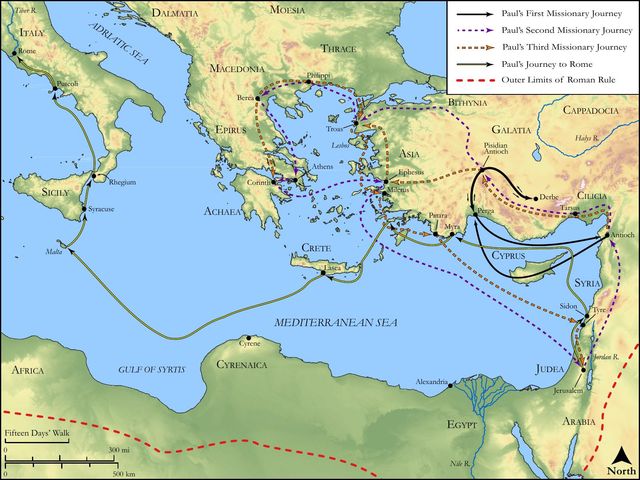
See on the biblical-era map


Study this verse
Public-domain commentary
Matthew Henry
From his Commentary on the Whole Bible. Henry comments on passages, not single verses — this entry covers Acts 16:25–34. His four-level outline is real structure in the source text, so it is rendered as structure.
We have here the designs of the persecutors of Paul and Silas baffled and broken.
I.The persecutors designed to dishearten and discourage the preachers of the gospel, and to make them sick of the cause and weary of their work; but here we find them both hearty and heartened.
1.They were themselves hearty, wonderfully hearty; never were poor prisoners so truly cheerful, nor so far from laying their hard usage to heart. Let us consider what their case was. The praetors among the Romans had rods carried before them, and axes bound upon them, the fasces and secures. Now they had felt the smart of the rods, the ploughers had ploughed upon their backs, and made long furrows. The many stripes they had laid upon them were very sore, and one might have expected to hear them complaining of them, of the rawness and soreness of their backs and shoulders. Yet this was not all; they had reason to fear the axes next. Their master was first scourged and then crucified; and they might expect the same. In the mean time they were in the inner prison, their feet in the stocks, which, some think, not only held them, but hurt them; and yet, at midnight, when they should have been trying, if possible, to get a little rest, they prayed and sang praises to God.
(1.)They prayed together, prayed to God to support them and comfort them in their afflictions, to visit them, as he did Joseph in the prison, and to be with them, - prayed that their consolations in Christ might abound, as their afflictions for him did, - prayed that even their bonds and stripes might turn to the furtherance of the gospel, - prayed for their persecutors, that God would forgive them and turn their hearts. This was not at an hour of prayer, but at midnight; it was not in a house of prayer, but in a dungeon; yet it was seasonable to pray, and the prayer was acceptable. As in the dark, so out of the depths, we may cry unto God. No place, no time, amiss for prayer, if the heart be lifted up to God. Those that are companions in suffering should join in prayer. Is any afflicted? Let him pray. No trouble, how grievous soever, should indispose us for prayer.
(2.)They sang praises to God. They praised God; for we must in every thing give thanks. We never want matter for praise, if we do not want a heart. And what should put the heart of a child of God out of tune for this duty if a dungeon and a pair of stocks will not do it? They praised God that they were counted worthy to suffer shame for his name, and that they were so wonderfully supported and borne up under their sufferings, and felt divine consolations so sweet, so strong, in their souls. Nay, they not only praised God, but they sang praises to him, in some psalm, or hymn, or spiritual song, either one of David's, or some modern composition, or one of their own, as the Spirit gave them utterance. As our rule is that the afflicted should pray, and therefore, being in affliction, they prayed; so our rule is that the merry should sing psalms (Jam 5:13), and therefore, being merry in their affliction, merry after a godly sort, they sang psalms. This proves that the singing of psalms is a gospel ordinance, and ought to be used by all good Christians; and that it is instituted, not only for the expressing of their joys in a day of triumph, but for the balancing and relieving of their sorrows in a day of trouble. It was at midnight that they sang psalms, according to the example of the sweet psalmist of Israel (Psa 119:62): At midnight will I rise to give thanks unto thee.
(3.)Notice is here taken of the circumstance that the prisoners heard them. If the prisoners did not hear them pray, yet they heard them sing praises.
[1.]It intimates how hearty they were in singing praises to God; they sang so loud that, though they were in the dungeon, they were heard all the prison over; nay, so loud that they woke the prisoners: for we may suppose, being at midnight, they were all asleep. We should sing psalms with all our heart. The saints are called upon to sing aloud upon their beds, Psa 149:5. But gospel grace carries the matter further, and gives us an example of those that sang aloud in the prison, in the stocks.
[2.]Though they knew the prisoners would hear them, yet they sang aloud, as those that were not ashamed of their Master, nor of his service. Shall those that would sing psalms in their families plead, in excuse for their omission of the duty, that they are afraid their neighbours should hear them, when those that sing profane songs roar them our, and care not who hears them?
[3.]The prisoners were made to hear the prison-songs of Paul and Silas, that they might be prepared for the miraculous favour shown to them all for the sake of Paul and Silas, when the prison-doors were thrown open. By this extraordinary comfort with which they were filled it was published that he whom they preached was the consolation of Israel. Let the prisoners that mean to oppose him hear and tremble before him; let those that are faithful to him hear and triumph, and take of the comfort that is spoken to the prisoners of hope, Zac 9:12.
2.God heartened them wonderfully by his signal appearances for them, Act 16:26.
(1.)There was immediately a great earthquake; how far it extended we are not told, but it was such a violent shock in this place that the very foundations of the prison were shaken. While the prisoners were hearkening to the midnight devotions of Paul and Silas, and perhaps laughing at them and making a jest of them, this earthquake would strike a terror upon them, and convince them that those men were the favourites of Heaven, and such as God owned. We had the house of prayer shaken, in answer to prayer, and as a token of God's acceptance of it, Act 4:31. Here the prison shaken. The Lord was in these earthquakes, to show his resentment of the indignities done to his servants, to testify to those whose confidence is in the earth the weakness and instability of that which they confide, and to teach people that, though the earth be moved, yet they need not fear.
(2.)The prison-doors were thrown open, and the prisoners' fetters were knocked off: Every man's bands were loosed. Perhaps the prisoners, when they heard Paul and Silas pray and sing psalms, admired them, and spoke honourably of them, and said what the damsel had said of them, Surely, these men are the servants of the living God. To recompense them for, and confirm them in, their good opinion of them, they share in the miracle, and have their bands loosed; as afterwards God gave to Paul all those that were in the ship with him (Act 27:24), so now he gave him all those that were in the prison with him. God hereby signified to these prisoners, as Grotius observes, that the apostles, in preaching the gospel, were public blessings to mankind, as they proclaimed liberty to the captives, and the opening of the prison-doors to those that were bound, Isa 61:1. Et per eos solvi animorum vincula - and as by them the bonds of souls were unloosed.
II.The persecutors designed to stop the progress of the gospel, that no more might embrace it; thus they hoped to ruin the meeting by the river side, that no more hearts should be opened there; but here we find converts made in the prison, that house turned into a meeting, the trophies of the gospel's victories erected there, and the jailer, their own servant, become a servant of Christ. It is probable that some of the prisoners, if not all, were converted; surely the miracle wrought on their bodies, in loosing their bands, was wrought on their souls too. See Job 36:8-10; Psa 107:14, Psa 107:15. But it is only the conversion of the jailer that is recorded.
1.He is afraid he shall lose his life, and Paul makes him easy as to this care, Act 16:27, Act 16:28.
(1.)He awoke out of his sleep. It is probable that the shock of the earthquake woke him, and the opening of the prison-doors, and the prisoners' expressions of joy and amazement, when in the dark they found their bands loosed, and called to tell one another what they felt: this was enough to awaken the jailer, whose place required that he should not be hard to wake. This waking him out of his sleep signified the awakening of his conscience out of its spiritual slumber. The call of the gospel is, Awake, thou that sleepest (Eph 5:14), like that of Jonah, Jon 1:6.
(2.)He saw the prison-doors open, and supposed, as well he might, that the prisoners had fled; and then what would become of him? He knew the Roman law in that case, and it was executed not long ago upon the keepers out of whose hands Peter escaped, Act 12:19. It was according to that of the prophet, Kg1 20:39, Kg1 20:42, Keep this man; if he be missing, thy life shall go for his life. The Roman lawyers after this, in their readings upon the law, De custodia reorum - The custody of criminals (which appoints that the keeper should undergo the same punishment that should have been inflicted on the prisoner if he let him escape), take care to except an escape by miracle.
(3.)In his fright he drew his sword, and was going to kill himself, to prevent a more terrible death, and expected one, a pompous ignominious death, which he knew he was liable to for letting his prisoners escape and not looking better to them; and the extraordinarily strict charge which the magistrates gave him concerning Paul and Silas made him conclude they would be very severe upon him if they were gone. The philosophers generally allowed self-murder. Seneca prescribes it as the last remedy which those that are in distress may have recourse to. The Stoics, notwithstanding their pretended conquest of the passions, yielded thus far to them. And the Epicureans, who indulged the pleasures of sense, to avoid its pains chose rather to put an end to it. This jailer thought there was no harm in anticipating his own death; but Christianity proves itself to be of God by this, that it keeps us to the law of our creation - revives, enforces, and establishes it, obliges us to be just to our own lives, and teaches us cheerfully to resign them to our graces, but courageously to hold them out against our corruptions.
(4.)Paul stopped him from his proceeding against himself (Act 16:28): He cried with a loud voice, not only to make him hear, but to make him heed, saying, Do not practise any evil to thyself; Do thyself no harm. All the cautions of the word of God against sin, and all appearances of it and approaches to it, have this tendency, "Do thyself no harm. Man, woman, do not wrong thyself, nor ruin thyself; hurt not thyself, and then none else can hurt thee; do not sin, for nothing else can hurt thee." Even as to the body, we are cautioned against those sins which do harm to it, and are taught to hate our own flesh, but to nourish and cherish it. The jailer needs not fear being called to an account for the escape of his prisoners, for they are all here. It was strange that some of them did not slip away, when the prison-doors were opened, and they were loosed from their bands; but their amazement held them fast, and, being sensible it was by the prayers of Paul and Silas that they were loosed, they would not stir unless they stirred; and God showed his power in binding their spirits, as much as in loosing their feet.
2.He is afraid he shall lose his soul, and Paul makes him easy as to this care too. One concern leads him to another, and a much greater; and, being hindered from hastening himself out of this world, he begins to think, if he had pursued his intention, whither death would have brought him, and what would have become of him on the other side death - a very proper thought for such as have been snatched as a brand out of the fire, when there was but a step between them and death. Perhaps the heinousness of the sin he was running into helped to alarm him.
(1.)Whatever was the cause, he was put into a great consternation. The Spirit of God, that was sen to convince, in order to his being a Comforter, struck a terror upon him, and startled him. Whether he took care to shut the prison-doors again we are not told. Perhaps he forgot this as the woman of Samaria, when Christ had impressed convictions on her conscience, left her water-pot and forgot her errand to the well; for he called for a light with all speed, and sprang in to the inner prison, and came trembling to Paul and Silas. Those that have sin set in order before them, and are made to know their abominations, cannot but tremble at the apprehension of their misery and danger. This jailer, when he was thus made to tremble, could not apply to a more proper person than to Paul, for it had once been his own case; he had been once a persecutor of good men, as this jailer was - had cast them into prison, as he kept them - and when, like him, he was made sensible of it, he trembled, and was astonished; and therefore he was able to speak the more feelingly to the jailer.
(2.)In this consternation, he applied to Paul and Silas for relief. Observe,
[1.]How reverent and respectful his address to them is: He called for a light, because they were in the dark, and that they might see what a fright he was in; he fell down before them, as one amazed at the badness of his own condition, and ready to sink under the load of his terror because of it; he fell down before them, as one that had upon his spirit an awe of them, and of the image of God upon them, and of their commission from God. It is probable that he had heard what the damsel said of them, that they were the servants of the living God, who showed to them the way of salvation, and as such he thus expressed his veneration for them. He fell down before them, to beg their pardon, as a penitent, for the indignities he had done them, and to beg their advice, as a supplicant, what he should do. He gave them a title of respect, Sirs, kurioi - lords, masters; just now it was, Rogues and villains, and he was their master; but now, Sirs, lords, and they are his masters. Converting grace changes people's language of and to good people and good ministers; and, to such as are thoroughly convinced of sin, the very feet of those that bring tidings of Christ are beautiful; yea, though they are disgracefully fastened in the stocks.
[2.]How serious his enquiry is: What must I do to be saved? First, His salvation is now his great concern, and lies nearest his heart, which before was the furthest thing from his thoughts. Not, What shall I do to be preferred, to be rich and great in the world? but, What shall I do to be saved? Secondly, He does not enquire concerning others, what they must do; but concerning himself, "What must I do?" It is his own precious soul that he is in care about: "Let others do as they please; tell me what I must do, what course I must take." Thirdly, He is convinced that something must be done, and done by him too, in order to his salvation: that it is not a thing of course, a thing that will do itself, but a thing about which we must strive, wrestle, and take pains. He asks not, "What may be done for me?" but, "What shall I do, that, being now in fear and trembling, I may work out my salvation?" as Paul speaks in his epistle to the church at Philippi, of which this jailer was, perhaps with respect to his trembling enquiry here, intimating that he must not only ask after salvation (as he had done), but work out his salvation with a holy trembling, Phi 2:12. Fourthly, He is willing to do any thing: "Tell me what I must do, and I am here ready to do it. Sirs, put me into any way, if it be but the right way, and a sure way; though narrow, and thorny, and uphill, yet I will walk in it." Note, Those who are thoroughly convinced of sin, and truly concerned about their salvation, will surrender at discretion to Jesus Christ, will give him a blank to write what he pleases, will be glad to have Christ upon his own terms, Christ upon any terms. Fifthly, He is inquisitive what he should do, is desirous to know what he should do, and asks those that were likely to tell him. If you will enquire, enquire ye, Isa 21:12. Those that set their faces Zionward must ask the way thither, Jer 50:5. We cannot know it of ourselves, but God has made it known to us by his word, has appointed his ministers to assist us in consulting the scriptures, and has promised to give his Holy Spirit to those that ask him, to be their guide in the way of salvation. Sixthly, He brought them out, to put this question to them, that their answer might not be by duress or compulsion, but that they might prescribe to him, though he was their keeper, with the same liberty as they did to others. He brings them out of the dungeon, in hopes they will bring him out of a much worse.
(3.)They very readily directed him what he must do, Act 16:31. They were always ready to answer such enquiries; though they are cold, and sore, and sleepy, they do not adjourn this cause to a more convenient time and place, do not bod him come to them the next sabbath at their meeting-place by the river side, and they will tell him, but they strike while the iron is hot, take him now when he is in a good mind, lest the conviction should wear off. Now that God begins to work, it is time for them to set in as workers together with God. They do not upbraid him with his rude and ill carriage towards them, and his going beyond his warrant; all this is forgiven and forgotten, and they are as glad to show him the way to heaven as the best friend they have. They did not triumph over him, though he trembled; they gave him the same directions they did to others, Believe in the Lord Jesus Christ. One would think they should have said, "Repent of thy abusing us, in the first place." No, that is overlooked and easily passed by, if he will but believe in Christ. This is an example to ministers to encourage penitents, to meet those that are coming to Christ and take them by the hand, not to be hard upon any for unkindness done to them, but to seek Christ's honour more than their own. Here is the sum of the whole gospel, the covenant of grace in a few words: Believe in the Lord Jesus Christ, and thou shalt be saved, and thy house. Here is, [1.] The happiness promised: "Thou shalt be saved; not only rescued from eternal ruin, but brought to eternal life and blessedness. Though thou art a poor man, an under-jailer or turnkey, mean and of low condition in the world, yet this shall be no bar to thy salvation. Though a great sinner, though a persecutor, yet thy heinous transgressions shall be all forgiven through the merits of Christ; and thy hard embittered heart shall be softened and sweetened by the grace of Christ, and thus thou shalt neither die for thy crime nor die of thy disease." [2.] The condition required: Believe in the Lord Jesus Christ. We must admit the record that God hath given in his gospel concerning his Son, and assent to it as faithful, and well worthy of all acceptation. We must approve the method God has taken of reconciling the world to himself by a Mediator; and accept of Christ as he is offered to us, and give up ourselves to be ruled and taught and saved by him. This is the only way and a sure way to salvation. No other way of salvation than by Christ, and no other way of our being saved by Christ than by believing in him; and no danger of coming short if we take this way, for it is the way that God has appointed, and he is faithful that has promised. It is the gospel that is to be preached to every creature, He that believes shall be saved. [3.] The extension of this to his family: Thou shalt be saved, and thy house; that is, "God will be in Christ a God to thee and to thy seed, as he was to Abraham. Believe, and salvation shall come to thy house, as Luk 19:9. Those of thy house that are infants shall be admitted into the visible church with thee, and thereby put into a fair way for salvation; those that are grown up shall have the means of salvation brought to them, and, be they ever so many, let them believe in Jesus Christ and they shall be saved; they are all welcome to Christ upon the same terms."
(4.)They proceeded to instruct him and his family in the doctrine of Christ (Act 16:32): They spoke unto him the word of the Lord. He was, for aught that appears, an utter stranger to Christ, and therefore it is requisite he should be told who this Jesus is, that he may believe in him, Joh 9:36. And, the substance of the matter lying in a little compass, they soon told him enough to make his being baptized a reasonable service. Christ's ministers should have the word of the Lord so ready to them, and so richly dwelling in them, as to be able to give instructions offhand to any that desire to hear and receive them, for their direction in the way of salvation. They spoke the word not only to him, but to all that were in his house. Masters of families should take care that all under their charge partake of the means of knowledge and grace, and that the word of the Lord be spoken to them; for the souls of the poorest servants are as precious as those of their masters, and are bought with the same price.
(5.)The jailer and his family were immediately baptized, and thereby took upon them the profession of Christianity, submitted to its laws, and were admitted to its privileges, upon their declaring solemnly, as the eunuch did, that they believed that Jesus Christ is the Son of God: He was baptized, he and all his, straightway. Neither he nor any of his family desired time to consider whether they should come into baptismal bonds or no; nor did Paul and Silas desire time to try their sincerity and to consider whether they should baptize them or no. But the Spirit of grace worked such a strong faith in them, all on a sudden, as superseded further debate; and Paul and Silas knew by the Spirit that it was a work of God that was wrought in them: so that there was no occasion for demur. This therefore will not justify such precipitation in ordinary cases.
(6.)The jailer was hereupon very respectful to Paul and Silas, as one that knew not how to make amends for the injury he had done to them, much less for the kindness he had received from them: He took them the same hour of the night, would not let them lie a minute longer in the inner prison; but,
[1.]He washed their stripes, to cool them, and abate the smart of them; to clean them from the blood which the stripes had fetched. It is probable that he bathed them with some healing liquor, as the good Samaritan helped the wounded man by pouring in oil and wine.
[2.]He brought them into his house, bade them welcome to the best room he had, and prepared his best bed for them. Now nothing was thought good enough for them, as before nothing bad enough.
[3.]He set meat before them, such as his house would afford, and they were welcome to it, by which he expressed the welcome which his soul gave to the gospel. They had spoken to him the word of the Lord, had broken the bread of life to him and his family; and he, having reaped so plentifully of their spiritual things, thought it was but reasonable that they should reap of his carnal things, Co1 9:11. What have we houses and tables for but as we have opportunity to serve God and his people with them?
(7.)The voice of rejoicing with that of salvation was heard in the jailer's house; never was such a truly merry night kept there before: He rejoiced, believing in God, with all his house. There was none in his house that refused to be baptized, and so made a jar in the harmony; but they were unanimous in embracing the gospel, which added much to the joy. Or it may be read, He, believing in God, rejoiced all the house over; panoiki - he went to every apartment, expressing his joy. Observe,
[1.]His believing in Christ is called believing in God, which intimates that Christ is God, and that the design of the gospel is so far from being to draw us from God (saying, Go serve other gods, Deu 13:2) that it has a direct tendency to bring us to God.
[2.]His faith produced joy. Those that by faith have given up themselves to God in Christ as theirs have a great deal of reason to rejoice. The eunuch, when he was converted, went on his way rejoicing; and here the jailer rejoiced. The conversion of the nations is spoken of in the Old Testament as their rejoicing, Psa 67:4; Psa 96:11. For, believing, we rejoice with joy unspeakable, and full of glory. Believing in Christ is rejoicing in Christ.
[3.]He signified his joy to all about him. Out of the abundance of the joy in his heart, his mouth spoke to the glory of God, and their encouragement who believed in God too. Those who have themselves tasted the comforts of religion should do what they can to bring others to the taste of them. One cheerful Christian should make many.
Historical interpretation
Historical reception
2 surviving comments on this verse. Each one is dated, so this reads as a timeline rather than a list.
Then he called for lights, and sprang in, and came trembling, and fell down before Paul and Silas; and brought them out, and said, Sirs, what must I do to be saved? Do you mark how the wonder overpowered him? And having called for lights, it says, he sprang in, and fell down at the feet of the prisoner; he, the prison keeper, saying, Sirs, what must I do to be saved? Why, what had they said? Observe, he does not, on finding himself safe, think all is well; he is overcome with awe at the miraculous power.
Do you mark what happened in the former case, and what here? There a girl was released from a spirit, and they cast them into prison, because they had liberated her from the spirit. Here, they did but show the doors standing open, and it opened the doors of his heart, it loosed two sorts of chains; that prisoner kindled the true light; for the light in his heart was shining. And he sprang in, and fell before them; and he does not ask, How is this? What is this? but straightway he says, What must I do to be saved?
Continue studying Acts 16:30 across the web’s major study libraries — every link below opens this exact verse, chapter, or book on the destination site.
Read & Compare
 BibleGatewayThis verse in more than 200 translations and 70 languages.
 Bible.comThe YouVersion reader — hundreds of translations, reading plans, and highlights.
 ESV.orgCrossway's official English Standard Version reader.
 NET BibleThe NET translation with 60,000+ translators' notes on every rendering decision.
 STEP BibleTyndale House's free study tool — original text, vocabulary, and scholarly resources.
 BibliaLogos Bible Software's free web reader.
 USCCBThe New American Bible (Revised Edition) with the U.S. bishops' study notes.
Commentaries
 BibleHub CommentariesDozens of classic commentaries on this verse, gathered on one page.
 StudyLightMore than 100 commentary sets — the largest collection on the web.
 BibleRefPlain-English commentary on what this verse means, verse by verse.
 Enduring WordDavid Guzik's free commentary on this chapter, widely used by Bible teachers.
 Bible Study ToolsVerse commentary alongside Greek and Hebrew study aids.
Original Language & Research
- BibleHub InterlinearThe verse word by word — original language, transliteration, and English.
- BibleHub LexiconEvery word's original-language definition and Strong's entry.
 Blue Letter BibleDeep-study tools — Strong's numbers, concordance, and word studies.
 CNTR CollationThe earliest Greek manuscripts of this verse, collated letter by letter.
Sermons, Hymns & Audio


TrulyRandomVerse is not affiliated with these sites and doesn’t control their content. They’re linked because they’re genuinely useful.
Summary
Acts 16:30 captures the Philippian jailer's desperate and pivotal question, "Sirs, what must I do to be saved?" This urgent inquiry emerges from a night of divine intervention, where an earthquake miraculously opened prison doors and loosened chains, yet Paul and Silas remained. Overwhelmed by these supernatural events and the integrity of his prisoners, the jailer, facing potential execution for perceived negligence, recognized a deeper, spiritual peril. His question transcends mere physical safety, revealing a profound conviction of sin and an immediate, overwhelming desire for eternal deliverance, marking a dramatic turning point in his life and a powerful moment in the early Christian mission.
Context
ShowHideLiterary Context
This verse is the climax of a dramatic sequence in Philippi. Paul and Silas, having been unjustly beaten and imprisoned for casting out a spirit of divination from a slave girl, were held in the innermost cell with their feet in stocks Acts 16:23-24. Despite their suffering, at midnight, they were praying and singing hymns to God, and the other prisoners were listening Acts 16:25. Suddenly, a violent earthquake shook the prison, opening all the doors and loosening everyone's chains Acts 16:26. The jailer, awakened by the commotion and fearing all the prisoners had escaped (which would have meant his own execution under Roman law), was about to take his own life Acts 16:27. Paul, however, cried out, assuring him that no one had fled Acts 16:28. Overwhelmed by these supernatural events and the unexpected integrity of his prisoners, the jailer called for lights, rushed in, and fell trembling before Paul and Silas, leading directly to the question in Acts 16:30.
Historical & Cultural Context
Philippi was a Roman colony, a strategic city in Macedonia, and its citizens, including the jailer, would have been deeply ingrained in Roman law and culture. Roman law was exceptionally strict regarding the custody of prisoners; if a prisoner escaped, the guard responsible faced the same punishment the prisoner would have received, often death. The jailer's immediate reaction to draw his sword and commit suicide underscores this severe legal reality and his profound fear of dishonor and execution. His address of Paul and Silas as "Sirs" (κύριοι, kyrioi) indicates a shift from his position of authority to one of profound respect and supplication, acknowledging their spiritual power and authority, which he had just witnessed through the earthquake and their miraculous restraint. This scene also highlights the clash between pagan Roman practices and the burgeoning Christian faith, demonstrating God's power to penetrate even the most hardened and structured environments.
Key Themes
ShowHideThe jailer's question contributes significantly to several key themes within the book of Acts and broader biblical theology. First, it powerfully illustrates the Urgency of Salvation, revealing a sudden and profound awareness of spiritual need prompted by a clear demonstration of divine power. The jailer's concern moves beyond physical safety to an existential crisis, highlighting humanity's universal need for deliverance from sin and its consequences. Second, it showcases Divine Intervention and Providence, as the earthquake was not a random event but a direct act of God, sovereignly orchestrating circumstances to open a door for the gospel message and bring a lost soul to repentance and faith. This echoes the theme of God's active involvement in the spread of His kingdom, as seen in other miraculous deliverances throughout Acts. Finally, the episode underscores the Universal Need for Redemption, demonstrating that the deepest human need—the need for salvation—transcends cultural, social, and religious boundaries. A Roman official in a pagan city, accustomed to earthly power, is brought to his knees by a spiritual reality, proving that the gospel is for all people, Jew and Gentile alike, as emphasized throughout Paul's ministry.
Exposition and Analysis
ShowHideKey Word Analysis
ShowHideMeaning "supreme in authority, i.e. (as noun) controller; by implication, Master (as a respectful title):-- God, Lord, master, Sir." The jailer's use of "Sirs" (κύριοι, kyrioi) is significant. It is a respectful address, but in this context, it goes beyond mere politeness. It implies a recognition of a higher authority or power residing in Paul and Silas, perhaps even a divine one, especially after witnessing the earthquake and their miraculous steadfastness. It reflects a shift from his previous position of authority over them to one of submission and earnest inquiry.
Meaning "3rd person singular active present of δέω; also deon deh-on'; neuter active participle of the same; both used impersonally; it is (was, etc.) necessary (as binding):--behoved, be meet, must (needs), (be) need(-ful), ought, should." The word "must" (δεῖ, deî) indicates a moral or divine necessity, not merely a suggestion or an option. It conveys the jailer's profound conviction that something is absolutely required on his part to address his desperate situation. This is not a casual question but a recognition of a binding obligation or an essential prerequisite for the deliverance he seeks.
Meaning "from a primary (contraction for obsolete, "safe"); to save, i.e. deliver or protect (literally or figuratively):--heal, preserve, save (self), do well, be (make) whole." While sōzō can refer to physical preservation, in this context, especially given Paul's subsequent answer in Acts 16:31, it clearly refers to spiritual salvation—deliverance from sin, its guilt, and its eternal consequences. The jailer's inquiry moves beyond his immediate physical safety (which was already secured by Paul's intervention) to a deep concern for his eternal destiny, indicating a divinely-prompted conviction of sin and a desire for reconciliation with God.
Verse Breakdown
ShowHide"And brought them out"
This phrase signifies the jailer's immediate and decisive action. From being their captor, he now physically leads Paul and Silas out of the inner prison, a place of maximum security and punishment, into a space where a more open and urgent conversation can take place. This physical act mirrors his internal shift from hostility to humility and receptiveness.
"and said"
The jailer's words are direct and urgent, reflecting the profound spiritual crisis he is experiencing. This is not a casual inquiry but a desperate cry for help, indicating a complete reversal of his previous demeanor and authority.
"Sirs"
As noted in the key word analysis, this address (κύριοι, kyrioi) is a term of profound respect and even reverence. It acknowledges Paul and Silas not as mere prisoners, but as individuals possessing a spiritual authority or insight that he desperately needs. It highlights his newfound humility and recognition of their unique standing.
"what must I do"
This is the core of his question, expressing a deep sense of personal responsibility and a willingness to act. The word "must" (δεῖ, deî) conveys an absolute necessity, indicating that the jailer understands that his situation requires a specific, binding action on his part. He is not asking for a favor, but for a directive, a path to follow.
"to be saved?"
This final phrase clarifies the object of his desperate search. While he was initially concerned about his physical life due to the prison break, Paul's intervention and the miraculous nature of the earthquake shifted his focus to a deeper, spiritual salvation. He is asking how to be delivered from a state of spiritual peril, how to gain eternal life, and how to be reconciled with the God who demonstrated such power.
Literary Devices
ShowHideThe narrative in Acts 16:30 employs several powerful literary devices. Dramatic Irony is evident as the jailer, initially a figure of authority and control, is brought to his knees, not by human force, but by divine power and the integrity of his prisoners. He fears earthly punishment, but God uses this fear to prompt a deeper concern for eternal salvation. The Symbolism of the earthquake is profound; it is not merely a natural phenomenon but a divine intervention, shaking not just the prison foundations but also the jailer's worldview, opening the way for the gospel. The darkness of the prison contrasts with the spiritual light that is about to dawn in the jailer's life. Finally, the jailer's question itself functions as a Rhetorical Question in a broader sense, as it encapsulates the fundamental human yearning for meaning and deliverance, making it universally relatable and setting the stage for the simple, yet profound, answer of the gospel.
Theological and Thematic Connections
ShowHideThe Philippian jailer's question, "Sirs, what must I do to be saved?", stands as one of the most direct and foundational inquiries about personal faith in the entire New Testament. It articulates the universal human condition of spiritual lostness and the innate longing for deliverance, whether consciously recognized or not. This moment underscores the Christian doctrine of salvation by grace through faith, emphasizing that salvation is not earned by human effort or ritual, but is a free gift of God received through belief. The immediate and clear response given by Paul and Silas in the very next verse provides the simple, yet profound, core of the Christian gospel, demonstrating God's accessibility and the clarity of His saving message. This powerful exchange illustrates God's sovereign ability to use extraordinary circumstances to bring individuals to a point of spiritual conviction, leading them to seek and receive the gift of eternal life through faith, regardless of their background or previous spiritual state.
Reflection and Application
ShowHideActs 16:30 serves as a timeless reminder of humanity's innate need for spiritual peace and the direct, accessible path to finding it. The Philippian jailer's dramatic conversion story encourages us that God's grace can reach anyone, anywhere, transforming lives in an instant. His desperate cry for salvation, prompted by overwhelming circumstances and divine intervention, mirrors the spiritual awakening many experience when confronted with their own mortality, the consequences of sin, or the undeniable power of God. This narrative challenges believers to be ready to articulate the simple gospel message, just as Paul and Silas were, to those who are searching. It also prompts us to consider our own spiritual state: Have we truly asked this question ourselves? Have we embraced the answer? For those who have, it is a call to compassionately share this life-altering truth with a world still desperately asking, "What must I do to be saved?"
Questions for Reflection
ShowHideFAQ
ShowHideWhy was the Philippian jailer so desperate to ask about salvation?
ShowHideThe jailer's desperation stemmed from a confluence of factors. First, under Roman law, if any prisoner escaped, the jailer would face the same punishment as the escaped prisoner, often death Acts 16:27. When the earthquake opened all the prison doors, his immediate fear was that all prisoners had fled, leading him to draw his sword to commit suicide to avoid a more dishonorable execution. However, Paul's cry that no one had escaped Acts 16:28 shifted his focus. The miraculous nature of the earthquake, combined with the unexpected integrity of Paul and Silas (who remained despite the opportunity to flee), revealed a power beyond human comprehension. This supernatural display, coupled with the prisoners' earlier prayer and praise, brought a profound conviction of a spiritual reality he had previously ignored, prompting his urgent question about eternal salvation rather than just physical safety.
Does "saved" in this verse refer to physical deliverance or spiritual salvation?
ShowHideWhile the Greek word sōzō (G4982) can mean physical preservation or healing, in the context of Acts 16:30, it unequivocally refers to spiritual salvation. The jailer's immediate physical danger (from the earthquake or Roman law) had already been averted by Paul's intervention. His question, "what must I do to be saved?", followed by Paul and Silas's response in Acts 16:31, "Believe on the Lord Jesus Christ, and thou shalt be saved, and thy house," clearly points to deliverance from sin and its eternal consequences, leading to eternal life. The subsequent events, including the jailer and his household being baptized Acts 16:33 and rejoicing in God Acts 16:34, further confirm that a spiritual transformation had occurred.
Christ-Centered Fulfillment
ShowHideThe Philippian jailer's desperate cry, "Sirs, what must I do to be saved?", finds its ultimate and singular answer in Jesus Christ. This question, born out of a profound realization of spiritual peril and a divinely orchestrated encounter, is the quintessential human question that only God can answer. Paul and Silas's immediate response in Acts 16:31—"Believe on the Lord Jesus Christ, and thou shalt be saved"—points directly to the person and work of Christ as the sole means of salvation. Jesus Himself declared, "I am the way, the truth, and the life. No one comes to the Father except through me" John 14:6. He is the Lamb of God who takes away the sin of the world John 1:29, the one whose death on the cross paid the penalty for humanity's sin, and whose resurrection conquered death, offering eternal life to all who believe. The jailer's question, therefore, is fulfilled in Christ, who is not merely a path to salvation but salvation itself, embodying the grace and truth that deliver humanity from spiritual darkness into His marvelous light 1 Peter 2:9. Every human heart, whether consciously or unconsciously, echoes the jailer's question, and Christ remains the only sufficient and eternal answer.