


Acts 4:31
Bible text: King James Version (1769 Blayney text) · Public domain
Bible text: King James Version with Strong's numbers · Public domain
Bible text: Berean Standard Bible · Public domain
Bible text: American Standard Version (1901) · Public domain
Bible text: World English Bible, Messianic edition · Public domain
Bible text: Geneva Bible (1599) · Public domain
Bible text: Young's Literal Translation · Public domain
- καὶkaiAndG2532CONJConjunction
- δεηθέντωνdeēthentōnwhen were prayingG1189V-AOP-GPMVerb Aorist Passive Deponent Participle Genitive Plural Masculine
- αὐτῶνautōntheyG846P-GPMPersonal pronoun Genitive Plural Masculine
- ἐσαλεύθηesaleuthēwas shakenG4531V-API-3SVerb Aorist Passive Indicative 3rd Singular
- ὁhotheG3588T-NSMDefinite article Nominative Singular Masculine
- τόποςtoposplaceG5117N-NSMNoun Nominative Singular Masculine
- ἐνeninG1722PREPPreposition
- ᾧhōwhichG3739R-DSMRelative pronoun Dative Singular Masculine
- ἦσανēsanthey wereG1510V-IAI-3PVerb Imperfect Active Indicative 3rd Plural
- συνηγμένοιsunēgmenoiassembledG4863V-RPP-NPMVerb Perfect Passive Participle Nominative Plural Masculine
- καὶkaiandG2532CONJConjunction
- ἐπλήσθησανeplēsthēsanthey were filledG4130V-API-3PVerb Aorist Passive Indicative 3rd Plural
- ἅπαντεςhapantesallG537A-NPMAdjective Nominative Plural Masculine
- ἁγίουhagiouHolyG40A-GSNAdjective Genitive Singular Neuter
- πνεύματοςpneumatosSpiritG4151N-GSNNoun Genitive Singular Neuter
- καὶkaiandG2532CONJConjunction
- ἐλάλουνelalounwere speakingG2980V-IAI-3PVerb Imperfect Active Indicative 3rd Plural
- τὸνtontheG3588T-ASMDefinite article Accusative Singular Masculine
- λόγονlogonwordG3056N-ASMNoun Accusative Singular Masculine
- τοῦtou<the>G3588T-GSMDefinite article Genitive Singular Masculine
- θεοῦtheouof GodG2316N-GSM-TNoun Genitive Singular Masculine Title
- μετὰmetawithG3326PREPPreposition
- παρρησίαςparrēsiasboldnessG3954N-GSFNoun Genitive Singular Feminine
English is a literal word-by-word gloss of the Greek, not the KJV's wording. Why?
This is the original text the KJV's translators worked from — each Greek word with its own literal English meaning in this verse, prepared by scholars at Tyndale House, Cambridge. The KJV translates whole sentences, not word by word, so its wording differs: one Greek word can become several English words, and the KJV may choose “charity” where the gloss reads “love”. Both are faithful — they answer different questions. For the KJV's own rendering, switch to the KJV text.
Details
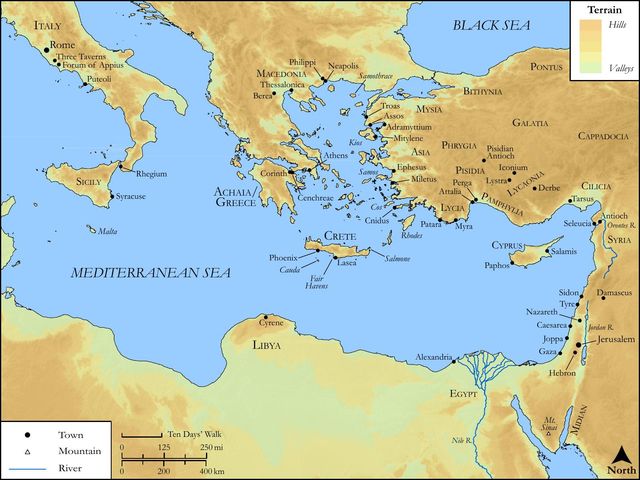
See on the biblical-era map
Study this verse
Public-domain commentary
Matthew Henry
From his Commentary on the Whole Bible. Henry comments on passages, not single verses — this entry covers Acts 4:23–31. His four-level outline is real structure in the source text, so it is rendered as structure.
We hear no more at present of the chief priests, what they did when they had dismissed Peter and John, but are to attend those two witnesses. And here we have,
I.Their return to their brethren, the apostles and ministers, and perhaps some private Christians (Act 4:23):
Being let go, they went to their own company, who perhaps at this time were met together in pain for them, and praying for them; as Act 12:12. As soon as ever they were at liberty, they went to their old friends, and returned to their church-fellowship.
1.Though God had highly honoured them, in calling them out to be his witnesses, and enabling them to acquit themselves so well, yet they were not puffed up with the honour done them, nor thought themselves thereby exalted above their brethren, but went to their own company. No advancement in gifts or usefulness should make us think ourselves above either the duties or the privileges of the communion of saints.
2.Though their enemies had severely threatened them, and endeavoured to break their knot, and frighten them from the work they were jointly engaged in, yet they went to their own company, and feared not the wrath of their rulers. They might have had comfort, if, being let go, they had retired to their closets, and spent some time in devotion there. But they were men in a public station, and must seek not so much their own personal satisfaction as the public good. Christ's followers do best in company, provided it be in their own company.
II.The account they gave them of what had passed:
They reported all that the chief priests and elders had said to them, adding, no doubt, what they were enabled by the grace of God to reply to them, and how their trial issued. They related it to them,
1.That they might know what to expect both from men and from God in the progress of their work. From men they might expect every thing that was terrifying, but from God every thing that was encouraging; men would do their utmost to run them down, but God would take effectual care to bear them up. Thus the brethren in the Lord would wax confident through their bonds, and their experiences, as Phi 1:14.
2.That they might have it recorded in the history of the church, for the benefit of posterity, particularly for the confirmation of our faith touching the resurrection of Christ. The silence of an adversary, in some cases, is next door to the consent and testimony of an adversary. These apostles told the chief priests to their faces that God had raised up Jesus from the dead, and, though they were a body of them together, they had not the confidence to deny it, but, in the silliest and most sneaking manner imaginable, bade the apostles not to tell any body of it.
3.That they might now join with them in prayers and praises; and by such a concert as this God would be the more glorified, and the church the more edified. We should therefore communicate to our brethren the providences of God that relate to us, and our experience of his presence with us, that they may assist us in our acknowledgment of God therein.
III.Their address to God upon this occasion:
When they heard of the impotent malice of the priests, and the potent courage of the sufferers, they called their company together and went to prayer: They lifted up their voice to God with one accord, Act 4:24. Not that it can be supposed that they all said the same words at the same time (though it was possible they might, being all inspired by one and the same Spirit), but one in the name of the rest lifted up his voice to God and the rest joined with him, humothumadon - with one mind (so the word signifies); their hearts went along with him, and so, though but one spoke, they all prayed; one lifted up his voice, and, in concurrence with him, they all lifted up their hearts, which was, in effect, lifting up their voice to God; for thoughts are as words to God. Moses cried unto God, when we find not a word said. Now in this solemn address to God we have,
1.Their adoration of God as the Creator of the world (Act 4:24): With one mind, and so, in effect, with one mouth, they glorified God, Rom 15:6. They said, "O Lord, thou art God, God alone; Despota, thou art our Master and sovereign Ruler" (so the word signifies), "thou art God; God, and not man; God, and not the work of men's hands; the Creator of all, and not the creature of men's fancies. Thou art the God who hast made heaven, and earth, and the sea, the upper and lower world, and all the creatures that are in both." Thus we Christians distinguish ourselves from the heathen, that, while they worship gods which they have made, we are worshipping the God that made us and all the world. And it is very proper to begin our prayers, as well as our creed, with the acknowledgement of this, that God is the Father almighty, Maker of heaven and earth, and of all things visible and invisible. Though the apostles were at this time full of the mystery of the world's redemption, yet they did not forget nor overlook the history of the world's creation; for the Christian religion was intended to confirm and improve, not to eclipse nor jostle out, the truths and dictates of natural religion. It is a great encouragement to God's servants, both in doing work and suffering work, that they serve the God that made all things, and therefore has the disposal of their times, and all events concerning them, and is able to strengthen them under all their difficulties. And, if we give him the glory of this, we may take the comfort of it.
2.Their reconciling themselves to the present dispensations of Providence, by reflecting upon those scriptures in the Old Testament which foretold that the kingdom of the Messiah would meet with such opposition as this at the first setting of it up in the world, Act 4:25, Act 4:26. God, who made heaven and earth, cannot meet with any [effectual] opposition to his designs, since none dare [at least, can prevailingly] dispute or contest with him. Yea, thus it was written, thus he spoke by the mouth, thus he wrote by the pen, of his servant David, who, as appears by this, was the penman of the second psalm, and therefore, most probably, of the first, and other psalms that are not ascribed to any other, though they have not his name in the title. Let it not therefore be a surprise to them, nor any discouragement to any in embracing their doctrine, for the scripture must be fulfilled. It was foretold, Psa 2:1, Psa 2:2,
(1.)That the heathen would rage at Christ and his kingdom, and be angry at the attempts to set it up, because that would be the pulling down of the gods of the heathen, and giving a check to the wickedness of the heathen.
(2.)That the people would imagine all the things that could be against it, to silence the teachers of it, to discountenance the subjects of it, and to crush all the interests of it. If they prove vain things in the issue, no thanks to those who imagined them.
(3.)That the kings of the earth, particularly, would stand up in opposition to the kingdom of Christ, as if they were jealous (though there is no occasion for their being so) that it would interfere with their powers, and intrench upon their prerogatives. The kings of the earth that are most favoured and honoured by divine Providence, and should do most for God, are strangers and enemies to divine grace, and do most against God.
(4.)That the rulers would gather together against God and Christ; not only monarchs, that have the power in their single persons, but where the power is in many rulers, councils, and senates, they gather together, to consult and decree against the Lord and against his Christ - against both natural and revealed religion. What is done against Christ, God takes as done against himself. Christianity was not only destitute of the advantage of the countenance and support of kings and rulers (it had neither their power nor their purses), but it was opposed and fought against by them, and they combined to run it down and yet it made its way.
3.Their representation of the present accomplishment of those predictions in the enmity and malice of the rulers against Christ. What was foretold we see fulfilled, Act 4:27, Act 4:28. It is of a truth - it is certainly so, it is too plain to be denied, and in it appears the truth of the prediction that Herod and Pilate, the two Roman governors, with the Gentiles (the Roman soldiers under their command), and with the people of Israel (the rulers of the Jews and the mob that is under their influence), were gathered together in a confederacy against thy holy child Jesus whom thou has anointed. Some copies add another circumstance, en tē polei sou tautē - in this thy holy city, where, above any place, he should have been welcomed. But herein they do that which thy hand and thy counsel determined before to be done. See here (1.) The wise and holy designs God had concerning Christ. He is here called the child Jesus, as he was called (Luk 2:27, Luk 2:43) in his infancy, to intimate that even in his exalted state he is not ashamed of his condescensions for us, and that he continues meek and lowly in heart. In the height of his glory he is the Lamb of God, and the child Jesus. But he is the holy child Jesus (so he was called, Luk 1:35, that holy thing), and thy holy child; the word signifies both a son and a servant, paida sou. He was the Son of God; and yet in the work of redemption he acted as his Father's servant (Isa 42:1), My servant whom I uphold. It was he whom God anointed, both qualified for the undertaking and called to it; and thence he was called the Lord's Christ, Act 4:26. And this comes in as a reason why they set themselves with so much rage and violence against him, because God had anointed him, and they were resolved not to resign, much less to submit to him. David was envied by Saul, because he was the Lord's anointed. And the Philistines came up to seek David when they heard he was anointed, Sa2 5:17. Now the God that anointed Christ determined what should be done to him, pursuant to that anointing. He was anointed to be a Saviour, and therefore it was determined he should be a sacrifice to make atonement for sin. He must die - therefore he must be slain; yet not by his own hands - therefore God wisely determined before by what hands it should be done. It must be by the hands of those who will treat him as a criminal and malefactor, and therefore it cannot be done by the hands either of angels or of good men; he must therefore be delivered into the hands of sinners as Job was, Job 16:11. And as David was delivered to Shimei to be made a curse (Sa2 16:11): The Lord has bidden him. God's hand and his counsel determined it - his will, and his wisdom. God's hand, which properly denotes his executive power, is here put for his purpose and decree, because with him saying and doing are not two things, as they are with us. His hand and his counsel always agree; for whatsoever the Lord pleased that did he. Dr. Hammon makes this phrase of God's hand determining it to be an allusion to the high priest's casting lots upon the two goats on the day of atonement (Lev 16:8), in which he lifted up the hand that he happened to have the lot for the Lord in, and that goat on which it fell was immediately sacrificed; and the disposal of this lot was from the Lord, Pro 16:33. Thus God's hand determined what should be done, that Christ should be the sacrifice slain. Or, if I may offer a conjecture, when God's hand is here said to determine, it may be meant, not of God's acting hand, but his writing hand, as Job 13:26, Thou writest bitter things against us; and God's decree is said to be that which is written in the scriptures of truth (Dan 10:21), and in the volume of the book it was written of Christ, Psa 40:7. It was God's hand that wrote it, his hand according to his counsel. The commission was given under his hand. (2.) The wicked and unholy instruments that were employed in the executing of this design, though they meant not so, neither did their hearts think so. Herod and Pilate, Gentiles and Jews, who had been at variance with each other, united against Christ. And God's serving his own purposes by what they did was no excuse at all for their malice and wickedness in the doing of it, any more than God's making the blood of the martyrs the seed of the church extenuated the guilt of their bloody persecutors. Sin is not the less evil for God's bringing good out of it, but he is by this the more glorified, and will appear to be so when the mystery of God shall be finished.
4.Their petition with reference to the case at this time. The enemies were gathered together against Christ, and then no wonder that they were so against his ministers: the disciple is not better than his Master, nor must expect better treatment; but, being thus insulted, they pray,
(1.)That God would take cognizance of the malice of their enemies: Now, Lord, behold their threatenings, Act 4:29. Behold them, as thou art said to behold them in the psalm before quoted (Psa 2:4), when they thought to break his bands asunder, and cast away his cords from them; he that sits in heaven laughs at them, and has them in derision; and then the virgin, the daughter of Zion, may despise the impotent menaces even of the great king, the king of Assyria, Isa 37:22. And now, Lord; ta nun there is an emphasis upon the now, to intimate that then is God's time to appear for his people, when the power of their enemies is most daring and threatening. They do not dictate to God what he shall do, but refer themselves to and him, like Hezekiah (Isa 37:17): "Open thine eyes, O Lord, and see; thou knowest what they say, thou beholdest mischief and spite (Psa 10:14); to thee we appeal, behold their threatenings, and either tie their hands or turn their hearts; make their wrath, as far as it is let loose, to praise thee, and the remainder thereof do thou restrain," Psa 76:10. It is a comfort to us that if we be unjustly threatened, and bear it patiently, we may make ourselves easy by spreading the case before the Lord, and leaving it with him.
(2.)That God, by his grace, would keep up their spirits, and animate them to go on cheerfully with their work: Grant unto thy servants that with all boldness they may speak thy word, though the priests and rulers have enjoined them silence. Note, In threatening times, our care should not be so much that troubles may be prevented as that we may be enabled to go on with cheerfulness and resolution in our work and duty, whatever troubles we may meet with. Their prayer is not, "Lord, behold their threatenings, and frighten them, and stop their mouths, and fill their faces with shame;" but, "Behold their threatenings, and animate us, open our mouths and fill our hearts with courage." They do not pray, "Lord, give us a fair opportunity to retire from our work, now that it is become dangerous;" but, "Lord, give us grace to go on in our work and not to be afraid of the face of man." Observe,
[1.]Those that are sent on God's errands ought to deliver their message with boldness, with all boldness, with all liberty of speech, not shunning to declare the whole counsel of God, whoever is offended; not doubting of what they say, nor of being borne out in saying it.
[2.]God is to be sought unto for an ability to speak his word with boldness, and those that desire divine aids and encouragements may depend upon them, and ought to go forth and go on in the strength of the Lord God.
[3.]The threatenings of our enemies, that are designed to weaken our hands and drive us off from our work, should rather stir us up to so much the more courage and resolution in our work. Are they daring that fight against Christ? For shame, let not us be sneaking that are for him.
(3.)That God would still give them power to work miracles for the confirmation of the doctrine they preached, which, by the cure of the lame man, they found to contribute very much to their success, and would contribute abundantly to their further progress: Lord, grant us boldness, by stretching forth thy hand to heal. Note, Nothing emboldens faithful ministers more in their work than the tokens of God's presence with them, and a divine power going along with them. They pray,
[1.]That God would stretch forth his hand to heal both the bodies and souls of men; else in vain do they stretch forth their hands, either in preaching (Isa 65:2), or in curing, Act 9:17.
[2.]That signs and wonders might be done by the name of the holy child Jesus, which would be convincing to the people, and confounding to the enemies. Christ had promised them a power to work miracles, for the proof of their commission (Mar 16:17, Mar 16:18); yet they must pray for it; and, though they had it, must pray for the continuance of it. Christ himself must ask, and it shall be given him. Observe, It is the honour of Christ that they aim at in this request, that the wonders might be done by the name of Jesus, the holy child Jesus, and his name shall have all the glory.
IV.The gracious answer God gave to this address, not in word, but in power.
1.God gave them a sign of the acceptance of their prayers (Act 4:31): When they had prayed (perhaps many of them prayed successively), one by one, according to the rule (Co1 14:31), and when they had concluded the work of the day, the place was shaken where they were assembled together; there was a strong mighty wind, such as that when the Spirit was poured out upon them (Act 2:1, Act 2:2), which shook the house, which was now their house of prayer. This shaking of the place was designed to strike an awe upon them, to awaken and raise their expectations, and to give them a sensible token that God was with them of a truth: and perhaps it was to put them in mind of that prophecy (Hag 2:7), I will shake all nations, and will fill this house with glory. This was to show them what reason they had to fear God more, and then they would fear man less. He that shook this place could make the hearts of those who threatened his servants thus to tremble, for he cuts off the spirit of princes, and is terrible to the kings of the earth. The place was shaken, that their faith might be established and unshaken.
2.God gave them greater degrees of his Spirit, which was what they prayed for. Their prayer, without doubt, was accepted, for it was answered: They were all filled with the Holy Ghost, more than ever; by which they were not only encouraged, but enabled to speak the word of God with boldness, and not to be afraid of the proud and haughty looks of men. The Holy Ghost taught them not only what to speak, but how to speak. Those that were endued habitually with the powers of the Holy Ghost had yet occasion for fresh supplies of the Spirit, according as the various occurrences of their service were. They were filled with the Holy Ghost at the bar (Act 4:8), and now filled with the Holy Ghost in the pulpit, which teaches us to live in an actual dependence upon the grace of God, according as the duty of every day requires; we need to be anointed with fresh oil upon every fresh occasion. As in the providence of God, so in the grace of God, we not only in general live, and have our being, but move in every particular action, Act 17:28. We have here an instance of the performance of that promise, that God will give the Holy Spirit to those that ask him (Luk 11:13), for it was in answer to prayer that they were filled with the Holy Ghost: and we have also an example of the improvement of that gift, which is required of all on whom it is bestowed; have it and use it, use it and have more of it. When they were filled with the Holy Ghost, they spoke the word with all boldness; for the ministration of the Spirit is given to every man, to profit withal. Talents must be traded with, not buried. When they find the Lord God help them by his Spirit, they know they shall not be confounded, Isa 50:7.
Historical interpretation
Five Centuries of Reception
7 surviving comments on this verse. Each one is dated, so this reads as a timeline rather than a list.
Select a marker to jump to its quote. Markers stagger vertically where authors wrote within a few decades of each other.
For it is said, "The place was shaken where they were assembled together; and they were all filled with the Holy Spirit, and they spake the word of God with boldness"
"The place was shaken," and that made them all the more unshaken. For this is sometimes a token of wrath, sometimes of favor and providence, but on the present occasion, of wrath. For in those times it took place in an unusual manner. Thus, at the Crucifixion, the earth was shaken: and the Lord Himself says, "Then there shall be famines, and pestilences, and earthquakes in divers places." But then the wrath of which it was a sign was against the adversaries: as for the disciples, it filled them with the Spirit. Observe, even the Apostles, after the prayer, are "filled with the Holy Ghost."
"For when they had prayed," it is said, "the place was shaken." And wherefore this was done, hear from the prophet, when he says, "He looketh on the earth, and maketh it to tremble." For by this He made it manifest that He is present to their prayers. And again, another prophet saith, "The earth was shaken, and did tremble at the presence of the Lord." And God did this, both to make it more awful, and to lead them on to a courageous trust. "And they were all filled with the Holy Ghost, and they spake the word of God with boldness." They gained increased boldness. As it was the beginning of their work, and they had besought a sensible sign for their persuasion-but after this we nowhere find the like happening-therefore great was the encouragement they received. In fact, they had no means of proving that He was risen, save by miraculous signs. So that it was not only their own assurance that they sought: but that they might not be put to shame, but that they might speak with boldness.
"And when they had prayed, the place was shaken where they were assembled together." This was the proof that they were heard, and of His visitation. "And they were all filled with the Holy Ghost." What means, "They were filled?" It means, They were inflamed; and the Gift burned up within them. "And they spake the word of God with boldness."
The power of the apostles’ words, which made those created from earth have faith, altered and set in motion the ground; but as to the fact that the one place leaped and was shaken more [than others], Scripture announced that beautiful [are the] feet that bring peace; therefore the joyful earth was moved under the tread of them [the apostles] to whom peace was given by the word of the holy Master. Transported through them, it has gone out into all lands with its swift favor.
And when they had prayed, the place in which they were gathered was shaken. Those who sought the strength of firm hearts against the deceit of the enemy received the sign of their prayer being heard through the earthquake, so that they might understand that the earthly hearts were to yield to them. When the Holy Spirit came upon them, even the earth itself was struck with fear. Although it might be understood as the joyful fear of those who, by believing, were to be subjected to the apostles, and who, with their earthly heaviness shaken off, learned to rise with Christ and seek heavenly things.
And they spoke the word of God with confidence. In the Greek it is added: To everyone willing to believe. Also, in the following reading, when it was said: And the multitude of those who believed were of one heart and one soul, here too in the Greek manuscripts, which our Codices do not have, it is added: And there was no division among them. And then, which is also contained in our Codices in a subdued manner: Nor did anyone say that what they possessed was their own. Blessed Cyprian also placed this sentiment in the third book of Testimonies, saying: “But the crowd of those who believed were of one heart and soul; nor was there any distinction among them, nor did anyone consider any of their possessions to be their own.” This passage fits well and coheres aptly with what was said above, since those who received the Holy Spirit on the holy day of Pentecost, though all were Galileans, spoke in the tongues of all who were present from different parts of the world, both Jews and proselytes. For there indeed, through the uniting of different languages, it was beautifully foreshadowed that the holy Church, by the gift of the same Spirit, would have one heart and soul among the different nations and languages across the world. For it is not for all believers to speak in all tongues, but the unity of different tongues in the faith of Christ was a sign, because there is one Lord, one faith, one baptism, one God and Father of all (Eph. IV).
Continue studying Acts 4:31 across the web’s major study libraries — every link below opens this exact verse, chapter, or book on the destination site.
Read & Compare
 BibleGatewayThis verse in more than 200 translations and 70 languages.
 Bible.comThe YouVersion reader — hundreds of translations, reading plans, and highlights.
 ESV.orgCrossway's official English Standard Version reader.
 NET BibleThe NET translation with 60,000+ translators' notes on every rendering decision.
 STEP BibleTyndale House's free study tool — original text, vocabulary, and scholarly resources.
 BibliaLogos Bible Software's free web reader.
 USCCBThe New American Bible (Revised Edition) with the U.S. bishops' study notes.
Commentaries
 BibleHub CommentariesDozens of classic commentaries on this verse, gathered on one page.
 StudyLightMore than 100 commentary sets — the largest collection on the web.
 BibleRefPlain-English commentary on what this verse means, verse by verse.
 Enduring WordDavid Guzik's free commentary on this chapter, widely used by Bible teachers.
 Bible Study ToolsVerse commentary alongside Greek and Hebrew study aids.
Original Language & Research
- BibleHub InterlinearThe verse word by word — original language, transliteration, and English.
- BibleHub LexiconEvery word's original-language definition and Strong's entry.
 Blue Letter BibleDeep-study tools — Strong's numbers, concordance, and word studies.
 CNTR CollationThe earliest Greek manuscripts of this verse, collated letter by letter.
Sermons, Hymns & Audio


TrulyRandomVerse is not affiliated with these sites and doesn’t control their content. They’re linked because they’re genuinely useful.
Summary
Acts 4:31 describes a pivotal moment for the early Christian community in Jerusalem, immediately following the release of Peter and John from the Sanhedrin. In response to their fervent, unified prayer for boldness in the face of escalating opposition, God dramatically intervenes, physically shaking the place where they were gathered and re-filling them all with the Holy Spirit, empowering them to continue proclaiming the word of God with unwavering courage and conviction.
Context
ShowHideLiterary Context
This verse is the climactic conclusion to a significant narrative arc in Acts 3 and 4. Peter and John had just performed a miraculous healing of a lame man at the Temple gate (Acts 3), which led to their arrest and interrogation by the Sanhedrin, the highest Jewish religious court (Acts 4:1-22). Despite threats and prohibitions against speaking in the name of Jesus, Peter and John boldly declared their resolve to obey God rather than men. Upon their release, they returned to their fellow believers, who, hearing of the threats, collectively lifted their voices in a powerful prayer for divine enablement to continue their mission (Acts 4:23-30). Acts 4:31 serves as God's immediate and tangible answer to that corporate petition, demonstrating divine affirmation and empowerment for their ongoing witness.
Historical & Cultural Context
The events unfold in Jerusalem, the epicenter of Jewish religious and political life, within a few weeks or months of Pentecost. The early church, still largely Jewish in composition, was operating under the watchful and often hostile eyes of the established Jewish authorities (the Sanhedrin, priests, Sadducees). These authorities viewed the apostles' proclamation of a crucified and resurrected Messiah as blasphemous and a threat to their religious order and precarious relationship with Roman rule. The believers were a nascent, vulnerable community facing significant pressure to conform or cease their activities. In this context, a physical manifestation of God's power, like the shaking of the building, would have held profound significance, echoing Old Testament divine appearances and validating their mission in a way that defied human opposition.
Key Themes
ShowHideActs 4:31 powerfully encapsulates several core themes prevalent throughout the book of Acts. Firstly, it highlights the power and efficacy of corporate prayer, demonstrating God's direct and immediate response to the unified petitions of His people, particularly when they seek His glory and the advancement of His kingdom, as seen in the prayer for boldness in Acts 4:29-30. Secondly, it underscores the ongoing and dynamic empowerment of the Holy Spirit. This "filling" is not a one-time event (like the initial outpouring at Pentecost in Acts 2), but a renewed infilling for specific tasks, challenges, and seasons of ministry, equipping believers for courageous witness. Thirdly, the verse emphasizes the necessity of boldness in proclaiming God's word (Greek: parrhesia), a recurring characteristic of Spirit-filled believers in Acts, enabling them to confidently share the gospel even in hostile environments (e.g., Acts 9:27). Finally, the physical shaking serves as a divine affirmation and tangible sign of God's presence and approval, echoing similar manifestations of God's power in the Old Testament, such as at Mount Sinai or in the Temple (e.g., Isaiah 6:4).
Exposition and Analysis
ShowHideKey Word Analysis
ShowHideThis word, derived from a root meaning "to beg as binding oneself," signifies an earnest, urgent petition or supplication. It implies a deep sense of need and dependence, going beyond casual request to a heartfelt plea. In this context, it highlights the intensity and seriousness of the early church's corporate prayer, reflecting their reliance on God in the face of severe threats.
This term describes a literal physical agitation, a trembling or rocking motion. It denotes a powerful, undeniable movement, often associated with divine presence or intervention. The shaking of the place was not a mere coincidence but a direct, tangible manifestation of God's power and His immediate response to their prayer, echoing Old Testament accounts of God's presence causing the earth to tremble.
Composed of "all" (pan) and "to speak" (rheo), this word literally means "all out-spokenness." It conveys frankness, bluntness, public declaration, and, by implication, confidence and courage. In the context of the early church, it refers to the freedom and courage to speak the truth of the gospel openly and without fear, even when facing opposition, threats, or potential persecution. It is a Spirit-empowered characteristic essential for effective witness.
Verse Breakdown
ShowHide"And when they had prayed"
This clause establishes the direct cause-and-effect relationship between the believers' earnest, unified prayer and the subsequent divine response. It underscores the power of corporate intercession and the immediacy of God's attention to the petitions of His people. Their prayer was not a passive request but an active, faith-filled engagement with God.
"the place was shaken where they were assembled together"
This describes a dramatic, physical manifestation of God's presence and power. The shaking of the building served as a tangible sign of divine affirmation and intervention, confirming that God had heard their prayer and was actively with them. It was a visible, undeniable display of God's sovereignty over human threats and opposition.
"and they were all filled with the Holy Ghost"
This signifies a renewed, fresh infilling and empowerment by the Holy Spirit, distinct from the initial outpouring at Pentecost. It emphasizes a dynamic, ongoing relationship with the Spirit, where believers are continually equipped for specific tasks and challenges. This filling was universal among those assembled, indicating a corporate anointing for their shared mission.
"and they spake the word of God with boldness"
This is the immediate and intended outcome of the Spirit's fresh anointing. The renewed filling of the Holy Spirit directly resulted in an increased measure of courage and confidence (boldness) to proclaim the gospel. This demonstrates that divine empowerment is always for the purpose of advancing God's kingdom through faithful witness, especially in the face of adversity.
Literary Devices
ShowHideActs 4:31 employs several potent Literary Devices. The most striking is Symbolism: the physical shaking of the place where the believers were gathered is a powerful symbol of God's dynamic presence, His immediate response to prayer, and His sovereign power over earthly circumstances. It echoes Old Testament theophanies where God's presence caused physical tremors (e.g., Mount Sinai). This shaking serves as a divine validation of their prayer and mission. Furthermore, there is a clear Cause and Effect relationship established: their fervent prayer (cause) directly leads to the divine shaking and the fresh filling of the Holy Spirit (effects), which in turn produces the ultimate desired effect: speaking the word of God with boldness. This chain of events highlights the practical and powerful results of Spirit-empowered prayer. The phrase "filled with the Holy Ghost" also functions as a form of Metonymy, where the "Holy Ghost" represents the divine power, presence, and enablement that empowers their speech and actions.
Theological and Thematic Connections
ShowHideActs 4:31 stands as a profound testament to the active and responsive nature of God in the life of the early church, and by extension, in the lives of believers today. It underscores the theological truth that God not only hears but also powerfully intervenes in response to the earnest prayers of His people, especially when those prayers align with His kingdom purposes. The renewed filling of the Holy Spirit highlights the Spirit's ongoing work of empowering believers for witness, demonstrating that the Spirit's presence is not a static event but a dynamic, continuous enablement for mission. This divine empowerment is intrinsically linked to the courage (boldness) required to proclaim God's truth in a world often hostile to it, affirming that effective ministry flows from divine anointing, not human strength or eloquence.
Reflection and Application
ShowHideActs 4:31 offers timeless principles for believers navigating a world that may be indifferent or hostile to the gospel. It powerfully reminds us that our primary resource in times of opposition is not strategic planning or human ingenuity, but fervent, unified prayer. When we gather to seek God's face, especially for the courage to speak His truth, we can anticipate a divine response that transcends natural limitations. This passage challenges us to cultivate a deep dependence on the Holy Spirit, recognizing that true boldness in witness is a supernatural gift, not a personality trait. It calls us to move beyond fear, trusting that the same Spirit who empowered the early church will equip us to declare God's word with conviction and clarity, even when it is unpopular or costly. Our effectiveness in ministry and evangelism is directly proportional to our willingness to be filled and led by the Spirit, enabling us to speak God's message with the authority and love it deserves.
Questions for Reflection
ShowHideFAQ
ShowHideWhy did the place shake, and what is its significance?
ShowHideThe shaking of the place was a supernatural, physical manifestation of God's immediate and powerful response to the fervent prayers of the early believers. Its significance is multifaceted: it served as a tangible sign of God's presence and approval, a divine affirmation that He heard their prayer and was actively with them. This echoes similar Old Testament accounts where God's presence caused the earth to tremble (e.g., Exodus 19:18). It was a powerful, undeniable demonstration of God's sovereignty over human threats and a confirmation that their mission was divinely sanctioned and empowered. It likely instilled both awe and renewed courage in the believers.
Was this a "second filling" of the Holy Spirit, distinct from Pentecost?
ShowHideYes, this event is often understood as a renewed or fresh infilling of the Holy Spirit, rather than a "second baptism" or a contradiction of the initial outpouring at Pentecost in Acts 2. The believers had already received the Holy Spirit at Pentecost, marking their initial empowerment and incorporation into the body of Christ. However, the book of Acts repeatedly shows believers being "filled" with the Spirit on subsequent occasions for specific purposes, particularly when facing opposition or needing fresh empowerment for witness (e.g., Acts 7:55, Acts 13:9). This indicates that while the initial indwelling is permanent, the Spirit's empowering presence for service can be renewed and intensified as needed, equipping believers for specific tasks and challenges.
What does "boldness" (parrhesia) truly mean in this context?
ShowHideIn Acts 4:31, "boldness" (Greek: parrhesía) signifies much more than mere courage; it denotes an "all out-spokenness," a freedom of speech, confidence, and unreserved frankness in public declaration. It means speaking the truth openly, plainly, and without fear, even in the face of threats, opposition, or potential persecution. For the early church, this was crucial for proclaiming the gospel of Jesus Christ to hostile authorities and a skeptical world. It is a Spirit-empowered characteristic that enables believers to overcome fear of man and confidently declare God's word, as seen in Peter's earlier boldness before the Sanhedrin in Acts 4:13.
Christ-Centered Fulfillment
ShowHideActs 4:31 finds its profound Christ-centered fulfillment in several ways. The Spirit's empowerment for bold witness directly extends the mission and ministry of Jesus Christ Himself. Jesus was the epitome of one filled with the Spirit, speaking the word of God with unparalleled authority and boldness, even in the face of intense opposition (e.g., Matthew 7:29, Luke 4:32). His life was marked by a constant reliance on prayer, and His ministry was characterized by divine power. Furthermore, the promise of the Holy Spirit, whose infilling is described here, was a central promise of Christ to His disciples, assuring them that they would receive power to be His witnesses (e.g., Acts 1:8). The "word of God" they spoke with boldness is ultimately the good news of Jesus Christ—His life, death, resurrection, and lordship. Thus, the shaking of the place and the fresh anointing of the Spirit were divine affirmations of Christ's ongoing work through His body, the Church, enabling them to continue His mission of proclaiming the kingdom of God with the same Spirit-empowered boldness that characterized His earthly ministry. The Church's boldness is a reflection of Christ's victory over sin and death, empowering believers to declare His triumph to a world in need of His saving grace.