


Matthew 21:22
Bible text: King James Version (1769 Blayney text) · Public domain
Bible text: Berean Standard Bible · Public domain
Bible text: American Standard Version (1901) · Public domain
Bible text: World English Bible, Messianic edition · Public domain
Bible text: Geneva Bible (1599) · Public domain
Bible text: Young's Literal Translation · Public domain
- καὶkaiAndG2532CONJConjunction
- πάνταpantaall thingsG3956A-APNAdjective Accusative Plural Neuter
- ὅσαhosaas much asG3745K-APNCorrelative pronoun Accusative Plural Neuter
- ἂνanmaybeG302PRTParticle or Disjunctive
- αἰτήσητεaitēsēteyou shall askG154V-AAS-2PVerb Aorist Active Subjunctive 2nd Plural
- ἐνeninG1722PREPPreposition
- τῇtēa<the>G3588T-DSFDefinite article Dative Singular Feminine
- προσευχῇproseuchēaprayerG4335N-DSFNoun Dative Singular Feminine
- πιστεύοντεςpisteuontesbelievingG4100V-PAP-NPMVerb Present Active Participle Nominative Plural Masculine
- λήμψεσθεlēmpsestheyou will receiveG2983V-FDI-2PVerb Future Middle Deponent Indicative 2nd Plural
English is a literal word-by-word gloss of the Greek, not the KJV's wording. Why?
This is the original text the KJV's translators worked from — each Greek word with its own literal English meaning in this verse, prepared by scholars at Tyndale House, Cambridge. The KJV translates whole sentences, not word by word, so its wording differs: one Greek word can become several English words, and the KJV may choose “charity” where the gloss reads “love”. Both are faithful — they answer different questions. For the KJV's own rendering, switch to the KJV text.
Details
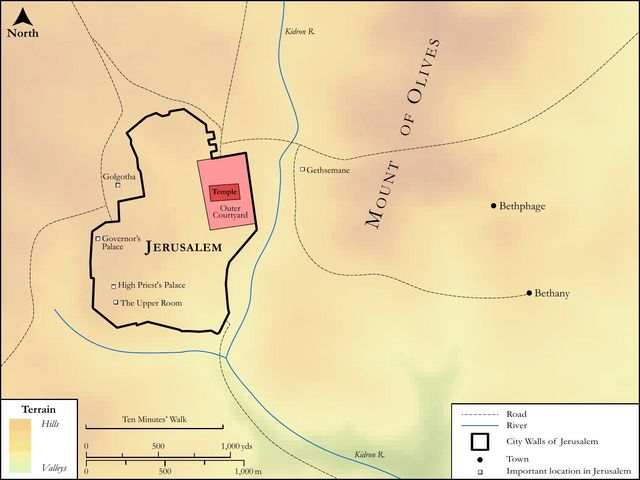
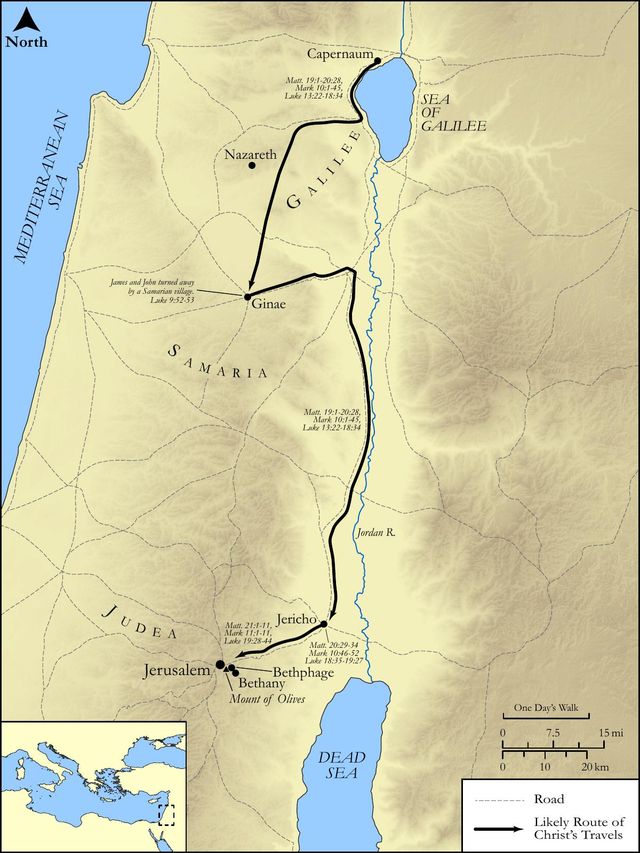
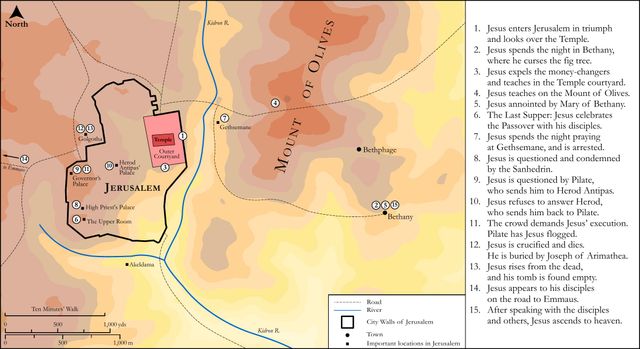
See on the biblical-era maps
Study this verse
Historical interpretation
Nine Centuries of Reception
9 surviving comments on this verse. Each one is dated, so this reads as a timeline rather than a list.
Select a marker to jump to its quote. Markers stagger vertically where authors wrote within a few decades of each other.
Herein also we find proof of the Lord's goodness; where He was minded to show forth an instance of the salvation procured by His means, He exerted the power of His might on the persons of men; by healing their present sicknesses, encouraging them to hope for the future, and to look for the healing of their soul. But now when He would exhibit a type of His judgments on the rebellious, He represents the future by the destruction of a tree; Let no fruit grow on thee henceforward for ever.
And that is compared to a fig tree, because the Apostles being the first believers out of Israel, like green figs shall in the glory, and the time, of their resurrection, be before the rest.
This was at once a type of the Gentiles, and no small comfort to the Apostles; for that they might not be perplexed, contriving how having no education for the purpose they should preach the Gospel, these children going before them did away that fear; for He who made these to sing His praises, shall give speech to those. This miracle also shows that Christ was the Framer of nature; seeing the children spoke things full of meaning, and agreeing with the Prophets, whereas the men uttered things meaningless, and full of frenzy.
He came not because He was an hungred, but for His disciples' sake; for because He ever did good and inflicted suffering on none, it behoved that He should set forth an example of His power of punishment; and this He would not exert upon man, but upon a plant.
This was only a supposition of the disciples that it was cursed because it had not fruit; for another Evangelist says that it was not yet the season. Why then was it cursed? For the disciples' sake, that they might learn that He had power to wither up those who crucified Him. And He worked this miracle in that which of all plants is the most juicy, that the greatness of the miracle might be more apparent. And when aught of this kind is done to brutes or vegetables, ask not whether the fig were with justice withered up, seeing it was not the season for its fruit; for to enquire thus were extreme madness, for in such creatures there can be neither fault nor punishment; but consider the miracle, and admire the Worker of it.
And that you may learn that this was done for their sakes, to the end, namely, that they should be stirred up to confidence, hear what is said further. Jesus answered and said unto them, Verily I say unto you, if ye shall have faith.
This that the Lord speaks of He ascribes to prayer and faith; whence He continues, And all things whatsoever ye shall ask in prayer believing ye shall receive.
And that thou mightest learn, that for their sakes this was done, that He might train them to feel confidence, hear what He saith afterwards. But what saith He? "Ye also shall do greater things, if ye are willing to believe and to be confident in prayer." Seest thou that all is done for their sake, so that they might not be afraid and tremble at plots against them? Wherefore He saith this a second time also, to make them cleave to prayer and faith. For not this only shall ye do, but also shall remove mountains; and many more things shall ye do, being confident in faith and prayer.
Hence it is to be understood that the Lord was in so great poverty, and so far from having courted any one, that He had found in all that city neither entertainer, nor abode, but He made His home in a little village, in the house of Lazarus and his sisters; for their village was Bethany; and it follows, and He lodged there.
When the shades of night were dispersed, and He was returning to the city, the Lord was an hungred, thus showing the reality of His human body.
The Lord about to suffer among the nations, and to take upon Him the offence of the Cross, sought to strengthen the minds of His disciples by a previous miracle; whence it follows, And seeing a fig-tree by the wayside, He came to it, and found nothing thereon, but leaves only.
For ever, (in sempiternum,) or, To the end of the world, (in sæculum,) for the Greek word αἰῶγ signifies both.
The Gentile dogs bark against us, affirming that the Apostles had not faith, because they were not able to remove mountains. To whom we answer, that many wonders were done by the Lord which are not written; and therefore we believe the Apostles to have done some not written; and that they were therefore not written, that the unbelieving might not have in them larger room for cavilling. For let us ask them, do they believe the miracles which are written, or do they not? And when they look incredulous, we can then establish that they who believe not the lesser would not have believed the greater.
The tree which He saw by the wayside we understand as the synagogue, which was nigh to the way inasmuch as it had the Law, but yet believed not on the way, that is, on Christ.
(Verse 21, 22.) And Jesus answered and said to them, Truly I say to you, if you have faith and do not doubt, you will not only do what was done to the fig tree, but even if you say to this mountain, 'Be taken up and cast into the sea,' it will happen. And all things you ask in prayer, believing, you will receive. The dogs of the Gentiles bark against us in their volumes, which they have left as a memorial of their own impiety, asserting that the apostles did not have faith because they were not able to move mountains. To which we will respond, many signs were done by the Lord, according to the testimony of St. John the Evangelist, which were written down, the world could not contain them all (John 21:25). Not that the world could not contain the books, which it can, even though they are many, in one small chest or bookcase; but rather that the magnitude of the signs cannot be borne by miracles and unbelief. Therefore, we believe that the apostles did these things, but they were not written down so as not to give greater occasion to unbelievers to contradict. Otherwise, let us ask them whether they believe in these signs that are written about or not. And when we see them as unbelievers, we will consequently prove that they will not believe in greater things if they do not believe in smaller things. This is against them. But let us understand the devil, who is called corrupt mountain by the prophet, as we have said before, proud and boasting against his Creator. And when it possesses the soul of a man and is rooted in it, it can be transferred by the apostles and those who are similar to the apostles into the sea, that is, into salty, turbulent, and bitter places that have no sweetness of God. And it is read in the Psalms: We will not fear when the earth is troubled, and the mountains are carried into the heart of the sea (Ps. XLV, 2).
A bad man is better overcome by giving way to him than by replying to him; for wickedness is not instructed but stimulated by reproof. The Lord accordingly sought by withdrawing Himself to check those whom His words could not check; whence it is said, And He left them, and went out of the city into Bethany.
Seeking surely to lodge in the body where His spirit also reposed; for so it is with all holy men, they love to be not where sumptuous banquets are, but where holiness flourishes.
For had His hunger been as man for carnal food, He would not have hungred in the morning; he truly hungers in the morning who hungers after the salvation of others.
Also the fig in respect of the multitude of seeds under one skin is as it were an assembly of the faithful. But He finds nothing on it but leaves only, that is, pharisaical traditions, an outward show of the Law without the fruits of truth.
Or; Into the sea, that is, into the world where the waters are salt, i. e. the people are wicked.
That is, nigh to the world; for if a man lives nigh to the world, he cannot preserve in himself the fruit of righteousness.
But whenever we are not heard when we pray, it is either because we ask something adverse to the means of our salvation; or because the perverseness of those for whom we ask hinders its being granted to them; or because the performance of our request is put off to a future time, that our desires may wax stronger, and so may have more perfect capacity for the joys they seek after.
And he avenges his exclusion from the elect by more cruel treatment of the reprobate.
Great is the promise which Christ makes to His disciples, the ability to move mountains, if only we are not ambiguous in faith, that is, we do not hesitate. Whatever we ask, unhesitantly believing in God’s power, we shall receive. One might ask, "And if I ask for something unprofitable, and foolishly believe that God will give me this, will I indeed receive this unprofitable thing? How is it that God is said to love mankind if He would fulfill my unprofitable request?" Listen then. First, when you hear "faith," you should understand that it means not "foolish faith" but "true faith"; and when you hear "prayer," understand it to mean that prayer which asks for things profitable, such as the Lord gave to us when He said, "Lead us not into temptation but deliver us from the evil one," and petitions of similar nature. Then consider the words "doubt not," [literally, "be ye not divided," me diakrithete]. For how could a man who is united with God as one and not divided or separated from Him, how could that man ask for something unprofitable? So if you are undivided and inseparable from God, then you will ask for and receive things which are profitable for you.
(ap. Anselm.) For in permitting His flesh to suffer that which properly pertains to flesh, He fore-shews His passion. Mark the earnest zeal of the active labourer, Who is said to have gone early into the city to preach, and to gain some to His Father.
(ord.) The Creator does no wrong to the owner, but His creature at His will is converted to the profit of others.
Continue studying Matthew 21:22 across the web’s major study libraries — every link below opens this exact verse, chapter, or book on the destination site.
Read & Compare
 BibleGatewayThis verse in more than 200 translations and 70 languages.
 Bible.comThe YouVersion reader — hundreds of translations, reading plans, and highlights.
 ESV.orgCrossway's official English Standard Version reader.
 NET BibleThe NET translation with 60,000+ translators' notes on every rendering decision.
 STEP BibleTyndale House's free study tool — original text, vocabulary, and scholarly resources.
 BibliaLogos Bible Software's free web reader.
 USCCBThe New American Bible (Revised Edition) with the U.S. bishops' study notes.
Commentaries
 BibleHub CommentariesDozens of classic commentaries on this verse, gathered on one page.
 StudyLightMore than 100 commentary sets — the largest collection on the web.
 BibleRefPlain-English commentary on what this verse means, verse by verse.
 Enduring WordDavid Guzik's free commentary on this chapter, widely used by Bible teachers.
 Bible Study ToolsVerse commentary alongside Greek and Hebrew study aids.
Original Language & Research
- BibleHub InterlinearThe verse word by word — original language, transliteration, and English.
- BibleHub LexiconEvery word's original-language definition and Strong's entry.
 Blue Letter BibleDeep-study tools — Strong's numbers, concordance, and word studies.
 CNTR CollationThe earliest Greek manuscripts of this verse, collated letter by letter.
Sermons, Hymns & Audio


TrulyRandomVerse is not affiliated with these sites and doesn’t control their content. They’re linked because they’re genuinely useful.
Summary
Matthew 21:22 presents a profound declaration from Jesus, asserting that when believers ask in prayer with genuine faith, they will receive all things. This statement, delivered in the context of Jesus' final week in Jerusalem, underscores the transformative power of unwavering trust in God's capacity and willingness to respond to the petitions of His disciples, linking divine action directly to the quality of human faith.
Context
ShowHideLiterary Context
This verse immediately follows Jesus' dramatic action of cursing a fig tree for its barrenness, causing it to wither instantly (Matthew 21:19). The disciples, astonished by this sudden and powerful miracle, question Jesus about its cause. Rather than simply explaining the mechanics of the miracle, Jesus uses the event as a springboard to teach a deeper spiritual principle: the power of faith. He shifts the focus from His own miraculous power to the potential power available to those who believe. This teaching is part of a broader series of lessons Jesus delivers during His final days in Jerusalem, often addressing themes of authority, the nature of the Kingdom, and the requirements for discipleship, particularly in the face of the religious establishment's unbelief. The passage thus serves as a direct commentary on the spiritual state required for effective interaction with God.
Historical & Cultural Context
The setting is Jerusalem during Passion Week, a time of heightened religious and political tension. Jesus had just entered the city triumphantly (Matthew 21:1-11) and then cleansed the Temple, declaring it a "house of prayer" (Matthew 21:12-13). Prayer was a central tenet of Jewish life, with specific times and places for devotion. The disciples, as devout Jews, were familiar with the Old Testament narratives of God answering the prayers of His people. However, Jesus' teaching here elevates their understanding of prayer beyond mere ritual, emphasizing the internal disposition of faith. The cultural understanding of miracles as signs of divine approval also plays a role, as the disciples' astonishment at the fig tree's withering highlights their expectation of God's direct intervention in the natural world.
Key Themes
ShowHideMatthew 21:22 powerfully contributes to several overarching themes within the Gospel of Matthew and the broader biblical narrative. Firstly, it highlights the supremacy and necessity of faith in the Kingdom of God. Jesus consistently links faith to divine action, whether in healing the sick or performing other miracles, as seen in passages like Matthew 9:28-29. Secondly, it illuminates the nature and efficacy of prayer, presenting it not as a passive request but as an active engagement with God that requires profound trust. The "all things" implies God's boundless capacity and generosity, though always understood within the framework of His sovereign will and perfect plan, a concept further explored in 1 John 5:14. Finally, the verse implicitly addresses the hindrance of doubt, contrasting the immediate, visible consequence of the fig tree's withering due to Jesus' word with the potential for believers to achieve great things if they pray without wavering, echoing the sentiments found in James 1:6.
Exposition and Analysis
ShowHideKey Word Analysis
ShowHideThis term refers to a specific request or petition, an active appeal made to a superior. Unlike other Greek words for asking that might imply demanding or inquiring, aitéō carries the nuance of a humble yet direct plea, highlighting the posture of dependence a believer takes before God. It signifies the act of making one's desires known to the divine.
Derived from the word for "faith" (pistis), pisteúō signifies more than intellectual assent; it denotes a deep, abiding trust and confidence in the character, power, and promises of God. It implies a full commitment and reliance, a conviction that God is both able and willing to act. This belief is not merely a mental exercise but a spiritual posture that entrusts one's entire being and petition to God.
This verb means "to take," "grasp," or "obtain." In the context of prayer, it indicates the certain outcome of faithful asking—the actual acquisition or experience of what was requested. It conveys the idea of a sure possession, emphasizing the tangible result of a prayer offered in faith, distinguishing it from merely having something offered or presented.
Verse Breakdown
ShowHide"And all things, whatsoever ye shall ask in prayer"
This opening clause establishes the expansive scope of the promise. "All things" (G3956, pâs) combined with "whatsoever" (G302, án and G3745, hósos) suggests an unlimited range of possibilities. The crucial condition is that these "all things" must be sought "in prayer" (G1722, en G4335, proseuchḗ). This specifies the medium and context: a direct, relational appeal to God, rather than a mere wish or demand. The implication is that the request is brought into the spiritual realm of communion with God.
"believing"
This single word provides the indispensable condition for the promise's fulfillment. The Greek word (G4100, pisteúō) signifies a deep, unwavering faith and trust in God's ability and willingness to grant the petition. It is not a superficial hope but a profound conviction that God will act. This belief must accompany the act of asking, indicating that the efficacy of the prayer is directly tied to the sincerity and strength of the petitioner's faith. Without this component, the promise is not activated.
"ye shall receive"
This final clause declares the certain outcome. The verb "receive" (G2983, lambánō) denotes the actual acquisition or obtaining of the requested "all things." It is a definitive promise of reception, contingent upon the preceding condition of asking in prayer with belief. This outcome is presented as a guaranteed consequence, highlighting God's faithfulness to His promises when His people approach Him with genuine, unwavering trust.
Literary Devices
ShowHideThe verse employs several significant literary devices that amplify its message. Hyperbole is evident in the phrase "all things, whatsoever," which, while seemingly limitless, is understood within the theological framework of God's will and wisdom. This exaggerated language serves to emphasize the vastness of God's power and generosity, rather than promising a blank check for any human desire. Conditionality is central to the verse's structure, presenting a clear "if-then" proposition: if you ask in prayer, and if you believe, then you will receive. This highlights the prerequisites for divine action. Furthermore, there is an implicit contrast with the disciples' initial astonishment at the fig tree, suggesting that their limited understanding of power should be replaced by a boundless faith in God's ability to act through their prayers. The emphasis on "believing" acts as a pivotal hinge, underscoring that faith is the non-negotiable element that unlocks the divine response.
Theological and Thematic Connections
ShowHideMatthew 21:22 is a cornerstone teaching on the power of prayer and faith, deeply rooted in the biblical understanding of God's character and His relationship with humanity. It reveals a God who is not distant or indifferent but intimately involved and responsive to the cries of His people. The phrase "all things" must be interpreted through the lens of God's sovereign will and perfect wisdom. True faith, as taught throughout Scripture, aligns itself with God's purposes, seeking His glory above personal gratification. Therefore, "receiving all things" implies receiving what is good, beneficial, and aligned with God's Kingdom agenda, as determined by His infinite knowledge and love. This verse encourages believers to approach God with bold confidence, knowing that He delights in answering prayers that reflect a heart surrendered to Him.
Reflection and Application
ShowHideMatthew 21:22 serves as both an incredible promise and a profound challenge to every believer. It calls us to examine the quality of our faith and the sincerity of our prayers. Are we merely uttering words, or are we truly engaging with the Almighty God with an unwavering conviction that He hears, cares, and is able to act? This verse compels us to move beyond superficial requests to a deep, abiding trust in God's character and His promises. It encourages us to cultivate a faith that is not easily swayed by circumstances or doubts, but rather rests firmly on the truth of God's Word. Furthermore, it reminds us that while God's power is limitless, our prayers should ultimately align with His perfect will, seeking His glory and the advancement of His Kingdom above all else. This alignment often requires a deeper relationship with God through His Word and Spirit, allowing our desires to be shaped by His.
Questions for Reflection
ShowHideFAQ
ShowHideDoes "all things" mean God will grant any desire I have, regardless of its nature?
ShowHideNo, the phrase "all things" in Matthew 21:22 is understood within the broader biblical context of God's character, His sovereignty, and His perfect will. True faith, as taught by Jesus, is not a magical formula to manipulate God into granting selfish desires, but rather a trusting alignment with His divine purposes. While God's power is limitless, His answers are always consistent with His wisdom, love, and holiness. As 1 John 5:14 clarifies, "if we ask anything according to his will, he hears us." Therefore, "all things" refers to all things that are good, righteous, and in alignment with God's plan for our lives and His Kingdom.
If my prayers are not answered, does it mean I lack sufficient faith?
ShowHideNot necessarily. While lack of faith can certainly hinder prayer, as seen in Jesus' own ministry where He "did not do many miracles there because of their lack of faith" (Matthew 13:58), unanswered prayer is not always a direct indictment of one's faith. God's answers can be "yes," "no," or "wait." A "no" or "wait" answer may be due to God's superior wisdom, His desire to develop perseverance in us, or because what we are asking for is not ultimately for our good or His glory. Sometimes, God's greatest answers come in ways we don't expect or through refining our faith in the process of waiting. The focus should be on trusting God's character, even when His response differs from our expectation.
Christ-Centered Fulfillment
ShowHideMatthew 21:22 finds its ultimate fulfillment and deepest meaning in the person and work of Jesus Christ. He is not merely the one who teaches about faith and prayer, but the very embodiment of perfect faith and the ultimate answer to prayer. Our access to God's boundless resources, implied by "all things," is made possible only through Christ. He is "the way, the truth, and the life," and "no one comes to the Father except through [Him]" (John 14:6). It is through His atoning sacrifice and resurrection that believers are reconciled to God, gaining confident access to His throne of grace (Ephesians 3:12). Furthermore, Jesus Himself lives to intercede for us at the right hand of God (Romans 8:34, Hebrews 7:25), ensuring that our prayers, offered in His name, are heard and presented perfectly before the Father. The "all things" we receive are ultimately spiritual blessings "in Christ" (Ephesians 1:3), culminating in the gift of the Holy Spirit, whom the Father gives to those who ask (Luke 11:13), empowering us to pray and live in alignment with God's will. Thus, the promise of Matthew 21:22 is not a standalone magical formula, but a profound invitation to participate in the divine life made possible by Christ's redemptive work.