


John 14:13
- καὶkaiAndG2532CONJConjunction
- ὅhowhichG3739R-ASNRelative pronoun Accusative Singular Neuter
- τιtioneG5100X-ASNIndefinite pronoun Accusative Singular Neuter
- ἂνanmaybeG302PRTParticle or Disjunctive
- αἰτήσητεaitēsēteyou may askG154V-AAS-2PVerb Aorist Active Subjunctive 2nd Plural
- ἐνeninG1722PREPPreposition
- τῷtōtheG3588T-DSNDefinite article Dative Singular Neuter
- ὀνόματίonomatinameG3686N-DSNNoun Dative Singular Neuter
- μουmouof MeG3165P-1GSPersonal pronoun Genitive 1st Singular
- τοῦτοtoutothisG3778D-ASNDemonstrative pronoun Accusative Singular Neuter
- ποιήσωpoiēsōwill I doG4160V-FAI-1SVerb Future Active Indicative 1st Singular
- ἵναinaso thatG2443CONJConjunction
- δοξασθῇdoxasthēamay be glorifiedG1392V-APS-3SVerb Aorist Passive Subjunctive 3rd Singular
- ὁhotheG3588T-NSMDefinite article Nominative Singular Masculine
- πατὴρpatērFatherG3962N-NSM-TNoun Nominative Singular Masculine Title
- ἐνeninG1722PREPPreposition
- τῷtōtheG3588T-DSMDefinite article Dative Singular Masculine
- υἱῷhuiōSonG5207N-DSMNoun Dative Singular Masculine
English is a literal word-by-word gloss of the Greek, not the KJV's wording. Why?
This is the original text the KJV's translators worked from — each Greek word with its own literal English meaning in this verse, prepared by scholars at Tyndale House, Cambridge. The KJV translates whole sentences, not word by word, so its wording differs: one Greek word can become several English words, and the KJV may choose “charity” where the gloss reads “love”. Both are faithful — they answer different questions. For the KJV's own rendering, switch to the KJV text.
Details
See on the biblical-era maps
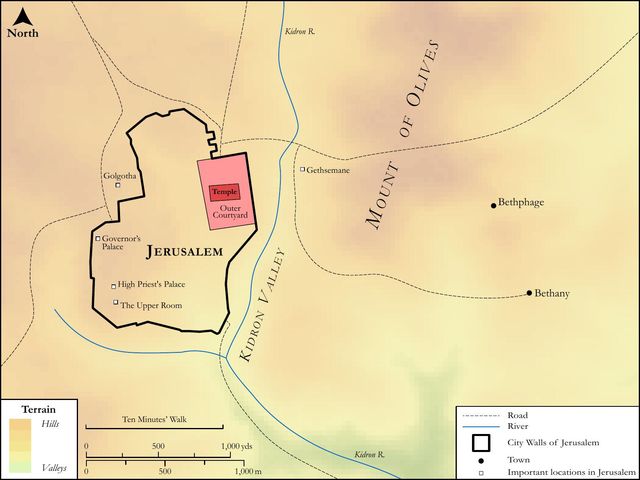
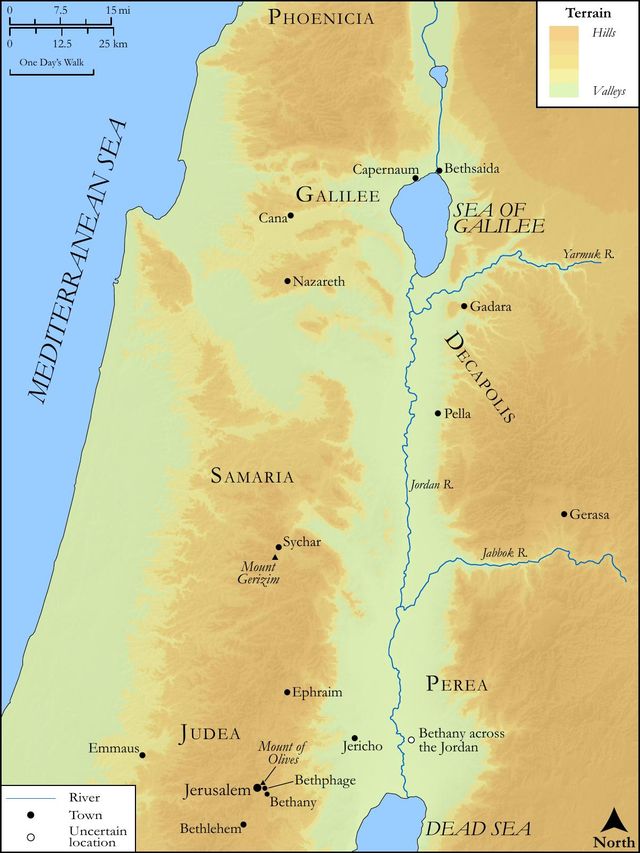
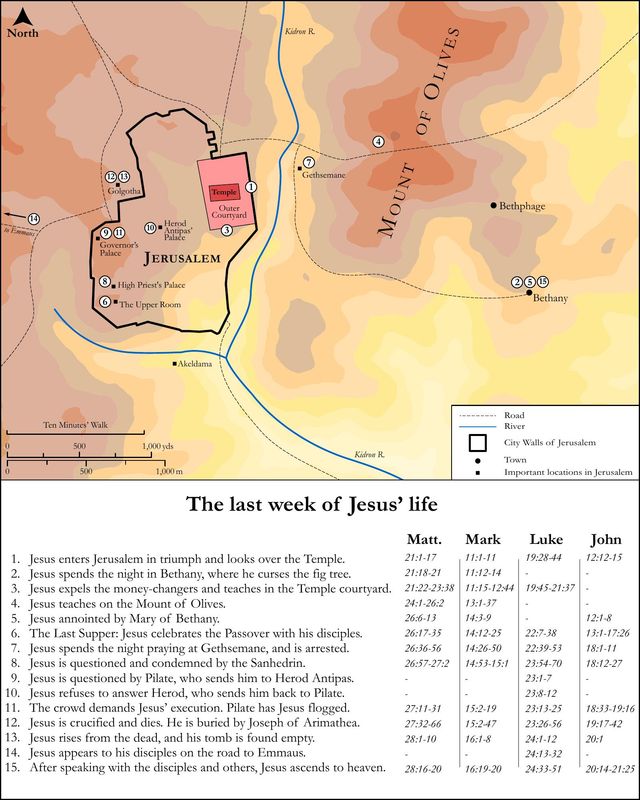
Study this verse
Public-domain commentary
Matthew Henry
From his Commentary on the Whole Bible. Henry comments on passages, not single verses — this entry covers John 14:12–14. His four-level outline is real structure in the source text, so it is rendered as structure.
The disciples, as they were full of grief to think of parting with their Master, so they were full of care what would become of themselves when he was gone; while he was with them, he was a support to them, kept them in countenance, kept them in heart; but, if he leave them, they will be as sheep having no shepherd, an easy prey to those who seek to run them down. Now, to silence these fears, Christ here assures them that they should be clothed with powers sufficient to bear them out. As Christ has all power, they, in his name, should have great power, both in heaven and in earth.
I.Great power on earth (Joh 14:12):
He that believeth on me (as I know you do), the works that I do shall he do also. This does not weaken the argument Christ had taken from his works, to prove himself one with the Father (that others should do as great works), but rather strengthens it; for the miracles which the apostles wrought were wrought in his name, and by faith in him; and this magnifies his power more than any thing, that he not only wrought miracles himself, but gave power to others to do so too.
1.Two things he assures them of: -
(1.)That they should be enabled to do such works as he had done, and that they should have a more ample power for the doing of them than they had had when he first sent them forth, Mat 10:8. Did Christ heal the sick, cleanse the leper, raise the dead? So should they. Did he convince and convert sinners, and draw multitudes to him? So should they. Though he should depart, the work should not cease, nor fall to the ground, but should be carried on as vigorously and successfully as ever; and it is still in the doing.
(2.)That they should do greater works than these.
[1.]In the kingdom of nature they should work greater miracles. No miracle is little, but some to our apprehension seem greater than others. Christ had healed with the hem of his garment, but Peter with his shadow (Act 5:15), Paul by the handkerchief that had touched him, Act 19:12. Christ wrought miracles for two or three years in one country, but his followers wrought miracles in his name for many ages in divers countries. You shall do greater works, if there be occasion, for the glory of God. The prayer of faith, if at any time it had been necessary, would have removed mountains.
[2.]In the kingdom of grace. They should obtain greater victories by the gospel than had been obtained while Christ was upon earth. The truth is, the captivating of so great a part of the world to Christ, under such outward disadvantages, was the miracle of all. I think this refers especially to the gift of tongues; this was the immediate effect of the pouring out of the Spirit, which was a constant miracle upon the mind, in which words are framed, and which was made to serve so glorious an intention as that of spreading the gospel to all nations in their own language. This was a greater sign to them that believed not (Co1 14:22), and more powerful for their conviction, than any other miracle whatever.
2.The reason Christ gives for this is, Because I go unto my Father, (1.) "Because I go, it will be requisite that you should have such a power, lest the work suffer damage by my absence." (2.) "Because I go to the Father, I shall be in a capacity to furnish you with such a power, for I go to the Father, to send the Comforter, from whom you shall receive power," Act 1:8. The wonderful works which they did in Christ's name were part of the glories of his exalted state, when he ascended on high, Eph 4:8.
II.Great power in heaven:
"Whatsoever you shall ask, that will I do (Joh 14:13, Joh 14:14), as Israel, who was a prince with God. Therefore you shall do such mighty works, because you have such an interest in me, and I in my Father." Observe,
1.In what way they were to keep up communion with him, and derive power from him, when he was gone to the Father - by prayer. When dear friends are to be removed to a distance from each other, they provide for the settling of a correspondence; thus, when Christ was going to his Father, he tells his disciples how they might write to him upon every occasion, and send their epistles by a safe and ready way of conveyance, without danger of miscarrying, or lying by the way: "Let me hear from you by prayer, the prayer of faith, and you shall hear from me by the Spirit." This was the old way of intercourse with Heaven, ever since men began to call upon the name of the Lord; but Christ by his death has laid it more open, and it is still open to us. Here is,
(1.)Humility prescribed: You shall ask. Though they had quitted all for Christ, they could demand nothing of him as a debt, but must be humble supplicants, beg or starve, beg or perish.
(2.)Liberty allowed: "Ask any thing, any thing that is good and proper for you; any thing, provided you know what you ask, you may ask; you may ask for assistance in your work, for a mouth and wisdom, for preservation out of the hands of your enemies, for power to work miracles when there is occasion, for the success of the ministry in the conversion of souls; ask to be informed, directed, vindicated." Occasions vary, but they shall be welcome to the throne of grace upon every occasion.
2.In what name they were to present their petitions: Ask in my name. To ask in Christ's name is,
(1.)To plead his merit and intercession, and to depend upon that plea. The Old Testament saints had an eye to this when they prayed for the Lord's sake (Dan 9:17), and for the sake of the anointed (Psa 84:9), but Christ's mediation is brought to a clearer light by the gospel, and so we are enabled more expressly to ask in his name. When Christ dictated the Lord's prayer, this was not inserted, because they did not then so fully understand this matter as they did afterwards, when the Spirit was poured out. If we ask in our own name, we cannot expect to speed, for, being strangers, we have no name in heaven; being sinners, we have an ill name there; but Christ's is a good name, well known in heaven, and very precious.
(2.)It is to aim at his glory and to seek this as our highest end in all our prayers.
3.What success they should have in their prayers: "What you ask, that will I do," Joh 14:13. And again (Joh 14:14), "I will do it. You may be sure I will: not only it shall be done, I will see it done, or give orders for the doing of it, but I will do it;" for he has not only the interest of an intercessor, but the power of a sovereign prince, who sits at the right hand of God, the hand of action, and has the doing of all in the kingdom of God. By faith in his name we may have what we will for the asking.
4.For what reason their prayers should speed so well: That the Father may be glorified in the Son. That is,
(1.)This they ought to aim at, and have their eye upon, in asking. In this all our desires and prayers should meet as in their centre; to this they must all be directed, that God in Christ may be honoured by our services, and in our salvation. Hallowed be thy name is an answered prayer, and is put first, because, if the heart be sincere in this, it does in a manner consecrate all the other petitions.
(2.)This Christ will aim at in granting, and for the sake of this will do what they ask, that hereby the glory of the Father in the Son may be manifested. The wisdom, power, and goodness of God were magnified in the Redeemer when by a power derived from him, and exerted in his name and for his service, his apostles and ministers were enabled to do such great things, both in the proofs of their doctrine and in the successes of it.
Historical interpretation
Seven Centuries of Reception
7 surviving comments on this verse. Each one is dated, so this reads as a timeline rather than a list.
Select a marker to jump to its quote. Markers stagger vertically where authors wrote within a few decades of each other.
But if we think it impious to believe that the Father has handed over all judgment to the Son in such a way that he does not have it himself—for he has it and cannot lose what the divine majesty has by its very nature—we ought to consider it equally impious to suppose that the Son cannot give what either men and women can merit or any creature can receive, especially as he himself has said, “I go to my Father, and whatever you shall ask of him in my name, that will I do.” For if the Son cannot give what the Father can give, the Truth has lied and cannot do what the Father has been asked for in his name. He therefore did not say, “For whom it has been prepared by my Father,” in order that requests should be made only of the Father. For all things that are asked of the Father, [the Son] has declared that he [himself] will give. And finally, he did not say, “Whatever you shall ask of me, that will I do” but “Whatever you shall ask of him in my name, that will I do.”
(Hom. lxxiv. 2) Having said, Believe for the works' sake, our Lord goes on to declare that He can do much greater than these, and what is more wonderful, give others the power of working them. Verily, verily, I say unto you, He that believeth on Me, the works that I do, shall he do also; and greater works than these shall he do.
(Hom. lxxiv. 2) i. e. I shall not perish, but shall remain in My proper dignity, in heaven. Or He means: It is your part henceforth to work miracles, since I am going.
(Hom. lxxiv. 2) In My name, He says. Thus the Apostles; In the name of Jesus of Nazareth, arise and walk. (Acts 3:6) All the miracles that they did, He did: the hand of the Lord was with them.
(Hom. lxxiv. 2) For when the great power of the Son is manifested, He that begat Him is glorified. He introduces this last, to confirm the truth of what He has said.
(Tract. lxxii. 2) Whatsoever ye shall ask. Then why do we often see believers asking, and not receiving? Perhaps it is that they ask amiss. When a man would make a bad use of what he asks for, God in His mercy does not grant him it. Still if God even in kindness often refuses the requests of believers, how are we to understand, Whatsoever ye shall ask in My name, I will do? Was this said to the Apostles only? No. He says above, He that believeth on Me, the works that I do shall he do also. And if we go to the lives of the Apostles themselves, we shall find that he who laboured more than they all, prayed that the messenger of Satan might depart from him, but was not granted his request. But attend: does not our Lord lay down a certain condition? In My name, which is Christ Jesus. Christ signifies King, Jesus, Saviour. Therefore whatever we ask for that would hinder our salvation, we do not ask in our Saviour's name: and yet He is our Saviour, not only when He does what we ask, but also when He does not. When He sees us ask any thing to the disadvantage of our salvation, He shows Himself our Saviour by not doing it. The physician knows whether what the sick man asks for is to the advantage or disadvantage of his health; and does not allow what would be to his hurt, though the sick man himself desires it; but looks to his final cure. And some things we may even ask in His name, and He will not grant them us at the time, though He will some time. What we ask for is deferred, not denied.
The Lord, by His promise, gave those whose hopes were resting on Himself a special ground of confidence, when He said, "For I go to the Father; and whatsoever ye shall ask in my name, I will do it." His proceeding, therefore, to the Father, was not with any view of abandoning the needy, but of hearing and answering their petitions. But what is to be made of the words, "Whatsoever ye shall ask," when we behold His faithful ones so often asking and not receiving? Is it, shall we say, for no other reason but that they ask amiss? For the Apostle James made this a ground of reproach when he said, "Ye ask and receive not, because ye ask amiss, that ye may consume it upon your lusts." What one, therefore, wishes to receive, in order to turn to an improper use, God in His mercy rather refuses to bestow. Nay, more, if a man asks what would, if answered, only tend to his injury, there is surely greater cause to fear, lest what God could not withhold with kindness, He should give in His anger. Do we not see how the Israelites got to their own hurt what their guilty lusting craved? For while it was raining manna on them from heaven, they desired to have flesh to eat. They disdained what they had, and shamelessly sought what they had not: as if it were not better for them to have asked not to have their unbecoming desires gratified with the food that was wanting, but to have their own dislike removed, and be made themselves to receive aright the food that was provided. For when evil becomes our delight, and what is good the reverse, we ought to be entreating God rather to win us back to the love of the good, than to grant us the evil. Not that it is wrong to eat flesh, for the apostle, speaking of this very thing, says, "Every creature of God is good, and nothing to be refused which is received with thanksgiving;" but because, as he also says, "It is evil for that man who eateth with offense;" and if so, with offense to man, how much more so if to God, to whom it was no light offense, on the part of the Israelites, to reject what wisdom was supplying, and ask for that which lust was craving: although they would not actually make the request, but murmured because it was wanting. But to let us know that the wrong lies not with any creature of God, but with obstinate disobedience and inordinate desire, it was not in swine's flesh that the first man found death, but in an apple; and it was not for a fowl, but for a dish of pottage, that Esau lost his birthright.
Wake up, then, believer, and give careful heed to what is stated here, "in my name:" for in these words He does not say, "whatsoever ye shall ask" in any way; but, "in my name." How, then, is He called, who promised so great a blessing? Christ Jesus, of course: Christ means King, and Jesus means Saviour! for certainly it is not any one who is a king that will save us, but only the Saviour-King; and therefore, whatsoever we ask for that is adverse to the interests of salvation, we do not ask in the name of the Saviour. And yet He is the Saviour, not only when He does what we ask, but also when He refuses to do so; since by not doing what He sees to be contrary to our salvation, He manifests Himself the more fully as our Saviour. For the physician knows which of his patient's requests will be favorable, and which will be adverse, to his safety; and therefore yields not to his wishes when asking what is prejudicial, that he may effect his recovery. Accordingly, when we wish Him to do whatsoever we ask, let it not be in any way, but in His name, that is, in the name of the Saviour, that we present our petition. Let us not, then, ask aught that is contrary to our own salvation; for if He do that, He does it not as the Saviour, which is the name He bears to His faithful disciples. For He who condescends to be the Saviour of the faithful, is also a Judge to condemn the ungodly. Whatsoever, therefore, any one that believeth on Him shall ask in that name which He bears to those who believe on Him, He will do it; for He will do it as the Saviour. But if one that believeth on Him asketh something through ignorance that is injurious to his salvation, he asketh it not in the name of the Saviour; for His Saviour He will no longer be if He do aught to impede his salvation. And hence, in such a case, in not doing what He is entreated to do, His way is kept the clearer for doing what His name imports. And on that account, not only as the Saviour, but also as the good Master, He taught us, in the very prayer He gave us, what we should ask, in order that, whatsoever we shall ask, He may do it; and that we, too, might thereby understand that we cannot be asking in the Master's name anything that is inconsistent with the rule of His own instructions.
How, then, are we to understand "Whatsoever ye shall ask, I will do it," if there are some things which the faithful ask, and which God, even purposely on their behalf, leaves undone? Or ought we to suppose that the words were addressed only to the apostles? Surely not. For what He has got the length of now saying is in the very line of what He had said before: "He that believeth in me, the works that I do shall he do also; and greater works than these shall he do;" which was the subject of our previous discourse. And that no one might attribute such power to himself, but rather to make it manifest that even these greater works were done by Himself, He proceeded to say, "For I go to the Father; and whatsoever ye shall ask in my name, I will do it." Was it the apostles only that believed on Him? When, therefore, He said, "He that believeth on me," He spake to those, among whom we also by His grace are included, who by no means receive everything that we ask. And if we turn our thoughts even to the most blessed apostles, we find that he who labored more than they all, yet not he, but the grace of God that was with him, besought the Lord thrice that the messenger of Satan might depart from him, and received not what he had asked. What shall we say, beloved? Are we to suppose that the promise here made, "Whatsoever ye shall ask in my name, I will do it," was not fulfilled by Him even to the apostles? And to whom, then, will ever His promise be fulfilled, if therein He has deceived His own apostles?
This is an explanation of the doctrine of miracles. It is by prayer, and invocation of His name, that a man is able to work miracles.
Observe the order (akolouthian) in which the glorifying of the Father comes. In the name of Jesus miracles were done, by which men were made to believe the Apostles' preaching. This brought them to the knowledge of the Father, and thus the Father was glorified in the Son.
Continue studying John 14:13 across the web’s major study libraries — every link below opens this exact verse, chapter, or book on the destination site.
Read & Compare
 BibleGatewayThis verse in more than 200 translations and 70 languages.
 Bible.comThe YouVersion reader — hundreds of translations, reading plans, and highlights.
 ESV.orgCrossway's official English Standard Version reader.
 NET BibleThe NET translation with 60,000+ translators' notes on every rendering decision.
 STEP BibleTyndale House's free study tool — original text, vocabulary, and scholarly resources.
 BibliaLogos Bible Software's free web reader.
 USCCBThe New American Bible (Revised Edition) with the U.S. bishops' study notes.
Commentaries
 BibleHub CommentariesDozens of classic commentaries on this verse, gathered on one page.
 StudyLightMore than 100 commentary sets — the largest collection on the web.
 BibleRefPlain-English commentary on what this verse means, verse by verse.
 Enduring WordDavid Guzik's free commentary on this chapter, widely used by Bible teachers.
 Bible Study ToolsVerse commentary alongside Greek and Hebrew study aids.
Original Language & Research
- BibleHub InterlinearThe verse word by word — original language, transliteration, and English.
- BibleHub LexiconEvery word's original-language definition and Strong's entry.
 Blue Letter BibleDeep-study tools — Strong's numbers, concordance, and word studies.
 CNTR CollationThe earliest Greek manuscripts of this verse, collated letter by letter.
Sermons, Hymns & Audio


TrulyRandomVerse is not affiliated with these sites and doesn’t control their content. They’re linked because they’re genuinely useful.
Summary
John 14:13 presents a profound promise from Jesus to His disciples, assuring them that whatever they ask in His name, He will do, with the ultimate purpose of glorifying the Father through the Son. This verse, situated within Jesus' final discourse before His crucifixion, unveils the transformative power of prayer when offered in alignment with His character and divine will, establishing a vital connection between the believer's petitions, Christ's active agency, and the triune God's ultimate glory.
Context
ShowHideLiterary Context
This verse is an integral part of Jesus' Farewell Discourse, spanning John chapters 13-17. Delivered in the intimate setting of the Upper Room, these chapters record Jesus' final, extended teachings to His disciples before His arrest and crucifixion. He is preparing them for His physical departure, comforting them, and equipping them for their future ministry. The immediate preceding verses (John 14:12) speak of believers doing "greater works" than Jesus, which sets the stage for the power and authority granted through prayer in His name, serving as a continuation of the theme of empowered ministry in His absence. The promise of the Holy Spirit, the Helper, in John 14:16-17 and John 14:26, further clarifies the means by which believers will understand and pray according to Christ's will, ensuring that their requests align with the divine purpose.
Historical & Cultural Context
In ancient Jewish thought, a person's "name" encapsulated their entire character, authority, and reputation. To act "in someone's name" was to act as their representative, with their full authority and backing. This concept is crucial for understanding Jesus' promise. The disciples, soon to be without Jesus' physical presence, would need a new understanding of how to access divine power and authority for their mission. The cultural understanding of "name" would have immediately conveyed to them that this was not a magical incantation but an authorization to operate under Jesus' full identity and purpose. Furthermore, the setting in Jerusalem during Passover week, with the looming threat of Jesus' crucifixion, imbued these words with immense weight and urgency, preparing the disciples for a new era of ministry empowered by the ascended Christ.
Key Themes
ShowHideJohn 14:13 contributes significantly to several overarching themes in John's Gospel. Primarily, it underscores the theme of Divine Authority and Power, demonstrating that Jesus, even in His impending departure, retains all authority and actively works on behalf of His followers. It also highlights the Interconnectedness of the Trinity, showing how the Son's actions in response to prayer ultimately serve to glorify the Father. This promise of answered prayer "in my name" is deeply tied to the theme of Abiding in Christ and bearing fruit, as seen in John 15:7-8, where abiding in His words enables effective prayer. It reinforces the New Covenant Relationship between God and humanity through Christ, where believers are granted direct access and partnership with the divine for the advancement of God's kingdom.
Exposition and Analysis
ShowHideKey Word Analysis
ShowHideThis term refers to asking or petitioning, often with a sense of requesting something from a superior. It implies a dependent relationship where the one asking is seeking something from another who has the power to grant it. In this context, it highlights the believer's reliance on Jesus for the fulfillment of their requests, emphasizing that the power to answer resides with Him.
More than a mere label, "name" in biblical thought signifies the full character, authority, nature, and reputation of an individual. To ask "in my name" is not to append a formulaic phrase to a prayer, but to pray in alignment with Jesus' very being, His purposes, His will, and His delegated authority. It implies a deep, intimate relationship and identification with Christ, where one's desires are shaped by His.
Derived from "doxa" (glory), this verb means to render or esteem glorious, to magnify, or to honor. It speaks of revealing the inherent splendor, majesty, and worth of someone. Here, it denotes that the ultimate aim of answered prayer and Christ's actions is to showcase the Father's supreme excellence and power, thereby bringing Him honor and recognition through the Son.
Verse Breakdown
ShowHide"And whatsoever ye shall ask in my name,"
This clause sets the condition and scope of the promise. The phrase "whatsoever ye shall ask" (Greek: hó ti an aitḗsēte) indicates a broad allowance, but it is immediately qualified by the crucial phrase "in my name." As discussed in the key word analysis, this is not a blank check for selfish desires but rather a profound theological statement implying that the requests must be consistent with Jesus' character, authority, and divine will. It suggests a prayer life deeply rooted in an understanding of who Jesus is and what His kingdom purposes are.
"that will I do,"
Here, Jesus Himself, the Son of God, makes a direct and active promise to respond. The "I" is emphatic, highlighting His personal agency and divine power. This assures the disciples that even after His ascension, He remains actively involved in the affairs of His followers, working to fulfill prayers that align with His name. It underscores His continued mediatorial role and authority in the heavenly realm.
"that the Father may be glorified in the Son."
This final clause reveals the ultimate purpose and theological motivation behind the entire promise. All divine action, including the answering of prayer, is ultimately directed toward the glory of God. When prayers are answered according to Christ's will, it demonstrates the Father's power, goodness, and faithfulness through the agency of the Son. This glorification is not merely verbal praise but a visible manifestation of God's nature and power through the Son's work in the world, confirming the unity and shared purpose of the Father and the Son.
Literary Devices
ShowHideJohn 14:13 employs several effective literary devices. The most prominent is Promise, as Jesus directly assures His disciples of His future action, providing comfort and confidence. The verse also utilizes a Purpose Clause ("that the Father may be glorified in the Son"), which clearly articulates the teleological aim of the promise, emphasizing that all actions are ultimately for God's glory. There is also a strong element of Emphasis through repetition of the "I" (implied in "I do") and the direct connection between asking "in my name" and His doing. Furthermore, the verse functions as a Theological Linkage, connecting the act of prayer, the Son's agency, and the Father's glory in a cohesive theological statement that underpins the entire Christian understanding of divine interaction with humanity.
Theological and Thematic Connections
ShowHideJohn 14:13 is a cornerstone verse for understanding Christian prayer and the dynamic relationship within the Trinity. It teaches that true prayer is not merely a human utterance but a participation in the divine will, mediated by Christ, and designed to bring ultimate glory to the Father. This promise underscores the active, ongoing intercession and authority of the ascended Christ, assuring believers that their prayers, when aligned with His character and purpose, are not only heard but acted upon by the Lord Himself. It transforms prayer from a passive request into a powerful partnership with God for the advancement of His kingdom, revealing that God's primary motivation in all things is His own glory, manifested through the Son.
Reflection and Application
ShowHideJohn 14:13 invites believers into a deeper, more intentional prayer life. It challenges us to move beyond superficial requests and to cultivate a profound intimacy with Christ, allowing His desires to shape our own. To ask "in His name" means to pray with His authority, for His purposes, and in a way that reflects His character. This requires diligent study of His Word, a life surrendered to His Spirit, and a heart attuned to His will. When our prayers are aligned with Christ's mission, we can pray with absolute confidence, knowing that the ascended Lord actively works to fulfill these petitions, not for our selfish gain, but for the ultimate glorification of the Father. This understanding transforms prayer from a burdensome duty into a powerful privilege, empowering us to participate in God's redemptive work in the world.
Questions for Reflection
ShowHideFAQ
ShowHideDoes "whatsoever ye shall ask" mean God will grant any request, even selfish ones?
ShowHideNo, the phrase "whatsoever ye shall ask" is immediately qualified by "in my name." As explained in the exposition, "in my name" signifies praying in alignment with Jesus' character, authority, and divine will. It's not a blank check for selfish desires but an invitation to pray for things that honor Him and advance His kingdom. True prayer in Jesus' name reflects a heart transformed by Him, seeking His purposes, not merely personal gratification. This understanding is consistent with other passages, such as 1 John 5:14, which states that God hears us "if we ask anything according to his will."
How can I know if I am asking "in His name"?
ShowHideAsking "in His name" involves several key elements. First, it means having a personal relationship with Jesus, where your desires are increasingly conformed to His through the work of the Holy Spirit. Second, it involves praying according to His revealed will, which is found in His Word. The more you immerse yourself in Scripture and understand Jesus' teachings and mission, the more your prayers will align with His purposes. Third, it implies praying with faith, believing that Jesus has the power and desire to act. Ultimately, it's about seeking God's glory above all else, trusting that what brings Him glory will also be what is best for you and His kingdom, as highlighted by the purpose clause in John 14:13.
Christ-Centered Fulfillment
ShowHideJohn 14:13 finds its profound Christ-centered fulfillment not merely in the act of prayer, but in the very person and work of Jesus Christ. This promise is possible because Jesus is the unique Son, the ultimate revelation of God, and the sole mediator between God and humanity. His promise to "do" whatsoever is asked in His name points directly to His ascended authority and ongoing reign as Lord of all. The ultimate goal—"that the Father may be glorified in the Son"—is the very essence of Christ's mission. His incarnation, perfect life, atoning death, and glorious resurrection were all designed to display the Father's glory (as seen in John 17:4). When believers pray in His name, they are participating in this divine purpose, channeling the power of the new covenant established through His blood. The Holy Spirit, whom Jesus promises to send (as detailed in John 14:26), enables believers to understand and pray according to the Father's will, ensuring that their petitions are indeed "in His name." Thus, this verse is a testament to Christ's present intercession (as described in Romans 8:34) and His active role in bringing about the Father's sovereign plan through His redeemed people, making Him the central figure through whom all divine power flows and all divine glory is manifested.