


Matthew 21:21
- ἈποκριθεὶςApokritheisAnsweringG611V-AOP-NSMVerb Aorist Passive Deponent Participle Nominative Singular Masculine
- δὲdenowG1161CONJConjunction
- ὁho<the>G3588T-NSMDefinite article Nominative Singular Masculine
- ἸησοῦςIēsousJesusG2424N-NSM-PNoun Nominative Singular Masculine Individual
- εἶπενeipensaidG2036V-2AAI-3SVerb 2nd Aorist Active Indicative 3rd Singular
- αὐτοῖς·autoisto themG846P-DPMPersonal pronoun Dative Plural Masculine
- ἀμὴνamēnAmenG281INJ-HEBInterjection
- λέγωlegōI sayG3004V-PAI-1SVerb Present Active Indicative 1st Singular
- ὑμῖν·huminto youG4771P-2DPPersonal pronoun Dative 2nd Plural
- ἐὰνeanifG1437CONDConjunction
- ἔχητεechēteyou shall haveG2192V-PAS-2PVerb Present Active Subjunctive 2nd Plural
- πίστινpistinfaithG4102N-ASFNoun Accusative Singular Feminine
- καὶkaiandG2532CONJConjunction
- μὴmēnotG3361PRT-NNegative Particle Negative
- διακριθῆτεdiakrithēteshall doubtG1252V-APS-2PVerb Aorist Passive Subjunctive 2nd Plural
- οὐounotG3756PRT-NNegative Particle Negative
- μόνονmonononlyG3441A-ASNAdjective Accusative Singular Neuter
- τὸtothe [miracle]G3588T-ASNDefinite article Accusative Singular Neuter
- τῆςtēsof theG3588T-GSFDefinite article Genitive Singular Feminine
- συκῆςsukēsfig treeG4808N-GSFNoun Genitive Singular Feminine
- ποιήσετεpoiēsetewill you doG4160V-FAI-2PVerb Future Active Indicative 2nd Plural
- ἀλλὰallabutG235CONJConjunction
- κἂνkaneven ifG1437CONJ + G1437=COND
- τῷtōto theG3588T-DSNDefinite article Dative Singular Neuter
- ὄρειoreimountainG3735N-DSNNoun Dative Singular Neuter
- τούτῳtoutōthisG3778D-DSNDemonstrative pronoun Dative Singular Neuter
- εἴπητε·eipēteyou shall sayG2036V-2AAS-2PVerb 2nd Aorist Active Subjunctive 2nd Plural
- ἄρθητιarthētido be taken awayG142V-APM-2SVerb Aorist Passive Imperative 2nd Singular
- καὶkaiandG2532CONJConjunction
- βλήθητιblēthētido be castG906V-APM-2SVerb Aorist Passive Imperative 2nd Singular
- εἰςeisintoG1519PREPPreposition
- τὴνtēntheG3588T-ASFDefinite article Accusative Singular Feminine
- θάλασσανthalassanseaG2281N-ASFNoun Accusative Singular Feminine
- γενήσεται·genēsetaiit will come to passG1096V-FDI-3SVerb Future Middle Deponent Indicative 3rd Singular
English is a literal word-by-word gloss of the Greek, not the KJV's wording. Why?
This is the original text the KJV's translators worked from — each Greek word with its own literal English meaning in this verse, prepared by scholars at Tyndale House, Cambridge. The KJV translates whole sentences, not word by word, so its wording differs: one Greek word can become several English words, and the KJV may choose “charity” where the gloss reads “love”. Both are faithful — they answer different questions. For the KJV's own rendering, switch to the KJV text.
Details
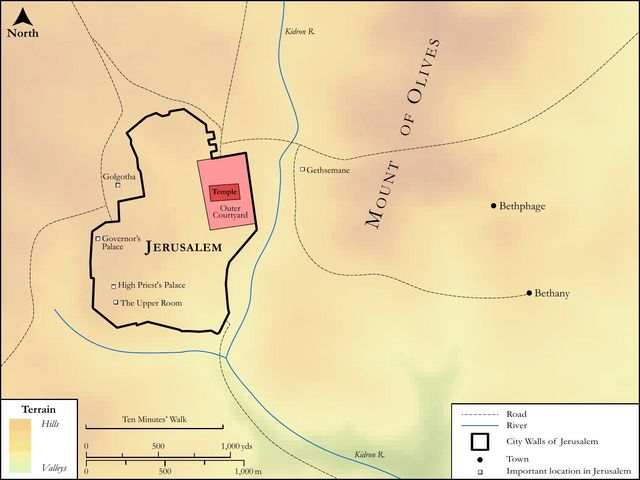
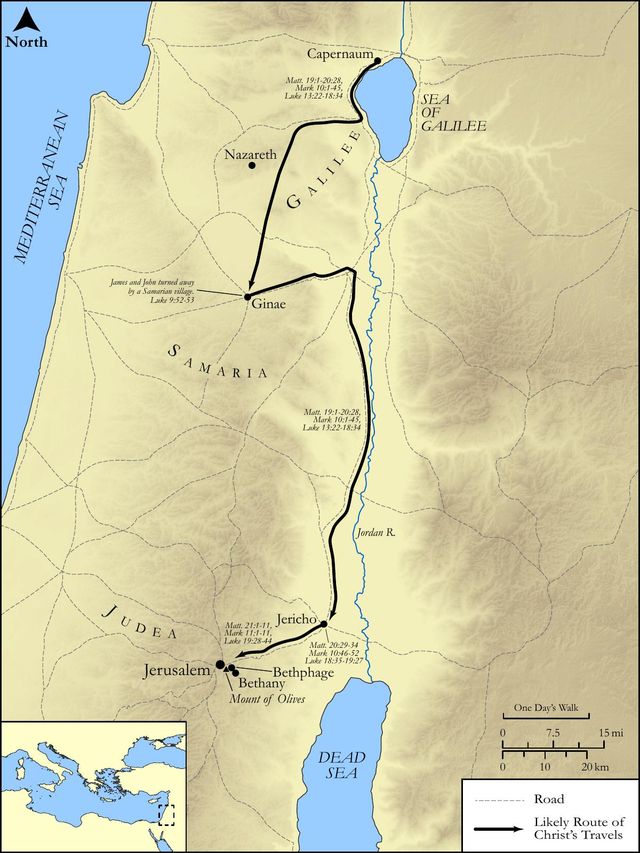
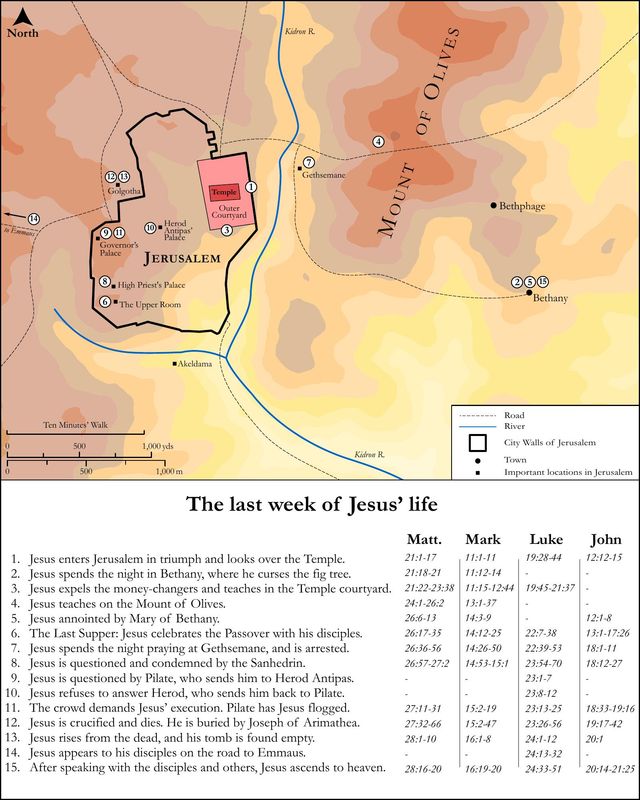
See on the biblical-era map
Study this verse
Historical interpretation
Ten Centuries of Reception
10 surviving comments on this verse. Each one is dated, so this reads as a timeline rather than a list.
Select a marker to jump to its quote. Markers stagger vertically where authors wrote within a few decades of each other.
But if the Lord come seeking fruit with temptations, and one be found having nought of righteousness but only a profession of faith, which is leaves without fruit, he is soon withered, losing even his seeming faith; and every disciple makes this fig tree to wither, by making it be seen that he is void of Christ, as Peter said to Simon, Thy heart is not right in the sight of God (Acts 8:21.) For it is better that a deceitful fig tree which is thought to be alive, yet brings forth no fruit, should be withered up at the word of Christ's disciples, than that by an imposture it should steal aawy innocent hearts. Also there is in every unbeliever a mountain great in proportion to his unbelief, which is removed by the words of Christ's disciples.
Herein also we find proof of the Lord's goodness; where He was minded to show forth an instance of the salvation procured by His means, He exerted the power of His might on the persons of men; by healing their present sicknesses, encouraging them to hope for the future, and to look for the healing of their soul. But now when He would exhibit a type of His judgments on the rebellious, He represents the future by the destruction of a tree; Let no fruit grow on thee henceforward for ever.
And that is compared to a fig tree, because the Apostles being the first believers out of Israel, like green figs shall in the glory, and the time, of their resurrection, be before the rest.
This was at once a type of the Gentiles, and no small comfort to the Apostles; for that they might not be perplexed, contriving how having no education for the purpose they should preach the Gospel, these children going before them did away that fear; for He who made these to sing His praises, shall give speech to those. This miracle also shows that Christ was the Framer of nature; seeing the children spoke things full of meaning, and agreeing with the Prophets, whereas the men uttered things meaningless, and full of frenzy.
He came not because He was an hungred, but for His disciples' sake; for because He ever did good and inflicted suffering on none, it behoved that He should set forth an example of His power of punishment; and this He would not exert upon man, but upon a plant.
This was only a supposition of the disciples that it was cursed because it had not fruit; for another Evangelist says that it was not yet the season. Why then was it cursed? For the disciples' sake, that they might learn that He had power to wither up those who crucified Him. And He worked this miracle in that which of all plants is the most juicy, that the greatness of the miracle might be more apparent. And when aught of this kind is done to brutes or vegetables, ask not whether the fig were with justice withered up, seeing it was not the season for its fruit; for to enquire thus were extreme madness, for in such creatures there can be neither fault nor punishment; but consider the miracle, and admire the Worker of it.
And that you may learn that this was done for their sakes, to the end, namely, that they should be stirred up to confidence, hear what is said further. Jesus answered and said unto them, Verily I say unto you, if ye shall have faith.
This that the Lord speaks of He ascribes to prayer and faith; whence He continues, And all things whatsoever ye shall ask in prayer believing ye shall receive.
And that thou mightest learn, that for their sakes this was done, that He might train them to feel confidence, hear what He saith afterwards. But what saith He? "Ye also shall do greater things, if ye are willing to believe and to be confident in prayer." Seest thou that all is done for their sake, so that they might not be afraid and tremble at plots against them? Wherefore He saith this a second time also, to make them cleave to prayer and faith. For not this only shall ye do, but also shall remove mountains; and many more things shall ye do, being confident in faith and prayer.
Hence it is to be understood that the Lord was in so great poverty, and so far from having courted any one, that He had found in all that city neither entertainer, nor abode, but He made His home in a little village, in the house of Lazarus and his sisters; for their village was Bethany; and it follows, and He lodged there.
When the shades of night were dispersed, and He was returning to the city, the Lord was an hungred, thus showing the reality of His human body.
The Lord about to suffer among the nations, and to take upon Him the offence of the Cross, sought to strengthen the minds of His disciples by a previous miracle; whence it follows, And seeing a fig-tree by the wayside, He came to it, and found nothing thereon, but leaves only.
For ever, (in sempiternum,) or, To the end of the world, (in sæculum,) for the Greek word αἰῶγ signifies both.
The Gentile dogs bark against us, affirming that the Apostles had not faith, because they were not able to remove mountains. To whom we answer, that many wonders were done by the Lord which are not written; and therefore we believe the Apostles to have done some not written; and that they were therefore not written, that the unbelieving might not have in them larger room for cavilling. For let us ask them, do they believe the miracles which are written, or do they not? And when they look incredulous, we can then establish that they who believe not the lesser would not have believed the greater.
The tree which He saw by the wayside we understand as the synagogue, which was nigh to the way inasmuch as it had the Law, but yet believed not on the way, that is, on Christ.
(Verse 21, 22.) And Jesus answered and said to them, Truly I say to you, if you have faith and do not doubt, you will not only do what was done to the fig tree, but even if you say to this mountain, 'Be taken up and cast into the sea,' it will happen. And all things you ask in prayer, believing, you will receive. The dogs of the Gentiles bark against us in their volumes, which they have left as a memorial of their own impiety, asserting that the apostles did not have faith because they were not able to move mountains. To which we will respond, many signs were done by the Lord, according to the testimony of St. John the Evangelist, which were written down, the world could not contain them all (John 21:25). Not that the world could not contain the books, which it can, even though they are many, in one small chest or bookcase; but rather that the magnitude of the signs cannot be borne by miracles and unbelief. Therefore, we believe that the apostles did these things, but they were not written down so as not to give greater occasion to unbelievers to contradict. Otherwise, let us ask them whether they believe in these signs that are written about or not. And when we see them as unbelievers, we will consequently prove that they will not believe in greater things if they do not believe in smaller things. This is against them. But let us understand the devil, who is called corrupt mountain by the prophet, as we have said before, proud and boasting against his Creator. And when it possesses the soul of a man and is rooted in it, it can be transferred by the apostles and those who are similar to the apostles into the sea, that is, into salty, turbulent, and bitter places that have no sweetness of God. And it is read in the Psalms: We will not fear when the earth is troubled, and the mountains are carried into the heart of the sea (Ps. XLV, 2).
(Quæst. Ev. i. 29.) Or, this is to be said by each servant of God in his own case respecting the mountain of pride, to cast it from him. Or, because by Jews the Gospel was preached, the Lord Himself, who is called the mount, is by the Jews cast among the Gentiles as into a sea.
A bad man is better overcome by giving way to him than by replying to him; for wickedness is not instructed but stimulated by reproof. The Lord accordingly sought by withdrawing Himself to check those whom His words could not check; whence it is said, And He left them, and went out of the city into Bethany.
Seeking surely to lodge in the body where His spirit also reposed; for so it is with all holy men, they love to be not where sumptuous banquets are, but where holiness flourishes.
For had His hunger been as man for carnal food, He would not have hungred in the morning; he truly hungers in the morning who hungers after the salvation of others.
Also the fig in respect of the multitude of seeds under one skin is as it were an assembly of the faithful. But He finds nothing on it but leaves only, that is, pharisaical traditions, an outward show of the Law without the fruits of truth.
Or; Into the sea, that is, into the world where the waters are salt, i. e. the people are wicked.
That is, nigh to the world; for if a man lives nigh to the world, he cannot preserve in himself the fruit of righteousness.
But whenever we are not heard when we pray, it is either because we ask something adverse to the means of our salvation; or because the perverseness of those for whom we ask hinders its being granted to them; or because the performance of our request is put off to a future time, that our desires may wax stronger, and so may have more perfect capacity for the joys they seek after.
And he avenges his exclusion from the elect by more cruel treatment of the reprobate.
(ap. Anselm.) For in permitting His flesh to suffer that which properly pertains to flesh, He fore-shews His passion. Mark the earnest zeal of the active labourer, Who is said to have gone early into the city to preach, and to gain some to His Father.
(ord.) The Creator does no wrong to the owner, but His creature at His will is converted to the profit of others.
Continue studying Matthew 21:21 across the web’s major study libraries — every link below opens this exact verse, chapter, or book on the destination site.
Read & Compare
 BibleGatewayThis verse in more than 200 translations and 70 languages.
 Bible.comThe YouVersion reader — hundreds of translations, reading plans, and highlights.
 ESV.orgCrossway's official English Standard Version reader.
 NET BibleThe NET translation with 60,000+ translators' notes on every rendering decision.
 STEP BibleTyndale House's free study tool — original text, vocabulary, and scholarly resources.
 BibliaLogos Bible Software's free web reader.
 USCCBThe New American Bible (Revised Edition) with the U.S. bishops' study notes.
Commentaries
 BibleHub CommentariesDozens of classic commentaries on this verse, gathered on one page.
 StudyLightMore than 100 commentary sets — the largest collection on the web.
 BibleRefPlain-English commentary on what this verse means, verse by verse.
 Enduring WordDavid Guzik's free commentary on this chapter, widely used by Bible teachers.
 Bible Study ToolsVerse commentary alongside Greek and Hebrew study aids.
Original Language & Research
- BibleHub InterlinearThe verse word by word — original language, transliteration, and English.
- BibleHub LexiconEvery word's original-language definition and Strong's entry.
 Blue Letter BibleDeep-study tools — Strong's numbers, concordance, and word studies.
 CNTR CollationThe earliest Greek manuscripts of this verse, collated letter by letter.
Sermons, Hymns & Audio


TrulyRandomVerse is not affiliated with these sites and doesn’t control their content. They’re linked because they’re genuinely useful.
Summary
Matthew 21:21 stands as a profound declaration from Jesus Christ, revealing the extraordinary power accessible through genuine, unwavering faith. Following the disciples' astonishment at the instantaneous withering of the fig tree, Jesus assures them that a steadfast belief, utterly devoid of doubt, empowers His followers to accomplish feats that appear humanly impossible, symbolized by the literal displacement of a mountain into the sea. This teaching underscores the transformative potential of faith when aligned with divine will.
Context
ShowHideLiterary Context
This verse is situated immediately after Jesus' dramatic action of cursing a barren fig tree (Matthew 21:18-19), which withered from the roots. The disciples, observing this swift and potent miracle, expressed their astonishment, prompting Jesus' teaching on faith. This event, in turn, follows Jesus' triumphal entry into Jerusalem (Matthew 21:1-11) and His subsequent cleansing of the Temple, where He overturned the tables of the money changers and denounced those who defiled His Father's house (Matthew 21:12-17). In this sequence, Jesus demonstrates His divine authority through both judgment (the fig tree, the Temple cleansing) and miraculous power, setting the stage for His profound lesson on the nature and efficacy of faith. The fig tree's barrenness serves as a parabolic warning against spiritual fruitlessness, while its immediate withering highlights the immediate consequences of rejecting God's purposes, a theme that resonates with the impending judgment upon Jerusalem.
Historical & Cultural Context
The setting is Jerusalem during Jesus' final week before His crucifixion, a period charged with tension and significant teachings. Fig trees were common in ancient Israel, valued for their fruit, and often used symbolically in prophetic literature to represent Israel's spiritual condition. A fig tree with leaves but no fruit (as implied in the narrative) was a sign of deception and spiritual barrenness. The concept of "moving mountains" was a well-known Jewish idiom for overcoming immense, seemingly insurmountable obstacles. Rabbis would sometimes refer to particularly brilliant scholars as "mountain movers" because of their ability to resolve difficult theological or legal problems. Thus, Jesus' statement, while hyperbolic, would have been understood by His audience as a promise of power over the greatest of human difficulties, not necessarily a literal geological feat.
Key Themes
ShowHideMatthew 21:21 contributes significantly to several overarching themes within Matthew's Gospel and the broader biblical narrative. Firstly, it powerfully emphasizes the boundless power of faith, presenting it not merely as intellectual assent but as an active, resolute trust in God's omnipotence. This faith serves as the conduit through which divine power can manifest, enabling believers to overcome "mountains" of obstacles, as also taught in Matthew 17:20. Secondly, the verse highlights the debilitating nature of doubt. The explicit condition "and doubt not" is paramount, suggesting that a divided mind or wavering trust acts as a significant impediment to the full expression of faith and the realization of God's promises. This echoes the principle found in James 1:6-8 regarding the instability of a double-minded person. Finally, the imagery of the fig tree and the mountain underscores the authority of Jesus and the kingdom of God. Jesus' ability to command nature, and His promise that His followers, through faith, can also exercise such authority, points to the inbreaking of God's sovereign rule and the power available to those who align with His will.
Exposition and Analysis
ShowHideKey Word Analysis
ShowHideDerived from G4102, pístis encompasses more than mere intellectual belief; it signifies profound trust, conviction, and reliance upon God. It implies a moral conviction of religious truth and, specifically in the New Testament, a reliance upon Christ for salvation. In this context, it is the unwavering confidence in God's ability and willingness to act, which serves as the active principle for receiving divine power.
From G1252, diakrínō means "to separate thoroughly," "to withdraw from," or "to discriminate." In its reflexive sense, it implies "to hesitate," "to waver," or "to be divided in one's mind." The negative "doubt not" (G3361 mḗ G1252 diakrínō) emphasizes the necessity of a singular, undivided focus of trust in God, without internal conflict, hesitation, or wavering, which would otherwise hinder the manifestation of faith.
From G1096, gínomai is a versatile verb meaning "to cause to be," "to become," or "to come into being." It denotes the active realization or occurrence of something. In this context, it assures the absolute certainty of the outcome: if the conditions of faith and no doubt are met, the seemingly impossible command will indeed come to pass, signifying God's active involvement in response to such faith.
Verse Breakdown
ShowHide"Jesus answered and said unto them, Verily I say unto you,"
This introductory phrase establishes the authoritative nature of Jesus' subsequent declaration. The term "Verily" (Greek: amēn) functions as a solemn affirmation, emphasizing the absolute truth and certainty of what He is about to convey. It signals a profound and foundational teaching.
"If ye have faith, and doubt not,"
This clause presents the essential conditions for the remarkable promise that follows. "Faith" (Greek: pístis) denotes a deep, abiding trust and conviction in God's power and faithfulness. The critical addition "and doubt not" (Greek: mē diakrínō) highlights the necessity of an undivided heart and mind. It speaks against internal hesitation, wavering, or being torn between belief and unbelief, which would neutralize the power of faith.
"ye shall not only do this [which is done] to the fig tree,"
Jesus refers back to the immediate miracle of the withered fig tree, which had just astonished His disciples. He assures them that the power they witnessed Him exercise is not exclusive to Him but will also be available to them. This phrase implies that their faith will enable them to perform similar acts of divine authority and judgment, signifying power over spiritual barrenness and hypocrisy.
"but also if ye shall say unto this mountain, Be thou removed, and be thou cast into the sea;"
This is the hyperbolic climax of Jesus' promise. The "mountain" serves as a powerful symbol for the most formidable, seemingly insurmountable obstacles or challenges in life—whether spiritual, physical, emotional, or circumstantial. To "say unto this mountain" implies a declarative command issued with divine authority, and "Be thou removed, and be thou cast into the sea" signifies its complete and utter eradication or removal from one's path. This is a vivid metaphor for overcoming the greatest difficulties.
"it shall be done."
This concluding affirmation reiterates the absolute certainty and efficacy of the promise. The Greek verb gínomai (to become, to come into being) here assures that the command, issued in faith, will indeed be accomplished. It underscores God's commitment to honor and act upon the faith of His children, demonstrating that nothing is impossible with Him.
Literary Devices
ShowHideMatthew 21:21 employs several potent literary devices to convey its profound message. The most prominent is Hyperbole, seen in the vivid imagery of commanding a "mountain, Be thou removed, and be thou cast into the sea." This exaggerated statement is not meant to be taken literally as a geological instruction but rather to emphasize the immense, seemingly impossible nature of the obstacles that can be overcome through unwavering faith. It functions to underscore the boundless power available to believers. Closely related is Symbolism, where the "mountain" symbolizes the greatest difficulties, trials, or spiritual strongholds that believers might face. The act of "casting into the sea" symbolizes their complete and irreversible removal or destruction. Furthermore, the verse uses Contrast by comparing the relatively smaller miracle of the fig tree's withering with the vastly greater, hyperbolic act of moving a mountain, thereby highlighting the expansive potential of faith. Jesus also uses Didactic Language, directly instructing His disciples with a clear "If... then..." structure, making the conditions and consequences of faith explicit.
Theological and Thematic Connections
ShowHideThis verse profoundly connects to the biblical understanding of God's omnipotence and His desire to work through human instruments of faith. It teaches that while God is sovereign, He has chosen to partner with humanity, empowering believers to participate in His redemptive work through faith. This is not a promise of arbitrary power for self-serving ends, but rather a declaration of the spiritual authority available to those whose hearts are fully aligned with God's will and who trust Him without reservation. The "mountain" represents not just personal obstacles but also the pervasive evils and spiritual strongholds that oppose the kingdom of God. True faith, therefore, becomes a dynamic force that enables the believer to witness God's transformative power in the world, bringing about His purposes and demonstrating His glory. It challenges believers to move beyond human limitations and to embrace a divine perspective where nothing is impossible with God.
Reflection and Application
ShowHideMatthew 21:21 serves as both a profound encouragement and a significant challenge for believers today. It calls us to examine the depth and sincerity of our faith, urging us to cultivate an unwavering trust in God's power, even when faced with seemingly insurmountable obstacles, our "mountains." These mountains can manifest as chronic illness, relational brokenness, financial ruin, deep-seated sin, or spiritual oppression. Jesus' words remind us that our limitations are not God's limitations. The critical element is not the size of our faith, but the object of our faith—the infinitely powerful God. Therefore, we are invited to bring our biggest challenges before Him in prayer, not with hesitant requests, but with confident expectation, believing that He is able to do "exceedingly abundantly above all that we ask or think" (Ephesians 3:20). This requires a conscious decision to reject doubt, which often stems from fear, past disappointments, or a limited view of God. Instead, we are called to immerse ourselves in God's Word, to remember His past faithfulness, and to lean into His character, allowing His truth to dismantle every stronghold of unbelief in our hearts.
Questions for Reflection
ShowHideFAQ
ShowHideDoes Jesus' promise mean I can literally move physical mountains if I have enough faith?
ShowHideWhile the verse uses the vivid imagery of moving a physical mountain, biblical scholars widely interpret this as a hyperbole—a deliberate exaggeration for emphasis. The "mountain" symbolizes immense, seemingly impossible obstacles, challenges, or difficulties in life. Jesus is not giving a literal instruction to rearrange geology, but rather assuring His disciples that through unwavering faith, they can overcome the most formidable spiritual, emotional, or circumstantial barriers. This interpretation aligns with the common Jewish idiom of "moving mountains" to describe overcoming great difficulties, and with other passages where Jesus speaks of faith in hyperbolic terms (e.g., a mustard seed of faith). The focus is on the power of God accessed through faith to accomplish what is humanly impossible.
What kind of "doubt" is Jesus referring to that hinders faith?
ShowHideThe Greek word for "doubt" (diakrínō) implies a state of being divided in one's mind, wavering, or hesitating. It's not merely intellectual questioning or seeking understanding, but a lack of conviction or an internal conflict that prevents one from fully trusting God. It's a double-mindedness that undermines the resolve of faith, as described in James 1:6-8, where a "double-minded man is unstable in all his ways." This kind of doubt is a spiritual impediment that can neutralize the power of faith and hinder the manifestation of God's promises. It suggests a heart not fully surrendered or confident in God's ability or willingness to act.
If I have faith and don't doubt, why do some prayers still seem unanswered?
ShowHideThis is a profound question that requires careful consideration. While Matthew 21:21 emphasizes the power of faith, it's crucial to understand that faith operates within the context of God's sovereign will and His ultimate purposes. Unanswered prayers are not necessarily a sign of insufficient faith, but may relate to several factors:
The promise in Matthew 21:21 is a powerful assurance of God's ability and willingness to act on behalf of those who trust Him, but it is always within the framework of His divine wisdom and perfect plan for our lives and for His kingdom.
Christ-Centered Fulfillment
ShowHideMatthew 21:21 finds its ultimate fulfillment and deepest meaning in the person and work of Jesus Christ Himself. He is the embodiment of perfect faith, never wavering, always in complete alignment with the Father's will. Jesus' own life was a testament to "mountain-moving" faith, as He confronted and overcame the greatest obstacles to humanity's flourishing: sin, death, and the power of Satan. His crucifixion, resurrection, and ascension represent the ultimate "casting into the sea" of the mountain of human sin and separation from God, a feat accomplished not by human might, but by divine power accessed through His perfect obedience and faith. Through His atoning sacrifice, Jesus has become the source of our faith, enabling us to participate in His victory. When we "have faith, and doubt not," it is not a self-generated power, but rather Christ's own life and Spirit working within us, empowering us to do what is humanly impossible. He is the "author and finisher of our faith" (Hebrews 12:2), and it is in Him that "all the fullness of the Godhead dwells bodily" (Colossians 2:9), making Him the ultimate "mountain-mover" who invites us to share in His triumph. Our ability to move mountains is thus a reflection of His indwelling presence and His ongoing work through His body, the church, as we live by faith in the Son of God who loved us and gave Himself for us (Galatians 2:20).