


Luke 17:7
Bible text: King James Version (1769 Blayney text) · Public domain
Bible text: King James Version with Strong's numbers · Public domain
Bible text: Berean Standard Bible · Public domain
Bible text: American Standard Version (1901) · Public domain
Bible text: World English Bible, Messianic edition · Public domain
Bible text: Geneva Bible (1599) · Public domain
Bible text: Young's Literal Translation · Public domain
- ΤίςTisWhichG5101I-NSMInterrogative pronoun Nominative Singular Masculine
- δὲdenowG1161CONJConjunction
- ἐξexofG1537PREPPreposition
- ὑμῶνhumōnyouG4771P-2GPPersonal pronoun Genitive 2nd Plural
- δοῦλονdoulona servantG1401N-ASMNoun Accusative Singular Masculine
- ἔχωνechōnhavingG2192V-PAP-NSMVerb Present Active Participle Nominative Singular Masculine
- ἀροτριῶνταarotriōntaplowingG722V-PAP-ASMVerb Present Active Participle Accusative Singular Masculine
- ἢēorG2228CONJConjunction
- ποιμαίνονταpoimainontashepherdingG4165V-PAP-ASMVerb Present Active Participle Accusative Singular Masculine
- ὃςhosthe [one]G3739R-NSMRelative pronoun Nominative Singular Masculine
- εἰσελθόντιeiselthontihaving come inG1525V-2AAP-DSMVerb 2nd Aorist Active Participle Dative Singular Masculine
- ἐκekout ofG1537PREPPreposition
- τοῦtoutheG3588T-GSMDefinite article Genitive Singular Masculine
- ἀγροῦagroufieldG68N-GSMNoun Genitive Singular Masculine
- ἐρεῖereiwill sayG4483V-FAI-3SVerb Future Active Indicative 3rd Singular
- αὐτῷ·autōto himG846P-DSMPersonal pronoun Dative Singular Masculine
- εὐθέωςeutheōsImmediatelyG2112ADVAdverb
- παρελθὼνparelthōnhaving comeG3928V-2AAP-NSMVerb 2nd Aorist Active Participle Nominative Singular Masculine
- ἀνάπεσε;anapesedo recline?G377V-2AAM-2SVerb 2nd Aorist Active Imperative 2nd Singular
English is a literal word-by-word gloss of the Greek, not the KJV's wording. Why?
This is the original text the KJV's translators worked from — each Greek word with its own literal English meaning in this verse, prepared by scholars at Tyndale House, Cambridge. The KJV translates whole sentences, not word by word, so its wording differs: one Greek word can become several English words, and the KJV may choose “charity” where the gloss reads “love”. Both are faithful — they answer different questions. For the KJV's own rendering, switch to the KJV text.
Details
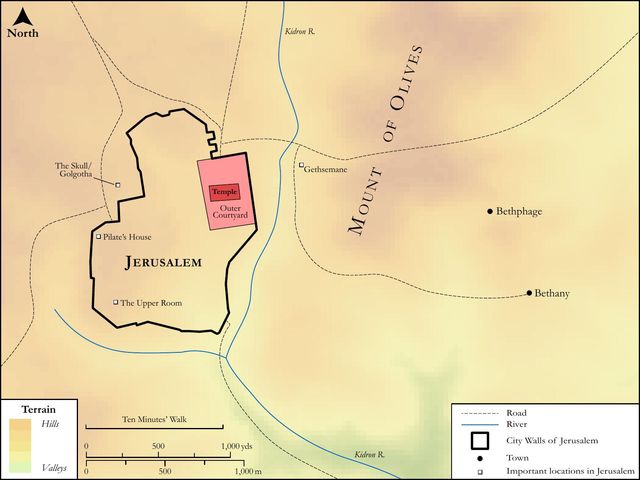
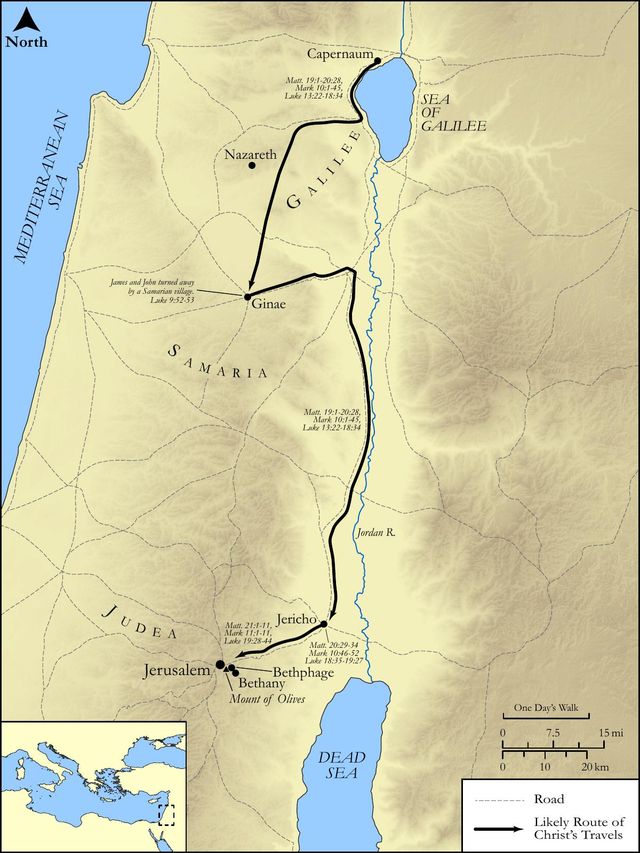
See on the biblical-era maps

Study this verse
Public-domain commentary
Matthew Henry
From his Commentary on the Whole Bible. Henry comments on passages, not single verses — this entry covers Luke 17:1–10. His two-level outline is real structure in the source text, so it is rendered as structure.
We are here taught,
I.That the giving of offences is a great sin, and that which we should every one of us avoid and carefully watch against, Luk 17:1, Luk 17:2.
We can expect no other than that offences will come, considering the perverseness and frowardness that are in the nature of man, and the wise purpose and counsel of God, who will carry on his work even by those offences, and bring good out of evil. It is almost impossible but that offences will come, and therefore we are concerned to provide accordingly; but woe to him through whom they come, his doom will be heavy (Luk 17:2), more terrible than that of the worst of the malefactors who are condemned to be thrown into the sea, for they perish under a load of guilt more ponderous than that of millstones. This includes a woe,
1.To persecutors, who offer any injury to the least of Christ's little ones, in word or deed, by which they are discouraged in serving Christ, and doing their duty, or in danger of being driven off from it.
2.To seducers, who corrupt the truths of Christ and his ordinances, and so trouble the minds of the disciples; for they are those by whom offences come.
3.To those who, under the profession of the Christian name, live scandalously, and thereby weaken the bands and sadden the hearts of God's people; for by them the offence comes, and it is no abatement of their guilt, nor will be any of their punishment, that it is impossible but offences will come.
II.That the forgiving of offences is a great duty, and that which we should every one of us make conscience of (Luk 17:3):
Take heed to yourselves. This may refer either to what goes before, or to what follows: Take heed that you offend not one of these little ones. Ministers must be very careful not to say or do any thing that may be a discouragement to weak Christians; there is need of great caution, and they ought to speak and act very considerately, for fear of this: or, "When your brother trespasses against you, does you any injury, puts any slight or affront upon you, if he be accessary to any damage done you in your property or reputation, take heed to yourselves at such a time, lest you be put into a passion; lest, when your spirits are provoked, you speak unadvisedly, and rashly vow to revenge (Pro 24:29): I will do so to him as he hath done to me. Take heed what you say at such a time, lest you say amiss."
1.If you are permitted to rebuke him, you are advised to do so. Smother not the resentment, but give it vent. Tell him his faults; show him wherein he has not done well nor fairly by you, and, it may be, you will perceive (and you must be very willing to perceive it) that you mistook him, that it was not a trespass against you, or not designed, but an oversight, and then you will beg his pardon for misunderstanding him; as Jos 22:30, Jos 22:31.
2.You are commanded, upon his repentance, to forgive him, and to be perfectly reconciled to him: If he repent, forgive him; forget the injury, never think of it again, much less upbraid him with it. Though he do not repent, you must not therefore bear malice to him, nor meditate revenge; but, it he do not at least say that he repents, you are not bound to be so free and familiar with him as you have been. If he be guilty of gross sin, to the offence of the Christian community he is a member of, let him be gravely and mildly reproved for his sin, and, upon his repentance, received into friendship and communion again. This the apostle calls forgiveness, Co2 2:7.
3.You are to repeat this every time he repeats his trespass, Luk 17:4. "If he could be supposed to be either so negligent, or so impudent, as to trespass against thee seven times in a day, and as often profess himself sorry for his fault, and promise not again to offend in like manner, continue to forgive him." Humanum est errare - To ere is human. Note, Christians should be of a forgiving spirit, willing to make the best of every body, and to make all about them easy; forward to extenuate faults, and not to aggravate them; and they should contrive as much to show that they have forgiven an injury as others to show that they resent it.
III.That we have all need to get our faith strengthened, because, as that grace grows, all other graces grow.
The more firmly we believe the doctrine of Christ, and the more confidently we rely upon the grace of Christ, the better it will be with us every way. Now observe here,
1.The address which the disciples made to Christ, for the strengthening of their faith, Luk 17:5. The apostles themselves, so they are here called, though they were prime ministers of state in Christ's kingdom, yet acknowledged the weakness and deficiency of their faith, and saw their need of Christ's grace for the improvement of it; they said unto the Lord, "Increase our faith, and perfect what is lacking in it." Let the discoveries of faith be more clear, the desires of faith more strong, the dependences of faith more firm and fixed, the dedications of faith more entire and resolute, and the delights of faith more pleasing. Note, the increase of our faith is what we should earnestly desire, and we should offer up that desire to God in prayer. Some think that they put up this prayer to Christ upon occasion of his pressing upon them the duty of forgiving injuries: "Lord, increase our faith, or we shall never be able to practise such a difficult duty as this." Faith in God's pardoning mercy will enable us to get over the greatest difficulties that lie in the way of our forgiving our brother. Others think that it was upon some other occasion, when the apostles were run aground in working some miracle, and were reproved by Christ for the weakness of their faith, as Mat 17:16, etc. To him that blamed them they must apply themselves for grace to mend them; to him they cry, Lord, increase our faith.
2.The assurance Christ gave them of the wonderful efficacy of true faith (Luk 17:6): "If ye had faith as a grain of mustard-seed, so small as mustard-seed, but yours is yet less than the least; or so sharp as mustard-seed, so pungent, so exciting to all other graces, as mustard to the animal spirits," and therefore used in palsies, "you might do wonders much beyond what you now do; nothing would be too hard for you, that was fit to be done for the glory of God, and the confirmation of the doctrine you preach, yea, though it were the transplanting of a tree from the earth to the sea." See Mat 17:20. As with God nothing is impossible, so are all things possible to him that can believe.
IV.That, whatever we do in the service of Christ, we must be very humble, and not imagine that we can merit any favour at his hand, or claim it as a debt; even the apostles themselves, who did so much more for Christ than others, must not think that they had thereby made him their debtor.
1.We are all God's servants (his apostles and ministers are in a special manner so), and, as servants, are bound to do all we can for his honour. Our whole strength and our whole time are to be employed for him; for we are not our own, nor at our own disposal, but at our Master's.
2.As God's servants, it becomes us to fill up our time with duty, and we have a variety of work appointed us to do; we ought to make the end of one service the beginning of another. The servant that has been ploughing, or feeding cattle, in the field, when he comes home at night has work to do still; he must wait at table, Luk 17:7, Luk 17:8. When we have been employed in the duties of a religious conversation, that will not excuse us from the exercises of devotion; when we have been working for God, still we must be waiting on God, waiting on him continually.
3.Our principal care here must be to do the duty of our relation, and leave it to our Master to give us the comfort of it, when and how he thinks fit. No servant expects that his master should say to him, Go and sit down to meat; it is time enough to do that when we have done our day's work. Let us be in care to finish our work, and to do that well, and then the reward will come in due time.
4.It is fit that Christ should be served before us: Make ready wherewith I may sup, and afterwards thou shalt eat and drink. Doubting Christians say that they cannot give to Christ the glory of his love as they should, because they have not yet obtained the comfort of it; but this is wrong. First let Christ have the glory of it, let us attend him with our praises, and then we shall eat and drink in the comfort of that love, and in this there is a feast.
5.Christ's servants, when they are to wait upon him, must gird themselves, must free themselves from every thing that is entangling and encumbering, and fit themselves with a close application of mind to go on, and go through, with their work; they must gird up the loins of their mind. When we have prepared for Christ's entertainment, have made ready wherewith he may sup, we must then gird ourselves, to attend him. This is expected from servants, and Christ might require it from us, but he does not insist upon it. He was among his disciples as one that served, and came not, as other masters, to take state, and to be ministered unto, but to minister; witness his washing his disciples' feet.
6.Christ's servants do not so much as merit his thanks for any service they do him: "Does he thank that servant? Does he reckon himself indebted to him for it? No, by no means." No good works of ours can merit any thing at the hand of God. We expect God's favour, not because we have by our services made him a debtor to us, but because he has by his promises made himself a debtor to his own honour, and this we may plead with him, but cannot sue for a quantum meruit - according to merit.
7.Whatever we do for Christ, though it should be more perhaps than some others do, yet it is no more than is our duty to do. Though we should do all things that are commanded us, and alas! in many things we come short of this, yet there is no work of supererogation; it is but what we are bound to by that first and great commandment of loving God with all our heart and soul, which includes the utmost.
8.The best servants of Christ, even when they do the best services, must humbly acknowledge that they are unprofitable servants; though they are not those unprofitable servants that bury their talents, and shall be cast into utter darkness, yet as to Christ, and any advantage that can accrue to him by their services, they are unprofitable; our goodness extendeth not unto God, nor if we are righteous is he the better, Psa 16:2; Job 22:2; Job 35:7. God cannot be a gainer by our services, and therefore cannot be made a debtor by them. He has no need of us, nor can our services make any addition to his perfections. It becomes us therefore to call ourselves unprofitable servants, but to call his service a profitable service, for God is happy without us, but we are undone without him.
Historical interpretation
Eight Centuries of Reception
8 surviving comments on this verse. Each one is dated, so this reads as a timeline rather than a list.
Select a marker to jump to its quote. Markers stagger vertically where authors wrote within a few decades of each other.
That no one should be uplifted in his labour. In Solomon, in Ecclesiasticus: "Extol not thyself in doing thy work." Also in the Gospel according to Luke: "Which of you, having a servant ploughing, or a shepherd, says to him when he cometh from the field, Pass forward and recline? But he says to him, Make ready somewhat that I may sup, and gird thyself, and minister to me, until I eat and drink; and afterwards thou shalt eat and drink? Does he thank that servant because he has done what was commanded him? So also ye, when ye shall have done that which is commanded you, say, We are unprofitable servants; we have done what we had to do."
For we know that no one sits down before he has first passed over. Moses indeed also passed over, that he might see a great sight. Since then thou not only sayest to thy servant, Sit down to meat, but requirest from him another service, so in this life the Lord does not put up with the performance of one work and labour, because as long as we live we ought always to work. Therefore it follows, And will not rather say, Make ready wherewith I may sup.
(de Quæst. Ev. l. 2. qu. 39.) Or else; To the many who understand not this faith in the truth already present, our Lord might seem not to have answered the petitions of His disciples. And there appears a difficulty in the connection here, unless we suppose He meant the change from faith to faith, from that faith, namely, by which we serve God, to that whereby we enjoy Him. For then will our faith be increased when we first believe the word preached, next the reality present. But that joyful contemplation possesseth perfect peace, which is given unto us in the everlasting kingdom of God. And that perfect peace is the reward of those righteous labours, which are performed in the administration of the Church. Be then the servant in the field ploughing, or feeding, that is, in this life either following his worldly business, or serving foolish men, as it were cattle, he must after his labours return home, that is, be united to the Church.
(de Quæst. Ev. ubi sup.) While His servants also are ministering, that is, preaching the Gospel, our Lord is eating and drinking the faith and confession of the Gentiles. It follows, And afterward thou shall eat and drink. As if He says, After that I have been delighted with the work of thy preaching, and refreshed myself with the choice food of thy compunction, then at length shalt thou go, and feast thyself everlastingly with the eternal banquet of wisdom.
Our Lord teaches us that it is no more than the just and proper right of a master to require, as their bounden duty, subjection from servants, adding, Doth he thank that servant because he did the things that were commanded him? I trow not. Here then is the disease of pride cut away. Why boastest thou thyself? Dost thou know that if thou payest not thy debt, danger is at hand, but if thou payest, thou doest nothing thankworthy? As St. Paul says, For though I preach the Gospel I have nothing to glory of, for necessity is laid upon me, yea, woe is unto me if I preach not the Gospel. (1 Cor. 9:16.)
Observe then that they who have rule among us, do not thank their subjects, when they perform their appointed service, but by kindness gaining the affections of their people, breed in them a greater eagerness to serve them. So likewise God requires from us that we should wait upon Him as His servants, but because He is merciful, and of great goodness, He promises reward to them that work, and the greatness of His loving-kindness far exceeds the labours of His servants.
Or the servant departs from the field when giving up for a time his work of preaching, the teacher retires into his own conscience, pondering his own words or deeds within himself. To whom our Lord does not at once say, Go from this mortal life, and sit down to meat, that is, refresh thyself in the everlasting resting-place of a blessed life.
He bids make ready wherewith he may sup, that is, after the labours of public discourse, He bids him humble himself in self-examination. With such a supper our Lord desires to be fed. But to gird one's self is to collect the mind which has been enfolded in the base coil of fluctuating thoughts, whereby its steps in the cause of good works are wont to be entangled. For he who girds up his garments does so, that in walking he may not be tripped up. But to minister unto God, is to acknowledge that we have no strength without the help of His grace.
Servants, I say, because bought with a price; (1 Cor. 6:20) unprofitable, for the Lord needeth not our good things, (Ps. 16:2) or because the sufferings of this present time are not worthy to be compared to the glory which shall be revealed in us. (Rom. 8:18.) Herein then is the perfect faith of men, when having done all things which were commanded them, they acknowledge themselves to be imperfect.
Who, when he returns from the field, would immediately say to him, "Come along, sit down," and would not say to him, "Prepare what I may eat"? The servant returns from the field when, after pausing from the work of preaching for a time, the teacher returns to his conscience, and, retreating from public speaking to the court of his heart, privately reviews his acts or words with himself. To whom the Lord does not immediately say, "Come along, sit down," that is, "pass from this mortal life, and be refreshed in the blessed abode of eternal life." For He will say this later, but in the meantime, after the shepherding and farming, He orders him to prepare what he may eat at home, that is, to display the labor of open speech, as well as the humility of self-reflection. For the Lord deigns to enter such a temple of conscience and desires to partake most willingly of such a meal. For behold, He says, I stand at the door and knock, if anyone hears my voice and opens the door, I will come in to him and dine with him, and he with me (Apoc. III).
Which of you, having a servant plowing or tending sheep. This parable teaches that faith, the more excellent it is outwardly in virtues, should become all the more humble within in conscience. For a servant plowing or tending sheep is understood as any teacher of the Church. About whom the Lord said: No one who puts his hand to the plow and looks back is fit for the kingdom of God. And to another who testified his love for Him, He responded for the third time: Feed my sheep.
Because faith makes its possessor a keeper of God's commandments, and adorns him with wonderful works; it would seem from thence that a man might thereby fall into the sin of pride. Our Lord therefore forewarned His Apostles by a fit example, not to boast themselves in their virtues, saying, But which of you having a servant plowing, &c.
Continue studying Luke 17:7 across the web’s major study libraries — every link below opens this exact verse, chapter, or book on the destination site.
Read & Compare
 BibleGatewayThis verse in more than 200 translations and 70 languages.
 Bible.comThe YouVersion reader — hundreds of translations, reading plans, and highlights.
 ESV.orgCrossway's official English Standard Version reader.
 NET BibleThe NET translation with 60,000+ translators' notes on every rendering decision.
 STEP BibleTyndale House's free study tool — original text, vocabulary, and scholarly resources.
 BibliaLogos Bible Software's free web reader.
 USCCBThe New American Bible (Revised Edition) with the U.S. bishops' study notes.
Commentaries
 BibleHub CommentariesDozens of classic commentaries on this verse, gathered on one page.
 StudyLightMore than 100 commentary sets — the largest collection on the web.
 BibleRefPlain-English commentary on what this verse means, verse by verse.
 Enduring WordDavid Guzik's free commentary on this chapter, widely used by Bible teachers.
 Bible Study ToolsVerse commentary alongside Greek and Hebrew study aids.
Original Language & Research
- BibleHub InterlinearThe verse word by word — original language, transliteration, and English.
- BibleHub LexiconEvery word's original-language definition and Strong's entry.
 Blue Letter BibleDeep-study tools — Strong's numbers, concordance, and word studies.
 CNTR CollationThe earliest Greek manuscripts of this verse, collated letter by letter.
Sermons, Hymns & Audio


TrulyRandomVerse is not affiliated with these sites and doesn’t control their content. They’re linked because they’re genuinely useful.
Summary
Luke 17:7 presents a rhetorical question from Jesus, illustrating a common master-servant dynamic in ancient agricultural society. It depicts a scenario where a master would not immediately invite a servant, returning from arduous field labor, to rest and eat, but would instead expect further service. This parable serves as a foundational premise for Jesus's subsequent teaching on the nature of duty and humility in service to God, challenging any notion that fulfilling one's basic obligations warrants special commendation or puts the servant in a position of merit.
Context
ShowHideLiterary Context
This verse is part of a series of teachings Jesus delivers to His disciples, immediately following instruction on the severe consequences of causing others to stumble, the imperative of radical forgiveness, and the transformative power of faith, even as small as a mustard seed (as seen in Luke 17:1-6). Luke 17:7-10 forms a mini-parable or illustrative scenario that directly precedes and sets the stage for the climactic teaching in Luke 17:10, where Jesus declares, "So likewise ye, when ye shall have done all those things which are commanded you, say, We are unprofitable servants; we have done that which was our duty to do." The entire passage emphasizes the nature of discipleship as one of humble, diligent, and unentitled service.
Historical & Cultural Context
The master-servant relationship described in Luke 17:7 was a pervasive and well-understood social and economic reality in Judaea. Servants (often slaves, though sometimes hired laborers) were considered property or entirely beholden to their masters. Their lives revolved around fulfilling the master's commands, with no expectation of special treatment or immediate reward beyond basic sustenance for their daily duties. Agricultural work, such as plowing and feeding cattle, was physically demanding and time-consuming, requiring continuous effort from dawn to dusk. Meals were significant, but for servants, they typically followed the master's needs and were not offered as a respite immediately upon completing one task, especially if other duties awaited. This cultural backdrop makes Jesus's rhetorical question resonate powerfully with His audience, who would intuitively understand the master's unquestioned authority and the servant's absolute obligation.
Key Themes
ShowHideThe primary themes elucidated by this verse include the nature of duty and obligation in service, particularly within a hierarchical relationship. It highlights that fulfilling one's expected responsibilities is not an act of special favor but a fundamental requirement. This sets up the concept of humility in service, challenging any sense of entitlement or expectation of praise for merely doing what is commanded. It implicitly teaches that true service is characterized by a diligent, continuous, and uncomplaining spirit. Furthermore, it contributes to the broader New Testament theme of grace versus works, laying groundwork for the understanding that even our best efforts in serving God do not earn us merit or put God in our debt, but are simply our appropriate response to His sovereign call and boundless grace, a concept further developed in passages like Romans 3:23-24.
Exposition and Analysis
ShowHideKey Word Analysis
ShowHideThis particle, often unexpressed in English, serves as an adversative or continuative. Here, it introduces a new thought that contrasts with or further develops the preceding ideas of faith and forgiveness. It signals a shift to a practical illustration that underscores the disciples' expected posture in light of their faith.
Derived from a word meaning "to bind," doûlos denotes a slave, bond-man, or one in complete subjection. This term is crucial as it emphasizes the absolute ownership and authority of the master over the servant. The servant's life and labor are not his own; they are entirely at the master's disposal. This highlights the complete devotion and lack of personal claim on time or reward that the master expects.
This adverb, translated as "by and by" in the KJV, is often misunderstood in modern English. In 17th-century English, "by and by" meant "immediately" or "straightway," not "eventually." Therefore, the verse asks, "Which of you, having a servant, will immediately say to him, 'Go and sit down to eat?'" This emphasizes the master's expectation of continued and immediate service, not a delayed reward or rest, upon the completion of one task.
Verse Breakdown
ShowHide"But which of you, having a servant plowing or feeding cattle,"
Jesus begins with a rhetorical question, appealing to the common experience and understanding of His audience. He paints a picture of a typical agricultural servant engaged in the demanding, essential tasks of plowing fields or tending livestock. This establishes a relatable scenario of a servant diligently performing his duties.
"will say unto him by and by, when he is come from the field,"
This clause highlights the servant's return from a long, arduous day of work. The crucial phrase "by and by" (meaning "immediately") underscores the master's expectation. The master would not immediately offer rest or reward upon the servant's return, implying that further duties are anticipated.
"Go and sit down to meat?"
This is the core of the rhetorical question, expecting a resounding "no" from the listeners. "Meat" here refers to a meal, not specifically animal flesh. To "sit down to meat" implies a position of honor, rest, and being served. The master's implied response is that the servant's duty is not yet complete; he must first serve the master's needs before attending to his own.
Literary Devices
ShowHideThe primary literary device employed in Luke 17:7 is a Rhetorical Question. Jesus poses a question not to elicit information, but to make a point, assuming the audience will agree with the implied answer (which is "no"). This technique powerfully draws the listeners into the scenario, allowing them to confirm the cultural norm themselves before Jesus applies it spiritually. The verse also functions as an Illustrative Scenario or a mini-parable, using a common, everyday situation to teach a profound spiritual truth. There is an element of Irony in the implied expectation: while a servant might desire immediate rest, the reality of their position dictates continued service, highlighting the disparity between human desire and the demands of duty.
Theological and Thematic Connections
ShowHideLuke 17:7, in conjunction with the verses that follow, profoundly shapes our understanding of Christian service and discipleship. It challenges any notion of earning God's favor or placing Him in our debt through our obedience or good works. The master-servant analogy underscores the truth that our service to God, no matter how diligent or extensive, is simply the fulfillment of our inherent duty as His creatures and redeemed children. We are not doing God a favor; rather, it is our privilege and obligation to serve Him. This perspective cultivates a spirit of humility, preventing pride in our accomplishments and fostering a reliance on God's grace alone for our salvation and all blessings. It teaches us to serve out of love and gratitude, not out of a desire for merit or immediate commendation, recognizing that our ultimate reward is found in God Himself and His gracious provision.
Reflection and Application
ShowHideThis seemingly simple verse holds profound implications for how we approach our walk with God and our service in His Kingdom. It serves as a vital corrective to any subtle or overt sense of entitlement we might harbor, reminding us that our obedience is not a bargaining chip with God, nor does it earn us special favor beyond what His grace already provides. Instead, it is the natural, humble response of a heart transformed by His love. We are called to serve diligently, faithfully, and without expectation of immediate praise or reward, understanding that our greatest privilege is simply to be used by the Almighty. This perspective frees us from the burden of performance-based spirituality and allows us to serve with genuine joy and humility, recognizing that even our best efforts are merely "our duty to do." It encourages us to find contentment in simply being God's servant, trusting that He sees our hearts and will reward us according to His perfect timing and boundless grace.
Questions for Reflection
ShowHideFAQ
ShowHideWhat does "by and by" mean in the King James Version of Luke 17:7?
ShowHideIn modern English, "by and by" typically means "eventually" or "after a while." However, in 17th-century English, when the King James Version was translated, "by and by" meant "immediately" or "straightway." Therefore, Luke 17:7 should be understood as asking, "Which of you, having a servant... will immediately say to him... 'Go and sit down to meat?'" This emphasizes the master's expectation of immediate continued service, not a delayed reward.
Is Jesus saying that God does not appreciate our service or good works?
ShowHideNo, Jesus is not implying that God does not appreciate our service. Rather, He is clarifying the nature of our relationship with God as His servants and disciples. Our service is a duty and a privilege, not a means to earn merit or put God in our debt. God certainly delights in our obedience and faithfulness, and He promises rewards for those who serve Him (e.g., Matthew 6:4, Hebrews 11:6). However, these rewards are by His grace, not because our actions somehow obligate Him. The point of Luke 17:7-10 is to cultivate humility and a proper understanding of our position before a sovereign God.
How does this verse relate to the concept of Christian reward or eternal life?
ShowHideThis verse teaches that our diligent service, while commanded and pleasing to God, does not earn us salvation or eternal life as a wage. Salvation is a gift received by grace through faith in Christ, not by works (as clearly stated in Ephesians 2:8-9). Our service is a response to that grace, an outflow of a transformed heart. While God does promise rewards for faithfulness (e.g., 1 Corinthians 3:12-15), these are distinct from salvation and are also ultimately expressions of His gracious character, not a strict payment for services rendered. The parable in Luke 17:7 reminds us to serve with humility, recognizing that even our best efforts are simply what we are obligated to do as His servants.
Christ-Centered Fulfillment
ShowHideWhile Luke 17:7 speaks to the general expectation of a master from his servant, its ultimate fulfillment and most profound application are found in the person and work of Jesus Christ. Jesus, though fully God, took on the form of a servant, emptying Himself and becoming obedient even unto death on a cross (as described in Philippians 2:5-8). He did not come to be served, but to serve, and to give His life as a ransom for many (a truth powerfully articulated in Mark 10:45). Unlike the earthly servant who performs duty out of obligation, Christ's service was a perfect, willing, and loving act of obedience to the Father's will, culminating in the ultimate sacrifice that secured our salvation. He perfectly exemplified the "unprofitable servant" in that His perfect obedience did not "earn" Him anything from the Father that He did not already possess as God, yet it was the Father's good pleasure to exalt Him. Our service, therefore, is not merely a duty, but a humble imitation of our Lord, who, after His arduous "field work" of redemption, did not immediately "sit down to meat" but continued His work of intercession and building His church, even as He awaits the full consummation of His Kingdom. When Jesus washed His disciples' feet, He provided a living parable of the humble service He expects from those who follow Him (as recorded in John 13:1-17). Thus, our service flows from His, a grateful response to the One who perfectly fulfilled all righteousness and served us unto salvation.