


John 6:27
- ἐργάζεσθεergazesthedo workG2038V-PNM-2PVerb Present Middle Or Passive Deponent Imperative 2nd Plural
- μὴmēnot [for]G3361PRT-NNegative Particle Negative
- τὴνtēntheG3588T-ASFDefinite article Accusative Singular Feminine
- βρῶσινbrōsinfoodG1035N-ASFNoun Accusative Singular Feminine
- τὴνtēnthatG3588T-ASFDefinite article Accusative Singular Feminine
- ἀπολλυμένηνapollumenēnis perishingG622V-PMP-ASFVerb Present Middle Participle Accusative Singular Feminine
- ἀλλὰallabut [for]G235CONJConjunction
- τὴνtēntheG3588T-ASFDefinite article Accusative Singular Feminine
- βρῶσινbrōsinfoodG1035N-ASFNoun Accusative Singular Feminine
- τὴνtēnwhichG3588T-ASFDefinite article Accusative Singular Feminine
- μένουσανmenousanis enduringG3306V-PAP-ASFVerb Present Active Participle Accusative Singular Feminine
- εἰςeisuntoG1519PREPPreposition
- ζωὴνzōēnlifeG2222N-ASFNoun Accusative Singular Feminine
- αἰώνιονaiōnioneternalG166A-ASFAdjective Accusative Singular Feminine
- ἣνhēnwhichG3739R-ASFRelative pronoun Accusative Singular Feminine
- ὁhotheG3588T-NSMDefinite article Nominative Singular Masculine
- υἱὸςhuiosSonG5207N-NSM-TNoun Nominative Singular Masculine Title
- τοῦtou<the>G3588T-GSMDefinite article Genitive Singular Masculine
- ἀνθρώπουanthrōpouof ManG444N-GSM-TNoun Genitive Singular Masculine Title
- ὑμῖνhuminto youG4771P-2DPPersonal pronoun Dative 2nd Plural
- δώσει·dōseiwill giveG1325V-FAI-3SVerb Future Active Indicative 3rd Singular
- τοῦτονtoutonHimG3778D-ASMDemonstrative pronoun Accusative Singular Masculine
- γὰρgarforG1063CONJConjunction
- ὁhotheG3588T-NSMDefinite article Nominative Singular Masculine
- πατὴρpatērFatherG3962N-NSM-TNoun Nominative Singular Masculine Title
- ἐσφράγισενesphragisenhas sealedG4972V-AAI-3SVerb Aorist Active Indicative 3rd Singular
- ὁho<the>G3588T-NSMDefinite article Nominative Singular Masculine
- θεόςtheosGodG2316N-NSM-TNoun Nominative Singular Masculine Title
English is a literal word-by-word gloss of the Greek, not the KJV's wording. Why?
This is the original text the KJV's translators worked from — each Greek word with its own literal English meaning in this verse, prepared by scholars at Tyndale House, Cambridge. The KJV translates whole sentences, not word by word, so its wording differs: one Greek word can become several English words, and the KJV may choose “charity” where the gloss reads “love”. Both are faithful — they answer different questions. For the KJV's own rendering, switch to the KJV text.
Details
See on the biblical-era map
Study this verse
Public-domain commentary
Matthew Henry
From his Commentary on the Whole Bible. Henry comments on passages, not single verses — this entry covers John 6:22–27. His four-level outline is real structure in the source text, so it is rendered as structure.
In these verses we have,
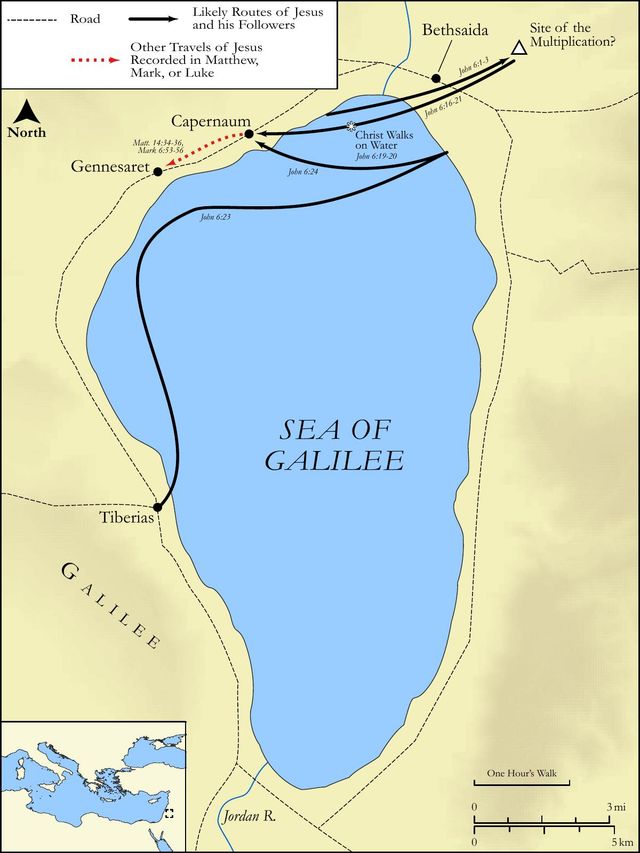
I.The careful enquiry which the people made after Christ, Joh 6:23, Joh 6:24.
They saw the disciples go to sea; they saw Christ retire to the mountain, probably with an intimation that he desired to be private for some time; but, their hearts being set upon making him a king, they way-laid his return, and the day following, the hot fit of their zeal still continuing,
1.They were much at a loss for him. He was gone, and they knew not what was become of him. They saw there was no boat there but that in which the disciples went off, Providence so ordering it for the confirming of the miracle of his walking on the sea, for there was no boat for him to go in. They observed also that Jesus did not go with his disciples, but that they went off alone, and left him among them on their side of the water. Note, Those that would find Christ must diligently observe all his motions, and learn to understand the tokens of his presence and absence, that they may steer accordingly.
2.They were very industrious in seeking him. They searched the places thereabouts, and when they saw that Jesus was not there, nor his disciples (neither he nor any one that could give tidings of him), they resolved to search elsewhere. Note, Those that would find Christ must accomplish a diligent search, must seek till they find, must go from sea to sea, to seek the word of God, rather than live without it; and those whom Christ has feasted with the bread of life should have their souls carried out in earnest desires towards him. Much would have more, in communion with Christ. Now,
(1.)They resolved to go to Capernaum in quest of him. There were his head-quarters, where he usually resided. Thither his disciples were gone; and they knew he would not be long absent from them. Those that would find Christ must go forth by the footsteps of the flock.
(2.)Providence favoured them with an opportunity of going thither by sea, which was the speediest way; for there came other boats from Tiberias, which lay further off upon the same shore, nigh, though not so nigh to the place where they did eat bread, in which they might soon make a trip to Capernaum, and probably the boats were bound for that port. Note, Those that in sincerity seek Christ, and seek opportunities of converse with him, are commonly owned and assisted by Providence in those pursuits. The evangelist, having occasion to mention their eating the multiplied bread, adds, After that the Lord had given thanks, Joh 6:11. So much were the disciples affected with their Master's giving thanks that they could never forget the impressions made upon them by it, but took a pleasure in remembering the gracious words that then proceeded out of his mouth. This was the grace and beauty of that meal, and made it remarkable; their hearts burned within them.
3.They laid hold of the opportunity that offered itself, and they also took shipping, and came to Capernaum, seeking for Jesus. They did not defer, in hopes to see him again on this side the water; but their convictions being strong, and their desires warm, they followed him presently. Good motions are often crushed, and come to nothing, for want of being prosecuted in time. They came to Capernaum, and, for aught that appears, these unsound hypocritical followers of Christ had a calm and pleasant passage, while his sincere disciples had a rough and stormy one. It is not strange if it fare worst with the best men in this evil world. They came, seeking Jesus. Note, Those that would find Christ, and find comfort in him, must be willing to take pains, and, as here, to compass sea and land to seek and serve him who came from heaven to earth to seek and save us.
II.The success of this enquiry:
They found him on the other side of the sea, Joh 6:25. Note, Christ will be found of those that seek him, first or last; and it is worth while to cross a sea, nay, to go from sea to sea, and from the river to the ends of the earth, to seek Christ, if we may but find him at last. These people appeared afterwards to be unsound, and not actuated by any good principle, and yet were thus zealous. Note, Hypocrites may be very forward in their attendance on God's ordinances. If men have no more to show for their love to Christ than their running after sermons and prayers, and their pangs of affection to good preaching, they have reason to suspect themselves no better than this eager crowd. But though these people were no better principled, and Christ knew it, yet he was willing to be found of them, and admitted them into fellowship with him. If we could know the hearts of hypocrites, yet, while their profession is plausible, we must not exclude them from our communion, much less when we do not know their hearts.
III.The question they put to him when they found him:
Rabbi, when camest thou hither? It should seem by Joh 6:59 that they found him in the synagogue. They knew this was the likeliest place to seek Christ in, for it was his custom to attend public assemblies for religious worship, Luk 4:16. Note, Christ must be sought, and will be found, in the congregations of his people and in the administration of his ordinances; public worship is what Christ chooses to own and grace with his presence and the manifestations of himself. There they found him, and all they had to say to him was, Rabbi, when camest thou hither? They saw he would not be made a king, and therefore say no more of this, but call him Rabbi, their teacher. Their enquiry refers not only to the time, but to the manner, of his conveying himself thither; not only When, but, "How, camest thou thither?" for there was no boat for him to come in. They were curious in asking concerning Christ's motions, but not solicitous to observe their own.
IV.The answer Christ gave them, not direct to their question (what was it to them when and how he came thither?) but such an answer as their case required.
1.He discovers the corrupt principle they acted from in following him (Joh 6:26): "Verily, verily, I say unto you, I that search the heart, and know what is in man, I the Amen, the faithful witness, Rev 3:14, Rev 3:15. You seek me; that is well, but it is not from a good principle." Christ knows not only what we do, but why we do it. These followed Christ,
(1.)Not for his doctrine's sake: Not because you saw the miracles. The miracles were the great confirmation of his doctrine; Nicodemus sought for him for the sake of them (Joh 3:2), and argued from the power of his works to the truth of his word; but these were so stupid and mindless that they never considered this. But,
(2.)It was for their own bellies' sake: Because you did eat of the loaves, and were filled; not because he taught them, but because he fed them. He had given them,
[1.]A full meal's meat: They did eat, and were filled; and some of them perhaps were so poor that they had not known of a long time before now what it was to have enough, to eat and leave.
[2.]A dainty meal's meat; it is probable that, as the miraculous wine was the best wine, so was the miraculous food more than usually pleasant.
[3.]A cheap meal's meat, that cost them nothing; no reckoning was brought in. Note, Many follow Christ for loaves, and not for love. Thus those do who aim at secular advantage in their profession of religion, and follow it because by this craft they get their preferments. Quantis profuit nobis haec fabula de Christo - This fable respecting Christ, what a gainful concern we have made of it! said one of the popes. These people complimented Christ with Rabbi, and showed him great respect, yet he told them thus faithfully of their hypocrisy; his ministers must hence learn not to flatter those that flatter them, nor to be bribed by fair words to cry peace to all that cry rabbi to them, but to give faithful reproofs where there is cause for them.
2.He directs them to better principles (Joh 6:27): Labour for that meat which endures to everlasting life. With the woman of Samaria he had discoursed of spiritual things under the similitude of water; here he speaks of them under the similitude of meat, taking occasion from the loaves they had eaten. His design is,
(1.)To moderate our worldly pursuits: Labour not for the meat that perishes. This does not forbid honest labour for food convenient, Th2 3:12. But we must not make the things of this world our chief care and concern. Note,
[1.]The things of the world are meat that perishes. Worldly wealth, honour, and pleasure, are meat; they feed the fancy (and many times this is all) and fill the belly. These are things which mean hunger after as meat, and glut themselves with, and which a carnal heart, as long as they last, may make a shift to live upon; but they perish, are of a perishing nature, wither of themselves, and are exposed to a thousand accidents; those that have the largest share of them are not sure to have them while they live, but are sure to leave them and lose them when they die.
[2.]It is therefore folly for us inordinately to labour after them. First, We must not labour in religion, nor work the works thereof, for this perishing meat, with an eye to this; we must not make our religion subservient to a worldly interest, nor aim at secular advantages in sacred exercises. Secondly, We must not at all labour for this meat; that is, we must not make these perishing things our chief good, nor make our care and pains about them our chief business; not seek those things first and most, Pro 23:4, Pro 23:5.
(2.)To quicken and excite our gracious pursuits: "Bestow your pains to better purpose, and labour for that meat which belongs to the soul," of which he shows,
[1.]That it is unspeakably desirable: It is meat which endures to everlasting life; it is a happiness which will last as long as we must, which not only itself endures eternally, but will nourish us up to everlasting life. The blessings of the new covenant are our preparative for eternal life, our preservative to it, and the pledge and earnest of it.
[2.]It is undoubtedly attainable. Shall all the treasures of the world be ransacked, and all the fruits of the earth gathered together, to furnish us with provisions that will last to eternity? No, The sea saith, It is not in me, among all the treasures hidden in the sand. It cannot be gotten for gold; but it is that which the Son of man shall give; hēn dōsei, either which meat, or which life, the Son of man shall give. Observe here, First, Who gives this meat: the Son of man, the great householder and master of the stores, who is entrusted with the administration of the kingdom of God among men, and the dispensation of the gifts, graces, and comforts of that kingdom, and has power to give eternal life, with all the means of it and preparatives for it. We are told to labour for it, as if it were to be got by our own industry, and sold upon that valuable consideration, as the heathen said, Dii laboribus omnia vendunt - The gods sell all advantages to the industrious. But when we have laboured ever so much for it, we have not merited it as our hire, but the Son of man gives it. And what more free than gift? It is an encouragement that he who has the giving of it is the Son of man, for then we may hope the sons of men that seek it, and labour for it, shall not fail to have it. Secondly, What authority he has to give it; for him has God the Father sealed, touton gar ho Patēr esphragisen̂ ho Theos - for him the Father has sealed (proved and evidenced) to be God; so some read it; he has declared him to be the Son of God with power. He has sealed him, that is, has given him full authority to deal between God and man, as God's ambassador to man and man's intercessor with God, and has proved his commission by miracles. Having given him authority, he has given us assurance of it; having entrusted him with unlimited powers, he has satisfied us with undoubted proofs of them; so that as he might go on with confidence in his undertaking for us, so may we in our resignations to him. God the Father scaled him with the Spirit that rested on him, by the voice from heaven, by the testimony he bore to him in signs and wonders. Divine revelation is perfected in him, in him the vision and prophecy is sealed up (Dan 9:24), to him all believers seal that he is true (Joh 3:33), and in him they are all sealed, Co2 1:22.
Historical interpretation
Six Centuries of Reception
21 surviving comments on this verse. Each one is dated, so this reads as a timeline rather than a list.
Select a marker to jump to its quote. Markers stagger vertically where authors wrote within a few decades of each other.
"Labour," says the Lord, "not for the meat which perisheth, but for that which endureth to everlasting life." And nutriment is received both by bread and by words. And truly "blessed are the peace-makers," who instructing those who are at war in their life and errors here, lead them back to the peace which is in the Word, and nourish for the life which is according to God, by the distribution of the bread, those "that hunger after righteousness."
How unworthy, also, is the way in which you interpret to the favour of your own lust the fact that the Lord "ate and drank" promiscuously! But I think that He must have likewise "fasted" inasmuch as He has pronounced, not "the full; "but "the hungry and thirsty, blessed: " (He) who was wont to profess "food" to be, not that which His disciples had supposed, but "the thorough doing of the Father's work; " teaching "to labour for the meat which is permanent unto life eternal; " in our ordinary prayer likewise commanding us to request "bread," not the wealth of Attalus therewithal.
For daily bread cannot be wanting to the righteous man, since it is written, "The Lord will not slay the soul of the righteous by hunger; " and again "I have been young and now am old, yet have I not seen the righteous forsaken, nor his seed begging their bread. And the Lord moreover promises and says, "Take no thought, saying, "What shall we eat, or what shall we drink, or wherewithal shall we be clothed? For after all these things do the nations seek. And your Father knoweth that ye have need of all these things. Seek ye first the kingdom of God and His righteousness, and alI these things shall be added unto you." To those who seek God's kingdom and righteousness, He promises that all things shall be added. For since all things are God's, nothing will be wanting to him who possesses God, if God Himself be not wanting to him. Thus a meal was divinely provided for Daniel: when he was shut up by the king's command in the den of lions, and in the midst of wild beasts who were hungry, and yet spared him, the man of God was fed. Thus Elijah in his flight was nourished both by ravens ministering to him in his solitude, and by birds bringing him food in his persecution. And-oh detestable cruelty of the malice of man!-the wild beasts spare, the birds feed, while men lay snares, and rage!
For just as in a golden chain the links are so intimately joined and connected together, as that the one holds the other, and is fitted on to it, and so carries on the chain-even so the miracles that have been handed down by the holy Gospels, one after the other, lead on the Church of God, which delights in festivity, and refresh it, not with the meat that perisheth, but with that which endureth unto everlasting life.
(viii. de Trin. c. 44) A seal throws out a perfect impression of the stamp, at the same time that it takes in that impression. This is not a perfect illustration of the Divine nativity: for sealing supposes matter, different kinds of matter, the impression of harder upon softer. Yet He who was God Only-Begotten, and the Son of man only by the Sacrament of our salvation, makes use of it to express the Father's fulness as stamped upon Himself. He wishes to show the Jews He has the power of giving the eternal meat, because He contained in Himself the fulness of God.
It is the nature of a seal to exhibit the whole form of the figure graven on it and that an impression taken from it reproduces it in every respect. And since it receives the whole of that which is impressed, it displays also in itself entirely whatever has been impressed on it. Yet this comparison is not adequate to exemplify the divine birth, because seals presuppose matter, difference of nature and an act of impression where the likeness of stronger natures is impressed on things of a more yielding nature.… What God had sealed should display in itself none other than the form of the God who sealed it.… As far as his being in the form of God by virtue of God’s seal on him, he still remained God. But inasmuch as he was to take the form of a servant and become obedient unto death, not grasping at his equality with God, he emptied himself through obedience to take the form of a slave. And he emptied himself of the form of God, that is, of that in which he was equal with God—not that he regarded his equality with God as any encroachment—although he was in the form of God and equal with God and sealed by God as God.
Follow therefore your trades as by the by, for your maintenance, but make the worship of God your main business; as also our Lord said: "Labour not for the meat which perishes, but for that which endureth unto everlasting life."
Therefore, since Christ was already formed in this [Church], He says, 'Set me as a seal upon your heart, as a seal upon your arm' (Song of Songs 8:6). Christ is a seal on the forehead, a seal on the heart. On the forehead, so that we may always confess [our faith]; on the heart, so that we may always love; a seal on the arm, so that we may always work. Therefore, let His image shine forth in our confession, shine forth in our love, shine forth in our deeds and actions; so that, if possible, His whole appearance may be expressed in us. He himself is our head, because the head of man is Christ: he himself is our eye, so that through him we may see the Father: he himself is our voice, through whom we speak to the Father: he himself is our right hand, through whom we offer our sacrifice to God the Father: he himself is also our seal, which is a sign of perfection and charity, because the loving Father has sealed the Son, as we read: "Whom the Father has sealed, God" (John 6:27). Therefore, Christ is our charity. Good love, when it offered itself for our sins: good love, which forgave sins.
That "the harvest is great, but the workmen are few," this also is well-known and manifest. Let us, therefore, "ask of the Lord of the harvest" that He would send forth workmen into the harvest; [Matthew 9:37-38] such workmen as "shall skilfully dispense the word of truth;" workmen "who shall not be ashamed;" faithful workmen; workmen who shall be "the light of the world;" [Matthew 5:14] workmen who "work not for the food that perishes, but for that food which abides unto life eternal;" [John 6:27] workmen who shall be such as the apostles; workmen who imitate the Father, and the Son, and the Holy Spirit; who are concerned for the salvation of men; not "hireling" [John 10:12-13] workmen; not workmen to whom the fear of God and righteousness appear to be gain; not workmen who "serve their belly;" not workmen who "with fair speeches and pleasant words mislead the hearts of the innocent;" [Romans 16:18] not workmen who imitate the children of light, while they are not light but darkness — "men whose end is destruction;" [Philippians 3:9] not workmen who practise iniquity and wickedness and fraud; not "crafty workmen;" [2 Corinthians 11:13] not workmen "drunken" and "faithless;" nor workmen who traffic in Christ; not misleaders; not "lovers of money; not malevolent."
For to say, "Labor not for the meat that perisheth," is not the expression of one implying that we ought to be idle; (in fact, this most especially is "meat that perisheth," for idleness is wont to teach all wickedness;) but that we ought to work, and to impart. This is meat that never perisheth; but if any be idle and gluttonous, and careth for luxury, that man worketh for "the meat that perisheth." So too, if a man by his labor should feed Christ, and give Him drink, and clothe Him, who so senseless and wretched as to say that such an one labors for the meat that perisheth, when there is for this the promise of the kingdom that is to come, and of those good things? This meat endureth forever.
But at that time, since the multitudes made no account of Him, nor sought to learn who it was that did these things, and by what power, but desired one thing only, to fill their bellies without working; Christ with good reason called such food, "meat that perisheth." "I fed," He saith, "your bodies, that after this ye might seek that other food which endureth, which nourisheth the soul; but ye again run after that which is earthy. Therefore ye do not understand that I lead you not to this imperfect food, but to that which giveth not temporal but eternal life, which nourisheth not the body but the soul."
Then when He had uttered such great words concerning Himself, and had said that He would give this food, in order that what was spoken might not stand in their way, to make His saying credible He attributeth the supply to the Father. For after saying, "Which the Son of Man shall give you"; He addeth, "Him hath God the Father sealed," that is, "hath sent Him for this purpose, that He might bring the food to you." The saying also admits of another interpretation; for in another place Christ saith, "He that heareth My words, hath set to his seal that God is true" (c. iii. 33), that is, hath "showed forth undeniably." Which indeed the expression seems to me to hint at even in this place, for "the Father hath sealed," is nothing else than "hath declared," "hath revealed by His testimony." He in fact declared Himself too, but since He was speaking to Jews, He brought forward the testimony of the Father.
(Hom. xliv. 1) After the rebuke, however, He proceeds to teach them: Labour not for the meat which perisheth, but for that meat which endureth unto everlasting life; meaning, Ye seek for temporal food, whereas I only fed your bodies, that ye might seek the more diligently for that food, which is not temporary, but contains eternal life.
(Hom. xliv. 1.) But, inasmuch as some who wish to live in sloth, pervert this precept, Labour not, &c. it is well to notice what Paul says, Let him that stole steal no more, but rather let him labour, working with his hands the thing which is good, that he may have to give to him that needeth. Ephes. 4:28) And he himself too, when he resided with Aquila and Priscilla at Corinth, worked with his hand. By saying, Labour not for the meat which perisheth, our Lord does not mean to tell us to be idle; but to work, and give alms. This is that meat which perisheth not; to labour for the meat which perisheth, is to be devoted to the interests of this life. Our Lord saw that the multitude had no thought of believing, and only wished to fill their bellies, without working; and this He justly called the meat which perisheth.
(Hom. xliv. 1) Or sealed, i. e. sent Him for this purpose, viz. to bring us food; or, sealed, was revealed the Gospel by means of His witness.
But He stoppeth not at rebukes, but addeth instruction also, saying, "Labor not for the meat which perisheth, but for that meat which endureth unto everlasting life."
"Which the Son of Man giveth unto you; for Him hath God the Father sealed."
What He saith, is of this kind: "Make ye no account of this earthly, but of that spiritual food." But since some of those who desire to live in doing nothing have abused this speech, as though Christ would entirely abolish working, it is seasonable to say somewhat to them. For they slander, so to speak, all Christianity, and cause it to be ridiculed on the score of idleness.
(Tr. xxv. 10) Under the figure of food He alludes to Himself. Ye seek Me, He saith, for the sake of something else; seek Me for My own sake.
(Tr. xxv. 10) As He told the woman of Samaria above, If thou knewest Who it is that saith to thee, Give me to drink, thou wouldest have asked of Him, and He would have given thee living water. (c. 4) So He says here, Which the Son of man shall give unto you.
"Labor not for the meat which perisheth, but for that which endureth unto everlasting life." What ye seek of me, ye seek for the sake of something else: seek me for my own sake. For He intimates that that food is Himself, which becomes more evident in what follows. "Which the Son of man shall give unto you, for Him hath God the Father sealed." You think all the while that I am getting up to give you to eat that sort of food, which ye take for the satisfying of hunger, and soon forget. Labor not for that food, but for that which endureth unto life eternal. And when He had said, "shall give," He added, "for Him hath God the Father sealed:" that is, for this the Father sealed, namely, that He might give that food; for what is meant by sealed, but impressed a certain something peculiar to Himself? For to seal, is to put a distinguishing mark upon a thing. Whoever seals a thing, puts a mark on it, lest it be confounded with any other. To seal, then, is to put on a mark. All things God has made are common things: something peculiar He has put upon His Son, namely, has begotten Him equal to Himself, that He might be distinguished, and not be reckoned as one of the whole creation.
The countenance of God the Father is the Son who is the imprint of God. But the light of God is the grace that passes into creation through the Spirit, by which we are refashioned to God through faith. We receive through God, as with a seal, the being conformed to his Son.
Something of this sort doth Paul teach us expanding the discourse universally and more generally, saying, He that soweth to his flesh shall of the flesh reap corruption, but he that soiveth to the Spirit shall of the Spirit reap life everlasting. For he says that they sow to the flesh who giving as it were full rein to the pleasures of the flesh, advance at full speed to whatever they will, by no means distinguishing what is profitable for them from what is hurtful and injurious, nor in any way accustomed to approve what seems good unto the Law-giver, but heedlessly hurried off to that alone which is pleasant and agreeable, and preferring nothing to things seen. Again he affirms that they sow to the Spirit, who expend the whole aim of their mind on those things wherein the Holy Ghost willeth us to excel, employing a mind so intense toward the cultivation of good things, that, did not voice of nature not to be disregarded constrain them to minister needful food to the flesh, they would not endure to descend even to this. I think then that we ought to take no forethought whatever for the flesh for the lusts thereof, but rather to apply ourselves to what is most needful, and to be zealous in practising those things, which bring us to the everlasting and Divine Life. For admiration for the delights of the body, and the esteeming nothing better than the superfluities of the belly, is truly brutish and akin to the extremest folly. But to apply ourselves to good things, and earnestly to strive to excel in virtues, and to be subject to the laws of the Spirit, and with all readiness to seek after the things of God, which are able to support us unto salvation:----I will grant that this truly beseemeth him who knoweth his own nature, and is not ignorant that he hath been made a reasonable creature after the Image of Him that created him. Therefore as the Saviour somewhere saith, Take we no thought, what shall we eat? or, what shall we drink? or, wherewithal shall we be clothed? but considering that the soul is more than meat, and the body than raiment, let us take thought how the more precious part of us may do well.
For though the body do well, and be fat with succession of delights, it will not profit the miserable soul; but on the contrary, will work it much harm. For it will depart into the everlasting fire, since they who have wrought no good, must needs undergo punishment for it: but if the body have been bridled with due reason, and brought under the law of the Spirit, both must surely be saved together. It is then most absurd, that for the flesh we should so take thought, which is but for a time and even now shall perish, as to think that it ought not to lack any one thing which it loves: and to take care for the soul, by way of appendix, or as though it were nothing worth; albeit I think we ought to apply ourselves so much the rather to cares for the soul, as it is of more value than the body. For so of a truth preferring what surpasses in the comparison to what is inferior, and giving a just vote in this matter, we shall become holy and wise jurors, and not bestow upon any other the palm of right reasoning, but rather shall put it upon our own heads. Let us then, as the Saviour saith, labour not for the meat which perisheth, which when it hath passed into the belly, and for a very little while deluded the mind with pettiest pleasure, goeth out into the draught, and is conveyed forth again from the belly. But the spiritual food which strengthened the heart, keepeth the man unto life everlasting, which also Christ promiseth to give us, saying, Which the Son of Man shall give unto you; at once knitting the human with that which is Divine, and connecting the whole mystery of the economy with Flesh in its order. But He hints, I suppose, at the Mystic and more Spiritual Food, whereby we live in Him, sanctified in body and soul. But we shall see Him speaking more openly of this hereafter. The discourse then must be kept for its fit time and place.
CHAPTER V. That the Only-Begotten Son is the Impress of the Person of God the Father, and no other Impress either is, or is conceived of, save He.
He was not ignorant, as God, of the charges that would result from Jewish folly, nor of the reasons why they were often foolishly enraged. He knew that they would reason in themselves, looking to the flesh alone, and not conceiving of God the Word therein, Who is This That seizeth upon God-befitting words? for who can give unto men food that keepeth them unto everlasting life? for wholly foreign to man's nature is such a thing, and it beseemeth Him Alone Who is God over all. The Saviour therefore defends Himself beforehand, and by seasonable arguments, shames their looked-for shameless talk. For He says that the Son of Man will give them the food which nourisheth them unto everlasting life, and immediately affirmed that He is sealed by the Father. Sealed again is either put for anointed (for he who is anointed is sealed), or as showing that He has been by Nature formed unto the Father. Just as if He had said, I am not unable to give you food which endureth and bringeth up unto everlasting life and delight. For though I seem as one of you, that is Man with flesh, yet was I anointed and sealed by God the Father unto an exact Likeness with Him. For ye shall see (He saith) that He is in Me, and I again in Him Naturally, even though for your sakes I was born Man of a woman, according to the Ineffable order of the economy. For I can do all things in God-befitting Authority and do not in any way come short of the Might inherent in My Father. And though God the Father giveth you the Spiritual Food, which preserveth unto everlasting life, it is clear that the Son too will give it, even though made in Flesh, since He is His Exact Image; the Likeness in every thing being conceived, not after the lineaments of flesh, nor yet ought conceived of in bodily form, but in God-befitting glory and Equal Power and royal Authority. But we must observe again, that when He says that the Son of Man will give the things God-befitting and that He hath been sealed unto the Image of God the Father, He endureth not the division of him that separateth the Temple of the Virgin from the true Sonship, but defines Himself and willeth to be conceived of again as One. For One in truth over us is Christ, bearing as it were the royal purple His Own Robe, I mean His Human Body, or His Temple, to wit of Soul and Body; since One too of Both is Christ.
But, most excellent sir, will the Christ-opposer again say, give the truth the power of overcoming: deal not subtilly with the saying, dishonourably turning it about, whithersoever thou wilt. Lo clearly hereby is the Son proved to be not of the Essence of the Father, but rather a copy of His Essence. Suppose some such thing (say they) as we say: A seal or signet impressed on wax, for example, or any other matter fit to receive it, and engraving a likeness only of itself, is taken away again by him who pressed it on, having lost no part of itself: so the Father, having imposed and imprinted Himself Wholly upon the Son in some way by a most accurate Likeness, from Himself hath He surely no part of His Essence, nor is conceived of as therefrom but a mere image and accurate likeness.
Let him that is zealous for knowledge see that now too is our opponent darting on us, like a serpent, and rears aloft his head surcharged with venom: but He Who shattereth the heads of the Dragon, will shatter it too, and will give us power to escape his manifold stubbornness. Let him then tell us, who has just been dinning us with dreadful words, Does not the seal or signet, which is made (it may be) of wood or of iron or of gold, full surely seal with |350 some impress those things whereon it comes, and will it not be and be conceived of as a seal apart from the impress? But I suppose that any one of our opponents too, even against his will constrained by fitness unto the very truth would confess that it will by all means seal with an impress; and without an impress, according to fair reasoning, not at all. Since then, as the Divine Scripture testifieth to us, the Son is the Impress of the Person of God the Father, in that He is in It and of It by Nature, whereupon is Himself impressed, or through whom else will the Father seal His Own Impress? For no one will say that the Father is not altogether in God-befitting Form, which is the Son, the Form of Him That begat Him; Whom if any behold spiritually, it is manifest that he will see the Father. Wherefore He says that He too is in Him Naturally, even though He be conceived to be of Him by reason of His Own Existence: as the brightness for instance, is in the brightening and of the brightening, and something different, according to the mode of conception, and again not different, as viewed in relation to it, because it is said to be of it, and again in it. And not I suppose in the way of division and complete essential partition are these things considered of: for they are inherent in respect of identity of essence in those things whence they are, and of which they are believed to be, tending forth according to expression in idea to something else, of their own, yet not separate. The Word of the Essence of the Father, not bare Word, nor without Flesh, is sealed then by the Father, yea rather through Him are sealed those things which are brought to likeness with God, as far as can be, as we understand in that which certain say, The light of Thy Countenance was marked upon us, O Lord. For he says that the Countenance of God the Father, is the Son, Which is again the Impress, but the light thereof is the grace which through the Spirit passeth through unto the creation, whereby we are remoulded unto God through faith, receiving through Him as with a seal, the conformation unto His Son, Who is the Image of the Father, that our being made after the Image and Likeness of the Creator, might be well preserved in us. But since the Son is confessedly the Countenance of God the Father, He will surely be the Impress too with which God seals.
Yea (says our opponent) we believe that God through the Spirit seals the Saints, but the things that you are bringing forward have no place in the present question. Wherefore we will recapitulate and say, The seal supposed to be of iron, or may be gold, impresses its own likeness on the matter whereon it comes, losing nothing of its own, but by the operation only of its being pressed on does it mark the things that receive it: thus do we hold that the Son has been sealed by the Father, not having ought of His Essence but possessing merely an accurate likeness thereof, and being Other than He, as the image to the archetype.
O boundless folly, and perilous conceit! how easily hast thou forgotten those things just now gone through. For we said that the Son was the Impress of the Father, and that with Him was sealed other than He, and not Himself, lest He be thought to be His Own Impress. But thou, having not rightly spurned our argument hereon, dost not blush to put about Him a likeness of operation only. In image only then will the Son be God according to you, and by Nature not at all, but merely in that He was fashioned and well formed after the Likeness of Him That begat; haply no longer of Him That begat: for it is time that ye should on these accounts take away the begetting also, yea rather there is every need even if ye will it not. On the duty of believing that the Son is begotten of the Father, we have already expended much argument, or shall do so in its place. But it were more fitting that we should proceed to the matter in hand, putting forward to those who are accustomed unrestrainedly to shameless talk the question, Will they not surely say that that which is given may also be taken away, and confess that that which is added can altogether be also lost? for does it not at some time happen that every thing is rejected, which is not firmly rooted in any by nature? It is evident, even should any of them not assent thereto. Some time then or other, according to the argument of possibility, the Son will be bereft of His Likeness. For He was sealed (as ye say) by the mere Operation of His Father upon Him, not having the stability that'is of natural Endowments, but conceived of and existing wholly other than His Father, and completely severed from His Essence. Doing then very excellently and fore-seeing matters by most cunning reasoning did ye secure the Father, by saying that He gives nought of Himself to the Son, save that He vouchsafes Him Likeness only, lest ought of passion should be conceived of as about Him. For this is your foolish mystery. For belike ye were ignorant that God the Father Who doeth all things without passion, will also beget without passion, and is superior to fire (for the argument brings us down to this necessity) which without passion or corporeal division, begets the burning which is of it. Let those then hear who are zealous in fancies only, and account unrestrained blasphemy to be not an unholy thing, but rather a virtue, that if they say that the Son is classed with the Father, in the propriety of likeness alone, He will abide in no secure possession of good things, but will wholly risk His being by Nature God, and will in possibility at least, admit of change for the worse. For there was said to that governor of Tyre too, words which reason necessitates us to attribute to the person of the devil, Thou art the seal of the likeness: but he to whom that speech is addressed, is found to have fallen from the likeness. Thou seest then, and clearly too, by such instances, that the mere being in the likeness of God is no security for an unmoved stability in things spiritual, nor yet does it suffice to perfect endurance in the good things in which they are, to have been duly sealed unto the Nature of the Maker. For they too fall, and are borne headlong, oft-times changing into a worse mind, than they had at the beginning. It is then possible, according to this argument, that the Son, attaining to Likeness with the Father by sameness of work only, and not firm fixed by the prop by Nature, but having His stability in the mere motions of His Own Will, should undergo change, or, though He do not suffer it, should find the not so suffering the result of admirable purpose, and not rather the steadfastness of Native stability, as God.
What then, most noble sirs, is the Son no longer God in truth? And if according to you, He is so found, why do we worship Him? why is He co-glorified with God the Father? why is He borne, as God, upon the highest Powers? Are then with us the Holy Seraphim themselves too ignorant that they do greatly err from what is fit, in glorifying Him Who is not by Nature God? They err, it seems, in calling Him Who is honoured with equal honour Lord of Sabaoth. Or shall we not say, that the highest Powers, Principalities Thrones and Dominions and Lordships, essay, after their power, to appear conformed to God? For if the so small animal of the earth, in respect of that creation, I mean man, be honoured with such beauty, what reason has one not for fully thinking, that to them who are far better than we, far better things are allotted? How then do they both call Him Lord of Sabaoth, and stand around as a guard, as ministering to the King of the universe? why sitteth He with the Father, and that on His Right Hand, the bond with the Lord, the creature with the Creator? For is it not fitter to bring that which by means of heed and wariness is free from passion and perfect, to the level of things originate rather than of God by Essence Who hath Naturally the inability to suffer? But it is manifest, though they confess it not. Who then will endure these babblers, or how will they not with reason hear, Woe to them that are drunken without wine?
But perchance they will Be ashamed of the absurdities of such arguments, and will betake themselves to this, and say, that the Son was sealed by the Father unto a most accurate Likeness, and is Unchangeable in Nature, even though He be not from the Father.
How then, tell me, will that which is not of God by Nature, bear His Attribute, and that be found not without share-essentially of the Excellences of the Divine Essence, which proceeded not therefrom, after the true mode of generation? For it is, I suppose, clear and confessed by all, that the Properties of the Godhead are wholly unattainable by the created nature, and that the qualities belonging to It by Nature will not exist in ought else that is, in equal and exact manner: as for example, Immutability is in God Naturally; in us by no means so, but a kind of stability likens us thereto, through heed and vigilance not suffering us readily to go after those things which we ought not. But if it were possible, that according to them, ought of Divine Attributes should be in any who is not of the Divine Nature Essentially, and that they should be so in him as they are in It; what (tell me) is to prevent all things God-befitting from at length coming down even upon those who are not by nature gods? For if one of them unhindered finds place (I mean Immutability) there will be room for the rest also, and what follows? utter confusion. For will not the superior pass below, and the inferior mount up into the highest place? And what is there yet to hinder even the Most High God from being brought down to our level, and us again from being gods even as the Father, when there no longer is or is seen any difference intervening, if the qualities which belong to God Only pass to us, and are in us naturally? And since God the Father contains in Himself Alone, as it seems, those Properties whereby we should be as He, we have remained men, and the angels likewise with us what they are, not mounting up to That which is above all. For if God should reveal Himself not Jealous, by putting His Own Attribute into the power of all, many surely would be those who were by nature gods, able to create earth and heaven and all the rest of the creation. For the Excellencies of Him Who is by Nature the Creator having once passed on, how will not they be as He is? or what prevents that which is radiant with equal goods from appearing in equal glory? But the God-opposer surely sees completely, how great the multitude of strange devices which is hence heaped up upon us and exclaims against the mislearning that is in him. The Godhead then will remain in Its Own Nature, and the creature will partake of It through spiritual relationship, but will never mount up unto the Dignity that unchangeably belongs to It. But our argument being thus arranged, we shall find that Immutability exists Essentially in the Son: He is then God by Nature, and of necessity of the Father, lest ought that is not of Him by Nature should reach to an equal dignity of Godhead.
But since they hold out to us as an incontestable argument their saying that the Son is other than the Father, as Image to archetype, and through this subtlety think to sever Him from the Essence of Him That begat Him, they shall be caught in no slight folly, and to have studied their assertion to no purpose, of any force in truth to accomplish fairly what they have at heart. For what further are they vainly contending for, or whence do they from only the distinctness of His own Being, sever the Son from the Father? For the fact that He exists Personally does not (I suppose) prove that He is diverse from the Essence of Him who begat Him. For He is confessedly of the Father, as being of His Essence; He is again in the Father, by reason of His being in Him by Nature; and you will hear Him say, at one time, I proceeded forth from the Father, and am come, again at another time, I am in the Father and the Father in Me. For He will not withdraw into a Personality wholly and completely separated, seeing that the Holy Trinity is conceived of as being in One Godhead; but being in the Father, in mode or position undivided as to consubstantiality, He will be conceived of as likewise of Him, according to the Procession which ineffably manifesteth Him in respect of beaming forth. For He is Light of Light. Therefore in the Father and of the Father, alike Undivided and separate, in Him as Impress, but as Image to Archetype will He be conceived of in His Own Person. But we will not simply discourse concerning this, but will confirm it by example from the Law, on all sides fortifying the force of truth against those who think otherwise.
The Law then appointed to the children of Israel to give to every man a ransom for his poll, half a didrachm. But one stater contains a didrachm. Yea and herein again was shadowed out to us Christ Himself, Who offered Himself for all, as by all, a Ransom to God the Father, and is understood in the one drachma, but not separately from the other, because that in the one coin, as we said before, two drachmae are contained. Thus may both the Son be conceived of in respect of the Father, and again the Father in respect of the Son, Both in One Nature, but Each Separate in part, as existing in His own Person, yet not wholly severed, nor One apart from the Other. And as in the one coin were two drachmae, having equal bulk with one another, and in no ways one less than the other; so shalt thou conceive of the in nought differing Essence of the Son in respect of God the Father, and again of the Father in respect of the Son, and thou shalt at length receive wholesome doctrine upon all points spoken of concerning Him.
They too seek Jesus, not for Jesus' sake, but for something else, who ask in their prayers not for eternal, but temporal blessings.
Bodily food only supports the flesh of the outward man, and must be taken not once for all, but daily; whereas spiritual food remaineth for ever, imparting perpetual fulness, and immortality.
When, through the hand of the priest, thou receivest the Body of Christ, think not of the priest which thou seest, but of the Priest thou dost not see. The priest is the dispenser of this food, not the author. The Son of man gives Himself to us, that we may abide in Him, and He in us. Do not conceive that Son of man to be the same as other sons of men: He stands alone in abundance of grace, separate and distinct from all the rest: for that Son of man is the Son of God, as it follows, For Him hath God the Father sealed. To seal is to put a mark upon; so the meaning is, Do not despise Me because I am the Son of man, for I am the Son of man in such sort, as that the Father hath sealed Me, i. e. given Me something peculiar, to the end that I should not be confounded with the human race, but that the human race should be delivered by Me.
Continue studying John 6:27 across the web’s major study libraries — every link below opens this exact verse, chapter, or book on the destination site.
Read & Compare
 BibleGatewayThis verse in more than 200 translations and 70 languages.
 Bible.comThe YouVersion reader — hundreds of translations, reading plans, and highlights.
 ESV.orgCrossway's official English Standard Version reader.
 NET BibleThe NET translation with 60,000+ translators' notes on every rendering decision.
 STEP BibleTyndale House's free study tool — original text, vocabulary, and scholarly resources.
 BibliaLogos Bible Software's free web reader.
 USCCBThe New American Bible (Revised Edition) with the U.S. bishops' study notes.
Commentaries
 BibleHub CommentariesDozens of classic commentaries on this verse, gathered on one page.
 StudyLightMore than 100 commentary sets — the largest collection on the web.
 BibleRefPlain-English commentary on what this verse means, verse by verse.
 Enduring WordDavid Guzik's free commentary on this chapter, widely used by Bible teachers.
 Bible Study ToolsVerse commentary alongside Greek and Hebrew study aids.
Original Language & Research
- BibleHub InterlinearThe verse word by word — original language, transliteration, and English.
- BibleHub LexiconEvery word's original-language definition and Strong's entry.
 Blue Letter BibleDeep-study tools — Strong's numbers, concordance, and word studies.
 CNTR CollationThe earliest Greek manuscripts of this verse, collated letter by letter.
Sermons, Hymns & Audio


TrulyRandomVerse is not affiliated with these sites and doesn’t control their content. They’re linked because they’re genuinely useful.
Summary
In John 6:27, Jesus redirects the crowd's focus from their immediate, physical hunger, satisfied by the miraculous feeding, to a deeper, spiritual longing. He challenges them to pursue not temporary, perishable sustenance, but the "meat which endureth unto everlasting life," a spiritual nourishment that only the Son of Man can provide, for He has been divinely authenticated and commissioned by God the Father. This verse serves as a pivotal transition, setting the stage for Jesus' profound discourse on Himself as the true "Bread of Life."
Context
ShowHideLiterary Context
This verse immediately follows the miraculous feeding of the five thousand, where Jesus supernaturally multiplied a few loaves and fish to feed a massive crowd. The people, having been physically satisfied, seek Jesus out again the next day, primarily motivated by the hope of receiving more free food. Jesus, with His divine insight, perceives their carnal intentions, recognizing that they are following Him for what He can provide materially rather than for who He is spiritually. John 6:27 is Jesus' direct and challenging response, a call to reorient their priorities from the temporal to the eternal, thereby introducing the profound "Bread of Life" discourse that dominates the rest of John chapter 6.
Historical & Cultural Context
In ancient Israel, bread was the staple of life, a fundamental necessity and a symbol of God's provision (e.g., manna in the wilderness). The crowd's desire for more bread aligns with a common human tendency to prioritize immediate physical needs and comforts. Furthermore, there was a Messianic expectation among some Jews that the Messiah would perform signs similar to Moses, including providing bread from heaven (John 6:30-31). Jesus' challenge cuts through these earthly expectations, elevating the discourse from physical sustenance to spiritual reality. His reference to "the Son of man" would have resonated with prophetic expectations, particularly from Daniel 7:13-14, signifying a divinely appointed, authoritative figure.
Key Themes
ShowHideJohn 6:27 encapsulates several crucial themes central to John's Gospel. Firstly, it starkly contrasts Spiritual vs. Material Focus, urging a shift from perishable physical sustenance to enduring spiritual nourishment. Secondly, it highlights Everlasting Life as the ultimate goal of seeking this enduring "meat," a concept foundational to John's theology, famously articulated in John 3:16. Thirdly, it underscores Jesus as the Exclusive Provider of this spiritual sustenance, foreshadowing His explicit declaration as the Bread of Life and the source of true life. Finally, the phrase "for him hath God the Father sealed" emphasizes Jesus' Divine Authority and Authentication, signifying God's explicit approval and commission of Jesus' unique identity and saving mission, much like a king's seal on a royal decree.
Exposition and Analysis
ShowHideKey Word Analysis
ShowHideFrom the base of ἔργον (ergon, "work"), this verb means "to toil (as a task, occupation, etc.), (by implication) effect, be engaged in or with." In this context, Jesus is not forbidding physical labor for sustenance, but rather challenging the ultimate object of one's toil and ambition. The emphasis is on the primary purpose and driving force behind one's efforts.
From the base of βιβρώσκω (bibrōskō, "to eat"), this term refers to "eating (literally or figuratively); by extension (concretely) food (literally or figuratively)." Here, it is used metaphorically to represent sustenance, both physical and spiritual. The contrast between "meat which perisheth" and "meat which endureth" highlights the qualitative difference between temporary satisfaction and eternal fulfillment.
From σφραγίς (sphragis, "a signet or private mark"), this verb means "to stamp (with a signet or private mark) for security or preservation (literally or figuratively); by implication, to keep secret, to attest." In this verse, it signifies divine authentication, ownership, and designation. God the Father has placed His authoritative mark of approval upon Jesus, confirming His unique identity as the Son of Man and His mission as the giver of eternal life.
Verse Breakdown
ShowHide"Labour not for the meat which perisheth,"
Jesus issues a powerful negative command, not against work itself, but against making perishable, temporary things the ultimate object of one's life's efforts and desires. This "meat" (food) symbolizes all earthly pursuits and satisfactions that are transient and cannot provide lasting fulfillment or eternal life. It challenges a worldview solely focused on material gain and physical comfort.
"but for that meat which endureth unto everlasting life,"
In stark contrast, Jesus commands a redirection of effort towards spiritual sustenance that has eternal value. This "meat" is not subject to decay or destruction; it "endureth" (remains, abides) permanently, leading directly to "everlasting life." This refers to a quality of life that is eternal in duration and divine in nature, characterized by a deep, abiding relationship with God.
"which the Son of man shall give unto you:"
This clause identifies Jesus Himself as the sole source and giver of this enduring, life-giving spiritual nourishment. The title "Son of man" emphasizes His humanity while subtly pointing to His divine authority and Messianic role, particularly as the one who possesses the power to bestow eternal life. This sets the stage for His subsequent declarations about being the Bread of Life.
"for him hath God the Father sealed."
This final clause provides the divine authorization for Jesus' claims and ability to give everlasting life. The Father's "seal" is an act of divine authentication, signifying that Jesus is uniquely commissioned, approved, and empowered by God Himself. It confirms His identity as the Messiah and the one through whom God's eternal purposes are realized, giving ultimate credibility to His words and mission.
Literary Devices
ShowHideJohn 6:27 is rich in literary devices that enhance its profound message. The most prominent is Contrast, as Jesus sets up a direct opposition between "meat which perisheth" and "meat which endureth unto everlasting life." This antithesis highlights the fundamental difference between temporal, earthly pursuits and eternal, spiritual realities, compelling the audience to choose between them. Symbolism is also heavily employed, with "meat" (βρῶσις) serving as a metaphor for sustenance in general, both physical and spiritual. The "meat which perisheth" symbolizes all temporary earthly provisions and desires, while the "meat which endureth" symbolizes the spiritual nourishment and eternal life that Christ offers. Furthermore, the act of God the Father having "sealed" the Son of Man is a powerful Metaphor for divine authentication and commissioning, akin to a king's signet ring validating a decree. This imagery conveys the absolute authority and divine backing behind Jesus' words and mission.
Theological and Thematic Connections
ShowHideJohn 6:27 is a profound theological statement that reorients human endeavor from the temporal to the eternal. It asserts that true life and lasting satisfaction are found not in material accumulation or fleeting pleasures, but in a spiritual relationship with Christ, who alone can impart everlasting life. This verse underscores the divine initiative in salvation: God the Father has authenticated His Son, Jesus, as the unique provider of this eternal sustenance. It challenges the human tendency to seek immediate gratification and calls for a deeper, Spirit-led pursuit of God's kingdom and righteousness. The "meat which endureth" points directly to Jesus Himself, who is the source of all spiritual life and the ultimate fulfillment of humanity's deepest longings.
Reflection and Application
ShowHideJohn 6:27 serves as a timeless challenge for believers today to critically examine the ultimate purpose and object of their daily "labor." Are our deepest desires, our most significant efforts, and our primary ambitions directed towards acquiring things that will ultimately perish, or are they invested in that which endures unto everlasting life? This verse calls us to a radical re-evaluation of our priorities, urging us to seek first the spiritual nourishment that comes from Christ, recognizing that true satisfaction, peace, and purpose are found only in Him. It encourages a shift from a consumeristic mindset, always seeking what can be gained for temporary comfort, to a Christ-centered one, valuing the eternal relationship and the spiritual sustenance He provides.
Questions for Reflection
ShowHideFAQ
ShowHideDoes "Labour not" mean we shouldn't work for a living or pursue earthly goals?
ShowHideNo, Jesus is not forbidding honest work or the pursuit of legitimate earthly goals. The Greek word for "labour" (ergázomai) refers to diligent effort or toil. The emphasis is on the ultimate object of one's labor and ambition. Jesus is challenging the crowd's primary motivation: they were seeking Him for more physical bread, which perishes, rather than for the spiritual nourishment that leads to eternal life. The command is a call to prioritize eternal values over temporal ones, to ensure that our deepest efforts are directed towards spiritual realities and our relationship with God, which alone provide lasting satisfaction and purpose. We are to work diligently in our earthly vocations, but our hearts and ultimate aspirations should be set on the enduring "meat" that Christ offers, as seen in Matthew 6:33.
What does it mean that "God the Father sealed" Jesus?
ShowHideThe act of "sealing" (Greek: sphragízō) carries significant meaning. In ancient times, a seal was used to authenticate a document, to mark ownership, to guarantee security, or to designate authority. When Jesus says God the Father has "sealed" Him, it signifies divine authentication and commissioning. It means that God the Father has publicly approved, authorized, and set apart Jesus as His chosen Son and the Messiah. This "seal" serves as a divine stamp of approval, confirming Jesus' unique identity and His authority to give everlasting life. It assures us that Jesus' claims and His mission are not self-appointed but are backed by the ultimate authority of God the Father, as also indicated in John 5:36-37.
Christ-Centered Fulfillment
ShowHideJohn 6:27 finds its ultimate fulfillment in the person and work of Jesus Christ. He is not merely the one who gives the "meat which endureth unto everlasting life," but He is that enduring meat. As the Bread of Life, Jesus offers Himself as the complete and satisfying spiritual sustenance that truly nourishes the soul unto eternity. His incarnation, life, atoning sacrifice on the cross, and resurrection are the means by which this eternal life is made available to humanity. He is the true manna from heaven, superior to the physical manna given in the wilderness, for those who partake of Him will never hunger or thirst spiritually. Through faith in Him, believers receive not just a longer life, but an entirely new quality of life—eternal life—which is a present reality and a future hope. Jesus, the one "sealed" by the Father, is the very embodiment of God's provision for humanity's deepest spiritual need, offering abundant and everlasting life to all who believe and follow Him as the way, the truth, and the life.