


Romans 8:16
- αὐτὸautoHimselfG846P-NSNPersonal pronoun Nominative Singular Neuter
- τὸtotheG3588T-NSNDefinite article Nominative Singular Neuter
- πνεῦμαpneumaSpiritG4151N-NSNNoun Nominative Singular Neuter
- συμμαρτυρεῖsummartureibears witness withG4828V-PAI-3SVerb Present Active Indicative 3rd Singular
- τῷtōtheG3588T-DSNDefinite article Dative Singular Neuter
- πνεύματιpneumatispiritG4151N-DSNNoun Dative Singular Neuter
- ἡμῶνhēmōnof usG3165P-1GPPersonal pronoun Genitive 1st Plural
- ὅτιhotithatG3754CONJConjunction
- ἐσμὲνesmenwe areG1510V-PAI-1PVerb Present Active Indicative 1st Plural
- τέκναteknachildrenG5043N-NPNNoun Nominative Plural Neuter
- θεοῦtheouof GodG2316N-GSM-TNoun Genitive Singular Masculine Title
English is a literal word-by-word gloss of the Greek, not the KJV's wording. Why?
This is the original text the KJV's translators worked from — each Greek word with its own literal English meaning in this verse, prepared by scholars at Tyndale House, Cambridge. The KJV translates whole sentences, not word by word, so its wording differs: one Greek word can become several English words, and the KJV may choose “charity” where the gloss reads “love”. Both are faithful — they answer different questions. For the KJV's own rendering, switch to the KJV text.
Details
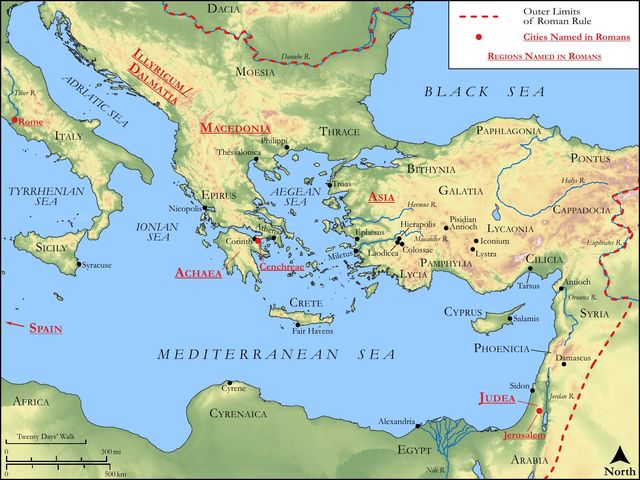
See on the biblical-era map

Study this verse
Public-domain commentary
Matthew Henry
From his Commentary on the Whole Bible. Henry comments on passages, not single verses — this entry covers Romans 8:10–16. His four-level outline is real structure in the source text, so it is rendered as structure.
In these verses the apostle represents two more excellent benefits, which belong to true believers.
I.Life.
The happiness is not barely a negative happiness, not to be condemned; but it is positive, it is an advancement to a life that will be the unspeakable happiness of the man (Rom 8:10, Rom 8:11): If Christ be in you. Observe, If the Spirit be in us, Christ is in us. He dwells in the heart by faith, Eph 3:17. Now we are here told what becomes of the bodies and souls of those in whom Christ is.
1.We cannot say but that the body is dead; it is a frail, mortal, dying body, and it will be dead shortly; it is a house of clay, whose foundation is in the dust. The life purchased and promised does not immortalize the body in its present state. It is dead, that is, it is appointed to die, it is under a sentence of death: as we say one that is condemned is a dead man. In the midst of life we are in death: be our bodies ever so strong, and healthful, and handsome, they are as good as dead (Heb 11:12), and this because of sin. It is sin that kills the body. This effect the first threatening has (Gen 3:19): Dust thou art. Methinks, were there no other argument, love to our bodies should make us hate sin, because it is such an enemy to our bodies. The death even of the bodies of the saints is a remaining token of God's displeasure against sin.
2.But the spirit, the precious soul, that is life; it is now spiritually alive, nay, it is life. Grace in the soul is its new nature; the life of the saint lies in the soul, while the life of the sinner goes no further than the body. When the body dies, and returns to the dust, the spirit if life; not only living and immortal, but swallowed up of life. Death to the saints is but the freeing of the heaven-born spirit from the clog and load of this body, that it may be fit to partake of eternal life. When Abraham was dead, yet God was the God of Abraham, for even then his spirit was life, Mat 22:31, Mat 22:32. See Psa 49:15. And this because of righteousness. The righteousness of Christ imputed to them secures the soul, the better part, from death; the righteousness of Christ inherent in them, the renewed image of God upon the soul, preserves it, and, by God's ordination, at death elevates it, and improves it, and makes it meet to partake of the inheritance of the saints in light. The eternal life of the soul consists in the vision and fruition of God, and both assimilating, for which the soul is qualified by the righteousness of sanctification. I refer to Psa 17:15, I will behold thy face in righteousness.
3.There is a life reserved too for the poor body at last: He shall also quicken your mortal bodies, Rom 8:11. The Lord is for the body; and though at death it is cast aside as a despised broken vessel, a vessel in which is no pleasure, yet God will have a desire to the work of his hands (Job 14:15), will remember his covenant with the dust, and will not lose a grain of it; but the body shall be reunited to the soul, and clothed with a glory agreeable to it. Vile bodies shall be newly fashioned, Phi 3:21; Co1 15:42. Two great assurances of the resurrection of the body are mentioned: - (1.) The resurrection of Christ: He that raised up Christ from the dead shall also quicken. Christ rose as the head, and first-fruits, and forerunner of all the saints, Co1 15:20. The body of Christ lay in the grave, under the sin of all the elect imputed, and broke through it. O grave, then, where is thy victory? It is in the virtue of Christ's resurrection that we shall rise. (2.) The indwelling of the Spirit. The same Spirit that raiseth the soul now will raise the body shortly: By his Spirit that dwelleth in you. The bodies of the saints are the temples of the Holy Ghost, Co1 3:16; Co1 6:19. Now, though these temples may be suffered for awhile to lie in ruins, yet they shall be rebuilt. The tabernacle of David, which has fallen down, shall be repaired, whatever great mountains may be in the way. The Spirit, breathing upon dead and dry bones, will make them live, and the saints even in their flesh shall see God. Hence the apostle by the way infers how much it is our duty to walk not after the flesh, but after the Spirit, Rom 8:12, Rom 8:13. Let not our life be after the wills and motions of the flesh. Two motives he mentions here: - [1.] We are not debtors to the flesh, neither by relation, gratitude, nor any other bond or obligation. We owe no suit nor service to our carnal desires; we are indeed bound to clothe, and feed, and take care of the body, as a servant to the soul in the service of God, but no further. We are not debtors to it; the flesh never did us so much kindness as to oblige us to serve it. It is implied that we are debtors to Christ and to the Spirit: there we owe our all, all we have and all we can do, by a thousand bonds and obligations. Being delivered from so great a death by so great a ransom, we are deeply indebted to our deliverer. See Co1 6:19, Co1 6:20. [2.] Consider the consequences, what will be at the end of the way. Here are life and death, blessing and cursing, set before us. If you live after the flesh, you shall die; that is, die eternally. It is the pleasing, and serving, and gratifying, of the flesh, that are the ruin of souls; that is, the second death. Dying indeed is the soul's dying: the death of the saints is but a sleep. But, on the other hand, You shall live, live and be happy to eternity; that is the true life: If you through the Spirit mortify the deeds of the body, subdue and keep under all fleshly lusts and affections, deny yourselves in the pleasing and humouring of the body, and this through the Spirit; we cannot do it without the Spirit working it in us, and the Spirit will not do it without our doing our endeavour. So that in a word we are put upon this dilemma, either to displease the body or destroy the soul.
II.The Spirit of adoption is another privilege belonging to those that are in Christ Jesus, Rom 8:14-16.
1.All that are Christ's are taken into the relation of Children to God, Rom 8:14. Observe,
(1.)Their property: They are led by the Spirit of God, as a scholar in his learning is led by his tutor, as a traveller in his journey is led by his guide, as a soldier in his engagements is led by his captain; not driven as beasts, but led as rational creatures, drawn with the cords of a man and the bands of love. It is the undoubted character of all true believers that they are led by the Spirit of God. Having submitted themselves in believing to his guidance, they do in their obedience follow that guidance, and are sweetly led into all truth and all duty.
(2.)Their privilege: They are the sons of God, received into the number of God's children by adoption, owned and loved by him as his children.
2.And those that are the sons of God have the Spirit,
(1.)To work in them the disposition of children.
[1.]You have not received the spirit of bondage again to fear, Rom 8:15. Understand it, First, Of that spirit of bondage which the Old Testament church was under, by reason of the darkness and terror of that dispensation. The veil signified bondage, Co2 3:15. Compare Rom 8:17. The Spirit of adoption was not then so plentifully poured out as now; for the law opened the wound, but little of the remedy. Now you are not under that dispensation, you have not received that spirit. Secondly, Of that spirit of bondage which many of the saints themselves were under at their conversion, under the convictions of sin and wrath set home by the Spirit; as those in Act 2:37, the jailer (Act 16:30), Paul, Act 9:6. Then the Spirit himself was to the saints a spirit of bondage: "But," says the apostle, "with you this is over." "God as a Judge," says Dr. Manton, "by the spirit of bondage, sends us to Christ as Mediator, and Christ as Mediator, by the spirit of adoption, sends us back again to God as a Father." Though a child of God may come under fear of bondage again, and may be questioning his sonship, yet the blessed Spirit is not again a spirit of bondage, for then he would witness an untruth.
[2.]But you have received the Spirit of adoption. Men may give a charter of adoption; but it is God's prerogative, when he adopts, to give a spirit of adoption - the nature of children. The Spirit of adoption works in the children of God a filial love to God as a Father, a delight in him, and a dependence upon him, as a Father. A sanctified soul bears the image of God, as the child bears the image of the father. Whereby we cry, Abba, Father. Praying is here called crying, which is not only an earnest, but a natural expression of desire; children that cannot speak vent their desires by crying. Now, the Spirit teaches us in prayer to come to God as a Father, with a holy humble confidence, emboldening the soul in that duty. Abba, Father. Abba is a Syriac word signifying father or my father; patēr, a Greek work; and why both, Abba, Father? Because Christ said so in prayer (Mar 14:36), Abba, Father: and we have received the Spirit of the Son. It denotes an affectionate endearing importunity, and a believing stress laid upon the relation. Little children, begging of their parents, can say little but Father, Father, and that is rhetoric enough. It also denotes that the adoption is common both to Jews and Gentiles: the Jews call him Abba in their language, the Greeks may call him patēr in their language; for in Christ Jesus there is neither Greek nor Jew.
(2.)To witness to the relation of children, Rom 8:16. The former is the work of the Spirit as a Sanctifier; this as a Comforter. Beareth witness with our spirit. Many a man has the witness of his own spirit to the goodness of his state who has not the concurring testimony of the Spirit. Many speak peace to themselves to whom the God of heaven does not speak peace. But those that are sanctified have God's Spirit witnessing with their spirits, which is to be understood not of any immediate extraordinary revelation, but an ordinary work of the Spirit, in and by the means of comfort, speaking peace to the soul. This testimony is always agreeable to the written word, and is therefore always grounded upon sanctification; for the Spirit in the heart cannot contradict the Spirit in the word. The Spirit witnesses to none the privileges of children who have not the nature and disposition of children.
Historical interpretation
Two Centuries of Reception
10 surviving comments on this verse. Each one is dated, so this reads as a timeline rather than a list.
Select a marker to jump to its quote. Markers stagger vertically where authors wrote within a few decades of each other.
The Spirit of adoption … bears witness and assures our spirits that we are children of God after we have passed from the spirit of slavery and come under the Spirit of adoption, when all fear has departed. We no longer act out of fear of punishment but do everything out of love for the Father. It is right too that the Spirit of God should be said to bear witness with our spirits and not with our souls, because the spirit is our better part.
Of the benefits of martyrdom. In the Proverbs of Solomon: "The faithful martyr delivers his soul from evils." Also in the same place: "Then shall the righteous stand in great boldness against them who have afflicted them, and who took away their labours. When they see them, they shall be disturbed with a horrible fear; and they shall wonder at the suddenness of their unhoped-for salvation, saying among themselves, repenting and groaning with distress of spirit, These are they whom some time we had in derision, and in the likeness of a proverb; we fools counted their life madness, and their end without honour. How are they reckoned among the children of God, and their lot among the saints! Therefore we have wandered from the way of truth, and the light of righteousness has not shined upon us, and the sun has not risen upon us. We have been wearied in the way of iniquity and of perdition, and we have walked through difficult solitudes; but we have not known the way of the Lord. What hath pride profited us? or what hath the boasting of riches brought to us? All these things have passed away as a shadow." Of this same thing in the cxvth Psalm: "Precious in the sight of the Lord is the death of His saints." Also in the cxxvth Psalm: "They who sow in tears shall reap in joy. Walking they walked, and wept as they cast their seeds; but coming they shall come in joy, raising up their laps." Of this same thing in the Gospel according to John: "He who loveth his life shall lose it; and he that hateth his life in this world shall find it to life eternal." Also in the same place: "But when they shall deliver you up, take no thought what ye shall speak; for it is not ye who speak, but the Spirit of your Father which speaketh in you." Also in the same place: "The hour shall come, that every one that killeth you shall think he doeth service to God l but they shall do this also because they have not known the Father nor me." Of this same matter, according to Matthew: "Blessed are they which shall suffer persecution for righteousness' sake; for theirs is the kingdom of heaven." Also in the same place: "Fear not them which kill the body, but are not able to kill the soul; but rather fear Him which is able to kill the soul and body in Gehenna." Also in the same place: "Whosoever shall confess me before men, him also will I confess before my Father which is in heaven; but he who shall deny me before men, him also will I deny before my Father which is in heaven. And he that shall endure to the end, the same shall be saved." Of this same thing, according to Luke: "Blessed shall ye be when men shall hate you, and shall separate you (from their company), and shall drive you out, and shall speak evil of your name, as wicked, for the Son of man's sake. Rejoice in that day, and exult; for, lo, your reward is great in heaven." Also in the same place: "Verily I say unto you, There is no man that leaveth house, or parents, or brethren, or wife, or children, for the sake of the kingdom of God, and does not receive seven times as much in this present time, but in the world to come life everlasting." Of this same thing in the Apocalypse: "And when he had opened the fifth seal, I saw under the altar of God the souls of them that were slain on account of the word of God and His testimony. And they cried with a loud voice, saying, How long, O Lord, holy and true, dost Thou not judge and avenge our blood on them that dwell on the earth? And unto every one of them were given white robes; and it was said to them, that they should rest still for a short time, until the number of their fellow-servants, and of their brethren, should be fulfilled, and they who shall afterwards be slain, after their example." Also in the same place: "After these things I saw a great crowd, which no one among them could number, from every nation, and from every tribe, and from every people and tongue, standing before the throne and before the Lamb; and they were clothed with white robes, and palms were in their hands. And they said with a loud voice, Salvation to our God, that sitteth upon the throne, and to the Lamb. And one of the elders answered and said to me, What are these which are clothed with white robes? who are they, and whence have they come? And I said unto him, My lord, thou knowest. And he said unto me, These are they who have come out of great tribulation, and have washed their robes, and made them white in the blood of the Lamb. Therefore they are before the throne of God, and serve Him day and night in His temple; and He who sitteth upon the throne shall dwell among them. They shall neither hunger nor thirst ever; and neither shall the sun fall upon them, nor shall they suffer any heat: for the Lamb who is in the midst of the throne shall protect them, and shall lead them to the fountains of the waters of life; and God shall wipe away every tear from their eyes." Also in the same place: "He who shall overcome I will give him to eat of the tree of life, which as in the paradise of my God." Also in the same place: "Be thou faithful even unto death, and I will give thee a crown of life." Also in the same place: "Blessed shall they be who shall watch, and shall keep their garments, lest they walk naked, and they see their shame." Of this same thing, Paul in the second Epistle to Timothy: "I am now offered up, and the time of my assumption is at hand. I have fought a good fight, I have finished my course, I have kept the faith. There now remains for me a crown of righteousness, which the Lord, the righteous Judge, will give me in that day; and not only to me, but to all also who love His appearing." Of this same thing to the Romans: "We are the sons of God: but if sons and heirs of God, we are also joint-heirs with Christ; if we suffer together, that we may also be magnified together." Of this same thing in the cxviiith Psalm: "Blessed are they who are undefiled in the way, and walk in the law of the Lord. Blessed are they who search into His testimonies."
That we must press on and persevere in faith and virtue, and in completion of heavenly and spiritual grace, that we may attain to the palm and the crown. In the book of Chronicles: "The Lord is with you so long as ye also are with Him; but if ye forsake Him, He will forsake you." In Ezekiel also: "The righteousness of the righteous shall not deliver him in what day soever he may transgress." Moreover, in the Gospel the Lord speaks, and says: "He that shall endure to the end, the same shall be saved." And again: "If ye shall abide in my word, ye shall be my disciples indeed; and ye shall know the truth, and the truth shall make you free." Moreover, forewarning us that we ought always to be ready, and to stand firmly equipped and armed, He adds, and says: "Let your loins be girded about, and your lamps burning, and ye yourselves like unto men that wait for their lord when he shall return from the wedding, that when he cometh and knocketh they may open unto him. Blessed are those servants whom their lord, when he cometh, shall find watching." Also the blessed Apostle Paul, that our faith may advance and grow, and attain to the highest point, exhorts us, saying: "Know ye not, that they which run in a race run all indeed, yet one receiveth the prize? So run, that ye may obtain. And they, indeed, that they may receive a corruptible crown; but ye an incorruptible." And again: "No man that warreth for God binds himself to anxieties of this world, that he may be able to please Him to whom he hath approved himself. Moreover, also, if a man should contend, he will not be crowned unless he have fought lawfully." And again: "Now I beseech you, brethren, by the mercy of God, that ye constitute your bodies a living sacrifice, holy, acceptable unto God; and be not conformed to this world, but be ye transformed in the renewing of your spirit, that ye may prove what is the will of God, good, and acceptable, and perfect." And again: "We are children of God: but if children, then heirs; heirs indeed of God, but joint-heirs with Christ, if we suffer together, that we may also be glorified together." And in the Apocalypse the same exhortation of divine preaching speaks, saying, "Hold fast that which thou hast, lest another take thy crown; " which example of perseverance and persistence is pointed out in Exodus, when Moses, for the overthrow of Ama-lek, who bore the type of the devil, raised up his open hands in the sign and sacrament of the cross, and could not conquer his adversary unless when he had stedfastly persevered in the sign with hands continually lifted up. "And it came to pass," says he, "when Moses raised up his hands, Israel prevailed; but when he let down his hands, Amalek grew mighty. And they took a stone and placed it under him, and he sate thereon. And Aaron and Hur held up his hands on the one side and on the other side, and Moses' hands were made steady even to the going down of the sun. Anti Jesus routed Amalek and all his people. And the Lord said unto Moses, Write this, and let it be a memorial in a book, and tell it in the ears of Jesus; because in destroying I will destroy the remembrance of Amalek from under heaven."
Nor let anything now be revolved in your hearts and minds besides the divine precepts and heavenly commands, with which the Holy Spirit has ever animated you to the endurance of suffering. Let no one think of death, but of immortality; nor of temporary punishment, but of eternal glory; since it is written, "Precious in the sight of the Lord is the death of His saints; " and again, "A broken spirit is a sacrifice to God: a contrite and humble heart God doth not despise." And again, where the sacred Scripture speaks of the tortures which consecrate God's martyrs, and sanctify them in the very trial of suffering: "And if they have suffered torments in the sight of men, yet is their hope full of immortality; and having been a little chastised, they shall be greatly rewarded: for God proved them, and found them worthy of Himself. As gold in the furnace hath He tried them, and received them as a sacrifice of a burnt-offering, and in due time regard shall be had unto them. The righteous shall shine, and shall run to and fro like sparks among the stubble. They shall judge the nations, and have dominion over the people; and their Lord shall reign for ever." When, therefore, you reflect that you shall judge and reign with Christ the Lord, you must needs exult and tread under foot present sufferings, in the joy of what is to come; knowing that from the beginning of the world it has been so appointed that righteousness should suffer there in the conflict of the world, since in the beginning, even at the first, the righteous Abel was slain, and thereafter all righteous men, and prophets, and apostles who were sent. To all of whom the Lord also in Himself has appointed an example, teaching that none shall attain to His kingdom but those who have followed Him in His own way, saying, "He that loveth his life in this world shall lose it; and he that hateth his life in this world shall keep it unto life eternal." And again: "Fear not them which kill the body, but are not able to kill the soul: but rather fear Him who is able to destroy both soul and body in hell." Paul also exhorts us that we who desire to attain to the Lord's promises ought to imitate the Lord in all things. "We are," says he, "the sons of God: but if sons, then heirs; heirs of God, and joint-heirs with Christ; if so be that we suffer with Him, that we may also be glorified together." Moreover, he added the comparison of the present time and of the future glory, saying, "The sufferings of this present time are not worthy to be compared with the coming glory which shall be revealed in us." Of which brightness, when we consider the glory, it behoves us to bear all afflictions and persecutions; because, although many are the afflictions of the righteous, yet those are delivered from them all who trust in God.
Cyprian to the people abiding at Thibaris, greeting. I had indeed thought, beloved brethren, and prayerfully desired-if the state of things and the condition of the times permitted, in conformity with what you frequently desired-myself to come to you; and being present with you, then to strengthen the brotherhood with such moderate powers of exhortation as I possess. But since I am detained by such urgent affairs, that I have not the power to travel far from this place, and to be long absent from the people over whom by divine mercy I am placed, I have written in the meantime this letter, to be to you in my stead. For as, by the condescension of the Lord instructing me, I am very often instigated and warned, I ought to bring unto your conscience also the anxiety of my warning. For you ought to know and to believe, and hold it for certain, that the day of affliction has begun to hang over our heads, and the end of the world and the time of Antichrist to draw near, so that we must all stand prepared for the battle; nor consider anything but the glory of life eternal, and the crown of the confession of the Lord; and not regard those things which are coming as being such as were those which have passed away. A severer and a fiercer fight is now threatening, for which the soldiers of Christ ought to prepare themselves with uncorrupted faith and robust courage, considering that they drink the cup of Christ's blood daily, for the reason that they themselves also may be able to shed their blood for Christ. For this is to wish to be found with Christ, to imitate that which Christ both taught and did, according to the Apostle John, who said, "He that saith he abideth in Christ, ought himself also so to walk even as He walked." Moreover, the blessed Apostle Paul exhorts and teaches, saying, "We are God's children; but if children, then heirs of God, and joint-heirs with Christ; if so be that we suffer with Him, that we may also be glorified together."
The witness of children is that by the Spirit they should be seen to bear the sign of the Father.
Paul showed by this that he called the soul “spirit” when it was spiritual, and the gift of the Spirit “Spirit.”
"The Spirit Itself beareth witness with our spirit, that we are the children of God." For it is not from the language merely, he says, that I make my assertion, but from the cause out of which the language has its birth; since it is from the Spirit suggesting it that we so speak. And this in another passage he has put into plainer words, thus: "God hath sent forth the Spirit of his Son into our hearts, crying, Abba Father." And what is that, "Spirit beareth witness with spirit?" The Comforter, he means, with that Gift, which is given unto us. For it is not of the Gift alone that it is the voice, but of the Comforter also who gave the Gift, He Himself having taught us through the Gift so to speak. But when the "Spirit beareth witness" what farther place for doubtfulness? For if it were a man, or angel, or archangel, or any other such power that promised this, then there might be reason in some doubting. But when it is the Highest Essence that bestoweth this Gift, and "beareth witness" by the very words He bade us use in prayer, who would doubt any more of our dignity? For not even when the Emperor elects any one, and proclaims in all men's hearing the honor done him, does anybody venture to gainsay.
The evidence of our adoption is that we have the Spirit, through whom we pray in the manner mentioned above; for only sons could receive such a pledge.
Paul uses the word spirit in two senses. The first is the Spirit of God, the second is our spirit, i.e., through the grace which we have been given.
Continue studying Romans 8:16 across the web’s major study libraries — every link below opens this exact verse, chapter, or book on the destination site.
Read & Compare
 BibleGatewayThis verse in more than 200 translations and 70 languages.
 Bible.comThe YouVersion reader — hundreds of translations, reading plans, and highlights.
 ESV.orgCrossway's official English Standard Version reader.
 NET BibleThe NET translation with 60,000+ translators' notes on every rendering decision.
 STEP BibleTyndale House's free study tool — original text, vocabulary, and scholarly resources.
 BibliaLogos Bible Software's free web reader.
 USCCBThe New American Bible (Revised Edition) with the U.S. bishops' study notes.
Commentaries
 BibleHub CommentariesDozens of classic commentaries on this verse, gathered on one page.
 StudyLightMore than 100 commentary sets — the largest collection on the web.
 BibleRefPlain-English commentary on what this verse means, verse by verse.
 Enduring WordDavid Guzik's free commentary on this chapter, widely used by Bible teachers.
 Bible Study ToolsVerse commentary alongside Greek and Hebrew study aids.
Original Language & Research
- BibleHub InterlinearThe verse word by word — original language, transliteration, and English.
- BibleHub LexiconEvery word's original-language definition and Strong's entry.
 Blue Letter BibleDeep-study tools — Strong's numbers, concordance, and word studies.
 CNTR CollationThe earliest Greek manuscripts of this verse, collated letter by letter.
Sermons, Hymns & Audio


TrulyRandomVerse is not affiliated with these sites and doesn’t control their content. They’re linked because they’re genuinely useful.
Summary
Romans 8:16 presents a profound truth regarding the believer's identity, asserting that the Holy Spirit provides an internal, undeniable testimony to the human spirit, confirming our status as adopted children of God. This divine witness offers deep assurance of our familial relationship with the Creator, transforming our understanding of ourselves and our access to the Father.
Context
ShowHideLiterary Context
Romans chapter 8 stands as a theological pinnacle within Paul's epistle, transitioning from the justification by faith in chapters 1-5 and the struggle with sin in chapter 7, to the glorious reality of life in the Spirit. Leading up to Romans 8:16, Paul establishes that there is "no condemnation for those who are in Christ Jesus" (Romans 8:1). He then contrasts living according to the flesh with living according to the Spirit, emphasizing that those "led by the Spirit of God are sons of God" (Romans 8:14). Immediately preceding our verse, Romans 8:15 introduces the "Spirit of adoption," through whom believers cry out, "Abba, Father!" Romans 8:16 then serves as the internal, experiential confirmation of this adopted status, providing the inner witness that validates the external declaration of sonship.
Historical & Cultural Context
The concept of adoption held significant legal and social weight in the Greco-Roman world, particularly in Roman law. An adopted child was fully and legally integrated into the new family, severing ties with their former family, taking on the new family name, and inheriting all rights and privileges as a natural-born child. This was a complete change of status, often used to secure an heir. Paul's audience, a mix of Jewish and Gentile believers in Rome, would have understood the profound implications of this legal and familial transformation. For Jewish believers, the idea of "children of God" was familiar, often referring to Israel as a nation or righteous individuals, but Paul here applies it universally to all who believe in Christ, emphasizing a new spiritual birth and legal standing that transcends ethnic boundaries. The cry "Abba, Father" (Romans 8:15) further highlights this intimacy, using an Aramaic term of endearment that Jesus Himself used, signifying a personal and trusting relationship with God.
Key Themes
ShowHideRomans 8:16 contributes significantly to several overarching themes in Romans and Paul's theology. Firstly, it underscores the theme of Divine Assurance, providing an internal, spiritual certainty of salvation and relationship with God that transcends mere intellectual belief. Secondly, it highlights the Active Role of the Holy Spirit in the believer's life, not merely as a power for sanctification but as the divine agent who confirms our identity. Thirdly, it reinforces the powerful truth of Spiritual Adoption, a central tenet of Paul's soteriology, where believers are brought into God's family not by natural birth or human merit, but by divine grace. This adoption carries with it the promise of Inheritance, as further elaborated in Romans 8:17, where believers are declared "heirs of God and fellow heirs with Christ." This verse, therefore, is crucial for understanding the believer's secure and intimate standing before God.
Exposition and Analysis
ShowHideKey Word Analysis
ShowHideThis multifaceted word (G4151) refers to a current of air, breath, or breeze; by analogy, it signifies a spirit, vital principle, or mental disposition. In the context of Romans 8:16, it refers primarily to the Holy Spirit, the divine third person of the Trinity, who indwells believers. However, the phrase "with our spirit" also refers to the human spirit, the innermost part of a person, which has been regenerated and made alive by God. The Holy Spirit interacts directly with this renewed human spirit.
Derived from sýn (with) and martyréō (to bear witness), this verb (G4828) means "to testify jointly," "to corroborate by concurrent evidence," or "to bear witness together with." It implies a shared, harmonious testimony. It's not just the Holy Spirit testifying to our spirit from outside, but rather a mutual, internal corroboration where the divine witness resonates with and is affirmed by the believer's own spirit. This joint testimony provides a powerful, internal conviction.
This noun (G5043) comes from the base of tíktō (to produce, to give birth), meaning "a child (as produced)." Unlike huios (son), which can emphasize legal standing or maturity, téknon highlights the natural relationship of offspring, emphasizing a shared nature and genuine familial bond. Here, it underscores that believers are not merely servants or subjects, but genuinely God's offspring, born of His Spirit, sharing in His divine nature (2 Peter 1:4).
Verse Breakdown
ShowHide"The Spirit itself beareth witness"
This clause emphasizes the active, personal, and divine agency of the Holy Spirit. It is the Spirit Himself, not merely a feeling or an idea, who initiates and delivers this crucial testimony. The term "beareth witness" (symmartyréō) suggests an authoritative and corroborating testimony, like a legal witness providing evidence.
"with our spirit"
This phrase highlights the reciprocal and intimate nature of the Holy Spirit's work. The divine testimony is not external or imposed, but an internal, experiential reality that resonates with the believer's regenerated human spirit. Our spirit, made alive by God, is able to apprehend and affirm the truth of the Spirit's witness, creating a deep, inner conviction.
"that we are the children of God"
This is the precise content and purpose of the Spirit's witness. The Spirit testifies to our true identity and status: we are not merely creatures, servants, or even friends, but genuinely "children of God." This signifies a profound familial relationship, characterized by intimacy, love, and the right to an inheritance, establishing our secure and beloved standing within God's family.
Literary Devices
ShowHidePaul employs several literary devices to convey the profound truth of Romans 8:16. The most prominent is Personification, where the Holy Spirit is portrayed as an active agent, a witness in a legal sense, providing testimony. This gives the abstract concept of divine assurance a tangible, relational quality. There is also an element of Synecdoche or Metonymy in the phrase "our spirit," where the spirit stands for the entire inner person, emphasizing that this witness is not merely intellectual but deeply internal and experiential. The verse's overall function is one of Assurance and Confirmation, serving as a rhetorical anchor that solidifies the believer's identity and security in Christ, building upon the preceding declaration of adoption in Romans 8:15.
Theological and Thematic Connections
ShowHideRomans 8:16 is a cornerstone for the doctrine of the assurance of salvation, affirming that a believer's confidence in their relationship with God is not based solely on human feelings or intellectual assent, but on the direct, internal testimony of the Holy Spirit. This divine witness serves as an unshakeable foundation for our identity as God's children, transforming fear into familial intimacy and doubt into conviction. It underscores the Holy Spirit's essential role in applying the benefits of Christ's redemption to individual believers, making the abstract truth of adoption a living reality within their hearts. This assurance empowers believers to live lives of grateful obedience, knowing they are deeply loved and eternally secure within God's family.
Reflection and Application
ShowHideThe truth of Romans 8:16 offers profound comfort and practical guidance for the believer's daily walk. In a world that constantly challenges our identity and worth, this verse anchors us in the unchanging reality of our divine sonship. When doubts assail, or when we feel distant from God, remembering that the Holy Spirit Himself testifies to our spirit can be a powerful antidote to anxiety and insecurity. This assurance empowers us to approach God not as a demanding judge, but as our loving "Abba, Father," fostering a spirit of confidence and intimacy in prayer. Furthermore, understanding our identity as God's beloved children motivates us to live in a manner worthy of that calling, not out of fear of punishment, but out of a deep desire to honor and please our Heavenly Father, whose Spirit dwells within us and confirms our belonging. It transforms our perspective from striving for acceptance to living from a place of already being fully accepted and cherished.
Questions for Reflection
ShowHideFAQ
ShowHideHow does the Holy Spirit "bear witness" with our spirit? Is it an audible voice or a feeling?
ShowHideThe Holy Spirit's witness is typically not an audible voice, nor is it solely a fleeting emotion, though it can certainly evoke feelings of peace, joy, and assurance. Rather, it is primarily an internal, spiritual conviction and deep-seated knowledge that aligns with the truth of God's Word. This witness manifests as a profound sense of belonging, a spiritual recognition of God as Father, and an inner peace concerning one's salvation. It often involves the Spirit illuminating Scripture, enabling the believer to truly grasp and appropriate the promises of God, and producing the "fruit of the Spirit" (Galatians 5:22-23) as evidence of His indwelling presence. It's a corroboration between the divine Spirit and the regenerated human spirit, a shared testimony that resonates deeply within.
Does every believer experience this witness in the same way or with the same intensity?
ShowHideNo, the experience of the Spirit's witness can vary among believers. While the objective truth of the Spirit's testimony (that we are children of God) is constant for all who are in Christ, the subjective perception or intensity of that witness can differ. Factors such as spiritual maturity, personal temperament, life circumstances, and even spiritual attacks can influence how strongly one feels or apprehends this inner assurance. Some may experience a profound, undeniable sense of peace, while others may have a quieter, more consistent conviction. The important thing is that the Spirit does bear witness, even if the believer's awareness of it fluctuates. It is a spiritual reality grounded in God's faithfulness, not solely on our fluctuating feelings.
What is the difference between being a "child of God" and a "son of God" in Paul's writings?
ShowHideIn English translations, "child" and "son" are often used interchangeably, but in the Greek, Paul sometimes uses distinct terms that carry nuanced meanings. "Children" (Greek: téknon, as in Romans 8:16) emphasizes the biological or relational aspect of being born into a family, highlighting a shared nature and genuine offspring. It speaks to new birth and regeneration. "Sons" (Greek: huios, as in Romans 8:14 and Romans 8:17) often carries a legal and mature connotation in the Greco-Roman context, referring to one who has reached legal maturity and is entitled to full inheritance rights. While all believers are "children" by spiritual birth, they are also "sons" in terms of their legal standing, maturity, and full inheritance rights in Christ. Both terms affirm the believer's intimate and privileged relationship with God.
Christ-Centered Fulfillment
ShowHideRomans 8:16 finds its ultimate fulfillment and meaning in Jesus Christ, who is the unique and eternal Son of God. Our adoption as children of God is not an independent act but is entirely "in Christ" (Ephesians 1:5). It is through His perfect life, atoning death, and glorious resurrection that we are reconciled to God and granted the privilege of sonship. The Holy Spirit, who bears witness with our spirit, is none other than the "Spirit of Christ" (Romans 8:9), sent by the Father and the Son to indwell believers. Jesus, by becoming truly human, identified with us, so that He might bring "many sons to glory" (Hebrews 2:10), making us "fellow heirs with Christ" (Romans 8:17). Our ability to cry "Abba, Father" (Romans 8:15) is a direct participation in Christ's own intimate relationship with the Father, granted to us by the Spirit who unites us to Him. Thus, the Spirit's witness to our sonship is a testimony to the completed work of Christ, through whom we gain full access and identity within the divine family.