


2 Corinthians 5:5
- ὉHoThe [One]G3588T-NSMDefinite article Nominative Singular Masculine
- δὲdenowG1161CONJConjunction
- κατεργασάμενοςkatergasamenoshaving preparedG2716V-ADP-NSMVerb Aorist Middle Deponent Participle Nominative Singular Masculine
- ἡμᾶςhēmasusG3165P-1APPersonal pronoun Accusative 1st Plural
- εἰςeisforG1519PREPPreposition
- αὐτὸautoveryG846P-ASNPersonal pronoun Accusative Singular Neuter
- τοῦτοtoutothisG3778D-ASNDemonstrative pronoun Accusative Singular Neuter
- θεόςtheos[is] GodG2316N-NSM-TNoun Nominative Singular Masculine Title
- ὁho<the>G3588T-NSMDefinite article Nominative Singular Masculine
- καὶkaiandG2532CONJConjunction
- δοὺςdoushaving givenG1325V-2AAP-NSMVerb 2nd Aorist Active Participle Nominative Singular Masculine
- ἡμῖνhēminto usG3165P-1DPPersonal pronoun Dative 1st Plural
- τὸνtontheG3588T-ASMDefinite article Accusative Singular Masculine
- ἀρραβῶναarrabōnapledgeG728N-ASMNoun Accusative Singular Masculine
- τοῦtouof theG3588T-GSNDefinite article Genitive Singular Neuter
- πνεύματοςpneumatosSpiritG4151N-GSNNoun Genitive Singular Neuter
English is a literal word-by-word gloss of the Greek, not the KJV's wording. Why?
This is the original text the KJV's translators worked from — each Greek word with its own literal English meaning in this verse, prepared by scholars at Tyndale House, Cambridge. The KJV translates whole sentences, not word by word, so its wording differs: one Greek word can become several English words, and the KJV may choose “charity” where the gloss reads “love”. Both are faithful — they answer different questions. For the KJV's own rendering, switch to the KJV text.
Details
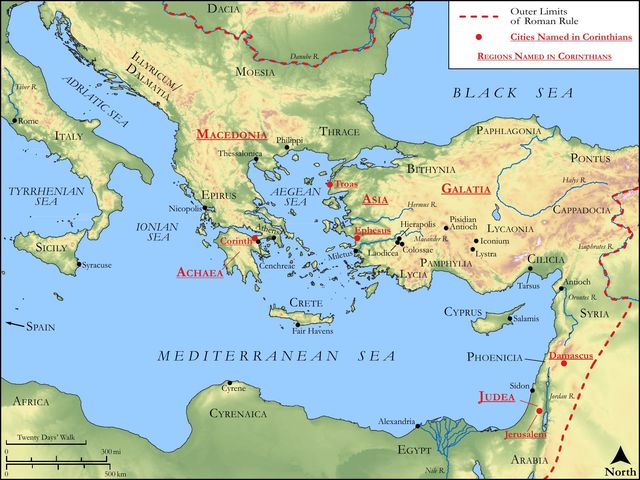
See on the biblical-era map

Study this verse
Public-domain commentary
Matthew Henry
From his Commentary on the Whole Bible. Henry comments on passages, not single verses — this entry covers 2 Corinthians 5:1–11. His four-level outline is real structure in the source text, so it is rendered as structure.
The apostle in these verses pursues the argument of the former chapter, concerning the grounds of their courage and patience under afflictions. And,
I.He mentions their expectation, and desire, and assurance, of eternal happiness after death, Co2 5:1-5. Observe particularly,
1.The believer's expectation of eternal happiness after death, Co2 5:1. He does not only know, or is well assured by faith of the truth and reality of the thing itself - that there is another and a happy life after this present life is ended, but he has good hope through grace of his interest in that everlasting blessedness of the unseen world: "We know that we have a building of God, we have a firm and well-grounded expectation of the future felicity." Let us take notice,
(1.)What heaven is in the eye and hope of a believer. He looks upon it as a house, or habitation, a dwelling-place, a resting-place, a hiding-place, our Father's house, where there are many mansions, and our everlasting home. It is a house in the heavens, in that high and holy place which as far excels all the palaces of this earth as the heavens are high above the earth. It is a building of God, whose builder and maker is God, and therefore is worthy of its author; the happiness of the future state is what God hath prepared for those that love him. It is eternal in the heavens, everlasting habitations, not like the earthly tabernacles, the poor cottages of clay in which our souls now dwell, which are mouldering and decaying, and whose foundations are in the dust.
(2.)When it is expected this happiness shall be enjoyed - immediately after death, so soon as our house of this earthly tabernacle is dissolved. Note,
[1.]That the body, this earthly house, is but a tabernacle, that must be dissolved shortly; the nails or pins will be drawn, and the cords be loosed, and then the body will return to dust as it was.
[2.]When this comes to pass, then comes the house not made with hands. The spirit returns to God who gave it; and such as have walked with God here shall dwell with God for ever.
2.The believer's earnest desire after this future blessedness, which is expressed by this word, stenazomen - we groan, which denotes,
(1.)A groaning of sorrow under a heavy load; so believers groan under the burden of life: In this we groan earnestly, Co2 5:2. We that are in this tabernacle groan, being burdened, Co2 5:4. The body of flesh is a heavy burden, the calamities of life are a heavy load. But believers groan because burdened with a body of sin, and the many corruptions that are still remaining and raging in them. This makes them complain, O wretched man that I am! Rom 7:24.
(2.)There is a groaning of desire after the happiness of another life; and thus believers groan: Earnestly desiring to be clothed upon with our house which is from heaven (Co2 5:2), to obtain a blessed immortality, that mortality might be swallowed up of life (Co2 5:4), that being found clothed, we may not be naked (Co2 5:3), that, if it were the will of God, we might not sleep, but be changed; for it is not desirable in itself to be unclothed. Death considered merely as a separation of soul and body is not to be desired, but rather dreaded; but, considered as a passage to glory, the believer is willing rather to die than live, to be absent from the body, that he may be present with the Lord (Co2 5:1), to leave this body that he may go to Christ, and to put off these rags of mortality that he may put on the robes of glory. Note,
[1.]Death will strip us of the clothing of flesh, and all the comforts of life, as well as put an end to all our troubles here below. Naked we came into this world, and naked shall we go out of it. But,
[2.]Gracious souls are not found naked in the other world; no, they are clothed with garments of praise, with robes of righteousness and glory. They shall be delivered out of all their troubles, and shall have washed their robes and made them white in the blood of the Lamb, Rev 7:14.
3.The believer's assurance of his interest in this future blessedness, on a double account: - (1.) From the experience of the grace of God, in preparing and making him meet for this blessedness. He that hath wrought us for the self-same thing is God, Co2 5:5. Note, All who are designed for heaven hereafter are wrought or prepared for heaven while they are here; the stones of that spiritual building and temple above are squared and fashioned here below. And he that hath wrought us for this is God, because nothing less than a divine power can make a soul partaker of a divine nature; no hand less than the hand of God can work us for this thing. A great deal is to be done to prepare our souls for heaven, and that preparation of the heart is from the Lord. (2.) The earnest of the Spirit gave them this assurance: for an earnest is part of payment, and secures the full payment. The present graces and comforts of the Spirit are earnests of everlasting grace and comfort.
II.The apostle deduces an inference for the comfort of believers in their present state and condition in this world, Co2 5:6-8. Here observe,
1.What their present state or condition is: they are absent from the Lord (Co2 5:6); they are pilgrims and strangers in this world; they do but sojourn here in their earthly home, or in this tabernacle; and though God is with us here, by his Spirit, and in his ordinances, yet we are not with him as we hope to be: we cannot see his face while we live: For we walk by faith, not by sight, Co2 5:7. We have not the vision and fruition of God, as of an object that is present with us, and as we hope for hereafter, when we shall see as we are seen. Note, Faith is for this world, and sight is reserved for the other world: and it is our duty, and will be our interest, to walk by faith, till we come to live by sight.
2.How comfortable and courageous we ought to be in all the troubles of life, and in the hour of death: Therefore we are, or ought to be, always confident (Co2 5:6), and again (Co2 5:8), We are confident, and willing rather to be absent from the body. True Christians, if they duly considered the prospect faith gives them of another world, and the good reasons of their hope of blessedness after death, would be comforted under the troubles of life, and supported in the hour of death: they should take courage, when they are encountering the last enemy, and be willing rather to die than live, when it is the will of God that they should put off this tabernacle. Note, As those who are born from above long to be there, so it is but being absent from the body, and we shall very soon be present with the Lord - but to die, and be with Christ - but to close our eyes to all things in this world, and we shall open them in a world of glory. Faith will be turned into sight.
III.He proceeds to deduce an inference to excite and quicken himself and others to duty, Co2 5:9-11.
So it is that well-grounded hopes of heaven will be far from giving the least encouragement to sloth and sinful security; on the contrary, they should stir us up to use the greatest care and diligence in religion: Wherefore, or because we hope to be present with the Lord, we labour and take pains, Co2 5:9. Philotimoumetha - We are ambitious, and labour as industriously as the most ambitious men do to obtain what they aim at. Here observe,
1.What it was that the apostle was thus ambitious of - acceptance with God. We labour that, living and dying, whether present in the body or absent from the body, we may be accepted of him, the Lord (Co2 5:9), that we may please him who hath chosen us, that our great Lord may say to us, Well done. This they coveted as the greatest favour and the highest honour: it was the summit of their ambition.
2.What further quickening motives they had to excite their diligence, from the consideration of the judgment to come, Co2 5:10, Co2 5:11. There are many things relating to this great matter that should awe the best of men into the utmost care and diligence in religion; for example, the certainty of this judgment, for we must appear; the universality of it, for we must all appear; the great Judge before whose judgment-seat we must appear, the Lord Jesus Christ, who himself will appear in flaming fire; the recompence to be then received, for things done in the body, which will be very particular (unto every one), and very just, according to what we have done, whether good or bad. The apostle calls this awful judgment the terror of the Lord (Co2 5:11), and, by the consideration thereof, was excited to persuade men to repent, and live a holy life, that, when Christ shall appear terribly, they may appear before him comfortably. And, concerning his fidelity and diligence, he comfortably appeals unto God, and the consciences of those he wrote to: We are made manifest unto God, and I trust also are made manifest in your consciences.
Historical interpretation
Two Centuries of Reception
10 surviving comments on this verse. Each one is dated, so this reads as a timeline rather than a list.
Select a marker to jump to its quote. Markers stagger vertically where authors wrote within a few decades of each other.
What shall we say then? Has not the flesh even now (in this life) the spirit by faith? so that the question still remains to be asked, how it is that the animate (or natural) body can be said to be sown? Surely the flesh has received even here the spirit-but only its "earnest; " whereas of the soul (it has received) not the earnest, but the full possession.
Designated, as He is, "the Mediator between God and man," He keeps in His own self the deposit of the flesh which has been committed to Him by both parties-the pledge and security of its entire perfection. For as "He has given to us the earnest of the Spirit, " so has He received from us the earnest of the flesh, and has carried it with Him into heaven as a pledge of that complete entirety which is one day to be restored to it.
But if repentance is a thing human, its baptism must necessarily be of the same nature: else, if it had been celestial, it would have given both the Holy Spirit and remission of sins. But none either pardons sins or freely grants the Spirit save God only. Even the Lord Himself said that the Spirit would not descend on any other condition, but that He should first ascend to the Father.
This is why he shows us how much better it is for us not to be sorry, if we should be surprised by death, and tells us that we even hold of God "the earnest of His Spirit" (pledged as it were thereby to have "the clothing upon," which is the object of our hope), and that "so long as we are in the flesh, we are absent from the Lord; " moreover, that we ought on this account to prefer "rather to be absent from the body and to be present with the Lord," and so to be ready to meet even death with joy.
The Spirit is our guarantee because he is the agent of our adoption.
"Now he that hath wrought us for this very thing is God." Hereby he shows that these things were prefigured from the first. For not now was this decreed: but when at the first He fashioned us from earth and created Adam; for not for this created He him, that he should die, but that He might make him even immortal. Then as showing the credibility of this and furnishing the proof of it, he added, "Who also gave the earnest of the Spirit." For even then He fashioned us for this; and now He hath wrought unto this by baptism, and hath furnished us with no light security thereof, the Holy Spirit. And he continually calls It an earnest, wishing to prove God to be a debtor of the whole, and thereby also to make what he says more credible unto the grosser sort.
God has given us the Spirit as a guarantee so that we might know that he will not allow the temple of his Spirit to perish.
For this period in God’s plan, in which the Lord has deigned to appear in time and visibly as a man and has given to us as a pledge the Holy Spirit, by whose sevenfold working we are given life (apostolic authority having been added like the seasoning of a few fish), what else therefore does this period in God’s plan effect but the possibility of attaining the prize of the heavenly calling without [our] powers failing us? “For we walk by faith and not by sight.”
However, now we see obscurely but then face to face; now we see partially but then completely. But the present ability to see in the Scriptures obscurely and partially something which, nonetheless, is in accord with Catholic faith is the work of the pledge which was received by the virgin church at her bridegroom’s lowly coming. She will be wed at his final coming when he will come in glory and when she will then behold face to face, for he has given to us a pledge which is the Holy Spirit, as the apostle says.
Since God the Creator foresaw the sin of Adam, he prepared a remedy for it. For he himself has given us the first fruits of the Spirit, so that by the miracles which the Spirit does in our midst we may be reassured that the promises of future glory are true.
Continue studying 2 Corinthians 5:5 across the web’s major study libraries — every link below opens this exact verse, chapter, or book on the destination site.
Read & Compare
 BibleGatewayThis verse in more than 200 translations and 70 languages.
 Bible.comThe YouVersion reader — hundreds of translations, reading plans, and highlights.
 ESV.orgCrossway's official English Standard Version reader.
 NET BibleThe NET translation with 60,000+ translators' notes on every rendering decision.
 STEP BibleTyndale House's free study tool — original text, vocabulary, and scholarly resources.
 BibliaLogos Bible Software's free web reader.
 USCCBThe New American Bible (Revised Edition) with the U.S. bishops' study notes.
Commentaries
 BibleHub CommentariesDozens of classic commentaries on this verse, gathered on one page.
 StudyLightMore than 100 commentary sets — the largest collection on the web.
 BibleRefPlain-English commentary on what this verse means, verse by verse.
 Enduring WordDavid Guzik's free commentary on this chapter, widely used by Bible teachers.
 Bible Study ToolsVerse commentary alongside Greek and Hebrew study aids.
Original Language & Research
- BibleHub InterlinearThe verse word by word — original language, transliteration, and English.
- BibleHub LexiconEvery word's original-language definition and Strong's entry.
 Blue Letter BibleDeep-study tools — Strong's numbers, concordance, and word studies.
 CNTR CollationThe earliest Greek manuscripts of this verse, collated letter by letter.
Sermons, Hymns & Audio


TrulyRandomVerse is not affiliated with these sites and doesn’t control their content. They’re linked because they’re genuinely useful.
Summary
Second Corinthians 5:5 articulates the profound truth that God Himself is the divine architect and craftsman, actively preparing believers for their ultimate, glorious, and eternal dwelling. This preparation is irrevocably guaranteed by the indwelling Holy Spirit, who serves as a tangible down payment and an unshakeable pledge of the full inheritance yet to be revealed, assuring believers of their future resurrection and glorification with Christ.
Context
ShowHideLiterary Context
This verse is a pivotal statement within Paul's deeply theological and pastoral discourse on the believer's eschatological hope and the nature of their future resurrection body. In the preceding verses 2 Corinthians 5:1-4, Paul contrasts the temporary, decaying "earthly tent" (the physical body) with a permanent, glorious "building from God, a house not made with hands, eternal in the heavens." He expresses a longing to be "clothed" with this heavenly dwelling, rather than being "unclothed" (i.e., existing in a disembodied state after death). Verse 5 then provides the divine foundation and assurance for this hope, shifting from the believer's longing to God's active work and guarantee. It answers the implicit question of how such a glorious future is possible, pointing directly to God's sovereign action and the Spirit's indwelling as the divine seal.
Historical & Cultural Context
The concept of an "earnest" (Greek: arrhabṓn) was deeply embedded in the commercial and legal practices of the ancient world. It referred to a first installment, a down payment, or a pledge given as security that the full amount or the entire promise would follow. This was common in various transactions, such as a deposit for a purchase, a portion of a bride-price, or a guarantee in a contract. For instance, in a land purchase, the arrhabṓn would bind the seller to complete the sale and the buyer to pay the remainder. Applying this term to the Holy Spirit would have resonated powerfully with Paul's audience, conveying a binding, non-refundable, and legally secure guarantee from God Himself. This cultural understanding elevates the Spirit's indwelling from a mere spiritual experience to a divine contractual obligation, securing the believer's future inheritance.
Key Themes
ShowHideSecond Corinthians 5:5 contributes significantly to several overarching themes within Paul's epistles and the broader New Testament. Firstly, it underscores Divine Sovereignty and Purpose, emphasizing that God is not merely a passive observer but the active agent who "wrought us for the selfsame thing," highlighting His intentional design for believers' eternal destiny. Secondly, it reinforces the theme of Assurance of Future Glory, providing a firm basis for confidence in the face of mortality and suffering, as seen in Paul's earlier discussion of affliction and comfort in 2 Corinthians 1. The Holy Spirit's presence is presented as the present, tangible evidence of a future, intangible reality. Thirdly, it highlights the Indispensable Role of the Holy Spirit in the life of the believer, not just as a source of power or guidance, but as the very guarantee of their inheritance, a concept also explored in Ephesians 1:13-14. This verse ties into the broader eschatological hope of the New Creation, where believers will receive glorified bodies and dwell eternally with God, a hope rooted in God's faithfulness and the Spirit's present work.
Exposition and Analysis
ShowHideKey Word Analysis
ShowHideThis verb signifies to "work fully," "accomplish," or "fashion." It implies a complete, deliberate, and effective process. In this context, it emphasizes God's intentional and masterful action in shaping and preparing believers for their ultimate, glorious destiny. It is not a casual or partial effort, but a divine work of craftsmanship and purpose, ensuring that the desired outcome—a heavenly dwelling and glorified body—will be achieved.
This versatile verb means "to give," "bestow," or "grant." Here, it highlights the gracious and active nature of God's provision. The Holy Spirit is not something earned or achieved by human effort, but a freely bestowed divine gift. This emphasizes God's initiative and generosity in providing the essential guarantee for the believer's future inheritance.
Derived from a Hebrew term, this word refers to a "pledge," "first installment," or "down payment" that guarantees the full amount or promise will follow. In ancient commercial and legal contexts, it was a binding and non-refundable assurance. When applied to the Holy Spirit, it powerfully portrays the Spirit's indwelling as God's tangible, present deposit, securing the believer's full and future inheritance and glorification. It is a divine guarantee that the full blessing will indeed be delivered.
Verse Breakdown
ShowHide"Now he that hath wrought us for the selfsame thing [is] God"
This clause establishes God as the sovereign agent behind the believer's ultimate destiny. The phrase "wrought us" (from katergázomai) signifies that God has actively and purposefully prepared, fashioned, and equipped believers for "the selfsame thing"—referring back to the heavenly dwelling and glorified body mentioned in the preceding verses. It underscores that our future glory is not accidental or self-achieved, but the result of God's deliberate and effective work in us, a work of divine craftsmanship.
"who also hath given unto us the earnest of the Spirit."
This second clause reveals the concrete evidence and guarantee of God's work. God has "given" (a gracious act) to believers "the earnest of the Spirit." The "earnest" (arrhabṓn) signifies a down payment or pledge, a binding assurance that the full promised inheritance will follow. The "Spirit" refers to the Holy Spirit, whose indwelling presence in believers is the tangible, present reality that guarantees their future glorification and full reception of their heavenly inheritance. The Holy Spirit is God's seal and guarantee, confirming His commitment to His promises.
Literary Devices
ShowHidePaul masterfully employs several literary devices in 2 Corinthians 5:5 to convey profound theological truths. The primary device is Metaphor, particularly the Metaphor of the "earnest" or "down payment." This commercial term transforms the abstract concept of spiritual assurance into a concrete, legally binding reality, making God's commitment tangible and understandable to his audience. The Holy Spirit is not merely a feeling or an influence, but a substantial, non-refundable deposit that guarantees the full inheritance. There is also an underlying Contrast between the temporary, earthly existence and the eternal, heavenly reality, which frames the entire discussion of the "earthly tent" versus the "heavenly dwelling" in the preceding verses. This verse resolves the tension of that contrast by presenting God's active work and the Spirit's indwelling as the bridge between the two. Furthermore, the phrasing "he that hath wrought us" employs Personification of God as a divine craftsman or builder, actively shaping and preparing believers for their ultimate purpose, underscoring His intentionality and power.
Theological and Thematic Connections
ShowHideSecond Corinthians 5:5 stands as a powerful testament to God's unwavering faithfulness and His active involvement in the eschatological destiny of His people. It bridges the gap between the present reality of faith and the future hope of glorification, establishing the Holy Spirit as the living, indwelling guarantee of this promised future. The verse affirms that the believer's hope for a resurrected, glorified body and eternal life with God is not wishful thinking but is grounded in God's own work and His unbreakable pledge. This theological truth provides immense comfort and confidence, assuring believers that the same God who initiated their salvation is also committed to its full completion, culminating in their dwelling with Him in glory.
Reflection and Application
ShowHideSecond Corinthians 5:5 offers profound comfort and a robust foundation for living with confident hope in a world often marked by uncertainty, suffering, and the inevitability of death. It calls believers to shift their perspective from the temporary struggles of this earthly life to the glorious, eternal reality that God has prepared and guaranteed. Understanding the Holy Spirit as God's "earnest" transforms our appreciation for His indwelling presence, recognizing Him not just as a source of power or guidance, but as the living, breathing proof of God's unbreakable covenant with us. This truth empowers us to live with assurance, knowing that our ultimate destiny is secure in God's hands. It encourages us to boldly face life's challenges, to persevere in faith, and to align our present lives with the eternal purpose for which God is actively "wrought us." The Spirit's presence is a constant reminder that we are not abandoned, but are being faithfully prepared for a future beyond our imagination, a future where we will be fully clothed with glory and dwell eternally with our Lord.
Questions for Reflection
ShowHideFAQ
ShowHideWhat does it mean that God "hath wrought us for the selfsame thing"?
ShowHideThis phrase means that God Himself is the one actively and purposefully preparing, fashioning, and equipping believers for their ultimate destiny. "The selfsame thing" refers to the heavenly dwelling and glorified body that Paul discusses in 2 Corinthians 5:1-4. It emphasizes God's intentional design and complete work in us, ensuring that our future glory and eternal life with Him are not accidental but divinely ordained and accomplished. It speaks to God as the divine craftsman, shaping us for His eternal purposes.
How does the Holy Spirit serve as an "earnest" or guarantee?
ShowHideThe term "earnest" (Greek: arrhabṓn) was a commercial and legal term for a down payment or pledge that guaranteed the full amount or promise would follow. When applied to the Holy Spirit, it means that the Spirit's indwelling in believers is God's tangible, non-refundable deposit, securing their full future inheritance in Christ. Just as a down payment legally binds a seller to complete a transaction, the Holy Spirit's presence is God's binding assurance that He will fulfill His promise of glorification and eternal life with Him. It is a present taste of a future reality, a divine seal on our redemption, as also taught in Ephesians 1:13-14.
Christ-Centered Fulfillment
ShowHideSecond Corinthians 5:5 finds its ultimate Christ-centered fulfillment in the person and work of Jesus, who is the very embodiment of God's promise and the means by which the "selfsame thing" is accomplished. It is through Christ's atoning sacrifice and victorious resurrection that believers are reconciled to God and granted the hope of a glorified body and eternal dwelling. The Holy Spirit, given as the "earnest," is none other than the Spirit of Christ Himself, poured out after His ascension (Acts 2:33). Jesus' resurrection from the dead is the firstfruits and the ultimate guarantee of our own future resurrection and glorification (1 Corinthians 15:20-23). The Spirit's indwelling is therefore a direct participation in Christ's life, power, and future glory, sealing believers for the day of redemption (Ephesians 4:30). Thus, God "wrought us for the selfsame thing" by sending His Son to secure our redemption and by giving us the Spirit, who continually transforms us into Christ's image (2 Corinthians 3:18) while guaranteeing our ultimate conformity to Him in glory (Romans 8:29).