


2 Corinthians 5:4
Bible text: King James Version (1769 Blayney text) · Public domain
Bible text: King James Version with Strong's numbers · Public domain
Bible text: Berean Standard Bible · Public domain
Bible text: American Standard Version (1901) · Public domain
Bible text: World English Bible, Messianic edition · Public domain
Bible text: Geneva Bible (1599) · Public domain
Bible text: Young's Literal Translation · Public domain
- καὶkaiAndG2532CONJConjunction
- γὰρgarforG1063CONJConjunction
- οἱhoithoseG3588T-NPMDefinite article Nominative Plural Masculine
- ὄντεςontesbeingG1510V-PAP-NPMVerb Present Active Participle Nominative Plural Masculine
- ἐνeninG1722PREPPreposition
- τῷtōtheG3588T-DSNDefinite article Dative Singular Neuter
- σκήνειskēneitentG4636N-DSNNoun Dative Singular Neuter
- στενάζομενstenazomenwe groanG4727V-PAI-1PVerb Present Active Indicative 1st Plural
- βαρούμενοιbaroumenoibeing burdenedG916V-PPP-NPMVerb Present Passive Participle Nominative Plural Masculine
- ἐφ᾽eph᾽becauseG1909PREPPreposition
- ᾧhōthatG3739R-DSNRelative pronoun Dative Singular Neuter
- οὐounotG3756PRT-NNegative Particle Negative
- θέλομενthelomenwe do wishG2309V-PAI-1PVerb Present Active Indicative 1st Plural
- ἐκδύσασθαιekdusasthaito be unclothedG1562V-AMNVerb Aorist Middle Infinitive
- ἀλλ᾽all᾽butG235CONJConjunction
- ἐπενδύσασθαιependusasthaito be clothedG1902V-AMNVerb Aorist Middle Infinitive
- ἵναinathatG2443CONJConjunction
- καταποθῇkatapothēamay be swallowed upG2666V-APS-3SVerb Aorist Passive Subjunctive 3rd Singular
- τὸtotheG3588T-NSNDefinite article Nominative Singular Neuter
- θνητὸνthnētonmortalG2349A-NSNAdjective Nominative Singular Neuter
- ὑπὸhupobyG5259PREPPreposition
- τῆςtēs<the>G3588T-GSFDefinite article Genitive Singular Feminine
- ζωῆςzōēslifeG2222N-GSFNoun Genitive Singular Feminine
English is a literal word-by-word gloss of the Greek, not the KJV's wording. Why?
This is the original text the KJV's translators worked from — each Greek word with its own literal English meaning in this verse, prepared by scholars at Tyndale House, Cambridge. The KJV translates whole sentences, not word by word, so its wording differs: one Greek word can become several English words, and the KJV may choose “charity” where the gloss reads “love”. Both are faithful — they answer different questions. For the KJV's own rendering, switch to the KJV text.
Details
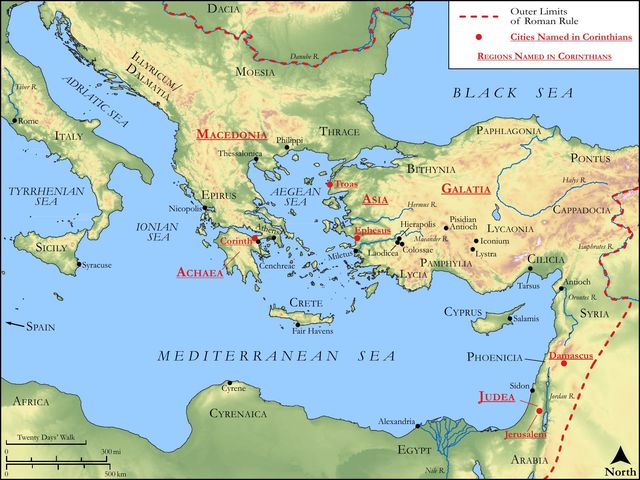
See on the biblical-era maps

Study this verse
Public-domain commentary
Matthew Henry
From his Commentary on the Whole Bible. Henry comments on passages, not single verses — this entry covers 2 Corinthians 5:1–11. His four-level outline is real structure in the source text, so it is rendered as structure.
The apostle in these verses pursues the argument of the former chapter, concerning the grounds of their courage and patience under afflictions. And,
I.He mentions their expectation, and desire, and assurance, of eternal happiness after death, Co2 5:1-5. Observe particularly,
1.The believer's expectation of eternal happiness after death, Co2 5:1. He does not only know, or is well assured by faith of the truth and reality of the thing itself - that there is another and a happy life after this present life is ended, but he has good hope through grace of his interest in that everlasting blessedness of the unseen world: "We know that we have a building of God, we have a firm and well-grounded expectation of the future felicity." Let us take notice,
(1.)What heaven is in the eye and hope of a believer. He looks upon it as a house, or habitation, a dwelling-place, a resting-place, a hiding-place, our Father's house, where there are many mansions, and our everlasting home. It is a house in the heavens, in that high and holy place which as far excels all the palaces of this earth as the heavens are high above the earth. It is a building of God, whose builder and maker is God, and therefore is worthy of its author; the happiness of the future state is what God hath prepared for those that love him. It is eternal in the heavens, everlasting habitations, not like the earthly tabernacles, the poor cottages of clay in which our souls now dwell, which are mouldering and decaying, and whose foundations are in the dust.
(2.)When it is expected this happiness shall be enjoyed - immediately after death, so soon as our house of this earthly tabernacle is dissolved. Note,
[1.]That the body, this earthly house, is but a tabernacle, that must be dissolved shortly; the nails or pins will be drawn, and the cords be loosed, and then the body will return to dust as it was.
[2.]When this comes to pass, then comes the house not made with hands. The spirit returns to God who gave it; and such as have walked with God here shall dwell with God for ever.
2.The believer's earnest desire after this future blessedness, which is expressed by this word, stenazomen - we groan, which denotes,
(1.)A groaning of sorrow under a heavy load; so believers groan under the burden of life: In this we groan earnestly, Co2 5:2. We that are in this tabernacle groan, being burdened, Co2 5:4. The body of flesh is a heavy burden, the calamities of life are a heavy load. But believers groan because burdened with a body of sin, and the many corruptions that are still remaining and raging in them. This makes them complain, O wretched man that I am! Rom 7:24.
(2.)There is a groaning of desire after the happiness of another life; and thus believers groan: Earnestly desiring to be clothed upon with our house which is from heaven (Co2 5:2), to obtain a blessed immortality, that mortality might be swallowed up of life (Co2 5:4), that being found clothed, we may not be naked (Co2 5:3), that, if it were the will of God, we might not sleep, but be changed; for it is not desirable in itself to be unclothed. Death considered merely as a separation of soul and body is not to be desired, but rather dreaded; but, considered as a passage to glory, the believer is willing rather to die than live, to be absent from the body, that he may be present with the Lord (Co2 5:1), to leave this body that he may go to Christ, and to put off these rags of mortality that he may put on the robes of glory. Note,
[1.]Death will strip us of the clothing of flesh, and all the comforts of life, as well as put an end to all our troubles here below. Naked we came into this world, and naked shall we go out of it. But,
[2.]Gracious souls are not found naked in the other world; no, they are clothed with garments of praise, with robes of righteousness and glory. They shall be delivered out of all their troubles, and shall have washed their robes and made them white in the blood of the Lamb, Rev 7:14.
3.The believer's assurance of his interest in this future blessedness, on a double account: - (1.) From the experience of the grace of God, in preparing and making him meet for this blessedness. He that hath wrought us for the self-same thing is God, Co2 5:5. Note, All who are designed for heaven hereafter are wrought or prepared for heaven while they are here; the stones of that spiritual building and temple above are squared and fashioned here below. And he that hath wrought us for this is God, because nothing less than a divine power can make a soul partaker of a divine nature; no hand less than the hand of God can work us for this thing. A great deal is to be done to prepare our souls for heaven, and that preparation of the heart is from the Lord. (2.) The earnest of the Spirit gave them this assurance: for an earnest is part of payment, and secures the full payment. The present graces and comforts of the Spirit are earnests of everlasting grace and comfort.
II.The apostle deduces an inference for the comfort of believers in their present state and condition in this world, Co2 5:6-8. Here observe,
1.What their present state or condition is: they are absent from the Lord (Co2 5:6); they are pilgrims and strangers in this world; they do but sojourn here in their earthly home, or in this tabernacle; and though God is with us here, by his Spirit, and in his ordinances, yet we are not with him as we hope to be: we cannot see his face while we live: For we walk by faith, not by sight, Co2 5:7. We have not the vision and fruition of God, as of an object that is present with us, and as we hope for hereafter, when we shall see as we are seen. Note, Faith is for this world, and sight is reserved for the other world: and it is our duty, and will be our interest, to walk by faith, till we come to live by sight.
2.How comfortable and courageous we ought to be in all the troubles of life, and in the hour of death: Therefore we are, or ought to be, always confident (Co2 5:6), and again (Co2 5:8), We are confident, and willing rather to be absent from the body. True Christians, if they duly considered the prospect faith gives them of another world, and the good reasons of their hope of blessedness after death, would be comforted under the troubles of life, and supported in the hour of death: they should take courage, when they are encountering the last enemy, and be willing rather to die than live, when it is the will of God that they should put off this tabernacle. Note, As those who are born from above long to be there, so it is but being absent from the body, and we shall very soon be present with the Lord - but to die, and be with Christ - but to close our eyes to all things in this world, and we shall open them in a world of glory. Faith will be turned into sight.
III.He proceeds to deduce an inference to excite and quicken himself and others to duty, Co2 5:9-11.
So it is that well-grounded hopes of heaven will be far from giving the least encouragement to sloth and sinful security; on the contrary, they should stir us up to use the greatest care and diligence in religion: Wherefore, or because we hope to be present with the Lord, we labour and take pains, Co2 5:9. Philotimoumetha - We are ambitious, and labour as industriously as the most ambitious men do to obtain what they aim at. Here observe,
1.What it was that the apostle was thus ambitious of - acceptance with God. We labour that, living and dying, whether present in the body or absent from the body, we may be accepted of him, the Lord (Co2 5:9), that we may please him who hath chosen us, that our great Lord may say to us, Well done. This they coveted as the greatest favour and the highest honour: it was the summit of their ambition.
2.What further quickening motives they had to excite their diligence, from the consideration of the judgment to come, Co2 5:10, Co2 5:11. There are many things relating to this great matter that should awe the best of men into the utmost care and diligence in religion; for example, the certainty of this judgment, for we must appear; the universality of it, for we must all appear; the great Judge before whose judgment-seat we must appear, the Lord Jesus Christ, who himself will appear in flaming fire; the recompence to be then received, for things done in the body, which will be very particular (unto every one), and very just, according to what we have done, whether good or bad. The apostle calls this awful judgment the terror of the Lord (Co2 5:11), and, by the consideration thereof, was excited to persuade men to repent, and live a holy life, that, when Christ shall appear terribly, they may appear before him comfortably. And, concerning his fidelity and diligence, he comfortably appeals unto God, and the consciences of those he wrote to: We are made manifest unto God, and I trust also are made manifest in your consciences.
Historical interpretation
Four Centuries of Reception
10 surviving comments on this verse. Each one is dated, so this reads as a timeline rather than a list.
Select a marker to jump to its quote. Markers stagger vertically where authors wrote within a few decades of each other.
How is it possible, therefore, that that seed should be after images of the angels, seeing it has obtained a form after the likeness of men? Why, again, since it was of a spiritual nature, had it any need of descending into flesh? For what is carnal stands in need of that which is spiritual, if indeed it is to be saved, that in it it may be sanctified and cleared from all impurity, and that what is mortal may be swallowed up by immortality;.
Still further did He also make it manifest, that we ought, after our calling, to be also adorned with works of righteousness, so that the Spirit of God may rest upon us; for this is the wedding garment, of which also the apostle speaks, "Not for that we would be unclothed, but clothed upon, that mortality might be swallowed up by immortality.".
This earnest, therefore, thus dwelling in us, renders us spiritual even now, and the mortal is swallowed up by immortality.
He who has perfected us for this very thing is God, who also has given unto us the earnest of the Spirit."
Then, again, questions very often are suggested by occasional and isolated terms, just as much as they are by connected sentences. Thus, because of the apostle's expression, "that mortality may be swallowed up of life " -in reference to the flesh-they wrest the word swallowed up into the sense of the actual destruction of the flesh; as if we might not speak of ourselves as swallowing bile, or swallowing grief, meaning that we conceal and hide it, and keep it within ourselves.
And again he says: "We that are in this tabernacle do groan, not as if we were oppressed with an unwillingness to be unclothed, but (we wish)to be clothed upon." He here says expressly, what he touched but lightly in his first epistle, where he wrote: ) "The dead shall be raised Incorruptible (meaning those who had undergone mortality), "and we shall be changed" (whom God shall find to be yet in the flesh).
To us continence has been pointed out by the Lord of salvation as an instrument for attaining eternity, and as a testimony of (our) faith; as a commendation of this flesh of ours, which is to be sustained for the "garment of immortality," which is one day to supervene; for enduring, in fine, the will of God.
Lastly, even if everything that is mortal in all the dead shall then be found decayed-at any rate consumed by death, by time, and through age,-is there nothing which will be "swallowed up of life," nor by being covered over and arrayed in the vesture of immortality? Now, he who says that mortality is going to be swallowed up of life has already admitted that what is dead is not destroyed by those other before-mentioned devourers.
It was accordingly not without good reason that he described them as "not wishing indeed to be unclothed," but (rather as wanting) "to be clothed upon; " in other words, as wishing not to undergo death, but to be surprised into life, "that this moral (body) might be swallowed up of life," by being rescued from death in the supervesture of its changed state.
Will receive our souls; so when this perishable life shall be dissolved, we shall have the habitation which is before the resurrection-that is, our souls shall he with God, until we shall receive the new house which is prepared for us, and which shall never fall. Whence also "we groan ""not for that we would be unclothed "as to the body, "but clothed upon"
Paul is saying here that we are oppressed by bodily sufferings and death.
"For indeed we that are in this tabernacle do groan, not for that we would be unclothed, but that we would be clothed upon." Here again he hath utterly and manifestly stopped the mouths of the heretics, showing that he is not speaking absolutely of a body differing in identity, but of corruption and incorruption: 'For we do not therefore groan,' saith he, 'that we may be delivered from the body: for of this we do not wish to be unclothed; but we hasten to be delivered from the corruption that is in it'. Wherefore he saith, 'we wish not to be unclothed of the body, but that it should be clothed upon with incorruption.' Then he also interprets it [thus,] "That what is mortal may be swallowed up of life." For since putting off the body appeared to many a grievous thing; and he was contradicting the judgments of all, when he said, "we groan," not wishing to be set free from it; ('for if,' says one, 'the soul in being separated from it so suffers and laments, how sayest thou that we groan because we are not separated from it?') lest then this should be urged against him, he says, 'Neither do I assert that we therefore groan, that we may put it off; (for no one putteth it off without pain, seeing that Christ says even of Peter, 'They shall "carry thee," and lead thee "whither thou wouldest not;"') but that we may have it clothed upon with incorruption.' For it is in this respect that we are burdened by the body; not because it is a body, but because we are encompassed with a corruptible body and liable to suffering, for it is this that also causes us pain. But the life when it arriveth destroyeth and useth up the corruption; the corruption, I say, not the body. 'And how cometh this to pass?' saith one. Inquire not; God doeth it; be not too curious.
Now He that hath wrought us for the selfsame thing is God, who also hath given unto us the earnest of the Spirit."
Continue studying 2 Corinthians 5:4 across the web’s major study libraries — every link below opens this exact verse, chapter, or book on the destination site.
Read & Compare
 BibleGatewayThis verse in more than 200 translations and 70 languages.
 Bible.comThe YouVersion reader — hundreds of translations, reading plans, and highlights.
 ESV.orgCrossway's official English Standard Version reader.
 NET BibleThe NET translation with 60,000+ translators' notes on every rendering decision.
 STEP BibleTyndale House's free study tool — original text, vocabulary, and scholarly resources.
 BibliaLogos Bible Software's free web reader.
 USCCBThe New American Bible (Revised Edition) with the U.S. bishops' study notes.
Commentaries
 BibleHub CommentariesDozens of classic commentaries on this verse, gathered on one page.
 StudyLightMore than 100 commentary sets — the largest collection on the web.
 BibleRefPlain-English commentary on what this verse means, verse by verse.
 Enduring WordDavid Guzik's free commentary on this chapter, widely used by Bible teachers.
 Bible Study ToolsVerse commentary alongside Greek and Hebrew study aids.
Original Language & Research
- BibleHub InterlinearThe verse word by word — original language, transliteration, and English.
- BibleHub LexiconEvery word's original-language definition and Strong's entry.
 Blue Letter BibleDeep-study tools — Strong's numbers, concordance, and word studies.
 CNTR CollationThe earliest Greek manuscripts of this verse, collated letter by letter.
Sermons, Hymns & Audio


TrulyRandomVerse is not affiliated with these sites and doesn’t control their content. They’re linked because they’re genuinely useful.
Summary
In 2 Corinthians 5:4, the Apostle Paul articulates the profound longing of believers who, while inhabiting their fragile, temporary earthly bodies, yearn not for disembodiment, but for a glorious transformation. This "groaning" expresses a deep spiritual desire for the resurrection body, where the limitations and decay of mortality are utterly consumed by the vibrant, eternal life that is promised in Christ. It encapsulates the Christian hope for ultimate redemption and a perfected existence in God's presence.
Context
ShowHideLiterary Context
This verse is an integral part of Paul's extended discourse in 2 Corinthians 4-5 concerning the nature of Christian suffering, endurance, and eschatological hope. Immediately preceding 2 Corinthians 5:4, Paul introduces the metaphor of the earthly body as a "tent" or "tabernacle" in 2 Corinthians 5:1, contrasting it with a permanent, eternal dwelling from God. He explains in 2 Corinthians 5:2-3 that believers groan not out of a desire to be "unclothed" (i.e., disembodied or naked), but to be "clothed upon" with their heavenly dwelling, so that they might not be found naked. Verse 4 further elaborates on this longing, emphasizing the desire for mortality to be swallowed up by life, leading seamlessly into Paul's assurance of God's provision and the believer's confidence in 2 Corinthians 5:5-8.
Historical & Cultural Context
Paul's ministry was characterized by immense suffering, persecution, and physical hardship, as detailed throughout 2 Corinthians. This personal experience deeply informed his theology of the body and resurrection. Among the Greeks, there were diverse philosophical views on the body: some viewed it as a prison from which the soul longed to escape (Platonism), while others embraced a more materialistic perspective. Paul's view, rooted in Jewish eschatology and Christian resurrection belief, affirmed the goodness of the body (as God's creation) while acknowledging its fallen, temporary state. His use of "tabernacle" (Greek: skēnos) would resonate with both Jewish audiences (recalling the temporary wilderness tabernacle) and Gentile audiences (understanding a tent as a temporary dwelling), highlighting the transient nature of earthly life in contrast to the permanence of God's eternal plan.
Key Themes
ShowHide2 Corinthians 5:4 powerfully contributes to several overarching themes in the epistle. Firstly, it underscores the eschatological hope of believers, pointing forward to the future resurrection and glorification of the body. This hope provides profound comfort and motivation amidst present suffering, a theme pervasive in 2 Corinthians 4. Secondly, it develops the theme of temporary vs. eternal, contrasting the fleeting nature of the "earthly tabernacle" with the enduring reality of "life" that will swallow up mortality. This eternal perspective helps believers navigate the burdens of this age. Lastly, the verse highlights the transformative power of God, emphasizing that the ultimate solution to human mortality is not annihilation or mere escape, but a divine act of being "clothed upon" with a new, immortal body, ensuring the complete triumph of life over death, a concept central to the Christian understanding of salvation and resurrection as seen in 1 Corinthians 15.
Exposition and Analysis
ShowHideKey Word Analysis
ShowHideThis word refers to a hut or temporary residence, metaphorically used here for the human body as the abode of the spirit. It emphasizes the transient, portable, and fragile nature of our earthly existence, contrasting it with a permanent, eternal dwelling. Paul's choice of this term powerfully conveys the idea that our physical bodies are not our ultimate, permanent home but rather temporary shelters.
This signifies to make (intransitively, be) in straits, implying to sigh, murmur, or pray inaudibly. It denotes a deep, inward sigh or anguish, often associated with spiritual longing, the burden of present circumstances, or the suffering of creation awaiting redemption. This "groaning" is not a complaint against life itself, but a profound yearning for the perfected state of being.
This means to drink down, or gulp entirely, both literally and figuratively. It conveys a powerful image of complete absorption, vanquishing, or overwhelming. In this context, it signifies the total triumph of eternal life over mortality, where death and decay are utterly consumed and rendered powerless by the superior force of life.
Verse Breakdown
ShowHide"For we that are in [this] tabernacle do groan, being burdened"
Paul explains the reason for their longing. Believers, currently residing in their mortal, temporary bodies (likened to a tent), experience an inward "groaning." This groaning is not merely physical discomfort but a deep spiritual anguish and burden, stemming from the limitations, decay, and suffering inherent in their present earthly existence. It is a yearning for something more, something eternal.
"not for that we would be unclothed, but clothed upon"
This clarifies the nature of the groaning. It is not a desire for death in itself, or to be disembodied and "naked" (without a body, which Paul views negatively in 2 Corinthians 5:3), but rather an earnest longing to be "clothed upon." This refers to the glorious transformation at the resurrection, where believers will receive a new, spiritual, and immortal body, a heavenly dwelling that will supersede their earthly one.
"that mortality might be swallowed up of life"
This states the ultimate purpose and hope of this transformation. The new, glorified body ensures that "mortality"—the state of being subject to death, decay, and corruption—will be completely and utterly consumed, absorbed, and vanquished by "life"—eternal, divine, and incorruptible life. This is the ultimate triumph of God's redemptive plan over the consequences of sin and death.
Literary Devices
ShowHidePaul employs several powerful literary devices in 2 Corinthians 5:4 to convey his profound theological message. The most prominent is Metaphor, specifically the tent/tabernacle metaphor for the human body, which underscores its temporary and fragile nature compared to a permanent building. This metaphor is extended through the imagery of being "unclothed" (disembodied) and "clothed upon" (receiving a new, glorified body), creating a vivid picture of transformation. Antithesis is also central, as Paul contrasts "unclothed" with "clothed upon," and most significantly, "mortality" with "life." This sharp opposition highlights the radical nature of the divine transformation. Finally, the phrase "swallowed up of life" is a potent example of Personification and Hyperbole, giving "life" an active, conquering agency that completely overwhelms and consumes "mortality," emphasizing the absolute victory that awaits believers.
Theological and Thematic Connections
ShowHideThe profound yearning expressed in 2 Corinthians 5:4 resonates deeply with the broader biblical narrative of creation, fall, and redemption. It underscores the Christian understanding that while the body is intrinsically good as God's creation, it is currently subject to the curse of sin and death, leading to a natural "groaning" for its ultimate liberation and glorification. This longing is not a rejection of physical existence, but a desire for its perfection, a state where the limitations and decay of our present form are utterly overcome by the fullness of divine life. It points to the eschatological hope that is central to Christian theology, affirming God's ultimate victory over death and His commitment to the holistic redemption of humanity, body and soul.
Reflection and Application
ShowHide2 Corinthians 5:4 offers a profound source of comfort and a powerful framework for understanding our present existence. In a world preoccupied with physical decline, suffering, and the inevitability of death, Paul's words redirect our gaze to an eternal hope. Our "groaning" is not a sign of weakness or despair, but a divinely implanted longing for the glorious future God has prepared. This perspective encourages us to endure present hardships with patience, knowing that our temporary afflictions are working for us an eternal weight of glory (2 Corinthians 4:17). It motivates us to live with an eternal mindset, prioritizing spiritual realities and investments in God's kingdom over the fleeting pursuits of this world, confident that our ultimate destiny is not disembodiment but a perfected, immortal existence where life reigns supreme.
Questions for Reflection
ShowHideFAQ
ShowHideDoes "unclothed" imply a negative view of being disembodied after death?
ShowHideYes, in this context, Paul uses "unclothed" (G1562, ekdýō) to describe a state of being without a body. While the soul departs the body at death, Paul's longing is not for a perpetual disembodied state but for the immediate transition into a glorified body. He views being "naked" (as referenced in 2 Corinthians 5:3) as an undesirable interim state. His ultimate hope, and the ultimate Christian hope, is for the resurrection body, where the spirit and a perfected body are reunited for eternity, demonstrating God's holistic redemption of humanity.
Christ-Centered Fulfillment
ShowHide2 Corinthians 5:4 finds its ultimate fulfillment in the person and work of Jesus Christ. His incarnation demonstrates God's affirmation of physical existence, while His death on the cross and subsequent resurrection provide the very mechanism by which "mortality might be swallowed up of life." Christ Himself is the "firstfruits" of those who will rise (1 Corinthians 15:20), embodying the glorified, spiritual body that believers long for. His resurrection guarantees our own future resurrection and transformation, as Paul declares that "when Christ, who is our life, appears, then you also will appear with him in glory" (Colossians 3:4). The "life" that swallows up mortality is none other than the eternal life found in Christ, who conquered death and the grave (Hebrews 2:14-15). Thus, our groaning is a Spirit-wrought longing for the full manifestation of the new creation inaugurated by Christ, where we will be fully conformed to His glorious body (Philippians 3:21).