


1 Corinthians 15:54
“Death is swallowed up in victory.
- ὅτανhotanWhenG3752CONJConjunction
- δὲdenowG1161CONJConjunction
- τὸto<the>G3588T-NSNDefinite article Nominative Singular Neuter
- φθαρτὸνphthartonperishableG5349A-NSNAdjective Nominative Singular Neuter
- τοῦτοtoutothisG3778D-NSNDemonstrative pronoun Nominative Singular Neuter
- ἐνδύσηταιendusētaimay have put onG1746V-AMS-3SVerb Aorist Middle Subjunctive 3rd Singular
- ἀφθαρσίανaphtharsian[the] imperishableG861N-ASFNoun Accusative Singular Feminine
- καὶkaiandG2532CONJConjunction
- τὸto<the>G3588T-NSNDefinite article Nominative Singular Neuter
- θνητὸνthnētonmortalG2349A-NSNAdjective Nominative Singular Neuter
- τοῦτοtoutothisG3778D-NSNDemonstrative pronoun Nominative Singular Neuter
- ἐνδύσηταιendusētaimay have put onG1746V-AMS-3SVerb Aorist Middle Subjunctive 3rd Singular
- ἀθανασίανathanasianimmortalityG110N-ASFNoun Accusative Singular Feminine
- τότεtotethenG5119ADVAdverb
- γενήσεταιgenēsetaiwill come to passG1096V-FDI-3SVerb Future Middle Deponent Indicative 3rd Singular
- ὁhotheG3588T-NSMDefinite article Nominative Singular Masculine
- λόγοςlogoswordG3056N-NSMNoun Nominative Singular Masculine
- ὁhowhichG3588T-NSMDefinite article Nominative Singular Masculine
- γεγραμμένος·gegrammenoswrittenG1125V-RPP-NSMVerb Perfect Passive Participle Nominative Singular Masculine
- κατεπόθηkatepothēHas been swallowed upG2666V-API-3SVerb Aorist Passive Indicative 3rd Singular
- ὁho<the>G3588T-NSMDefinite article Nominative Singular Masculine
- θάνατοςthanatosdeathG2288N-NSMNoun Nominative Singular Masculine
- εἰςeisinG1519PREPPreposition
- νῖκοςnikosvictoryG3534N-ASNNoun Accusative Singular Neuter
English is a literal word-by-word gloss of the Greek, not the KJV's wording. Why?
This is the original text the KJV's translators worked from — each Greek word with its own literal English meaning in this verse, prepared by scholars at Tyndale House, Cambridge. The KJV translates whole sentences, not word by word, so its wording differs: one Greek word can become several English words, and the KJV may choose “charity” where the gloss reads “love”. Both are faithful — they answer different questions. For the KJV's own rendering, switch to the KJV text.
Details
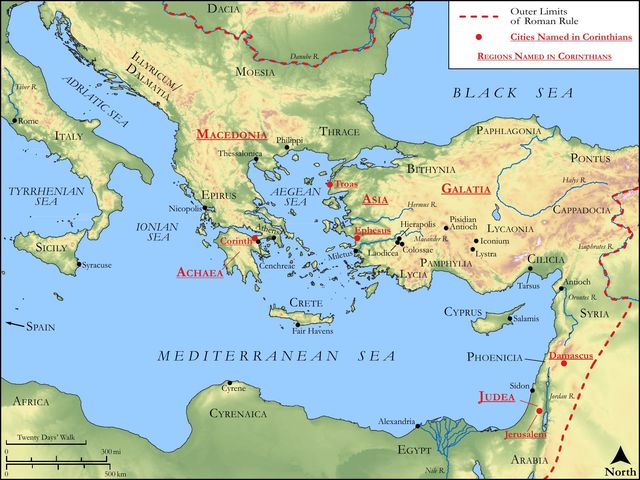
See on the biblical-era map

Study this verse
Public-domain commentary
Matthew Henry
From his Commentary on the Whole Bible. Henry comments on passages, not single verses — this entry covers 1 Corinthians 15:51–57. His three-level outline is real structure in the source text, so it is rendered as structure.
To confirm what he had said of this change,
I.He here tells them what had been concealed from or unknown to them till then - that all the saints would not die, but all would be changed.
Those that are alive at our Lord's coming will be caught up into the clouds, without dying, Th1 4:11. But it is plain from this passage that it will not be without changing from corruption to incorruption. The frame of their living bodies shall be thus altered, as well as those that are dead; and this in a moment, in the twinkling of an eye, Co1 15:52. What cannot almighty power effect? That power that calls the dead into life can surely thus soon and suddenly change the living; for changed they must be as well as the dead, because flesh and blood cannot inherit the kingdom of God. This is the mystery which the apostle shows the Corinthians: Behold, I show you a mystery; or bring into open light a truth dark and unknown before. Note, There are many mysteries shown to us in the gospel; many truths that before were utterly unknown are there made known; many truths that were but dark and obscure before are there brought into open day, and plainly revealed; and many things are in part revealed that will never be fully known, nor perhaps clearly understood. The apostle here makes known a truth unknown before, which is that the saints living at our Lord's second coming will not die, but be changed, that this change will be made in a moment, in the twinkling of an eye, and at the sound of the last trump; for, as he tells us elsewhere, the Lord himself shall descend with a shout, with a voice of the archangel, and with the trump of God (Th1 4:16), so here, the trumpet must sound. It is the loud summons of all the living and all the dead, to come and appear at the tribunal of Christ. At this summons the graves shall open, the dead saints shall rise incorruptible, and the living saints be changed to the same incorruptible state, Co1 15:52.
II.He assigns the reason of this change (Co1 15:53):
For this corruptible must put on incorruption, and this mortal must put on immortality. How otherwise could the man be a fit inhabitant of the incorruptible regions, or be fitted to possess the eternal inheritance? How can that which is corruptible and mortal enjoy what is incorruptible, permanent, and immortal? This corruptible body must be made incorruptible, this mortal body must be changed into immortal, that the man may be capable of enjoying the happiness designed for him. Note, It is this corruptible that must put on incorruption; the demolished fabric that must be reared again. What is sown must be quickened. Saints will come in their own bodies (Co1 15:38), not in other bodies.
III.He lets us know what will follow upon this change of the living and dead in Christ:
Then shall be brought to pass that saying, Death is swallowed up in victory; or, He will swallow up death in victory. Isa 25:8. For mortality shall be then swallowed up of life (Co2 5:4), and death perfectly subdued and conquered, and saints for ever delivered from its power. Such a conquest shall be obtained over it that it shall for ever disappear in those regions to which our Lord will bear his risen saints. And therefore will the saints hereupon sing their epinikion, their song of triumph. Then, when this mortal shall have put on immortality, will death be swallowed up, for ever swallowed up, eis nikos. Christ hinders it from swallowing his saints when they die; but, when they rise again, death shall, as to them, be swallowed for ever. And upon this destruction of death will they break out into a song of triumph.
1.They will glory over death as a vanquished enemy, and insult this great and terrible destroyer: "O death! where is thy sting? Where is now thy sting, thy power to hurt? What mischief hast thou done us? We are dead; but behold we live again, and shall die no more. Thou art vanquished and disarmed, and we are out of the reach of thy deadly dart. Where now is thy fatal artillery? Where are thy stores of death? We fear no further mischiefs from thee, nor heed thy weapons, but defy thy power, and despise thy wrath. And, O grave! where is thy victory? Where now is thy victory? What has become of it? Where are the spoils and trophies of it? Once we were thy prisoners, but the prison-doors are burst open, the locks and bolts have been forced to give way, our shackles are knocked off, and we are for ever released. Captivity is taken captive. The imaginary victor is conquered, and forced to resign his conquest and release his captives. Thy triumphs, grave, are at an end. The bonds of death are loosed, and we are at liberty, and are never more to be hurt by death, nor imprisoned in the grave." In a moment, the power of death, and the conquests and spoils of the grave, are gone; and, as to the saints, the very signs of them will not remain. Where are they? Thus will they raise themselves, when they become immortal, to the honour of their Saviour and the praise of divine grace: they shall glory over vanquished death.
2.The foundation for this triumph is here intimated,
(1.)In the account given whence death had its power to hurt: The sting of death is sin. This gives venom to his dart: this alone puts it into the power of death to hurt and kill. Sin unpardoned, and nothing else, can keep any under his power. And the strength of sin is the law; it is the divine threatening against the transgressors of the law, the curse there denounced, that gives power to sin. Note, Sin is the parent of death, and gives it all its hurtful power. By one man sin entered into the world, and death by sin, Rom 5:12. It is its cursed progeny and offspring.
(2.)In the account given of the victory saints obtain over it through Jesus Christ, Co1 15:56. The sting of death is sin; but Christ, by dying, has taken out this sting. He has made atonement for sin; he has obtained remission of it. It may hiss therefore, but it cannot hurt. The strength of sin is the law; but the curse of the law is removed by our Redeemer's becoming a curse for us. So that sin is deprived of its strength and sting, through Christ, that is, by his incarnation, suffering, and death. Death may seize a believer, but cannot sting him, cannot hold him in his power. There is a day coming when the grave shall open, the bands of death be loosed, the dead saints revive, and become incorruptible and immortal, and put out of the reach of death for ever. And then will it plainly appear that, as to them, death will have lost its strength and sting; and all by the mediation of Christ, by his dying in their room. By dying, he conquered death, and spoiled the grave; and, through faith in him, believers become sharers in his conquests. They often rejoice beforehand, in the hope of this victory; and, when they arise glorious from the grave, they will boldly triumph over death. Note, It is altogether owing to the grace of God in Christ that sin is pardoned and death disarmed. The law puts arms into the hand of death, to destroy the sinner; but pardon of sin takes away this power from the law, and deprives death of its strength and sting. It is by the grace of God, through the redemption which is in Christ Jesus, that we are freely justified, Rom 3:24. It is no wonder, therefore,
(3.)If this triumph of the saints over death should issue in thanksgiving to God: Thanks be to God, who giveth us the victory through Christ Jesus, our Lord, Co1 15:57. The way to sanctify all our joy is to make it tributary to the praise of God. Then only do we enjoy our blessings and honours in a holy manner when God has his revenue of glory out of it, and we are free to pay it to him. And this really improves and exalts our satisfaction. We are conscious at once of having done our duty and enjoyed our pleasure. And what can be more joyous in itself than the saints' triumph over death, when they shall rise again? And shall they not then rejoice in the Lord, and be glad in the God of their salvation? Shall not their souls magnify the Lord? When he shows such wonders to the dead, shall they not arise and praise him? Psa 88:10. Those who remain under the power of death can have no heart to praise; but such conquests and triumphs will certainly tune the tongues of the saints to thankfulness and praise - praise for the victory (it is great and glorious in itself), and for the means whereby it is obtained (it is given of God through Christ Jesus), a victory obtained not by our power, but the power of God; not given because we are worthy, but because Christ is so, and has by dying obtained this conquest for us. Must not this circumstance endear the victory to us, and heighten our praise to God? Note, How many springs of joy to the saints and thanksgiving to God are opened by the death and resurrection, the sufferings and conquests, of our Redeemer! With what acclamations will saints rising from the dead applaud him! How will the heaven of heavens resound his praises for ever! Thanks be to God will be the burden of their song; and angels will join the chorus, and declare their consent with a loud Amen, Hallelujah.
Historical interpretation
Eighteen Centuries of Reception
13 surviving comments on this verse. Each one is dated, so this reads as a timeline rather than a list.
Select a marker to jump to its quote. Markers stagger vertically where authors wrote within a few decades of each other.
F God took place in these last times, that is, in the end, rather than in the beginning .
Therefore, when man has been liberated, "what is written shall come to pass, Death is swallowed up in victory. O death sting? "
O death, where is thy sting? O grave, where is thy victory? The sting of death is sin "-here is the corruption; "and the strength of sin is the law" -that other law, no doubt, which he has described "in his members as warring against the law of his mind," -meaning, of course, the actual power of sinning against his will.
That one ought to make confession while he is in the flesh. In the fifth Psalm: "But in the grave who will confess unto Thee? " Also in the twenty-ninth Psalm: "Shall the dust make confession to Thee? " Also elsewhere that confession is to be made: "I would rather have the repentance of the sinner than his death." Also in Jeremiah: "Thus saith the Lord, Shall not he that falleth arise? or shall not he that is turned away be converted? "
For if the kingdom of God, which is life, were possessed by the body, it would happen that the life would be consumed by corruption. But now the life possesses what is dying, in order that "death may be swallowed up in victory"
For man is by nature afraid of death and of the dissolution of the body. But there is this most startling fact, that he who has put on the faith of the cross despises even what is naturally fearful and for Christ’s sake is not afraid of death.
"But when this corruptible shall have put on incorruption, and this mortal shall have put on immortality, then shall come to pass the saying that is written, Death is swallowed up in victory."
Thus, since he was speaking of great and secret things, he again takes prophecy to confirm his word. "Death is swallowed up in victory:" i.e., utterly; not so much as a fragment of it remains nor a hope of returning, incorruption having consumed corruption.
Then not only shall we not obey any enticement of sin, but there will be no such enticements of the kind we are commanded not to obey.
Were our heretics capable of grasping this one truth, they would surrender their pride and become reconciled and would never again worship God anywhere but in the church.
There are many desires of the sick which health takes away. In just the same way as physical health undercuts those desires, so immortality does remove all other desires because immortality is our health.
The apostle Paul seems to have directly pointed his finger at the flesh when he wrote: “this corruptible must put on incorruption.” When he says this, he as good as points with his finger. That which is visible can be pointed at in this way. The soul cannot be pointed at, though it can be called corruptible, because it is corrupted by moral biases.
Where is death? Seek it in Christ, for it exists no longer. It did exist, and now death is dead. O Life, O Death of death! Be of good heart, death will die in us also. What has taken place in our Head will also take place in his members. Death will die in us also. But when? At the end of the world, at the resurrection of the dead in which we believe and about which we have no doubt.… These are words given to those who triumph, that you may have something to think about, something to sing about in your heart, something to hope for in your heart, something to seek with faith and good works.
Because of the necessary activities of this life, health is not to be despised until “this mortal shall put on immortality.” This is the true and perfect and unending health which is not refreshed by corruptible pleasure when it fails through earthly weakness but is maintained by heavenly strength and made young by eternal incorruptibility.
The second class of miracles, on this view, foretell what God has not yet done, but will do, universally. He raised one man (the man who was Himself) from the dead because He will one day raise all men from the dead. Perhaps not only men, for there are hints in the New Testament that all creation will eventually be rescued from decay, restored to shape and subserve the splendour of re-made humanity. The Transfiguration and the walking on the water are glimpses of the beauty and the effortless power over all matter which will belong to men when they are really waked by God. Now resurrection certainly involves “reversal” of natural process in the sense that it involves a series of changes moving in the opposite direction to those we see. At death, matter which has been organic, falls back gradually into the inorganic, to be finally scattered and used perhaps in other organisms. Resurrection would be the reverse process. It would not of course mean the restoration to each personality of those very atoms, numerically the same, which had made its first or “natural” body. There would not be enough to go round, for one thing; and for another, the unity of the body even in this life was consistent with a slow but perplexed change of its actual ingredients. But it certainly does mean matter of some kind rushing towards organism as now we see it rushing away. It means, in fact, playing backwards a film we have already seen played forwards. In that sense it is a reversal of Nature. But, of course, it is a further question whether reversal in this sense is necessarily contradiction. Do we know that the film cannot be played backwards?
Well, in one sense, it is precisely the teaching of modern physics that the film never works backwards. For modern physics, as you have heard before, the universe is “running down.” Disorganization and chance is continually increasing. There will come a time, not infinitely remote, when it will be wholly run down or wholly disorganized, and science knows of no possible return from that state. There must have been a time, not infinitely remote, in the past when it was wound up, though science knows of no winding-up process. The point is that for our ancestors the universe was a picture: for modern physics it is a story. If the universe is a picture these things either appear in that picture or not; and if they don’t, since it is an infinite picture, one may suspect that they are contrary to the nature of things. But a story is a different matter; specially if it is an incomplete story. And the story told by modern physics might be told briefly in the words “Humpty Dumpty was falling.” That is, it proclaims itself an incomplete story. There must have been a time before he fell, when he was sitting on the wall; there must be a time after he had reached the ground. It is quite true that science knows of no horses and men who can put him together again once he has reached the ground and broken. But then she also knows of no means by which he could originally have been put on the wall. You wouldn’t expect her to. All science rests on observation: all our observations are taken during Humpty Dumpty’s fall, because we were born after he lost his seat on the wall and shall be extinct long before he reaches the ground. But to assume from observations taken while the clock is running down that the unimaginable winding-up which must have preceded this process cannot occur when the process is over is the merest dogmatism. From the very nature of the case the laws of degradation and disorganization which we find in matter at present, cannot be the ultimate and eternal nature of things. If they were, there would have been nothing to degrade and disorganize. Humpty Dumpty can’t fall off a wall that never existed.
Continue studying 1 Corinthians 15:54 across the web’s major study libraries — every link below opens this exact verse, chapter, or book on the destination site.
Read & Compare
 BibleGatewayThis verse in more than 200 translations and 70 languages.
 Bible.comThe YouVersion reader — hundreds of translations, reading plans, and highlights.
 ESV.orgCrossway's official English Standard Version reader.
 NET BibleThe NET translation with 60,000+ translators' notes on every rendering decision.
 STEP BibleTyndale House's free study tool — original text, vocabulary, and scholarly resources.
 BibliaLogos Bible Software's free web reader.
 USCCBThe New American Bible (Revised Edition) with the U.S. bishops' study notes.
Commentaries
 BibleHub CommentariesDozens of classic commentaries on this verse, gathered on one page.
 StudyLightMore than 100 commentary sets — the largest collection on the web.
 BibleRefPlain-English commentary on what this verse means, verse by verse.
 Enduring WordDavid Guzik's free commentary on this chapter, widely used by Bible teachers.
 Bible Study ToolsVerse commentary alongside Greek and Hebrew study aids.
Original Language & Research
- BibleHub InterlinearThe verse word by word — original language, transliteration, and English.
- BibleHub LexiconEvery word's original-language definition and Strong's entry.
 Blue Letter BibleDeep-study tools — Strong's numbers, concordance, and word studies.
 CNTR CollationThe earliest Greek manuscripts of this verse, collated letter by letter.
Sermons, Hymns & Audio


TrulyRandomVerse is not affiliated with these sites and doesn’t control their content. They’re linked because they’re genuinely useful.
Summary
1 Corinthians 15:54 powerfully declares the ultimate victory over death achieved through Christ's resurrection, a triumph that transforms the perishable and mortal human body into an imperishable and immortal state. This verse encapsulates the glorious future awaiting believers, where the consequences of sin are utterly conquered by divine power, thereby fulfilling ancient prophecy and serving as a foundational cornerstone of Christian hope regarding the resurrection body and eternal life.
Context
ShowHideLiterary Context
This verse is the climactic declaration within Paul's most extensive theological discourse on the resurrection of the dead, found in 1 Corinthians 15. Paul has systematically built his argument from the historical fact of Christ's resurrection as the "firstfruits" of those who have fallen asleep (1 Corinthians 15:20), to the order of resurrection, Christ's reign, and the eventual subjection of all things to God (1 Corinthians 15:23-28). He then addresses the nature of the resurrection body, contrasting the "natural body" with the "spiritual body" (1 Corinthians 15:44), and explaining the necessary transformation from earthly to heavenly. Verse 54 follows immediately after Paul's explanation of the "mystery" of not all sleeping but all being changed at the sound of the last trumpet (1 Corinthians 15:51-53), serving as the triumphant culmination of this profound theological exposition.
Historical & Cultural Context
The church in Corinth, a vibrant and cosmopolitan Roman city, was a melting pot of diverse philosophical and religious ideas. Within this environment, some members of the Corinthian church, possibly influenced by Greek philosophical traditions (such as Platonism, which often devalued the physical body in favor of the immortal soul, or Epicureanism, which denied an afterlife), were denying the future bodily resurrection of the dead. This denial was a significant threat to the core of Christian belief, as it undermined the very hope of salvation and eternal life. Paul's letter, therefore, serves as a robust defense of the bodily resurrection, asserting its foundational importance to the Christian faith. He argues that if there is no resurrection of the dead, then Christ Himself has not been raised, rendering Christian faith futile and preaching meaningless (1 Corinthians 15:14). This chapter aims to correct this theological error and ground the Corinthians' hope in the tangible, future reality of resurrection.
Key Themes
ShowHideThe central theme of 1 Corinthians 15 and, by extension, verse 54, is the Resurrection of the Dead. Paul emphasizes the Glorious Transformation that awaits believers, where the perishable human body will be changed into an imperishable one, and the mortal into an immortal one. This transformation is not merely a resuscitation but a fundamental change in nature, making the body fit for eternity and highlighting God's power to renew and perfect. Another crucial theme is the Ultimate Victory Over Death. Death, humanity's greatest enemy and the ultimate consequence of sin (Romans 6:23), is declared to be completely vanquished, "swallowed up in victory," signifying its utter annihilation and loss of power over believers. Finally, the verse highlights the Fulfillment of Prophecy, as Paul explicitly states that this event brings to pass "the saying that is written," directly referencing the Old Testament prophecy found in Isaiah 25:8, which underscores the divine plan and continuity across covenants.
Exposition and Analysis
ShowHideKey Word Analysis
ShowHideThis term refers to that which is perishable, subject to decay, ruin, and ultimately, death. It emphasizes the transient and decaying nature of our current physical bodies, highlighting their susceptibility to corruption and dissolution.
This word is derived from a compound meaning "deathlessness." It signifies the state of being deathless, undying, or possessing everlasting life. In the context of the verse, it describes the new, eternal quality that the resurrected body will possess, free from the power of death.
This powerful verb (here in the aorist passive indicative) means to drink down, gulp entire, or be completely consumed, absorbed, or abolished. It paints a vivid picture of death being utterly defeated, engulfed, and annihilated by victory, having no existence or power left.
Verse Breakdown
ShowHide"So when this corruptible shall have put on incorruption"
This clause speaks of a necessary and decisive transformation of the present, perishable human body. The verb "put on" (G1746, endýō) metaphorically describes the act of being clothed or invested with a new nature. The "corruptible" (G5349, phthartós) refers to our current bodies, which are subject to decay and death. This body will be divinely transformed, taking on "incorruption" (G861, aphtharsía), meaning imperishability and freedom from decay, a state fit for eternity.
"and this mortal shall have put on immortality"
This parallel clause reiterates and reinforces the profound nature of the transformation. "Mortal" (G2349, thnētós) denotes that which is subject to death, destined to die. This dying nature will be replaced by "immortality" (G110, athanasía), the state of being deathless. Together, these two parallel phrases emphasize the complete reversal of humanity's fallen state, where decay and death are replaced by eternal life and imperishability.
"then shall be brought to pass the saying that is written"
This phrase signals the fulfillment of ancient prophecy. "Then" (G5119, tóte) marks the definitive moment of this eschatological event. "Shall be brought to pass" (G1096, gínomai) indicates that something will come into being or be fulfilled. Paul is explicitly pointing to a specific Old Testament scripture, confirming that the resurrection and the defeat of death are part of God's predetermined plan.
"Death is swallowed up in victory."
This is the prophetic declaration itself, directly quoted from Isaiah 25:8. "Death" (G2288, thánatos), humanity's ultimate enemy, is depicted as being utterly consumed and abolished. The phrase "swallowed up" (G2666, katapínō) conveys a sense of complete annihilation, leaving no trace or power. This overwhelming defeat occurs "in victory" (G3534, nîkos), signifying a decisive, triumphant conquest, not merely an escape or avoidance of death, but its utter and final subjugation.
Literary Devices
ShowHidePaul employs several powerful literary devices in this verse to convey his triumphant message. Antithesis is prominent, contrasting "corruptible" with "incorruption" and "mortal" with "immortality." This stark opposition highlights the radical and complete nature of the transformation that occurs at the resurrection, emphasizing the divine power that reverses the effects of sin and decay. Personification is used when "Death" is depicted as an entity that can be "swallowed up," giving it an active role as an enemy that is decisively defeated. This personification makes the victory over death more tangible and dramatic. Finally, the phrase "the saying that is written" is a direct Allusion to the Old Testament, specifically Isaiah 25:8. This allusion grounds Paul's eschatological teaching in the continuity of God's redemptive plan, demonstrating that the ultimate triumph over death is not a new idea but a long-foretold divine promise.
Theological and Thematic Connections
ShowHide1 Corinthians 15:54 stands as a profound theological declaration, affirming the ultimate triumph of God's life-giving power over the destructive force of death, which entered the world through sin. This verse underscores the Christian understanding of resurrection not merely as a resuscitation but as a glorious transformation into an eternal, incorruptible state, mirroring the resurrected body of Christ. It is a powerful affirmation of the sovereignty of God, who not only created life but also has the power to reclaim it from the clutches of death, fulfilling His ancient promises and securing the eternal destiny of His people. The victory over death is intrinsically linked to the defeat of sin, as "the sting of death is sin" (1 Corinthians 15:56), making this verse a celebration of salvation's comprehensive scope.
Reflection and Application
ShowHideFor believers today, 1 Corinthians 15:54 offers immense hope, comfort, and a profound reorientation of perspective. It assures us that physical death, while a reality in this fallen world, is not the ultimate end for those in Christ, but rather a transition to an eternal, perfected existence with God. This promise provides deep comfort in times of grief, reminding us that those who die in Christ are not eternally lost but will experience a glorious resurrection, free from decay and mortality. Furthermore, knowing that death's sting has been removed and its power vanquished should instill courage in our daily lives. We are freed from the ultimate fear of death, enabling us to live with boldness, purpose, and dedication to God's work, knowing that our labor in the Lord is not in vain (1 Corinthians 15:58). The hope of resurrection and eternal life should inspire us to live lives that honor God, seeking holiness and pursuing righteousness, as our future is secured in the triumph of Christ.
Questions for Reflection
ShowHideFAQ
ShowHideWhat is "the saying that is written" that Paul refers to?
ShowHideThe phrase "the saying that is written" refers directly to the Old Testament prophecy found in Isaiah 25:8. In this passage, the prophet Isaiah declares, "He will swallow up death in victory; and the Lord GOD will wipe away tears from off all faces; and the rebuke of his people shall he take away from off all the earth: for the LORD hath spoken it." Paul's quotation confirms that the ultimate triumph over death, realized through Christ's resurrection and the future resurrection of believers, is part of God's long-foretold divine plan, demonstrating the continuity between the Old Testament promises and their New Testament fulfillment.
What does it mean for "Death to be swallowed up in victory"?
ShowHideTo be "swallowed up in victory" signifies a complete and decisive annihilation of death. It's not merely that death is overcome or avoided, but that it is utterly consumed, absorbed, and abolished, losing all its power and existence. This powerful imagery conveys a total and irreversible defeat of humanity's greatest enemy. For believers, it means that death no longer holds its sting or its finality. Because of Christ's resurrection, death is transformed from a terrifying end into a conquered foe, a mere transition to eternal life. This ultimate victory ensures that believers will experience a bodily resurrection into an incorruptible and immortal state, forever free from the power of decay and death.
Christ-Centered Fulfillment
ShowHide1 Corinthians 15:54 finds its profound Christ-centered fulfillment in the person and work of Jesus Christ, who is the "firstfruits of those who have fallen asleep" (1 Corinthians 15:20). His resurrection from the dead is the singular event that guarantees the future resurrection of all believers and the ultimate defeat of death. Jesus, by His death and resurrection, disarmed the powers of sin and death, fulfilling the prophecy that death would be "swallowed up in victory." He is the "resurrection and the life" (John 11:25), and because He lives, believers will also live (John 14:19). The transformation from corruptible to incorruptible, and mortal to immortal, is made possible only through union with Christ, who conquered the grave. He is the divine agent through whom God's ancient promise of victory over death is brought to pass, offering believers the glorious hope of a future resurrection body like His own (Philippians 3:21). Thus, 1 Corinthians 15:54 is not merely a statement about a future event, but a triumphant declaration rooted in the accomplished work of Jesus Christ, the Victor over death.