


1 Corinthians 15:42
Bible text: King James Version (1769 Blayney text) · Public domain
Bible text: King James Version with Strong's numbers · Public domain
Bible text: Berean Standard Bible · Public domain
Bible text: American Standard Version (1901) · Public domain
Bible text: World English Bible, Messianic edition · Public domain
Bible text: Geneva Bible (1599) · Public domain
Bible text: Young's Literal Translation · Public domain
- ΟὕτωςHoutōsSoG3779ADVAdverb
- καὶkaialso [is]G2532CONJConjunction
- ἡhētheG3588T-NSFDefinite article Nominative Singular Feminine
- ἀνάστασιςanastasisresurrectionG386N-NSFNoun Nominative Singular Feminine
- τῶνtōnof theG3588T-GPMDefinite article Genitive Plural Masculine
- νεκρῶνnekrōndeadG3498A-GPMAdjective Genitive Plural Masculine
- σπείρεταιspeiretaiIt is sownG4687V-PPI-3SVerb Present Passive Indicative 3rd Singular
- ἐνeninG1722PREPPreposition
- φθορᾷphthoradecayG5356N-DSFNoun Dative Singular Feminine
- ἐγείρεταιegeiretaiit is raisedG1453V-PPI-3SVerb Present Passive Indicative 3rd Singular
- ἐνeninG1722PREPPreposition
- ἀφθαρσίᾳ·aphtharsiaimmortalityG861N-DSFNoun Dative Singular Feminine
English is a literal word-by-word gloss of the Greek, not the KJV's wording. Why?
This is the original text the KJV's translators worked from — each Greek word with its own literal English meaning in this verse, prepared by scholars at Tyndale House, Cambridge. The KJV translates whole sentences, not word by word, so its wording differs: one Greek word can become several English words, and the KJV may choose “charity” where the gloss reads “love”. Both are faithful — they answer different questions. For the KJV's own rendering, switch to the KJV text.
Details
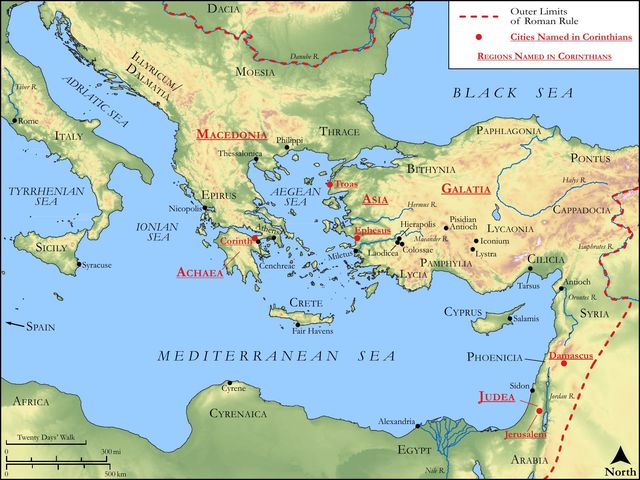
See on the biblical-era maps

Study this verse
Public-domain commentary
Matthew Henry
From his Commentary on the Whole Bible. Henry comments on passages, not single verses — this entry covers 1 Corinthians 15:35–50. His three-level outline is real structure in the source text, so it is rendered as structure.
The apostle comes now to answer a plausible and principal objection against the doctrine of the resurrection of the dead, concerning which observe the proposal of the objection: Some man will say, How are the dead raised up? And with what body do they come? Co1 15:35. The objection is plainly two-fold. How are they raised up? that is, "By what means? How can they be raised? What power is equal to this effect?" It was an opinion that prevailed much among the heathens, and the Sadducees seem to have been in the same sentiment, that it was not within the compass of divine power, mortales aeternitate donare, aut revocare defunctos - to make mortal men immortal, or revive and restore the dead. Such sort of men those seem to have been who among the Corinthians denied the resurrection of the dead, and object here, "How are they raised? How should they be raised? Is it not utterly impossible?" The other part of the objection is about the quality of their bodies, who shall rise: "With what body will they come? Will it be with the same body, with like shape, and form, and stature, and members, and qualities, or various?" The former objection is that of those who opposed the doctrine, the latter the enquiry of curious doubters.
I.To the former the apostle replies by telling them this was to be brought about by divine power, that very power which they had all observed to do something very like it, year after year, in the death and revival of the corn; and therefore it was an argument of great weakness and stupidity to doubt whether the resurrection of the dead might not be effected by the same power: Thou fool! that which thou sowest is not quickened unless it die, Co1 15:36. It must first corrupt, before it will quicken and spring up. It not only sprouts after it is dead, but it must die that it may live. And why should any be so foolish as to imagine that the man once dead cannot be made to live again, by the same power which every year brings the dead grain to life? This is the substance of the apostle's answer to the first question. Note, It is a foolish thing to question the divine power to raise the dead, when we see it every day quickening and reviving things that are dead.
II.But he is longer in replying to the second enquiry.
1.He begins by observing that there is a change made in the grain that is sown: It is not that body which shall be that is sown, but bare grain, of wheat or barley, etc.; but God gives it such a body as he will, and in such way as he will, only so as to distinguish the kinds from each other. Every seed sown has its proper body, is constituted of such materials, and figured in such a manner, as are proper to it, proper to that kind. This is plainly in the divine power, though we no more know how it is done than we know how a dead man is raised to life again. It is certain the grain undergoes a great change, and it is intimated in this passage that so will the dead, when they rise again, and live again, in their bodies, after death.
2.He proceeds hence to observe that there is a great deal of variety among others bodies, as there is among plants: as,
(1.)In bodies of flesh: All flesh is not the same; that of men is of one kind, that of beasts another, another that of fishes, and that of birds another, Co1 15:39. There is a variety in all the kinds, and somewhat peculiar in every kind, to distinguish it from the other.
(2.)In bodies celestial and terrestrial there is also a difference; and what is for the glory of one is not for the other; for the true glory of every being consists in its fitness for its rank and state. Earthly bodies are not adapted to the heavenly regions, nor heavenly bodies fitted to the condition of earthly beings. Nay,
(3.)There is a variety of glory among heavenly bodies themselves: There is one glory of the sun, and another of the moon, and another of the stars; for one star differs from another star in glory, Co1 15:41. All this is to intimate to us that the bodies of the dead, when they rise, will be so far changed, that they will be fitted for the heavenly regions, and that there will be a variety of glories among the bodies of the dead, when they shall be raised, as there is among the sun, and moon, and stars, nay among the stars themselves. All this carries an intimation along with it that it must be as easy to divine power to raise the dead, and recover their mouldered bodies, as out of the same materials to form so many different kinds of flesh and plants, and, for aught we know, celestial bodies as well as terrestrial ones. The sun and stars may, for aught we know, be composed of the same materials as the earth we tread on, though as much refined and changed by the divine skill and power. And can he, out of the same materials, form such various beings, and yet not be able to raise the dead? Having thus prepared the way, he comes,
3.To speak directly to the point: So also, says he, is the resurrection of the dead; so (as the plant growing out of the putrefied grain), so as no longer to be a terrestrial but a celestial body, and varying in glory from the other dead, who are raised, as one star does from another. But he specifies some particulars: as,
(1.)It is sown in corruption, it is raised in incorruption. It is sown. Burying the dead is like sowing them; it is like committing the seed to the earth, that it may spring out of it again. And our bodies, which are sown, are corruptible, liable to putrefy and moulder, and crumble to dust; but, when we rise, they will be out of the power of the grave, and never more be liable to corruption.
(2.)It is sown in dishonour, it is raised in glory. Ours is at present a vile body, Phi 3:21. Nothing is more loathsome than a dead body; it is thrown into the grave as a despised and broken vessel, in which there is no pleasure. But at the resurrection a glory will be put upon it; it will be made like the glorious body of our Saviour; it will be purged from all the dregs of earth, and refined into an ethereal substance, and shine out with a splendour resembling his.
(3.)It is sown in weakness, it is raised in power. It is laid in the earth, a poor helpless thing, wholly in the power of death, deprived of all vital capacities and powers, of life and strength: it is utterly unable to move or stir. But when we arise our bodies will have heavenly life and vigour infused into them; they will be hale, and firm, and durable, and lively, and liable no more to any infirmity, weakness, or decay.
(4.)It is sown a natural, or animal body, sōma psuchikon, a body fitted to the low condition and sensitive pleasures and enjoyments of this life, which are all gross in comparison of the heavenly state and enjoyments. But when we rise it will be quire otherwise; our body will rise spiritual. Not that body would be changed into spirit: this would be a contradiction in our common conceptions; it would be as much as to say, Body changed into what is not body, matter made immaterial. The expression is to be understood comparatively. We shall at the resurrection have bodies purified and refined to the last degree, made light and agile; and, though they are not changed into spirit, yet made fit to be perpetual associates of spirits made perfect. And why should it not be as much in the power of God to raise incorruptible, glorious, lively, spiritual bodies, out of the ruins of those vile, corruptible, lifeless, and animal ones, as first to make matter out of nothing, and then, out of the same mass of matter, produce such variety of beings, both in earth and heaven? To God all things are possible; and this cannot be impossible.
4.He illustrates this by a comparison of the first and second Adam: There is an animal body, says he, and there is a spiritual body; and then goes into the comparison in several instances.
(1.)As we have our natural body, the animal body we have in this world, from the first Adam, we expect our spiritual body from the second. This is implied in the whole comparison.
(2.)This is but consonant to the different characters these two persons bear: The first Adam was made a living soul, such a being as ourselves, and with a power of propagating such beings as himself, and conveying to them a nature and animal body like his own, but none other, nor better. The second Adam is a quickening Spirit; he is the resurrection and the life, Joh 11:25. He hath life in himself, and quickeneth whom he will, Joh 5:20, Joh 5:21. The first man was of the earth, made out of the earth, and was earthy; his body was fitted to the region of his abode: but the second Adam is the Lord from heaven; he who came down from heaven, and giveth life to the world (Joh 6:33); he who came down from heaven and was in heaven at the same time (Joh 3:13); the Lord of heaven and earth. If the first Adam could communicate to us natural and animal bodies, cannot the second Adam make our bodies spiritual ones? If the deputed lord of this lower creation could do the one, cannot the Lord from heaven, the Lord of heaven and earth, do the other?
(3.)We must first have natural bodies from the first Adam before we can have spiritual bodies from the second (Co1 15:49); we must bear the image of the earthy before we can bear the image of the heavenly. Such is the established order of Providence. We must have weak, frail, mortal bodies by descent from the first Adam, before we can have lively, spiritual, and immortal ones by the quickening power of the second. We must die before we can live to die no more.
(4.)Yet if we are Christ's, true believers in him (for this whole discourse relates to the resurrection of the saints), it is as certain that we shall have spiritual bodies as it is now that we have natural or animal ones. By these we are as the first Adam, earthy, we bear his image; by those we shall be as the second Adam, have bodies like his own, heavenly, and so bear him image. And we are as certainly intended to bear the one as we have borne the other. As surely therefore as we have had natural bodies, we shall have spiritual ones. The dead in Christ shall not only rise, but shall rise thus gloriously changed.
5.He sums up this argument by assigning the reason of this change (Co1 15:50): Now this I say that flesh and blood cannot inherit the kingdom of God; nor doth corruption inherit incorruption. The natural body is flesh and blood, consisting of bones, muscles, nerves, veins, arteries, and their several fluids; and, as such, it is of a corruptible frame and form, liable to dissolution, to rot and moulder. But no such thing shall inherit the heavenly regions; for this were for corruption to inherit incorruption, which is little better than a contradiction in terms. The heavenly inheritance is incorruptible, and never fadeth away, Pe1 1:4. How can this be possessed by flesh and blood, which is corruptible and will fade away? It must be changed into ever-during substance, before it can be capable of possessing the heavenly inheritance. The sum is that the bodies of the saints, when they shall rise again, will be greatly changed from what they are now, and much for the better. They are now corruptible, flesh and blood; they will be then incorruptible, glorious, and spiritual bodies, fitted to the celestial world and state, where they are ever afterwards to dwell, and have their eternal inheritance.
Historical interpretation
Eighteen Centuries of Reception
9 surviving comments on this verse. Each one is dated, so this reads as a timeline rather than a list.
Select a marker to jump to its quote. Markers stagger vertically where authors wrote within a few decades of each other.
We must therefore conclude that it is in reference to the flesh that death is mentioned; which [flesh], after the soul's departure, becomes breathless and inanimate, and is decomposed gradually into the earth from which it was taken. This, then, is what is mortal. And it is this of which he also says, "He shall also quicken your mortal bodies." And therefore in reference to it he says, in the first [Epistle] to the Corinthians: "So also is the resurrection of the dead: it is sown in corruption, it rises in incorruption." For he declares, "That which thou sowest cannot be quickened, unless first it die."
This sowing of the body he called the dissolving thereof in the ground, "because it is sown in corruption," (but "is raised) to honour and power." Now, just as in the case of the grain, so here: to Him will belong the work in the revival of the body, who ordered the process in the dissolution thereof.
Else let them show that the soul was sown after death; in a word, that it underwent death,-that is, was demolished, dismembered, dissolved in the ground, nothing of which was ever decreed against it by God: let them display to our view its corruptibility and dishonour (as well as) its weakness, that it may also accrue to it to rise again in incorruption, and in glory, and in power. Now in the ease of Lazarus, (which we may take as) the palmary instance of a resurrection, the flesh lay prostrate in weakness, the flesh was almost putrid in the dishonour of its decay, the flesh stank in corruption, and yet it was as flesh that Lazarus rose again-with his soul, no doubt.
Indeed, since he proposes as his examples "wheat grain, or some other grain, to which God giveth a body, such as it hath pleased Him; " since also he says, that "to every seed is its own body; " that, consequently, "there is one kind of flesh of men, whilst there is another of beasts, and (another) of birds; that there are also celestial bodies and bodies terrestrial; and that there is one glory of the sun, and another glory of the moon, and another glory of the stars" -does he not therefore intimate that there is to be a resurrection of the flesh or body, which he illustrates by fleshly and corporeal samples? Does he not also guarantee that the resurrection shall be accomplished by that God from whom proceed all the (creatures which have served him for) examples? "So also," says he, "is the resurrection of the dead." How? Just as the grain, which is sown a body, springs up a body.
But the corruptible and mortal putting on in corruption and immortality, what else is this, but that which is sown in corruption rising in in corruption?
Just as the rational soul is not good or bad in itself but is capable of becoming either of these, so our body is neither perishable nor imperishable by nature but acquires these immanent, essential qualities in due course.
"So also is the resurrection of the dead."
"So," How? with considerable difference. Then leaving this doctrine as sufficiently proved, he again comes to the proof itself of the resurrection and the manner of it, saying,
"It is sown in corruption, it is raised in incorruption." And observe his consideration. As in the case of seeds, he used the term proper to bodies, saying, "it is not quickened, except it die:" so in the case of bodies, the expression belonging to seeds, saying, "it is sown in corruption, it is raised in incorruption." He said not, "is produced," that thou mightest not think it a work of the earth, but is "raised." And by sowing here, he means not our generation in the womb, but the burial in the earth of our dead bodies, their dissolution, their ashes. Wherefore having said, "it is sown in corruption, it is raised in incorruption."
In due time I yielded to better and more enlightened minds, or rather, to truth itself, as I heard in the words of the apostle the groaning of the saints in their battle against carnal concupiscence. Although the saints are spiritually minded, they are still carnal in the corruptible body which remains a weight upon the soul. They will, however, be spiritual also in body when the body sown animal will rise spiritual. They are still prisoners under the wall of sin, in as much as they are subject to stimulation by desires to which they do not consent. Thus I came to understand this matter as did Hilary, Gregory, Ambrose, and other holy and renowned teachers of the church, who saw that the apostle, by his own words, fought strenuously the same battle against carnal concupiscences he did not wish to have yet in fact did have.
The second class of miracles, on this view, foretell what God has not yet done, but will do, universally. He raised one man (the man who was Himself) from the dead because He will one day raise all men from the dead. Perhaps not only men, for there are hints in the New Testament that all creation will eventually be rescued from decay, restored to shape and subserve the splendour of re-made humanity. The Transfiguration and the walking on the water are glimpses of the beauty and the effortless power over all matter which will belong to men when they are really waked by God. Now resurrection certainly involves “reversal” of natural process in the sense that it involves a series of changes moving in the opposite direction to those we see. At death, matter which has been organic, falls back gradually into the inorganic, to be finally scattered and used perhaps in other organisms. Resurrection would be the reverse process. It would not of course mean the restoration to each personality of those very atoms, numerically the same, which had made its first or “natural” body. There would not be enough to go round, for one thing; and for another, the unity of the body even in this life was consistent with a slow but perplexed change of its actual ingredients. But it certainly does mean matter of some kind rushing towards organism as now we see it rushing away. It means, in fact, playing backwards a film we have already seen played forwards. In that sense it is a reversal of Nature. But, of course, it is a further question whether reversal in this sense is necessarily contradiction. Do we know that the film cannot be played backwards?
Well, in one sense, it is precisely the teaching of modern physics that the film never works backwards. For modern physics, as you have heard before, the universe is “running down.” Disorganization and chance is continually increasing. There will come a time, not infinitely remote, when it will be wholly run down or wholly disorganized, and science knows of no possible return from that state. There must have been a time, not infinitely remote, in the past when it was wound up, though science knows of no winding-up process. The point is that for our ancestors the universe was a picture: for modern physics it is a story. If the universe is a picture these things either appear in that picture or not; and if they don’t, since it is an infinite picture, one may suspect that they are contrary to the nature of things. But a story is a different matter; specially if it is an incomplete story. And the story told by modern physics might be told briefly in the words “Humpty Dumpty was falling.” That is, it proclaims itself an incomplete story. There must have been a time before he fell, when he was sitting on the wall; there must be a time after he had reached the ground. It is quite true that science knows of no horses and men who can put him together again once he has reached the ground and broken. But then she also knows of no means by which he could originally have been put on the wall. You wouldn’t expect her to. All science rests on observation: all our observations are taken during Humpty Dumpty’s fall, because we were born after he lost his seat on the wall and shall be extinct long before he reaches the ground. But to assume from observations taken while the clock is running down that the unimaginable winding-up which must have preceded this process cannot occur when the process is over is the merest dogmatism. From the very nature of the case the laws of degradation and disorganization which we find in matter at present, cannot be the ultimate and eternal nature of things. If they were, there would have been nothing to degrade and disorganize. Humpty Dumpty can’t fall off a wall that never existed.
Continue studying 1 Corinthians 15:42 across the web’s major study libraries — every link below opens this exact verse, chapter, or book on the destination site.
Read & Compare
 BibleGatewayThis verse in more than 200 translations and 70 languages.
 Bible.comThe YouVersion reader — hundreds of translations, reading plans, and highlights.
 ESV.orgCrossway's official English Standard Version reader.
 NET BibleThe NET translation with 60,000+ translators' notes on every rendering decision.
 STEP BibleTyndale House's free study tool — original text, vocabulary, and scholarly resources.
 BibliaLogos Bible Software's free web reader.
 USCCBThe New American Bible (Revised Edition) with the U.S. bishops' study notes.
Commentaries
 BibleHub CommentariesDozens of classic commentaries on this verse, gathered on one page.
 StudyLightMore than 100 commentary sets — the largest collection on the web.
 BibleRefPlain-English commentary on what this verse means, verse by verse.
 Enduring WordDavid Guzik's free commentary on this chapter, widely used by Bible teachers.
 Bible Study ToolsVerse commentary alongside Greek and Hebrew study aids.
Original Language & Research
- BibleHub InterlinearThe verse word by word — original language, transliteration, and English.
- BibleHub LexiconEvery word's original-language definition and Strong's entry.
 Blue Letter BibleDeep-study tools — Strong's numbers, concordance, and word studies.
 CNTR CollationThe earliest Greek manuscripts of this verse, collated letter by letter.
Sermons, Hymns & Audio


TrulyRandomVerse is not affiliated with these sites and doesn’t control their content. They’re linked because they’re genuinely useful.
Summary
1 Corinthians 15:42 serves as a pivotal statement in Paul's comprehensive defense and explanation of the resurrection of the dead, initiating a series of profound contrasts that illuminate the nature of the resurrected body. This verse succinctly captures the transformative journey from our present, perishable physical existence to a future, imperishable spiritual reality, emphasizing that while the earthly body is "sown in corruption," it will be "raised in incorruption." It lays the groundwork for understanding the continuity and radical discontinuity between the mortal and immortal forms, asserting the foundational Christian hope in a glorified bodily resurrection.
Context
ShowHideLiterary Context
1 Corinthians 15 is Paul's most extensive and systematic treatment of the resurrection. The preceding verses (e.g., 1 Corinthians 15:1-11) establish the historical reality of Christ's resurrection as the cornerstone of the Christian faith, without which faith is futile. Paul then addresses the Corinthian believers' specific doubts and questions, particularly those who denied the resurrection of the dead (e.g., 1 Corinthians 15:12). 1 Corinthians 15:35 directly poses the questions Paul answers in the subsequent verses: "But someone will ask, 'How are the dead raised? With what kind of body do they come?'" Verse 42 marks the beginning of Paul's detailed answer, using an analogy of a seed to explain the transformation from the earthly to the heavenly body, setting the stage for the series of contrasts that follow in 1 Corinthians 15:43-44.
Historical & Cultural Context
The Corinthian church, situated in a bustling, cosmopolitan Greek city, was heavily influenced by Hellenistic thought. Greek philosophy, particularly Platonism, often held a dualistic view that elevated the soul while disparaging the physical body as a prison or something inherently corrupt. This worldview made the concept of a bodily resurrection, especially of a physical body, challenging and even repugnant to some. Furthermore, the mystery religions and philosophical schools of the day offered various ideas about the afterlife, but none fully embraced the Jewish-Christian concept of a future bodily resurrection. Paul's discourse directly confronts these prevailing cultural assumptions, asserting a distinctly Christian understanding rooted in the Old Testament hope and the historical event of Christ's resurrection. His use of agricultural metaphors, like sowing a seed, would have been readily understood by an agrarian society, making complex theological truths accessible.
Key Themes
ShowHide1 Corinthians 15 is rich with theological themes that 1 Corinthians 15:42 profoundly contributes to. Firstly, it underscores The Certainty and Necessity of Resurrection, affirming that the resurrection of believers is as sure as Christ's own resurrection, which Paul argues is indispensable for Christian faith (e.g., 1 Corinthians 15:17). Secondly, the verse introduces the theme of Radical Transformation, highlighting that the resurrected body will not merely be a resuscitation of the old but a glorious, qualitative change from perishable to imperishable, from weak to powerful, from natural to spiritual, as further elaborated in 1 Corinthians 15:43-44. This transformation is a divine act, demonstrating God's power to conquer death and decay. Thirdly, it touches upon the Continuity and Discontinuity of the Body, using the seed analogy to explain that while there is a continuity of identity, the form and properties of the resurrected body will be profoundly different and superior, fit for eternity. This concept is vital for understanding the Christian hope in a future that redeems the whole person, body and soul, as seen in the ultimate redemption of our bodies.
Exposition and Analysis
ShowHideKey Word Analysis
ShowHideThis word, derived from the idea of extending or scattering, refers to the act of planting seed. In the context of 1 Corinthians 15:42, Paul uses it metaphorically to describe the burial of the human body. Just as a farmer plants a seed in the ground, so too is the human body laid into the earth at death. This metaphor highlights that death is not an end but a preparatory stage for new life, much like a seed must "die" to produce a plant.
This term signifies decay, ruin, perishing, or decomposition. It describes the natural state of the physical body after death, which is subject to deterioration, disease, and the processes of mortality. Paul uses this word to emphasize the transient, fragile, and perishable nature of our present earthly existence, highlighting the effects of sin and the fall on the physical creation.
Formed by negating the root of "corruption" (with the 'a-' prefix), this word means "without decay," "imperishability," or "immortality." It describes the eternal, immortal, and glorified nature of the resurrected body. This body will be free from disease, aging, death, and any form of deterioration, perfectly reflecting God's eternal design and the triumph over the effects of sin and death. It speaks to a state of unending existence and genuineness, a quality of the divine.
Verse Breakdown
ShowHide"So also is the resurrection of the dead."
This opening clause serves as a direct affirmation and a transition from Paul's preceding arguments about the certainty of Christ's resurrection to the nature of the general resurrection of believers. The "So also" (Greek, hoútō_ _kaí') connects the manner of Christ's resurrection, which involved a transformation, to the future resurrection of all believers. It declares that just as Christ was raised, so too will all who are in Him be raised, establishing the theological certainty of this future event.
"It is sown in corruption;"
This phrase uses the metaphor of sowing a seed to describe the act of burial. The "it" refers to the human body at the point of death and interment. The body is "sown" (buried) in a state of "corruption," meaning it is subject to decay, mortality, and the natural processes of deterioration that follow death. This acknowledges the grim reality of physical death and the perishable nature of our earthly bodies, highlighting their vulnerability and transient existence.
"it is raised in incorruption:"
This contrasting clause reveals the glorious outcome of the resurrection. The same body, though transformed, is "raised" (awakened, lifted up) not in its former state of decay but "in incorruption." This signifies a radical transformation to an imperishable, immortal, and glorified state. The resurrected body will be free from all forms of decay, disease, and death, reflecting the eternal and perfect nature of God's new creation. This is the divine reversal of the effects of the fall, promising an eternal existence in a body fit for eternity.
Literary Devices
ShowHidePaul masterfully employs several literary devices in 1 Corinthians 15:42 to convey profound theological truths. The most prominent is Antithesis (or contrast), where "corruption" is starkly set against "incorruption." This direct opposition highlights the dramatic and qualitative transformation that occurs at resurrection, emphasizing the radical difference between the perishable earthly body and the imperishable heavenly body. Complementing this is the Metaphor of "sowing." The act of burying the body is likened to planting a seed, which must decay before new life emerges. This powerful agricultural image demystifies the resurrection, making it relatable and illustrating that death is not an end but a necessary precursor to a new, superior form of life. Furthermore, there is an implicit Parallelism in the structure of the two clauses, "It is sown in corruption; it is raised in incorruption," which creates a rhythmic and memorable statement, reinforcing the cause-and-effect relationship between death and resurrection, and the profound change in state.
Theological and Thematic Connections
ShowHide1 Corinthians 15:42 is a foundational stone in the broader biblical doctrine of eschatology, particularly concerning the nature of the resurrected body. It affirms the ultimate triumph of God over sin and death, not just spiritually but physically. This verse assures believers that the future state involves a tangible, albeit transformed, body, which contrasts sharply with Gnostic or purely spiritualized views of the afterlife. It underscores the goodness of creation and God's intention to redeem not just souls but also the physical realm, culminating in a new heavens and new earth. The promise of incorruption speaks to the eternal security and glory awaiting those who belong to Christ, a hope that transcends earthly suffering and mortality.
Reflection and Application
ShowHide1 Corinthians 15:42 offers profound comfort and shapes our perspective on life, death, and eternity. For those grappling with the reality of mortality, the decay of the body, or the loss of loved ones, this verse provides a powerful antidote to despair. It transforms our understanding of death from a finality into a transition, a sowing that anticipates a glorious harvest. This hope encourages believers to live with an eternal mindset, prioritizing spiritual realities and investing in what will last. While our earthly bodies are temporary and subject to the ravages of time and sin, their future transformation affirms God's original good design and the ultimate redemption of our whole being—spirit, soul, and body. It reminds us that our present sufferings are temporary, and a future glory awaits that far outweighs them. This hope empowers us to face present challenges with resilience, knowing that our ultimate destiny is one of incorruptible glory with Christ.
Questions for Reflection
ShowHideFAQ
ShowHideDoes 1 Corinthians 15:42 mean our resurrected bodies will be entirely different, or will they retain any continuity with our earthly bodies?
ShowHide1 Corinthians 15:42 and the surrounding verses in 1 Corinthians 15 teach both continuity and discontinuity. The metaphor of the seed is key: when you plant a seed, it decays, but what grows from it is recognizably the same kind of plant, yet vastly different and more glorious than the mere seed. Similarly, Paul emphasizes that "it is sown... it is raised," implying that the "it" (the individual person, the body) retains its identity. However, the nature of that body is radically transformed. It moves from "corruption" (perishable, mortal) to "incorruption" (imperishable, immortal). Paul further explains this transformation in 1 Corinthians 15:43-44, stating it is sown in dishonor but raised in glory, sown in weakness but raised in power, sown a natural body but raised a spiritual body. So, while it will be our body, it will be fundamentally changed, glorified, and perfectly suited for eternal life in God's presence, much like Christ's own resurrected body (Philippians 3:21).
Christ-Centered Fulfillment
ShowHide1 Corinthians 15:42 finds its ultimate Christ-centered fulfillment in the person and work of Jesus Christ, who is the "firstfruits of those who have fallen asleep" (1 Corinthians 15:20). His resurrection from the dead, in a transformed yet recognizable body, is the prototype and guarantee of our own future resurrection. Jesus was "sown in corruption" through His death and burial, experiencing the full reality of human mortality and the grave. Yet, He was "raised in incorruption," demonstrating His victory over sin and death, and inaugurating a new creation. His incorruptible body, which appeared to His disciples and ascended into heaven, is the pattern for the glorified bodies believers will receive. Because Christ, the "last Adam," became a life-giving spirit (1 Corinthians 15:45), those who are united with Him by faith will also partake in His resurrection life. Our hope of an incorruptible body is not merely an abstract theological concept but a concrete promise secured by the historical reality of Christ's triumph, ensuring that just as we have borne the image of the man of dust, we shall also bear the image of the man of heaven (1 Corinthians 15:49). This future glory is a direct result of His finished work on the cross and His powerful resurrection, making Him the source and guarantee of our own eternal, incorruptible existence.