


Romans 8:14
- ὅσοιhosoiAs many asG3745K-NPMCorrelative pronoun Nominative Plural Masculine
- γὰρgarforG1063CONJConjunction
- πνεύματιpneumatiby [the] SpiritG4151N-DSNNoun Dative Singular Neuter
- θεοῦtheouof GodG2316N-GSM-TNoun Genitive Singular Masculine Title
- ἄγονταιagontaiare ledG71V-PPI-3PVerb Present Passive Indicative 3rd Plural
- οὗτοιhoutoitheseG3778D-NPMDemonstrative pronoun Nominative Plural Masculine
- υἱοὶhuioisonsG5207N-NPMNoun Nominative Plural Masculine
- θεοῦtheouof GodG2316N-GSM-TNoun Genitive Singular Masculine Title
- εἰσινeisinareG1510V-PAI-3PVerb Present Active Indicative 3rd Plural
English is a literal word-by-word gloss of the Greek, not the KJV's wording. Why?
This is the original text the KJV's translators worked from — each Greek word with its own literal English meaning in this verse, prepared by scholars at Tyndale House, Cambridge. The KJV translates whole sentences, not word by word, so its wording differs: one Greek word can become several English words, and the KJV may choose “charity” where the gloss reads “love”. Both are faithful — they answer different questions. For the KJV's own rendering, switch to the KJV text.
Details
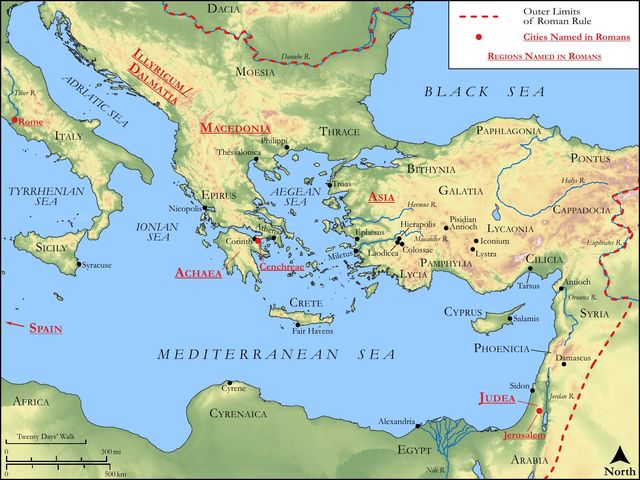
See on the biblical-era map

Study this verse
Public-domain commentary
Matthew Henry
From his Commentary on the Whole Bible. Henry comments on passages, not single verses — this entry covers Romans 8:10–16. His four-level outline is real structure in the source text, so it is rendered as structure.
In these verses the apostle represents two more excellent benefits, which belong to true believers.
I.Life.
The happiness is not barely a negative happiness, not to be condemned; but it is positive, it is an advancement to a life that will be the unspeakable happiness of the man (Rom 8:10, Rom 8:11): If Christ be in you. Observe, If the Spirit be in us, Christ is in us. He dwells in the heart by faith, Eph 3:17. Now we are here told what becomes of the bodies and souls of those in whom Christ is.
1.We cannot say but that the body is dead; it is a frail, mortal, dying body, and it will be dead shortly; it is a house of clay, whose foundation is in the dust. The life purchased and promised does not immortalize the body in its present state. It is dead, that is, it is appointed to die, it is under a sentence of death: as we say one that is condemned is a dead man. In the midst of life we are in death: be our bodies ever so strong, and healthful, and handsome, they are as good as dead (Heb 11:12), and this because of sin. It is sin that kills the body. This effect the first threatening has (Gen 3:19): Dust thou art. Methinks, were there no other argument, love to our bodies should make us hate sin, because it is such an enemy to our bodies. The death even of the bodies of the saints is a remaining token of God's displeasure against sin.
2.But the spirit, the precious soul, that is life; it is now spiritually alive, nay, it is life. Grace in the soul is its new nature; the life of the saint lies in the soul, while the life of the sinner goes no further than the body. When the body dies, and returns to the dust, the spirit if life; not only living and immortal, but swallowed up of life. Death to the saints is but the freeing of the heaven-born spirit from the clog and load of this body, that it may be fit to partake of eternal life. When Abraham was dead, yet God was the God of Abraham, for even then his spirit was life, Mat 22:31, Mat 22:32. See Psa 49:15. And this because of righteousness. The righteousness of Christ imputed to them secures the soul, the better part, from death; the righteousness of Christ inherent in them, the renewed image of God upon the soul, preserves it, and, by God's ordination, at death elevates it, and improves it, and makes it meet to partake of the inheritance of the saints in light. The eternal life of the soul consists in the vision and fruition of God, and both assimilating, for which the soul is qualified by the righteousness of sanctification. I refer to Psa 17:15, I will behold thy face in righteousness.
3.There is a life reserved too for the poor body at last: He shall also quicken your mortal bodies, Rom 8:11. The Lord is for the body; and though at death it is cast aside as a despised broken vessel, a vessel in which is no pleasure, yet God will have a desire to the work of his hands (Job 14:15), will remember his covenant with the dust, and will not lose a grain of it; but the body shall be reunited to the soul, and clothed with a glory agreeable to it. Vile bodies shall be newly fashioned, Phi 3:21; Co1 15:42. Two great assurances of the resurrection of the body are mentioned: - (1.) The resurrection of Christ: He that raised up Christ from the dead shall also quicken. Christ rose as the head, and first-fruits, and forerunner of all the saints, Co1 15:20. The body of Christ lay in the grave, under the sin of all the elect imputed, and broke through it. O grave, then, where is thy victory? It is in the virtue of Christ's resurrection that we shall rise. (2.) The indwelling of the Spirit. The same Spirit that raiseth the soul now will raise the body shortly: By his Spirit that dwelleth in you. The bodies of the saints are the temples of the Holy Ghost, Co1 3:16; Co1 6:19. Now, though these temples may be suffered for awhile to lie in ruins, yet they shall be rebuilt. The tabernacle of David, which has fallen down, shall be repaired, whatever great mountains may be in the way. The Spirit, breathing upon dead and dry bones, will make them live, and the saints even in their flesh shall see God. Hence the apostle by the way infers how much it is our duty to walk not after the flesh, but after the Spirit, Rom 8:12, Rom 8:13. Let not our life be after the wills and motions of the flesh. Two motives he mentions here: - [1.] We are not debtors to the flesh, neither by relation, gratitude, nor any other bond or obligation. We owe no suit nor service to our carnal desires; we are indeed bound to clothe, and feed, and take care of the body, as a servant to the soul in the service of God, but no further. We are not debtors to it; the flesh never did us so much kindness as to oblige us to serve it. It is implied that we are debtors to Christ and to the Spirit: there we owe our all, all we have and all we can do, by a thousand bonds and obligations. Being delivered from so great a death by so great a ransom, we are deeply indebted to our deliverer. See Co1 6:19, Co1 6:20. [2.] Consider the consequences, what will be at the end of the way. Here are life and death, blessing and cursing, set before us. If you live after the flesh, you shall die; that is, die eternally. It is the pleasing, and serving, and gratifying, of the flesh, that are the ruin of souls; that is, the second death. Dying indeed is the soul's dying: the death of the saints is but a sleep. But, on the other hand, You shall live, live and be happy to eternity; that is the true life: If you through the Spirit mortify the deeds of the body, subdue and keep under all fleshly lusts and affections, deny yourselves in the pleasing and humouring of the body, and this through the Spirit; we cannot do it without the Spirit working it in us, and the Spirit will not do it without our doing our endeavour. So that in a word we are put upon this dilemma, either to displease the body or destroy the soul.
II.The Spirit of adoption is another privilege belonging to those that are in Christ Jesus, Rom 8:14-16.
1.All that are Christ's are taken into the relation of Children to God, Rom 8:14. Observe,
(1.)Their property: They are led by the Spirit of God, as a scholar in his learning is led by his tutor, as a traveller in his journey is led by his guide, as a soldier in his engagements is led by his captain; not driven as beasts, but led as rational creatures, drawn with the cords of a man and the bands of love. It is the undoubted character of all true believers that they are led by the Spirit of God. Having submitted themselves in believing to his guidance, they do in their obedience follow that guidance, and are sweetly led into all truth and all duty.
(2.)Their privilege: They are the sons of God, received into the number of God's children by adoption, owned and loved by him as his children.
2.And those that are the sons of God have the Spirit,
(1.)To work in them the disposition of children.
[1.]You have not received the spirit of bondage again to fear, Rom 8:15. Understand it, First, Of that spirit of bondage which the Old Testament church was under, by reason of the darkness and terror of that dispensation. The veil signified bondage, Co2 3:15. Compare Rom 8:17. The Spirit of adoption was not then so plentifully poured out as now; for the law opened the wound, but little of the remedy. Now you are not under that dispensation, you have not received that spirit. Secondly, Of that spirit of bondage which many of the saints themselves were under at their conversion, under the convictions of sin and wrath set home by the Spirit; as those in Act 2:37, the jailer (Act 16:30), Paul, Act 9:6. Then the Spirit himself was to the saints a spirit of bondage: "But," says the apostle, "with you this is over." "God as a Judge," says Dr. Manton, "by the spirit of bondage, sends us to Christ as Mediator, and Christ as Mediator, by the spirit of adoption, sends us back again to God as a Father." Though a child of God may come under fear of bondage again, and may be questioning his sonship, yet the blessed Spirit is not again a spirit of bondage, for then he would witness an untruth.
[2.]But you have received the Spirit of adoption. Men may give a charter of adoption; but it is God's prerogative, when he adopts, to give a spirit of adoption - the nature of children. The Spirit of adoption works in the children of God a filial love to God as a Father, a delight in him, and a dependence upon him, as a Father. A sanctified soul bears the image of God, as the child bears the image of the father. Whereby we cry, Abba, Father. Praying is here called crying, which is not only an earnest, but a natural expression of desire; children that cannot speak vent their desires by crying. Now, the Spirit teaches us in prayer to come to God as a Father, with a holy humble confidence, emboldening the soul in that duty. Abba, Father. Abba is a Syriac word signifying father or my father; patēr, a Greek work; and why both, Abba, Father? Because Christ said so in prayer (Mar 14:36), Abba, Father: and we have received the Spirit of the Son. It denotes an affectionate endearing importunity, and a believing stress laid upon the relation. Little children, begging of their parents, can say little but Father, Father, and that is rhetoric enough. It also denotes that the adoption is common both to Jews and Gentiles: the Jews call him Abba in their language, the Greeks may call him patēr in their language; for in Christ Jesus there is neither Greek nor Jew.
(2.)To witness to the relation of children, Rom 8:16. The former is the work of the Spirit as a Sanctifier; this as a Comforter. Beareth witness with our spirit. Many a man has the witness of his own spirit to the goodness of his state who has not the concurring testimony of the Spirit. Many speak peace to themselves to whom the God of heaven does not speak peace. But those that are sanctified have God's Spirit witnessing with their spirits, which is to be understood not of any immediate extraordinary revelation, but an ordinary work of the Spirit, in and by the means of comfort, speaking peace to the soul. This testimony is always agreeable to the written word, and is therefore always grounded upon sanctification; for the Spirit in the heart cannot contradict the Spirit in the word. The Spirit witnesses to none the privileges of children who have not the nature and disposition of children.
Historical interpretation
Ten Centuries of Reception
8 surviving comments on this verse. Each one is dated, so this reads as a timeline rather than a list.
Select a marker to jump to its quote. Markers stagger vertically where authors wrote within a few decades of each other.
The Spirit of God is the same as the Spirit of Christ and the same as the Holy Spirit. But he is also called the Spirit of adoption, as the apostle makes clear in this passage. David spoke of this Spirit also when he said: “Take not thy Holy Spirit from me.” There are many sons of God, as Scripture says: “You are gods, sons of the Most High, all of you,” … but only one is the Son by nature, the only begotten of the Father, through whom all the rest are called sons. Likewise there are many spirits but only one who truly proceeds from God himself and who bestows on all the others the grace of his name and his sanctification.
If we are the sons of God, if we have already begun to be his temples, if (after receiving the Holy Spirit) we live holily and spiritually, if we have lifted up our eyes from the earth toward heaven, if we have raised our hearts, full of God and Christ, to supernal and divine things, let us do nothing which is not worthy of God and Christ, as the apostle arouses and urges us.
"For as many as are led by the Spirit of God, they are the sons of God." Now this is again a much greater honor than the first. And this is why he does not say merely, As many as live by the Spirit of God, but, "as many as are led by the Spirit of God," to show that he would have Him use such power over our life as a pilot doth over a ship, or a charioteer over a pair of horses. And it is not the body only, but the soul itself too, that he is for setting under reins of this sort. For he would not have even that independent, but place its authority also under the power of the Spirit. For lest through a confidence in the Gift of the Font they should turn negligent of their conversation after it, he would say, that even supposing you receive baptism, yet if you are not minded to be "led by the Spirit" afterwards, you lose the dignity bestowed upon you, and the pre-eminence of your adoption. This is why he does not say, As many as have received the Spirit, but, "as many as are led by the Spirit," that is, as many as live up to this all their life long, "they are the sons of God."
Then since this dignity was given to the Jews also, for it says, "I said ye are Gods, and all of you children of the Most High"; and again, "I have nourished and brought up children"; and so, "Israel is My first-born"; and Paul too says, "Whose is the adoption" - he next asserts the great difference between the latter and the former honor. For though the names are the same, he means, still, the things are not the same.
This applies to all who are worthy to be governed by the Holy Spirit, just as (on the contrary) those who sin are moved by the spirit of the devil, who was a sinner from the beginning.
It is clear that these people will live the blessed life with their Father.
Since the Lord prepares the will, he also touches the hearts of his children with fatherly inspirations so that they might do good.… Consequently, we do not think that our free will is lacking, nor do we doubt that, in each and every movement of man’s free will, his help is the stronger force.
For ye have not received the spirit of bondage again to fear; but ye have received the Spirit of adoption, whereby we cry, Abba, Father."
After stating that through the Holy Spirit will be given to us the life of glory, which will exclude all mortality from our bodies [n. 628], the Apostle now proves this: first, he shows that this glorious life is given by the Holy Spirit; secondly, why it is deferred [v. 17b; n. 650]. In regard to the first he presents this argument: All who are sons of God obtain the inheritance of a glorious life; but those who are ruled by the Holy Spirit are sons of God. Therefore, all who are ruled by the Holy Spirit obtain the inheritance of a glorious life. First, therefore, he posits the minor of this proof; 316 secondly, the major [v. 17; n. 646]. In regard to the first he does two things; first, he states his proposition; secondly, he proves it [n. 637]. 635. In regard to the first there two things to consider. First, how some are led by the Spirit of God. This can be understood in the following way: All who are led by the Spirit of God, i.e., ruled as by a leader and director, which the Spirit does in us, inasmuch as he enlightens us inwardly about what we ought to do: "Let thy good spirit lead me" (Ps 143:10). But because one who is led does not act on his own, whereas the spiritual man is not only instructed by the Holy Spirit regarding what he ought to do, but his heart is also moved by the Holy Spirit, it is necessary to get a better understanding of what is meant by all who are led by the Spirit of God. For those are led who are moved by a higher instinct. Hence we say that animals do not act but are led, because they are moved to perform their actions by nature and not from their own impulse. Similarly, the spiritual man is inclined to do something not as though by a movement of his own will chiefly, but by the prompting of the Holy Spirit, as it says in Is (59:19): "He will come like a rushing stream, which the wind of the Lord drives," and in Lk (4:1): "Jesus was led by the Spirit into the wilderness." However, this does not mean that spiritual men do not act through will and free choice, because the Holy Spirit causes the very movement of the will and of free choice in them, as it says in Phil (2:13): "God is at work in you both to will and to work." 317 636. Secondly, we must consider how those who are led by the Spirit of God are sons of God. This is clarified by a likeness to natural children, who are produced by the natural seed coming from the father. But the spiritual seed proceeding from the Father is the Holy Spirit. Therefore, through this seed some men are born as sons of God: "No one born of God commits sin, because the seed of God abides in him" (1 Jn 3:9). 637. Then (v.15) he proves that men who receive the Holy Spirit are sons of God; and this in three ways. First, by distinguishing the gifts of the Holy Spirit; secondly, by our own testimony [v. 15b; n. 644]; thirdly, by the testimony of the Spirit [v. 16; n. 645]. 638. In regard to the first it should be noted that the Holy Spirit produces two effects in us: one is fear: "His delight shall be in the fear of the Lord" (Is 11:3); the other is love: "God’s love has been poured into our hearts through the Holy Spirit which has been given to us" (Rom 5:5). But fear makes slaves; love does not. To realize this it is necessary to consider that fear bears on two things, namely, the evil from which someone flees through fear, and whatever seems to be the source of that evil. For a person is said to fear being killed and the king who has the power to kill. But sometime it happens that the evil from which someone recoils is contrary to a bodily or temporal good which a person sometimes loves inordinately and recoils from having it injured or destroyed by a mere man. This is human or worldly fear and is not from the Holy Spirit. Indeed, the Lord forbids such fear: "Do not fear those who kill the body" (Mt 10:28). 318 639. There is a second type of fear which recoils from an evil contrary to created nature, namely, the evil of being punished, and shrinks from having this evil inflicted by a spiritual cause, namely, by God. Such fear is praiseworthy at least in one respect, namely, that it fears God: "Oh that they had such a mind as this always, to fear me and to keep all my commandments" (Dt 5:29). In this respect it is from the Holy Spirit. But insofar as such fear does not recoil from an evil opposed to ones spiritual good, namely, sin, but only punishment, it is not praiseworthy. It has this shortcoming not from the Holy Spirit but from man’s guilt; just as deformed faith is from the Holy Spirit, inasmuch as it is faith but not its deformity. Hence, even if a person does something good under the influence of such fear, he does not act well, because he does not act spontaneously but compelled by fear of punishment -- and this is characteristic of slaves. Therefore, this fear is properly called servile, because it makes a man act as a slave does. 640. There is a third type of fear which recoils from evil opposed to a spiritual good, namely, from sin or separation from God, which a person fears to incur from the just vengeance of God. Thus it bears on spiritual goods, but with an eye on punishment. This is called initial fear, because it is usually found in men at the beginning of their conversion. For it fears punishment due to past sins and it fears separation from God through sin because of grace infused with charity. This is the fear mentioned in Ps 111 (v.10): "The fear of the Lord is the beginning of wisdom." 641. The fourth type of fear has its eye entirely on spiritual things, because it fears nothing except separation from God. This is holy fear which endures forever," as it says in Ps 19 (v.9). But just as initial fear is caused by imperfect love, so this fear is caused by 319 perfect love: "Perfect love casts out fear" (1 Jn 4:18). For this reason initial fear and chaste fear are not distinguished against charity’s love which is the cause of both, but the fear of punishment is; because just as this fear produces slavery, so charity’s love produces the freedom of sons. For it makes a man act voluntarily for the honor of God -- which is characteristic of sons. 642. Now the Old Law was given in fear which was signified by the thunder and things of that sort which occurred when it was given, as it says in Ex 19 and in Heb (12:21): "So terrifying was the sight that Moses said, ‘I tremble with fear." So the Old Law, which induced men to obey God’s commandments by inflicting punishments, was given in a spirit of slavery; hence it says in Gal (4:24): "One is from Mount Sinai, bearing children for slavery." 643. Therefore, he says here: It was correct to say that "all who are led by the Spirit of God are sons of God." For in the New Law you did not receive the spirit of slavery to fall back into fear, namely, of punishments; but you have received the Spirit of sonship, by which we are adopted as children of God: "That we might receive adoption as sons" (Gal 4:5). This does not mean that there is one spirit and another spirit, but that it is the same spirit, who produces servile fear in some and love in others. 644. Then (v.15b) he manifests the same thing by our confession. For we confess that we have God as our Father, when we follow the -Lord’s instruction to pray: "Our Father, who art in heaven" (Mt 6:9). And since it is suitable not only for the Jews but also for Gentiles to say this, he uses two words to signify "Father," namely, "Abba," which is Hebrew, and "Pater," which can be Latin or Greek. Even the 320 Lord himself says: Father, all things are possible to you" (Mk 14:36); "You will call me, My Father" (Jer 3:19). We say this not so such with the sound of our voice as with the intention of our heart, an intention so strong that it is called a cry, as with Moses to whom it was said: "Why do you cry to me? (Ex 14:15), namely, with the intention in your heart. But the great strength of this intention comes from the feeling of filial fear which he produces in us. Therefore, he says: In which, namely, the Holy Spirit, we cry: Abba, Father. Hence it says in Is (6:3) that the seraphim, burning with the fire of the Holy Spirit, "cried one to another: Holy, holy, holy...". 645. Then (v.16) he manifests the same thing through the testimony of the Holy Spirit, to show that we are not deceived in our confession; hence he says: The reason I say that "we cry, Abba, Father" in the Holy Spirit is that the Spirit himself is bearing witness to our spirit that we are children of God. He bears this testimony not with external words that reach men’s ears, as the Father gave testimony to his own Son in Mt (3:17), but through the effect of filial love he produces in us. Therefore, he says that he bears testimony not to our ears but to our spirit. 646. Then (v.17) he posits the major. First he shows that to children is owed the inheritance, saying: If some are children, namely, through the Spirit, it follows that they are heirs, because the inheritance is owed not only to the natural child but also to the adopted: "We have been born anew to an inheritance which is imperishable" (1 Pt 1:4); "Yea, I have a goodly heritage" (Ps 16:6). 647. Secondly, he shows what that inheritance is. 321 First he describes it in relation to God the Father, saying: heirs of God. Now one’s heir is a person who receives or gets his chief goods and not some small gifts, as we read in Gen (25:15) that Abraham gave all his possessions to Isaac, but to the sons of his concubines he bestowed gifts. Now the chief good by which God is rich is himself. For he is rich of himself and not in virtue of something else, because he does not need the goods others have, as it says in Ps 15 (v.2): "You do not need my goods." Hence the children of God obtain God himself as their inheritance: "The Lord is my chosen portion" (Ps 16:5); "The Lord is my portion, says my soul" (Lam 3:24). 648. But since the child does not obtain the inheritance unless the Father dies, it seems that man cannot be an heir of God, who never dies. The answer is that this applies to temporal goods which cannot be possessed by many at the same time; hence one must die, if another is to inherit. But spiritual goods can be held by many at the same time; therefore, it is not necessary that the Father die in order that the children become heirs. Yet it can be said that God dies for us inasmuch as he is in us by faith. 649. Secondly, he describes this inheritance on the part of Christ, saying: fellow heirs with Christ, because just as he is the chief Son with whom we share sonship, so he is the chief heir, to whom we are united in the inheritance: "This is the heir" (Mt 21:38). 650. Then (v.17b) he shows why this glorious life is delayed: first, he gives the reason concerned with suffering; secondly, the preeminence of glory over suffering [v. 18; n. 652]. 651. In regard to the first it must be recalled that Christ, the principal heir, attained to the inheritance, of glory through suffering: "Was it not necessary that the 322 Christ should suffer these things and enter his glory?" (Lk 24:26). But we must not expect to obtain the inheritance by an easier way. Therefore, it is necessary that we attain to that inheritance through suffering: "Through many tribulations we must enter the kingdom of God" (Ac 14:22). For we do not receive an immortal and unsuffering body at once, in order that we might suffer along with Christ. Hence he says, provided we suffer with him, i.e., along with Christ endure the tribulations of this world patiently, in order that we may also be glorified with Christ: "If we have died with him, we shall also reign with him" (2 Tim 2:11).
Continue studying Romans 8:14 across the web’s major study libraries — every link below opens this exact verse, chapter, or book on the destination site.
Read & Compare
 BibleGatewayThis verse in more than 200 translations and 70 languages.
 Bible.comThe YouVersion reader — hundreds of translations, reading plans, and highlights.
 ESV.orgCrossway's official English Standard Version reader.
 NET BibleThe NET translation with 60,000+ translators' notes on every rendering decision.
 STEP BibleTyndale House's free study tool — original text, vocabulary, and scholarly resources.
 BibliaLogos Bible Software's free web reader.
 USCCBThe New American Bible (Revised Edition) with the U.S. bishops' study notes.
Commentaries
 BibleHub CommentariesDozens of classic commentaries on this verse, gathered on one page.
 StudyLightMore than 100 commentary sets — the largest collection on the web.
 BibleRefPlain-English commentary on what this verse means, verse by verse.
 Enduring WordDavid Guzik's free commentary on this chapter, widely used by Bible teachers.
 Bible Study ToolsVerse commentary alongside Greek and Hebrew study aids.
Original Language & Research
- BibleHub InterlinearThe verse word by word — original language, transliteration, and English.
- BibleHub LexiconEvery word's original-language definition and Strong's entry.
 Blue Letter BibleDeep-study tools — Strong's numbers, concordance, and word studies.
 CNTR CollationThe earliest Greek manuscripts of this verse, collated letter by letter.
Sermons, Hymns & Audio


TrulyRandomVerse is not affiliated with these sites and doesn’t control their content. They’re linked because they’re genuinely useful.
Summary
Romans 8:14 serves as a profound declaration of Christian identity, asserting that the defining characteristic of those who truly belong to God's family is their active guidance by the Holy Spirit. This verse encapsulates the transformative power of the Spirit's indwelling, establishing a direct and inseparable link between being led by God's Spirit and possessing the privileged status of divine sonship, signifying a new life of intimate relationship and spiritual inheritance in Christ.
Context
ShowHideLiterary Context
Romans 8:14 is situated within Paul's magnificent exposition on the believer's new life in the Spirit, often hailed as the theological pinnacle of his letter to the Romans. Immediately preceding this verse, Paul contrasts life "according to the flesh" with life "according to the Spirit," emphasizing that those in Christ are no longer enslaved to sin but are indwelt by the Spirit of God (Romans 8:9-11). He then asserts the believer's freedom from obligation to the flesh, urging them to put to death the deeds of the body by the Spirit (Romans 8:12-13). Verse 14 functions as a climactic summary and foundational principle, providing the definitive evidence and outcome of this Spirit-empowered existence: genuine sonship. The subsequent verses further elaborate on this sonship, introducing the "Spirit of adoption" and the cry of "Abba, Father!" (Romans 8:15), and the glorious inheritance shared with Christ (Romans 8:17).
Historical & Cultural Context
In the Greco-Roman world, adoption (Latin: adoptio) was a significant legal and social practice, particularly among the elite. It was not merely a matter of charity but often served to secure an heir, perpetuate a family name, or forge political alliances. An adopted son (Latin: filius adoptivus) held the full legal rights and privileges of a natural-born son, including inheritance, and was often considered to have a stronger claim than a natural child if the adoption was for specific purposes like succession. This legal concept of full sonship, with all its attendant rights and responsibilities, resonates deeply with Paul's use of "sons of God" (Greek: huios theou). Unlike the modern concept of "children" (Greek: tekna, emphasizing birth or origin), "sons" (Greek: huios) in this context often implied legal maturity, full standing, and the right to inheritance, particularly in a patriarchal society. Paul's audience, familiar with Roman law, would have understood the profound implications of being adopted into God's family, granting them full legal status and an unbreakable bond with the divine Father.
Key Themes
ShowHideThis verse powerfully contributes to several overarching themes in Romans and Pauline theology. It underscores the Sovereignty and Indwelling of the Holy Spirit, portraying the Spirit not as a passive influence but as an active guide who leads believers into conformity with God's will and character. It is central to the theme of Divine Sonship and Adoption, establishing that spiritual sonship is not achieved through human effort or lineage, but is a gracious gift bestowed by God through the Spirit, granting believers full access and inheritance rights within God's family, as further expounded in Galatians 4:4-7. Furthermore, it highlights Sanctification and the New Creation, demonstrating that being led by the Spirit is the practical outworking of the believer's new identity in Christ, enabling them to live a life that pleases God and overcomes the power of the flesh, as Paul discusses in Romans 6:1-14.
Exposition and Analysis
ShowHideKey Word Analysis
ShowHideThis word signifies being actively conducted, guided, or driven. It implies a purposeful direction rather than a passive drifting. In this context, it speaks to the Holy Spirit's active role in guiding believers, much like a shepherd leads his flock or a vehicle is steered. It suggests an ongoing, dynamic relationship where the believer yields to the Spirit's promptings and direction in their daily life, thoughts, and actions.
This term, in its broadest sense, refers to a current of air, breath, or a breeze. Theologically, it denotes the divine Spirit, the Holy Spirit, who is God Himself. Here, it refers specifically to the Third Person of the Trinity, who indwells believers, empowers them, and guides them into truth and righteousness. The Spirit is the active agent of God's presence and power within the believer, enabling them to live a life consistent with their new identity.
While often translated as "sons," this term carries significant legal and relational weight in the biblical and ancient Near Eastern context. It denotes a mature, legally recognized heir with full rights and privileges, distinct from a mere "child" (Greek: teknon, which emphasizes biological origin). To be a "son of God" means to possess the full legal standing, inheritance rights, and intimate relationship with God that Christ Himself enjoys, by virtue of adoption through the Spirit.
Verse Breakdown
ShowHide"For as many as are led by the Spirit of God,"
This clause establishes the condition or defining characteristic. The Greek word ágō (led) signifies an ongoing, active guidance, not a one-time event. It implies a responsiveness and submission to the Holy Spirit's influence, direction, and promptings in all aspects of life. This leading is not coercive but persuasive, guiding believers in their thoughts, desires, decisions, and actions, empowering them to live in accordance with God's will. The phrase "Spirit of God" emphasizes the divine source and authority of this guidance.
"they are the sons of God."
This clause presents the profound consequence and identity. Those who consistently demonstrate this Spirit-led life are unequivocally identified as "sons of God." This is a declaration of their status, not merely a descriptive title. As discussed in the "Key Word Analysis," "sons" (Greek: huios) denotes full legal standing, maturity, and the right to inheritance, distinct from a general sense of "children." It signifies a privileged, intimate, and secure relationship with God as their Father, granted through spiritual adoption and evidenced by the Spirit's work within them.
Literary Devices
ShowHideRomans 8:14 employs several powerful literary devices. Assertion is prominent, as Paul states a clear, unequivocal truth: being led by the Spirit is the definitive mark of divine sonship. This assertion functions as a Criterion or a test, providing a clear indicator of genuine spiritual identity. The verse also utilizes Cause and Effect, where the cause is "being led by the Spirit of God," and the effect is "they are the sons of God." This highlights the direct, causal relationship between the Spirit's work in a believer's life and their secure identity in God's family. Furthermore, there is an element of Synecdoche, where "being led by the Spirit" stands for the entire transformed life of a believer, which is the comprehensive evidence of their sonship.
Theological and Thematic Connections
ShowHideRomans 8:14 is a cornerstone for understanding the believer's new covenant identity and the indispensable role of the Holy Spirit in Christian life. It underscores that true sonship is not merely a legal declaration but an experiential reality, marked by the Spirit's active guidance. This guidance is intrinsically linked to sanctification, as the Spirit empowers believers to overcome the flesh and live righteously, thereby demonstrating their familial relationship with a holy God. The verse also speaks to the profound truth of spiritual adoption, where believers are brought into the intimate, privileged relationship of a child with their Father, a relationship mediated and confirmed by the indwelling Spirit. This sonship grants believers access to God, assurance of their salvation, and the promise of a glorious inheritance.
Reflection and Application
ShowHideRomans 8:14 offers profound assurance and a clear challenge for every believer. It assures us that our identity as children of God is not based on our fluctuating feelings or perfect performance, but on the undeniable evidence of the Holy Spirit's active presence and guidance in our lives. If we find ourselves increasingly sensitive to God's voice, desiring to obey His will, and empowered to resist sin, these are tangible proofs of our divine sonship. This verse also serves as a powerful call to intentional submission. Being "led by the Spirit" is not passive; it requires active listening, discerning His voice amidst the clamor of the world and our own desires, and consciously yielding to His direction. It means cultivating a life of prayer, studying God's Word, and seeking His wisdom in every decision, trusting that His leading will always align with His perfect will for our lives, leading us into greater peace, righteousness, and joy.
Questions for Reflection
ShowHideFAQ
ShowHideWhat does it mean to be "led by the Spirit of God"?
ShowHideTo be "led by the Spirit of God" means to live a life characterized by active submission and responsiveness to the Holy Spirit's guidance, influence, and empowerment. It implies that the Spirit, who indwells every believer (Romans 8:9), is the primary director of one's thoughts, desires, decisions, and actions. This leading is not a mystical, abstract concept but involves discerning God's will through His Word, prayer, wise counsel, and the inner conviction or prompting of the Spirit. It's a dynamic, ongoing relationship where the believer consciously chooses to walk in step with the Spirit rather than yielding to the desires of the flesh (Galatians 5:16).
How does being "led by the Spirit" relate to being a "son of God"?
ShowHideRomans 8:14 establishes a direct and inseparable link: being led by the Spirit is the definitive evidence and experience of being a "son of God." It's not that we become sons by being led, but rather, because we are sons (through faith in Christ and adoption), we are led by the Spirit. The Holy Spirit is the "Spirit of adoption" (Romans 8:15) who confirms our sonship and enables us to live consistently with that identity. Therefore, the Spirit's active guidance in a believer's life is the hallmark of their new, intimate relationship with God as Father, distinguishing them from those who are not in Christ. This leading demonstrates that they are truly part of God's family and heirs to His promises (Romans 8:17).
Christ-Centered Fulfillment
ShowHideRomans 8:14 finds its ultimate Christ-centered fulfillment in the person and work of Jesus Christ, who perfectly exemplified what it means to be "led by the Spirit" and is the archetypal "Son of God." Jesus, though eternally God, lived His earthly life fully dependent on and empowered by the Holy Spirit. From His conception by the Spirit (Luke 1:35) to His baptism where the Spirit descended upon Him (Matthew 3:16), and throughout His ministry as He cast out demons and performed miracles by the Spirit (Matthew 12:28), Jesus demonstrated perfect obedience to the Father through the Spirit's leading. He is the "Son of God" in a unique and preeminent sense (John 3:16), and it is through His atoning sacrifice and resurrection that humanity can be reconciled to God and receive the Spirit. Believers become "sons of God" by being united with Christ, the true Son, through faith. The Spirit who leads us is the very Spirit of Christ (Romans 8:9), poured out because we are sons, enabling us to cry "Abba, Father!" (Galatians 4:6). Thus, our Spirit-led sonship is a direct participation in Christ's own relationship with the Father, made possible by His finished work on the cross.