


Genesis 28:7
Bible text: King James Version (1769 Blayney text) · Public domain
Bible text: Berean Standard Bible · Public domain
Bible text: American Standard Version (1901) · Public domain
Bible text: World English Bible, Messianic edition · Public domain
Bible text: Geneva Bible (1599) · Public domain
Bible text: Young's Literal Translation · Public domain
- וַיִּשְׁמַעvai·yish·Ma'and he had listenedH8085Conj-w ¦ V-Qal-ConsecImperf-3msVerb Qal Consecutive Imperfect 3rd Singular Masculineוַandיִּשְׁמַעhe had listened
- יַעֲקֹבya·'a·KoJacobH3290N-proper-mNoun Proper Masculine
- אֶל'eltoH413PrepPreposition
- אָבִיו'a·Vivhis fatherH1N-msc ¦ 3msNoun Singular Masculine Constructאָבִיfatherוhis
- וְאֶלve·'eland toH413Conj-w ¦ PrepPrepositionוְandאֶלto
- אִמּוֹ'i·Mohis motherH517N-fsc ¦ 3msNoun Singular Feminine Constructאִמּmotherוֹhis
- וַיֵּלֶךְvai·Ye·lekhand he had goneH1980Conj-w ¦ V-Qal-ConsecImperf-3msVerb Qal Consecutive Imperfect 3rd Singular Masculineוַandיֵּלֶךְhe had gone
- פַּדֶּנָהpa·De·nahPaddan towardsH6307N-proper ¦ SfxNoun Proper LocationפַּדֶּנָPaddanהtowards
- אֲרָם'a·RamAramH758N-properNoun Proper Location
English is a literal word-by-word gloss of the Hebrew, not the KJV's wording. Why?
This is the original text the KJV's translators worked from — each Hebrew word with its own literal English meaning in this verse, prepared by scholars at Tyndale House, Cambridge. The KJV translates whole sentences, not word by word, so its wording differs: one Hebrew word can become several English words, and the KJV may choose “the LORD” where the gloss reads “Yahweh”. Both are faithful — they answer different questions. For the KJV's own rendering, switch to the KJV text.
Details
See on the biblical-era maps


Study this verse
Public-domain commentary
Matthew Henry
From his Commentary on the Whole Bible. Henry comments on passages, not single verses — this entry covers Genesis 28:6–9.
This passage concerning Esau comes in in the midst of Jacob's story, either, 1. To show the influence of a good example. Esau, though the greater man, now begins to think Jacob the better man, and disdains not to take him for his pattern in this particular instance of marrying with a daughter of Abraham. The elder children should give to the younger an example of tractableness and obedience; it is bad if they do not: but it is some alleviation if they take the example of it from them, as Esau here did from Jacob. Or, 2. To show the folly of an after-wit. Esau did well, but he did it when it was too late, He saw that the daughters of Canaan pleased not his father, and he might have seen that long ago if he had consulted his father's judgment as much as he did his palate. And how did he now mend the matter? Why, truly, so as to make bad worse. (1.) He married a daughter of Ishmael, the son of the bond-woman, who was cast out, and was not to inherit with Isaac and his seed, thus joining with a family which God had rejected, and seeking to strengthen his own pretensions by the aid of another pretender. (2.) He took a third wife, while, for aught that appears, his other two were neither dead nor divorced. (3.) He did it only to please his father, not to please God. Now that Jacob was sent into a far country Esau would be all in all at home, and he hoped so to humour his father as to prevail with him to make a new will, and entail the promise upon him, revoking the settlement lately made upon Jacob. And thus, [1.] He was wise when it was too late, like Israel that would venture when the decree had gone forth against them (Num 14:40), and the foolish virgins, Mat 25:11. [2.] He rested in a partial reformation, and thought, by pleasing his parents in one thing, to atone for all his other miscarriages. It is not said that when he saw how obedient Jacob was, and how willing to please his parents, he repented of his malicious design against him: no, it appeared afterwards that he persisted in that, and retained his malice. Note, Carnal hearts are apt to think themselves as good as they should be, because perhaps, in some one particular instance, they are not so bad as they have been. Thus Micah retains his idols, but thinks himself happy in having a Levite to be his priest, Jdg 17:13.
Continue studying Genesis 28:7 across the web’s major study libraries — every link below opens this exact verse, chapter, or book on the destination site.
Read & Compare
 BibleGatewayThis verse in more than 200 translations and 70 languages.
 Bible.comThe YouVersion reader — hundreds of translations, reading plans, and highlights.
 ESV.orgCrossway's official English Standard Version reader.
 NET BibleThe NET translation with 60,000+ translators' notes on every rendering decision.
 STEP BibleTyndale House's free study tool — original text, vocabulary, and scholarly resources.
 BibliaLogos Bible Software's free web reader.
 USCCBThe New American Bible (Revised Edition) with the U.S. bishops' study notes.
Commentaries
 BibleHub CommentariesDozens of classic commentaries on this verse, gathered on one page.
 StudyLightMore than 100 commentary sets — the largest collection on the web.
 BibleRefPlain-English commentary on what this verse means, verse by verse.
 Enduring WordDavid Guzik's free commentary on this chapter, widely used by Bible teachers.
 Bible Study ToolsVerse commentary alongside Greek and Hebrew study aids.
Original Language & Research
- BibleHub InterlinearThe verse word by word — original language, transliteration, and English.
- BibleHub LexiconEvery word's original-language definition and Strong's entry.
 Blue Letter BibleDeep-study tools — Strong's numbers, concordance, and word studies.
 SefariaThe Hebrew text with Rashi and centuries of Jewish commentary.
Sermons, Hymns & Audio


TrulyRandomVerse is not affiliated with these sites and doesn’t control their content. They’re linked because they’re genuinely useful.
Summary
Genesis 28:7 concisely records Jacob's obedient departure from his family home in Canaan for Padanaram. This journey, undertaken at the command of his father Isaac to secure a wife from his kin and at the urgent counsel of his mother Rebekah to escape Esau's murderous wrath, marks a pivotal moment in Jacob's life, initiating a period of exile and profound spiritual formation under divine guidance, essential for the perpetuation of the Abrahamic covenant and the lineage of the promised Messiah.
Context
ShowHideLiterary Context
This verse immediately follows Isaac's solemn charge to Jacob, instructing him not to marry a Canaanite woman but to travel to Padanaram, to the house of Bethuel, his mother's father, and take a wife from among Laban's daughters Genesis 28:1-2. This command is given in the aftermath of Jacob's deceptive acquisition of the birthright blessing from Esau, which ignited Esau's intense and murderous hatred Genesis 27:41. Rebekah, fully aware of Esau's deadly intentions, had independently urged Jacob to flee to her brother Laban in Haran until Esau's fury subsided Genesis 27:43-45. Thus, Jacob's departure is presented as a dual act: an obedient response to his father's marital directives and a necessary escape from his brother's imminent threat, seamlessly blending divine purpose with human circumstances.
Historical & Cultural Context
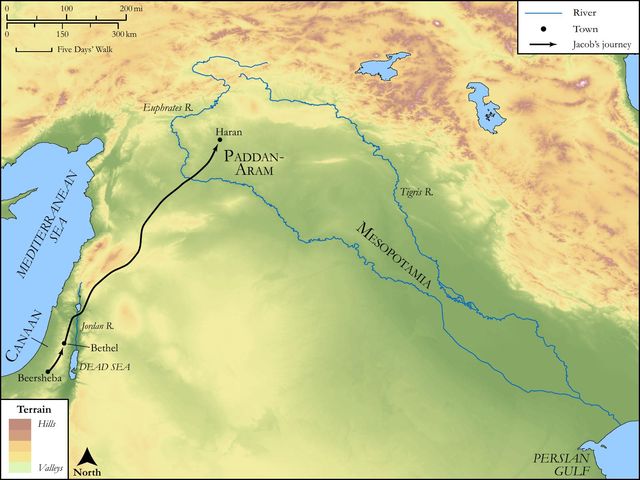
In the family of Isaac, obedience to parents, especially the father, was paramount, particularly concerning marriage. Marrying within one's extended family or tribe was a common practice to preserve lineage, property, and cultural identity, preventing assimilation with foreign peoples. The region of Padanaram (meaning "field of Aram" or "table-land of Aram") was located in Mesopotamia, specifically the area around Haran, which was the ancestral home of Abraham's family before their migration to Canaan Genesis 11:31. This geographical detail underscores the cultural imperative to return to the family's original roots for a suitable spouse, ensuring the purity of the covenant line and avoiding the idolatrous practices of the Canaanites. The journey itself would have been long and arduous, requiring significant faith and resilience.
Key Themes
ShowHideGenesis 28:7 contributes significantly to several overarching themes within the book of Genesis. It highlights the theme of Divine Sovereignty and Providence, demonstrating how God orchestrates events, even those born of human sin and fear, to fulfill His covenant promises. Jacob's flight, while seemingly a consequence of his deception, becomes the very means by which God directs him to his future wife and the place where he will encounter God profoundly at Bethel Genesis 28:10-22. The verse also underscores the theme of Obedience, presenting Jacob's compliance with his parents' wishes as a crucial act, despite his recent moral failings. This act of filial duty is presented as a positive step, aligning with God's plan for the continuation of the chosen lineage and the eventual birth of the nation of Israel. Furthermore, it marks the beginning of Jacob's Journey of Faith and Formation, a period of exile and hardship that will serve as a crucible for his character, shaping him into the patriarch Israel.
Exposition and Analysis
ShowHideKey Word Analysis
ShowHideA primitive root meaning to hear intelligently, often with the implication of attention, obedience, or consent. It signifies more than merely hearing sound; it implies an active listening and a responsive compliance. In this context, Jacob not only heard his parents' instructions but acted upon them, demonstrating a willing submission to their directives.
A primitive word referring to a father, in a literal and immediate sense. It emphasizes Isaac's role as the patriarch and the source of the command regarding Jacob's marriage. The term highlights the familial authority structure central to the narrative.
A primitive word referring to a mother, as the bond of the family. This inclusion underscores Rebekah's significant influence in Jacob's departure, both in advising him to flee Esau and in supporting the marital directive. It signifies that Jacob's compliance was to both parental figures.
A primitive root meaning to walk, literally or figuratively; causatively, to carry. In this context, it describes Jacob's physical departure, his act of setting out on the journey. It conveys the active movement and initiation of his exile.
Verse Breakdown
ShowHide"And that Jacob obeyed his father and his mother,"
This clause highlights Jacob's compliance with the instructions given by both Isaac and Rebekah. The verb "obeyed" (Hebrew shama) implies not just hearing but actively heeding and acting upon the counsel. This is a significant detail, especially in light of Jacob's recent manipulative actions to secure the blessing, suggesting a capacity for filial duty and submission to authority, even amidst his personal complexities.
"and was gone to Padanaram;"
This clause states Jacob's destination, Padanaram, the region in Mesopotamia where Rebekah's family resided. This journey was undertaken to fulfill Isaac's command to find a wife from his kin, thereby preserving the purity of the Abrahamic lineage, and simultaneously served as an escape from Esau's murderous intent. It marks the commencement of a new, formative chapter in Jacob's life, moving him out of the familiar land of Canaan and into a period of exile and divine encounter.
Literary Devices
ShowHideThe verse employs Emphasis through its concise declaration of Jacob's obedience, highlighting this act as a significant turning point despite the preceding narrative of deception. There is a subtle Irony present, as Jacob, who previously manipulated his father, now readily obeys both parents in a matter that, while serving his safety, also aligns with God's larger covenant plan. The simple statement of his departure to Padanaram also functions as Foreshadowing, signaling the beginning of a long and transformative journey for Jacob, replete with divine encounters and personal growth, ultimately shaping him into the patriarch Israel. The directness of the statement creates a sense of Narrative Progression, swiftly moving the plot forward after the intense family drama of the preceding chapters.
Theological and Thematic Connections
ShowHideGenesis 28:7 offers a profound insight into God's sovereign working through imperfect human agents. Jacob's obedience, though perhaps motivated by a complex mix of filial duty and self-preservation, is presented as a decisive act that aligns with God's overarching plan for the covenant lineage. This moment underscores that God's purposes are not thwarted by human sin or weakness; rather, He can providentially guide individuals, turning even their flights of necessity into steps toward the fulfillment of His promises. Jacob's journey to Padanaram, to find a wife from his own people, was crucial for maintaining the distinctiveness of the chosen line, ensuring the continuity of the Abrahamic covenant and setting the stage for the birth of the twelve tribes of Israel.
Reflection and Application
ShowHideGenesis 28:7 serves as a powerful reminder that obedience, particularly to those in authority, can align with God's broader purposes, even when our personal circumstances are challenging or our past actions are flawed. Jacob's journey, though born out of necessity and a desire for personal safety, became a divinely orchestrated pathway for God to work profoundly in his life, shaping his character and preparing him for his crucial role in the unfolding redemptive narrative. It teaches us that even in imperfect situations, our acts of obedience, however small, can be critical steps in God's plan for us, leading to new encounters with His presence and promises, much like God's assurance to Jacob to be with him throughout his travels. This verse encourages us to trust that God can redeem our past and use our present obedience to guide us into His future for us, even when the path ahead seems uncertain or difficult.
Questions for Reflection
ShowHideFAQ
ShowHideWhy is Jacob's obedience highlighted here, considering his previous deception?
ShowHideThe text highlights Jacob's obedience to emphasize that despite his recent manipulative actions to secure the blessing, he still demonstrates a capacity for filial duty. This moment of obedience is crucial because it aligns with God's plan for the covenant lineage. It shows that God can use and guide individuals even with their imperfections, and that specific acts of obedience, even if mixed with other motivations, can be pivotal in His overarching redemptive purposes, preparing Jacob for the profound divine encounters that follow, such as his dream at Bethel.
What is the significance of Padanaram as Jacob's destination?
ShowHidePadanaram, or "field of Aram," was the region in Mesopotamia where Rebekah's family (Bethuel and Laban) resided. Its significance lies primarily in preserving the purity of the Abrahamic covenant line. Isaac had explicitly instructed Jacob not to marry a Canaanite woman, but to take a wife from his own kin. Going to Padanaram ensured that Jacob would marry within his extended family, maintaining the distinctiveness of the chosen people and fulfilling God's promise to Abraham to make him a great nation. This journey was essential for the continuation of the lineage through which the Messiah would eventually come.
Does Jacob's flight from Esau diminish the sincerity of his obedience?
ShowHideWhile Jacob's immediate motivation for leaving was certainly to escape Esau's murderous anger, the text explicitly frames his departure as an act of obedience to both his father's marital instructions and his mother's advice to flee. The Hebrew word shama implies willing compliance and active heeding. Therefore, his departure was a confluence of both practical necessity and filial duty. The narrative presents it as an obedient act that ultimately serves God's larger plan, demonstrating how God can use multiple motivations and circumstances to achieve His sovereign will.
Christ-Centered Fulfillment
ShowHideJacob's journey from his homeland, driven by both obedience and the necessity of escape, foreshadows the ultimate journey and perfect obedience of Christ. While Jacob's obedience was imperfect and intertwined with self-preservation, it served a vital role in preserving the lineage through which the Messiah would eventually come. Christ, in stark contrast, perfectly embodied obedience, not fleeing danger but willingly embracing the Father's will, even unto the ultimate sacrifice on the cross Philippians 2:8. Jacob's search for a wife from his own people, preserving the covenant line, finds its ultimate fulfillment in Christ, who gathers a bride, the Church, not from one lineage but from all peoples, establishing a new covenant family through His blood Revelation 5:9. God's providential guidance of Jacob, ensuring the continuation of His promises despite human failings, culminates in the sending of His Son, the perfectly obedient One, who fulfills all covenant promises and brings salvation to humanity, offering the true "ladder" to heaven that Jacob glimpsed at Bethel John 1:51.